Specs are compiled from manufacturer listings and verified buyer reviews and can change over time — please confirm the key details on the product page before buying.
If you want one answer: buy the Garmin Instinct 3 AMOLED. Its multi-band GPS (a receiver that locks onto several satellite signals at once so your route doesn’t drift) is the most reliable mapping tool here, and its 18-day battery means you won’t be hunting for a cable mid-hike. Everything else in this list fills a narrower job — a budget trail watch, a senior safety band, a featherweight runner’s tool.
This guide is built by comparing the manufacturers’ published specifications and the patterns across verified customer reviews, so you get each pick’s real strengths and trade-offs instead of marketing spin.
Below you’ll find nine wrist-worn GPS monitors sorted by what they actually do well, plus the specs that matter and the ones that are just noise. Match the GPS-mode battery, satellite band and durability rating to where you actually go.
Top Picks

How To Choose The Best Wrist Worn GPS Monitor
A wrist-worn GPS monitor is a watch that finds your position by satellite and shows it on your wrist. That sounds simple, but two watches with the same screen can behave completely differently on a ridgeline, in a city canyon, or six hours into a hike. Here is what actually separates them.
Satellite lock: single-band versus dual-band
Dual-band GNSS means the watch listens on two satellite frequencies (L1 and L5) at once. That helps it ignore bounced signals off buildings and cliffs, so your recorded track doesn’t zigzag. Single-band GPS still works well in open country and drains less power. If you run in cities, canyons or dense forest, pay for dual-band; if you mostly walk open trails, single-band is honest value.
Battery life in GPS mode is not the same as standby
Watch makers quote two very different numbers. Smartwatch mode is everyday wear with notifications; GPS mode is when the satellite radio is firing. A watch claiming weeks of standby may only hold a day or two of continuous tracking. Always find the GPS-mode figure before you plan a long route.
Ruggedness ratings you can actually compare
MIL-STD-810H is a set of military test standards for shock, vibration, temperature and dust. IP68 means it survives dust and a dunking in fresh water; IP69K adds protection against high-pressure water jets. 5 ATM means it’s rated for swimming-depth pressure. None of these make a watch suitable for hot saunas or sea water unless the maker says so.
Side-by-Side Comparison
| Model | Best For | GPS Type | Battery (watch mode) | Water / Durability | Amazon |
|---|---|---|---|---|---|
| Garmin Instinct 3 AMOLED★ Best Overall | All-round trail and everyday wear | Multi-band GPS with SatIQ | 18 days | 45mm fiber-reinforced polymer, metal bezel | Amazon |
| Military Smart Watch (Tiwain)Budget Champion | Budget outdoors, calls on wrist | Six-satellite single-band | 10 days (30-day standby) | IP68, zinc alloy | Amazon |
| Seculife Medical Alert SmartbandBest confidence | Keeping tabs on a family member | GPS with geofencing | 1 day | IP67 splash resistant | Amazon |
| KOSPET PULSE 2 | Hard-use hiking and workouts | Dual-band L1+L5, 6 systems | 15 days typical | 5 ATM / IP69, MIL-STD-810H | Amazon |
| Fitbit Charge 6 | Everyday fitness and Google tools | Built-in GPS | 7 days | Metal case, silicone band | Amazon |
| Garmin vívoactive 5 | Health tracking with long battery | GPS with 30+ sport apps | 11 days | 42mm fiber-reinforced polymer | Amazon |
| KOSPET Tank M4C | Group hikes with push-to-talk | Dual-band L1+L5, 6 systems | 15 days typical | 5 ATM / IP69K, MIL-STD-810H | Amazon |
| COROS PACE 4 | Runners chasing lightness | GPS, 41-hour GPS runtime | 19 days | 32g, 11.8mm thin | Amazon |
| Garmin Forerunner 70 | Runners wanting simplicity | GPS, 23-hour GPS mode | 13 days | 43mm ABS case | Amazon |
Detailed Reviews
1. Garmin Instinct 3 AMOLED, Rugged GPS Smartwatch, 45mm, Black
Our pick — 4.5+★ from 950+ verified ratings; the strongest balance of quality and price.
The one you strap on and forget about until the trailhead sign
Eighteen days is the number that makes this watch live up to its billing. You get that runtime in smartwatch mode from a 350 mAh battery, so a week-long trip fits in one charge with room to spare. Compare that with the Seculife band’s one-day battery in the same list and the gap is the whole point — 18 days against 1 day, with no nightly ritual on the bedside table.
Positioning is where it earns the top spot. Garmin’s multi-band GPS with SatIQ (a mode that picks the satellite setup your surroundings need) locks onto your track through tree cover and city blocks alike, and the 3-axis compass and barometric altimeter add heading and elevation. A 1.2-inch AMOLED display stays readable in glare, and the 45mm fiber-reinforced polymer case with a metal-reinforced bezel shrugs off knocks. The built-in LED flashlight with variable intensities and strobe modes is the sleeper feature — it’s genuinely useful finding a trail marker after sunset.
Owners praise the 18-day battery and button-driven functionality: charging every two-plus weeks changes how you use a GPS watch. Buyers report “up to 18 days between charges” and praise the heart-rate and exercise accuracy. The honest catch is the interface — ease of use is the one area drawing mixed notes, and the button-driven menu takes a few days to learn. On a watch this capable, that’s a short learning curve, not a lasting gripe.
Why It Tops The List
- 18-day battery from a 350 mAh cell keeps a multi-day trip on one charge
- Multi-band GPS with SatIQ holds a track in tree cover and city blocks
- Built-in LED flashlight with variable intensities and strobe modes
- 3-axis compass and barometric altimeter for heading and elevation
- 1.2-inch AMOLED display readable in glare
Where It Asks More Of You
- Button-driven menu takes a few days to learn
- Health metrics are close estimates, not medical readings
My call: The strongest all-rounder here for hikers, runners and anyone who wants GPS accuracy without a charging habit.
Look elsewhere if: You want a touch-first interface and no buttons to learn.
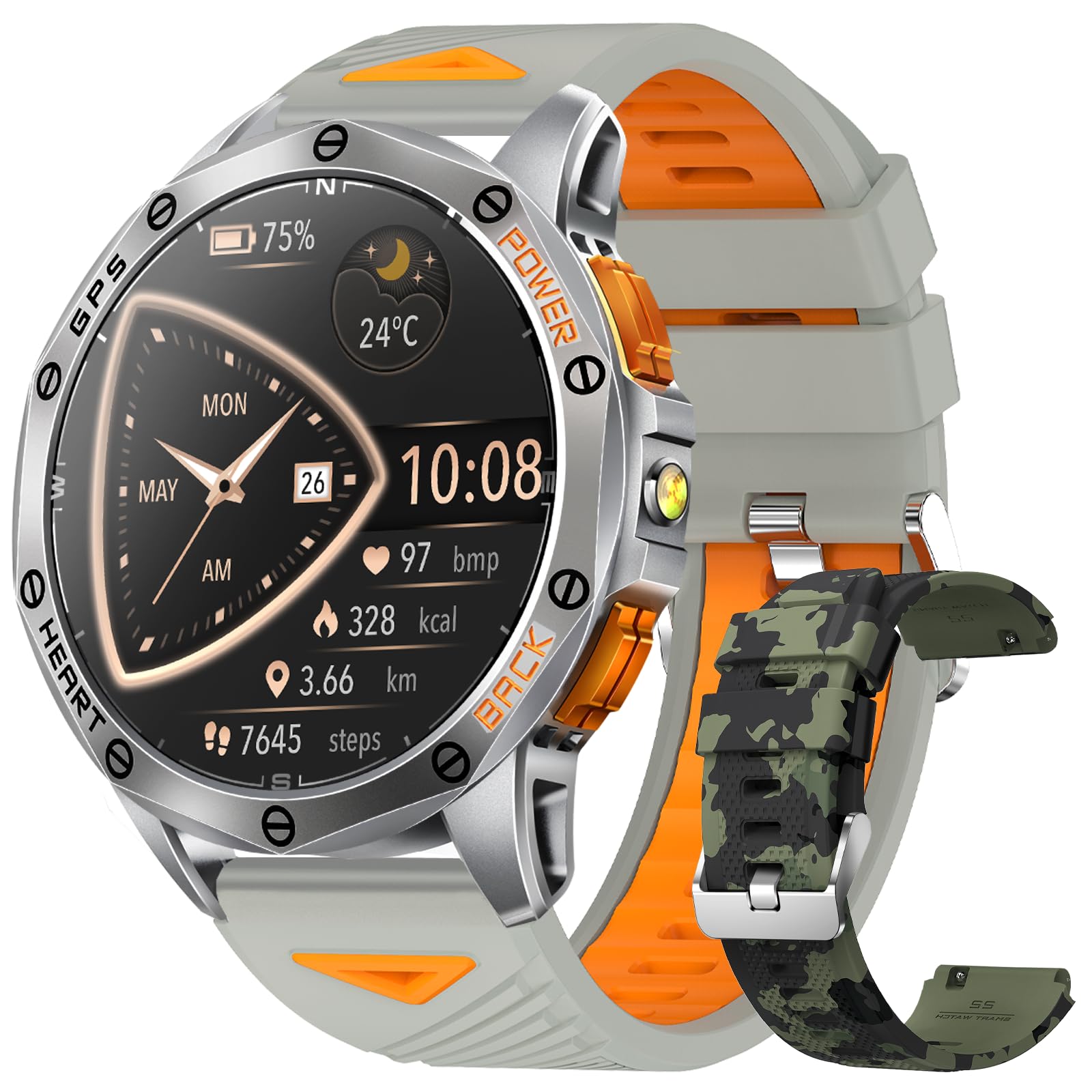
2. Military Smart Watch
A six-satellite GPS radio and a 20-meter flashlight for entry-level money
The Tiwain watch finds its place with two numbers: a 530 mAh battery and a standby claim of 30 days. In everyday wear you’re looking at 7-10 days on a charge and a 2-hour refill, so it keeps up with a normal week. GPS continuous use runs about 3 days, which is enough for day hikes and weekend rides — this is a single-frequency receiver, so expect it to work better in open country than between tall buildings.
Where it beats expectations is the odds and ends. A built-in LED flashlight throws light up to 20 meters and fires from the side button, and you get a compass, altimeter and barometer in the same case. The zinc alloy body carries a vacuum-plated finish and an IP68 rating (dust-tight and dunk-proof in fresh water). The maker is explicit that it’s not built for sea water or saunas, so take that seriously. 170+ sport modes cover everything from walking to basketball, and it takes calls and notifications on the wrist.
Owners describe it as a solid value device — owners mention “battery life lasting up to three weeks” with easy phone pairing, and the health screens get steady praise. The trade-off is depth of software: this is a broad feature box rather than a precision training tool, and the companion app won’t match the polish of a Garmin or COROS.
What you get for the money: A 1.43-inch AMOLED screen, 530 mAh battery, twin straps in the box, and an IP68 zinc-alloy case — more hardware than you’d expect at this tier.
The honest limit: Single-frequency GPS and a lighter app ecosystem mean it’s a daily-wear outdoor watch, not a race-day instrument.
Reach for this if: You want flashlight, compass and GPS on your wrist without spending like a flagship buyer.
Keep walking if: You train to split-second pace data and need dual-band accuracy.
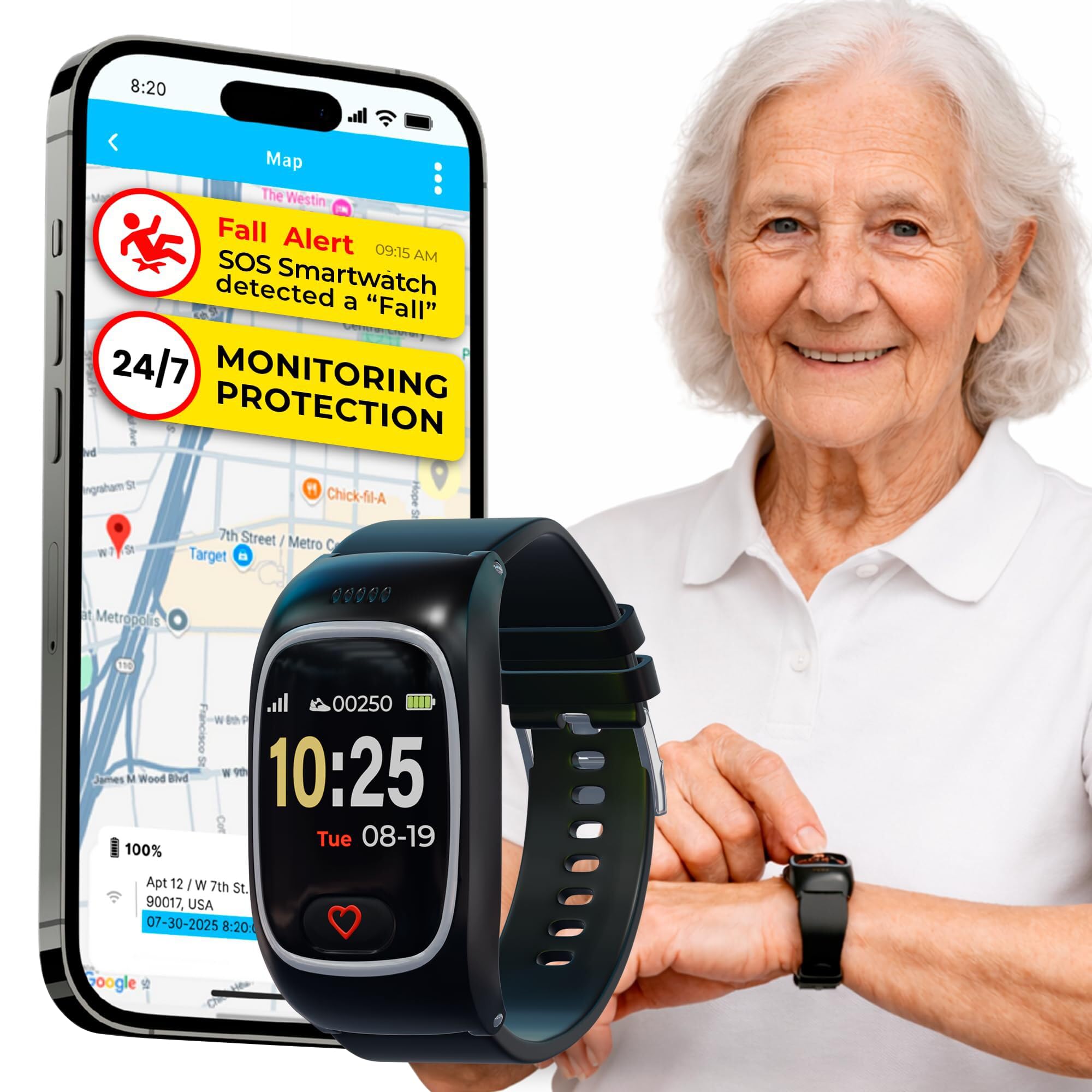
3. Seculife Medical Alert Smartband for Seniors
A GPS band built for the family watching from another city
This is a different animal from the training watches here — it’s a location and safety band, and it should be judged on that job. Press the SOS button for 3 seconds, or let the fall detection trip, and an emergency call goes straight to pre-selected family contacts. The Secupro app shows live location and lets you draw GEO-fence zones, so you get notified by app or SMS when the wearer leaves or enters a safe area. It keeps 1 year of location history.
Two-way calling and hands-free auto-answering are the features families actually lean on — an approved contact calls and the band picks up on its own, so there’s no button to press. Owners praise the oversight: customers note tracking a loved one’s location in the Secupro app without effort. The build quality is the most praised trait. It’s worth being clear about the running cost too: the watch needs a monthly subscription starting from per month to open up unlimited fall alerts, live tracking and voice minutes.
Set your expectations on battery. A 680 mAh cell delivers roughly a day per charge — the largest capacity here by raw spec, but the always-connected safety features are what draw it down. Setup also splits opinion: some find the app easy, others wrestle with it. The IP67 rating covers splashes, not swimming.
Built for the caregiver: Auto-answering calls, SOS in a 3-second press, fall alerts and geofenced safe zones, all visible in one app — this is a family tool, not a fitness tracker.
Know before you buy: A monthly subscription is required for the full safety suite, and daily charging is part of the routine.
Made for: Families who want live location and one-press emergency calling on an elderly relative’s wrist.
Not for: Anyone expecting week-long battery or a device they can swim in.
4. KOSPET PULSE 2 Smart Watch
Twelve drop tests passed, and a GPS radio that hunts two signals at once
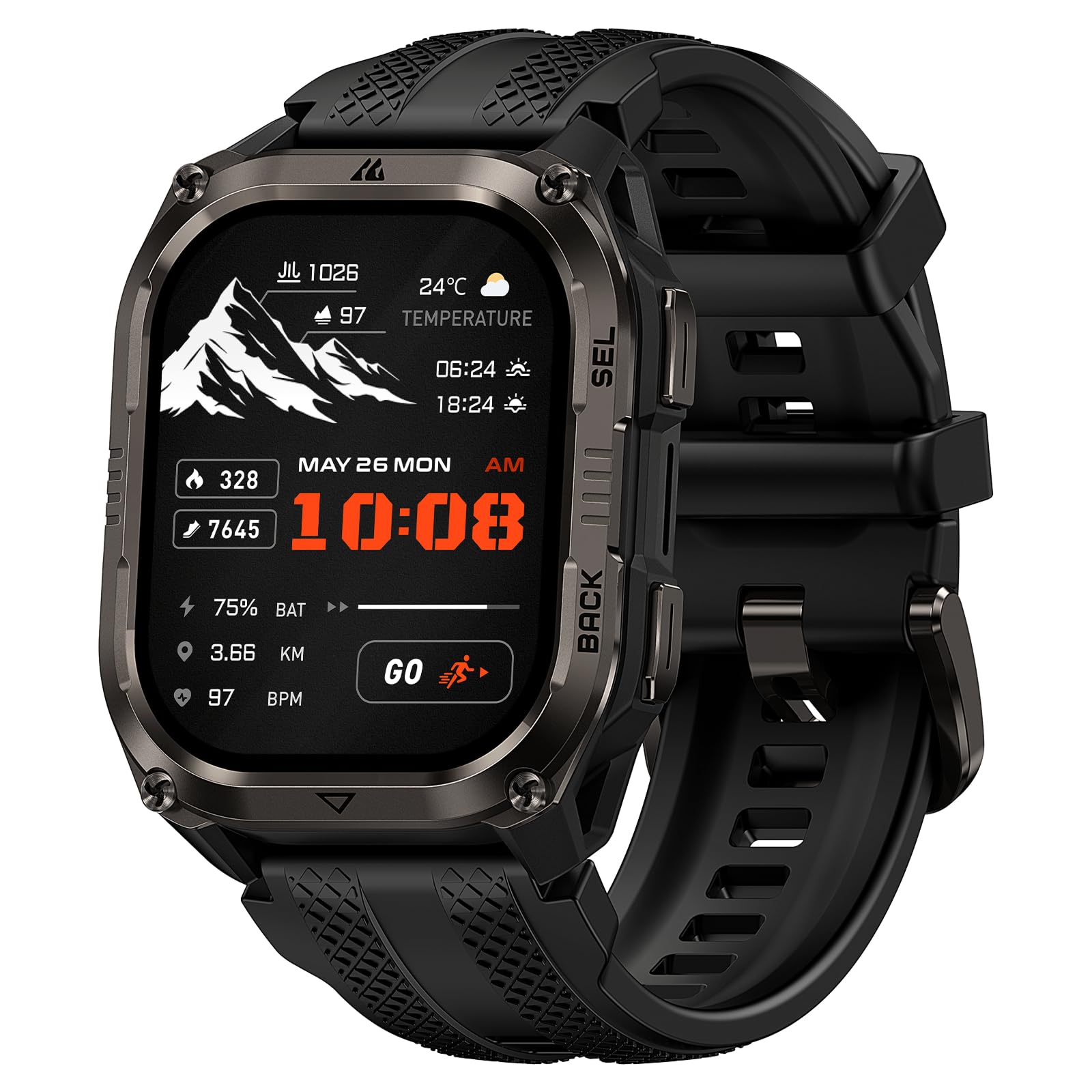
The PULSE 2 is the watch you hand to someone who destroys things. It has passed 12 SGS-tested MIL-STD-810H tests, wears Corning Gorilla Glass over the face, and carries both 5 ATM and IP69 ratings — pressure-rated for swimming plus protected against high-pressure water jets. The dual-band L1+L5 GNSS with six satellite systems is the serious part of the spec sheet: it acquires signals faster and holds position better in forests and mountain trails.
A 450 mAh battery gives up to 15 days of typical use, 11 days of heavy use, or 5 days with the always-on display running. That always-on figure is the one to weigh if you like the screen lit all day. You also get 170+ sport modes with auto-recognition of 6 common activities, round-the-clock heart rate, SpO₂, stress and sleep tracking, and the Apexmove app for watch faces and training plans.
Owners rate the overall build and feature set highly — the watch quality is what draws the most favorable comment. The one weakness worth naming is outdoor brightness: the display gets mixed reviews, with readability in bright daylight workouts coming up as the sticking point. If you train in full sun with the screen always on, budget for squinting.
Built For Abuse
- Passed 12 SGS-tested MIL-STD-810H durability tests
- Dual-band L1+L5 GNSS across six satellite systems
- 5 ATM and IP69 water protection in one case
- Up to 15 days typical battery from 450 mAh
Rough Edges
- Screen can be hard to read in bright sunshine
- Always-on display drops runtime to about 5 days
Best matched to: Hikers, campers and gym-goers who want dual-band GPS in a case that survives drops.
Pass on it if: You work outdoors in glaring light and need a screen you can read without shading it.
5. Google Fitbit Charge 6 – Fitness Tracker – Obsidian/Black

A slim band with built-in GPS, Google Wallet tap-to-pay and Google Maps directions
The Charge 6 is the lightest-weight option for someone who wants a tracker, not a tank. It packs built-in GPS, 40+ exercise modes, all-day activity tracking and 24/7 heart rate into a slim silicone band, with a rated 7 days of battery and a 2-hour charge. Turn-by-turn directions from Google Maps pipe through to the wrist, and Google Wallet handles tap-to-pay on a snack stop.
Where it earns real points is the exercise-machine link — connect it to compatible treadmills and ellipticals and it shows your heart rate live on the machine’s display. A stress management score, a nightly Sleep Score and a Smart Wake alarm round out the daily routine. It also reads ECG, a useful extra for anyone who wants that on the wrist.
Be realistic about longevity, because that’s where this one draws the most divided feedback. Reliability and durability are the recurring themes in the reviews, and some units disappoint early. Owners praise the everyday comfort and quick pairing. Buy it understanding that it’s a well-featured tracker with more variance in how long it lasts than the Garmins here.
The comfort-first angle: Built-in GPS, 40+ exercise modes and Google Maps directions in a band slim enough to sleep in.
The gamble: Durability is the mixed note on this one, so consider how you feel about a replacement sooner than you’d like.
Fits your wrist if: You want GPS runs, tap-to-pay and sleep scores in the slimmest band here.
Better to skip if: You expect a decade-long workhorse and hate the thought of a swap-out.
6. Garmin vívoactive 5 42mm

Eleven days of battery aimed at the body, not just the distance
Garmin’s vívoactive 5 takes the health-tracking angle and stretches battery life to 11 days in smartwatch mode (or 5 days with the display always on). The bright AMOLED display is the first thing you notice; the useful part is Body Battery, an energy score that tells you when to push and when to rest, fed by sleep, naps, stress levels and workouts. You also get a nightly Sleep Score with coaching and HRV status (heart-rate variability, a measure of how recovered you are).
There are more than 30 built-in indoor and GPS sport apps — walking, running, cycling, HIIT, swimming, golf and more. Wheelchair mode is a notable inclusion, tracking pushes instead of steps with dedicated push and handcycle activities. It also carries over music downloads from Spotify, Amazon Music or Deezer so you can run without the phone.
Battery and sleep tracking are the two places owners split, so know what you’re getting: some find the battery outstanding, others see it fall short of a day, and sleep scoring divides opinion on accuracy. The display and interface are what most reviewers praise. The honest read is that this is a comfortable daily health watch for the moderate exerciser, not a battery king like the Instinct 3.
The Health Argument
- Up to 11 days in smartwatch mode
- Body Battery energy score and HRV status
- 30+ indoor and GPS sport apps
- Wheelchair mode tracks pushes instead of steps
The Reality Check
- Battery and sleep scoring draw mixed feedback
- Display always-on cuts runtime to roughly 5 days
Choose it when: Your priority is recovery insight and sleep coaching rather than maximum charge cycles.
Look past it when: You need a flat-out endurance battery over health data.
7. KOSPET Tank M4C Smart Watch
Push-to-talk for four people, no cell signal required
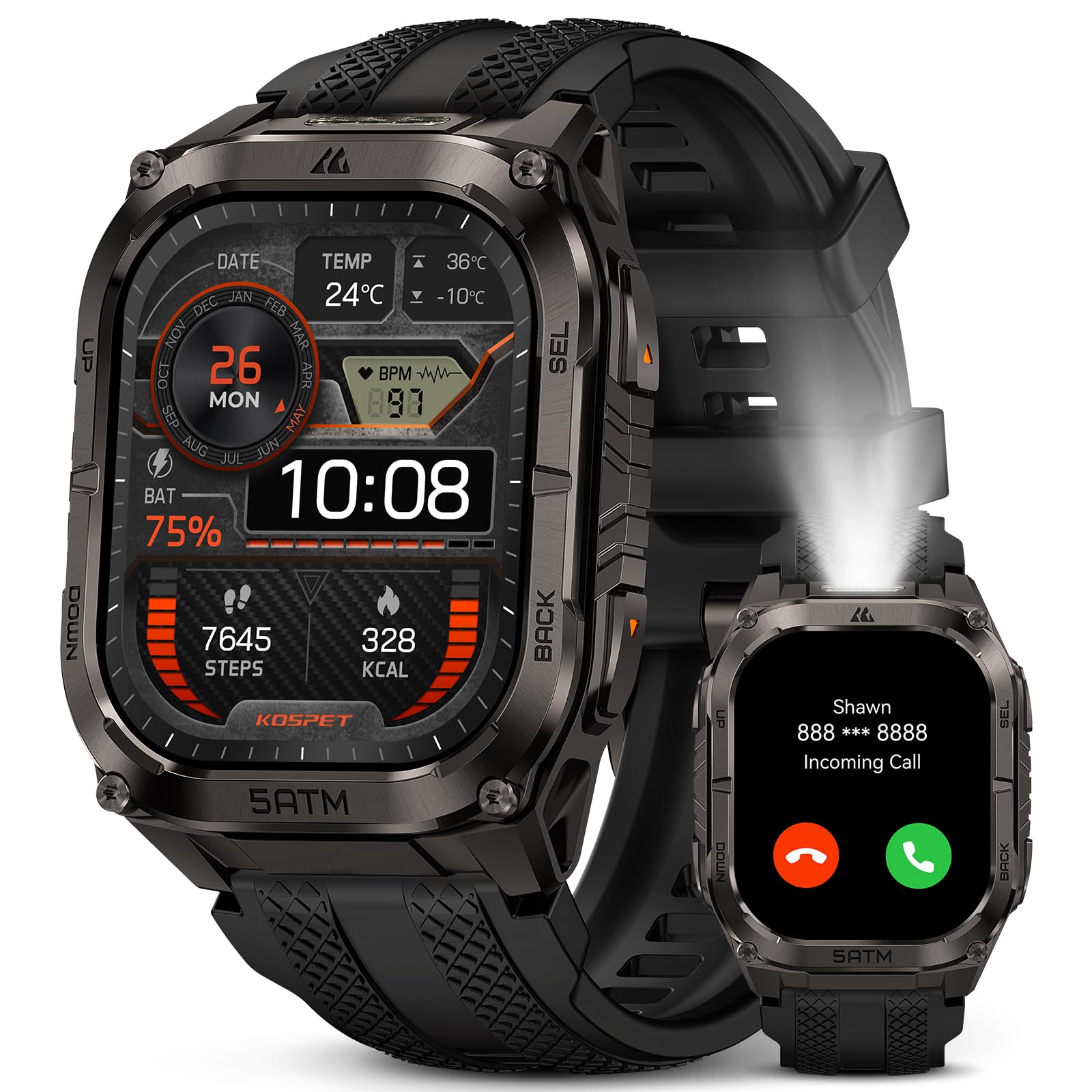
The Tank M4C is the one feature-rich oddity on this list, and that’s a compliment. It carries a built-in walkie-talkie that lets up to 4 people push-to-talk up to 40 metres apart with no mobile signal at all. Pair that with dual-band L1+L5 GNSS across six satellite systems and it becomes a group-hike tool you can’t really replace with a phone. Stainless steel, 15 MIL-STD-810H test passes, and a 1.96-inch AMOLED with Gorilla Glass 3 round out the rugged story.
Then there’s the light. A high-brightness LED flashlight with five adjustable levels is genuinely useful for night hikes, camp chores or a power cut, and it’s backed by a 5 ATM and IP69K rating that handles swimming and water jets. Battery lands at up to 15 days typical, 21 hours in GPS mode, or about 5 hours with the flashlight running. The 4PD sensor continuously tracks heart rate, blood oxygen, stress and sleep including REM stages, and 170+ sport modes cover the training side.
Owners prize the walkie-talkie and flashlight above all — the most consistently praised features in the reviews, alongside value for money. The caveat sits with battery and band durability: some units don’t hold charge and band wear has come up. Weigh that against the fact that no other watch here offers radio-style chat on the trail.
The standout: Built-in walkie-talkie for up to 4 people at 40 metres, with dual-band GPS, an IP69K rating and a five-level flashlight in the same stainless-steel case.
The fair caveat: Battery consistency and band longevity are the two things to watch in long-term ownership.
Pick it for: Group hikes, fieldwork and anyone who wants off-grid comms built into a GPS watch.
Choose another if: Radio chatter isn’t on your list and you’d rather have proven long-term battery behavior.
8. COROS PACE 4 GPS Watch
Lighter than an energy gel, with a GPS run time that outlasts your longest race
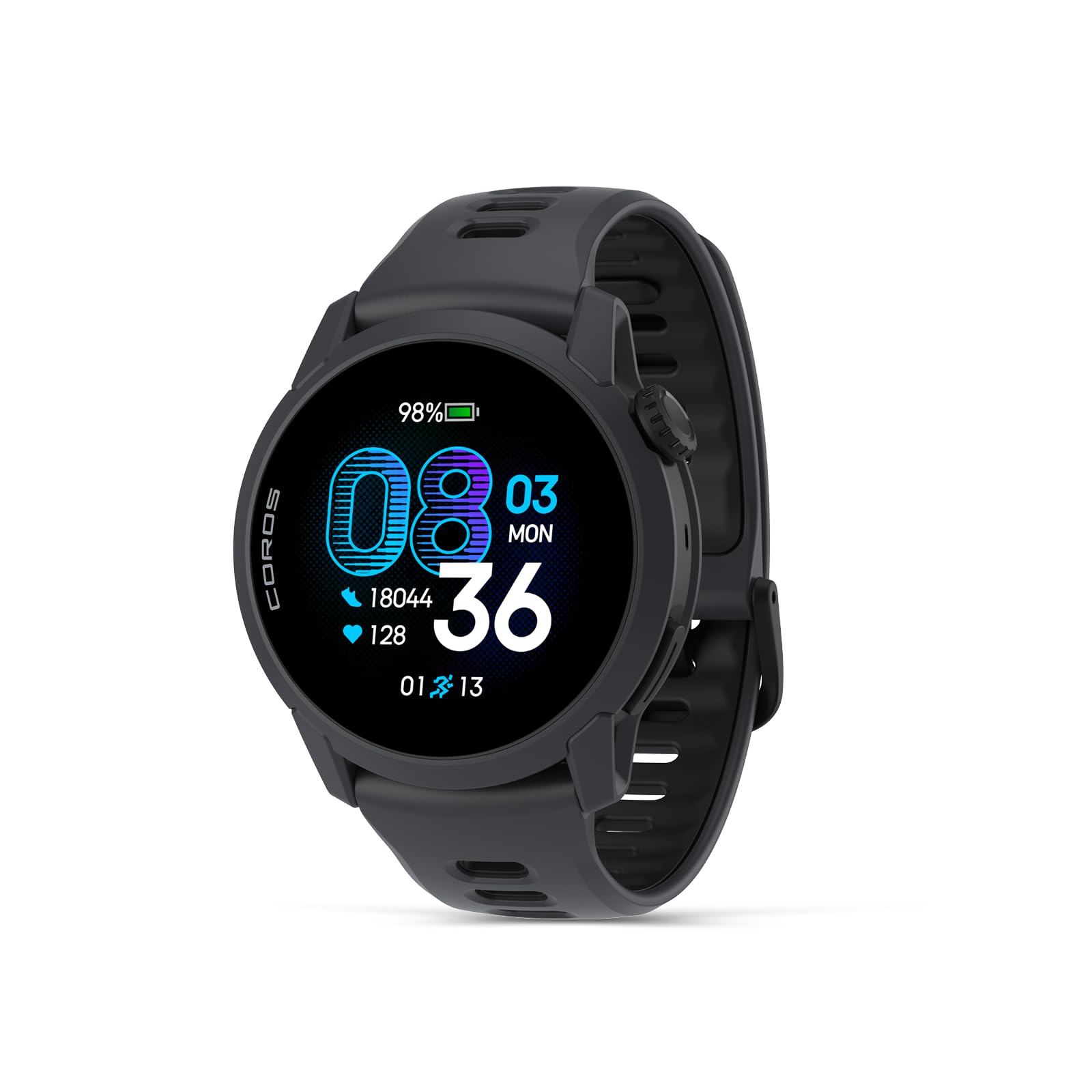
Thirty-two grams is the number that defines this watch. With the nylon band it weighs 32g and measures just 11.8mm thin, so it disappears on the wrist and never feels like dead weight at mile twenty. That lightness doesn’t cost you runtime: you get 41 hours of continuous GPS use and up to 19 days of daily battery. On GPS stamina alone it leads the Forerunner 70’s 23 hours comfortably.
The 1.2-inch touchscreen AMOLED auto-adjusts brightness so it stays readable in any light, and COROS claims 164% higher resolution than the PACE 3. Controls are a tactile digital crown plus two buttons, with a customizable Action Button for one-tap access to things like breadcrumb navigation. A voice recording tool lets you log how a session felt, and Voice Control can set alarms or build a workout. Training metrics cover recovery time, sleep stages, HRV and menstrual cycles.
Accuracy and battery are the two things owners celebrate — reviewers point out outstanding battery life and precise GPS. Brightness holds up even in direct sun. What you don’t get is a broad smartwatch ecosystem; this watch is pointed squarely at running and training, and if you want notifications and payments on your wrist, look elsewhere.
The runner’s arithmetic: 32g on the wrist, 41 hours in GPS mode, and 19 days between charges — three numbers that put it ahead of heavier GPS watches for long-distance work.
Where it stops: It’s a training instrument first, so smartwatch extras are thin.
The right wrist: Distance runners and triathletes who count grams and GPS hours.
Not the right wrist: Anyone who wants their watch to double as a daily smartwatch.
9. Garmin Forerunner 70, 43mm, Black
A no-fuss running watch that does one thing with quiet certainty
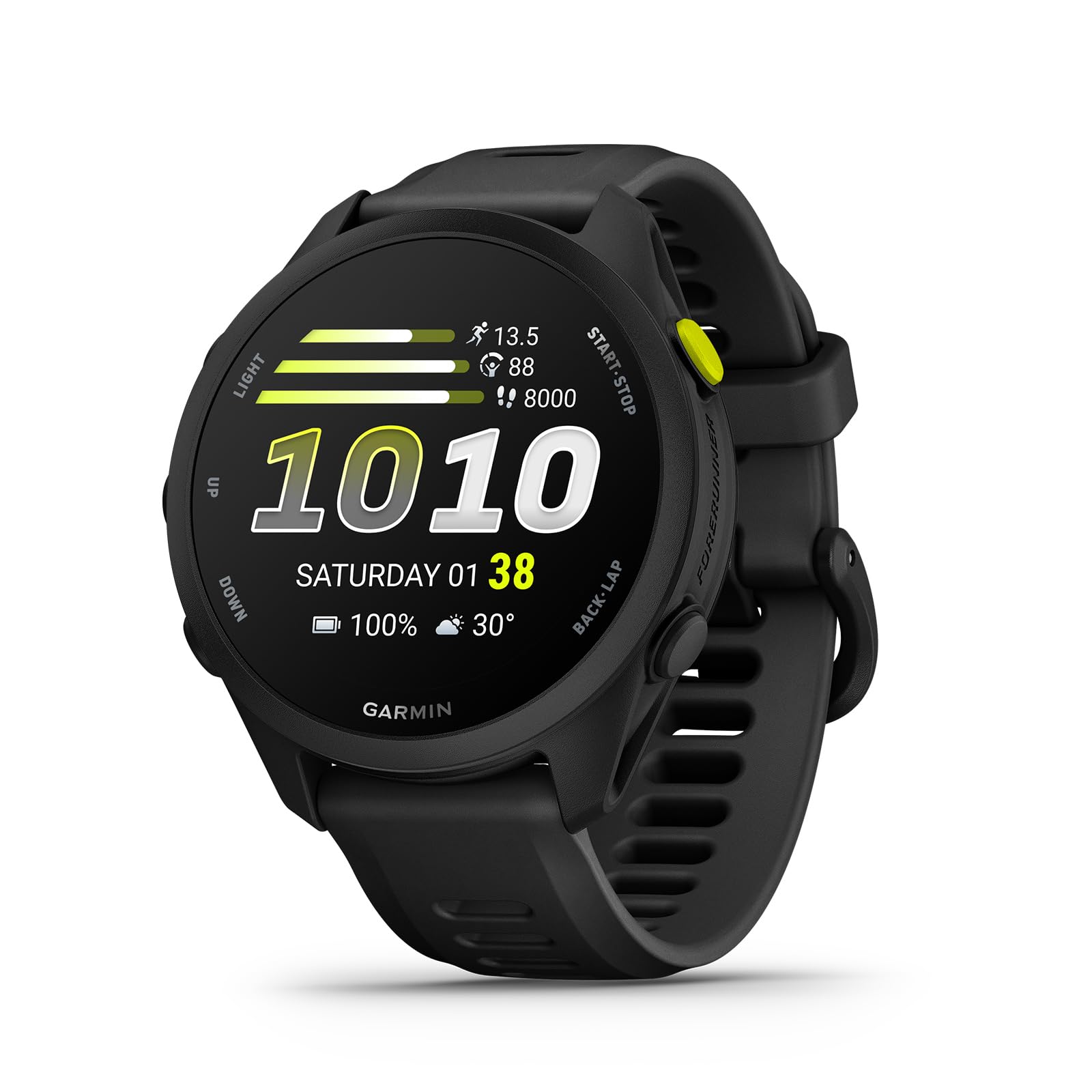
The Forerunner 70 gives you 13 days of battery in smartwatch mode and up to 23 hours in GPS mode — plenty for marathon training and the days between. The 43mm ABS case with a silicone band is light on the wrist and simple to put on. It’s built around the basics: running, swimming and walking, tracked accurately, without the toolkit of a feature-heavy flagship.
Owners describe it as a great running watch with accurate tracking, and its handling of swims and walks gets specific praise. If you want a watch that turns on, finds the satellites, and does the job, this is the honest answer. The one gap that surfaces is fitness-tracking breadth — swim strokes and walks register well, but the exercise category list has limits, and water aerobics isn’t included.
Compare it with the COROS PACE 4 above: the Forerunner holds 13 days against the COROS’s 19 days, and 23 hours of GPS against 41. But it does the essential job cleanly, and for a beginner-runner profile that’s often all you need.
Where it shines: Accurate tracking of runs, swims and walks from a 43mm case with a straightforward setup.
What it won’t do: The sport category list is narrow, so specialized activity modes are limited.
Right for: Newer runners who want accurate GPS tracking without a complicated menu system.
Wrong for: Multi-sport athletes who need dozens of activity categories.
Know the Specs
Dual-band vs single-band GPS
Single-band GPS listens on one satellite frequency. Dual-band (L1 plus L5) listens on two, which helps a watch pick the true signal out of bounced copies. That keeps your track smooth through city streets and tree cover. Both work in the open; dual-band just holds firm where the sky is partly blocked.
Battery mode: why two numbers
Smartwatch mode is everyday wear with notifications and heart-rate tracking. GPS mode fires the satellite radio, which is far heavier on the battery. A watch claiming 18 days in smartwatch mode may only hold a day or two of continuous tracking. Match the GPS-mode figure to the length of your longest outing.
IP and ATM water ratings
IP68 means dust-tight and safe in a fresh-water dunking. IP69 and IP69K add protection from high-pressure water jets. 5 ATM means pressure-rated for swimming. These ratings are not a licence for sea water or a sauna unless the manufacturer says so — several of these watches specifically rule out both.
MIL-STD-810H explained
MIL-STD-810H is a set of military test standards for shock, vibration, temperature and dust. A watch that passes 12 or 15 of these tests has been dropped, frozen and shaken on purpose. It tells you the case will survive real abuse — it doesn’t tell you the battery will.
Common Questions
Do I really need dual-band GPS for hiking?
How long does the battery actually last in GPS mode?
Can I wear these watches in the pool or the sea?
Is a medical alert band the same as a fitness GPS watch?
What does an always-on display do to battery life?
Will these watches work with an iPhone?
Is a compass or an altimeter worth having?
How light does a GPS watch need to be for 24/7 wear?
Do I need a subscription to use these watches?
Which pick suits a family member who lives alone?
The Bottom Line
You want a wrist worn gps monitor that keeps tracking without a nightly charging habit. For most people, that makes the Garmin Instinct 3 AMOLED the one to buy: it runs 18 days per charge and uses multi-band GPS (it locks onto more satellite signals at once, so your route stays steady between tall buildings and trees). It holds 4.5+ stars across 900+ ratings. Want a lighter wrist and longer GPS time? The COROS PACE 4 weighs 32g and gives 41 hours of GPS tracking. And to keep an eye on someone you love, the Seculife band puts fall alerts and live location in one app. Pick the Instinct 3 if you want the safest all-round bet — the ratings back it up.
How we choose
We do not accept paid placement. Every pick is matched to a real buyer and a real use-case; we do not hands-on test units.
Sources
Specifications: manufacturer listings and product documentation. Review insights: verified customer reviews, as of November 2026. Pricing: not shown on this page (it changes often); check the current price via the retailer link.
As an Amazon Associate, Tactical Gear Guy earns from qualifying purchases. This does not affect which products we feature.