Specs are compiled from manufacturer listings and verified buyer reviews and can change over time — please confirm the key details on the product page before buying.
If your slider shots wobble, hum into the microphone, or stall halfway down the rail, the problem is almost always the wrong slider for your camera weight — not your technique. Match the payload rating to your rig and the decibel rating to your audio setup. This guide sorts eight single-axis rails by how they actually behave on a shoot.
This guide is built by comparing the manufacturers’ published specifications and the patterns across verified customer reviews, so you get each pick’s real strengths and trade-offs instead of marketing spin.
You will see the manual carbon rails that pack into a backpack, the motorized dollies that repeat a move exactly, and the long-rail rigs built for time-lapse. Below are eight single-axis rails ranked by how they behave on a shoot.
Top Picks


How To Choose The Best X-Axis Camera Slider
A camera slider is a rail that carries your camera in a straight line — one axis, left to right — so a shot glides instead of sitting locked on a tripod. That single axis is what separates a slider from a gimbal or a pan-tilt head.
Payload Rating Is Not One Number
Most rails quote a horizontal load, then a much lower figure for vertical or tilted use. A rail rated at 4.4lb/2kg flat may hold only 2.2lb/1kg at a 45° tilt. Weigh your camera plus lens plus any cage or monitor, then read the tilted number, not the flat one.
Manual Versus Motorized
A manual rail is pushed by hand and weighs less because there is no motor or battery. A motorized dolly adds repeatable speed, time-lapse, and A-to-B loops, but it needs power and it adds ounces. If a client needs the same move twice, go motorized.
Rail Length Versus Sliding Travel
A 24-inch rail does not give you 24 inches of movement. The carriage has to stop before the ends, so a 24-inch/60cm rail often delivers around 16.73 inches/42cm of actual travel. Check the travel figure if your shot depends on distance.
Side-by-Side Comparison
| Model | Best For | Rail Length | Max Load | Motor | Amazon |
|---|---|---|---|---|---|
| NEEWER DL400★ Best Overall | Solo shooters running everything from a phone | — | 6.6 lb | Motorized, below 30dB | Amazon |
| Fotodiox Pro SlideCam 800-32″Budget Workhorse | Heavy rigs on a tight budget | 32″ | — | Manual, ball-bearing | Amazon |
| Zecti 24″/60cmTravel Pick | Backpack travel and action cams | 24″/60cm | 4.4 lb | Manual, 4 bearings | Amazon |
| GVM 48″/120CM | Long panoramic and time-lapse sweeps | 48″/120cm | — | Motorized, remote control | Amazon |
| NEEWER ER1 31.5″ | Studio product work with an app | 31.5″/80cm | 11 lb flat / 5.5 lb at 45° | Motorized, silent stepper | Amazon |
| Accsoon Toprig S60 | Dialing in exact speed by hand | 24″/60cm (16.73″ travel) | 8.81 lb flat / 5.5 lb vertical | Motorized, below 30dB | Amazon |
| Accsoon Toprig 24″ | Long interview and film setups | 24″/60cm | 4kg flat / 2.5kg at 90° | Motorized, below 30dB | Amazon |
Detailed Reviews
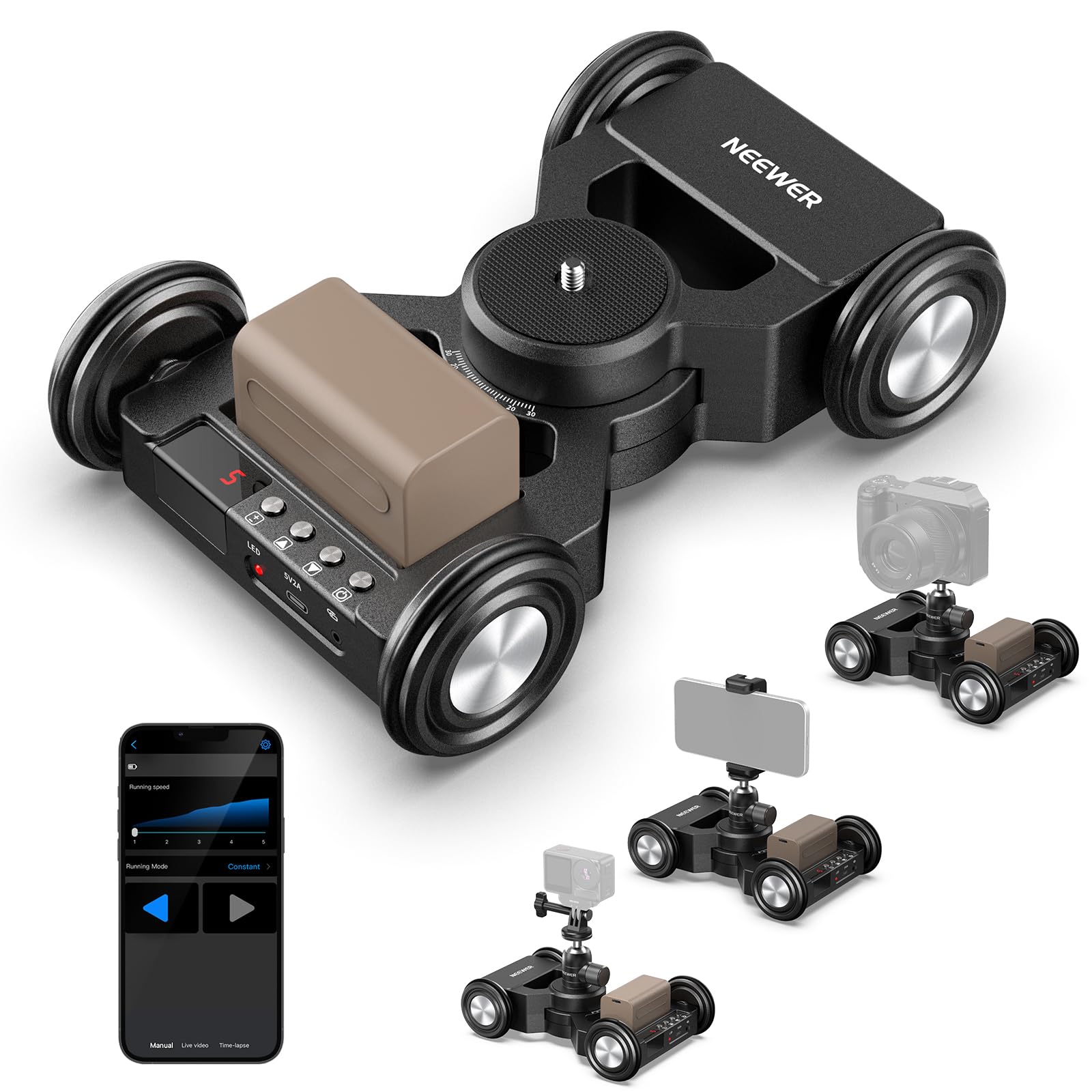
1. NEEWER DL400 Motorized Camera Slider
Our pick — 4.5+★ from 80+ verified ratings; the strongest balance of quality and price.
A motorized dolly light enough to carry one-handed, with the app doing the fiddly work.
The DL400 makes the most sense for a one-person crew who shoots DSLR and mirrorless bodies and wants the camera to move without a second pair of hands. It carries up to 6.6 lb, so a Canon, Sony, Nikon, or Fujifilm body with a standard zoom fits with headroom. At 3.75 pounds it is 1.25 pounds lighter than the Fotodiox Pro SlideCam, which is the difference between a bag you sling over a shoulder and one you leave in the car.
What you control from your phone is the real draw. The NEEWER App runs Manual, Live Video, and Time Lapse modes wirelessly, so you can start a move without touching the rig and shaking the frame. Time-lapse does need a camera shutter cable, sold separately, so factor that into your kit list before your first shoot day.
On the rail you get five speeds measured in seconds per metre — 60, 50, 35, 25, and 15 s/m — plus a ball head that rotates 360° and tilts 90° for angles off the straight line. The manual 30° left and right movement adds a small pan at the ends. As owners put it, don’t start the run at 60 s/m going uphill or the carriage shakes, so save the slow setting for flat rails.
What earns it the top spot
- App control for Manual, Live Video, and Time Lapse keeps your hands off the rig
- Dual motor runs below 30dB so it stays out of your audio
- 3.75 pounds total makes it genuinely portable
- Included NP-F750 battery delivers up to 5 hours of runtime
Where it asks for patience
- Time-lapse requires a shutter cable you buy separately
- 6.6 lb ceiling rules out heavy cinema bodies
- The 60 s/m crawl shakes on an incline — start slower on flat ground only
Reach for this if: you shoot solo with a mirrorless body and want repeatable motion without hiring a second operator.
Look elsewhere if: your rig tops 6.6 lb — step up to the NEEWER ER1 at 11 lb horizontally.
2. Fotodiox Pro SlideCam 800-32″ Video Slider Stabilizer
Heavy-metal rail support at an entry-level tier, built for cameras that outweigh most sliders.
This is the pick for someone mounting a real video rig — a full DSLR or camcorder with glass that sags a lighter rail. Fotodiox uses a double-layer anodized aluminum sliding platform with a ball-bearing carriage, and the 32-inch rail gives you room to glide.
Adaptability is where it earns its place. You can run it on a tripod, or set it on a flat surface using the included removable legs with non-skid rubber feet. Multiple 1/4-20 and 3/8-inch screw holes sit at both ends and the middle, so you have mounting options rather than one fixed point. A bubble level in the sliding plate takes the guesswork out of alignment.
The honest catch is the legs. The build is smooth and the glide is well regarded, but the stability gets a split reaction — some owners find it very solid, while others have the legs work loose over a shoot. Check the leg locks before a long run. It folds to 4 x 6 x 43 inches and ships with a carrying case, and Fotodiox backs it with a 24-month manufacturing warranty.
Who it fits: a shooter with a heavy camera who wants a stable rail and does not need a motor — the ball-bearing carriage does the smoothing for you.
The trade-off: it is a manual rail, so there is no time-lapse repeat and no app. If you need identical takes, look at the motorized picks above and below.
Solid buy when: the camera is heavy and the budget is not.
Think twice if: you work on uneven ground where loose legs will cost you a retake.
3. Zecti Camera Slider 24″/60 cm
The rail that disappears into a backpack and still handles a mirrorless body.
Portability is the whole pitch here. At 654g/23oz it slides into a daypack or a carry-on, and it ships with a scratch-resistant carrying bag so the carbon does not get chewed up in transit.
Under the hood it runs four precision bearings along a double interior carbon fiber rail. The carriage gives you multiple 1/4-inch and 3/8-inch screw holes at the center and the ends, plus removable legs with non-skid rubber feet and a bubble level for fine adjustment. It works horizontally, vertically, diagonally, and sideways, and takes everything from a DSLR to a GoPro or Insta360.
Here is the part worth knowing before you shoot. This is a manual slider, and the maker notes that if it makes noise or drags, the culprit is usually over-tightened screws — back them off slightly and the glide comes back. The load ceiling is 4.4 pounds, so pack a light lens rather than a long telephoto. Carbon body, tiny footprint, and a spare-screw adjustment is the whole deal.
Reasons it travels well
- 23oz carbon build packs into a backpack with a carrying bag included
- Four bearing carriage on a double rail for quiet movement
- Legs, bubble level, and multi-point screw holes cover any angle
- Works with phones, action cams, and mirrorless bodies
Honest limits
- No motor — every move is by hand, so repeat takes vary
- 4.4 lb maximum recommendation stops a heavy rig
- Needs occasional screw loosening if it starts to drag
The right call for: travelers and vloggers who want a light rail in the bag at all times.
The wrong call for: anyone needing identical motorized repeats — the DL400 handles that brief.
4. GVM 48″/120CM Carbon Fiber Motorized Camera Slider

Four feet of rail for the slow sweep a short slider simply cannot give you.
If your shot is a long reveal or a time-lapse across a wide room, the length is the reason to buy this. The GVM runs 48 inches/120cm of carbon fiber, against the NEEWER CS1M’s 16 inches/40cm — a much longer travel per take. That extra rail is what lets you build a gradual pan across a set or a product line without cutting.
The modes are where a motorized long rail pays off. Tracking shooting keeps a constant speed and runs back and forth between a set start and end point. Time-lapse can fire up to 1,000 photos on a schedule with an adjustable step distance. A 120° panoramic mode is set by the red knobs on both sides. There is also a manual mode if you want to push it by hand.
The remote control lets you set start and end points, sliding speed, dwell time, distance, pause time, and shot count without touching the rail. Six shutter cables and one extension cable ship in the box, so most camera bodies are covered out of the gate. It carries 5.42 kg and folds to 120 centimeters, so plan the bag accordingly. Check with GVM on compatible camera bodies, since the shutter cables cover most but not all.
What a long motorized rail buys you
- 48″/120cm rail for slow, extended sweeps
- Time-lapse up to 1,000 photos with adjustable step distance
- 120° panoramic mode set by the side knobs
- Six shutter cables plus extension cable included
Plan around this
- Folds to 120 centimeters — it is a case, not a pocket slider
- 5.42 kg total means a solid tripod and a plan for transport
- Long-rail time-lapse takes up real shooting time
Built for: landscape and time-lapse shooters who need distance in a single move.
Not built for: travel kits — the Zecti 24-inch rail packs far easier for that job.
5. NEEWER 31.5″/80cm Motorized Camera Slider

The slider that holds a full rig without complaint — 11 pounds flat, 5.5 pounds tilted.
Payload is the headline. The ER1 takes 11 pounds horizontally and 5.5 pounds at a 45° tilt, which puts it well above the DL400’s 6.6 pounds and gives you room for a proper video body with a fast lens. The 31.5-inch/80cm carbon fiber rail is light for its size at 8.7 pounds, and the four roller bearings keep the carriage balanced on the glide.
Control comes two ways: the NEEWER App on your phone, or an optional 2.4G remote that is not in the box. Both open up manual, video, and time-lapse modes with adjustable speed, interval, and exposure. A silent stepper motor drives the movement, and the included 4400mAh NP-F750 battery gives you hours of continuous filming. There is also a 5V 2A Type C input if you want to run off a portable charger, which is sold separately.
The caution worth carrying into your shoot is macro work. NEEWER notes minor shake may occur when using the slider for macro photography, so for extreme close-ups expect to slow down and brace. On the plus side, the side knobs let you set tracking or a 120° panorama, and a 45° tilt option widens your angles. Threaded 1/4-inch and 3/8-inch holes mount to any standard tripod.
The stronger rig option: 11 pounds of flat payload means the camera you actually want to use, not the camera the rail can just barely hold.
The follow-up question: how far do you need to glide — 31.5 inches/80cm covers product and interview work but falls short of the 48-inch GVM for big sweeps.
Made for: studio and product shooters with a heavy camera and a phone to control the move.
Not for: field macro work where even a hint of shake kills the take.
6. Accsoon Toprig S60 Motorized Camera Slider (24inch)
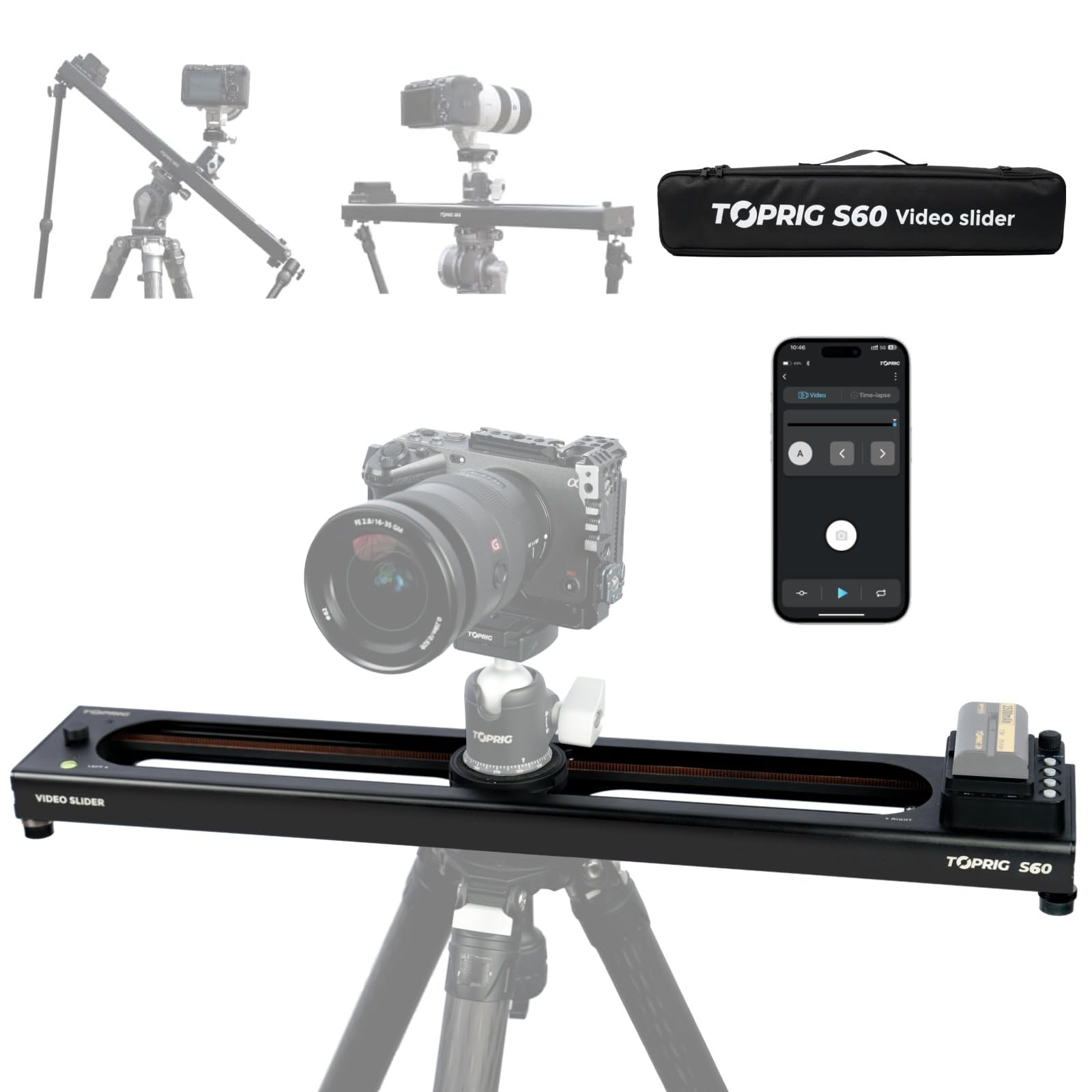
A physical speed knob on a brushless slider that runs for over 60 hours on one battery.
Most motorized rails make you pull out a phone to change speed. The S60 gives you a full button panel and a precise speed knob that takes you from 0.1 cm/s to 5 cm/s in real time, no screen needed. If Bluetooth is more your speed, the TopRig App on iOS or Android runs Time-Lapse, smooth Loops, and exact A-B point sequences. Either way it powers up and auto-calibrates in 12 seconds.
The motor matters for audio. It is a brushless unit that runs below 30dB, so a cooking video or an interview keeps clean sound without a separate recorder. The rail is aluminum alloy and handles 8.81lb/4kg horizontally and 5.5lb/2.5kg vertically. Travel is 16.73 inches/42cm on a 24-inch/60cm rail, and the whole thing weighs 4.96lb/2.25kg with a carrying bag included.
The runtime is what seals it. It runs on a common NP-F550/750/970 battery — not included — and can run for over 60 hours horizontally on a single NP-F550 battery at 3200mAh. For a studio setup it also takes a 7.4 to 16.8V DC input, with the adapter sold separately. The mount is a universal 1/4″-20 screw for Canon, Sony, GoPro, and smartphones. Owners describe the panel as a one-piece solid design, and the controls feel accordingly.
Why the hands-on control wins
- 0.1 to 5 cm/s speed knob adjusts live, mid-shot
- Brushless motor below 30dB keeps dialogue clean
- 60+ hours horizontally on an NP-F550 battery
- 12-second power-up and auto-calibration
What to have on hand
- Battery, DC adapter, and ball head all sell separately
- 16.73-inch/42cm travel is short for wide reveals
- Vertical ceiling of 5.5lb/2.5kg caps heavier cine rigs
Worth it when: you change speed shot to shot and want your hands on the rail, not the app.
Wait on it if: you need a longer glide — the GVM’s 48 inches/120cm carries that brief.
7. Accsoon Toprig Motorized Camera Slider 24inch
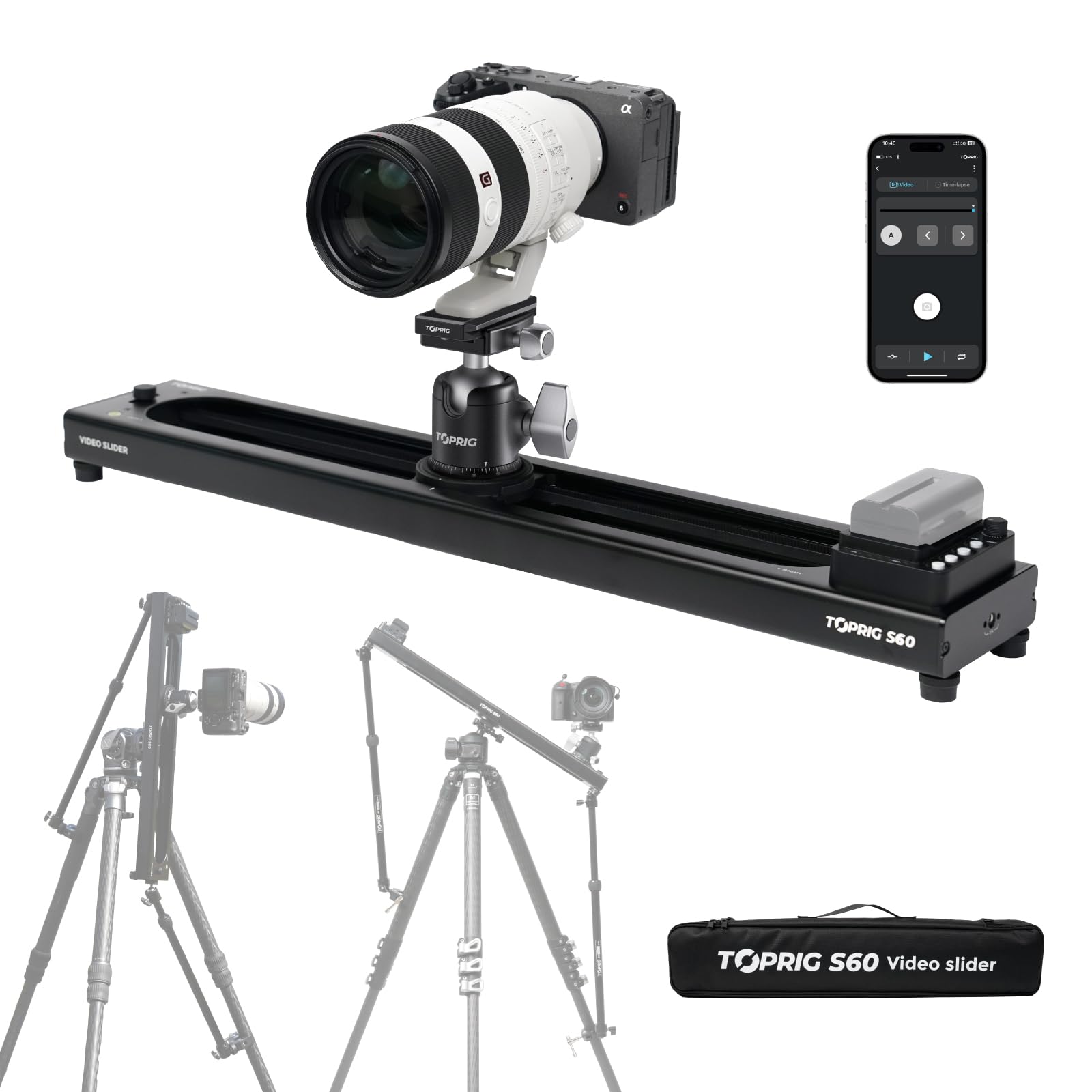
A motorized rail at 3.3 pounds — light enough to hang off a single tripod on set.
At 3.3lb (about 1.5kg) this aluminum slider is the lightest motorized pick here. That matters most on a shoot where you are moving between setups all day and every ounce adds up. It still holds a 200mm focal length lens for standard shooting or a 24mm macro for precise work, and the rail runs vertical and horizontal.
The motor is the same brushless stepper design as the S60, running below 30dB, so the frame shakes and background buzz that would ruin an interview recording stay out of the way. Load limits are 4kg horizontally and 2.5kg at a 90° tilt. Control comes from the full-button panel or the Toprig app over Bluetooth, with Video, Time-Lapse, and Loop modes plus A-to-B point moves. It also auto-calibrates in 12 seconds.
The notes page is the honest part. Batteries and the DC cable are not included, and Toprig advises using an NP-F battery and DC IN at the same time. The DC supply must be 12V 3A — a higher voltage can starve the motor of current and stop it detecting stalls properly. There is a mixed note on smoothness in the feedback, with some finding it steady and others describing jitter, so test your unit early and use the 120° panoramic and slow speed settings on a solid tripod.
What stands out: 3.3 pounds with a below-30dB brushless motor — a light rig that stays quiet enough for on-camera audio.
Where to be careful: power setup is on you. Get the 12V 3A supply right or the motor will not behave.
Go for this if: you need a motorized rail that travels light and you already own NP-F batteries.
Leave it on the shelf if: you want a plug-and-shoot kit — the S60 above at least bundles the button control clearly.
Know the Specs
Payload by Angle
Every rail quotes more than one load figure because the carriage hangs differently when tilted. A rail rated 4.4lb/2kg flat may hold only 2.2lb/1kg at a 45° tilt. Weigh your camera with the lens attached and compare against the tilted number if you plan angled shots.
Motor Noise in Decibels
Motorized rails often quote a decibel figure for how loud the movement is. Below 30dB, the motor stays out of a dialogue track recorded on the same set. A manual rail has no motor, so it makes no noise — the trade is that every move is by hand.
Speed in Seconds per Metre
Some motors list speed as seconds per metre — how long the carriage takes to cover one metre. A 60 s/m setting is slow and cinematic; 15 s/m is brisk. Higher numbers mean slower movement, which is the opposite of how most speed specs read.
Sliding Travel
The rail length is not the same as the distance the carriage moves. A 24-inch/60cm rail can give around 16.73 inches/42cm of travel once the ends are accounted for. Check the travel figure if your shot distance matters.
Common Questions
What is the difference between a camera slider and a gimbal?
Can a camera slider hold a heavy DSLR?
Do I need a shutter cable for time-lapse on a motorized slider?
Will my slider motor noise get into my audio?
How long does a motorized slider battery last?
Does a 24-inch slider give me 24 inches of travel?
Can I use a camera slider with a phone or a GoPro?
Why does my manual slider feel rough or noisy?
Can a motorized slider shoot a 120 degree panorama?
Is a carbon fiber slider better than an aluminum one?
The Bottom Line
For most solo shooters, the best X-Axis Camera Slider is the NEEWER DL400 — app control, a sub-30dB motor, and 3.75 pounds that won’t weigh down your bag. If your camera is heavy and your budget is not, the Fotodiox Pro SlideCam gives you a stable aluminum rail with a ball-bearing carriage. And for a long, slow sweep, the GVM 48″/120CM is the one to reach for. The DL400 leads on the balance of motor control and portability that most buyers actually need.
How we choose
We do not accept paid placement. Every pick is matched to a real buyer and a real use-case; we do not hands-on test units.
Sources
Specifications: manufacturer listings and product documentation. Review insights: verified customer reviews, as of November 2026. Pricing: not shown on this page (it changes often); check the current price via the retailer link.
As an Amazon Associate, Tactical Gear Guy earns from qualifying purchases. This does not affect which products we feature.