Specs are compiled from manufacturer listings and verified buyer reviews and can change over time — please confirm the key details on the product page before buying.
Wool polishing pads are the fastest way to cut scratches and oxidation out of paint — and the fastest way to burn through a clearcoat if you pick the wrong one. The right pad stays flat under the machine, spins without hopping, and finishes down fine enough to hand the car back haze-free. The wrong one sheds fibers into wet compound, loses its loop backing halfway through a hood, or bites so hard you chase swirl marks you created yourself.
This guide is built by comparing the manufacturers’ published specifications and the patterns across verified customer reviews, so you get each pick’s real strengths and trade-offs instead of marketing spin.
Below you will find pads sorted by what they actually do on a spinning machine — from a coarse wool disc that removes paint defects to fine single-sided pads built for the final gloss pass. Each entry names its real diameter, grit rating and weight so you can match a pad to your backing plate before you buy the best Wool Polishing Pads for your paint correction job.
Top Picks

How To Choose The Best Wool Polishing Pads
Wool is an abrasive cutting medium, not a soft buffing cloth. Understanding three things — grit, diameter and how the pad attaches — tells you more than any photo on a listing page.
Match the grit rating to the job
A grit number tells you how aggressive the wool face is. The SPTA 9-inch double-side pad carries a grit number of 160 with an extra-coarse rating, which suits heavy oxidation and deep scratch removal. The Woolous 7-inch pad sits at a grit number of 2000 with a fine rating, which is a finishing pass rather than a cutting pass. Start aggressive, then finish fine — a fine pad on badly oxidized gelcoat just burnishes the chalk.
Pick a diameter your machine can actually turn
A bigger pad covers more panel per pass but needs a more powerful machine to keep spinning under load. The Rupes BigFoot measures 5.75 inches and the SPTA double-side pad measures 9 inches — the smaller disc is easier to keep flat on curved panels, while the larger one eats a hood or boat hull in fewer passes. Check your backing plate size before ordering, because a 9-inch pad on a small orbital will bog down and hop.
Decide between hook-and-loop and thread mount
Hook-and-loop (often called velcro) means the pad presses onto a backing plate and pulls off by hand, so you can swap from cutting to finishing in seconds. Thread mount means the pad screws directly onto a rotary spindle — the 5/8-11 thread is the common rotary size, and the SPTA 9-inch pad and the SPTA 8-inch set both accommodate it. If you own a rotary, thread mount is the more secure option; if you own an orbital, you want loop backing.
Expect some shedding on a new pad
Natural wool sheds loose fibers on the first run or two. The Sisha-A two-pack says to let the machine idle with the pad fitted for a few minutes, or flap the pad by hand, to shake the float wool out before you touch paint. Do that once and the lint settles down.
Side-by-Side Comparison
| Model | Best For | Diameter | Grit Type | Items | Amazon |
|---|---|---|---|---|---|
| Rupes BigFoot Coarse Wool★ Best Overall | Cutting defects on curved panels | 5.75 inches | Coarse | 1 | Amazon |
| TCP Global Premium Wool (2 Pack)Best For Finishing | Wax and sealant application | 6 inches | Fine | 2 | Amazon |
| Woolous 7 Inch Wool Buffing PadBest Gloss Pass | Final gloss pass on paint | 7 inches | Fine | 1 | Amazon |
| 2 Pack 7″ Wool Polishing & Buffing Pads | Oxidized boat hulls and RVs | 7 inches | Wool | 2 | Amazon |
| SPTA 9″ Double Side Wool Pad | Heavy compound cutting | 9 inches | Extra Coarse | 1 | Amazon |
| Fasmov 3 Pack Wool Polishing Pad | Multi-surface workshop use | 7 inches | Fine | 3 | Amazon |
| SPTA 8″ 4-Piece Set with Backing Plate | Grinder and rotary setups | 8 inches | Coarse | 4 | Amazon |
| 3M Wool Polishing Pad 05713 | Gelcoat and fiberglass gloss | 9 inches | Very Fine | 1 | Amazon |
Detailed Reviews
1. Rupes BigFoot Coarse Wool 5.75″ Orbital Polishing Pad
Our pick — 4.5+★ from 400+ verified ratings; the strongest balance of quality and price.
The small-diameter cutter that stays flat where big pads start hopping.
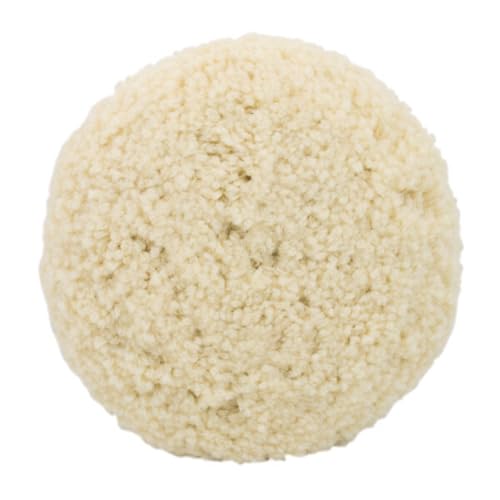
If you are chasing defects out of a curved fender or a door edge, pad control matters more than pad size — and this 5.75-inch disc is the easiest one here to keep planted. Rupes builds it with a dual-density wool surface, meaning the wool face has two layers of firmness so it cuts aggressively without going wobbly under the spindle. It carries a coarse grit type and a grit number of 1500, so it is a defect-removal pad rather than a finishing pad.
Weight is where this pad separates from the big discs. At 0.03 kg it stays light enough that the machine does not fight you on a vertical panel, while the SPTA 9-inch double-side pad sits at 0.38 kg — a difference of 12.7x. On a long polishing session over a roofline, that gap is the difference between a pad you can steer and one that feels like it is dragging the tool out of your hands.
The honest limitation is coverage. A 5.75-inch face covers less panel per pass than the 9-inch SPTA and the 8-inch SPTA set, so a full vehicle is more passes and more time. This is the pad for someone correcting defects carefully, not someone trying to buff a whole boat hull in an afternoon. It is also a single pad in the box, so a full detail usually means keeping a spare on hand.
Why detailers keep this one loaded
- 5.75-inch diameter keeps the pad flat on curves and edges
- Dual-density wool gives cutting power without losing finish quality
- 0.03 kg keeps the machine balanced on vertical panels
- Coarse grit type suits paint defect removal and refinishing
What you trade for that control
- Smaller face means more passes to cover a full panel
- Single pad per pack — spares are a separate purchase
The one to load first: Buy this if you correct defects on curved panels and want a pad the machine will not wrestle away from you.
Look wider if: You are buffing large flat areas and want a 9-inch face covering more ground per pass.
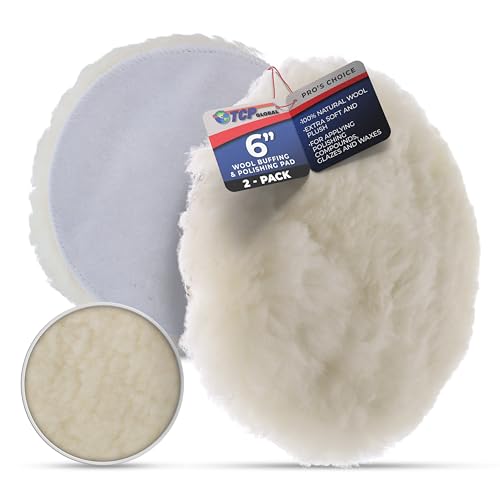
2. TCP Global Premium 6 Inch Wool Buffing Pads (2 Pack)
A plush fine-grit pad built for wax and sealant, not for carving out scratches.
Six inches across, a 1-inch thick pile, and a fine grit type — this pad is aimed squarely at the last step of a detail. The extra-plush wool face spreads compound, glaze, sealant or wax evenly instead of grinding it into the paint, which is what reduces swirl marks on a final pass. Two pads come in the pack, so you can run one while the other dries after washing.
What buyers respond to most is the overall build — the quality of the wool is the standout, followed closely by how effective it is at spreading product evenly across a panel. The loop backing is the other practical win: it centers on the plate and pulls off by hand for a fast change between steps. It measures 32 g, light enough that it will not throw off the balance of a small orbital.
The catch is durability. Some owners find these hold up across multiple washes, while others have had a pad separate or refuse to wrap cleanly around the machine. Treat them as a consumable finishing pad rather than a long-service cutting pad, and keep pressure moderate. On a fiberglass boat the fine face does a good job, but you would not reach for it first to cut heavy oxidation.
Where it earns its place: The 1-inch pile and fine grit type make this the pad you grab for the gloss step after the cutting is done, not before.
The honest caveat: Durability is the mixed part — wash it gently, let it dry fully, and do not expect cutting-pad longevity from a finishing pad.
Reach for this if: You want two fine pads for spreading wax, sealant or glaze on paint and fiberglass.
Keep looking if: Your paint has real oxidation and you need a coarse cutter to remove it first.
3. Woolous Wool Buffing Pads 7 Inch
Fine-grit natural lambswool for the pass where you want shine, not scratches.
Here is the number that describes this pad: a grit number of 2000. That is a fine rating, which puts it on the finishing end of the scale rather than the cutting end. Compare it to the SPTA 9-inch double-side pad at a grit number of 160 — that is a 12.5x gap, and it tells you these two pads are for completely different stages of the same job.
The face is 100% natural lambswool on a single-sided 7-inch pad, backed with hook-and-loop so it presses onto your plate and peels off. It weighs 5.12 ounces, and it is built for buffing, cutting, compounding and polishing paint when paired with a compound or wax matched to your surface. Woolous suggests testing in an inconspicuous area first, which is sensible advice for any new pad on an unfamiliar clearcoat.
One thing worth planning for: this is a single pad, and it is a single-sided one. The 2 Pack Sisha-A pads give you two for roughly the same shelf position, so if you want a spare mid-job, that pack is the more practical buy. Here, you get one fine-faced lambswool disc and the discipline of washing it out and letting it dry fully before storage.
Pick this for: A fine final pass on automotive paint where you want gloss built up, not material removed.
Think twice if: You want two pads in the box or need a coarse cutter for heavy oxidation.
4. 2 Pack 7″ Wool Polishing & Buffing Pads with Hook and Loop

Two twisted-wool cutters for chalky gelcoat and oxidized paint that needs real bite.
Sun-beaten fiberglass boat hulls and RV exteriors are the target here. Each pad is built from 100% twisted 4-ply sheeps wool, and the manufacturer is direct about it being a high-density wool pad — which means it cuts harder than a wool blend, microfiber or foam pad. You get two 7-inch pads in the pack, and they weigh 5.6 ounces each.
Two details matter on a machine. First, the pad is designed not to jump or hop across the panel, and it is built to run without generating so much heat that it burns the paint. Second, the larger available cutting surface per square inch means faster cutting action with less downward pressure from you — which is easier on your arms over a long hull. It works on painted automotive surfaces, airplane panels and wood floors as well as boats.
The trap with dense natural wool is lint on the first run. Let the machine idle with the pad fitted for a few minutes, or flap the pad by hand, to shake the loose float wool out before the pad touches paint. After that it settles. Washable and reusable, so a two-pack covers a full boat job with a spare.
The case for the two-pack
- Twisted 4-ply sheeps wool cuts harder than blends, microfiber or foam
- Two 7-inch pads in the pack, each 5.6 ounces
- Built to resist hopping and excess heat on the panel
- Washable and reusable for repeat jobs
Before your first pass
- Expect loose float wool on the first run — idle or flap it out first
- Aggressive cutting means a light hand until you know the pad
Buy it for: Restoring heavily oxidized gelcoat, RV siding or dull paint where a fine pad will not touch it.
Not your pad if: You just want a soft finishing face for spreading wax.
5. SPTA 9″ Wool Buffing Pad
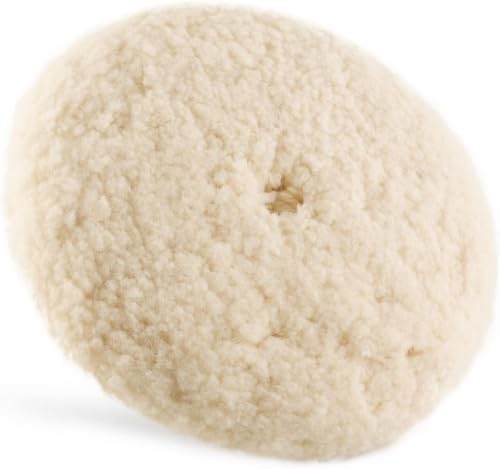
Nine inches of extra-coarse wool with a thread mount that screws straight on.
A 9-inch diameter with a grit number of 160 and an extra-coarse rating makes this the heaviest cutter on the list. It is double-sided, so you flip the pad rather than swap it, and it carries a 5/8-11 thread for direct mounting on a rotary spindle — no backing plate needed. Buyers report it running well up to 2500 rpm and pulling scratches out of paint on a compound pass, and the overall build quality is what earns the most approval, with cutting performance right behind it.
Weight is the honest conversation. At 0.38 kg this pad is heavy — against the Rupes BigFoot at 0.03 kg, that is a 12.7x difference. On a rotary turning a large flat hood it is a benefit, because the mass keeps the pad flat and the cut consistent. On a vertical panel or a tight curve, that same mass asks more of your wrists and shoulders.
The dual-sided face and threaded arbor suit automotive clearcoats, gelcoat and fiberglass, and it handles deep scratches, severe oxidation and orange peel. It is washable and reusable, which matters when a pad this aggressive loads up with compound. One practical note: check that your machine has the 5/8-11 spindle before you order, because a thread-mounted pad will not go onto a hook-and-loop plate.
The standout spec: A 9-inch double-sided cutting face on a 5/8-11 thread means a full-size rotary can cut a large panel in fewer passes with a consistent bite.
Size the weight before you buy: 0.38 kg is real mass in your hands — great for flat horizontal panels, tiring on vertical ones.
Suits you if: You run a rotary with a 5/8-11 spindle and want one aggressive pad to cover big flat panels.
Wrong tool if: You polish with a small orbital and hook-and-loop plates only.
6. Fasmov 3 Pack Wool Polishing Pad, 7 inch
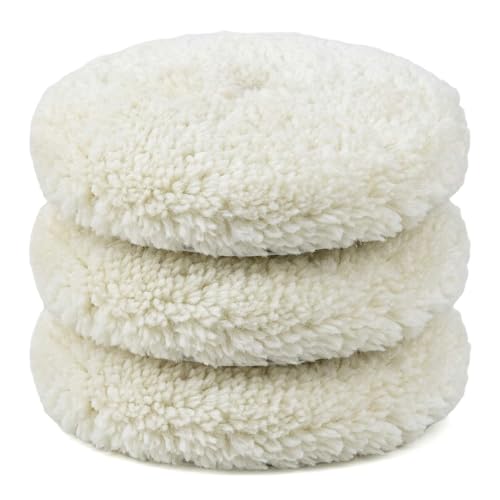
Three fine-faced 7-inch pads that spread across paint, stone, wood and glass.
Where most pads here pick a lane, this set spreads out. The 7-inch wool face carries a fine grit type, and Fasmov lists it for car paint, boats, countertops, wood finishes, glass, stone, artificial stone panels, flooring and even musical instruments. Three pads in the pack means you can dedicate one to paint and one to workshop surfaces without cross-contaminating compounds.
Control is the selling point in use. The pad is built not to jump or hop on the panel, and it is made to run cooler so it does not burn the finish — which matters more on wood and stone than on clearcoat. Wool is generally more aggressive and easier to control than foam, so it also suits swirl mark and oxidation removal on painted surfaces.
Fine grit means this is not your heavy cutter. If a hull is chalky or a clearcoat is badly scratched, start with a coarse pad and finish here. It is also a 3-pack of the same pad rather than a graduated set, so you get repetition, not a range of aggressiveness.
Built for breadth: One 7-inch fine pad design that stretches from car paint to countertops, wood and glass — three of them, washable and reusable.
Know the limit: Fine grit type means it finishes; it does not replace a coarse cutting pad for heavy oxidation.
Right for you if: You work across paint, stone, wood and glass and want three pads you can assign to different surfaces.
Shop elsewhere if: You need a graduated range from coarse cutting through fine finishing.
7. SPTA Wool Polishing Pads 8″

Four 8-inch pads and the backing plate you need to mount them — one box, one job.
Buying pads and a plate separately is the usual annoyance with wool buffing, and this set closes that gap: four 8-inch natural wool pads plus a 5/8-11 thread backing plate in the same box. The pads carry a coarse grit type, so they cut oxidized paint, orange peel, deep scratches and sanding marks on hard top coats and clear coats, and they will handle painted automotive and wood floor surfaces too.
In use, owners find them effective with corded grinders and say the velcro attachment holds secure, with high-shine finishes coming through on the buff. The wool is more aggressive than a blend, microfiber or foam, so it cuts quicker — SPTA’s own guidance is to start with a wool pad and finish with a foam pad to bring the gloss back up.
The durability picture is mixed, and the shedding is the part that draws the most attention. Some pads hold up and keep cutting; others have fallen apart or thrown fibers during a session. Run the idle break-in before that first pass, keep the machine speed sensible, and this four-pad set gives you enough spares to finish a full vehicle even if one gives out.
What makes the box worth it
- Four 8-inch pads in one set, not a single pad
- 5/8-11 thread backing plate included
- Coarse grit type cuts oxidation, orange peel and deep scratches
- Se-cure velcro attachment and washable, reusable wool
Set your expectations here
- Shedding is the common trade-off with dense natural wool
- Durability varies from pad to pad within the set
The complete kit choice: Take this if you need four aggressive 8-inch pads and do not already own a 5/8-11 backing plate.
Look at a single pad if: You already have a plate and only want one or two cutters.
8. 3M Wool Polishing Pad, 05713, Single Sided, 9 in

A 9-inch very-fine wool blend built for the last mirror-gloss pass on gelcoat.
This pad is the finisher of the group, and the spec that says so is its very fine grit type. Wool blended with very fine fibers makes for a fast, mirror-like polish on paint, gelcoat and fiberglass across boats, cars, trucks and RVs — and owners consistently place it above foam pads on fiberglass work.
Build quality is what wins people over here, followed by how effective it is at bringing up gloss — with gelcoat high-gloss polishing being the use it gets singled out for most. The 9-inch single-sided face is designed to run with liquid polish to lift very fine defects like swirls and microscratches, and the Hookit hook-and-loop attachment lets you pull the pad off and swap it without tools.
Two things to weigh. Long-term durability gets a mixed read — some pads hold up well, others show wear faster than expected. And lint is a real factor: fibers come off during use, so the idle break-in and a clean pad face matter. 3M also recommends pairing it with its Perfect-It machine polish and compound line, and its own listing notes this pad is for industrial or occupational use only rather than consumer sale.
Where it shines: A 9-inch very-fine wool blend that turns gelcoat and fiberglass from chalky to mirror gloss on the final pass.
The honest catch: It is a finisher, not a cutter — and shedding plus variable long-term wear mean you should keep a spare and break it in properly.
Choose this if: You finish gelcoat, fiberglass or paint with liquid polish and want a professional-grade very-fine wool blend.
Move on if: You need a coarse cutter for heavy oxidation or want a pad rated for straightforward consumer use.
Know the Specs
Grit number and grit type
A grit number rates how fine or aggressive the wool face is, and the grit type names that in words. A low number with a coarse or extra-coarse type — like the SPTA 9-inch pad at 160 — cuts paint defects and oxidation fast. A high number with a fine rating — like the Woolous at 2000 — burnishes and brings up gloss instead of removing material. Order your pads from coarse to fine and you avoid creating swirl marks you then have to remove.
Pad diameter
Diameter is the pad’s working face, given in inches or millimetres. A 5.75-inch pad is easy to keep flat on curves and tight panels; a 9-inch pad covers far more panel per pass but needs a machine with enough power to keep turning it. Match the pad to your backing plate or spindle before ordering, because a pad that is too large for the tool will hop and build heat.
Hook-and-loop versus thread mount
Hook-and-loop (velcro) pads press against a backing plate and pull off by hand, so changing from cutting to finishing takes seconds. Thread-mounted pads screw onto a rotary spindle — the 5/8-11 thread is the standard rotary size — and stay locked on under load. If you run a rotary, thread mount is the sturdier choice; if you run an orbital, you want loop backing and a matching plate.
Weight and shedding
Pad weight, given in kilograms or ounces, tells you how the tool will feel in your hands. A heavy pad keeps a large flat panel cutting consistently but tires your wrists on vertical work; a light pad is easier to steer. Shedding is separate — natural wool releases loose fibers on the first runs, so idle the machine with the pad fitted or flap it by hand before the pad touches paint.
Common Questions
Will a 9-inch wool pad fit my orbital polisher?
What grit wool pad should I use for heavy oxidation?
Do wool polishing pads shed on the first use?
Can I use a wool pad with wax instead of compound?
Which is faster, a wool pad or a foam pad?
What is a 5/8-11 thread and do I need it?
Can I wash and reuse a wool buffing pad?
Will a wool pad burn through my clearcoat?
What is the difference between coarse and fine wool pads?
Do I need a backing plate to use these wool pads?
The Bottom Line
The wool polishing pads that earns top spot is the Rupes BigFoot Coarse Wool 5.75″, because its dual-density wool face cuts defects while the 0.03 kg weight keeps the machine balanced on curved panels — the highest-rated pick here at 4.5+ stars across 400+ owners. If you need to strip heavy oxidation off a hull or an RV, reach for the SPTA 9″ Double Side and its extra-coarse, double-sided cutting face. And if your job is the final gloss on gelcoat, the 3M 05713 delivers that very-fine wool blend in one 9-inch pad.
How we choose
We do not accept paid placement. Every pick is matched to a real buyer and a real use-case; we do not hands-on test units.
Sources
Specifications: manufacturer listings and product documentation. Review insights: verified customer reviews, as of November 2026. Pricing: not shown on this page (it changes often); check the current price via the retailer link.
As an Amazon Associate, Tactical Gear Guy earns from qualifying purchases. This does not affect which products we feature.