Specs are compiled from manufacturer listings and verified buyer reviews and can change over time — please confirm the key details on the product page before buying.
Buying the wrong wood blade wastes money twice — once when it dulls on wet branches, and again when you drive back to the store. The fix is simpler than the marketing suggests: match the teeth-per-inch count to your material, then pick a pack size that matches how often you use the saw. For pruning live branches and storm-downed limbs, a coarse 5 TPI blade rips through fast. For nail-embedded studs and pallet wood, a 6/12 TPI bi-metal blade is the safer call. Seven packs below cover both jobs, and every one of them fits a standard reciprocating saw.
This guide is built by comparing the manufacturers’ published specifications and the patterns across verified customer reviews, so you get each pick’s real strengths and trade-offs instead of marketing spin.
You will see what each pack actually cuts, where it struggles, and which blade geometry suits your work. The quick comparison table strips each option down to length and tooth count, so you can spot the trade-offs in seconds. Here is what separates a great wood sawzall blade from one that burns out mid-cut.
Top Picks

How To Choose A Wood Sawzall Blade
The first decision is not brand — it is what you plan to cut. A blade built for green branches will bog down on a nail-riddled fence board, and a nail-cutting blade will chew through pruning work without ever letting its teeth bite properly. Get the tooth geometry right first, then size the blade length and pack count to the job.
Read the TPI before anything else
TPI stands for teeth per inch — the number of cutting teeth packed into one inch of blade edge. A low count like 5 TPI leaves big, deep gullets (the gaps between teeth that carry sawdust away), which makes it aggressive on soft and wet wood. A 6/12 TPI blade alternates two tooth counts, so it handles nail-embedded wood with less risk of a tooth snapping off.
Match blade length to reach, not to habit
Longer blades give you more reach into thick limbs and stacked material. A 12-inch blade strokes further through a trunk than a 9-inch one. Shorter 9-inch blades stay stiffer and easier to aim in tight pruning work, which is why most pruning packs settle there.
Steel type decides how the blade dies
Bi-metal blades weld a tough cutting edge onto a flexible backing, so they resist snapping when you flex the saw in a cut. High-carbon steel blades cut cleanly but are less forgiving. If your work is demolition-heavy with nails, bi-metal earns its place.
Pack size is a math problem
A 5-pack suits occasional pruning around the yard. A 10, 25, or 50-pack is a consumable stockpile for contractors who change blades often. Bigger packs lower your per-blade cost, but only if you will actually burn through them before they rust in the toolbox.
Side-by-Side Comparison
| Model | Best For | Blade Length | TPI | Pack Count | Amazon |
|---|---|---|---|---|---|
| BOSCH RP125 5-Piece★ Best Overall | Deep pruning and thick limbs | 12 in | 5 | 5 | Amazon |
| EZARC 9-Inch 5TPIBest Value | Everyday yard pruning on a budget | 9 in | 5 | 5 | Amazon |
| BOSCH RP95 5 pc. | Precision branch work | 9 in | 5 | 5 | Amazon |
| Diablo Fleam Ground | Pressure-treated wood and plunge cuts | 9 in | 5 | 5 | Amazon |
| ALEXEX 10 Pack 4/6 TPI | Nail-embedded wood on a budget | 9 in | 4/6 | 10 | Amazon |
| THYENTUL 25 Pack 6/12TPI | Demo and trimming on a stockpile | 9 in | 6/12 | 25 | Amazon |
| GOSHHINE 50 Pack 6/12 TPI | Heavy contractor volume | 9 in | 6/12 | 50 | Amazon |
Detailed Reviews
1. BOSCH RP125 12-Inch Reciprocating Saw Blades
Our pick — 4.5+★ from 850+ verified ratings; the strongest balance of quality and price.
The long-reach pruning blade that eats thick limbs without a chainsaw.
Twelve inches of blade changes what a reciprocating saw can do in a yard. The RP125 runs a 12-inch length — the longest here — and that extra stroke reaches deeper into a limb before you reposition the saw. Bosch pairs it with a 5 TPI tooth count, meaning five big cutting teeth per inch with wide gaps to clear wet sawdust fast. Buyers report it can handle 8-10 inch thick branches, which is chainsaw territory for most homeowners.
What wins people over is longevity. Bosch fits these with Turbo-Teeth technology and claims up to 3X the life of standard reciprocating blades — a maker claim, though owner reports of teeth holding up on thick limbs lean that way. Owners talk about cutting thick limbs and roots without the teeth rounding off early. The set ships as five blades weighing 9 ounces total.
Weigh that reach against the limitations. Inside tight pruning work where you are aiming precisely, the shorter Bosch RP95 tracks straighter. If you mainly cut fat, low limbs and stumps, the reach is worth it.
Where the RP125 Wins
- 12-inch blade gives the deepest reach into thick limbs of any pick here
- 5 TPI coarse tooth clears wet sawdust aggressively on green wood
- Turbo-Teeth build aims for up to 3X the life of standard blades
- Owners say it handles 8-10 inch thick branches
Where It Gives Ground
- The long blade flexes — owners are mixed on it for precise work
- Five blades means you restock sooner if you cut daily
- Tight plunge cuts ask more of you than a stiff 9-inch blade
Reach for this: homeowners and landscapers knocking down fat limbs and roots who want chainsaw-style capacity from a reciprocating saw.
Not your blade: fine detail pruning where a flexing 12-inch blade asks more control than a stiff 9-inch one.
2. EZARC 9-Inch Reciprocating Saw Blades 5-Pack
Grey steel and staggered teeth built to clear yard waste fast.
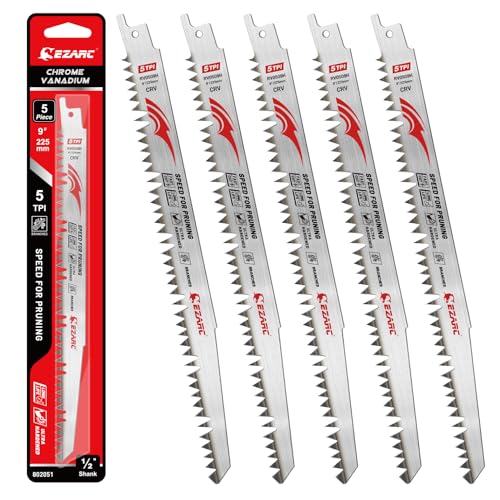
For the homeowner who prunes a few times a season, EZARC is the practical entry point. It uses grey steel with a staggered tooth pattern — teeth set slightly left and right of center so the kerf stays clear — and a 5 TPI count that cuts green wood quickly. Owners mention it slices through green, dead, wet, and dry wood without slowing down, which covers most of what a backyard saw meets.
The teeth are fleam-ground, a sharpening style that produces a keener edge with deep gullets for chip clearance. EZARC claims its tooth design delivers a 3x longer lifetime, a manufacturer figure rather than an independent test. The universal shank fits DeWalt, Bosch, Makita, Black & Decker, Milwaukee, Porter Cable, Skil, Ryobi, Hitachi, and Metabo saws.
The catch is what it will not tolerate. EZARC explicitly warns against cutting wood with nails — a nail will chip a fine tooth fast. If your cutting list includes pallets or fence boards, step up to a bi-metal 6/12 TPI instead. For clean limb and stump work, this pack does the job at a friendly entry price.
Sharpness first: owners single out the cutting edge above all — these arrive sharp and keep biting through branch after branch. The 1.3 millimeter thickness keeps the blade stiff enough to aim.
Know its lane: no nails. Keep a separate bi-metal pack for demolition wood.
Buy this if: your cutting is clean limbs, shrubs, and small stumps, and you want a sharp pruning blade without overspending.
Look elsewhere if: you shop pallets for firewood or rip out fence boards — go bi-metal for nail work.
3. BOSCH RP95 9 In. Reciprocating Saw Blades

The light, precise Bosman-style pruning blade that starts sharp and stays that way.
Here is the number that frames this pick: the RP95 set weighs 1.44 ounces. That is featherweight for a five-pack, and it matters when you spend a morning reaching overhead with the saw in one hand. Compare it to the RP125 above at 9 ounces and you get a sense of how much lighter this 9-inch pruning pack rides. The 5 TPI tooth count matches its bigger sibling, so it cuts just as aggressively.
Bosch makes this one in high carbon steel with a precision-ground edge that starts sharp and stays sharper, then adds a 5° tilt angle — the teeth lean slightly to cut faster with less drag. The grey color-coding pops against other blades, so you grab the right one from the toolbox without squinting. Customers note it handles trees up to 6 inch diameter without trouble. Swiss-made is off the table as a claim, but the premium-material language is Bosch’s own.
The 9-inch length is the trade-off. You lose the reach of the 12-inch RP125 on fat trunks, and the near-identical tooth count means you are really choosing reach versus weight. Owners praise the cutting performance far more than anything else. For controlled branch work where you want the saw to feel nimble, this is the better-balanced tool.
What Makes It Nimble
- 1.44 ounces total — light under the arm for overhead pruning
- 5° tilt angle speeds the cut with less blade drag
- Precision-ground edge designed to hold sharpness
- Grey color-coding separates it from your metal-cutting blades
What You Trade Away
- 9-inch length reaches less than the 12-inch RP125 on thick trunks
- High-carbon steel is less forgiving than bi-metal in demolition
Suits the steady hand: anyone who prunes precisely and wants a light, controllable blade overhead.
Skip the reach game: cutting 10-inch trunks is a job for a longer blade — this one stops short of that.
4. Diablo 9-Inch Reciprocating Saw Blades 5-Pack
Built to drop into pressure-treated lumber with a plunge tip that bites on contact.
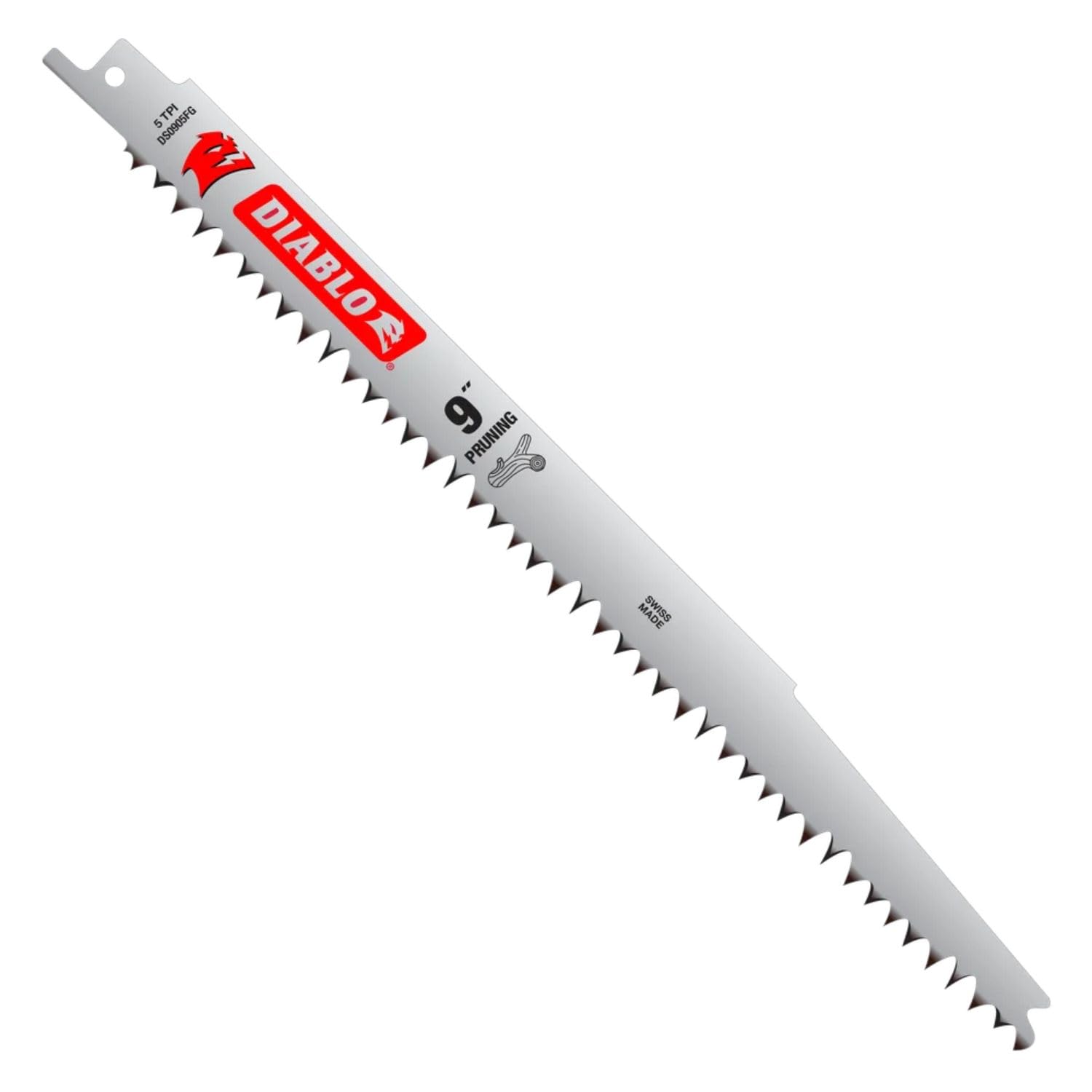
Most pruning blades treat pressure-treated wood as an afterthought. Diablo builds for it. A bi-directional tooth design — teeth that cut on both the push and pull stroke — produces fast, smooth cuts, and the fleam-ground edge gets there quicker. The standout is the unique plunge tip, which lets you push straight into a board or limb without a pilot relief cut. On a job where you are opening a deck board or dropping a stump, that saves real repositioning time.
Reviewers point out it rips through palm fronds without clogging and holds sharpness across a long run. Cordless saws get along with it fine, which matters if you are working the yard away from an outlet. The value angle is real too — Diablo is cheaper than dulling a chain saw blade on the same brush. The 9-inch blade keeps it controllable in tight work.
One honest limit: Diablo does not recommend it for wood with nails. If your material is demolition lumber, the Goshine 50-pack below is the safer money. For clean lumber and plumper garden debris, though, the plunge tip and bi-directional teeth make this the nicest cutter in the middle of this list.
The plunge advantage: the unique tip design lets you start a cut anywhere without a starter hole — a genuine time saver on pressure-treated boards and stumps.
The glass ceiling: nail-embedded lumber is off the menu; that is a bi-metal job.
Your match if: you cut pressure-treated wood, palm fronds, and clean branches and want the smoothest cut in the middle tier.
Pass on this one: tearing out nailed pallets and fence sections, where a 6/12 TPI bi-metal will outlast it.
5. ALEXEX 9 Inch Reciprocating Saw Blades 10 Pack

Ten bi-metal blades that let you cut through nails without flinching.
This pack doubles down where pruning blades back off — nail-embedded wood. ALEXEX builds these from bi-metal with 8% cobalt, a tougher alloy than plain carbon steel, and uses a 4/6 TPI alternating tooth pattern. That mixed count means coarser 4 TPI teeth for fast hogging and finer 6 TPI teeth to clean up the cut and resist chipping on a nail. The non-stick coating helps chips slide free. Compared to a 5-pack, you get a 2.0x pack count here — 10 blades instead of 5.
Shoppers say it cuts through 4×4 posts without trouble, and the alternating teeth cut with less vibration than a single-count blade. That reduced chatter is the difference between a clean end and a splintered one. ALEXEX claims up to 5X longer cutting life than standard blades — a manufacturer figure worth taking with salt — and the 1/2-inch shank fits most corded and cordless reciprocating saws.
The honest note is blade stock: some owners find the steel thinner than Diablo’s. Thin blades flex more and may not survive a torqued cut, so feed the saw at a steady pace rather than forcing it. For pallet breaking, PVC, and nail-laced studs on a budget, the ten-pack buys you a lot of cutting.
Why It Belongs in the Truck
- 10 blades — twice the pack of the 5-count options here
- 8% cobalt bi-metal shrugs off nail strikes on demolition wood
- 4/6 TPI alternating teeth cut cleaner and calmer than single-count blades
- Non-stick coating keeps sawdust moving
The Fine Print
- Thinner steel than Diablo — some owners flag it as flexible
- Not the smoothest choice for finish work in soft lumber
Great fit: DIY demolition crews breaking pallets, PVC, and nailed studs who need volume without a premium price.
Misses for: finish cuts in clean softwood, where a coarse 5 TPI pruning blade leaves a smoother edge.
6. THYENTUL 9 in Sawzall Blades 25 Pack
Twenty-five blades for the crew that treats nails as someone else’s problem.
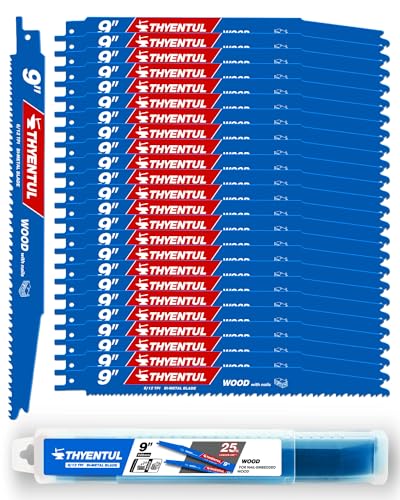
Think of this as a consumable stockpile. You get twenty-five 9-inch bi-metal blades with a 6/12 TPI tooth pattern in a white storage box — the kind of box you refill and carry between jobs. A 1/2-inch shank fits the mainstream Sawzall tools out there, from Bosch and DeWalt to Milwaukee, Makita, Ryobi, Hitachi, Flex, Hilti, and Metabo. The 6/12 count pairs coarse teeth for speed with finer teeth to hold shape around nails.
The cut leaves a smooth edge, which is more than most rough demo blades manage. Dual-metal construction with heat treatment and a UV coating gives these high hardness compared to plain carbon steel. Use them for studs, nail-embedded wood, tree trimming, and plastic pipe. The 0.05 inch thickness keeps the blade rigid enough to resist buckling when you lean on it.
Durability is the honest split here. Owners describe the quality and value as solid, and the blades cut through nails well — but a chunk of feedback says they do not last as long as some rivals. Read that as a trade on a 25-pack: you are buying volume for demolition, not heirloom blades. Feed at moderate speed and they reward you.
Built for demolition: nail-cut capability and a smooth-cutting 6/12 TPI edge, with a 1/2-inch shank that fits nearly every reciprocating saw on the shelf.
Know the odds: durability draws mixed feedback, so treat this pack as refill stock for rough work rather than everyday finish cutting.
Right for: remodelers and demolition crews who burn through blades on studs and nail-embedded wood and want a box at the ready.
Wrong for: anyone expecting each blade to survive weeks of daily cutting — size the pack accordingly.
7. GOSHHINE 9″ Reciprocating Saw Blades 50 Pack

Fifty thick bi-metal blades for crews that never want to stop for a refill.
This is maximum volume with maximum blade stock. Goshine packs fifty 9-inch bi-metal blades with a 6/12 TPI tooth count into a white storage box you can re-use for other tools. At 0.05 inches (1.27mm) thick, the steel is described as thicker than many blades on the market — and a thicker blade resists bowing when you work a hooked cut in a nail-embedded stud. The 12-ounce set is hefty on the shelf, but most of it stays parked in the box between blades.
The teeth handle wood and wood packed with nails — think abandoned fences, nailed window frames, and pallets. Owners describe it tearing into nails and screws quickly, and one reviewer noted taking apart an old boat trailer with the pack. The three-stage heat-treated high-strength bi-metal is meant to keep hardness and toughness together longer than plain carbon steel.
Durability feedback is split. Some owners say the blades last forever; others find them not as tough as rival bi-metal stock. On a fifty-count refill, that split reads more like lottery variance across a giant box than a warning. The 0.05 inch thickness beats the thinner ALEXEX stock, so flexing is less of a worry here. If you want one box to cover demo, framing tear-out, and light pruning for months, this is the biggest single stash in the roundup.
The Case for Fifty
- 50 blades — the largest single pack here for the heaviest users
- 0.05 inch thickness resists bowing better than thinner stock
- 6/12 TPI bites through nails and screws cleanly
- Reusable white storage box keeps the stock organized
Before You Commit
- Durability draws mixed reports — some last forever, others fade fast
- Overkill for a homeowner pruning a couple of trees a year
Designed for: contractors and heavy DIY users running repeated nail-embedded demolition who want one bulk stash and no mid-job stops.
Not the move if: you only trim a few branches each season — a 5-pack covers that without a fifty-blade box in your shop.
Know the Specs
Teeth Per Inch (TPI)
The count of teeth in one inch of blade edge sets the personality of the cut. A 5 TPI blade carries big teeth with deep gullets, so it clears wet sawdust fast and slices green limbs aggressively. A 6/12 TPI blade alternates coarse and fine teeth, which cuts nail-embedded wood with less risk of snapping a tooth. Pick low TPI for clean green wood, mixed TPI for lumber with hardware in it.
Blade Material
High-carbon steel takes a keen edge and cuts cleanly, but it is brittle around nails. Bi-metal welds a hard cutting edge to a flexible backing, so it survives the flex of a demolition cut and tolerates an occasional nail strike. For nail-embedded wood, PVC, and pallets, bi-metal earns its place; for clean pruning, carbon steel is a fine, sharp choice.
Blade Length
Length is about reach. A 12-inch blade strokes deeper into a thick trunk before you reposition the saw, while a 9-inch blade stays stiffer and easier to aim in tight work. Longer costs a little control; shorter costs a little reach. Match the length to the thickest thing you plan to cut.
Shank Fit
The shank is the part that slots into the saw. A 1/2-inch shank fits the mainstream reciprocating tools — Bosch, DeWalt, Milwaukee, Makita, Ryobi, and similar. Most packs list broad compatibility, but confirm your brand is named before buying if the fit matters.
Common Questions
Will these blades fit my DeWalt or Milwaukee reciprocating saw?
What TPI is best for cutting tree branches?
Can a wood sawzall blade cut through nails?
How long does a wood sawzall blade last?
Is a longer blade always better for pruning?
Can I cut pressure-treated wood with a pruning blade?
What is the difference between 5 TPI and 6/12 TPI blades?
Do I need a 5-pack or a 50-pack of blades?
Will these blades cut PVC pipe and plastic?
The Bottom Line
For most people, the winning wood sawzall blade is the BOSCH RP125 5-Piece — a 12-inch blade with a 5 TPI coarse tooth that reaches deep into thick limbs and clears wet sawdust fast. If you want a light, controllable blade for overhead pruning, the BOSCH RP95 at 1.44 ounces is the nimble pick. And for nail-embedded demolition, the ALEXEX 10 Pack gives you bi-metal volume that takes nails in stride. Match the TPI to your material and the pack size to your workload, and every saw pull pays off.
How we choose
We do not accept paid placement. Every pick is matched to a real buyer and a real use-case; we do not hands-on test units.
Sources
Specifications: manufacturer listings and product documentation. Review insights: verified customer reviews, as of November 2026. Pricing: not shown on this page (it changes often); check the current price via the retailer link.
As an Amazon Associate, Tactical Gear Guy earns from qualifying purchases. This does not affect which products we feature.