Specs are compiled from manufacturer listings and verified buyer reviews and can change over time — please confirm the key details on the product page before buying.
Which trainer actually belongs under your bike depends on one thing most shoppers never check: how much climbing resistance it can throw back at you. A trainer that tops out at a 10% gradient will feel flat the moment a Zwift route tilts up to 18%, and no amount of wattage fixes that. Below you will find the trainers that hold their feel through the steep stuff, plus the honest trade-offs that separate them.
This guide is built by comparing the manufacturers’ published specifications and the patterns across verified customer reviews, so you get each pick’s real strengths and trade-offs instead of marketing spin.
Some trainers run near-silent and some rattle the floorboards, so the noise figure matters as much as the gradient. This breakdown covers what each unit simulates, how it connects, and which one suits your setup in a guide to the best zwift smart trainer.
Top Picks


How To Choose The Best Zwift Smart Trainer
The trainer you choose decides how Zwift feels under your legs, not how it looks on a spec sheet. A unit that simulates an 18% incline climbs like a real hill; one capped at 10% goes mushy on the same route. Start there, then work down to noise, connectivity and power accuracy.
Gradient simulation is the number that shapes your ride
Gradient simulation, measured in percent, is how steep a virtual climb the trainer can physically resist against your pedals. Higher is better for race simulation and punchy climbs, since a trainer that can replicate an 18% or 24% slope will hold its feel on the sharpest ramps in Watopia. If you mostly do structured intervals on flat routes, a 10% cap rarely gets in the way.
Peak watts versus how it feels
Load capacity in watts tells you the sprint the trainer can resist without folding — 1500 watts covers most riders, while 2000 to 2200 watts leaves headroom for hard out-of-saddle efforts. This figure is a ceiling, not a feel rating. The smoothness of resistance changes and the realism of the road under your tires do more for the experience than a bigger number on the box.
Noise: the figure your neighbors care about
A direct-drive trainer loses the wheel-on tire squeal, but it can still rattle. One unit here measures its noise at roughly 58dB at 30km/H under load, which is about the sound of a normal conversation. If you ride before sunrise or share thin walls, treat the decibel figure and direct-drive design as your first filter, not the last.
Connection protocol and power accuracy
Dual-mode ANT+ and Bluetooth lets the trainer talk to Zwift, TrainerRoad or your head unit at the same time — check that both are named, since a Bluetooth-only unit limits how many devices pair. Power accuracy quoted as ±1% or ±2% tells you how close the trainer’s readings sit to a real power meter, and a tighter figure keeps your training zones honest when you swap between indoor and outdoor riding.
Side-by-Side Comparison
| Model | Best For | Max Gradient | Peak Watts | Weight | Amazon |
|---|---|---|---|---|---|
| Garmin TacX Neo 2T★ Best Overall | All-round Zwift training | — | 2200W | 47.4 lb | Amazon |
| Wahoo KICKR CORE 2 (11-Speed)Top Performer | Plug-and-ride cassette setup | 16% | 1800W | 13.6 kg | Amazon |
| XPLOVA NOZA VBest for Vibration | Vibration-quiet training | 18% | 2200W | 18 kg | Amazon |
| Wahoo KICKR CORE 2 (Zwift Cog) | Zwift-native virtual shifting | — | 1800W | 13.6 kg | Amazon |
| Elite Direto XR-T | Steep climb simulation | 24% | — | 16.3 kg | Amazon |
| Tacx Flux S | Off-season fitness base | 10% | 1500W | 50 lb | Amazon |
| CYCPLUS R200 | Self-powered riding | 19% | 2200W | — | Amazon |
| ThinkRider X2Max | Budget Zwift entry | 18% | 2000W | 35.2 lb | Amazon |
| Garmin TacX NEO 3M | Motion-simulating realism | 25% | 2200W | 52 lb | Amazon |
Detailed Reviews
1. Garmin TacX Neo 2T Smart Trainer
Our pick — 4.5+★ from 450+ verified ratings; the strongest balance of quality and price.
The near-silent 2200W direct-drive unit that owners treat as the standard for indoor riding.
The Neo 2T runs on 32 Neodymium magnets in a magnetic resistance system, which is the reason it can push back hard without the mechanical drone of a wheel-on design. It holds a load capacity of 2200 watts — a gearing ceiling that lets you sprint out of the saddle on a Zwift finish without the trainer folding under the effort. It speaks ANT+ and Bluetooth to your bike computer, phone, tablet and laptop, and works across iOS, Android, macOS and Windows.
Buyers report that the build quality wins them over, and that it stays quiet—both points come up again and again in owner feedback. That quiet is the difference between a 6am session that wakes the house and one that doesn’t. Setup also gets praise: the box includes a front wheel block, power cable, quick-release skewer, thru-axle skewer and axle adapters for 130mm QR, 135mm QR, 12 x 142mm thru-axle and 12 x 142mm Boost, plus a month of Tacx Premium software.
The honest catch is responsiveness: opinion on how quickly the resistance reacts splits down the middle, so a rider chasing instant feedback on short punchy climbs may notice a lag some owners shrug off. Pick this if you want a dedicated spot for a permanent pain cave; a small apartment that folds the trainer away weekly should weigh that heft first.
Where it earns its place
- 2200 watts of load capacity keeps sprints honest
- 32 Neodymium magnets behind a notably quiet magnetic resistance system
- Broad axle adapter set covers QR and thru-axle bikes from the start
- Works with iOS, Android, macOS and Windows along with the Tacx Premium software trial
The honest trade-offs
- Resistance responsiveness draws split opinion
- 47.4 pounds and a 27″ x 19″ x 10″ footprint means it wants a permanent home
Built for: riders who ride indoors several times a week and want one quiet, sturdy unit to leave set up.
Think twice if: you need a trainer you can fold and tuck into a closet between sessions.
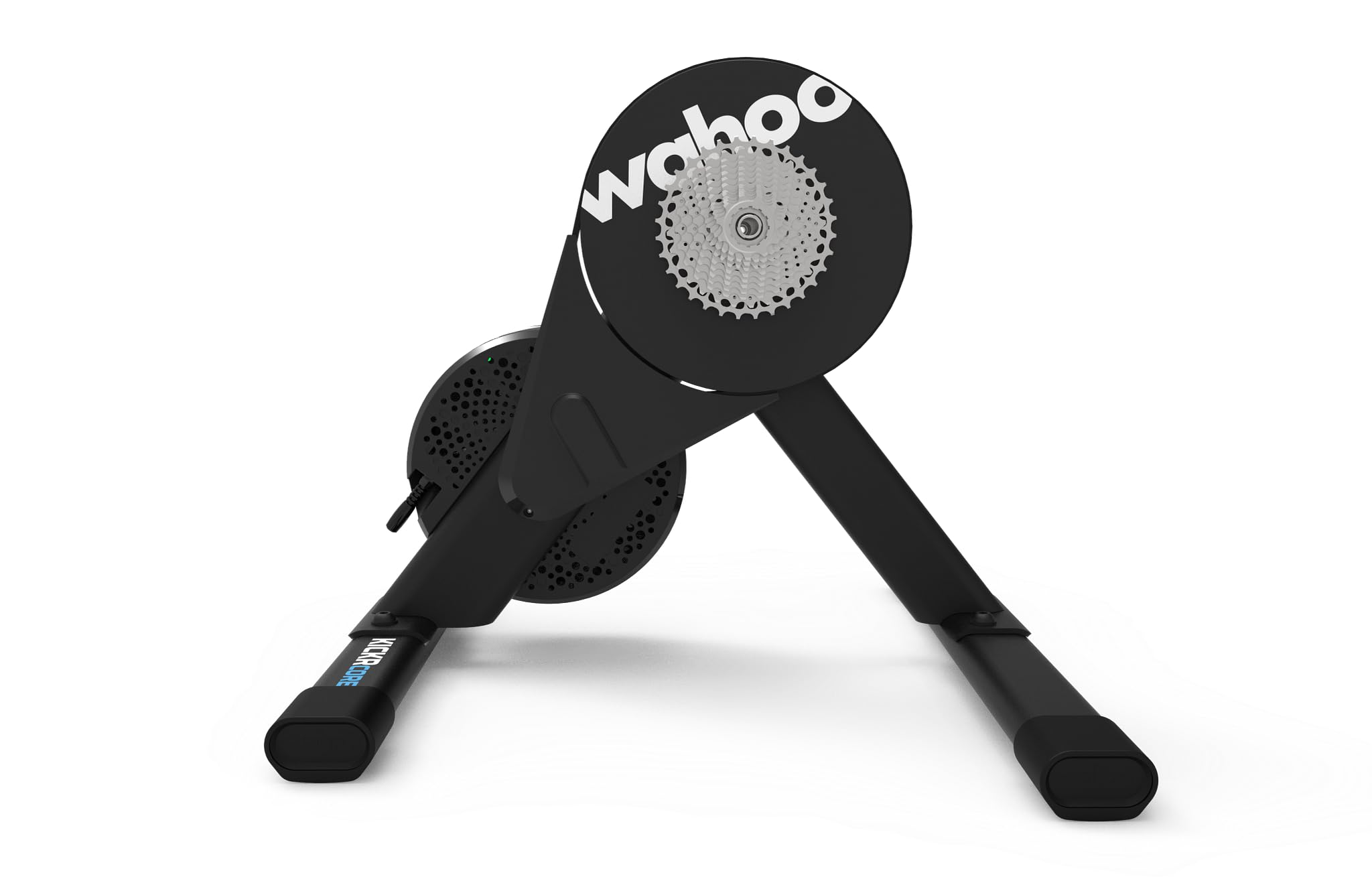
2. Wahoo KICKR CORE 2 Smart Bike Trainer, 11 Speed Cassette
The crowd-favorite 1800W direct drive that ships with an 11-speed cassette already threaded on.
For anyone who would rather ride than wrench, the 11-speed cassette arriving pre-fitted is the whole argument. You bolt the bike on, pair over built-in Wi-Fi, and you are pedaling while other owners are still hunting for a cassette tool. The unit handles 1800 watts, simulates a 16% grade, and quotes ±2% power accuracy — a close-enough figure that keeps your Zwift zones believable without claiming perfection.
Ride feel is the other half of the pitch, and it is a smooth, road-like resistance built for structured training and hard efforts. Quality is what draws the steady praise, and setup ease runs a close second; the unit is also built to fit 8 to 13 speed bikes. At 13.6 kg it is far easier to shift than the Neo 2T, which lands at 47.4 pounds — a real difference if you move the trainer between rooms.
The recurring gripe is power output dropouts during a session, which is worth knowing before you plan a race around live numbers. A few riders also find the adjustability side less polished than the ride itself. Neither undercuts the core experience — this is a mature, well-liked platform — but a rider who obsesses over watt-by-watt parity might want the tighter ±1% accuracy of a different unit.
Why it holds its spot: a pre-installed cassette, Wi-Fi pairing and a 16% grade give you a plug-and-ride Zwift setup with almost no assembly friction, and the ±2% accuracy is honest enough for most training blocks.
The one to weigh: dropouts in power output during a ride are the most-repeated complaint, so treat the Wi-Fi link as something to stabilise rather than set and forget.
Smartest buy for: riders who want Zwift running within minutes of unboxing and value a lighter, movable trainer over raw heft.
Look elsewhere if: you race on live power and cannot tolerate intermittent wattage gaps.
3. XPLOVA NOZA V Smart Trainer, Direct Drive
Four rubber feet and front and rear stabilizers soak up vibration instead of broadcasting it through the floorboards.
Four rubber feet plus stabilizers on the front and rear legs are the standout engineering here — a vibration-absorption setup that keeps the trainer from drumming into the frame of your bike and the floor beneath it. That detail matters in an apartment or above a downstairs neighbor, and it is paired with the quiet running of the NOZA range. The electromagnetic motor smooths out load changes, so climbs and descents roll under your legs rather than stepping sharply.
The performance ceiling is generous: 2200 watts maximum output and an 18% maximum tilt, which puts it in the same conversation as the Neo 2T’s 2200 watts. Power measurement sits within ±2%, so your indoor zones stay close to reality without the precision of a laboratory instrument. A folding front leg and a cadence function round it out — small conveniences you appreciate every time you fold the unit up.
The catch sits in the name recognition, not the hardware. At 18 kg and 24.21″L x 23.54″W x 19.88″H it occupies real floor space, and it is a less familiar badge than Wahoo or Garmin, so buyers lean heavily on the spec sheet rather than brand history. If you want a proven-ecosystem purchase with years of community knowledge, this may not be your first stop; if you want a high-output direct-drive trainer with genuine vibration damping, the spec list holds up well.
Reach for this if: your indoor setup sits above someone else’s ceiling and noise and vibration are your strongest constraints.
skip it if: you want a household brand with a deep library of user troubleshooting behind it.
4. Wahoo KICKR CORE 2 with Zwift Cog and Click Shifting
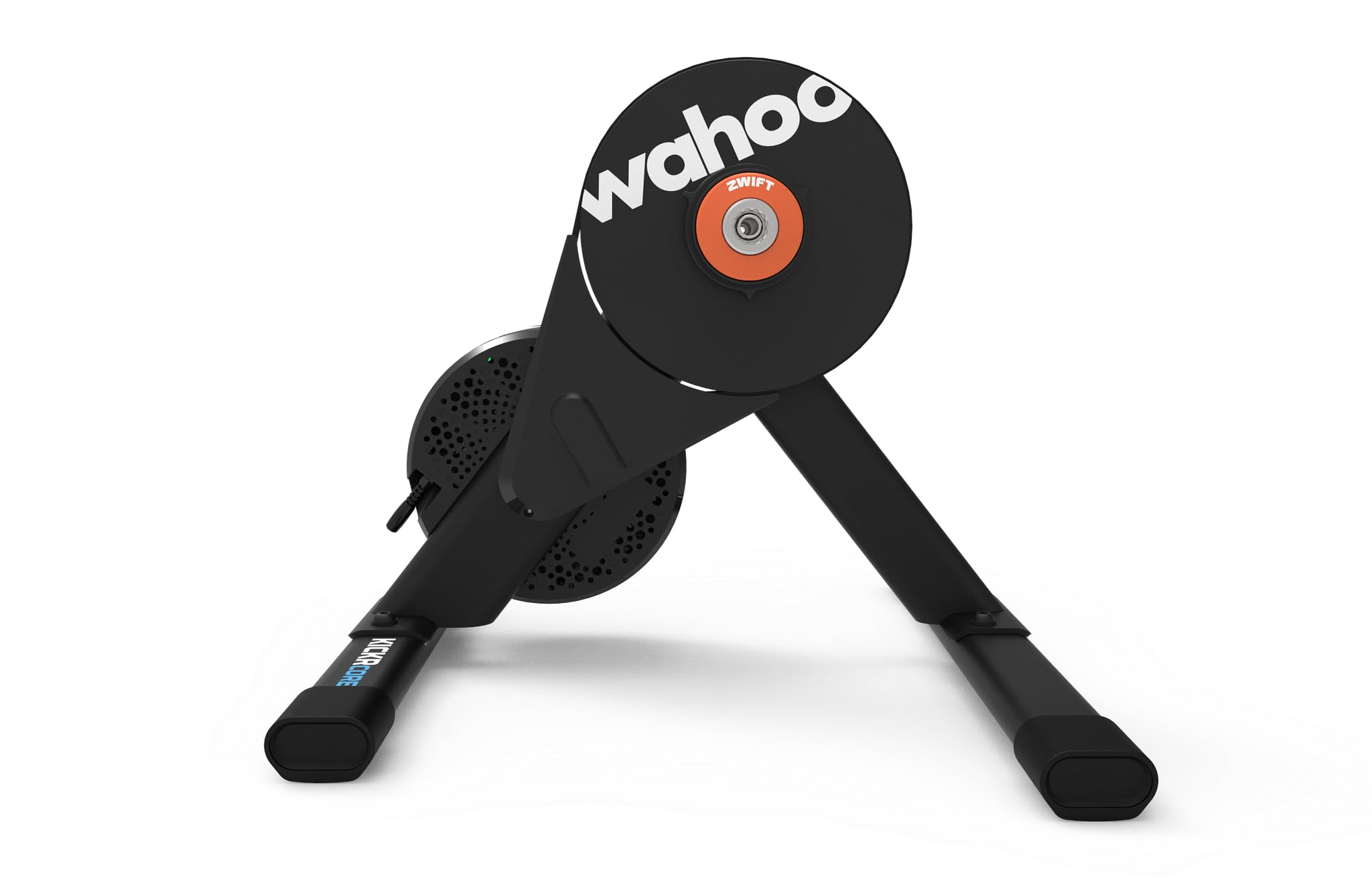
The version that swaps the cassette for a pre-installed Zwift Cog and turns gear changes into Zwift Click button presses.
Here the Zwift Cog is pre-installed and the Zwift Click shifter takes over gear changes, so you shift with your fingers instead of the drivetrain. For a Zwift-first rider that is the smoothest possible on-ramp: no cassette compatibility puzzle, no derailleur tuning, just pair and ride. Built-in Wi-Fi handles faster pairing and automatic updates, and the same 1800-watt ceiling and road-like resistance carry over from the standard CORE.
Compatibility earns the top mention in owner feedback, and setup ease sits right behind it — this is a trainer buyers describe as easy to get running and easy to live with. It fits 8 to 13 speed bikes, and the included accessories cover QR adapters for 130mm and 135mm, plus 12×142 and 12×148 thru-axle adapters. At 13.6 kg it stays manageable to shift around a room.
The trade-off is connectivity consistency: the Wi-Fi link is praised by some riders and reported as prone to frequent disconnections by others, which is a real thing to plan for if you race in Zwift events. Value also draws mixed feelings from buyers who wished they had committed sooner. Neither flaw is a hardware failure — the ride itself is well-regarded — but a runner-up claiming stable Wi-Fi from the start is worth cross-shopping if a dropped pairing mid-race would ruin your session.
The case for Zwift Cog: virtual shifting via the Click remote removes drivetrain noise and the cassette-compatibility question entirely, and the pre-installed Cog means the trainer is ready before you are.
Watch the wireless: Wi-Fi pairing is the point of contention, so keep an Ethernet-style fallback or a Bluetooth pairing ready if stability matters on race day.
Best for: dedicated Zwift riders who want shifting on the bars and no mechanical drivetrain in their pain cave.
Look elsewhere if: you split time between Zwift and other apps that expect a physical cassette and derailleur.
5. Elite Direto XR-T Smart Trainer
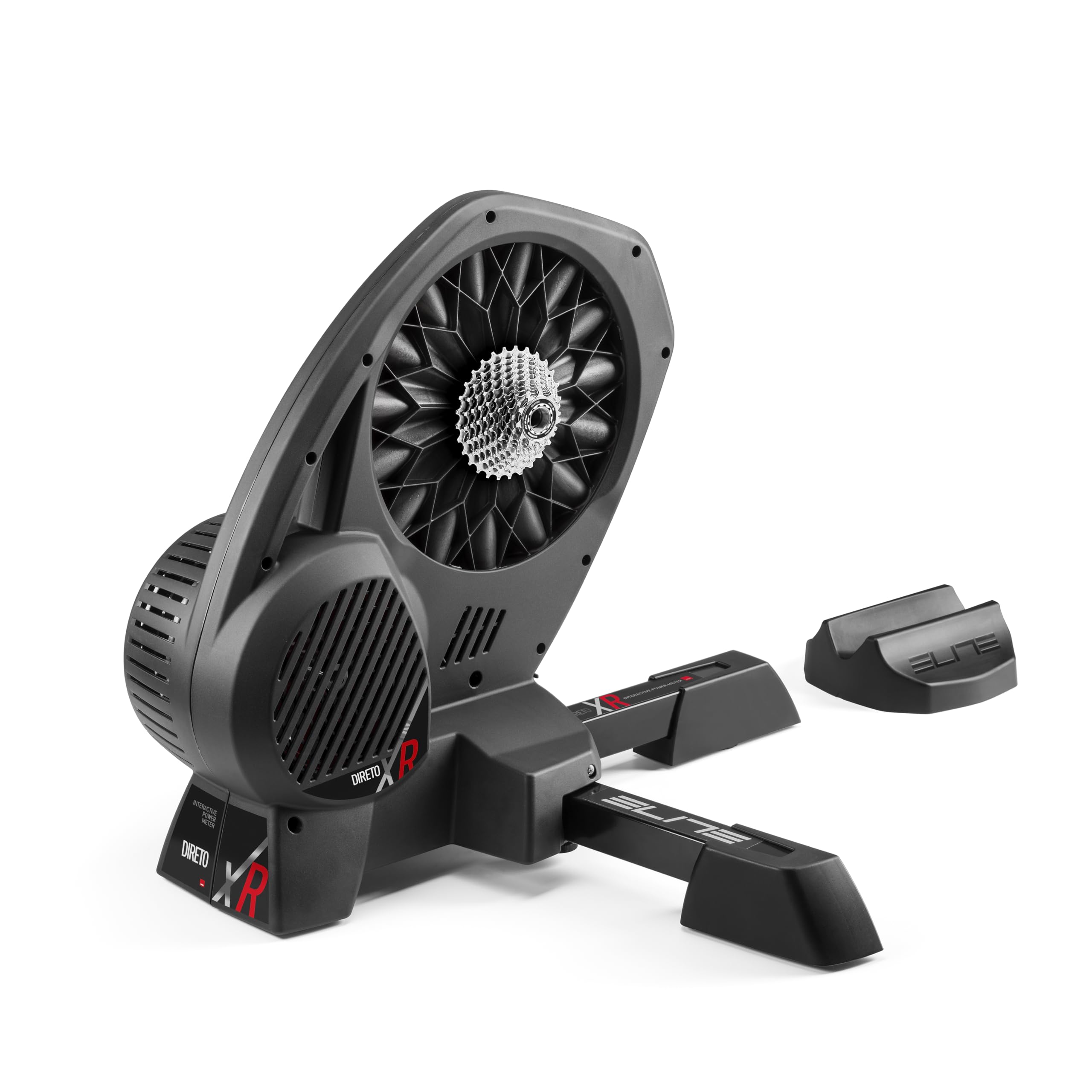
A 24% slope ceiling, the steepest in this lineup, that makes most virtual climbs feel gentle in comparison.
Elite fits an OTS optical torque sensor power meter into the Direto XR-T and quotes ±1.5% accuracy — a tighter figure than the ±2% on the Wahoo CORE pair. That sensor measures your actual output rather than estimating it, and the result is a hyperrealistic slope simulation that tops out at a 24% gradient, the steepest in this lineup. It automatically varies resistance as the route tilts, so the climb comes to you.
The XR-T is the sprocket-box-free version of the Direto XR — same trainer, same electronics, no cassette included. That is worth understanding before you buy, since you will need to source and fit a cassette yourself. It is compatible with the most varied range of bike models, and the flywheel is larger than previous direct-drive Elite units, which feeds the full-circle pedaling feel the brand makes a point of.
At 16.3 kg and 25.59″L x 21.65″W x 11.81″H it moves around without much trouble, sitting clearer of the floor than taller direct-drive frames. The genuine caveat is the cassette and setup work landing on your shoulders. If you already have a spare cassette and a chain whip, the steepest-grade simulation here makes this an easy favorite; if you want zero wrenching, the pre-fitted KICKR CORE 2 is the friendlier route.
what separates it
- 24% slope simulation leads the whole lineup
- ±1.5% power accuracy from an integrated OTS optical torque sensor
- Flywheel is larger than earlier Elite direct-drive models
What you take on
- No cassette included — you supply and fit your own
Choose it if: steep Zwift climbing and honest wattage are what you chase, and you can do your own cassette swap.
The snag: expect to buy and install a cassette before your first ride.
6. ThinkRider X2Max Smart Bike Trainer

An 18% slope, 2000W of resistance and ANT+/BLE dual-protocol pairing for a fraction of the flagship spend.
If you want realistic Zwift climbing on a tight budget, the X2Max is the clear budget champion of this list. It simulates an 18% tilt and pushes up to 2000W through a DEPT dynamic electromagnetic torque power meter, with power meter error of ±2%. It speaks both BLE and ANT+ dual-mode protocols, so it pairs with Zwift and other mainstream cycling software without fuss.
Quietness is a genuine headline: when running at 30km/H the noise level sits at about 58dB, roughly a conversation’s volume. The I-beam triangular structure is there for balance and stability while riding, and the iron frame gives the whole thing a planted feel. Quality is what earns the steadiest praise in owner feedback, with value for money a strong second — and that pairing is exactly what makes a budget trainer worth owning.
Two things are worth knowing. First, the cassette is not included, so budget for one alongside the trainer. Second, connectivity and resistance performance draw mixed feedback—Bluetooth performance is smooth for some and resistance response is inconsistent for others. It is a strong first trainer rather than a settled one. Setting it next to the Garmin 2T shows the gap: the X2Max sits at 35.2 pounds versus 47.4 pounds, and 17.7″L x 19.2″W x 21.6″H versus 27″L x 19″W x 10″H, so it is far easier to move while giving up some floor presence.
Where the value shows
- 18% slope simulation and 2000W output at entry-level spend
- About 58dB at 30km/H — genuinely apartment-friendly
- BLE and ANT+ dual-mode pairing with Zwift and other software
- 35.2 pounds is far easier to reposition than the heavier flagships
Where to expect compromise
- Cassette not included, so add one to the cost
- Connectivity and resistance response split opinion among owners
Great fit for: a first Zwift trainer where realistic climbing matters more than polished electronics.
Hold off if: you need a factory-fit cassette and rock-solid resistance changes on day one.
7. CYCPLUS Smart Bike Trainer R200
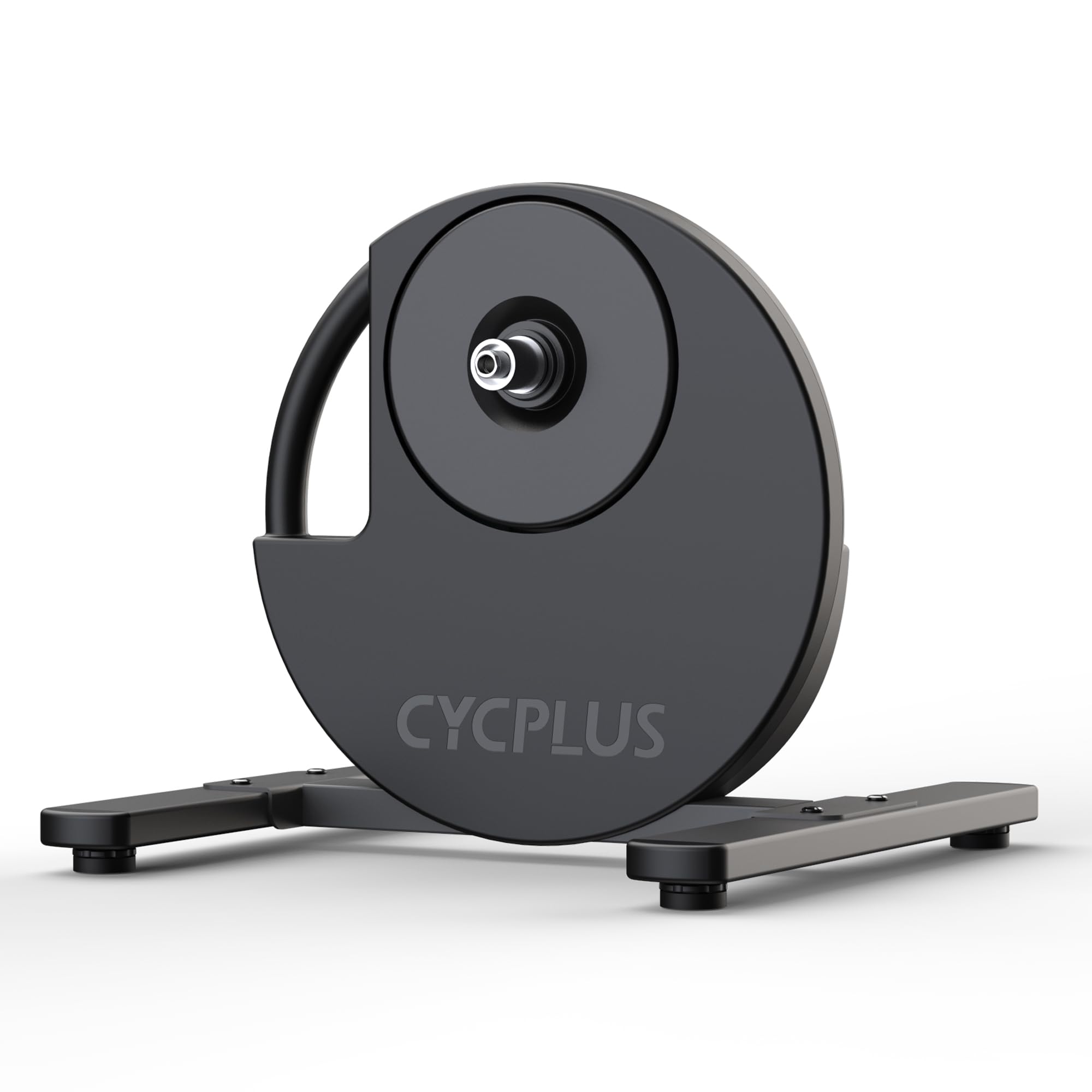
An 80 N·m brushless motor, 2200W peak and self-powered riding in one mid-range package.
The R200 leads with a brushless motor rated at 80 N·m max torque and 2200W peak power, which is the engine that lets it hold high resistance without the drone of a geared drive. Power accuracy is quoted at ±1% — the tightest figure outside the Elite here — so your Zwift zones stay close to real. It simulates a 19% incline and syncs automatically with riding software to match real-world terrain gradients.
One standout feature is that it runs both self-powered and plug-in, meaning you can ride without an outlet on days you want to. A built-in cooling fan with an tune airflow path keeps the unit exchanging hot and cold air so it holds performance on long sessions. Dual-mode BLE and ANT+ gives you Zwift and MyWhoosh connectivity, and a CYCPLUS app adds customizable training programs. Quality earns the steadiest praise from owners.
Two honest points. The virtual shifting needs the CYCPLUS BC2 Shifter, sold separately, and it is not compatible with ERG mode — so if structured intervals are your routine, weigh that carefully. Reliability also splits opinion: some units run flawlessly while others shut off unexpectedly. A mixed smoothness report on resistance changes echoes that. With a 2 Year Manufacturer warranty behind it and a generous spec sheet, it is a compelling mid-range pick for free-riding and course simulation rather than pure ERG work.
Standout spec: ±1% power accuracy plus 2200W peak from the brushless motor and 19% gradient put serious hardware into a mid-range frame, and the self-powered option is a genuine convenience most rivals skip.
Plan around this: ERG mode is off the table and virtual shifting needs an extra shifter, so interval-focused riders should map out the workflow before committing.
Picks up where others leave off: free-riders chasing accurate power and steep gradients who like the option of riding unplugged.
Not the one for: riders whose training block is built around ERG-mode intervals or who need the shifter bundled in.
8. Tacx Flux S Smart Bike Trainer

The steady base-mileager that gets you through the off-season indoors.
Not every rider needs a 24% virtual climb. The Flux S simulates inclines up to a 10% gradient with a max sprint resistance of 1500 watts and measures power within 3% accuracy—enough to keep fitness ticking over, and plenty for a rider whose off-season is about holding form rather than racing. It works with popular third-party training apps such as Zwift and Tacx, and the sturdy design lets you ride full-out and stand on the pedals without it walking away.
Functionality is the spec that earns the most owner approval, and value for money ranks right behind it — a pair that tells you this trainer does the basics reliably for its tier. Setup is straightforward, and ride quality and training performance both draw positive notes. The next-to-silent direct-drive build is the point, helping you ride without disturbing the rest of the house.
The genuine limitation is the 10% ceiling: on steep Zwift routes you will feel the trainer run out of slope before the road does. Noise, too, draws mixed reports — very quiet for some, a rattle for others — so check yours carefully in the first week. At 50 pounds and 22.99″L x 19.49″W x 9.99″H it wants a fixed spot. For fitness maintenance and gentle base work, it covers everything you need; for race simulation, look up the list to the high-gradient picks.
Suits you if: your indoor goal is staying fit over winter, not chasing virtual podiums on steep ramps.
Know before you buy: 10% is the ceiling, so the steepest Zwift climbs will feel clipped.
9. Garmin TacX NEO 3M Smart Trainer

The one that rocks under you, with motion plates built straight into the frame.
Built-in integrated motion plates are the whole story here: they add a side-to-side, realistic movement that a fixed-frame trainer cannot reproduce, and you can toggle them on or off. The Tacx virtual flywheel simulates different road surfaces — cobblestone and gravel among them — when paired with the Tacx Training app or another popular training app. A 25% gradient simulation and descent simulation ask your legs to handle the toughest climbs and then let gravity do its work on the way down.
Power accuracy is quoted within 1% across a broad range of power outputs, backed by reliable power, speed and cadence readings. The well-balanced design holds stability up to 2200 watts even in explosive sprints, and a built-in LED indicator shows how hard you are pushing through a range of colours. It arrives with a pre-installed 11-speed cassette and needs no calibration, so the first ride comes quickly. A Tacx smart network adapter adds an Ethernet or Wi-Fi connection for stable pairing when multiple trainers share a room.
The clear caveat is heft and floor space: 52 pounds and 23.4″L x 24.8″W x 31.5″H is the biggest footprint on this list, and it wants a permanent pain cave rather than a closet. It also sits at a premium tier, so if you do not value the motion plates the price-to-realism ratio is harder to justify than on the Neo 2T. For a rider who wants the closest thing to road noise under tires, the movement and surface simulation justify the extra presence.
What impresses
- Integrated motion plates add realistic movement, toggleable on or off
- Virtual flywheel simulates cobblestone and gravel surfaces
- 25% gradient and descent simulation with ±1% power accuracy
- Pre-installed 11-speed cassette, no calibration needed, Wi-Fi or Ethernet option
What to weigh first
- 52 pounds and the largest footprint here — it wants a fixed spot
- Premium-tier spend, so the motion plates must matter to you
For: riders who want surface and movement realism and will dedicate a permanent space to it.
Forget it if: you fold your setup away or balk at a 52-pound unit.
Know the Specs
Gradient Simulation (percent)
This is how steep a virtual climb the trainer can resist against. A unit simulating 24% can push back hard on the sharpest ramps; one capped at 10% runs out of resistance on the same route. If you race on hilly Zwift courses, this number shapes the feel more than raw watts. On flat, structured intervals it barely matters.
Peak Watts (load capacity)
The sprint ceiling the trainer can hold without giving way — 1500 watts covers most riders, while 2000 to 2200 watts leaves headroom for hard out-of-saddle efforts. Bigger is not automatically better; the smoothness of resistance changes and the road feel do more for the ride than a higher number.
Power Accuracy (±percentage)
How close the trainer’s power reading sits to a real power meter. A ±1% figure keeps your training zones honest; a ±3% figure is fine for base fitness but less precise for watt-chasing. Tighter is better if you swap regularly between indoor and outdoor rides.
ANT+ and Bluetooth Dual Mode
These are the wireless protocols that let the trainer talk to Zwift, TrainerRoad or a head unit. Dual-mode means both are available at once, so more than one device can pair. A Bluetooth-only unit limits your options — check both are named before you buy.
Common Questions
Will every trainer here connect to Zwift?
What gradient simulation do I need for Zwift racing?
Do these trainers include a cassette?
How quiet is a direct-drive trainer in an apartment?
Is a ±1% power accuracy worth paying for over a ±2% or ±3% figure?
Can I use a trainer with ERG mode and virtual shifting at the same time?
Will a trainer fit both a thru-axle and a quick-release bike?
How much floor space does a smart trainer take up?
Do I need a plug socket, or can a trainer run self-powered?
Is a heavier trainer more stable during sprints?
The Bottom Line
For most riders, the zwift smart trainer worth buying is the Garmin TacX Neo 2T — it pairs 2200 watts of load capacity with one of the quietest magnetic builds in the lineup. If you would rather skip the cassette sourcing and start riding fast, the Wahoo KICKR CORE 2 11-speed ships with one pre-fitted. And if steep virtual climbing is your thing, the Elite Direto XR-T simulates up to 24% with ±1.5% power accuracy.
Zwift compatibility runs through all nine, so the tiebreaker is your own floor and schedule: match gradient ceiling to the routes you race, weight to how often you move the unit, and noise to who lives below you.
How we choose
We do not accept paid placement. Every pick is matched to a real buyer and a real use-case; we do not hands-on test units.
Sources
Specifications: manufacturer listings and product documentation. Review insights: verified customer reviews, as of November 2026. Pricing: not shown on this page (it changes often); check the current price via the retailer link.
As an Amazon Associate, Tactical Gear Guy earns from qualifying purchases. This does not affect which products we feature.