Specs are compiled from manufacturer listings and verified buyer reviews and can change over time — please confirm the key details on the product page before buying.
If your zucchini noodles keep turning out limp, watery, or uneven, the fix is usually the tool and not your technique. A spiralizer that wobbles on the counter, uses a dull blade, or leaves you chasing loose blades in a drawer turns a five-minute job into a ten-minute mess. This guide sorts the countertop crankers, handheld twisters, and folding models by what actually matters: blade variety, suction grip, easy cleaning, and whether the thing fits in your kitchen at all.
This guide is built by comparing the manufacturers’ published specifications and the patterns across verified customer reviews, so you get each pick’s real strengths and trade-offs instead of marketing spin.
You do not need every blade ever stamped from steel. You need the right number for the noodles you actually eat, a base that stays put, and a body that cleans up without a fight. Here is the honest breakdown of every zucchini noodle maker worth putting on your counter.
Top Picks


How To Choose The Best Zucchini Noodle Maker
The right spiralizer for you depends on three things: how much zucchini you spiralize in a week, whether you have counter space you can spare, and how much cleanup you are willing to do. Everything else is detail. Get those three right and the blade count sorts itself out.
Countertop crank or handheld twist
A countertop model uses suction feet and a crank arm to push vegetables through the blade, so it handles dense produce like sweet potato and butternut squash with less hand fatigue. A handheld model is a small cylinder you twist the vegetable through by hand. It packs into a drawer in seconds but struggles once the vegetable gets short. A handheld is often enough for a single zucchini at dinner; a countertop unit is what you want for batch meal prep. Note the physical size difference: the Brieftons 10-Blade Countertop measures 11.8″L x 8.3″W x 6″H while the Veggetti handheld measures 2.76″L x 2.76″W x 6.32″H — a 4.3x gap in overall footprint.
Blade count and noodle widths
More blades means more shapes, not necessarily better noodles. A 10-blade model gives you angel hair through lasagne-width sheets plus curly fries and crinkle chips. A 3-blade or 5-blade unit covers the common widths most people actually eat: thin spaghetti, medium fettuccine, and a flat ribbon. If you only ever make zoodles for one pasta dish, three blades is plenty. If you want to batch-prep sweet potato ribbons and beet spirals alongside zucchini noodles, extra blades pay off.
Suction strength and surface fit
Suction pads only grab flat, hard, non-porous surfaces: granite, marble, smooth tile, glass. They do not hold on wood butcher block, textured stone, or a silicone mat. Before you buy a countertop unit, look at your own counter and decide whether the feet will have something solid to bite. A lever-style suction pad that turns to lock is generally firmer than a plain push-down cup, especially once you start pushing a raw beet through a blade.
Cleaning and blade storage
Blades are the part that fights back at the sink. Look for labeled blades you can identify without guessing, a storage caddy or built-in compartment so nothing floats loose in a drawer, and a body that either disassembles fully or is dishwasher safe on the top rack. A spiralizer you dread cleaning is a spiralizer that stays in the cupboard.
Side-by-Side Comparison
| Model | Best For | Blades | Style | Weight | Amazon |
|---|---|---|---|---|---|
| Brieftons 10-Blade Countertop★ Best Overall | Batch meal prep and every noodle shape | 10 | Countertop crank | 3.5 pounds | Amazon |
| Spiralizer 7-Blade Vegetable SlicerTop Performer | Hard root vegetables like sweet potato | 7 | Countertop crank | 0.9 kg | Amazon |
| Brieftons 5-Blade CountertopCompact Pick | Small kitchens and weeknight zoodles | 5 | Countertop crank | 2.1 pounds | Amazon |
| SUSTEAS Vegetable Spiralizer | Garden harvest and large batches | 5 | Countertop crank | — | Amazon |
| Starfrit Pro Foldable | Drawer storage with minimal space | 3 | Foldable crank | 1.8 pounds | Amazon |
| Vegetable Spiralizer 4-in-1 Rotating Blade | Hands-free blade switching | 4 | Vertical rotary | 0.71 kg | Amazon |
| OXO Good Grips Handheld | Single servings and small drawers | 1 | Handheld | 4.32 ounces | Amazon |
| Veggetti Veggie Slicer | Cheap intro to zoodles | 2 | Handheld | 3.68 ounces | Amazon |
| Joseph Joseph Spiro Hand Held | Grating plus spiraling in one | 3 | Handheld with container | 0.21 kg | Amazon |
Detailed Reviews
1. Brieftons 10-Blade Vegetable Spiralizer
Our pick — 4.5+★ from 11,500+ verified ratings; the strongest balance of quality and price.
Ten labeled blades and a catch container that goes straight to the fridge — this is batch-prep in one session.
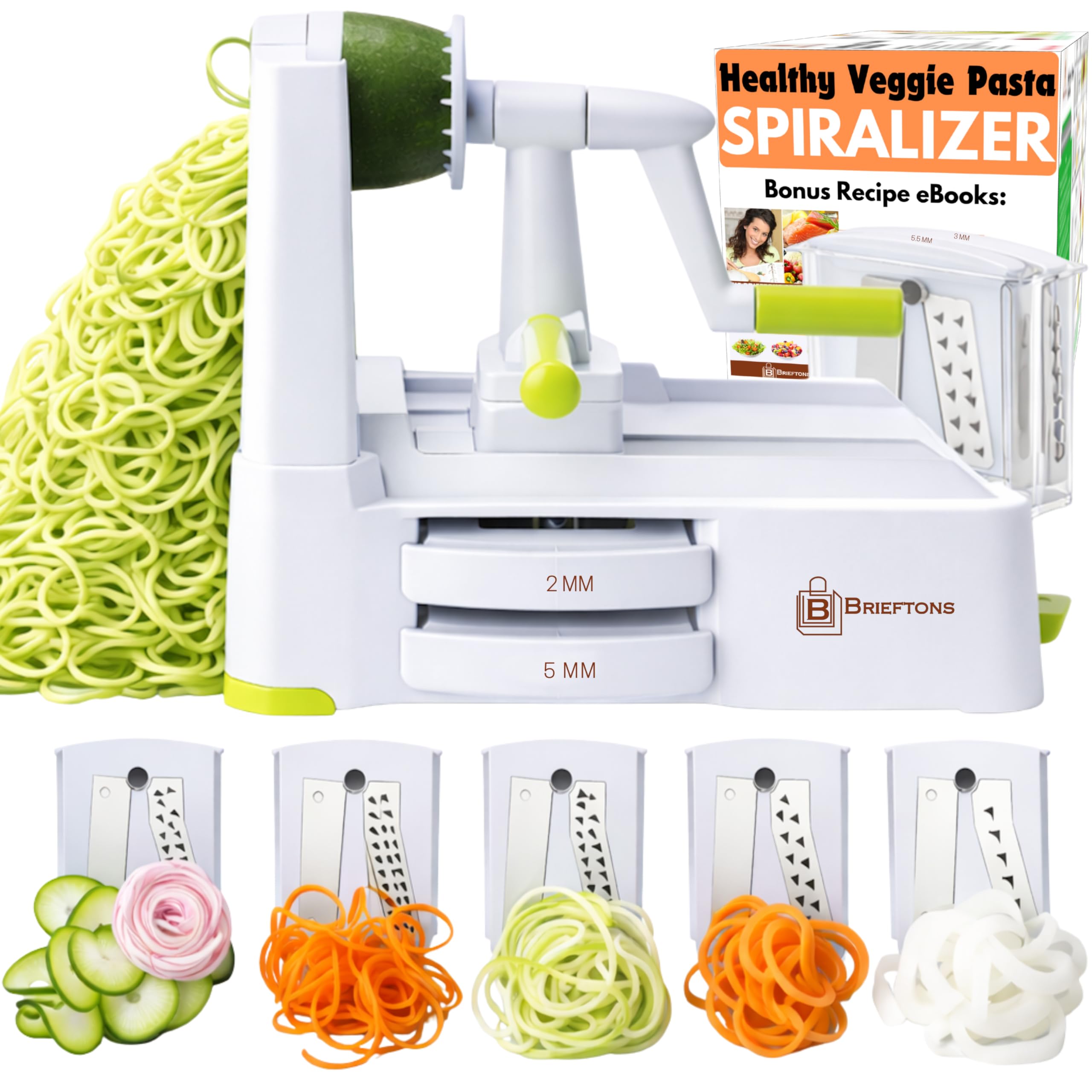
You get ten noodle shapes from one unit, and that is why this earns the top slot. The ten blades cut angel hair, spaghetti, tagliatelle, linguine, pappardelle, ribbons, curly fries, fine ridged pasta, crinkle chips, and lasagne-width flat cuts. Each blade is 420-grade hardened Japanese stainless steel (a hard, rust-proof steel grade) and labeled, so you grab the right shape without squinting. That blade spread is wider than any other spiralizer here.
The catch container is the quieter win. Noodles drop into the included tub as you crank instead of scattering across the counter, then the keep-fresh lid snaps on and the whole thing goes into the fridge. Sunday batch prep for the week takes one session, one tub, and no extra bowls. Storage is handled too: one blade sits pre-installed, two live in a built-in compartment, and seven ride in the blade caddy, so nothing sharp floats loose in a drawer.
The oversized suction pad locks onto granite, marble, tile, and glass with a counter-clockwise turn, and the side handle gives you real leverage for dense produce. Sweet potato, butternut squash, and raw beets come out in clean spirals instead of stalling the blade. It handles produce up to 10 inches long and 7 inches wide, so a fat garden zucchini fits fine. At 3.5 pounds and 11.8″L x 8.3″W x 6″H it is a genuine countertop tool, not a drawer gadget — worth clearing space for if you spiralize more than once a week.
Reviewers single out the smooth crank and the clean blade cuts that leave soft zucchini intact instead of mushing it. Cleaning comes a close second; the parts come apart and rinse without a scrubbing session. The honest catch is that ten blades means ten things to wash and store, so owners who only ever make spaghetti-width zoodles are paying for shapes they will not use. It is also the heaviest pick on this list at 3.5 pounds.
What it gets right
- Ten labeled 420-grade Japanese stainless steel blades — the widest shape range here
- Catch container with keep-fresh lid means noodles go straight to the fridge
- All ten blades store inside the unit — no loose blades in the drawer
- Oversized suction pad plus side handle powers through sweet potato and beets
- BPA-free ABS body with a safety-locking blade rack and platform slide stop
What to weigh first
- 3.5 pounds and 11.8″L x 8.3″W x 6″H — it wants real counter or cupboard space
- Ten blades is more washing than a three-blade model needs
Buy it if: you batch-prep zoodles, sweet potato ribbons, and beet spirals and want every shape in one tub-to-fridge session.
Think twice if: you make one pasta dish a week and would rather rinse three blades than ten.
2. Spiralizer 7-Blade Vegetable Slicer
Built for the vegetables that break cheaper spiralizers — sweet potatoes and turnips included.
The Spiralizer 7-Blade is the model most people picture when they hear “spiralizer,” and its reinforced ABS frame backs that reputation up. It runs 420 high-carbon cutlery-grade stainless steel blades in an ultra-reinforced ABS body, and the maker claims the third-generation frame is 30-35% tougher than the others on the market. That reinforcement is aimed squarely at hard root vegetables — the sweet potatoes and turnips that snap handles on lighter units. Seven blades cover the noodle shapes most people cook with.
Reviewers praise the seconds-long assembly and the easy cleanup, and many mention the fun of watching a zucchini turn into pasta. The lifetime no-hassle replacement policy is the kind of backup that matters on a tool with sharp blades you use weekly. It comes with a recipe e-book built around keto, paleo, raw, vegan, and gluten-free meals, so the first cook does not have to invent a dish.
The recurring gripe is durability under hard use — the frame holds up for most people but the odd unit gives way during a heavy spiralizing session, which is why the warranty matters. It sits in the same countertop-crank family as the Brieftons 10-Blade above, but with seven blades instead of ten and a slightly heavier 0.9 kg body. If you spiralize raw beets and butternut squash often, go with either countertop model; if you want a top performer that most kitchens already know, this is it.
The sturdy reputation: reinforced ABS and 420 high-carbon steel are chosen specifically for dense produce, so sweet potato noodles stop being a losing battle.
One thing to plan around: the frame is the part that occasionally gives out on a hard spiral, so take the lifetime replacement seriously and register it.
Reach for this if: hard root vegetables are your main spiralizing job and you want a brand with a backup plan.
Look elsewhere if: you want the widest blade spread — that is the Brieftons 10-Blade, not this.
3. Brieftons 5-Blade Countertop Vegetable Spiralizer
Five blades, a 10.6-inch body, and a suction pad the maker says can lift an 11-pound marble board.
Five labeled Japanese 420-grade blades cover the widths most kitchens use, so pick this Brieftons if the ten-blade version above feels like overkill. The set gives you 2mm angel hair, 3mm spaghetti, 5mm fettuccine, 5.5mm pappardelle, and a flat ribbon slicer. The 5mm and 5.5mm blades are the ones that tackle raw beets and butternut squash. Soft zucchini goes through any of them, so everyday zoodles are no trouble.
The oversized suction pad uses a lever you turn counter-clockwise to lock onto granite, marble, tile, or glass, and Brieftons claims it can lift an 11-pound marble cutting board. The body is BPA-free white ABS plastic and the blades are dishwasher safe on the top rack only — keep them out of high-heat cycles so the steel stays sharp. Blades snap into a safety-locking rack with a platform slide stop, and five blades store safely: one pre-installed, two in a built-in compartment, two in a separate caddy.
Reviewers agree it sets up in seconds and cranks through zucchini without stalling. The size is the real selling point for small kitchens: at 10.6″L x 4.9″W x 7.9″H and 2.1 pounds it tucks away where the ten-blade model needs more room. One limit to know before you buy: it will not work on celery, thin carrots, eggplant, cauliflower florets, or spongy produce, and it wants firm produce at least 1.5 inches wide.
Best for: cooks who want countertop suction grip and dishwasher-safe blades without surrendering half a cupboard.
Watch out for: vegetables under 1.5 inches wide or spongy produce will not spiral cleanly in this unit.
4. SUSTEAS Vegetable Spiralizer, 5 Blades
Every blade is marked in fractions — you always know exactly which noodle you are cutting.
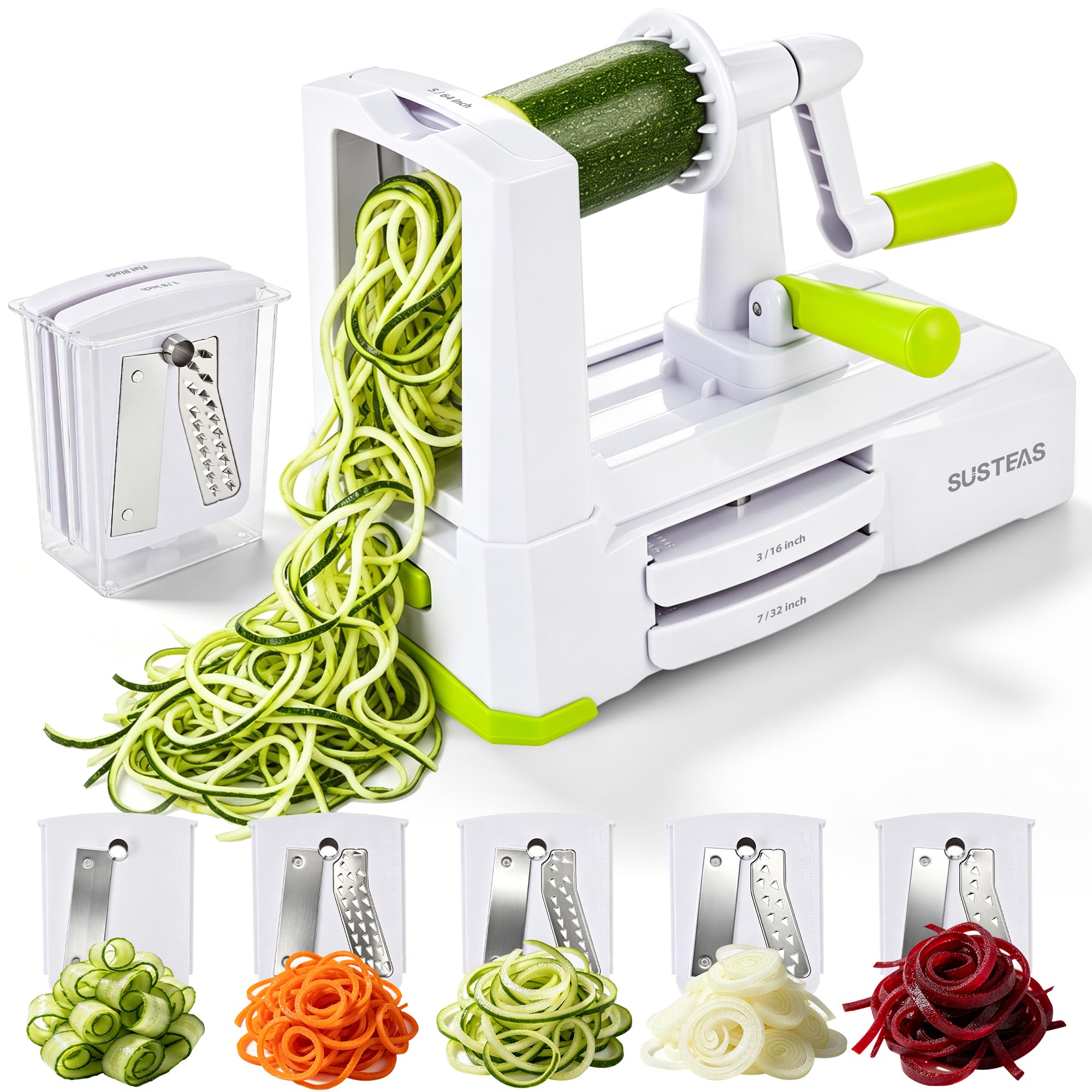
The SUSTEAS does something the others leave vague: it tells you the exact width of every blade. You get 5/64-inch for angel hair, 1/8-inch for spaghetti, 3/16-inch for fettuccine, 7/32-inch for pappardelle, and a flat ribbon slicer for veggie sheets and salads. Each blade is clearly marked so swapping takes seconds, and the steel is food-grade and BPA-free. If you like knowing exactly what you are getting, that precision is a genuine advantage over the generic “thick and thin” labeling on cheaper handheld units.
The suction base is the part built for real work. Turn the switch counter-clockwise and it locks onto granite, marble, smooth tile, or glass, with the maker claiming stronger grip than standard silicone pads. That firm hold matters when you are pushing butternut squash through — the unit stays put instead of skating. Storage is all-in-one: one blade pre-installed, two in compartments inside the body, and two in a blade case that stacks on top of the main unit.
Cleanup needs a plan, though. The blades, handle bar, and blade holder are safe on the top rack of the dishwasher, but the main body is hand-wash only and the maker warns against cycles above 158°F. The body is ABS, TPR, and PS plastic at 5.31″L x 8.27″W x 11.02″H, so it sits upright like a tall box on the counter. The honest caveat: it is one of the pricier picks here and the body cannot go in the dishwasher, so if you want zero hand-washing, the Brieftons 5-Blade is the easier clean.
Worth the counter space
- Five blades with exact inch widths and clear markings
- Suction base locks with a switch and holds during hard-vegetable spiraling
- All-in-one storage keeps every blade attached to the main unit
- Handles zucchini, sweet potato, beets, cucumbers, and onions
The trade-off
- Main body is hand-wash only — top-rack dishwasher applies to blades only
- Tall upright footprint takes more vertical room than a low-profile crank
The pick for: cooks who want to dial in exact noodle widths and store every blade on the unit.
skip it if: hand-washing the main body every session would stop you reaching for it.
5. Starfrit Pro Foldable Spiralizer

It folds shut to take up 50% less space — the spiralizer that actually disappears into a drawer.
The Starfrit solves the problem every countertop spiralizer creates: where does it live when you are not using it. The folding design cuts its stored footprint by 50%, which matters if your drawers are already crowded. Three blades cover the essentials — a slicing blade, a fine spiral blade, and a medium spiral blade — and suction-grip feet hold it steady while you crank. At 1.8 pounds it is light enough to lift one-handed, and the stainless steel blades are dishwasher safe.
The food holder with a pusher guide keeps vegetables firm against the blade, so soft zucchini does not wobble or collapse as you push. That guide is what stops a half-used zucchini from rolling away mid-spiral. The open design at 9.17″L x 4.65″W x 10.83″H handles vegetables up to the size the holder grips, and the fold mechanism makes it the one pick here built around being put away rather than displayed.
Three blades is the trade-off. If you want crinkle chips and lasagne-width sheets, the Brieftons 10-Blade has you covered; if you want a compact tool that does spaghetti and fettuccine width and folds flat, this is the smarter fit. The extra step of folding and unfolding each session becomes routine, but it is one more move than a static crank requires.
The drawer-space answer: 50% less storage footprint, 1.8 pounds, and dishwasher-safe blades make it the easiest pick to live with in a small kitchen.
Where it pauses: three blades means no curly fries or crinkle cuts, and the fold becomes one more step every time.
Made for: cramped kitchens where a full countertop unit would never get pulled out.
Pass if: you want exotic cuts like crinkle chips — you need more blades than three.
6. Vegetable Spiralizer 4-IN-1 Rotating Blade with Suction Cup

You switch blades by turning a wheel — your hands never go near the cutting edge.
This vertical rotary model takes a different approach to the blade-change problem. Instead of pulling a sharp blade out of a rack, you rotate a roller to select a different blade — so your hands stay clear of the edge the whole time. The vertical design lets gravity feed the vegetable downward as you work, which is why the maker says it saves time and effort. You cut vegetables to under 4 inches first, then spiral. Four blades in 420 stainless steel give you four shapes.
A 2-cup container catches noodles underneath, so the counter stays clean. Reviewers praise the build quality first and the low-effort cranking second — the rotating blade selector keeps the work off your wrists. The suction cup base locks the unit down before you start, and the body disassembles fully for washing, though it needs to dry in a well-ventilated spot afterward.
Two limits to know going in. The 4-inch vegetable length limit means a long zucchini needs trimming first, and the vertical upright design is taller than a low horizontal crank. It is also lighter-duty than the heavier countertop models here, so expect it to be gentler on harder root vegetables. For zucchini, cucumber, carrots, and sweet potato in everyday amounts, it handles the job with almost no effort.
Right choice for: anyone who wants blade changes without touching a sharp edge and a catch cup built into the unit.
Not ideal for: extra-long zucchini — you will be trimming everything under 4 inches first.
7. OXO Good Grips Handheld Spiralizer
The four-ounce handheld that stores as a cap and handles a single zucchini better than most.
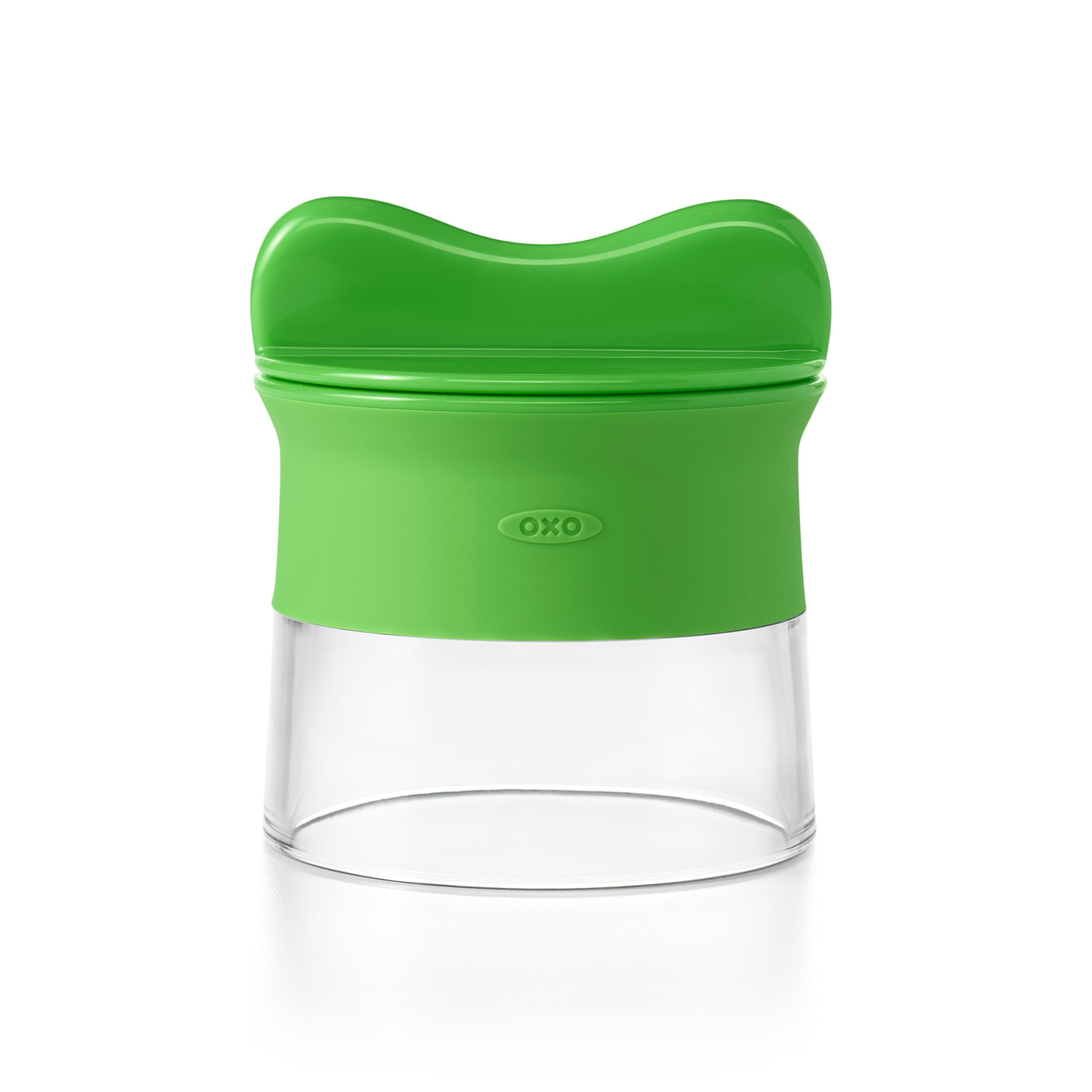
Some nights you want one zucchini’s worth of noodles and nothing else. For that, a handheld is the right tool, and the OXO Good Grips is the polished version. It weighs 4.32 ounces and measures 3.15″L x 3.15″W x 1.5″H, so it lives in a drawer with the utensils. The non-slip grip keeps the body steady in your hand, and the food holder keeps your fingers away from the blade while doubling as the storage cap.
The spirals come out clean on zucchini and potatoes, which is the test that matters — you get proper curly noodles for a frittata, a salad garnish, or a quick low-carb plate. At 3.15″L x 3.15″W x 1.5″H it drops into a utensil drawer instead of claiming counter space. At its price it is a low-risk way to test whether zoodles become a weekly habit before you spend on a countertop crank.
The catch is the single blade. You get one curly-noodle cut, so no fettuccine width, no ribbons, no crinkle cuts — and short vegetables are harder to hold as they shrink toward the blade. It beats the Veggetti on build feel and grip, but it will not match a countertop model for batch volume. As a one-portion tool, though, it does exactly what it should without the cleanup of a full unit.
The grab-and-go case: 4.32 ounces, a non-slip grip, and a food holder that caps the unit for storage — the lowest-friction way to make one serving of zoodles.
What you give up: a single blade shape, and the smaller the vegetable gets the more care it takes to keep it off your knuckles.
Pick this if: you spiralize one vegetable at a time and want zero counter footprint.
Hold off if: you want fettuccine-width noodles or ribbon cuts — one blade cannot deliver those.
8. Veggetti Veggie Slicer, Dual Stainless Steel Blade

The entry ticket to zoodles — a 3.68-ounce handheld with thick and thin on one unit.
This is the cheapest way to find out whether zoodles are for you. The Veggetti is a small handheld at 2.76″L x 2.76″W x 6.32″H and 3.68 ounces, with two separate stainless steel blades — one side cuts thick strands, the other thin. Twist the vegetable and you get carb-free pasta in seconds, no electricity, no counter space. The spiked holder grips the vegetable once it has been sliced short, so the last inch does not leave you guessing.
Zucchini, squash, carrots, and cucumbers all go through it, and it is dishwasher safe. For the money it is the simplest way to test a low-carb swap before investing in a full countertop machine. One thing to understand before you order: slicing performance is genuinely mixed on this one — some units shred zucchini without trouble, while others struggle to cut cleanly through firmer vegetables. That inconsistency is the risk you take at the entry tier, and it is why the countertop models above exist.
If your produce is soft zucchini and you only ever want thin or thick spaghetti, the Veggetti is hard to argue with at its tier. If you want raw beets or sweet potato, step up to a suction-based countertop crank. Treat it as a starter tool rather than a permanent kitchen fixture and it does the entry job well.
Smartest first buy: soft zucchini and cucumbers, thin or thick, on the tightest budget.
Not the right fight for: hard root vegetables — firm produce is where entry-tier blades struggle.
9. Joseph Joseph Spiro Hand Held Vegetable Slicer Spiralizer

It spirals and grates — a handheld that collects the noodles in its own base as you twist.
Joseph Joseph’s Spiro solves one thing most handhelds ignore: where the noodles land. The container base collects food as you cut, so nothing ends up on the counter, and the lid doubles as the food holder. Three attachments come in the box — a coarse spiral blade, a fine spiral blade, and a rotary grating blade — plus a handle. That means you get two noodle widths and grated vegetables from one compact tool, which is more range than the Veggetti or the OXO.
The self-aligning design keeps food straight as you twist the soft-grip handle, and it is dishwasher safe. It weighs 0.21 kg and measures 3.07″L x 3.07″W x 6.3″H, so it stores easily. It is backed by a one-year warranty against manufacturing defects, which is more than most handhelds offer.
Here is the honest part: effectiveness is mixed on this model. Soft vegetables like zucchini and cucumber spiral cleanly, but firmer produce can defeat the blades. Value is also split — some cooks find it worth every bit, others feel the plastic build does not match the price expectation. The grating blade is where it wins against the other handhelds here, so if you want a single drawer tool for zoodles and grated carrot, this is the smarter fit. If you need raw beet noodles, pick a countertop model instead.
Why it earns a spot
- Three attachments: coarse spiral, fine spiral, and rotary grating
- Container base catches noodles as you cut
- Self-aligning design and soft-grip handle keep the twist steady
- Dishwasher safe, with a one-year manufacturing warranty
Read before buying
- Firmer vegetables can defeat the blades — soft produce is the balance
- Plastic build draws split opinions on value
The one to grab for: zucchini, cucumber, and grated carrot from one compact drawer tool.
Look past it for: sweet potato or beet noodles — firm produce is where the Spiro stalls.
Know the Specs
Blade count and blade width
Blade count is a range spec: more blades means more shapes you can cut. Look at the actual widths if you can, because millimeters decide which pasta a noodle can stand in for. A 2mm blade makes angel hair, 3mm makes spaghetti, and 5mm or wider makes fettuccine and ribbons. Each blade in the Brieftons units is labeled, which saves you hunting for the right size mid-recipe.
Suction base versus handheld grip
A suction pad only bites on flat, hard, non-porous surfaces like granite, marble, smooth tile, or glass. Wood, textured stone, and silicone mats defeat it. Lever-style suction pads that turn to lock are firmer than push-down cups, and the horizontal countertop units also add a side handle for extra push on dense produce. A handheld model relies on your grip instead, so it works on any surface but asks more of your wrist.
Cleaning and blade storage
Blades are the demanding part. Check whether the blades are dishwasher safe on the top rack, whether the body can go in with them, and whether the unit has a caddy or built-in compartment for storage. A loose blade in a drawer is a hazard and a hassle. Models that store all blades inside the unit (like the 10-blade Brieftons and the SUSTEAS) keep everything accounted for and cut the clutter.
Produce size limits
Some countertop models handle produce up to 10 inches long and 7 inches wide, but others cap vegetables at under 4 inches and need trimming first. Handheld models struggle once the vegetable gets short and you are pushing toward the blade. Note the maker’s stated limits before buying, and skip units with narrow limits if you spiralize long garden zucchini.
Common Questions
Will a suction-base spiralizer stick to my kitchen counter?
Is a handheld or countertop zucchini noodle maker better?
How many blades do I actually need for zucchini noodles?
Can I spiralize sweet potato and raw beets in a handheld spiralizer?
Are the blades dishwasher safe?
How wide does a vegetable need to be to spiralize?
Do zucchini noodles really replace pasta on a low-carb diet?
How much counter space does a spiralizer need?
What produce should I avoid putting through a spiralizer?
How do I store the blades safely?
The Bottom Line
For most kitchens, the zucchini noodle maker worth buying is the Brieftons 10-Blade Countertop Spiralizer. It covers every noodle shape you could want, catches the noodles in its own tub, and stores all ten blades inside the unit, so you get no loose parts and no counter mess. If hard root vegetables are your main concern, the Spiralizer 7-Blade builds its frame around sweet potatoes and turnips. And if drawer space is the deciding vote, the Starfrit Pro Foldable Spiralizer folds to half its size and slips into a small kitchen.
How we choose
We do not accept paid placement. Every pick is matched to a real buyer and a real use-case; we do not hands-on test units.
Sources
Specifications: manufacturer listings and product documentation. Review insights: verified customer reviews. Pricing: not shown on this page (it changes often); check the current price via the retailer link.
As an Amazon Associate, Tactical Gear Guy earns from qualifying purchases. This does not affect which products we feature.