Specs are compiled from manufacturer listings and verified buyer reviews and can change over time — please confirm the key details on the product page before buying.
You want one camera that handles a wide street scene and a bird on a far branch without swapping lenses. Buy on optical zoom and stabilization first — those two decide whether your long shots come out sharp or smeared. This guide covers eleven compact zoom cameras, explains what each one is actually good at, and tells you plainly which one fits your shooting.
This guide is built by comparing the manufacturers’ published specifications and the patterns across verified customer reviews, so you get each pick’s real strengths and trade-offs instead of marketing spin.
Every pick below has a real optical zoom lens (a glass lens that physically moves to magnify, not a software crop), so far-away subjects keep their detail. These eleven picks cover the range of a zoom point and shoot camera without drowning you in specs.
Top Picks

How To Choose The Best Zoom Point and Shoot Camera
Most first-time buyers shop by megapixels alone, which is the wrong spec to start with on a zoom compact. On a compact zoom camera, the number that changes your results most is the zoom range and how well the camera steadies it — not the pixel count.
Start with the zoom range you actually need
A 5x optical zoom (a lens that magnifies up to five times) handles vacations, group shots, and street scenes. A 30x to 60x lens reaches across a stadium or up into a tree. A 125x superzoom goes all the way to distant wildlife, but it is a bigger, heavier camera to carry.
Check for optical stabilization
Optical image stabilization (a moving lens element that counteracts your hand shake) keeps long shots sharp without a tripod. It matters more as the zoom gets longer — at 60x a small tremor becomes a big blur.
Look at aperture for low light
Aperture is the lens opening, written as an f-number. A lower number like f/1.8 or f/2.0 lets in more light for dim rooms and evening shots. A higher number like f/5.6 needs more light or a steadier hand.
Decide if you need a viewfinder
An OLED viewfinder (a tiny screen you look into) helps you frame in bright sun when the rear screen washes out. Many pocket zooms skip it to stay small, so weigh that trade-off against how much you shoot outdoors.
Side-by-Side Comparison
| Model | Best For | Optical Zoom | Resolution | Screen | Amazon |
|---|---|---|---|---|---|
| KODAK PIXPRO FZ55 Bundle★ Best Overall | Budget travelers | 5x | 16 MP | 2.7″ | Amazon |
| 4K Digital Camera 24X Optical ZoomBest for Vlogging | Vloggers and beginners | 24x | 88 MP | 3″ flip | Amazon |
| Minolta MNB10ZHighest Resolution | High-resolution stills | 10x | 64 MP | Flip LCD | Amazon |
| KODAK PIXPRO AZ528 | Wildlife on a budget | 52x | 16 MP | 3″ | Amazon |
| Panasonic LUMIX FZ80D | All-in-one reach | 60x | — | 3.0″ touch | Amazon |
| OM SYSTEM Tough TG-7 | Rugged and underwater | 4x | 12 MP | — | Amazon |
| Panasonic LUMIX TZ/ZS99 | Pocket travel zoom | 30x | — | 1,840k tilt | Amazon |
| LUMIX ZS99 (Silver) | Daily pocket carry | 30x | — | 1,840k tilt | Amazon |
| Nikon COOLPIX P1100 | Extreme superzoom | 125x | 16 MP | Rotating LCD | Amazon |
| Sony RX100 VII | Fast autofocus | 24-200mm | 20.1 MP | — | Amazon |
| Canon PowerShot G7 X Mark III | Low-light stills | 4.2x | — | — | Amazon |
Detailed Reviews
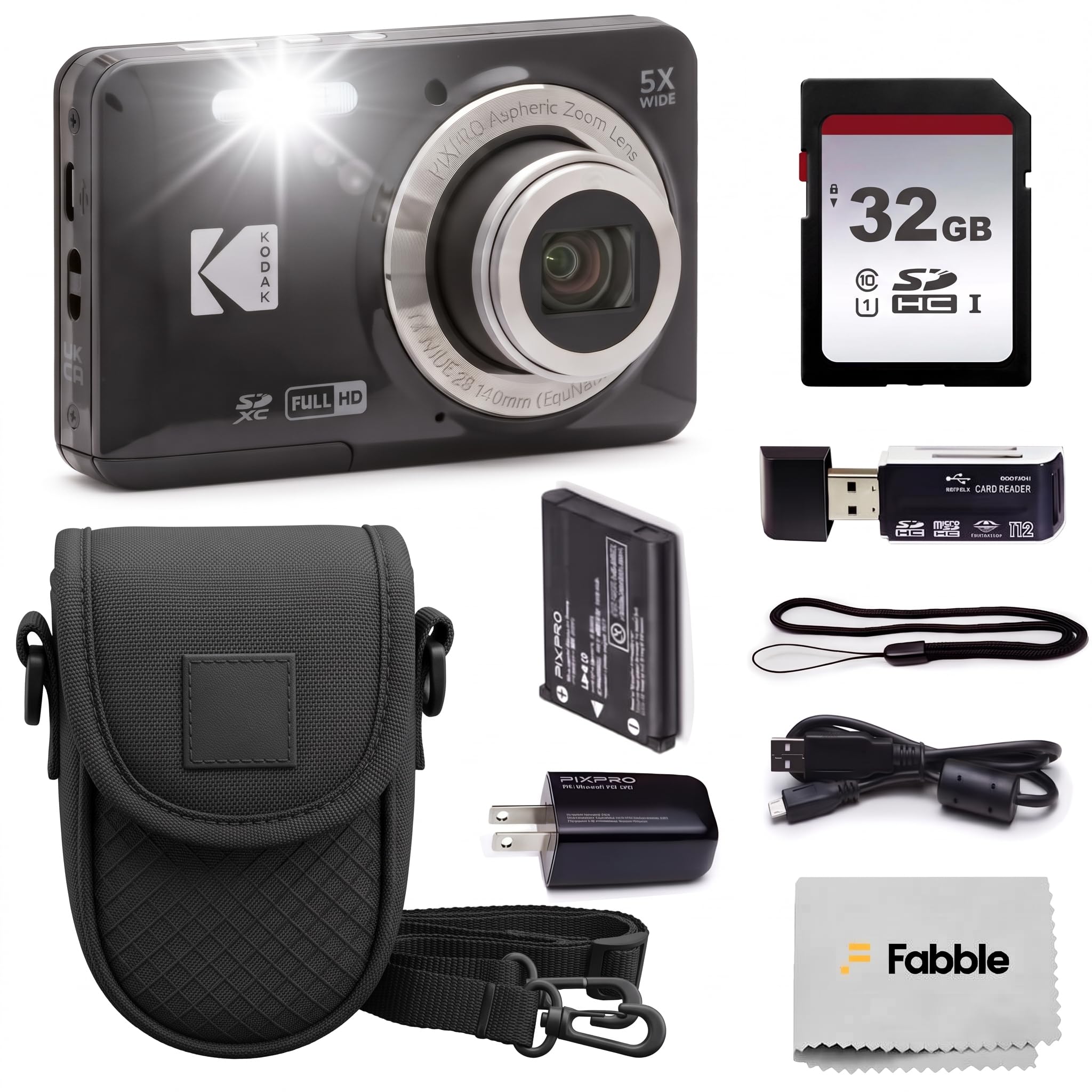
1. KODAK PIXPRO FZ55 Compact Zoom Digital Camera
Our pick — 4.5+★ from 350+ verified ratings; the strongest balance of quality and price.
The pocket zoom that quietly nails the basics and keeps your bag light on every trip.
What wins people over here is value: a 16MP sensor and 5x zoom for well under what a premium compact costs. This is a camera that does the everyday job — vacations, family gatherings, a day out — without asking you to learn a menu system. The 16MP sensor (megapixels: the more there are, the more detail it can record) gives you crisp shots you can crop into and still print.
You can back up for the group shot and then punch in for a close-up, thanks to the 5x optical zoom paired with a 28mm wide-angle lens (a lens wide enough to fit a whole room or landscape in frame). Video records at 1080P Full HD, which is plenty sharp for sharing on a phone. And the 2.7″ LCD screen (the rear display you compose and review on) keeps the body small enough to slide into a jacket pocket.
The honest catch is reach: 5x will not pull in distant wildlife or far stage detail. At 5x this is a travel and street camera, not a wildlife tool — the Panasonic LUMIX FZ80D reaches 60x, a far longer throw than the 5X here. For most casual buyers that gap never matters, which is why this sits at the top.
What makes it a safe buy
- Real zoom, small body: 5x optical zoom and a 28mm wide end cover both landscapes and close-ups.
- Easy to pick up: point-and-shoot operation with a straightforward recording button.
- Fits a pocket: a 2.7″ screen keeps the footprint travel-friendly.
- Video that travels: 1080P Full HD clips are ready to share straight from the card.
Where it asks you to compromise
- Short reach: 5x optical zoom will not pull in distant wildlife or far stage detail.
- Small screen: the 2.7″ LCD is the compact trade-off for a pocketable body.
- Not a low-light specialist: it shines in good daylight, so plan around dim scenes.
Reach for this if: you want one small, affordable camera for trips, birthdays, and everyday snaps.
Look elsewhere if: your main goal is zooming far down a field or across a stadium.
2. 4K Digital Camera 24X Optical Zoom
A flip-screen zoom camera built to point at your own face and record 4K without a second thought.
For anyone building a channel or filming clips of themselves, the 3″ 180° flip screen (a rear screen that tilts all the way forward so you can see yourself) is the whole point. You frame your shot while looking straight at it. The 24X optical zoom, with a focal range of 24 to 576 millimeters, keeps far subjects sharp because the glass actually moves rather than cropping.
The sensor shoots 88MP photos and 4K UHD video, and a built-in flash helps in dim rooms. Built-in WiFi sends clips to your phone for quick posting, and plugging in a USB cable turns it into a webcam for livestreams. There are 9 shooting modes to work through as you get comfortable.
Here is the trade-off. This is a beginner-first camera, so the interface rewards patience and the deeper manual controls are thin — the Sony RX100 VII at 20.1MP is a far more capable stills machine for anyone chasing pro-level results. For vlog-style content it is a friendly starting point.
Sharpened for sharing: the flip screen plus built-in WiFi turns a solo shoot into a clean, postable clip with no extra gear.
Frame the real limit: the 88MP figure is a headline number, not a jump over a bigger-sensor camera — treat it as a vlogging tool first.
The natural home for this: creators and beginners who film themselves and want zoom plus a selfie screen in one piece.
Think twice if: you already own a dedicated stills camera and only need a compact zoom for travel.
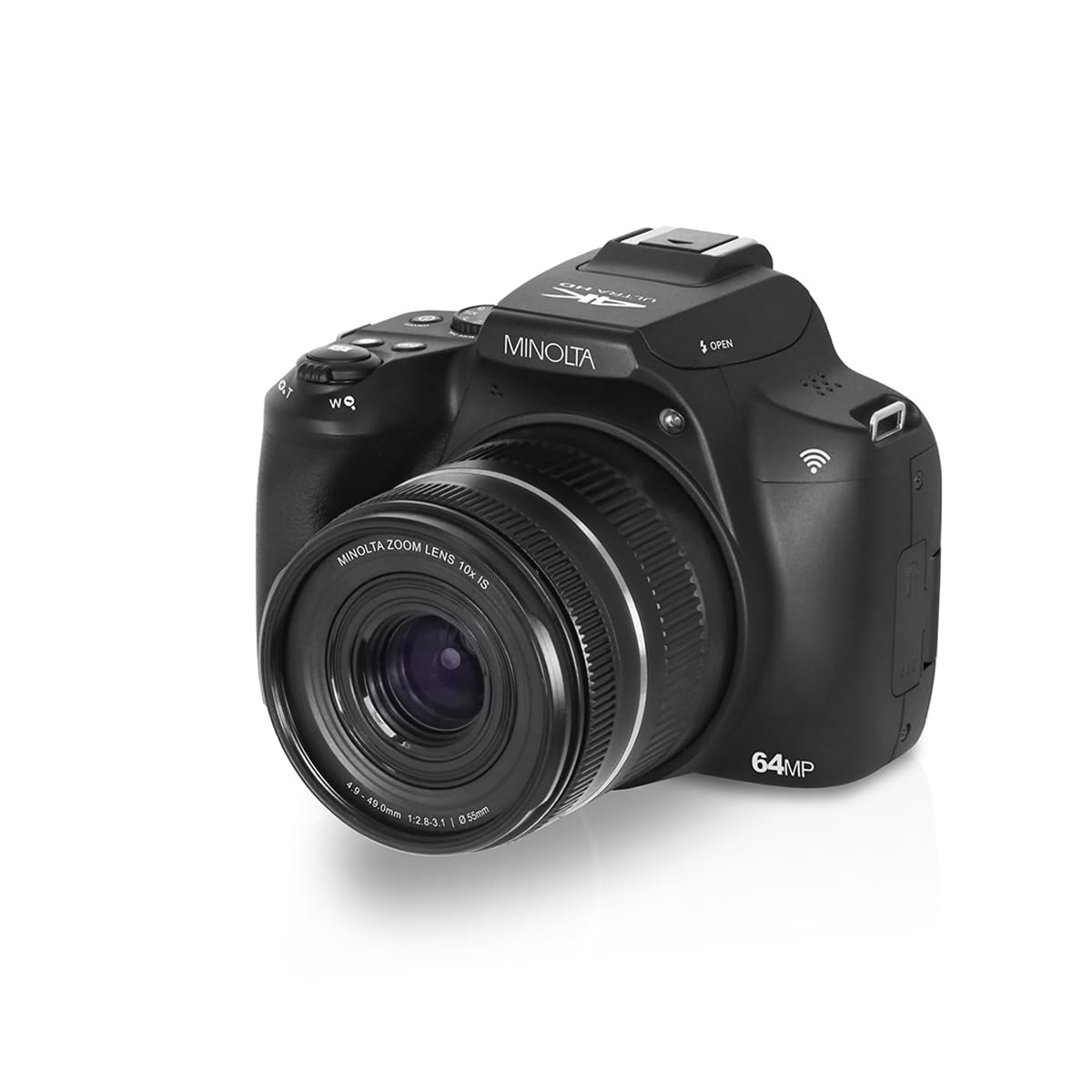
3. Minolta MNB10Z 64MP 4K Bridge Camera
Big megapixels and a full starter kit, aimed at editors who want room to crop.
The 64MP CMOS sensor is the draw for anyone who enlarges prints or crops hard into a shot. You get more pixels to work with than the 16MP KODAK PIXPRO FZ55, so editing headroom is genuinely larger. The 10x optical zoom plus a macro mode (close-up shooting) covers portraits, landscapes, and small details.
Video shoots in 4K, and burst mode freezes fast action for sports or pets. Smart features like face detection, time-lapse, and anti-shake round out the package, and the box includes a 32GB SD card, case, rechargeable battery, and charger. Built-in Wi-Fi lets you control the camera from your phone.
The honest conversation is picture quality — feedback splits between buyers who get results they like and others who find shots soft. That makes this a fit question rather than a slam dunk: it rewards you most when light is good and you are not pushing the long end. Some also note it takes some learning to get the best from it.
Where it earns its place: a 64MP sensor and 10x zoom make it a flexible first bridge camera with a kit already in the box.
The realistic caveat: image quality divides opinion, so go in expecting daytime shooting to be its strong suit.
Fits you well if: you want high-resolution stills and a ready-to-go bundle without hunting for accessories.
Second guess it if: you shoot in tricky light and expect consistent sharpness every frame.
4. KODAK PIXPRO AZ528 16MP Digital Camera

A 52x reach that brings birds and athletes close without a bag full of lenses.
The distance this camera covers is the headline. A 52x optical zoom runs from a 24mm wide angle (wide enough for sweeping landscapes) all the way into tight telephoto for birds, wildlife, and athletes. A 16MP BSI CMOS sensor (a back-illuminated design that gathers more light) pairs with built-in optical image stabilization, so handheld shots at full reach stay steadier.
Burst mode fires at 6fps to catch fast action, and you review frames on the 3″ LCD. Built-in Wi-Fi moves photos to your phone for quick posts or turns the phone into a live remote viewfinder. Video records at 1080p Full HD, and the rechargeable Li-ion battery covers a full day of shooting.
Zoom this long has a truth most buyers learn on day one: last year’s long shots need steadiness or good light. Some find the very longest frames softer than they hoped, and autofocus at the far end is the part to practice. Get the technique down and it delivers reach far beyond its 25 autofocus points would suggest.
Why the reach sells it
- Huge range in one body: 52x optical zoom from 24mm wide to tight telephoto, no lens swaps.
- Steady handheld: built-in OIS (optical image stabilization) fights hand shake at full zoom.
- Action ready: 6fps burst catches wildlife and sports sequences.
- Share remotely: Wi-Fi transfers photos to your phone or works as a live viewfinder.
What to factor in
- Technique matters: the longest shots reward a steady hand and bright light.
- Autofocus at the far end: the part to practice before a big trip.
- Bigger than a pocket cam: the long telescope lens means more body to carry.
Built for: birders, sports fans, and travelers who want serious reach without premium pricing.
Know before you buy: expect to steady your shots — the far end is where you earn the frame.
5. Panasonic LUMIX FZ80D Compact Camera

From a wide landscape at 20mm to a super-telephoto 1200mm without ever changing a lens.
This is the range-versus-convenience pick. A 60x optical zoom spans 20mm wide to 1200mm super-telephoto in a single compact body, which is dramatically more reach than the KODAK PIXPRO FZ55’s 5X — a gap no digital trick can close. Landscapes, wildlife, and sports all come from the same lens.
You get less blur in your shots because Panasonic’s F2.8–F5.9 lens pairs with a Power Optical Image Stabilizer. Framing stays easy even in bright sun thanks to a bright 0.39-inch OLED viewfinder (a tiny screen you look into) plus a 3.0-inch touch LCD with roughly 1.84M dots. 4K Photo captures the decisive moment at 30 fps, and tools like Focus Select help you pull the right frame. USB-C charging keeps it topped up on the road.
The trade-off: at 60x the long end benefits from steady technique and good light, so handheld super-telephoto shots ask something of you. The FZ80D is the camera for someone who wants one device to cover it all rather than a pocket-first travel cam.
One body, every distance: 20-1200mm in 60x optical zoom means you leave the lens bag at home.
Frame the honest limit: the 1200mm end rewards a steady hand, so the stabilization is doing heavy lifting there.
Best matched to: travelers and nature shooters who want wide-to-superzoom in a single camera.
Not the pick if: pocket-size is your top priority and 5x-to-30x zoom already covers your shots.
6. OM SYSTEM Olympus Tough TG-7

The zoom camera that takes a dunking, a drop, and a freeze without flinching.
Most zoom cameras are fair-weather tools. The Tough TG-7 is built for the opposite. A snorkel trip, a hike, or a snow day is inside its comfort zone because it is waterproof to 50 ft (15m), shockproof to 7 ft (2.1m), crushproof to 220 lbf (100kgf), freezeproof to 14°F (-10°C), and dustproof.
The lens is a 25-100mm equivalent with 4x optical zoom and a bright F2.0 maximum aperture (a wide opening that lets in more light) for clarity in dim conditions. A 12MP back-illuminated CMOS sensor and TruePic VIII processor handle the imaging. The Variable Macro System lets you focus as close as 1cm, and there are five underwater shooting modes plus 4K video at up to 30fps and 120fps high-speed Full HD.
Where it gives up reach to a long superzoom, it wins back on toughness — a 4x optical zoom will not pull in distant wildlife the way a 52x model can. And the deep menu rewards a little practice to open up its macro strengths. For wet, rough, or cold adventures it is the standout.
Adventure-proof first: waterproof, shockproof, crushproof, freezeproof, and dustproof — this is the camera you take where others stay home.
Honest limit: the 4x zoom is the smallest reach on this list, so it is a close-and-rugged tool, not a distance one.
Pick it for: snorkeling, diving, hiking, and any trip where water and drops are real.
Pass if: your main need is pulling far-off subjects close rather than surviving the conditions.
7. Panasonic LUMIX TZ/ZS99 Point and Shoot Camera

A 24-720mm LEICA lens in a body that genuinely slips into a pocket.
You get the travel balance: 30x optical zoom in a 24-720mm LEICA lens, folded into a compact body you can carry every day. It covers sweeping landscapes and your favorite moments without adding bulk. What wins people over is the size-to-reach ratio: 30x zoom in a 24-720mm LEICA lens that fits a pocket.
4K video shoots at 30p, and 4K PHOTO grabs bursts at 30fps; HD high-speed video at 120fps gives you slow-motion options. A 1,840k-dot tiltable touchscreen helps you shoot from any angle, and universal USB Type-C charging means one cable handles the trip. Bluetooth v5.0 and a Send Image button push photos to your phone through the Panasonic Image App.
Image quality is the honest dividing line — bright-light shots please, while low light is where the smaller sensor shows itself. The interface packs a full set of modes, so a beginner will spend a little time learning the menu. Still, for a pocket zoom that shoots everything from wide to far, it is a strong travel companion.
The travel case for it
- Reach in a pocket: 30x optical zoom across a 24-720mm LEICA lens stays portable.
- Shoot from anywhere: a 1,840k-dot tiltable touchscreen handles awkward angles.
- One cable: USB Type-C charging simplifies packing.
- Quick sharing: Bluetooth v5.0 and a Send Image button move photos to your phone.
What to keep in mind
- Low light is the limit: a small sensor plus dim scenes is where results divide.
- Menu learning curve: the full mode set rewards a little setup time.
- No viewfinder: framing relies on the rear screen, so bright sun is a factor.
Made for: travelers and concert-goers who want big zoom in a pocketable body.
Skip if: you shoot mostly at night and expect crisp results without extra light.
8. LUMIX ZS99 Point & Shoot Digital Camera

The same 30x pocket formula, tuned toward steady shots and everyday carry in silver.
What sets this ZS99 apart is the stabilization: a 24-720mm LEICA lens with 30x optical zoom and 5-Axis HYBRID O.I.S. (image stabilization on several axes at once) to keep long shots steady. Zoom is what people rave about here: 30x optical reach in a body small enough to carry every day.
4K video at 30p and 4K PHOTO bursts at 30fps cover stills and clips; 120fps HD high-speed video opens up slow-motion. The 1,840k-dot tiltable touchscreen and USB Type-C charging keep shooting convenient. Bluetooth v5.0 with a Send Image button moves photos straight to your phone. There are 121 autofocus points to lock onto subjects.
The recurring gripe is low light — the smaller sensor is where dim scenes push back, and the operation is not for everyone who wants a one-button camera. Compared with the TZ/ZS99 above, this silver version leans on the stronger stabilization rating; pick whichever color and handling suits you, because the zoom formula is the same.
Why zoom lovers pick it: 30x optical reach plus 5-Axis HYBRID O.I.S. keeps far shots usable in a pocket body.
The fair caveat: low light is its weak spot, so plan daytime shooting around its strengths.
A good match for: daily carriers who want a compact zoom with steady optics and easy phone sharing.
Reconsider if: you mostly shoot indoors or at night and need stronger low-light results.
9. Nikon COOLPIX P1100 Superzoom Digital Camera

A 24-3000mm reach that turns a distant bird into a full-frame portrait.
When the subject is genuinely far away, nothing here reaches like this. A 125x optical zoom spans a 24-3000mm equivalent, with a further 250X Dynamic Fine Zoom for the extreme end. Dual Detect Optical VR (vibration reduction) is rated equivalent to shooting at a shutter speed 4.0 stops faster, which is what makes that reach usable in hand.
It is a true point-and-shoot across the range: ultra-telephoto, wide-angle, and macro close-ups, as JPEG or.NRW (RAW) files. 4K UHD video, slow-motion, time-lapse, and Superlapse movies cover motion. A dedicated Bird-watching Mode on the mode dial tune settings for the shot, and Close Focus Macro reaches as close as roughly 1 cm. A customizable control ring handles manual focus or exposure.
The obvious trade-off is size and price tier — this is a serious investment and a larger camera to carry than a pocket zoom. It rewards the buyer who will actually use 3000mm of reach. Nature shooters, especially birders, get the most from it.
The reach that defines it: 125x optical zoom to 24-3000mm with 4.0-stop VR is the longest throw on this list.
The buyer it suits: birders and wildlife shooters who need maximum distance in a fixed-lens body.
The right call for: dedicated wildlife and birding shooters who want the longest reach available.
Overkill if: your shots are mostly portraits and travel scenes that a 30x pocket zoom already handles.
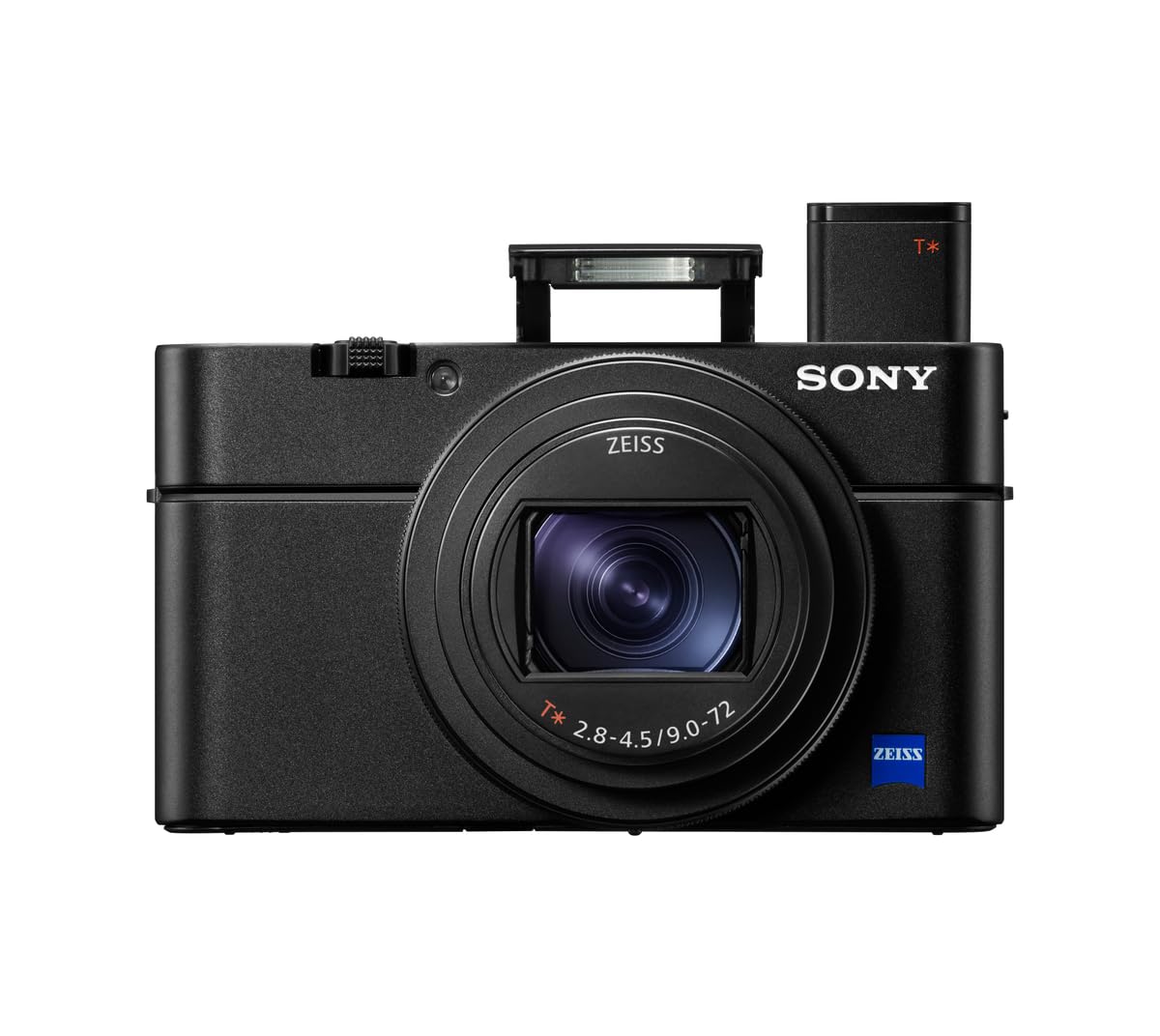
10. Sony RX100 VII Premium Compact Camera
A pocket camera with autofocus fast enough to catch a bird mid-flight.
The number that sells this one is speed. Autofocus locks in 0.02 seconds using 357 phase-detection points and 425 contrast-detection points (the two ways a camera reads focus). It shoots up to 20 fps blackout-free, with AF/AE recalculated up to 60 times a second, so fast action stays sharp. A 20.1MP 1.0-type stacked CMOS sensor and a Zeiss Vario Sonnar T 24-200mm F2.8-F4.5 lens sit at the core.
AI-based real-time tracking follows subjects in stills and movies, with real-time eye AF for people and animals. 4K video records with S-Log3, a microphone jack, and Active mode stabilization. It fits easily in a purse or pocket, and much of the praise lands on picture quality and clear video in sunlight.
The reach is the honest limit here — the 24-200mm zoom covers everyday and portrait distances but stops far short of a 52x or 125x superzoom when you need the long throw. This is the pick for someone who values focus speed and compact size over maximum magnification.
Speed is the story: 0.02s autofocus and 20 fps blackout-free shooting make it a genuine action tool in a pocket.
Where it stops: the 24-200mm zoom cannot reach distant wildlife the way the superzooms here can.
This one’s for: shooters who chase fast-moving subjects and want pro-grade autofocus in a compact.
Choose another if: maximum zoom range is the reason you are buying.
11. Canon PowerShot G7 X Mark III Digital Camera (Black)

A fast-aperture compact built for dim rooms and street evenings, not far-off subjects.
The aperture is the reason to look here. An f/1.8-2.8 maximum aperture (a wide lens opening that takes in more light) across a 24-100mm, 4.2x optical zoom lens gives this camera an edge in low light that long-zoom rivals cannot match. Optical image stabilization reduces shake, and phase-detection autofocus with 99 points keeps subjects locked.
Picture quality draws the praise, with images described as amazing and results holding up against a phone. The 3:2 aspect ratio and phase-detection focus point to a photography-first design. It is a compact you carry for stills, not a superzoom built for distance.
Set the expectation plainly: 4.2x optical zoom is a short reach, so this is the pick for portraits, street, and indoor moments rather than wildlife. Functionality gets mixed feedback, and the battery is rated around 1 hour, so a spare makes sense for a long day. It is a stills-focused compact, not a long-reach zoom.
The case for it: a bright f/1.8-2.8 lens plus optical stabilization makes it the low-light specialist of this group.
The honest read: 4.2x zoom is the shortest reach here — pair it with a superzoom if distance matters.
Great fit for: street and indoor shooters who want bright-lens stills in a small body.
Not for you if: your shots live at the far end of a football field or treeline.
Know the Specs
Optical Zoom vs Digital Zoom
Optical zoom moves physical glass to magnify, so detail stays intact. Digital zoom crops and enlarges pixels, which softens the image. The gap matters — the Panasonic LUMIX FZ80D’s 60x optical zoom against the KODAK PIXPRO FZ55’s 5X is a real difference in how far you can shoot cleanly, not a software trick.
Image Stabilization
Stabilization counteracts hand shake, and it matters more as zoom grows. The OM SYSTEM Tough TG-7 relies on its rugged body and bright lens, the Nikon COOLPIX P1100 uses Dual Detect Optical VR rated to 4.0 stops, and the LUMIX ZS99 uses 5-Axis HYBRID O.I.S. — all ways to keep long shots steady.
Sensor and Megapixels
Megapixels measure recorded detail, while sensor size shapes low-light ability. The Sony RX100 VII’s 20.1MP 1.0-type sensor and the Minolta’s 64MP CMOS differ in resolution and light gathering — more pixels help cropping, a larger sensor helps dim scenes.
Aperture and Low Light
Aperture is the lens opening, written as an f-number. Lower values like the Canon G7 X Mark III’s f/1.8 or the Tough TG-7’s F2.0 let in more light. Higher values like F5.6 need more light or a steadier hand for clean results.
Common Questions
Is optical zoom better than digital zoom on a point and shoot?
How much zoom do I need for wildlife and birds?
Can a compact zoom camera shoot 4K video?
Does image stabilization really help at long zoom?
Are these cameras good in low light?
What is the difference between the LUMIX TZ/ZS99 and the ZS99 silver model?
Can I take one of these cameras underwater?
Do these zoom cameras connect to my phone?
Do I need a viewfinder on a point and shoot zoom camera?
How close can these cameras focus for macro shots?
The Bottom Line
For most people, the zoom point and shoot camera winner is the KODAK PIXPRO FZ55 Bundle: a 5x optical zoom and 28mm wide end cover landscapes and close-ups in a body that slips into a pocket. If you want maximum reach for birds and far subjects, grab the Nikon COOLPIX P1100 and its 125x optical zoom. And for wet, rough, or cold adventures, the OM SYSTEM Tough TG-7 is the one to reach for, with waterproofing to 50 ft and a 1cm macro reach.
The KODAK PIXPRO AZ528 sells the most units with its 52x reach, but the FZ55 scores higher at 4.5+ — a pocket-first 5x camera beating a longer lens. Match the zoom range to what you shoot and the aperture to your light, and you carry one right camera instead of a bag of compromises.
How we choose
We do not accept paid placement. Every pick is matched to a real buyer and a real use-case; we do not hands-on test units.
Sources
Specifications: manufacturer listings and product documentation. Review insights: verified customer reviews, as of November 2026. Pricing: not shown on this page (it changes often); check the current price via the retailer link.
As an Amazon Associate, Tactical Gear Guy earns from qualifying purchases. This does not affect which products we feature.