Specs are compiled from manufacturer listings and verified buyer reviews and can change over time — please confirm the key details on the product page before buying.
If your iPhone’s zoom turns a distant sign into a mushy smear of pixels, you already know the problem: digital zoom just crops and stretches what the sensor captured. A clip-on telephoto lens puts real glass in front of the camera, and that’s the difference between a readable subject and a blurry guess. Below you’ll find the eight models that hold up best for iPhone owners, sorted by what they actually do well. One quick note before you scroll: this list uses flexible, human-like matching for iPhone compatibility (mounting to the iPhone camera), so not every pick is the exact model number you searched — the nearest same-type optic serving the same purpose is included instead.
This guide is built by comparing the manufacturers’ published specifications and the patterns across verified customer reviews, so you get each pick’s real strengths and trade-offs instead of marketing spin.
Magnification numbers get thrown around loosely, so the guide below separates true optical reach from software trickery and tells you which mount each lens actually needs. Read on for the clearest breakdown of the zoom attachment for iphone that fits how you actually shoot.
Top Picks


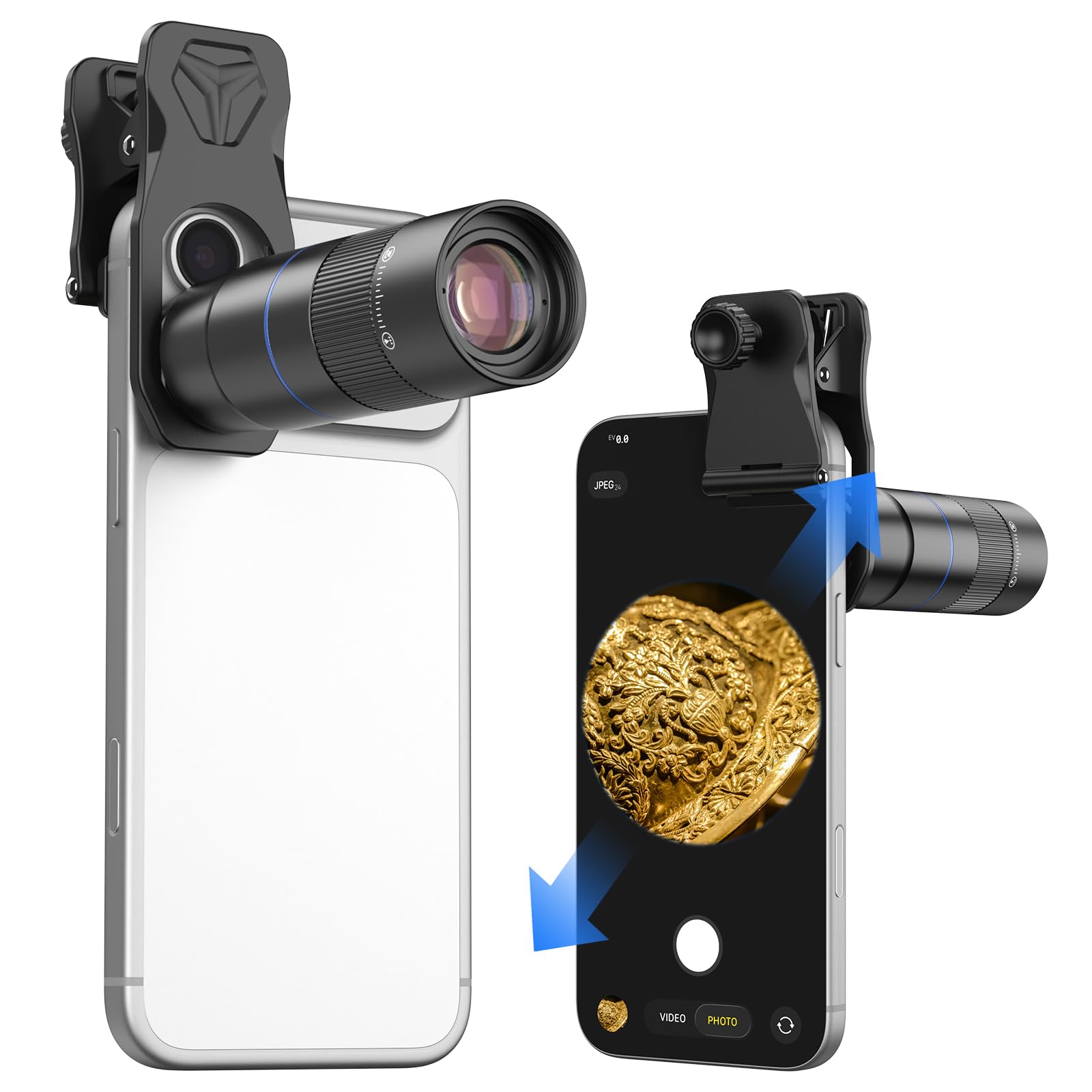
How To Choose The Best Zoom Attachment for iPhone
The first thing to settle is not magnification at all — it is how the lens attaches to your phone. Get the mount wrong and the sharpest optic in the world will sit in a drawer. Everything else follows from there.
Match the mount to what you already own
A 17mm thread mount means the lens twists into a matching threaded ring on a phone case or cage. It locks down tight and stays aligned, but the case or cage is usually sold separately, so check what you own before buying. A T-mount works the same way with a different thread standard, and it is specific to certain SmallRig cases and cages. A universal clip simply clamps over the phone’s camera, which fits the widest range of phones but can shift slightly.
Understand what magnification really means
A 2X lens doubles the reach of whatever camera it sits over. That is a small number with a big effect, because it multiplies the phone’s own telephoto camera rather than replacing it. A 6X or 20-60X lens reaches dramatically further, but each step up usually costs you light and steadiness.
Weigh the lens before you commit
Glass has mass. A lens that hangs off the end of a phone turns a one-handed snapshot into a two-handed operation, and a heavy one can strain a gimbal or drag your hand down during a long concert set. Light lenses suit handheld shooting; heavier ones want a tripod or a rig.
Check compatibility with your exact model
Some lenses are built for a specific iPhone generation and its specific camera layout. Others are universal. If you shoot on the newest Pro model, a made-for-it lens aligns perfectly. If you upgrade phones every year, a universal mount will outlast the handset.
Side-by-Side Comparison
| Model | Best For | Magnification | Mount | Weight | Amazon |
|---|---|---|---|---|---|
| NEEWER HD 85MM LS-59★ Best Overall | Sharpest optics with filter support | 2.5x optical | 17mm thread | 12.35 ounces | Amazon |
| SmallRig 2X Telephoto 5920Best for Rig Builders | Locked-down rig shooting | 2X optical | T-mount | 103 g | Amazon |
| APEXEL 6X UpgradedBest Reach for the Money | Long reach in a pocket | 6X, 144mm equivalent | 17mm universal clip | 4.28 ounces | Amazon |
| PGYTECH 2X for iPhone 16 Pro | Concert and wildlife reach | 2X, 200mm equivalent | iPhone 16 Pro case | — | Amazon |
| NEEWER HD 65mm LS-66 | Filter-friendly mid-reach | 1.7x optical | 17mm thread | — | Amazon |
| TELESIN 2X Master Lens | iPhone 17 Pro Max portraits | 2X, 200mm equivalent | Telesin case + adapter | — | Amazon |
| Freewell 1.7X | Fast twist-on portrait glass | 1.7x optical | 17mm thread | — | Amazon |
| MIAO LAB 20-60X | Moon, birds, and long-distance scouting | 20-60X zoom | Universal clip | 3.8 pounds | Amazon |
Detailed Reviews
1. NEEWER HD 85MM Telephoto Phone Lens LS-59
Our pick — 4.5+★ from 100+ verified ratings; the strongest balance of quality and price.
Real glass with a filter thread on the front — the pick that treats your phone like a camera body.
This is the one to buy if you want your phone photos to look like they came off a proper camera rig. The 85mm focal length (a short telephoto, the classic length for separating a subject from its background) pulls distant detail forward without the flattened look of an extreme zoom. Its 8 elements in 6 groups correct distortion, and the HD coating keeps the frame sharp. Magnification lands at 2.5x optical.
The mount is the part that matters most here. It twists onto a 17mm threaded backplate on a phone case or cage, and it is not compatible with M or T mounts, so verify your case first. NEEWER lists support for the PA193 and PA194 plates for the iPhone 18 Pro and 18 Pro Max, plus SmallRig, Kase, and Beastcage cages. The shell is black anodized aviation-level aluminum alloy — rugged, anti-rust, and scratch resistant. NEEWER expressly advises against using this lens with clips.
What wins people over is the optical quality, the single trait buyers single out most. Footage comes off this lens looking genuinely professional rather than like an upscaled crop. The catch is bulk: at 12.35 ounces it is 2.9x the weight of the APEXEL 6X at 4.28 ounces, and the weight draws enough comment that gimbal use becomes awkward. Treat it as a rig lens, not a pocket one. The 72mm front thread is the quiet bonus — that is 24% wider than the 65mm NEEWER’s 58mm front thread, so it accepts larger ND, VND, CPL, and UV filters.
Where this lens earns its keep
- 8 elements in 6 groups behind HD coating for clean, corrected detail
- 72mm front thread takes ND, VND, CPL, and UV filters
- Anodized aviation-level aluminum alloy shell resists rust and scratches
What to plan around before buying
- 12.35 ounces of glass makes gimbal work clumsy
- Needs a 17mm threaded case or cage — sold separately, no clips
- Manual focus means you dial in sharpness yourself
Reach for this if: you already run a phone cage and want the sharpest glass on the list with room for filters up front.
Look elsewhere if: you shoot handheld video on a gimbal — the 12.35-ounce body will fight you every frame.
2. SmallRig 2X Telephoto Lens 5920
Built to bolt onto a cage and never drift a millimeter.
SmallRig’s approach is the opposite of a clip: this lens screws onto a standard T-Mount, which means it attaches to compatible SmallRig phone cases and cages (sold separately) with a fixed, permanent connection. No awkward clips, no misalignment mid-shoot. The 2X magnification sits over your phone’s built-in 4x, 5x, or 8x telephoto camera and doubles that reach optically, which is what separates it from digital zoom that degrades the image. The 60mm focal length is the shorter end of the telephoto class here — the NEEWER 85MM sits at 85 mm.
The multi-coated glass is built to cut chromatic aberration (the colored fringing at high-contrast edges), distortion, and color shift, and the output is ready for 4K work. The frame is aluminum alloy and the whole kit is compact enough to travel. One thing you have to respect: the minimum focusing distance is 5m (16.4ft), so this is a lens for reaching out, not for close work. SmallRig also recommends third-party camera apps such as Lightroom, Blackmagic, ProCam, Indigo, or Fotorgear to lock the telephoto lens manually, and the included ultra-wide sticker prevents the ultra-wide camera from kicking in and causing vignetting.
Here is the honest read: with a 3.5+ rating, this is the lowest-scored pick on the list, and it is a specialist tool that expects you to know your way around camera settings. It is also the most affordable route into a rigid, no-drift mount. Note the extra steps — telephoto-only operation, macro mode off, sticker applied — before you assume it is plug-and-play. If you want a rig that stays aligned through a whole shoot and you don’t mind setting it up deliberately, this is the one.
The rigid-mount payoff: a T-Mount connection holds alignment through a whole session, and the 4K-ready coated glass delivers the detail that digital zoom cannot.
The setup tax: the 5m minimum focus distance, the prohibited main and ultra-wide cameras, and the manual-app recommendation all mean this lens asks for deliberate handling rather than point-and-shoot ease.
Best suited to: SmallRig cage owners who want a fixed camera-to-lens marriage and shoot 4K video on the telephoto camera.
Think twice if: you want to shoot close subjects or expect the native camera app to just work without adjusting settings.
3. APEXEL 6X Upgraded Telephoto Lens for iPhone and Android
Six times the reach in something that slips into a jacket pocket.
Six times optical pull, a 144mm equivalent focal length, and a body that weighs 4.28 ounces — that combination is why this is the pick for travel, street scenes, and concerts. Its 10 glass elements in 7 groups carry multi-layer coatings, and the housing is aircraft-grade aluminum. Compare it to the PGYTECH 2X at 200 mm equivalent: APEXEL trades reach density for portability, sitting at 144mm equivalent in a far smaller package. That is a 39% shorter equivalent focal length than the PGYTECH, but you get it in a lens you can forget you are carrying.
The dual-use design is the clever bit. Clip it to your phone for telephoto shots, or attach the included eyecup and it becomes a standalone monocular you can hold to your eye with no screen at all. It fits most smartphones through a universal clip and 17mm thread. One setup quirk to know: after attaching, zoom your phone to 2x or higher (2x–2.5x is the recommended range) until the black circle disappears, and on iOS switch off the small flower icon for macro mode before you shoot.
Quality and compatibility are what buyers praise most, and the numbers back up the broad-fit claim. The honest limit is fit on oversized handsets, with larger phones such as the iPhone 12 Pro Max flagged as a poor match. The clip can also block part of the screen. Apexel is upfront that this is best for daily distance, not for the moon or extreme long-range work. For the money, nothing else here reaches this far at this weight.
Go with this one if: you want genuine 6X reach that travels light and doubles as a handheld monocular.
Pass if: you carry a phone on the large end, where the universal clip struggles to hold a clean fit.
4. PGYTECH 2X Telephoto Lens for iPhone 16 Pro

Made for one phone, and it shows — 200mm of optical reach on the 16 Pro.
PGYTECH aimed this lens at a very specific buyer: the iPhone 16 Pro or 16 Pro Max owner who shoots concerts and wildlife and wants reach without a rig. It delivers a 200mm equivalent optical telephoto on the 16 Pro’s 4× camera, and 400mm equivalent when you push into the phone’s 8× digital setting. That 200mm equivalent is 39% more reach than the APEXEL 6X’s 144mm equivalent — the PGYTECH gives up portability and compatibility for that extra stretch.
The auto focus is note, since several lenses here are manual-only, and the clip-on design pairs with PGYTECH’s RetroVa phone case. The kit ships as one 2X telephoto lens, one lens adapter ring for the iPhone 16 Pro, and a lens pouch. The lens is a zoom design rather than a fixed prime.
The trade-off is narrowness by design. It fits the iPhone 16 Pro and 16 Pro Max and nothing else, so if you upgrade to a newer handset this lens stays behind. It is a precise tool for a precise body, and if that is the phone in your pocket, the reach-to-portability ratio is hard to argue with.
Reach without the rig: a 200mm equivalent optical focal length in a clip-on package, doubling to 400mm equivalent on the phone’s digital zoom — exactly what a concert or a bird blind demands.
One phone only: built for the iPhone 16 Pro and 16 Pro Max, with an included adapter ring that will not stretch to any other generation.
Pick it up if: you shoot on an iPhone 16 Pro or Pro Max and want auto-focus telephoto reach for stage and wildlife.
Walk past if: your phone is any other model — this lens will not fit it.
5. NEEWER HD 65mm Telephoto Phone Camera Lens LS-66

A modest zoom with a serious filter thread and a hood to keep flare away.
A 65mm focal length and 1.7x magnification make this a gentler stepping stone than the 85mm NEEWER, and for street, architecture, and sports it reads as a natural framing boost rather than a telescope. Its 7 elements in 5 groups use multicoated HD glass for sharp, detailed results.
The 58mm front thread is what owners value, and value is the word that keeps coming up. That thread takes the included lens hood — a shroud that blocks stray light and keeps flare out of your frames — and it also suits 58mm filters like ND, variable ND, CPL, and UV, which are sold separately. Sitting 24% narrower than the 85mm NEEWER’s 72mm front thread, the 58mm interface is the more common accessory size. Mounting is 17mm thread only, fitting NEEWER’s PA018 and PA019 backplates along with cases and cages that carry 17mm threads, and the black anodized aluminum alloy shell resists rust, scratch, and minor impacts.
Two things to check before buying. The backplate, cage, or case is not included, and NEEWER does not suggest using it on lens clips. The focus is fixed, so what you aim at is what you get. For an outdoor shooter who wants consistent, hooded, filter-ready telephoto shots, this is a tidy package.
The strong points
- Included lens hood blocks flare for outdoor shooting
- 58mm front thread opens up ND, VND, CPL, and UV filters
- Anodized aluminum shell stands up to scratches and knocks
Before you add to cart
- Backplate or cage is sold separately
- Fixed focus gives you no adjustability
- NEEWER does not recommend it on lens clips
Fits best: outdoor content creators already running a 17mm threaded case who want hood plus filter support.
Not for: anyone hoping to clip this onto a bare phone — the 17mm thread mount needs a backplate.
6. TELESIN 2X Telephoto Master Lens for iPhone 17 Pro Max
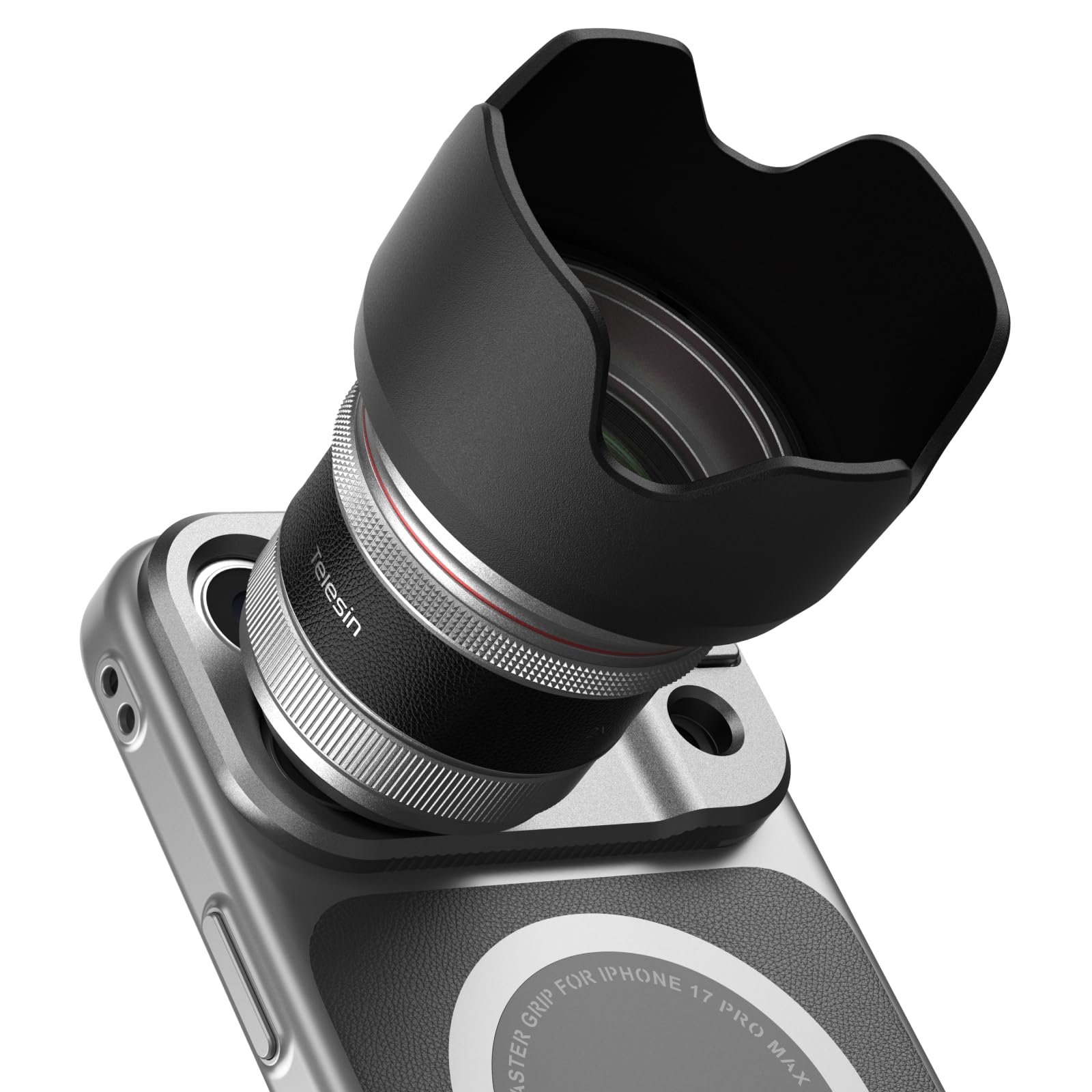
The portrait specialist — 105mm framing and an app that fights hand shake.
Pair this lens with the phone’s zoom set to 2.2x and you get the classic 105mm perspective, the framing photographers reach for when a portrait should feel authentic rather than compressed. Push it further and the lens delivers a true 200mm equivalent optical zoom (4x on the iPhone 17 Pro Max) and 400mm equivalent digital (8x). That is the same 200mm-equivalent optical reach as the PGYTECH 2X, reached through a very different mount.
The stabilization is where TELESIN goes its own way. Its EIS (electronic image stabilization, software that counteracts shake by shifting the frame) logic was rebuilt inside a dedicated Reef Color App, which taps the phone’s gyroscope data directly to steady your shots. The cost is a crop factor of about 10%. Installation runs through the included Telesin case for the iPhone 17 Pro Max and a dedicated adapter plate — tool-free, with precise alignment to the main camera to avoid vignetting. The package is complete: lens, case, lens case, adapter plate, lens hood, lens cap, and a cleaning cloth, with 90 days of warranty.
What owners rave about is how easy the whole thing is to hold and use, and the ergonomics read as professional in the hand. The durability side is the honest caution — reports of the case breaking early sit alongside the praise, so treat the included case as the wear item it may be. Buy this for the portrait framing and the stabilization app; keep expectations realistic about the case.
Portrait-first design: the 105mm look at 2.2x zoom plus 200mm equivalent optical reach gives faces the depth photographers want.
The weak link: the bundled case has a durability track record that gives pause, so consider it replaceable rather than permanent.
Ideal for: iPhone 17 Pro Max owners who shoot people and want app-driven stabilization to keep handheld frames steady.
Best avoided if: you expect the included phone case to last the life of the lens.
7. Freewell 1.7X Telephoto Lens for 17mm Mount Phone Case

Twist, shoot, done — the fastest mount here for portraits and wildlife.
Freewell keeps it simple: a 1.7x optical magnification lens that twists into the 17mm thread mount on your phone case or rig and locks down onto the 1x main camera with a stable connection. Portraits, wildlife, and distant landscapes are the stated targets, and the 1.7x boost tightens framing without the setup fuss of heavier optics.
The multi-layer coating cuts glare and lifts contrast for sharper, more vibrant images. The body is high-quality aluminum alloy, chosen for reliable performance outdoors. Minimum focusing distance is 65CM, so you can shoot subjects fairly close, and the lens is a prime design. Manual focus means you dial in sharpness yourself.
The honest note is that this is a modest-magnification lens — 1.7x, not the 6X or 20-60X reach of some picks here. That is the point. If your goal is a cleaner portrait or a slightly tighter landscape and you already own a 17mm case, the twist-on connection makes it the least fiddly way to get there.
Right choice when: you want a fast, secure twist-on boost to 1.7x for portraits and you already have a 17mm-threaded case.
Not the move if: you are chasing long-distance reach — 1.7x will not get you to the moon.
8. MIAO LAB 20-60X Zoom Telephoto Lens with Tripod

Twenty to sixty times — this is a spotting scope that happens to fit a phone.
When “distant” means the moon, a distant bird, or a far shoreline, this is the only pick here that gets you there. The 20-60X magnification range sweeps from a wide field of view down to tight close-ups, and a focus ring on the barrel lets you dial the focal length precisely. Bird watching, moon watching, camping, fishing, golf, and concerts are all fair game. The body is aviation-grade aluminum, and the matching tripod is built from the same material, with four-section legs extending from 34-88cm, triple anti-slip locks rated to 3kg, a 360° pan-tilt head, and a universal 1/4″-20 thread mount.
The tripod is not an accessory afterthought — it is the reason this works. At 3.8 pounds, this lens needs support, and with a 45mm large-diameter objective lens it gathers light well for dawn and dusk shooting. A standard 58mm filter thread takes UV, VND, CPL, and star filters. Two modes keep it flexible: clip it to the phone and shoot, or attach the eyecup and use it as a standalone monocular with no screen involved. The clamp adjusts from 7-10cm to fit most phones, though MIAO LAB notes that mini, 8, 7, 6, 5, and 4 models are excluded.
Functionality and quality are what customers praise most, and the optics hold up. The mounting system is the mixed part — the spring mounts can be fussy to seat and hold steady. If you plan to chase the moon or scout a lake from a hilltop, the reach justifies the fuss.
Why it goes the distance
- 20-60X range for lunar, bird, and long-scouting subjects
- Aviation-grade aluminum tripod with 360° pan-tilt head included
- Doubles as a standalone monocular with the eyecup
- 58mm filter thread for UV, VND, CPL, and star filters
What you accept going in
- 3.8 pounds means it lives on the tripod, not in a pocket
- Spring clamp can be tricky to mount and adjust
- Excludes mini and older iPhone models
Best matched to: birders, moon watchers, and long-distance scouts who want a tripod-backed scope that also shoots through a phone.
Skip if: you want an everyday pocket lens — 3.8 pounds is a separate bag item.
Know the Specs
Optical magnification versus digital zoom
Optical magnification bends real light through glass to enlarge your subject, so detail stays intact. Digital zoom simply crops and stretches the pixels you already captured, which is why it turns grainy at distance. Every lens here is optical, and that is the whole reason to attach one.
Focal length in millimeters
Focal length describes how much the lens magnifies and compresses the scene. A 60mm or 65mm lens gives a modest, natural boost; 85mm and above pulls distant subjects forward and flattens backgrounds. The “equivalent” figure translates that glass into the full-frame terms photographers use.
Mount type: 17mm thread, T-mount, or clip
A 17mm thread twists into a matching threaded ring on a case or cage for a locked connection. A T-mount uses a different thread standard on specific cages. A universal clip works on the widest range of phones but can shift slightly. Match the mount to your case before anything else.
Front filter thread size
A front thread lets you screw on filters — ND to cut light, CPL to tame reflections, UV for protection. The larger the front thread (58mm, 72mm), the more filter options you can attach. This is the feature that turns a lens into a system.
Weight and stabilization
Glass adds mass at the end of a phone, which makes handheld shots harder to keep steady. That is why a heavy lens pairs with a tripod or rig, and why many lenses here lean on the phone’s own stabilization or an app-driven system rather than built-in optics.
Focus type
Manual focus means you turn a ring or adjust on screen to sharpen the subject. Fixed focus locks the lens so what you aim at is what you get. Auto focus lets the lens find sharpness for you. Each suits a different shooting style.
Common Questions
Will a zoom lens work with my iPhone model if I have not checked the mount first?
Is a 6X lens actually better than a 2X for everyday shooting?
Why does the lens show a black circle in the frame?
Do I need a special phone case to use these lenses?
Can a heavy telephoto lens be used on a gimbal?
What is the difference between a 17mm thread mount and a T-mount?
Can these lenses shoot the moon or very distant subjects?
Do the lenses have image stabilization built in?
Can I attach filters to these telephoto lenses?
Will a 2X telephoto lens degrade my image quality?
The Bottom Line
For most people chasing real optical reach on an iPhone, the NEEWER HD 85MM LS-59 is the winner — 8 elements in 6 groups, a 72mm filter thread, and footage that reads as genuinely professional. If you want to bolt a lens onto a cage and never think about alignment again, the SmallRig 2X is your fit. And when you want six times the reach in a pocket-sized body that doubles as a monocular, the APEXEL 6X is the one to grab. One honest nudge before you decide: the NEEWER’s weight is its one recurring trade-off, so if handheld video is your priority, weigh whether a lighter pick serves you better.
How we choose
We do not accept paid placement. Every pick is matched to a real buyer and a real use-case; we do not hands-on test units.
Sources
Specifications: manufacturer listings and product documentation. Review insights: verified customer reviews, as of November 2026. Pricing: not shown on this page (it changes often); check the current price via the retailer link.
As an Amazon Associate, Tactical Gear Guy earns from qualifying purchases. This does not affect which products we feature.