Specs are compiled from manufacturer listings and verified buyer reviews and can change over time — please confirm the key details on the product page before buying.
If you want to read a face or a license plate from across a yard, the number that decides everything is optical zoom — a real lens that moves, not a software crop that turns pixels into mush. A true 4x optical zoom lens (a glass element that physically extends your reach) lets you pull a distant detail up close without losing sharpness. Real optical glass is what separates a useful perimeter camera from a toy. Below are three wired and wireless pan-tilt-zoom cameras that genuinely carry a 4x optical lens, sorted by what each one does best.
This guide is built by comparing the manufacturers’ published specifications and the patterns across verified customer reviews, so you get each pick’s real strengths and trade-offs instead of marketing spin.
You’ll see how night-vision range, resolution, and pan coverage split these three apart, and which trade-offs actually matter once the camera is on your wall. Here is the honest breakdown of the zoom 4x ip camera market.
Top Picks

How To Choose The Best Zoom 4x IP Camera
The mistake most first-time buyers make is chasing the biggest digital-zoom number on the box. Digital zoom just enlarges pixels — it makes a blurry blob bigger, not clearer. Optical zoom moves real glass, so a 4x optical lens keeps detail intact when you punch in. That is the whole reason you’re shopping this category, so check it first and ignore the digital figure.
Optical zoom and field of view
A 4x optical lens lets you swing from a wide look at your whole driveway down to a tight read on one door. The Anpviz, for example, runs a 2.8–12 mm lens with a field of view from 57° to 19° (vertical) — wide when zoomed out, narrow and detailed when zoomed in. The wide end covers more ground; the 19° tele end is where faces and plates resolve. You want a camera that does both through the lens, not through software.
Wired PoE or wireless WiFi
PoE cameras pull power and data through one Ethernet cable, so you never hunt for an outlet near the eave. WiFi cameras skip the cable run but lean on your router’s signal, and a weak spot means dropouts. If you can run one Ethernet cable, PoE beats WiFi on reliability. If you can’t, dual-band WiFi helps — but placement matters more than the spec sheet.
Night vision range in feet
Infrared distance is the honest number here. It tells you how far the camera can actually see in the dark before the image goes black. A 65 ft rating covers a driveway or a garage bay; a 165 ft rating reaches the far fence line. Match the infrared rating to the depth of your driveway or yard, not the whole property.
Side-by-Side Comparison
| Model | Best For | Optical Zoom | Resolution | Night Vision | Amazon |
|---|---|---|---|---|---|
| Anpviz 4MP PoE PTZ★ Best Overall | Wired perimeter coverage with an NVR | 4X optical (16X digital) | 4 MP | 65 ft infrared | Amazon |
| FOSCAM 4K/8MP WiFi PTZ | Sharp 4K detail and active tracking | 4X optical | 8 MP (3840×2160) | 165 ft color | Amazon |
| Pyle PIPCAMHD46 | Entry-level PTZ on a tight plan | 4X optical | 960p | 75 ft infrared | Amazon |
Detailed Reviews
1. Anpviz 4MP PoE PTZ IP Camera
Our pick — 4.0+★ from 150+ verified ratings; the strongest balance of quality and price.
The wired workhorse that turns one Ethernet cable into full pan-tilt-zoom control.
This is the pick for someone who already has — or plans to add — a network video recorder and wants a camera that just works on a fixed cable. It delivers 4 MP video at 2560×1440 and a 4x optical zoom (16x digital on top), so you can swing from a wide garage view down to a single door. Unlike the FOSCAM below, it has no onboard auto-tracking, so you drive the pan and tilt yourself through the app or a Windows browser.
Reach is solid but modest: 65 ft of infrared night vision covers a driveway, garage bay, or front walk — not a whole back field. That’s a real step down from the FOSCAM’s 165 ft color night vision, and worth knowing if your target area is deep. What the Anpviz gives back is steadiness. It takes power over the same Ethernet cable (Cat5 through Cat8), so there’s no separate adapter to fail and no WiFi signal to fight.
Owner feedback praises the IP66 build and overall quality first, with day-and-night picture and easy setup close behind. It’s IP66 rated (sealed against rain and dust) and runs from -4°F to 140°F, so it shrugs off weather. The recurring honest caveat is the software side: it wants a Windows browser with a plug-in, no Mac, and third-party recorder setup takes an extra activation step. If you’re all-Apple, that’s a genuine snag.
What earns its spot
- 4x optical zoom with 350° pan and 90° tilt — wide coverage, real detail
- Single-cable PoE power plus DC 12V fallback if you have no NVR
- ONVIF support pairs with Blue Iris, Synology, Milestone and more
- 120dB WDR balances harsh sun and deep shadow on faces and plates
Weigh these first
- Night vision tops out at 65 ft — half the FOSCAM’s reach
- No auto-tracking; you move the camera yourself
- Setup wants a Windows browser with a plug-in, not Mac
Best fit: anyone wiring a PoE camera into an existing or planned NVR who wants dependable pan-tilt-zoom on one cable.
Think twice if: your target area runs past 65 ft at night or you only own a Mac.
2. FOSCAM 4K/8MP Security Camera Outdoor
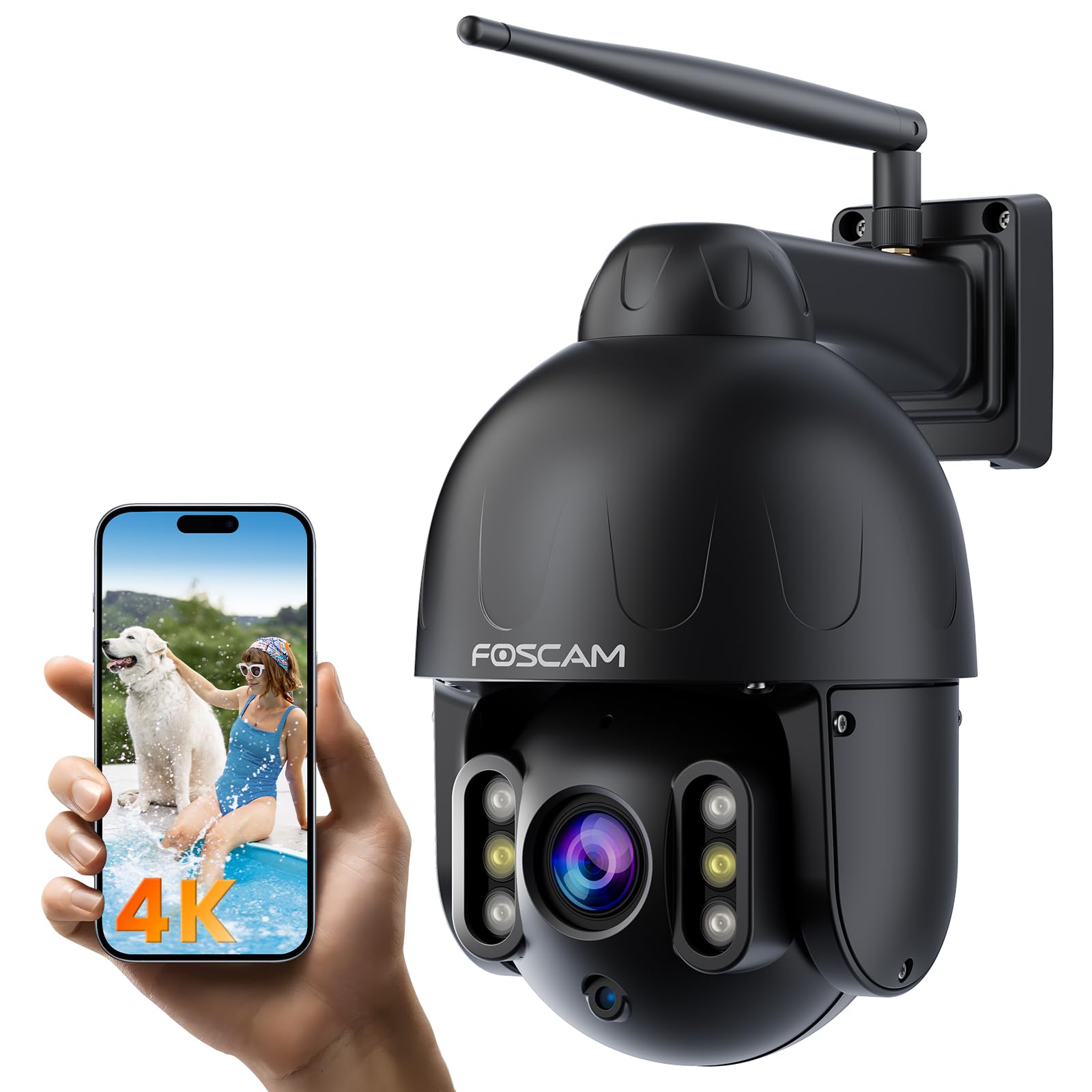
Twice the pixels of the Anpviz, and night vision that reaches 165 ft in color.
If sharp detail after dark is the whole point, this is the one. The sensor captures 8 MP at 3840×2160 — double the resolution of the Anpviz’s 4 MP — so faces, plates, and package labels hold up when you zoom in. Night vision reaches 165 ft versus the Anpviz’s 65 ft, and it does so in color thanks to a high-sensitivity CMOS sensor and bright spotlights. That’s the difference between a driveway camera and one that guards the whole yard.
The 4x optical zoom pairs with 360° horizontal and 90° vertical rotation, and unlike the Anpviz it actively follows a person once it spots them, then returns to its home position afterward. Recognition covers people, pets, vehicles, and parcels. Dual-band 2.4G and 5G WiFi lets it switch bands to hold a steadier link, and recordings can live on a micro SD card up to 512GB or an ONVIF recorder.
Owners single out the 4K image and the auto-tracking, and most find setup easy. The honest trade-off is WiFi itself: it’s a wireless camera, so a weak spot on your property is a weak spot in coverage. The two-way audio and smart-home hooks through Alexa and Google Assistant are handy, but the signal is the thing to plan around.
The standout spec: 8 MP at 3840×2160 outruns the Anpviz’s 4 MP, and 165 ft of color night vision doubles its infrared reach.
The catch to plan for: it leans on your WiFi, so placement near a strong signal matters more than any spec on the box.
Reach for this if: you want the sharpest picture and the longest color night vision of the three.
Look elsewhere if: your router can’t reach the mounting spot — a wired PoE camera will beat it on reliability.
3. Pyle PIPCAMHD46 Outdoor IP Camera

An entry-level PTZ dome with real glass zoom, if you can live with its limits.
Here’s the budget route into 4x optical zoom, and it’s a genuinely different proposition from the two above. Resolution sits at 960p — well under the FOSCAM’s 4K and below the Anpviz’s 4 MP — so detail softens faster when you punch in. Night vision reaches 75 ft via infrared, giving you a modest bump over the Anpviz’s 65 ft but nowhere near the FOSCAM’s 165 ft. Manage expectations accordingly.
The saving grace is the optics and the open standards. It’s a PTZ dome with a 4x optical lens and no digital distortion, and it meets ONVIF and H.264 streaming standards, so it talks to many NVRs and web applications. The metal housing carries an IP66 rating (sealed against rain) with a shaded anti-glare dome, and it adjusts pan and tilt remotely from the app.
Owners praise the picture quality most, and Pyle rates it for plate reading day or night. But be honest about two things before you buy. There is no SD card slot on this model, so you’ll need an NVR or cloud recording — the PIPCAMHD47 is the sibling that takes a card. And the software experience is uneven: reliability draws a genuinely mixed response, with the web interface sometimes freezing. That’s a fit issue for tinkerers, not a reason to dismiss the whole thing.
The real draw: 4x optical zoom and ONVIF/H.264 compatibility in a metal IP66 dome — the cheapest way into this category.
The honest limit: 960p resolution and no SD slot mean you need a recorder and a tolerance for softer detail.
Worth it for: a budget-conscious buyer with an NVR or cloud plan who just needs real optical zoom.
Pass if: you want crisp 4K detail or local SD recording without extra hardware.
Know the Specs
4x Optical vs Digital Zoom
Optical zoom moves a physical lens element to enlarge a distant subject without losing resolution. Digital zoom just crops and stretches pixels. A camera that advertises both — like the Anpviz’s “4x optical (16x digital)” — does the clear work with the lens and the fuzzy work with software. For reading a plate or a face, only the optical figure counts.
Night Vision Distance in Feet
Infrared night-vision distance tells you how far the camera can illuminate and see in the dark. It’s measured in feet and varies widely across this category. Match it to the depth of the area you’re guarding — a short driveway needs far less reach than a long yard.
PoE vs WiFi Connectivity
PoE (Power over Ethernet) sends power and data down a single cable to the camera, so there’s no nearby outlet needed and no wireless dropouts. WiFi cameras skip the cable but depend on signal strength at the mounting spot. Wired favors reliability; wireless favors an easy install where you can’t run cable.
ONVIF and NVR Compatibility
ONVIF is an open standard that lets a camera talk to recorders and software from other brands — Blue Iris, Synology, Milestone and the like. NVR is a network video recorder that stores your footage. If you already own a recorder, ONVIF support decides whether a new camera will plug into it or fight it.
Common Questions
What does 4x optical zoom actually do on an IP camera?
Do I need an NVR to use a PoE PTZ camera?
Is 65 ft of night vision enough for a driveway?
Can the Pyle PIPCAMHD46 record to an SD card?
What is ONVIF and why does it matter for compatibility?
Does the FOSCAM work with Alexa or Google Assistant?
Can the FOSCAM camera track a person automatically?
How do I power a PoE camera if I do not have a PoE switch?
What temperature range can these outdoor cameras handle?
Is higher resolution or longer night vision more important?
The Bottom Line
For most buyers wiring a camera into a recorder, the zoom 4x ip camera winner is the Anpviz 4MP PoE PTZ — a genuine 4x optical lens with 350° pan, single-cable PoE power, and ONVIF support that plays nicely with the recorders you already own. If sharp 4K detail and tracking a moving person matter more than a cable, the FOSCAM 4K/8MP brings 8 MP and 165 ft of color night vision. And if you just want real optical zoom on a budget and already have a recorder, the Pyle PIPCAMHD46 is your entry point.
The Anpviz takes the top spot on the strength of its owner ratings, which beat both rivals despite the FOSCAM’s bigger sensor.
How we choose
We do not accept paid placement. Every pick is matched to a real buyer and a real use-case; we do not hands-on test units.
Sources
Specifications: manufacturer listings and product documentation. Review insights: verified customer reviews. Pricing: not shown on this page (it changes often); check the current price via the retailer link.
As an Amazon Associate, Tactical Gear Guy earns from qualifying purchases. This does not affect which products we feature.