Specs are compiled from manufacturer listings and verified buyer reviews and can change over time — please confirm the key details on the product page before buying.
If you want one small kit that genuinely covers fire, water, light, and food gathering, the ESEE Mini-KIT is the pick worth buying. It packs 14 real pieces into a tin that measures 3.75 in. x 2.25 in. by 0.75 in. and weighs 4.8 ounces, so it slides into a glovebox or a pack pocket without you noticing it is there. The bigger question with any apocalypse kit is not how much gear you can pile up — it is whether the gear actually works when the power is out and your phone is dead.
This guide is built by comparing the manufacturers’ published specifications and the patterns across verified customer reviews, so you get each pick’s real strengths and trade-offs instead of marketing spin.
Below you will find three very different ways to prepare, from a pocket tin to a full 72-hour bag, plus a plain-English breakdown of what each one actually contains. Read on for the zombie apocalypse survival kit that matches how you actually plan to bug out.
Top Picks

How To Choose The Best Zombie Apocalypse Survival Kit
Most people overbuy gear and underbuy planning. A survival kit is only useful if you know what is inside it before you need it, and if it covers water, warmth, light, and the ability to signal for help. Decide first whether you are building a pocket kit, a car kit, or a full go bag — because each one solves a different problem.
Match the kit’s size and weight to where it will live
A tin the size of a deck of cards belongs in a glovebox, a jacket pocket, or the side pouch of a hiking pack. A full go bag that weighs 11.3 pounds is a different commitment — you carry it on your back or leave it by the door for an evacuation. Weigh the kit against how far you would actually have to carry it, and be honest with yourself about that distance.
Check whether fire, water, and light are all covered
These three do the most work in a real emergency. A ferro rod (a metal rod you scrape with a striker to throw sparks) gives you unlimited fire lighting without matches running out. A water filter lets you drink from a stream instead of rationing pouches. A light source keeps you working after dark. A kit that lists all three is a real kit; one that lists only a whistle and a blanket is a warm night, not a survival plan.
Know what is in the box before you buy it
A kit with a printed contents list lets you check that you can actually use every item. A “mystery” assortment hands the choosing to someone else, which can be fun as a gift but is a gamble as your primary plan. If a seller lists the pieces and the materials, they are telling you what they are selling.
Side-by-Side Comparison
| Model | Best For | Pieces | Weight | Fire, Water & Light | Amazon |
|---|---|---|---|---|---|
| ESEE Izula Gear Mini-KIT★ Best Overall | Glovebox and pack-pocket carry | 14 | 4.8 ounces | Ferro rod, fishing kit, Brite-Strike LED | Amazon |
| Seventy2 Survival System | Whole-household 72-hour evacuation | 35 | 11.3 pounds | Sawyer Mini filter, stormproof matches, fire-starter knife | Amazon |
| Doomsday Mystery Crate | Gifting and gear discovery | — | — | Assorted, listed only as a variety | Amazon |
Detailed Reviews
1. ESEE Knives Mini-KIT, Izula Gear Mini Survival Kit in Tin
Our pick — 4.5+★ from 150+ verified ratings; the strongest balance of quality and price.
A tin smaller than a deck of cards that still covers fire, water, light, and signaling.
This is the kit for the person who wants prep that disappears into daily life. The 14 pieces include a small ferro rod for spark-based fire lighting, a fishing kit, a Brite-Strike LED light, a button compass, snare wire, cordage, a small signal mirror, 4 tinder tabs, and a folding razor blade.
What wins people over is coverage rather than bulk. Buyers describe the contents as complete for the small stuff and genuinely useful across situations, and it makes sense: a ferro rod never runs out the way matches do, and snare wire plus a fishing kit means food gathering is addressed even if it is in a basic form. The whole thing weighs 4.8 ounces, so unlike the Seventy2 go bag below at 11.3 pounds, you will forget this is in your car until you need it.
The honest catch is the value math. This is the most-discussed sticking point in the review pages, and the split is fair — plenty of buyers find a kit this capable well worth it, while others look at a folding razor blade, some wire, and a little ferro rod and think they could assemble the same thing at the hardware store. That is a fair objection, and it is the one you should weigh before clicking buy. ESEE backs the set with 4.5+ stars across 160+ ratings, so the crowd lands on the positive side.
What earns the top spot
- 14 pieces cover fire, water, light, signaling, and shelter basics in one tin
- 4.8 ounces means it actually gets carried instead of left at home
- The tin itself works as a container and has a lid stamped with the Randall’s Adventure & Training logo
- The signal mirror and button compass tackle navigation and rescue signaling, not just comfort
Where the money is debatable
- Value splits opinion hardest of anything in the listing — some buyers see a fair package, others see gear they could assemble themselves
- The components are deliberately small: this is a backup layer, not a solo doomsday plan
- No first aid supplies or food and water are included
Reach for this if: you want one lightweight tin that covers spark-based fire lighting, water sourcing, light, and signaling for a car or pack.
Look elsewhere for: a full evacuation bag — this has no first aid, food, or shelter, so it pairs with a go bag rather than replacing one.
2. Seventy2 Survival System
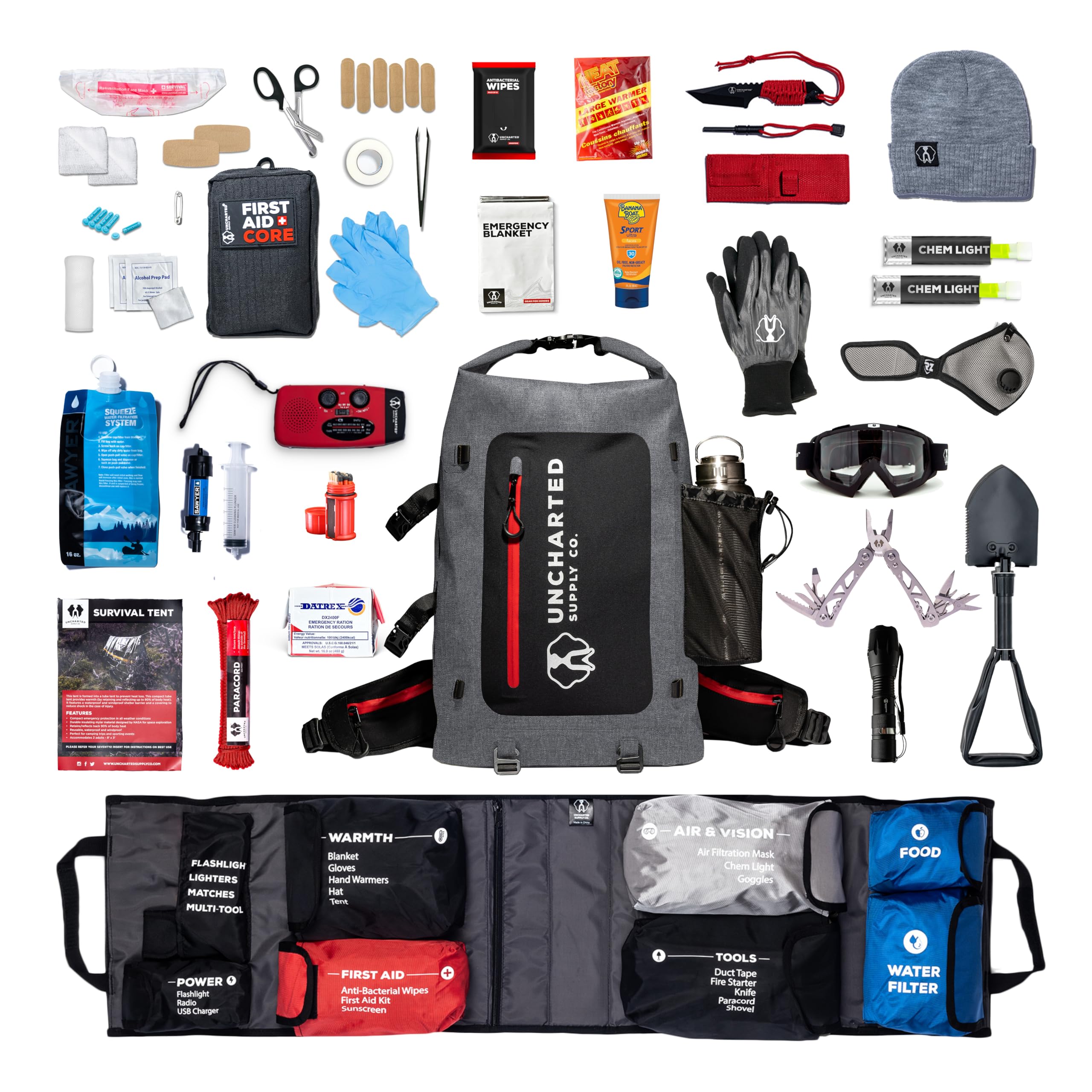
One bag that answers all three days, built for the person who wants to grab and go.
Thirty-five pieces is the number that defines this kit, and it is a different category of prep than the Mini-KIT above. You get a 2400-calorie food bar, 2 water pouches, and a Sawyer Mini water filter with a drinking pouch for staying hydrated beyond what you carry. Shelter and warmth come in the form of a survival tent, a mylar blanket, waterproof gloves, a beanie, and hand warmers. Tools and gear run from a folding shovel and multitool to a flashlight with batteries, paracord, duct tape, stormproof matches, a chem light, a whistle, an Empire knife with fire starter, and a crank radio that doubles as a flashlight and phone charger.
The organization is where this earns its place. Everything is packed into a waterproof backpack with internal compartments, and each item carries color-coded icons and step-by-step guidance so you are not blindly rummaging through a bag in the dark. The filtration mask and goggles cover the air side of a disaster too, which the compact tin simply cannot. A folding shovel alongside a survival tent means shelter is genuinely handled rather than improvised.
It weighs 11.3 pounds, so unlike the 4.8-ounce tin, this is a bag you strap on and carry, which is exactly the point for an evacuation. The kit holds 4.0+ stars across 30+ ratings — a smaller sample than the Mini-KIT’s, so treat the score as a directional read rather than a settled verdict. It is a Shark Tank-featured system designed with survival experts and first responders, built around the standard 72-hour evacuation window.
Why it earns the premium tier: the breadth is the selling point — first aid kit with 30+ pieces, SPF30 sunscreen, antibacterial wipes, air filtration mask, goggles, and a crank radio that charges a phone. That is a system, not a gadget.
The realistic trade-off: 11.3 pounds is a real load on your back, and this is built for one person. A household of four needs four bags, not one.
Best for: a household that wants a single grab-and-go bag for power outages, evacuations, and road emergencies where one person is the plan.
Think twice if: you need kit for a whole family or want something light enough for a bug-out walk — this is a car-and-home bag.
3. Doomsday Mystery Crate – Rugged Polymer Ammo Crate
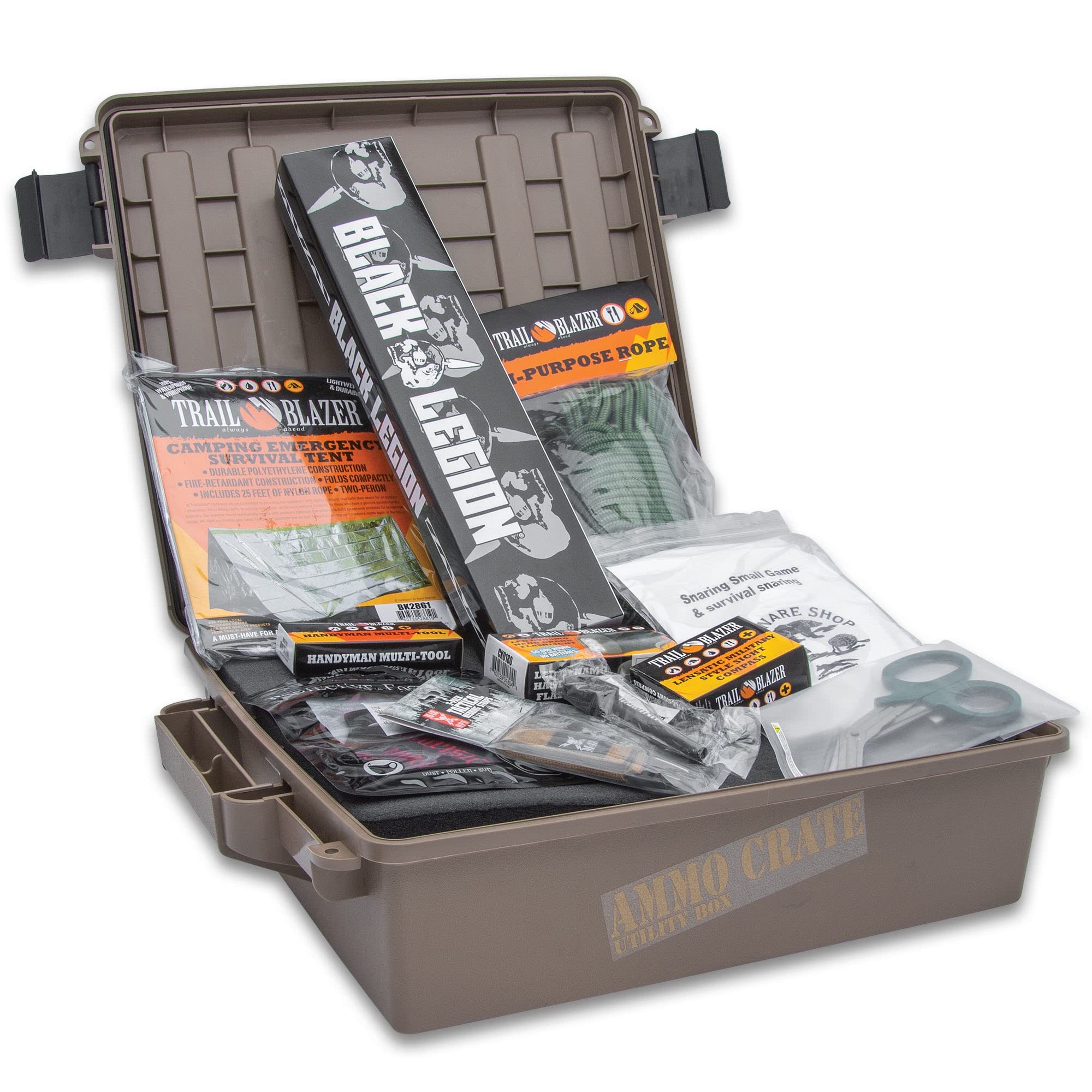
The unboxing gamble: a rugged polymer ammo crate stuffed with survival, outdoor, and emergency gear.
This one is simple to describe and hard to plan around. You get a rugged polymer ammo crate filled with an assortment of survival, outdoor, emergency, and bug-out gear — and the assortment is the entire concept. K EXCLUSIVE pitches it as turning a doomsday into an ordinary day, and as a gift for preppers or outdoorsmen the surprise is the fun. The listing describes every item as new, never opened, and premium quality.
Compared with the ESEE tin and the Seventy2 bag, the difference is certainty. Those two tell you exactly which ferro rod, filter, or flashlight you are getting, which is what you want as your actual emergency plan. This crate tells you the crate is polymer and the gear is a variety. If you already own gear, an unknown assortment can fill gaps you did not know you had — or duplicate the flashlight you already own twice.
Here is the part you need to hear straight. The 2.5+ star rating across a small handful of ratings is not a number that supports this as your primary survival kit, and the sample is small enough that it may not tell the whole story either. Buy it for what it clearly is: a durable polymer ammo crate with useful storage value plus a surprise pile of gear inside. Buy it for the crate and the gift moment, and keep your real prep on one of the two kits above.
The case for it: a rugged polymer ammo crate has lasting value as storage after the mystery gear gets sorted, and no-hassle gifting is a real use for the person who has everything.
What you are giving up: no contents list means no way to confirm fire, water, and light are covered before an emergency, and the rating here is the lowest of the three.
Buy it as: a gift for a prepper or outdoorsman who enjoys a surprise, or as a storage crate that comes with bonus gear.
Not as: the kit you bet your family on — a listed-contents kit like the Mini-KIT is the safer anchor.
Know the Specs
Piece count and what it really tells you
Piece count is the fastest way to compare kits, but it is not the whole story. The ESEE Mini-KIT’s 14 pieces cover fire lighting, fishing, light, compass, cordage, snare wire, signaling, tinder, and a cutting blade — a tight set where every piece does a job. The Seventy2’s 35 pieces add first aid, shelter, warmth, food, and water filtration. Read the list, not just the number: 35 duplicate pieces are worth less than 14 pieces of real coverage.
Weight and packed size for a bag you will actually carry
A kit you leave at home does nothing for you. At 4.8 ounces, the ESEE tin goes anywhere, which is why it suits a glovebox or a pack pocket. At 11.3 pounds, the Seventy2 is a load you plan around — you carry it from the house to the car at speed, or from the car to shelter. Neither is wrong; they solve different problems. Match the weight to how far you would realistically move on foot.
Common Questions
Is a small survival tin really enough for an apocalypse situation?
What does a ferro rod do that matches cannot?
How long does a 72-hour survival kit actually last one person?
Can I fly with a survival kit in my carry-on?
Is the Doomsday Mystery Crate a good first survival kit?
What should a survival kit contain for water?
How should I store a survival kit so it is ready to grab?
Does the Seventy2 come pre-packed or do I build it myself?
What is the difference between a bug-out bag and a pocket survival tin?
The Bottom Line
For most people building a zombie apocalypse survival kit, the ESEE Izula Gear Mini-KIT is the one to start with — 14 pieces in 4.8 ounces that cover fire, water sourcing, light, and signaling, all in a tin you will actually keep in the car. If your plan is a real evacuation with a household, step up to the Seventy2 Survival System for its 35 pieces, Sawyer Mini filter, and waterproof backpack. And the Doomsday Mystery Crate is the gift or the bonus crate, not the foundation. The one nudge worth making: the Mini-KIT carries the highest score of the three at 4.5+ stars, and that is the number to trust when you are choosing the kit your prep rests on.
How we choose
We do not accept paid placement. Every pick is matched to a real buyer and a real use-case; we do not hands-on test units.
Sources
Specifications: manufacturer listings and product documentation. Review insights: verified customer reviews, as of November 2026. Pricing: not shown on this page (it changes often); check the current price via the retailer link.
As an Amazon Associate, Tactical Gear Guy earns from qualifying purchases. This does not affect which products we feature.