Specs are compiled from manufacturer listings and verified buyer reviews and can change over time — please confirm the key details on the product page before buying.
Nicking a wire every time you snip a zip tie is the problem a purpose-built tool solves. A proper remover releases the locking pawl (the little ratchet tab inside the tie head) so you can reuse the tie. A flush cutter trims the tail flat, so no sharp stub is left to scratch you. The pick that gets this right most consistently is the Tsunoda KBN-150, a Japanese-made cutter that pulls the tie tight and shears it flat in one squeeze.
This guide is built by comparing the manufacturers’ published specifications and the patterns across verified customer reviews, so you get each pick’s real strengths and trade-offs instead of marketing spin.
Some tools here release a tie intact, others trim it for good, and a few do both. Below you will find the nine worth your bench space, matched to how you actually use them, in this breakdown of the best zip tie removal tool options.
Top Picks


How To Choose The Best Zip Tie Removal Tool
Start with the question that decides everything else: do you need the tie back, or do you need it gone? A remover lifts the locking tab so the same tie can be threaded again. A cutter shears the tail off for good. Buying a cutter when you needed an opener is the mistake that leaves you with a tool that never had a chance.
Opener or cutter — pick your job first
A remover works like a slim fork that slides under the tie head and frees the pawl. That saves you from clipping a tie you only just installed, and it keeps bundles intact when you need to add or pull a single cable. A cutter is the faster path when the tie is scrap and you just want the tail gone. If you work on both sides of that line, a kit that ships with both tools is the sensible buy.
Why flush cut is the spec worth chasing
A flush cut trims the tie level with the head, so nothing protrudes. A stub left standing is what snags a glove, scratches a panel, or scores a cable jacket on the next pull. Look for a tool whose blade sits flat against the tie head rather than one that bites at an angle — that single design detail is the difference between a clean bundle and a scratchy one.
Match the tool to the tie width you actually use
Tie width is measured in millimeters or inches, and a tool only handles the range it was built for. Light nylon ties sit at the thin end; heavy-duty and stainless ties need a beefier jaw and more leverage. Check the width range before you buy, because an oversized tie jammed in an undersized tool is how blades chip.
Tension control protects what you are bundling
A tensioning gun pulls the tie to a set tightness and cuts automatically once it gets there; adjustable models let you dial that pull back for soft insulation. Without that control, a strong hand can crush a cable or crack a conduit. If you bundle delicate wire, adjustable tension is what stops the gun from crushing insulation.
Side-by-Side Comparison
| Model | Best For | Type | Length | Tie / Cut Capacity | Amazon |
|---|---|---|---|---|---|
| Tsunoda KBN-150★ Best Overall | Flush cutting and tightening in one squeeze | Pull-and-cut cutter | 6 inches | Tie up to 0.31-inch width | Amazon |
| DURATECH 8-Inch Zip Tie ToolBest Value | Tightening and cutting nylon ties on a budget | Tensioning gun | 8 inches | Tie widths 0.1 to 0.4 inches | Amazon |
| Lasnten 2 Pcs Remover OpenerBest for Reuse | Releasing plastic and nylon ties intact | Opener (2-pack) | 3.7 inches | Plastic and nylon ties | Amazon |
| Lasnten 3 Pcs Cable Tie Tool Set | One kit for tightening, cutting and releasing | Tightener + cutter + opener | 3.7 inches | Tie width under 0.37 inch | Amazon |
| TR Industrial Cable Tie Cutters | Clean cuts without nicking bundled cables | Flush cutter | — | Nylon cable ties | Amazon |
| OFFO Metal Cable Tie Gun | Stainless steel ties and repetitive fence work | Tensioning gun | 8.2 inches | 12 mm cutting width | Amazon |
| Zhushan Cable Tie Gun | Wide tie range with adjustable tension | Tensioning gun | 165 mm | Nylon ties 2.4 to 12 mm | Amazon |
| Jonard Tools CTG-1000 | Heavy-duty ties with staged tension control | Tensioning gun | 6 inches | Ties up to 3/16 inch wide | Amazon |
| ACT Cable Tie Removal Tool (2-Pack) | All-day production line removal without wire damage | Remover (2-pack) | — | Ties 18 lbs to 250 lbs tensile | Amazon |
Detailed Reviews
1. Tsunoda KBN-150 Pull & Flush Cut Zip Tie Cutter
Our pick — 4.5+★ from 850+ verified ratings; the strongest balance of quality and price.
The 6-inch Japanese cutter that pulls a tie tight and shears it flat in one motion.
You get two jobs out of one squeeze here: pull the tail to tension, then cut it dead flat. The blade shears ties up to 0.31 inch wide, which covers the everyday nylon ties in most drawers and then some. That flat cut matters because nothing is left standing to snag a glove or scratch a panel. Your bundle ends up neat instead of scratchy.
The jaw is not limited to plastic, either. The listed cutting capacity runs to soft iron 14, copper 10, strand copper wire 10, brass 12 and plastic 4mm, so the same tool trims a stray wire when you need it to. The grip is a hard PVC handle, which stays planted in a dry hand and gives you a firm squeeze point for tightening. At 135 g it sits light enough to keep in a pouch all day.
Quality is the thing that wins people over, and it is what the maker leans on with the Japan build and a 6-inch overall length that fits a standard toolbox slot. The honest trade-off is the hard handle: it rewards a firm hand but offers little padding, so long sessions on soft insulation are where a cushioned grip would be kinder. This is a cutting tool first, so if you need to release a tie intact, pair it with an opener.
What earns it the top slot
- Flush cut leaves no sharp stub, so bundles stay safe to handle.
- Tightens and cuts in a single squeeze — no second tool needed.
- Cuts soft iron 14 and copper 10, not just plastic ties.
- Light 135 g body in a hard PVC grip that stays planted.
Where it asks a little of you
- Hard handle gives little padding on long jobs.
- Cuts only — it will not free a tie you want to reuse.
Bench-ready pick: anyone who trims ties flush all day and wants one tool to tighten and cut.
Pair it up: it cuts only, so add an opener if reusable ties are part of your routine.
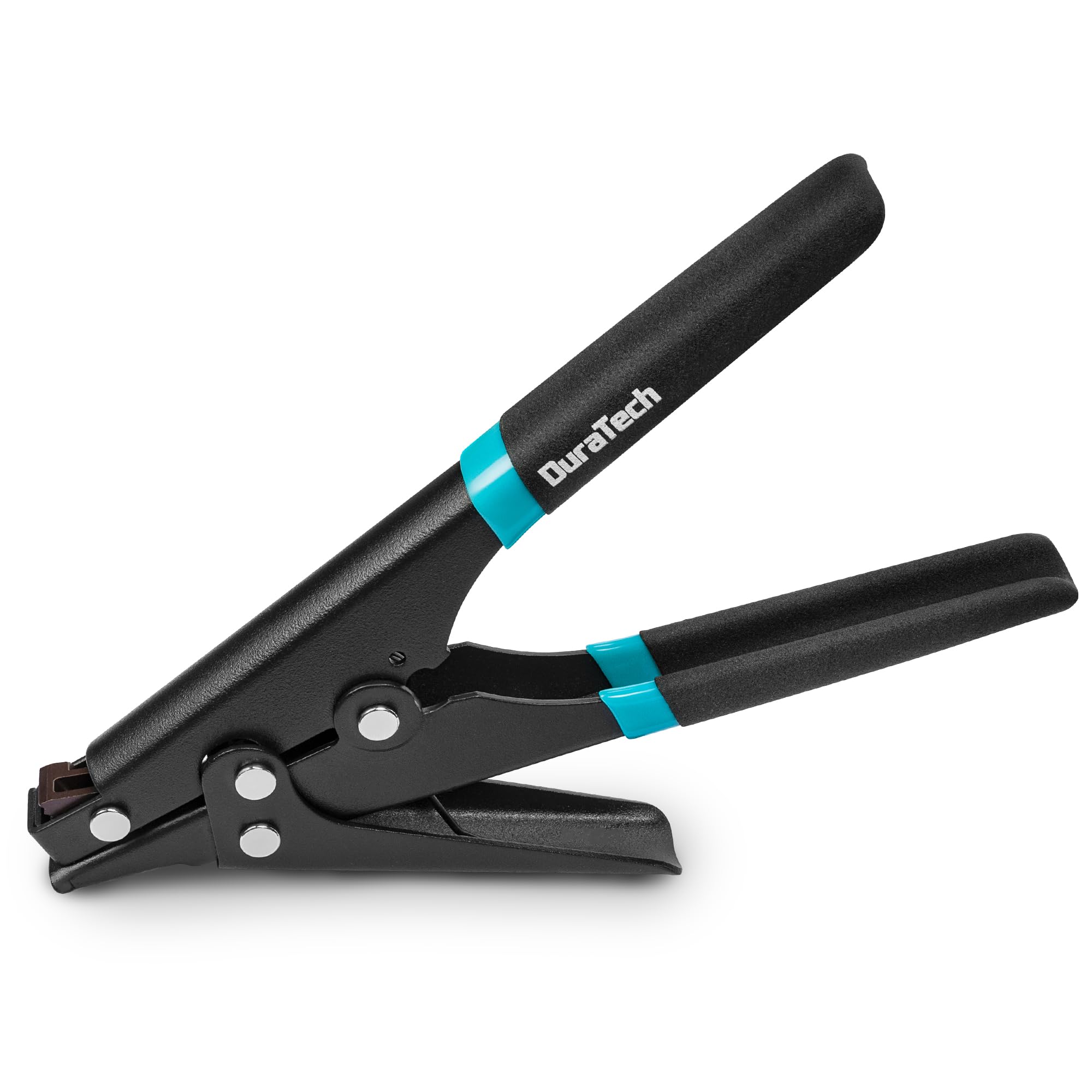
2. DURATECH 8-Inch Zip Tie Tool, Cable Tie Gun
Eight inches of alloy-steel leverage for the tightener who wants a cut without the fuss.
This is a tensioning gun first. You feed the tie in, squeeze to pull it to the tension you want, then push the cutoff lever and the excess drops off. The alloy steel body runs 8 inches long, so you get real leverage on a stubborn tie without fighting it. A black powder-coated finish adds rust resistance, which matters if the gun lives in a damp garage or a truck box.
Compatibility runs from 0.1 to 0.4 inches in tie width, a range that takes small nylon ties right up to heavier ones. That is a wider band than a lot of guns allow, and it means one tool covers the drawers, the shop and the yard. Quality and value are what buyers keep coming back to, and the ergonomic handle is shaped to keep tensioning accurate rather than fumbling.
One honest note from the field: the gripping plate that does the tightening earns mixed reactions, so a few users find it does not always grab. That is worth knowing if you tighten a lot of heavy ties under tension — check the tie is seated before you squeeze. For light to medium nylon work, this is the value pick and it does the job cleanly.
The pull-and-cut logic: lever tensioning plus a separate cutoff push keeps each motion clean and repeatable, which is easier to control than a single squeeze on delicate bundles.
The one caution: the gripping plate engagement is the recurring gripe, so seat the tie fully before you pull.
Grab it for: budget-minded tightening and trimming on nylon ties from 0.1 to 0.4 inches.
Look elsewhere if: you regularly tighten heavy ties under high tension, where plate grip matters most.
3. Lasnten 2 Pcs Cable Zip Tie Remover Opener Release Tool
A slim fork that lifts the lock and hands your zip tie back, uncut and reusable.
Here is the reuse tool: two openers, each 3.7 inches long, plus a storage box so they do not vanish into the bottom of a bag. You slide the tip under the tie head, free the pawl, and the tie comes loose in the same shape it went on. That saves you from buying fresh ties every time you add a cable. It also spares your hands the hunt for a knife to hack a tie off.
It slips into a tool box pocket at just 3.7 inches long. In practice, this one suits standard plastic and nylon ties, not bulky straps.
Functionality is a mixed bag by the company’s own read of reviews — some find it frees ties easily, others find it hard to operate on tight heads. Value also draws complaints from buyers who expected more. The honest framing: this is a good fit for light reuse on plastic and nylon ties, and a poor one for metal ties, which the listing says it struggles with. It works best when you keep the tie range and material in mind.
The reuse win: freeing a tie instead of cutting it keeps a bundle intact and saves the cost of replacements over a season of small jobs.
The real limit: it is built for plastic and nylon ties and is not the tool for metal ties or heavy straps — match it to the tie in your hand.
Best for the reuse-minded: hobbyist and light-duty users who loose plastic or nylon ties and thread them again.
Skip if: you are working metal ties or heavy strap widths that need a bigger jaw.
4. Lasnten 3 Pcs Cable Tie Tool Set with Storage Box

Three tools in one box: tighten a tie, cut it, or free it — your call.
This is the set for the person who does not yet know which job will show up next. You get a tightening and cutting tool, an opener to release ties intact, and a storage box that keeps the small parts together. One purchase covers tightening, cutting and releasing ties around the house, the shop or the garden.
It handles nylon ties under about 0.37 inch wide and under about 0.1 inch thick, so typical bags, pipes and wire bundles all fit. The set is built for hands-on jobs like fixing pipe runs, sealing bags and tying off fruit. Its mix of high carbon steel, stainless steel, silicone and plastic keeps the weight low. The opener carries a 2.2-inch maximum diameter, so it reaches wider than the smaller 2-piece opener in this guide.
Where the 2-piece version gives you two openers and nothing else, this set puts three tools in your hand for the same task family. It suits a first-time buyer who wants a tightener, cutter and opener in one box rather than a single blade. If you already know you only ever cut ties, a dedicated flush cutter will feel sharper and simpler.
The all-in-one case: tightener, opener and box together ends the frustration of a drawer full of half-solutions and keeps small parts from going missing.
The honesty clause: a multi-tool set trades a little specialty sharpness for range, so if your work is purely flush cutting, a dedicated cutter wins on feel.
The fresh-start kit: a newcomer who wants to tighten, cut and release without buying three separate tools.
Think twice if: your only job is flush cutting all day and you want maximum sharpness in one blade.
5. TR Industrial Cable Tie Cutters

The snips that slip behind the tie instead of digging into the cable.
A smart blade design is the whole pitch here. The jaw seats behind the tie so the edge slices the strap rather than the bundle, which is how you cut a tight tie without nicking a wire. No jagged edges, no frayed ends — the cut comes off clean enough that a bundle stays tidy and safe to grab. Owners single out that blade placement as the reason the cut stays clean on tightly secured ties.
Weighing 5.9 ounces, it is light enough to keep on a peg board and swing all afternoon. An auto-return spring opens the jaw after every cut, so you are not fighting it between ties, and a safety-lock latch keeps the blade closed when the tool is in a bag. At 6.77 inches long it fits a standard grip.
What wins people over is cut quality on tightly secured ties — the blade nips through them without scoring the cable underneath. That is the exact scenario this tool was shaped for, and it holds up across repeated use. The main trade-off is that it cuts only; it will not free a tie for reuse. Buy it to remove ties, not to recover them.
Where it shines: tight, awkward ties on bundled cables — the blade backs them off without touching the wire beneath.
Know before you buy: this is a pure cutter, so pair it with an opener if reusable ties are on your list.
Reach for this if: you snip ties constantly and want a clean, non-damaging cut every time.
Not your tool if: you need to release and reuse ties rather than destroy them.
6. OFFO Metal Cable Tie Gun

An 8.2-inch gun that tightens and cuts stainless steel ties without throwing sparks of sharp edge.
Steel ties are the hard case, and this gun is aimed straight at them. It fastens and automatically cuts stainless ties with adjustable bundling pressure, so the cut comes off clean instead of leaving a razor edge you could catch a finger on. The 8.2-inch length gives it reach over a fence run or a heavy bundle, and the trigger pull is designed to keep pressure steady across a long job.
The blade is SKD11 steel, chosen for high hardness and wear resistance, and the handles are TPR — a rubbery grip that resists slipping when your hands are hot or wet. That combination is what lets it stay comfortable across repeated ties. The cutting width is listed at 12 millimeters, so check your tie size before committing. It handles self-locking and stepped ties as well.
Here is where it beats the smaller Lasnten set for real leverage: at 8.2 inches long, it brings noticeably more reach to heavy work than that 3.7-inch opener kit. It is built for fence and yard work, where the clean cut on stainless ties is why people keep it. The catch is that its edge is tuned for the heavy end — for tiny indoor nylon ties, a small light cutter feels more precise.
Built for the heavy stuff
- Fastens and auto-cuts stainless steel ties cleanly.
- Adjustable bundling pressure guards against over-tightening.
- SKD11 blade holds up under repeated steel cuts.
- TPR handles stay grippy when hands are hot or wet.
The heavy-end trade-off
- 12 mm cutting width means checking bigger ties first.
- Tuned for steel and heavy bundles, so it feels bulky on tiny indoor ties.
The steel-tie workhorse: fence crews and anyone bundling with stainless ties who wants clean cuts and steady tension.
Overkill if: all your ties are small indoor nylon and you want something lighter in hand.
7. Zhushan Cable Tie Gun
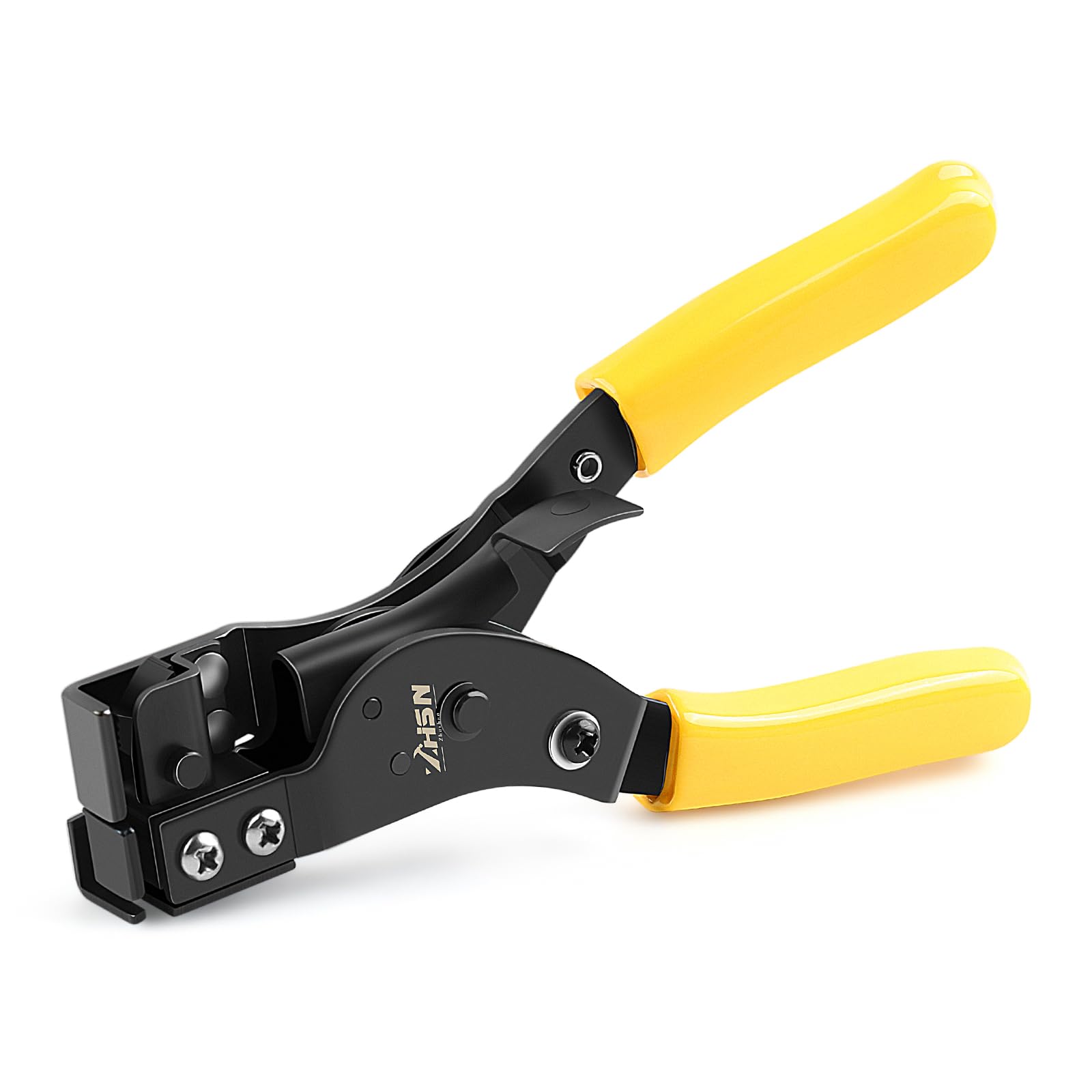
One pistol-grip gun that spans 2.4 to 12 mm nylon ties with a tension dial.
The span is the selling point. This gun takes nylon ties from 2.4 mm up to 12 mm wide, so a single tool covers the thin ties on a desk job and the chunky ones on a construction run. The adjustable tension dial lets you dial the pull down for soft cables, and the flush cut trims the tail for a finish that will not snag. The metal body keeps it rigid under the pull.
At 165 mm long and 0.25 kg, it sits light enough to keep in hand for a shift. Handling is meant for comfort — an ergonomic pistol grip, and a 12-month warranty backs the build. It is aimed at electrical installs, industrial manufacturing, state grid work and underground cable, so the design leans toward repeated use.
Functionality is strong, but tension adjustment, flush cut and durability each draw mixed reactions in the reviews. Some buyers report the pull keeps ties fairly tight and the cut does not sit perfectly flush. A few report the blade breaking early. For mixed day-to-day tie work, it holds up. If your job demands a dead-flat cut every single time, though, a dedicated flush cutter in this guide is the more certain bet.
What it does well: one gun for the whole tie drawer, from 2.4 mm to 12 mm, with a tension dial that respects soft insulation.
The mixed reviews: the cut is not always dead flush and a few blades fail early — treat it as a capable generalist rather than a precision flush trimmer.
Choose this for: a mixed workload where tie sizes vary and you want one gun and a tension dial.
Want certainty on the cut? A dedicated flush cutter gives a flatter finish every time.
8. Jonard Tools CTG-1000 Heavy Duty Cable Tie Gun

Four tension settings and an automatic flush cut once the pull hits the mark.
The idea is simple and it works: set the tension knob to one of the 4 levels (0 to 3), pull the tie to that tension, and the gun flush cuts automatically once it gets there. That removes the guesswork that crushes soft cable, and it means a whole crew can match tightness on the same job. The flush cut prevents the sharp edges that catch on fingers and gear.
It handles standard and heavy-duty ties up to 3/16 inch wide, so it covers bigger straps than a light trimmer. At 10.72 ounces and 6 inches long, it feels substantial in hand without being clumsy. Precision-engineered parts keep the action smooth, and the ergonomic handle shape is meant for comfort over long repeats.
Compare it to the DURATECH gun above: both tighten and cut, but the Jonard adds staged 0-to-3 tension control and takes ties up to 3/16 inch, while the DURATECH works a 0.1 to 0.4 inch tie range. That staged control is the reason to step up if consistent tightness matters. The catch is its overall footprint and weight make it less of a pocket tool than a small opener.
The crew feature: four numbered tension stops let you keep tightness uniform across every tie in a run.
Size note: the 10.72-ounce body is built for bench and panel work, not a shirt pocket.
Built for consistency: installers who need every tie in a run pulled to the same setting.
Reconsider if: you want a tiny pocket tool and never bundle wider than 3/16 inch.
9. ACT Cable Tie Removal Tool (Pack of 2)

Guarded blades that slide behind the strap so the wire underneath survives the cut.
Two safety guards are the whole trick. They slide behind the tie strap before the blade ever bites, so the cut lands on the tie and not the cable. On a bundle you cannot afford to open up, that guard is the reason this tool exists. A cushion grip rests in the hand naturally to keep the squeeze motion comfortable across all-day work.
The blades are heat-treated forged alloy steel at Rockwell 53 to 58 Rc — a hardness spec that speaks to edge holding under repeated cuts. It works on ties from 18 lbs up to 250 lbs tensile strength, so the same tool frees a light wire tie and a heavy strap. The two-pack means one can live in the bag and one at the bench.
Quality and wire protection are what the tool is known for — it clears tightly fastened ties fast and leaves cables untouched. The honest counterweight: at the top of this group it costs the most, and the grip durability earns mixed notes, with the plastic and rubber grip coming off over time on some units. For a working pro cutting hundreds of ties a week, that guard and the hardness are worth the outlay; for occasional home use, a simpler opener is plenty.
Why pros pay up: guarded blades mean the wire behind a tight tie stays intact, which is the costliest mistake this tool prevents.
The wear note: some grips loosen over time, so treat the cushion sleeve as the part that ages first.
For the working pro: technicians cutting 18-to-250-lb ties all day who cannot risk a nicked cable.
Home users: a simpler opener covers light reuse far more cheaply than this guarded pair.
Know the Specs
Flush cut vs. angled cut
A flush cut trims the tie level with its head so nothing sticks out. An angled cut leaves a stub that can snag or scratch. When a listing says “flush cut,” it is promising the flat trim — the feature that keeps a bundle safe to handle.
Tie width and diameter capacity
Tools are rated by the tie width they accept, in millimeters or inches, and openers by a maximum diameter. Match that number to the ties in your drawer: a 0.31-inch cutter and a 12 mm gun cover different worlds, and an oversized tie jams an undersized jaw.
Adjustable tension
A tensioning gun pulls a tie to a set tightness and then cuts. Adjustable models let you dial that pull down for soft insulation, so you do not crush a cable. Staged settings such as 0-to-3 make it easy to repeat the same tension across a whole run.
Tensile strength range
Ties are sold by tensile strength in pounds — the pull they hold before failing. A removal tool rated for a wide range, like 18 lbs to 250 lbs, frees light wire ties and heavy straps with the same edge. Check the range if you work across both ends.
Common Questions
Will a zip tie removal tool let me reuse the same tie?
What does a flush cut actually do that a knife does not?
Can these tools cut metal or stainless steel cable ties?
How do I pick the right tie width for my tool?
Is a tensioning gun better than hand-tightening zip ties?
Will these cutters nick the wires inside a bundle?
Do I need a left-handed or ambidextrous model?
What is the difference between a cable tie gun and a pair of flush cutters?
Which tool is best for heavy 250-lb cable ties?
Will a zip tie opener damage the tie if I want to reuse it?
The Bottom Line
Start with the Tsunoda KBN-150. It tightens and flush cuts in one squeeze, so you get a clean, safe bundle, and it carries the strongest owner reputation in this group at 4.5+ stars across 800+ ratings. If you need to release ties intact instead, the Lasnten 3-piece set gives you a tightener, cutter and opener in one box. For stainless steel ties and fence work, the OFFO Metal Cable Tie Gun is the one built for the heavy end. Match the tool to the tie: an opener for reuse, a flush cutter for permanent removal, a tensioning gun for steel.
How we choose
We do not accept paid placement. Every pick is matched to a real buyer and a real use-case; we do not hands-on test units.
Sources
Specifications: manufacturer listings and product documentation. Review insights: verified customer reviews, as of November 2026. Pricing: not shown on this page (it changes often); check the current price via the retailer link.
As an Amazon Associate, Tactical Gear Guy earns from qualifying purchases. This does not affect which products we feature.