Specs are compiled from manufacturer listings and verified buyer reviews and can change over time — please confirm the key details on the product page before buying.
The short answer: buy the sensor that reports both temperature and humidity accurately and pairs with the hub you already own. Everything else — screens, buttons, phone apps — is secondary. This guide covers nine Zigbee temperature sensors, from tiny battery-only pucks to large LCD displays you can read from across the room, and explains in plain words which one belongs in your hallway, greenhouse, or server closet.
This guide is built by comparing the manufacturers’ published specifications and the patterns across verified customer reviews, so you get each pick’s real strengths and trade-offs instead of marketing spin.
You can add any sensor below without handing over your Wi-Fi password. Each one speaks Zigbee (a low-power wireless language that lets small battery devices talk to a hub). What separates them is accuracy and how often they report, so match those two things to the room you plan to monitor. That is how the picks below sort out the best zigbee temperature sensor for your setup.
Top Picks

How To Choose The Best Zigbee Temperature Sensor
Most buyers assume any Zigbee sensor will just work. In practice, three things decide whether you love yours or box it up: which hub it speaks to, how accurate its readings are, and whether it has a screen you can read without opening an app. Get those three right and the rest is decoration.
The hub you own decides half the shortlist
A Zigbee sensor is only as useful as the bridge it talks to. Some models pair happily with SmartThings, Home Assistant, Hubitat, and Echo speakers with a built-in Zigbee radio. Others, like the Aqara line, need their own branded hub before they will show you anything. Check your hub’s compatibility list before you buy — an unlisted sensor is a guess, not a guarantee.
If you use Home Assistant, note that some sensors prefer the Zigbee2MQTT integration over ZHA for full feature access. That is a setup detail, not a dealbreaker, but it saves an evening of head-scratching if you know it going in.
Accuracy is a number, not a feeling
Look for the temperature accuracy figure written as a plus-or-minus value, like ±0.2°C or ±0.5°C. A smaller number means the reading sits closer to the truth. For a hallway thermostat or a plant shelf, ±1°C is fine. For a wine cellar, a humidor, or a greenhouse where a degree swings a crop, the tighter ±0.2°C to ±0.3°C sensors earn their place.
Humidity accuracy works the same way — ±2%RH is tighter than ±3%RH — and it matters more than most people expect in bathrooms and basements.
Screen, battery, and where it lives
A sensor with a large LCD display is wonderful in a hallway because anyone can glance at it. But that screen draws power, and a sensor that refreshes every 5 seconds will empty its batteries faster than a tiny puck that only pings the hub. Match the display size to the room, and match the battery type — AAA cells you can swap at the supermarket versus a coin cell — to how much hassle you want every couple of years.
Side-by-Side Comparison
| Model | Best For | Temp Accuracy | Power | Display | Amazon |
|---|---|---|---|---|---|
| Shelly BLU H&T ZB★ Best Overall | Outdoor & humid spots | ±0.5°C | 3V battery | None | Amazon |
| THIRDREALITY Sensor LiteBudget Champion | Budget-friendly monitoring | ±0.3°C | 2 × AAA | None | Amazon |
| SONOFF SNZB-02WDBest for Wet Rooms | Greenhouse & bathroom | — | Lithium | LCD | Amazon |
| Aqara T1 | HomeKit households | ±0.3°C | Coin cell | None | Amazon |
| THIRDREALITY LCD | Visible on-device readout | ±1°C | 2 × AAA | LCD | Amazon |
| Shelly BLU H&T Display ZB | Light-aware automation | ±1°C | Battery | E-Paper | Amazon |
| SONOFF SNZB-02DR2 | Large-display multi-room | ±0.2°C | 2 × AAA | 3.6″ LCD | Amazon |
| Haozee 3-Pack | Covering several rooms | — | Button cell | None | Amazon |
| Aqara W100 | Climate control hub | ±0.2°C | 2 × CR2450 | 3.4″ LCD | Amazon |
Detailed Reviews
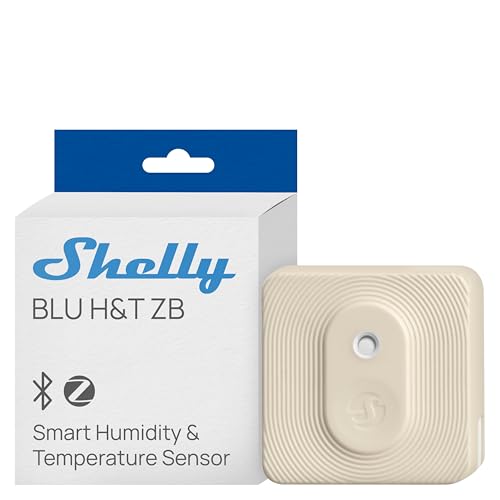
1. Shelly BLU H&T ZB Ivory Temperature & Humidity Sensor
Our pick — 4.0+★ from 150+ verified ratings; the strongest balance of quality and price.
An IP54-sealed sensor you can mount outdoors or beside a sink and forget about.
The number that wins this pick is the IP54 rating — a dust and splash-resistance grade that means you can mount it outdoors or beside a bathroom sink without worrying. Most sensors this small are indoor-only. This one survives a damp windowsill or a greenhouse shelf. At 13 g it is genuinely tiny, and it weighs about as much as a couple of AA batteries.
It talks both Bluetooth and Zigbee, and it runs on a 3V battery with a stated accuracy of ±0.5°C (half a degree Celsius — close enough that your heating schedule won’t chase a ghost). The upper temperature ceiling reaches 140°F, so a hot attic or a sun-baked shed is within its range. The maker includes a 3-year warranty and needs a Shelly gateway or any Shelly Plus, Pro, or Gen3 device to reach the app.
Here is the trade-off you should hear before buying: there is no screen at all. You read it entirely through the app, and the app needs a Shelly gateway to see it. If your smart home already runs on Shelly gear, this is a natural fit. If it runs on SmartThings or Hubitat, check the pairing list carefully first. This pick earned 4.0+ stars across 150+ ratings — one of the highest scores on this list.
What earns its keep
- IP54 sealing lets it live outdoors and in splash-prone rooms
- 13 g body hides almost anywhere without a bracket
- Zigbee plus Bluetooth gives you two paths to connect
- 3-year warranty from the maker
Where it pins you down
- No LCD — you need the app to read anything
- Needs a Shelly gateway or Shelly Plus/Pro/Gen3 device
- ±0.5°C is looser than the ±0.2°C leaders on this list
Pick this for: an existing Shelly home that wants weather-sealed monitoring outdoors or in wet rooms.
Think twice if: you have no Shelly gateway — you would need one to see readings.
2. THIRDREALITY Zigbee Temperature and Humidity Sensor Lite
Two AAA batteries, a Sensirion sensor, and years of quiet monitoring for pennies a month.
For a first Zigbee sensor, this is the one to open first. It runs a Sensirion sensor — a brand name that shows up in serious climate gear — with ±0.3°C temperature accuracy from -15°C to 50°C and ±2% humidity accuracy across the full 0–100% range. That combination is the same territory as sensors that cost noticeably more.
The batteries are the practical win here. Two AAA cells give at least 2 years of normal use, and AAA cells are the ones you can buy at any corner shop. Not every sensor on this list gives you that convenience. The 3M-rated adhesive backing means you can stick it on a wine cellar wall, a nursery shelf, or a plant tent without drilling a hole.
The catch: there is no screen and no display of any kind. You read it entirely through an app, and the Alexa app only shows temperature, not humidity. If you want to glance at a number on the wall, this is not that sensor. If you want a reliable, cheap, battery-you-can-replace monitor, it fits. Verified owners say it works right from the start and survives being tucked inside a freezer.
Why it earns the budget crown: ±0.3°C accuracy, a Sensirion sensor, and 2 AAA batteries that last years — without the price of the premium picks.
One honest note: Alexa’s own app strips out humidity, so if you rely only on Alexa, you will see half the data.
Reach for this if: you want accurate readings and swappable batteries without fuss.
Look elsewhere if: you need a visible on-device number.
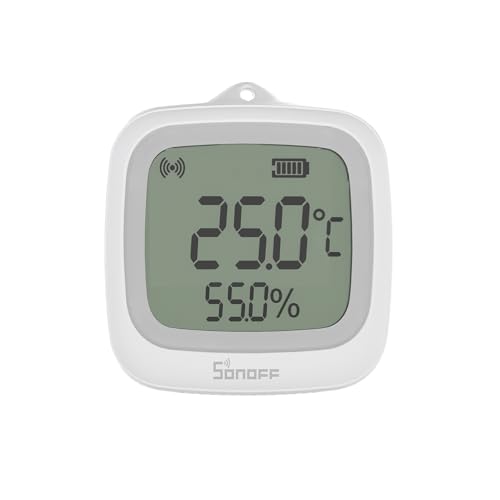
3. SONOFF SNZB-02WD Zigbee Sensor
An IP65 LCD sensor with a breathable membrane, built for greenhouses, bathrooms, and damp corners.
IP65 is the headline spec — a rating that means water jets and dust will not get inside. That is why this sensor suits bathrooms, greenhouses, and warehouses where humidity runs high. It also has a breathable membrane that keeps moisture from fogging the internal sensor, so the readings stay steady even when the room is steamy.
The LCD shows real-time temperature and humidity on the device, and the app adds chart export if you like tracking trends over weeks. Mounting is flexible: a magnet holds it to a fridge or frame, or you can hang it from the included rope. It measures 5.85 cm long and weighs 65 g, so it is a palm-sized puck, not a wall panel.
The honest split here is accuracy. This sensor’s temperature readings hold up, but the humidity reading is the recurring weak spot — several buyers report it drifts. What wins most people over is the thing it does best: it just works. Owners pair it with SmartThings and Home Assistant and use it in basements, garages, and grow rooms. If you are logging exact RH values for a lab, look at the ±2% picks instead. If you want a tough sensor that lives where other sensors won’t, this earns its place.
Best for humid spaces: bathrooms, greenhouses, and garages that would ruin a bare-bones indoor sensor.
The honest gap: humidity readings drift more than the tightest sensors on this list, so treat RH as a guide rather than a measurement.
4. Aqara Zigbee Temperature and Humidity Sensor T1

A 30 g puck that reports temperature, humidity, and air pressure for Aqara Hub and HomeKit households.
The third reading is what separates it. Where most sensors stop at temperature and humidity, this one also reports air pressure in real time through the Aqara app. If your HomeKit setup already runs on an Aqara hub, this is a natural companion, and it can trigger fans or humidifiers through Aqara smart plugs.
Accuracy is genuinely tight: ±0.3°C across -15°C to 50°C (-4°F to 122°F) and ±3% humidity from 0–100%. At 3.6 cm long and 30 g, it is small enough to tuck on a shelf or wall corner, and the 3M adhesive makes placement tool-free. Aqara states up to 2 years of battery life from the included coin cell.
Now the part that makes or breaks the purchase: it needs an Aqara Hub, sold separately, and a secure 2.4GHz Wi-Fi connection. It is not compatible with hubs from other brands — so on a SmartThings or Hubitat network, it will not connect. If you already have an Aqara hub, this is an easy yes. If you don’t, factor in the hub before you buy.
What wins the sale: three sensors in one body — temperature, humidity, and air pressure — with the tight ±0.3°C accuracy that a serious climate log needs.
What to plan for: it stays locked inside the Aqara ecosystem, and the hub is a separate purchase.
Right pick for: an existing Aqara Hub owner who wants pressure data alongside temperature and humidity.
Fair warning: without an Aqara hub, this sensor will not talk to your network.
5. THIRDREALITY Zigbee Temperature and Humidity Sensor

An LCD sensor that shows temperature, humidity, and battery level on the device itself.
The LCD is the reason to pick this. It shows temperature, humidity, and battery level, refreshing every 20 seconds so you are never reading a stale figure. For a hallway, hallway-adjacent kitchen, or any room where you glance rather than tap, that is genuinely useful in a way no app can replace.
It speaks Zigbee 3.0 and pairs with Echo speakers with a built-in Zigbee hub, SmartThings, Home Assistant, Hubitat, and more. Two AAA batteries stretch to about a year of typical use, and the freestanding design lets you just set it on a shelf. Temperature accuracy is ±1°C from -10°C to 50°C (14°F to 122°F), and humidity is ±2% from 0–95%. The function that keeps people happy is the pairing — it just works across a wide list of hubs.
Here is the honest limitation: ±1°C is the loosest accuracy on this list. For comfort monitoring in a living room, that is fine. For a wine cellar or a lab log, ±0.2°C or ±0.3°C sensors do a better job. Owners appreciate the readable display and stable battery indicator, and for the many homes where ±1°C is plenty, this earns its place.
Why owners keep it
- LCD shows temperature, humidity, and battery level at a glance
- Refreshes every 20 seconds — you are not reading stale data
- Wide Zigbee 3.0 hub compatibility, including Echo with built-in Zigbee
- AAA batteries last about a year
What to weigh honestly
- ±1°C accuracy is the loosest on this list — fine for comfort, not for logging
- Alexa’s app shows temperature only, not humidity
Go for it if: you want the reading visible on a shelf, not buried in an app.
Keep looking if: your use case is precision logging where a degree matters.
6. Shelly BLU H&T Display ZB Black Sensor
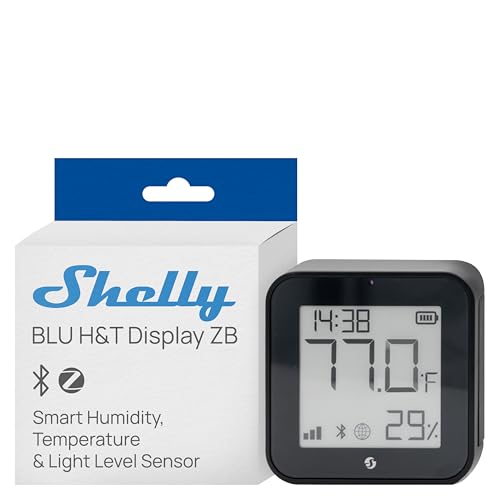
An e-paper display that shows temperature, humidity, light level, and time without draining the battery.
Most sensors here measure two things. This one measures four — temperature, humidity, light level, and time — and shows all of them on an e-paper screen (a low-power display that holds its image without a constant draw, like an e-reader). You can read the numbers on the device itself without opening the app, and the screen does not smash the battery trying.
The light reading is the interesting extra. You can automate lights, fans, and blinds based on brightness, temperature, or humidity, which is a real step beyond a passive thermometer. It supports both Bluetooth and Zigbee, ships with a plastic stand and metal plate, and carries a 3-year EU spare-parts duration — a signal the maker plans to support it.
Accuracy is ±1°C and the range starts at 14°F, so it is a comfort sensor rather than a lab sensor. And like all Shelly products in this line, it needs a Shelly gateway for the app. If you already run Shelly, that is a pleasure. If you do not, check compatibility before committing. At 4.0+ stars across 90+ ratings it carries one of the highest scores here.
Where the extra lives: light-level sensing on top of temperature and humidity, plus a readable e-paper screen that holds its image, means no constant app tap.
The honest trade: ±1°C accuracy is comfort-grade, and the Shelly app wants a Shelly gateway to work.
Best for: a Shelly home that wants blinds and lights reacting to brightness, not just temperature.
Not your pick if: you need tighter than ±1°C or do not own a Shelly hub.
7. SONOFF SNZB-02DR2 AirGuard TH 2-Pack

A 3.6-inch LCD refreshed every 5 seconds, backed by a Swiss Sensirion sensor rated ±0.2°C.
Big display, tight sensor, two-pack — this is the most feature-rich combo on the list. The 3.6″ LCD shows real-time readings updated every 5 seconds, plus daily highs and lows and comfort-level signals. That refresh rate plus a Swiss Sensirion sensor delivering ±0.2°C and ±2% RH makes it the most accurate readout on this list for the money.
The two-pack matters too. You can set one unit to display data from another sensor as a remote source — so a living room screen shows the nursery reading. It reaches 120m/400ft coverage, provides 6-month history records with daily, weekly, monthly, and half-year curves, and includes dew point and VPD insights. All of that history is exportable for free.
Where the readings win, the pairing is the recurring gripe. Owners mention that the sensor can be fussy with certain smartphone or hub combos, and that accuracy feedback is split. On the positive side, its compatibility with Home Assistant and SmartThings is the pick’s strongest suit. For a multi-room monitoring setup where the number on the wall needs to be legible and accurate, this is the pick. Just confirm your hub pairing before you rely on it.
Worth it for: a multi-room setup where a big legible screen and ±0.2°C accuracy both matter.
Worth knowing: pairing can be finicky on some hubs, and accuracy ratings are mixed in practice — verify your hub first.
8. Haozee Zigbee Temperature and Humidity Sensor, 3-Pack

Three button-cell pucks that cover three rooms in one purchase.
It supports the Ewelink Zigbee gateway as its bridge, and for Home Assistant users the maker specifically recommends pairing through Zigbee2MQTT rather than ZHA — that detail matters because Zigbee2MQTT open up the full feature set for automation. The signal is stable with an Ewelink gateway, and the built-in sensor reports temperature and humidity in real time. For a home office, plant tent, or cellar setup, it is the practical choice.
The honest limit: this is an entry-level sensor and the data sheet is lean. There is no stated temperature accuracy figure, no display, and no battery-life claim. If you want a specified ±0.2°C reading for a lab, look elsewhere. If you want to cover three rooms cheaply and reliably through Home Assistant, this is the smart bulk buy.
The value argument: three sensors for single-puck convenience, with wall-mount or tabletop placement and Ewelink gateway support.
The data gap: the maker does not publish a temperature accuracy figure, so treat this as a monitor, not a precision instrument.
Best value for: covering several rooms through Ewelink, Home Assistant, or Zigbee2MQTT.
Not your answer if: you need a specified accuracy rating on paper.
9. Aqara Thread/Zigbee Smart Climate Sensor W100

A climate sensor with a 3.4-inch LCD, 3 programmable buttons, and IR control of an air-conditioner.
This is the most ambitious sensor here. Beyond temperature and humidity at ±0.2°C and ±2%RH, it puts a 3.4-inch LCD on your desk and adds 3 programmable buttons — single, double, and long presses — for a total of 9 customizable actions. You can trigger lights, curtains, and scenes from the sensor itself. That is a genuine upgrade from a sensor that just reports numbers.
It supports both Zigbee and Thread (Thread is a newer low-power wireless standard that some hubs use instead of Zigbee), which widens compatibility across Apple Home, Alexa, Google Home, Samsung SmartThings, Home Assistant, and Homey. It runs on 2 CR2450 batteries with up to 2.4 years on Zigbee mode and 2.3 years on Thread mode. A further feature: with an Aqara Hub M3 it can pair with a third-party IR air-conditioner and adjust the HVAC from the device or the app.
The honest caveat is accuracy in the real world. Buyers describe the design and build as appealing, but reports of temperature readings that run several degrees off are common enough that this sits at 3.5+ stars across 140+ ratings — the lowest score on this list. Thread mode also requires a Matter Controller and a Thread Border Router, while Zigbee mode needs an Aqara hub. If you want buttons and a screen more than lab-grade accuracy, it is a fascinating package. If you want a pure thermometer, the tighter-reading picks above are safer.
What makes it different
- Zigbee plus Thread support for wide ecosystem reach
- 3 programmable buttons for 9 total actions
- 3.4-inch LCD and ±0.2°C rated temperature accuracy
- IR control of an air-conditioner through Aqara Hub M3
Where it asks you to compromise
- 3.5+ stars is the lowest on this list — real-world accuracy reports run several degrees off
- Thread mode needs a Matter Controller and Thread Border Router; Zigbee mode needs an Aqara hub
- Tight sensor spec but the field reports do not match it
Pick it for: a smart-home tinkerer who wants buttons, a screen, and IR HVAC control more than a pure thermometer.
Steer clear if: reliable, tested accuracy is your one requirement.
Know the Specs
Temperature Accuracy (±°C)
The plus-or-minus figure is how far the reading can drift from true. A ±0.2°C rating keeps the number close; a ±1°C rating is looser but fine for comfort monitoring in a living room. Serious climate logs and wine cellars want the smaller figure. The tighter the spec, the more you should confirm real-world reports back it up.
IP Rating (Ingress Protection)
IP54 means dust-tight and splash-resistant — safe near a bathroom sink or outside under cover. IP65 adds protection against water jets, which suits greenhouses and warehouses. Indoor-only sensors will fail in a steamy room over time. If your sensor lives anywhere damp, the IP number is the spec that keeps it alive.
Zigbee vs Thread vs Bluetooth
Zigbee is a low-power wireless protocol that small battery sensors use to talk to a hub — it keeps batteries alive for years. Thread is a newer protocol that needs a separate router. Bluetooth covers short range without a hub. A sensor that speaks more than one gives you flexibility and a longer useful life as your ecosystem changes.
Battery Type and Life
AAA cells are the easiest to replace — you can buy them anywhere. Coin cells (like CR2450) and 3V cells last longer but are harder to source locally. A sensor claiming 2 years on AAA or 2.4 years on CR2450 will typically outlive your patience for changing batteries. Choose the cell type that suits how much hassle you want every couple of years.
Common Questions
Does a Zigbee temperature sensor need a hub to work?
Which sensors work with Alexa without extra hardware?
Can I use the Aqara T1 with SmartThings or Hubitat?
Why does humidity accuracy matter as much as temperature?
Can a Zigbee sensor go in the bathroom?
Is Thread better than Zigbee for temperature sensors?
How often does a Zigbee sensor report?
Can I see historic temperature data or export it?
Do Zigbee sensors cost a lot of battery over a year?
The Bottom Line
For most homes, the zigbee temperature sensor to buy is the Shelly BLU H&T ZB. It keeps working where splashes and dust happen, thanks to an IP54 rating (a seal score: 5 means dust-protected, 4 means safe against splashing water). It also holds a 4.0+ star rating across 150+ owners, on a list where most picks sit at 4.0+. Want the lowest spend without giving up real accuracy? The THIRDREALITY Sensor Lite gives you ±0.3°C readings from a Sensirion sensor (a chip brand known for steady readings) and runs on two AAA batteries. For a multi-room setup where a big, easy-to-read screen matters, the SONOFF SNZB-02DR2 two-pack leads with its 3.6-inch display and ±0.2°C Swiss sensor. Those are the two numbers worth knowing before you commit.
How we choose
We do not accept paid placement. Every pick is matched to a real buyer and a real use-case; we do not hands-on test units.
Sources
Specifications: manufacturer listings and product documentation. Review insights: verified customer reviews, as of November 2026. Pricing: not shown on this page (it changes often); check the current price via the retailer link.
As an Amazon Associate, Tactical Gear Guy earns from qualifying purchases. This does not affect which products we feature.