Specs are compiled from manufacturer listings and verified buyer reviews and can change over time — please confirm the key details on the product page before buying.
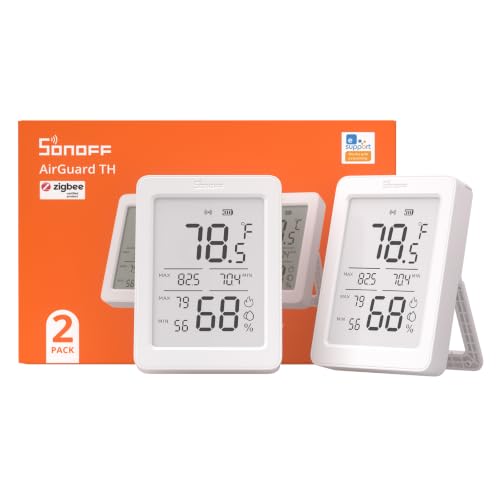
Buying a Zigbee humidity sensor is mostly an exercise in avoiding two disappointments: a sensor that drops off your mesh, and a humidity reading you cannot trust. The pick that gets both right for most homes is the SONOFF SNZB-02DR2 AirGuard TH two-pack — a 3.6-inch LCD screen you can read from across the room, a Swiss Sensirion sensor rated at ±2% RH (relative humidity, the percentage of moisture the air is holding), and a second unit in the box so you can watch two rooms at once. Below are nine Zigbee sensors that genuinely pair with a hub, sorted by what each one is actually good at.
This guide is built by comparing the manufacturers’ published specifications and the patterns across verified customer reviews, so you get each pick’s real strengths and trade-offs instead of marketing spin.
Zigbee is a low-power wireless language that lets a battery sensor talk to a hub instead of your Wi-Fi router. That single design choice decides your battery life, your range and your automation options. Here is everything worth knowing before you pick a zigbee humidity sensor for your own home.
Top Picks

How To Choose The Best Zigbee Humidity Sensor
The wrong assumption most first-time buyers carry is that a humidity sensor is a plug-and-play gadget like a smart plug. It is not. A Zigbee sensor is a radio endpoint — it needs a hub, a coordinator or a smart speaker with a Zigbee radio built in before it can send a single reading anywhere. Buy the sensor first and the hub second and you will spend an evening staring at a pairing screen.
Confirm your hub before you confirm the sensor
These sensors do not all speak to the same gateways. Some list SmartThings, Home Assistant and Hubitat by name; others, like the Aqara T1, need their own brand’s hub and will not join a foreign one. Read the compatibility line on the listing as a hard requirement, not a suggestion. If you run Home Assistant, Zigbee2MQTT and ZHA are two different Zigbee integrations with two different device-support lists, and at least one of these sensors explicitly recommends Zigbee2MQTT over ZHA.
Humidity accuracy is the number that matters most
Temperature accuracy is usually quoted in fractions of a degree and rarely changes a buying decision. Humidity accuracy is quoted as ±% RH, and it is the figure that decides whether your bathroom reading is believable. A ±2% RH sensor keeps a greenhouse or a wine cellar honest. A looser sensor can drift enough that a humidifier kicks on when the air is already damp.
Power, placement and how often you want to climb a ladder
Most of these run on AAA cells, one uses a CR2477 coin cell, and one carries a rechargeable-style 3-volt lithium. Refresh intervals also vary — a 5-second refresh gives you a live dial, a 20-second refresh is gentler on the battery. Match the refresh interval to the job. A cupboard sensor does not need a reading every five seconds.
Side-by-Side Comparison
| Model | Best For | Humidity Accuracy | Power | Screen | Amazon |
|---|---|---|---|---|---|
| SONOFF SNZB-02DR2 AirGuard TH (2-Pack)★ Best Overall | Two rooms on one big display | ±2% RH | 2 x AAA (included) | 3.6” LCD | Amazon |
| THIRDREALITY Zigbee Sensor with LCDTop Performer | Automation routines and alerts | ±2% RH | 2 x AAA | LCD | Amazon |
| Shelly BLU H&T ZBWeatherproof Pick | Damp and dusty spots | — | 3V DC | None | Amazon |
| Aqara Zigbee Temperature and Humidity Sensor T1 | Aqara and HomeKit homes | ±3% RH | Up to 2 years | None | Amazon |
| THIRDREALITY Zigbee Temperature Humidity Sensor Lite | Sticking to a wall and forgetting it | ±2% RH | 2 x AAA (included) | None | Amazon |
| SONOFF SNZB-02D LCD | Budget first Zigbee sensor | ±2% RH | Lithium metal | LCD | Amazon |
Detailed Reviews
1. SONOFF SNZB-02DR2 AirGuard TH 2-Pack
Our pick — 4.0+★ from 750+ verified ratings; the strongest balance of quality and price.
A screen so big you read it from the doorway, and a spare unit in the box.
The 3.6-inch LCD is the whole argument for this one. Walk past it from several meters out and you still see the live temperature, the humidity, today’s high and today’s low, and a comfort-level icon without squinting or opening an app. That is a real convenience for a hallway, a nursery or a parent’s kitchen. Readings refresh every 5 seconds, so the number you see is genuinely the number in the room right now.
Under the plastic sits a Swiss Sensirion sensor rated at ±0.4 °F (a fraction of a degree of temperature error) and ±2% RH on humidity — the tighter humidity figure among the picks that publish one. It reports over Zigbee with up to 120m/400ft of coverage, which is why it drives automations cleanly; the review pages describe it switching a minisplit as a remote sensor through Home Assistant. Two units ship in the box, which is where the comparison numbers get interesting: the two-pack ships two sensors to the single SNZB-02D’s one, and the housing stands 3.74 inches tall against the 0.72-inch profile of the SNZB-02D — a bigger readout at the cost of a bigger wall footprint.
What wins people over is compatibility — it slots into the hubs buyers actually run, and the app adds 6-month history with daily, weekly, monthly and half-year curves you can export. It also does dew point and VPD (vapor pressure deficit, a grower’s measure of how hard the air pulls moisture from a leaf) if you keep plants. The catch is the pairing side: connectivity and accuracy both come off mixed in owner feedback, so a few buyers hit setup friction or question a reading. Nothing here is a systemic failure, but budget a little patience on first join.
Two-pack value
- 3.6” LCD readable from several meters away
- ±2% RH humidity and ±0.4 °F temperature accuracy
- Two sensors per box for two-room coverage
- 6-month exportable history with dew point and VPD
- Real-time data refresh every 5 seconds
No display readout
- Needs a Zigbee hub you supply yourself
- Connectivity and accuracy feedback is mixed
- Taller body than a slim stick sensor
Multi-room coverage: anyone who wants to read the room at a glance and cover a second space without buying twice.
Single-room buyers: you want a set-and-forget stick you never look at — a screen this size is wasted on a cupboard.
2. THIRDREALITY Zigbee Temperature and Humidity Sensor with LCD
Built for routines first, readout second — this is the automation workhorse of the group.
If you plan to wire your sensor into logic rather than glance at it, start here. The THIRDREALITY pairs over Zigbee 3.0 with the mainstream hubs by name — Echo (4th Gen), Echo Plus, Echo Studio, Eero 6, Eero Pro 6, SmartThings 2015/2018, Aeotec, Hubitat, Home Assistant, Homey and its own hub. The example the listing gives is exactly the kind of routine buyers want: when humidity falls below 40%, start the humidifier. That is a sensor doing a job, not just reporting a number.
Its refresh runs every 20 seconds, which is deliberate — a slower poll is gentler on the two AAA cells, quoted at 1 year of typical use. Accuracy sits at ±1 °C across -10 °C to 50 °C and ±2% RH across 0-95%. That ±1 °C is looser than the ±0.4 °F of the AirGuard above, so if precise temperature matters more than automation, the SONOFF leads there. What the THIRDREALITY does better is stick around: it supports OTA (over-the-air) firmware updates, so the manufacturer can fix and improve it after you have mounted it.
Functionality is what wins people over here, and the display and battery indicator hold up over time — the listing’s own example has the battery icon still showing full after months of use. Own it as a humidity and automation tool and it delivers. The honest limits: the Alexa app shows temperature only and no humidity, and the.6cm-length body is small enough that the LCD is a nicety rather than a headline. Pair it with a hub you already trust and leave it to the routines.
Hub pairing ease: the humidity trigger at 40% and the temperature trigger at 27 °C turn this into an actual controller of fans and humidifiers, not a passive readout.
Needs Zigbee hub: ±1 °C accuracy is honest but not the finest — the ±0.2 °C SONOFF SNZB-02M and this unit should not be judged on the same temperature scale.
Smart home starters: your smart home already has a hub and you want a sensor that triggers devices, not one that looks pretty.
Standalone use: you need precise temperature tracking or you rely on the Alexa app for humidity readings.
3. Shelly BLU H&T ZB
Thirteen grams of sensor for the damp corners and dusty server rooms the others avoid.
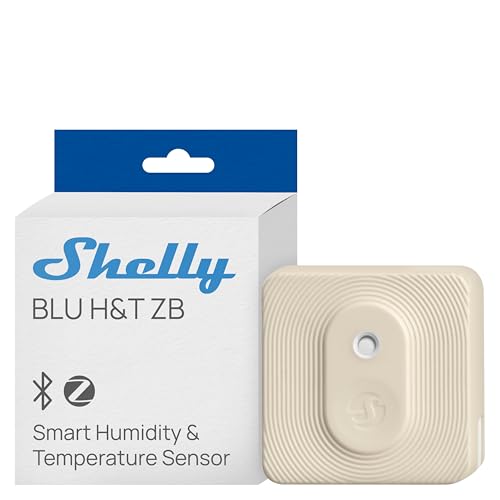
At 13 g this is the lightest thing on the list — a coin-sized puck you can stick anywhere without a bracket, and at IP54 (a rating for dust ingress and splashing water, not submersion) it is built for spots a bare indoor sensor would not survive. Shelly pitches it at storage rooms and server racks, where a leaking pipe or a rising humidity trend is worth catching early. It also reports both Bluetooth and Zigbee, so it can bridge two kinds of network in one small package.
The trade-off is the gateway requirement. Shelly says it needs a Shelly BLU Gateway, or any Shelly Plus, Pro or Gen3 device, to talk to the Shelly Smart Control app — so this is the pick that most rewards an existing Shelly household. Temperature accuracy is ±0.5 °C, which is solid but not the tightest here, and no humidity accuracy figure is published, so treat it as a trend and alert sensor rather than a lab reference. There is also a 3-year warranty, which is a longer backing than most of the group offers.
Battery life is described as long but not quantified on the page, and there is no display — every reading lands in the app. Shelly’s own pitch about early weather alerts and triggering blinds or heating is the real use case: this sensor is a trigger, not a gauge. Buy it because you already have Shelly gear or you need IP54 protection, and skip the brow-furrowing over a spec sheet that hides its battery figure.
Phone-first setups: Shelly households and anyone monitoring a damp basement, storage room or server rack where splashes and dust are a real risk.
Long-range needs: you want a display or a published humidity accuracy spec to lean on — neither is here.
4. SONOFF SNZB-02WD IP65

Three round sensors, one box, one hub — whole-house coverage without a second thought.
If your instinct is to put a sensor in the basement, another in the nursery and a third in the wine cellar, this is the pack that gets you there in one order. Three identical battery-powered pucks, each with a built-in button cell and a round body that mounts on a wall or sits on a table. The design is deliberately plain — no screen, no buttons to fiddle with, just a reading and a signal.
The listing is unusually clear about its software preference: it supports Home Assistant through Zigbee2MQTT and explicitly recommends Zigbee2MQTT over ZHA for the full feature set. That is a helpful disclosure — if you already run Zigbee2MQTT, this is a clean fit. It also supports the Ewelink Zigbee gateway for Tuya-family setups, so there are two viable ecosystem paths. No humidity accuracy figure is published, and the pack is low-volume by seller standards, so it is a value-and-coverage play rather than a precision instrument.
The real win is spread. Three sensors let you compare two rooms side by side and spot a damp wall before it becomes a repair bill, which no single sensor does. The real limitation is bare-bones feedback — no screen, no published accuracy, thin review history. For second-guessing your placement and covering a whole home on a tight budget, the pack makes obvious sense.
Whole-home spread: budget-conscious homes that want a sensor in every room and are willing to run Zigbee2MQTT for full features.
Premium finish fans: anyone who wants a screen or a stated accuracy figure — neither appears on this listing.
5. Aqara Zigbee Temperature and Humidity Sensor T1

The one that locks you into Aqara — and, if you are already there, rewards you for it.
This sensor reads temperature, humidity and air pressure in real time, three measurements in a 30 g puck that sticks to a wall with 3M adhesive. Accuracy is ±0.3 °C across -15 °C to 50 °C and ±3% RH across 0-100%. If you want HomeKit or Alexa control, the Aqara hub is the bridge that makes it work — and that is also the catch. Aqara states plainly that the T1 is not compatible with hubs from other brands, so a SmartThings or Hubitat household should look elsewhere.
Placement is where the T1 demands some attention. Aqara asks for placement within 400 inches of its hub for stable connectivity, and the hub and router need to share the same network. That is a real constraint in a long house, but it is clear, and the app handles the rest — trends, threshold alerts, and automation through Aqara smart plugs. Battery life is quoted at up to 2 years, which keeps it out of your maintenance list.
For Aqara and Apple Home users, the T1 is the obvious fit: it speaks the same app language as the rest of the ecosystem and honestly reports its own limits. For anyone else, that hub lock is disqualifying. Capacity and review history are modest here, so this is a considered pick, not a crowd favorite — treat it as the tidy solution for a house already running Aqara.
Aqara ecosystem users: your hub is Aqara, your app is Aqara Home or Apple Home, and you want three measurements from one small sensor.
Mixed-brand homes: your hub is SmartThings, Hubitat or anything that is not Aqara — it will not pair.
6. THIRDREALITY Zigbee Temperature and Humidity Sensor Lite

Stick it to the wall, forget it for two years — the simplest sensor in the roundup.
No screen, no fuss, a 3M-rated adhesive backing and a polycarbonate shell. The Lite is the sensor you buy in multiples and scatter — basement, greenhouse, pet house, wine cellar, baby nursery, wherever the climate matters. What makes it worth the price is the sensor inside: a Sensirion unit rated at ±0.3 °C from -15 °C to 50 °C and ±2% RH from 0% to 100%, with the tight ±2% RH figure that keeps humidity readings believable. For a no-display unit, that is real accuracy.
Battery life is the standout claim — 2 AAA cells, included, quoted at at least 2 years of normal use, backed by a low-power design. That is a sensor you mount once. Remote monitoring runs through whichever compatible app you already use, and SmartThings and Home Assistant owners get historical data; the THIRDREALITY app adds a month of history on its own. Its compatibility list is the most detailed of the group — Echo (4th Gen), Echo Plus, Echo Studio, Eero 6, Eero Pro 6, SmartThings 2015/2018, Aeotec, Homey, Hubitat, Home Assistant and its own hub, with a candid note that anything not listed is unconfirmed.
What owners like is that it works from the start and keeps working, including in freezers where few sensors are tested. The sensor quality and value are the things people praise most. That is not the same as a featured pick — there is no display, no pressure tracking, and the history depth is app-dependent. If you want a silent, long-lived sentinel, the Lite does that job with the best combination of accuracy and battery life here.
Compact lite body: ±0.3 °C and ±2% RH accuracy with a quoted 2+ year battery makes this a sensor you genuinely set and forget.
Fewer extra features: no screen and app-dependent history — you need a hub and an app to see anything at all.
Budget sensor runs: covering several spaces with accurate, long-life sensors you never plan to touch again.
Feature-heavy setups: you want to glance at a display or track air pressure — this one is invisible by design.
7. SONOFF SNZB-02D LCD Zigbee Thermometer Hygrometer

The cheapest way into a screen-equipped Zigbee sensor with real accuracy numbers.
For a first Zigbee humidity sensor, this is the safest starting point. It packs a Swiss-made sensor rated at ±0.2 °C / ±0.4 °F on temperature and ±2% RH on humidity, refreshing every 5 seconds — accuracy that beats many pricier units on paper. The LCD shows temperature, humidity and battery status with simple icons, and the whole body sits at a slim 0.72 inches deep, so it disappears against a wall rather than protruding like the taller AirGuard.
It reports over Zigbee with up to 120m/400ft of coverage and keeps up to half a year of free cloud storage, viewable hourly and exportable, plus app alerts when you cross a comfort threshold. You can also read the highest and lowest values for any hour or day. The °C/°F switch is a double press on the back, which is a small detail that matters if you cook or garden in one unit and think in the other.
Here is the honest part: owner feedback on connectivity, accuracy and setup is genuinely mixed. Some pair it with an Aeotec hub and get accurate readings, others hit disconnection and question the numbers — a pattern that usually traces to mesh range or hub quirks rather than the sensor itself, but it is real. At its budget price, though, it is a low-risk first sensor, and if it works in your home it will earn its keep.
Quick glance checks: a low-cost first Zigbee sensor with a screen, genuine accuracy figures and a slim profile.
App-only users: setup and connectivity experience varies, so buy it where returns are easy and pair it near your hub first.
Know the Specs
±% RH (Relative Humidity Accuracy)
This is the error margin on humidity, written as a percentage of the full range. A ±2% RH figure means the reading sits within two percentage points of the true moisture level — close enough to trust for a humidifier trigger or a greenhouse. A ±3% RH unit is a little looser but still useful for comfort monitoring. When the listing publishes no humidity accuracy at all, treat the sensor as a trend and alert device rather than a reference instrument.
Zigbee Hub Requirement
Zigbee sensors do not connect to your Wi-Fi. They beam a low-power radio signal to a hub, and the hub passes it to your app. Some sensors work with many hubs — SmartThings, Home Assistant, Hubitat, Echo with a built-in Zigbee radio — while others, like the Aqara T1, lock to their own brand’s hub. Check that line first, because a sensor that cannot pair is a paperweight. The upside of Zigbee is battery life: a sensor that only sends tiny data packets can run for years on two AAA cells.
IP Ratings on a Humidity Sensor
An IP rating like IP65 or IP54 describes how well a body resists dust and water. The number after the P covers solids and the second covers liquid — IP65 means dust-tight and protected against water jets, IP54 means limited dust ingress and protection from splashes. For a bathroom, greenhouse or wash-down area, this is the spec that decides whether the sensor survives the first season. For a dry hallway, it is irrelevant.
Refresh Interval and Battery Life
The refresh interval is how often the sensor checks the air and reports. A 5-second refresh gives you a live-feeling number; a 20-second refresh is kinder to the battery and still fine for automation. Battery type matters too — a CR2477 coin cell quoted at 2+ years is a genuine set-and-forget, while a 1-year AAA estimate means you should plan a yearly swap. Match the interval to the space: a cupboard sensor can refresh slowly and last longer.
Common Questions
Do I really need a Zigbee hub for these sensors?
Will a Zigbee humidity sensor work with Home Assistant?
How accurate should a humidity sensor be for a greenhouse?
What does ±2% RH actually mean in practice?
Can I use a Zigbee humidity sensor in a bathroom or greenhouse?
How long do the batteries last on these sensors?
Is a Zigbee sensor better than a Wi-Fi one?
Do these sensors show humidity on a screen or only in the app?
What is VPD and do I need a sensor that measures it?
Can several humidity sensors share one hub?
The Bottom Line
For most homes, the zigbee humidity sensor worth buying is the SONOFF SNZB-02DR2 AirGuard TH 2-Pack, because it pairs a 3.6-inch screen readable from across the room with a ±2% RH Sensirion sensor and gives you two units in the box to cover a second space. If automation is the goal rather than a readout, the THIRDREALITY with LCD turns your humidity reading into a working humidifier trigger and supports OTA firmware updates.
For a damp bathroom or a greenhouse, the SONOFF SNZB-02WD IP65 is the one to reach for — the waterproof membrane is the difference between a sensor that works and one that fogs out. And if you simply want accurate sensors in every room and never think about them again, the THIRDREALITY Lite delivers ±0.3 °C and ±2% RH accuracy with a quoted 2+ year battery on two AAA cells.
One last thought: the crowd favorite is the SONOFF SNZB-02D, at 4.0+ stars across 3,400+ ratings — but it is not the best sensor here, only the cheapest. Pay a little more for the AirGuard and you get the screen and the two-pack that make a humidity sensor genuinely useful instead of a number on an app you never open.
How we choose
We do not accept paid placement. Every pick is matched to a real buyer and a real use-case; we do not hands-on test units.
Sources
Specifications: manufacturer listings and product documentation. Review insights: verified customer reviews, as of November 2026. Pricing: not shown on this page (it changes often); check the current price via the retailer link.
As an Amazon Associate, Tactical Gear Guy earns from qualifying purchases. This does not affect which products we feature.