Specs are compiled from manufacturer listings and verified buyer reviews and can change over time — please confirm the key details on the product page before buying.
You want a screen that stops a line drive from hitting your pitcher’s shins during front toss — and one that will not wobble, sag, or fall apart by mid-season. The short answer: the CHAMPRO Brute is the safest bet for most backyards and cages, the FORTRESS is the best-built frame if you can move real weight, and the budget L-screens are the ones you carry in a trunk. Everything below explains why, in plain terms.
This guide is built by comparing the manufacturers’ published specifications and the patterns across verified customer reviews, so you get each pick’s real strengths and trade-offs instead of marketing spin.
These are the picks I would stack in my own cage, explained so a first-time buyer can choose with confidence, and this breakdown of the z screen baseball options makes the trade-offs easy to see before you commit.
Top Picks


How To Choose The Best Z Screen Baseball
A Z-screen is a protective barrier you stand behind while you throw — the tapered top lets you pitch over or under it from either arm without leaning around a frame. The whole point is that a batted ball hits the net, not your pitcher. Get the shape, net, and weight right and the screen lasts for seasons; get them wrong and you are replacing a sagging net by August.
Z-Screen vs. L-Screen: Which Shape Fits Your Drill
An L-screen has a rectangular cutout on one side — you pitch through the window and the solid panel covers the rest. A Z-screen instead uses a tapered, angled top edge that you throw over. Z-screens tend to suit front toss and coach-thrown drills where you want a clean sightline. L-screens with a defined cutout, like the ORIENGEAR and VEVOR models here, give a more framed window for game-speed pitching.
Read the Net Before the Frame
Net construction is what actually stops the ball. Look for how many plies (layers of mesh) the netting uses and the mesh size — a 45-ply high-density net on the VEVOR is a very different animal from a thinner multi-ply weave. Knotless polyester resists wear and holds its shape; cheap knotted netting frays at the intersections over time. Mesh around 1.75 inches is a common balance between ball-stopping and give.
Weight and Frame Decide Whether It Stays Up
A screen you cannot move is a screen you never use, and a screen that is too light blows over. Steel-tube frames with real gauge thickness stay planted but run heavy — the CHAMPRO frame uses 13.5 gauge 1.5-inch steel tubes. Fiberglass-pole designs fold into a bag and travel easily but rely on ground stakes to hold in wind. Match the weight to how far you actually haul it.
Side-by-Side Comparison
| Model | Best For | Screen Size | Frame / Net | Weight | Amazon |
|---|---|---|---|---|---|
| CHAMPRO Brute★ Best Overall | Best Overall | 7′ x 5′ | 13.5 ga steel / 60-ply weatherized PE | 46 lb | Amazon |
| ORIENGEAR 7×7Backyard Pick | Backyard portability | 7′ x 7′ | Steel base + fiberglass / 7-strand polyester | 11.2 lb | Amazon |
| VEVOR Batting ScreenCage Roller | Rolling cage setup | 7′ x 7′ | Frame + 5.5″ wheels / 45-ply PE | 25.4 lb | Amazon |
| ZivPlay L Screen | Thickest net listed | 7′ x 7′ (3.5′ cutout) | Powder-coated steel / 2.5mm HDPE | — | Amazon |
| PowerNet 7 FT Z-Screen | True Z-screen shape | 7′ x 7′ | Alloy steel / padded frame | — | Amazon |
| FORTRESS Pitching Screen | Heaviest-duty frame | 7′ x 7′ | 1.5″ galvanized steel / #42 grade | 70 lb | Amazon |
| PodiuMax L-Screen | Widest stable base | 7′ x 7′ | Galvanized steel + fiberglass / 7-ply | 14.2 lb | Amazon |
| MR Portable L-Screen | Budget trunk carrier | 7′ x 7′ | Steel base + fiberglass / 30-ply PE | — | Amazon |
| MR 10’x10′ Screen | Team / facility use | 10′ x 10′ | 1.5″ alloy steel / 5-ply polyester | — | Amazon |
Detailed Reviews
1. CHAMPRO Brute Heavy-Duty Steel Frame Pitcher’s Z Screen
Our pick — 4.5+★ from 100+ verified ratings; the strongest balance of quality and price.
The one that shrugs off Texas sun for years and still stops a screaming line drive.
What sells the Brute is how it protects both arms without you rebuilding it: the reversible Z shape flips around so a righty or a lefty can throw overhand or underhand. The tapered top means you throw over the screen rather than around a window. And this is the crowd favorite here — 4.5+ stars across 130+ owners — the highest score in this whole group.
The build is what earns the money. A 13.5 gauge, 1.5-inch diameter steel tube frame (thicker, heavier tubing than thin-pole designs) takes direct line drives without folding. The net is 60-ply weatherized polyethylene — dense enough to hold its shape through a full season outdoors. A 7′ x 5′ span is tall enough to hide behind for front toss yet narrower than the 7×7 covers, so it tucks into a tighter cage.
Here is the honest trade-off: this thing is 46 pounds. That is heavy next to the ORIENGEAR at 11.2 pounds — the Brute is not a one-hand lift from the garage. Treat it as semi-permanent and it rewards you, because durability is exactly what buyers bring up most about it. Buyers report the net holding up in the Texas sun for five years and still working for fastpitch front toss.
What Earns It First Place
- 60-ply weatherized net and a 13.5 gauge steel frame built for repeated impacts
- Reversible Z shape switches between right- and left-hand pitchers in seconds
- Durability and quality are the two things buyers praise most, with value close behind
- Bungee straps pull the envelope net tight against the bottom tube for a snug fit
Who Should Think Twice
- At 46 pounds it stays put — expect two people or a cart to move it far
- The 7′ x 5′ size covers less width than a 7×7 screen, so aim matters
Reach for this if: you want the toughest set-and-leave-it screen for a home cage or field and durability tops your list.
Look elsewhere if: you need to carry a screen in and out of a car every session — grab a lighter folding model below.
2. ORIENGEAR 7×7 FT Pitching Screen with 3.5×3.5 FT Cutout
A full 7×7 cover you can actually carry in one hand and stake down solo.
For a parent hauling gear between garage and park, weight is everything — and the ORIENGEAR comes in at just 11.2 pounds. Compare that to the CHAMPRO’s 46 pounds and the difference is obvious: this one goes in a trunk, over a shoulder, or into the carry bag without a struggle. The frame combines a sturdy steel base with flexible fiberglass poles, so it flexes on impact instead of taking the full force on rigid joints.
A full 7′ x 7′ face is the biggest flat cover of the portable picks, and the 3.5′ x 3.5′ cutout frames a clear pitching window. The net is heavy-duty 7-strand knotless polyester with 1.75-inch mesh — knotless meaning the mesh is woven without knots at the crossings, which is easier on the ball and holds shape longer. Four ground stakes anchor it on grass or turf, and the reduced tipping is the point on a breezy day.
The catch: fiberglass poles are the trade-off for that light weight. They are forgiving, but against a full-speed mistake ball they will not feel as brick-solid as a heavy steel Z-screen. Set it up, stake it, and store it in the bag after use — the maker notes that storage extends service life. For backyard front toss and indoor drills, the portability makes up for it.
The balance point: a 7×7 face at 11.2 pounds is the portability-to-coverage winner in this group, and the included carry bag plus stakes mean it is ready the minute you unload it.
Best suited to: the traveling coach or parent who sets up and breaks down in minutes.
The one trade-off: flexible poles and light weight mean it is happiest on grass with the stakes driven in, not left freestanding in wind.
3. VEVOR Batting Screen with Carry Bag & Ground Stakes
Two wheels do what your back would rather not — roll it into place and go.
The VEVOR solves a problem the heavy screens ignore: moving. Two 5.5-inch wheels let you drag it across the field to the mound instead of dead-lifting it. The netting is double-sided and thickened to 45-ply high-density, so it holds up to ball impacts, and the L-screen measures 7′ x 7′ with a 1.75-inch mesh. A double-sided design means both lefties and righties throw from the same setup.
At 25.4 pounds it sits in the middle — lighter than a full steel cage screen but still planted. That weight shows in shipping too: the packaged unit lists at 13.22 kg, versus 5.78 kg for the MR Portable L-Screen, so the VEVOR arrives as a sturdier box of hardware. Assembly flows without complex steps — the screen drops into the frame and you are pitching.
The honest note on a wheeled screen is that the wheels become the moving part that draws attention over a long season; keep the axle sane and it rolls clean for years. For a school, a coach with a cart, or a club with a shared field, the wheels mean the screen actually gets used every session.
Why coaches like it: the wheels plus a 7×7 face plus a double-sided setup remove the two most common reasons a screen sits unused — too hard to move and only built for one arm.
Serious home-or-school fit: anyone dragging a screen across a field session after session.
Not the lightest: at 25.4 pounds it rolls wonderfully but will not fold to a backpack.
4. ZivPlay L Screen Pitching Screen for Batting Cage

A thicker net meant to outlast the thin webbing that breaks on cheaper screens.
If you have ever seen a pitching net split at the seams, the ZivPlay’s pitch is the fix: a double-layer 2.5mm HDPE (high-density polyethylene — a tough plastic) net, versus the thinner 1.7mm netting that breaks easily on lighter builds. The face is a full 7′ x 7′ L-screen with a 3.5′ x 3.5′ pitching cutout. Flip it around and both left- and right-handers throw from it.
Setup takes under five minutes with no tools, and it holds up to strong contact without going down. A carry bag is included for transport. Quality and value are the two things owners bring up most about this screen — great value for money, easy setup, and a net that stands up to contact. The one mixed area is durability in the hardware: some concern centers on the welded nuts holding the wheels, so if you rely on rolling it, that is the spot to keep an eye on.
That said, this is a solid mid-tier L-screen at a fair value — the thick netting is the reason to pick it over the thinner builds. For a batting cage where the screen lives in place most of the time, the wheel hardware barely comes into play.
The Case For The ZivPlay
- 2.5mm double-layer HDPE net is the thickest listed here, built to resist splitting
- Full 7×7 face with a 3.5×3.5 cutout and a flip-around design for both arms
- Under-5-minute, no-tools setup and an included carry bag
- Quality and value are the standout themes owners mention
The Fine Print
- Durability is mixed on the welded nuts that hold the wheels
- The value is in the netting, so treat the rolling hardware with a little care
Buy it when: net thickness and a clean 7×7 face are the priority and the screen mostly stays put.
Just know: the wheels are the least sturdy part — keep them snug and roll gently.
5. PowerNet 7 FT Z-Screen Pitching and Hitting Net
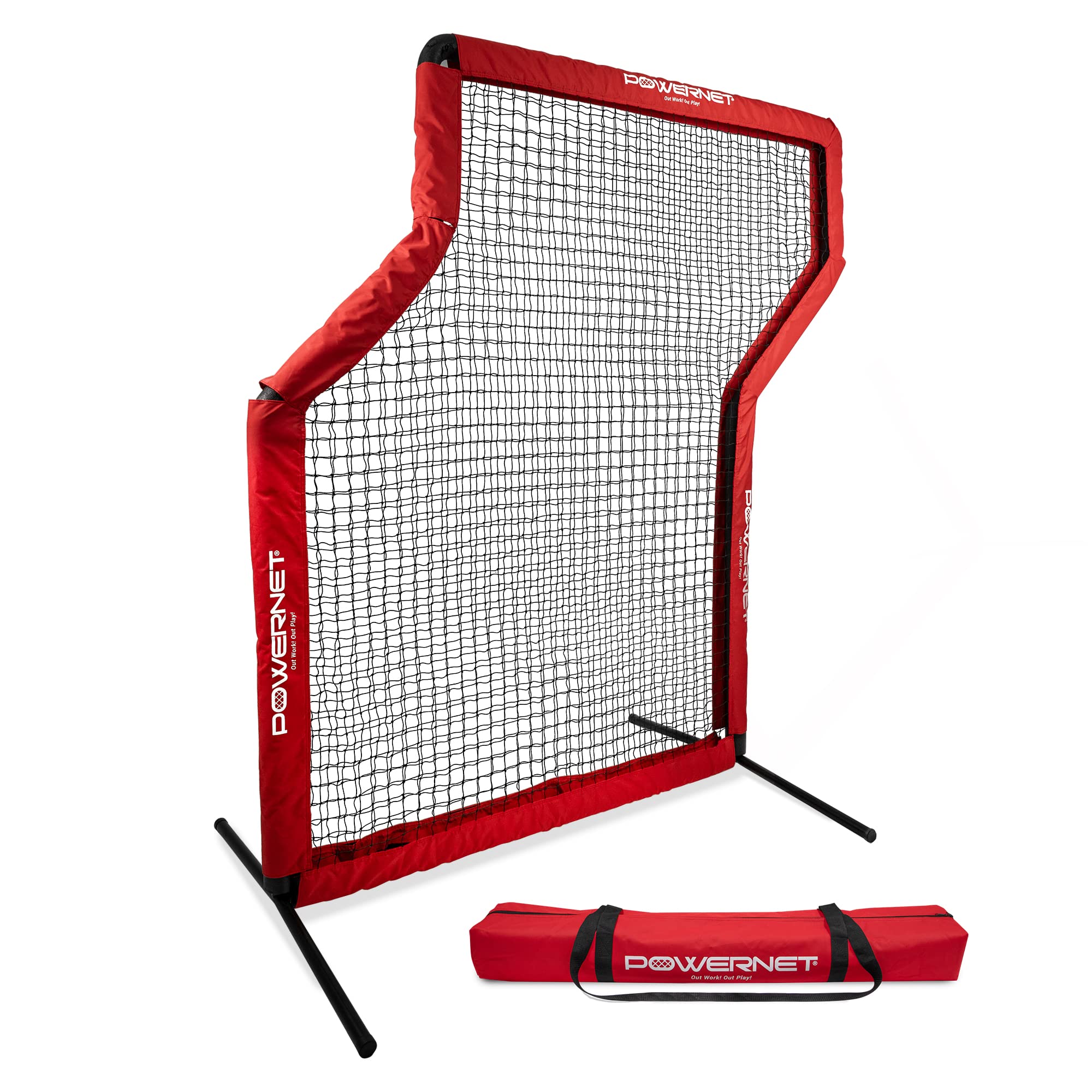
The screen that actually has the Z shape — tapered top, clean throw from either arm.
Most of the picks here are L-screens with a window; this one is a genuine Z-screen. The tapered top lets right- and left-handers throw unobstructed from the same setup, which is the whole reason the Z profile exists. Extra padding on the frame protects against hard direct shots, and it folds down into a heavy-duty carrying bag for storage in a car.
Setup is quick — under two minutes, no tools — and sturdy ground stakes hold it against wind and hard contact. PowerNet also points to professional-player names in its marketing, but ignore the hype: the real question is whether the frame and net survive repeated abuse. Owners say the quality and durability are there, calling it perfect for both baseball and softball and noting it takes a beating very well.
The honest caveat is the warranty math — PowerNet covers manufacturer defects for a limited time but explicitly excludes wear from sun, wind, rain, and normal use. So plan to store it indoors or under cover, and do not count on the frame being bulletproof under a hot sun for years. Buy it for the Z shape and fast setup; treat care and storage as part of the deal.
What it gets right: the tapered Z top is exactly the shape a coach-thrown front toss drill wants, and the padded frame takes hard contact without complaint.
Pick it for: the pure Z-screen shape and a two-minute, no-tools setup you can move anywhere.
Be ready to store it: the limited warranty will not cover sun, wind, or weather damage — keep it sheltered.
6. FORTRESS Pitching Screen with Mid-Height Cut-Out

Seventy pounds of galvanized steel that does not care how hard the ball comes back.
When you want a screen that simply will not move, the FORTRESS is the answer: a 1.5-inch black galvanized steel frame with wide steel feet that hold steady through short-toss training. The 7′ x 7′ face uses #42 grade netting in a pillowcase style, reinforced with knotted twine for extra strength and dual protection. Double bolts on all corners add stability you can feel before you throw a pitch.
The cutout sits at mid-height and off to one side, positioned so you can run toss drills without turning your body. For throwing reps that build spin and movement, the framed window lets you compare release points and watch how the ball breaks. This is the heaviest screen in the group at 70 pounds — but that is the entire point of buying it.
The catch: at 70 pounds it takes two people to move and will not fit a sedan. Store it outdoors and factor in the six-month guarantee — that shorter coverage window tells you this is a set-and-leave screen, not a portable. If your cage is fixed and you want a fortress that stays planted through a full practice, this is it.
Built for permanence: galvanized steel, a reinforced #42 net, and wide feet make this the most planted screen here — perfect for a dedicated backyard cage that never moves.
For the fixed cage owner: you have a spot on the field and want the screen never to shift.
Not a traveler: 70 pounds and a six-month guarantee make this a stay-put purchase, not a trunk companion.
7. PodiuMax L-Screen 7×7 FT Pitcher Protection Net
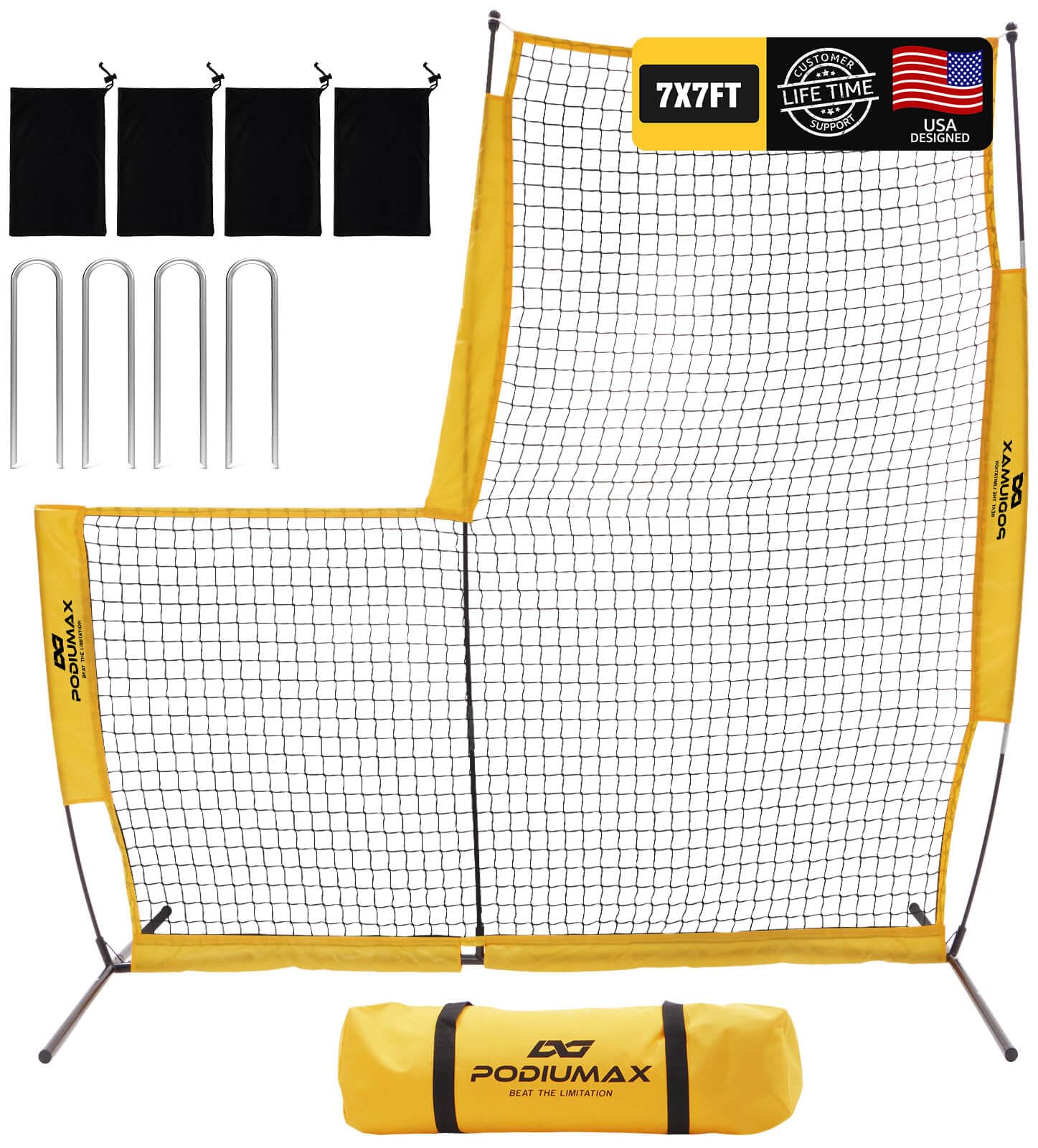
A wide stance built so a hard line drive cannot knock it onto your pitcher.
The PodiuMax attacks the tipping problem directly: a 3.7-foot base that the maker says is 70% wider than standard bases, so it stays upright even on strong contact. The face is a full 7′ x 7′ screen with a 3.5′ x 3.5′ pitching window, and the netting is 7-ply tear-resistant mesh rated to withstand ball speeds up to 125 MPH. Tie-down support comes from four sandbags and four ground anchors.
The structure leans on thickened fiberglass poles plus 25mm galvanized steel pipes, which resist rust and oxidation — so weather is less of a worry than on plain-steel builds. At 14.2 pounds it stays light enough to move without a cart, and it assembles in about five minutes and packs into a bag for the field.
What you give up for that wide base and light weight is a slightly busier setup — sandbags, anchors, and stakes all need filling and seating to get the stability the wide stance promises. Do the prep and it stands firm; skip the anchors and you lose the main advantage. For a backyard or park where wind is a factor, the extra footing is worth the minute it takes.
Where It Shines
- 3.7-foot base holds through heavy contact instead of tipping
- 7-ply tear-resistant net rated for ball speeds up to 125 MPH
- Galvanized steel + fiberglass resist rust and oxidation
- 4 sandbags and 4 anchors included; about a five-minute setup
Where It Asks More
- Stability relies on filling sandbags and driving anchors each time
- 14.2 pounds is light, but the accessory kit adds setup steps
Made for: windy fields and parents who want a wide, stubborn base without the heavy steel weight.
Do this first: fill and seat the sandbags and anchors — that is where the stability comes from.
8. MR Portable Baseball L-Screen 7×7 FT
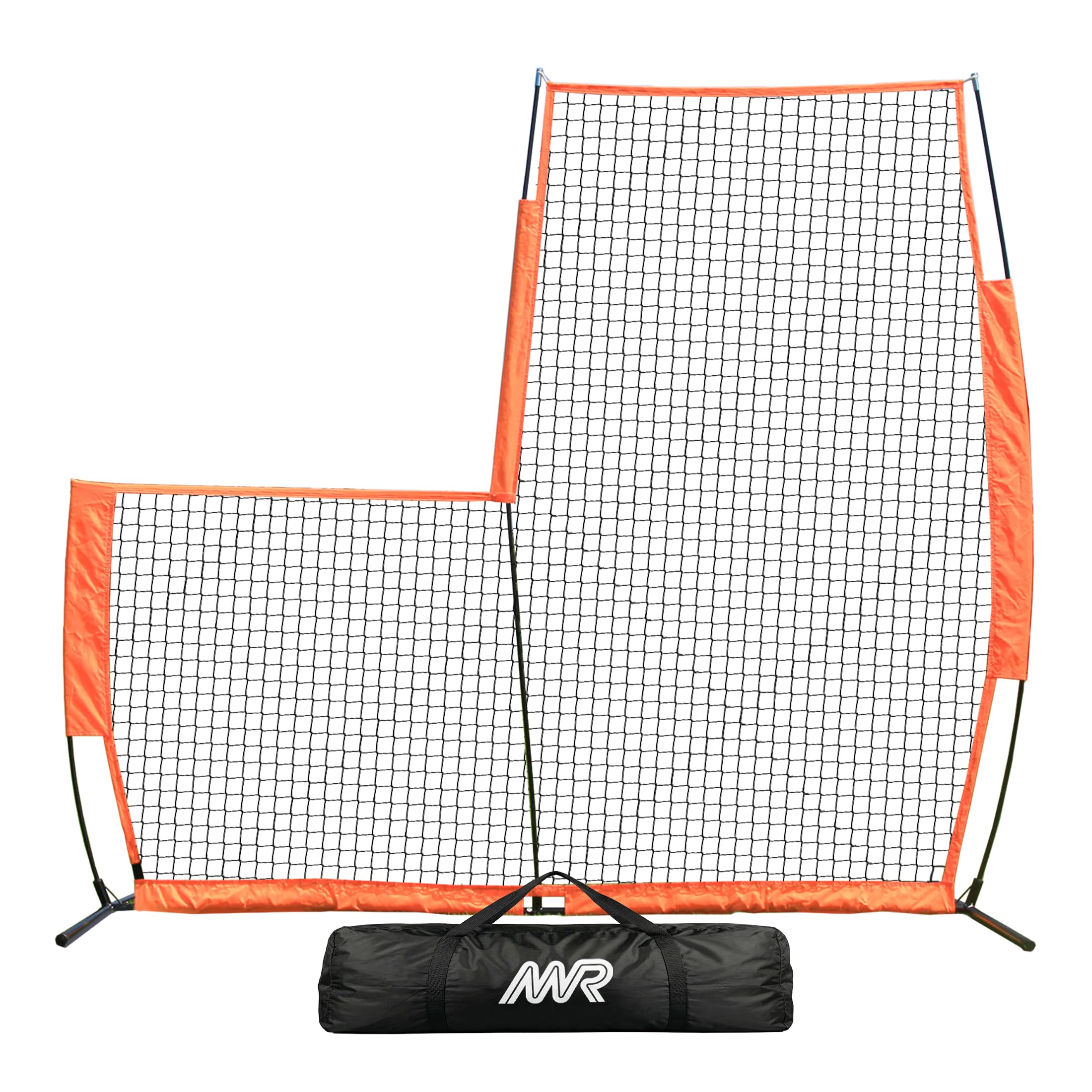
The low-cost L-screen that folds into a trunk and gets the reps in.
For a first screen or a second one for the yard, the MR Portable keeps the entry cost low without cutting the essentials: a steel base, fiberglass poles, and 30-ply polyethylene netting on a 7′ x 7′ face. The fold-up system assembles in minutes and pops up ready to protect a pitcher working on fastballs, curves, and changeups.
Where it clearly differs from the heavier picks is weight: at 5.78 kg packaged, it is easier to haul than the VEVOR’s 13.22 kg box — so it is the one you grab for a solo trip to the park. It works for any level of player, children through adults, in a yard of any size, and stores small between sessions.
Two honest limits: the netting is 30-ply, thinner than the CHAMPRO’s 60-ply and the ZivPlay’s thick 2.5mm, so it is built for practice reps rather than surviving a season of full-speed machine fire. And with fewer proven long-term durability checks under its belt, it is a smart starter screen — not the last one you will ever buy.
The value read: metal and fiberglass at a low entry point, with a 30-ply net that is honest for the task — good for a beginner or a traveling dad on a tight budget.
Good starting point: a first-time buyer who wants a full 7×7 screen and a portable carry without a big outlay.
Know its ceiling: the 30-ply net is thinner, so it suits controlled reps over heavy daily machine abuse.
9. MR 10’x10′ Professional Baseball Pitching Screen
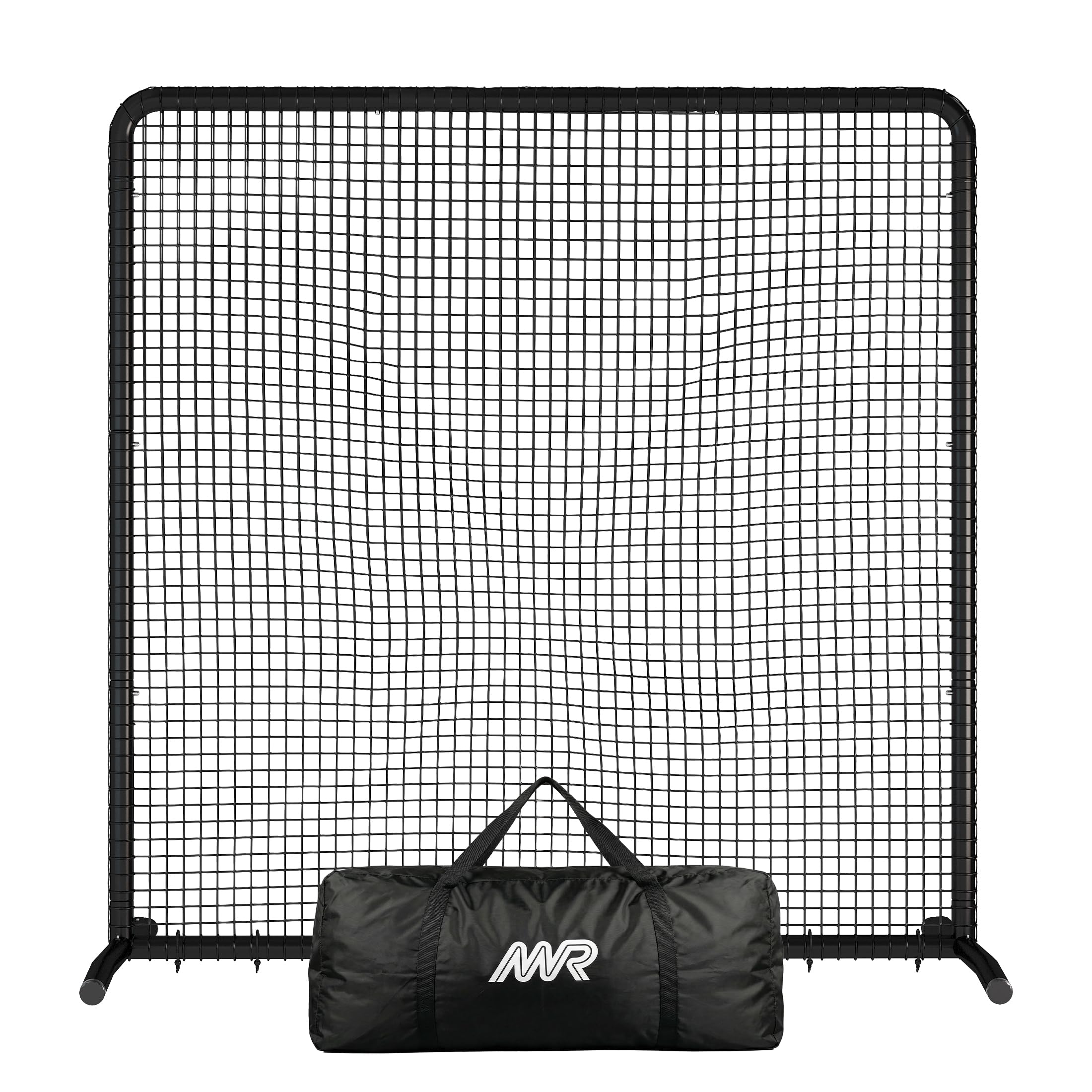
Ten feet of cover for a full bullpen or team session, not a single throw.
Every other pick tops out at 7×7; this one goes to 10′ x 10′, a genuinely bigger wall to hide behind during team batting practice, facility use, or a shared school bullpen. The frame uses 1.5-inch diameter alloy steel tubes with powder-coating for rust resistance, and the net is 5-ply polyester built to absorb a stronger batting impact.
Setup leans on a pillowcase-style netting with overlocked edges — the net slips on and the whole thing assembles in minutes. It suits players from children to adults and stands in for a pitching machine during practice. The standout here is the backing: a lifetime warranty, the longest coverage of anything on this list, which tells you MR expects this frame to last.
The trade-off is scale: a 10×10 face is more screen than a backyard toss drill needs, and it wants more room and more hands to move. If your practice space is small, the 7×7 picks above fit better. But for a program that needs real coverage, the extra two feet of height and width on each side is the difference between hiding and peeking around.
The facility angle: a 10×10 face plus a lifetime warranty is a team-scale screen, and the pillowcase netting keeps setup quick for whoever has to put it up before practice.
Choose it if: you run team practice, a school bullpen, or a facility that needs a big protective wall.
Skip the size if: your space is a small backyard — a 7×7 covers the same drill with less bulk.
Know the Specs
Ply Count and Mesh Size
Ply is how many layers of mesh the netting uses — 30-ply on the MR Portable, 60-ply weatherized on the CHAMPRO. More layers generally mean more density and durability against repeated impacts. Mesh size (like the 1.75-inch openings on the ORIENGEAR and VEVOR) is the size of each hole: smaller mesh gives more surface to catch the ball and holds up better over time.
Frame Material and Gauge
Gauge measures tube thickness — a lower gauge number means thicker, heavier steel, so 13.5 gauge on the CHAMPRO is a beefier tube than a thin pole. Galvanized and powder-coated steel resist rust; fiberglass poles flex on impact but are lighter. Heavier steel frames stay planted but add pounds; lighter frames fold and travel but need stakes and anchors to hold in wind.
Z-Screen vs. L-Screen Shape
A Z-screen has a tapered top you throw over — the CHAMPRO and PowerNet use this profile, which lets both arms throw without repositioning. An L-screen has a rectangular cutout you throw through. Both protect the pitcher; the difference is sightline and how you set up your drill.
Size and Portability
A 7×7 screen is the common standard; the MR 10×10 gives more cover for team use but takes more room. Weight is the real portability number — 11.2 pounds folds and travels, 70 pounds stays where you put it. Match the weight to how far you carry it, and the size to how much of the field you need to cover.
Common Questions
Will a Z-screen protect my pitcher as well as an L-screen cutout?
How much does a pitching screen actually weigh and can one person move it?
What net ply do I need for real line drives?
Can I use a baseball L-screen for softball too?
Do I need to stake or sandbag a pitching screen?
What size screen should I buy for a small backyard?
Is a steel frame better than fiberglass poles?
How long will a batting screen net last outdoors?
What does a pitching screen warranty usually cover?
The Bottom Line
The z screen baseball pick that earns the top spot is the CHAMPRO Brute — a 60-ply weatherized net on a 13.5 gauge steel frame that flips for either arm and has proven it survives real seasons outdoors. If you break down and travel every session, reach for the ORIENGEAR at 11.2 pounds, and if wind is your enemy, the wide-base PodiuMax holds its ground. Match the net density to your practice speed and the screen will protect the pitcher all season.
How we choose
We do not accept paid placement. Every pick is matched to a real buyer and a real use-case; we do not hands-on test units.
Sources
Specifications: manufacturer listings and product documentation. Review insights: verified customer reviews, as of November 2026. Pricing: not shown on this page (it changes often); check the current price via the retailer link.
As an Amazon Associate, Tactical Gear Guy earns from qualifying purchases. This does not affect which products we feature.