Specs are compiled from manufacturer listings and verified buyer reviews and can change over time — please confirm the key details on the product page before buying.
The right YTX30L-BS battery is the one whose cold cranking amps (the burst of power that turns a cold engine over) match your machine’s displacement, and whose box actually drops into your battery tray without shimming. Get those two things wrong and you are jump-starting a Harley in a parking lot. This guide sorts genuine YTX30L-BS replacements by chemistry, cranking power, and real owner outcomes, so you can pick once and ride.
This guide is built by comparing the manufacturers’ published specifications and the patterns across verified customer reviews, so you get each pick’s real strengths and trade-offs instead of marketing spin.
Powersports batteries are the rare part where size, terminal side, and chemistry decide everything before brand loyalty gets a vote. Below you get the picks that fit the tray, plus a plain-English spec primer on CCA and lead-acid versus lithium. This is how you choose a ytx30l-bs battery that starts on the first push and does not leave you stranded mid-season.
Top Picks


How To Choose The Best YTX30L-BS Battery
YTX30L-BS is a size class, not a brand. Any battery carrying that model number should share the same footprint and the same terminal layout, which is why a dozen makers can sell you one. The decisions that actually change your experience are chemistry, cranking amps, and how the terminals are built.
Match the dimensions and terminal side first
Pull your old battery, set it on a bench, and measure length, width, and height. Most of this class lands near 6.5 inches long, 5 inches wide, and just under 7 inches tall, but a couple of picks run a fraction larger. Terminal polarity matters just as much — you want the positive post on the correct side so your cables reach without twisting. Confirm both before you buy, because a battery that is 0.1 inch too wide will not seat.
Cold cranking amps versus amp-hours
Cold cranking amps (CCA) measure the punch available to spin a cold engine; amp-hours (Ah) measure how long the battery can feed accessories with the engine off. A big v-twin or a side-by-side with a winch wants high CCA, and this class spans roughly 300 to 850 CCA depending on chemistry. If you run lights, a winch, or a sound system while parked, the Ah figure starts to matter too.
Lead-acid or lithium — pick your trade-off
Sealed lead-acid AGM batteries are the familiar default: cheap to replace, happy on a standard charger, and heavy. Lithium LiFePO4 packs weigh a fraction of that, hold a charge far longer on the shelf, and deliver more cranking punch per pound. The catch is that they want a lithium-specific charger and cost more upfront. Choose lead-acid for a simple spare, lithium if weight and shelf life matter.
Check the warranty before the voltage
Every battery here reads 12 volts, so that number tells you nothing. The warranty tells you how much the maker trusts its own plates. Coverage in this class ranges from a single year up to a multi-year free-replacement term with a prorated tail. A longer term is your best protection against the one failure mode that actually stings — a battery that goes flat before its time.
Side-by-Side Comparison
| Model | Best For | Cranking Amps | Capacity | Weight | Amazon |
|---|---|---|---|---|---|
| Daakmax YTX30L-BS 400CCA AGM★ Best Overall | All-round drop-in replacement | 400 CCA | 30Ah | 18.2 lbs | Amazon |
| UPLUS YTX30L-BS 400CCA AGMMost Cranking Punch | High cranking with local support | 400 CCA | 30Ah | 18 lbs | Amazon |
| Banshee YTX30L-BS 500CCATop Cranking Output | Max cranking and long warranty | 500 CCA | 30Ah | — | Amazon |
| Mighty Max YTX30L-BS 385CCA | Budget-friendly AGM | 385 CCA | 30Ah | 21.4 lbs | Amazon |
| Forgetyo YTX30L-BS LiFePO4 | Lightest weight, lithium swap | 850A max | 12Ah | 5.29 lbs | Amazon |
| TPE YTX30L-BS 720A LiFePO4 | Lithium with faster cranking | 720A | 14Ah | 5.29 lbs | Amazon |
| ZIPPBATTERY YTX30L-BS 385CCA | Wide vintage bike coverage | 385 CCA | 30Ah | 20.1 lbs | Amazon |
| ExpertPower YTX30L-BS 300CCA | Lawn tractor and jetski duty | 300 CCA | 30Ah | 19 lbs | Amazon |
| Upstart YIX30L-BS 30Ah AGM | Polaris-specific fit | — | 30Ah | — | Amazon |
Detailed Reviews
1. Daakmax YTX30L-BS 400CCA Maintenance-Free AGM
Our pick — 4.0+★ from 950+ verified ratings; the strongest balance of quality and price.
Four hundred cranking amps in a sealed box that drops straight into the standard YTX30L tray.
For the rider who wants one battery to cover a big v-twin, an ATV, or a UTV without weighing options, the Daakmax is the pick. It pushes 400 cold cranking amps (the cold-start punch) out of a 12V 30Ah sealed AGM pack. That is enough muscle to spin a mid-to-large displacement engine on a chilly morning. The measured footprint is 6.54 inches wide by 4.96 inches deep by 6.89 inches tall, so it slides into the tray a stock YTX30L-BS came out of. The standard positive-and-negative post layout means your cables reach the same spots they always did.
What wins people over is the build itself. The sealed AGM construction (acid soaked into fiberglass mats) is spill-proof, needs no acid filling, and takes vibration better than a flooded cell. That matters on a thumper single or a trail machine that spends its life rattling. The value story holds up too — plenty of owners treat this as the sensible middle choice against dealership parts. It weighs 18.2 pounds, which is ordinary for a 30Ah lead-acid pack, and one owner’s Honda Shadow fit is exactly what you would expect from the size class. It carries a 1-year warranty.
The honest caveat is battery life. Sealed lead-acid is a consumable, and this is no exception — a long service life depends on keeping it on a tender through winter. The terminal layout also rewards a careful eye: check polarity against your old unit before you connect anything. If you want a pack that survives deep discharge and long shelf sits, a lithium pick further down changes that math. Otherwise, as owners put it, this is the one that just works.
Where it earns its keep
- 400 CCA starts mid-to-large displacement engines without drama
- Sealed AGM never needs acid or water checks
- Standard 6.54 x 4.96 x 6.89 inch footprint drops into the stock tray
- Spill-proof and vibration-resistant for trail and road duty
What to plan around
- Lead-acid life depends on a winter tender, not a miracle
- Terminal side must be confirmed against your old battery
Reach for this if: you want one sealed replacement for a motorcycle, ATV, or side-by-side and value easy install over chemistry experiments.
Think twice if: you leave a machine parked for months — a lithium pack holds its charge far longer between rides.
2. UPLUS YTX30L-BS 400CCA AGM with Local Support
A 400-amp hitter with the longest support network of any lead-acid pick here.
The UPLUS matches the top pick on power: 400 CCA (cold cranking amps, the burst of current that turns a cold engine) and 12V 30Ah (amp-hours, how much charge it holds). So what separates it is the backup. You get a 15-month warranty with a 60-day refund window, and the brand keeps a fixed office in California plus multiple US warehouses. If your battery ever fails, that means a real place to call and a US return. Its size — 6.54 by 4.96 by 6.81 inches — runs a touch shorter than the class standard, so check clearance above the terminals before you seat it.
It is built on 99.99% pure primary lead, which the maker says charges better than recycled lead. Treat that as a maker claim, but the practical read is a sealed AGM that arrives factory-activated (charged and ready) with a low self-discharge rate. Buyers report it starting a CFMOTO Zforce 1000 without fuss. Against the ExpertPower’s 300 CCA below, this one gives you 400 CCA, which is the difference between an easy cold crank and a long grind on a bigger engine.
The weight is 18 pounds, the lighter end for a 30Ah lead-acid. The trade-off is the same one that follows every sealed battery in this class: it is a consumable, and long life means keeping it topped up off-season. Nothing here overpromises — it is a strong-cranking AGM with a warranty you can actually reach someone about.
Support that answers: a 15-month warranty plus a California office and US warehouses makes a rare dud a call, not a dead end.
Mind the height: at 6.81 inches tall it is slightly shorter than some trays expect above the terminals — dry-fit before you bolt up.
Best matched to: buyers who value a real warranty contact over the longest possible service record.
Worth noting: it cranks just as hard as the best pick but asks you to confirm tray clearance first.
3. Banshee YTX30L-BS 500CCA High Performance
Five hundred cranking amps and the longest free-replacement term of the whole group.
If a hard-starting big-bore engine is your problem, the Banshee is the answer on paper. It delivers 500 CCA — the highest of any lead-acid pick here and a full hundred above the 400-amp crowd. It is a 12V 30Ah sealed, maintenance-free unit that ships already charged and ready to bolt in. The footprint matches the class at 6.54 by 4.96 by 6.89 inches, so the tray and cables line up as expected.
The warranty is the headline. You get 35 months of free replacement, then a prorated 50% term through month 48 — a much longer commitment than the 1-year terms most of this field offers. Owners of heavier UTVs like the Uforce XL 1000 report quick, easy turnover — the whole point of the extra amps. It replaces a long list of part numbers, from the YB30L-B to the GTX30L-12B, so cross-referencing against your old label is straightforward.
Here is the fair caution. It also lists a flush terminal type, so confirm your cable ends mate cleanly. For a stubborn large engine or a warranty-focused buyer, those extras justify the ask.
The amp advantage: 500 CCA gives the strongest cold crank in the lead-acid set — real help on a big v-twin or a winch-heavy side-by-side.
The warranty payoff: 35 months free replacement beats the typical 1-year term by a wide margin.
Worth the step up if: your engine hesitates on cold mornings or you want the longest replacement coverage on the list.
skip it if: you run a modest-displacement machine — those extra amps go unused.
4. Mighty Max YTX30L-BS 385CCA SLA AGM

The grounded everyday AGM — 385 amps, familiar footprint, no surprises in the tray.
Mighty Max built its name on unglamorous, dependable SLA batteries, and this one fits the pattern. It is a 12V 30Ah sealed lead-acid pack with 385 CCA, which lands it just under the 400-amp picks but comfortably above the 300 CCA of the entry option. The measured box is 6.60 by 4.96 by 6.88 inches, and polarity is positive-right, negative-left — check that against your old cable routing before you order.
The design brief is durability. It handles high discharge rates, a wide operating temperature band, and deep-discharge recovery, and it can mount in any position because the acid is held in glass mats rather than sloshing loose. It resists shock and vibration, which is what you want on a machine that sees rough ground. Installation lands in the easy column, though you get the battery and screws only — no harness or mounting hardware comes in the box.
Where it gives ground is longevity. It is a heavy pack at 21.4 pounds, and like every sealed battery here its life hinges on how you treat it, with winter storage the usual make-or-break. For a rider who wants a solid 385-CCA AGM at the budget-friendly end of the field, this is a straightforward call.
Why riders grab it
- 385 CCA covers most mid-size motorcycles and ATVs
- Mounts in any position and resists shock and vibration
- Deep-discharge recovery and wide temperature tolerance
Small print worth reading
- Battery and screws only — no harness or mounts included
- At 21.4 pounds it is heavy for the 30Ah class
Fits the bill when: you want dependable amps at the budget-friendly end and a footprint that behaves like the rest of the class.
Consider the trim: if every extra pound or amp counts, the lighter 400 CCA picks sit just above it.
5. Forgetyo YTX30L-BS LiFePO4 850A Battery

A 5.29-pound lithium pack that out-cranks every lead-acid on this page.
The first thing you notice is the heft — there isn’t any. This Forgetyo LiFePO4 (a lithium iron phosphate chemistry) weighs 5.29 pounds, a fraction of a 20-plus-pound lead-acid brick. Yet it claims a maximum 850 CCA, the highest crank figure in the entire guide by a wide margin. It is a 12.8V 12Ah pack rated for 2000-plus discharge cycles, versus a few hundred for typical lead-acid. The dimensions run 6.61 by 5 by 6.96 inches, so dry-fit it before trusting that it seats exactly like your old box.
Inside sits a built-in BMS — a battery management system, a circuit that cuts power if it senses overcharging, over-discharging, a short, or overheating. That protection is the lithium advantage: the pack guards itself instead of quietly cooking its own plates. It also holds a charge far longer on a shelf and can live in a machine that sits for weeks. Owners point to reliable starts and the weight loss as the standout wins. Charge temperature spans -4°F to 131°F. You will want a lithium-specific charger at 14.6V and 2A-5A.
The trade-off is real and worth stating plainly. It costs more upfront than any lead-acid here, it needs that dedicated lithium charger, and a lead-acid charger can shorten its life. Some owners mention charging issues, so pair it with the right hardware. For a racer chasing every pound or a machine with a buried battery box, though, the swap pays off fast.
The physics win: 5.29 pounds and up to 850 CCA is a combination no sealed lead-acid pack can touch.
Self-preservation built in: the BMS guards against overcharge, over-discharge, shorts, and heat.
Go lithium if: weight, shelf life, and cycle count matter more to you than the higher buy-in.
Stay lead-acid if: you are not ready to buy a dedicated lithium charger alongside it.
6. TPE YTX30L-BS 720A LiFePO4 DLF30L-BS
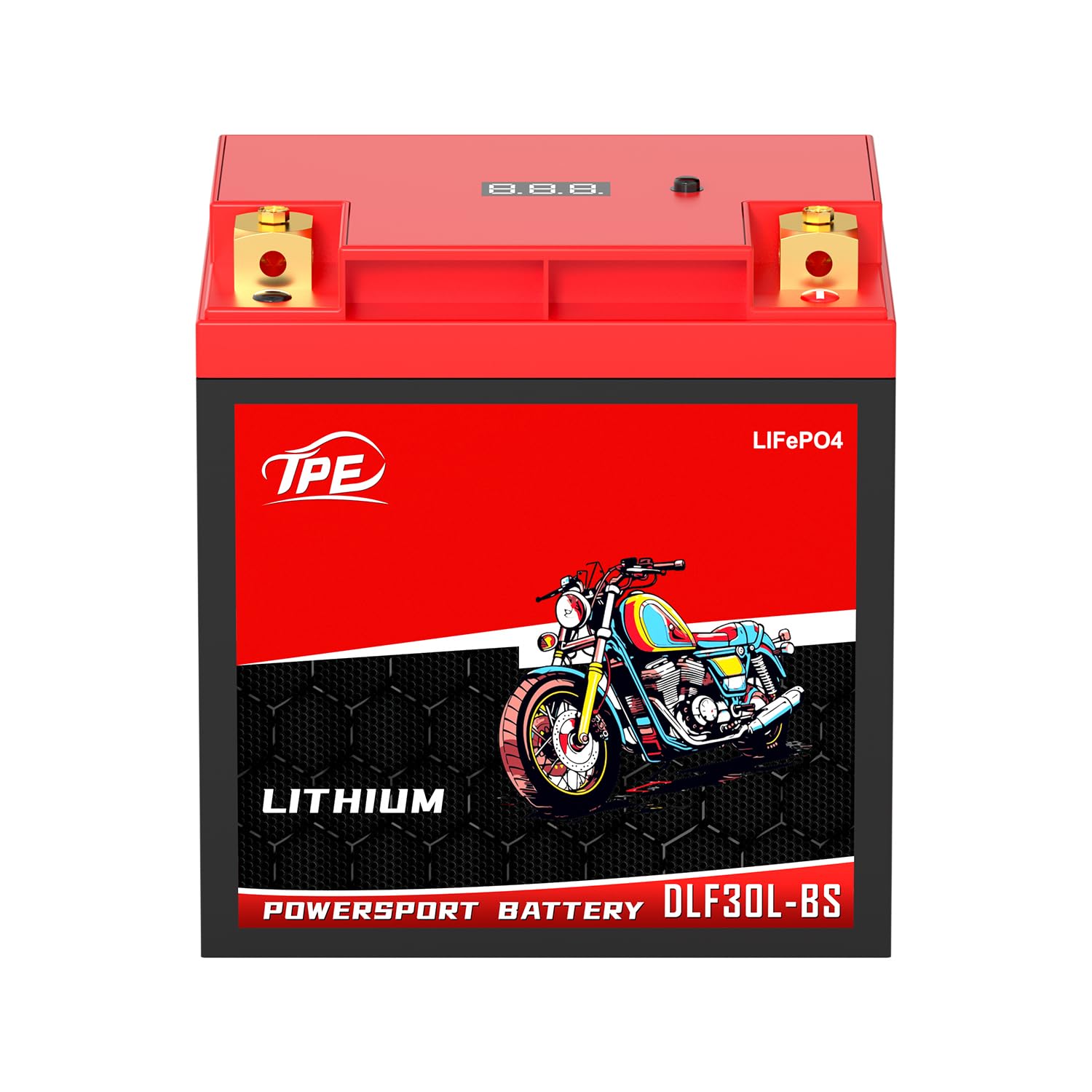
A 720-amp lithium pack that drops in at the same 5.29-pound featherweight.
TPE sits a rung below the Forgetyo on raw amps but outruns every lead-acid pick here. It is a 12.8V 14Ah lithium pack rated at 720A cranking, and it tips the scale at 5.29 pounds — the same featherweight as the other lithium entry. The dimensions are 6.61 by 5 by 6.96 inches, a close match to the standard class. Against the Forgetyo’s 850A it gives up some peak amps, but it buys that back with 14Ah of capacity versus 12Ah for longer accessory draw.
The internal BMS does the same protective work — cutting off overcharge, over-discharge, shorts, and overheating. The maker rates it at up to ten times more starts than a lead-acid, thanks to lithium’s far longer cycle life. Customers note it cranking a 700cc motorcycle without complaint, with quicker turnover than the battery it replaced. It arrives fully charged and ready to install, so there is no bench-charging ritual on day one. It covers a long list of replacement numbers, from the YB30L-B to the 12N24-3, so cross-checking is easy.
The catch is the same one that follows every lithium pack: it wants a dedicated 12V 3A lithium iron phosphate charger. Feed it lead-acid charging and you shorten its life. If weight and cranking speed top your list, this is the smarter-spec version of the lithium upgrade.
The lithium pitch
- 720A cranking crushes any lead-acid rating here
- 14Ah capacity beats the other lithium pick for accessory headroom
- 5.29 pounds and comes fully charged
The real cost
- Needs a dedicated LiFePO4 charger, not a lead-acid one
- Higher buy-in than the sealed AGM options
Choose this if: you want lithium cranking speed plus a little more capacity for lights or a winch.
Hold off if: a standard lead-acid charger is all you own and you do not plan to add a lithium one.
7. ZIPPBATTERY YTX30L-BS 385CCA AGM

The compatibility list on this one reads like a vintage-bike registry.
Bringing an older machine back to life is where the ZIPPBATTERY earns its slot, thanks to a long cross-reference list. Its 385 CCA sealed AGM (absorbed glass mat, a spill-proof lead-acid build) fits a deep roster — Honda GL1000 and CB750, Kawasaki KZ900 and KZ1000, Yamaha XS650 and XS1100, Suzuki GS750, several classic Harleys, the Ducati Monster line, BMW airheads, and early Polaris, Ski-Doo, and Sea-Doo models. That fit range is the reason to pick it. It measures 6.54 by 5 by 6.89 inches, and at 20.1 pounds it runs heavier than the 19-pound ExpertPower, so plan for a little more lift into the tray.
The hardware is the selling point for wrenching at home. It ships with a T3 nut-and-bolt terminal kit rather than bare posts, so you are not hunting for odd hardware when the old bolts vanish. Like every AGM here it is factory-activated, spill-proof, and maintenance-free. The warranty is 18 months on quality issues, with a 60-day replacement-or-refund window before it narrows to replacement only. That is longer coverage than the 1-year terms several picks offer.
Be realistic about the fit-and-finish. A few owners find installation fiddly, so give yourself time to route the cables cleanly rather than rushing the drop-in. And treat it the way you would any lead-acid pack — a consumable, not a forever part.
Old-bike reach: the cross-reference list spans Honda, Kawasaki, Yamaha, Suzuki, Ducati, BMW, Triumph, and more — a strong match for classics.
Hardware included: the T3 nut-and-bolt terminal kit saves a parts run mid-swap.
A strong fit for: vintage or multi-brand owners who want the bolt kit and a long compatibility list in one box.
Patience pays if: your cable routing is tight — set aside time to fit it cleanly.
8. ExpertPower YTX30L-BS 300CCA AGM

A 300-amp AGM that moonlights as a lawn-tractor and jetski battery.
Not every buyer needs to spin a big v-twin. The ExpertPower makes its case to the rider who also wants a dependable pack for a riding mower or a jet ski. The box is 6.53 by 5 by 6.88 inches with a – + polarity layout.
The build leans on deep-discharge recovery and a low self-discharge rate for standby periods, which is exactly what a mower or a stored jet ski needs. It is factory-activated and spill-proof, so no topping off fluids. Reviewers point out clean fits, and off-road compatibility covers the Sportsman, RZR, and Touring series. Against the 400 CCA picks up top, it gives up cranking muscle — that is the number that decides whether this is right for you. A generous measure at 19 pounds makes it a relatively easy lift into the tray.
The realistic limit is the 300 CCA ceiling. On a large-displacement v-twin in cold weather, that is a thin margin. On a tractor, a jet ski, or a small ATV, it is plenty.
Where it fits best
- 30Ah capacity suits mowers, jet skis, and seasonal machines
- Low self-discharge for long standby sits
- Deep-discharge recovery and spill-proof AGM build
Mind the ceiling
- 300 CCA is the lowest here — thin for a big v-twin in the cold
- Not the pick for hard-starting large engines
Reach for it when: your machine is modest-displacement or seasonal and you want one AGM to cover tractor, jetski, and ATV duty.
Look higher up if: a large v-twin or a winch-heavy side-by-side is your daily ride — those want 385 CCA or more.
9. Upstart YIX30L-BS 30Ah AGM

Built around one machine family — Polaris side-by-sides and ATVs.
This one is for the Polaris owner first. The Upstart is a 12V 30Ah sealed AGM sized to drop into common Polaris ATV and UTV trays — Sportsman 500 and 570, RZR 800, and Ranger 570/800 setups — with top-side terminals and built-in carry handles. It is a maintenance-free AGM, arrives fully charged, and uses standard hardware, so no special tools or dealer visit is needed. The six-cell design is the familiar lead-acid layout that a stock Polaris battery uses.
Where it is designed to win is ruggedness: a sealed AGM build that handles vibration and deep discharges, which suits winch use and cold-weather starts on the trail. The carry handles are a small thing that becomes a big one when you are lifting it into a cramped engine bay. Against a dealer part it is an economical alternative, which is the reason most Polaris owners go looking in the first place.
Now the honest part. The consensus on this one is more mixed than the group average — quality and value draw split opinions, and some report a short lifespan measured in months rather than years. Treat it as a value-priced, machine-specific replacement rather than a proven long-hauler, and lean on the drop-in fit as its real strength.
Tuned for Polaris: the top-terminal, handle-equipped sizing targets Sportsman, RZR, and Ranger trays directly.
Trail-ready build: sealed AGM with deep-discharge and vibration tolerance.
Read the reviews: quality and lifespan draw split opinions, so weigh the value against a longer-term pick.
Made for: Polaris owners who want a config-free drop-in at a value price.
Weigh carefully if: you want the longest service life — a strong-warranty or lithium pick is a safer bet.
Know the Specs
Cold Cranking Amps (CCA)
CCA is the current a battery can deliver for 30 seconds at 0°F while keeping a usable voltage — in plain words, the muscle that spins a cold engine. Higher CCA means an easier cold start, especially on a large v-twin or a high-compression side-by-side. This class runs from about 300 CCA on the entry options to 500 CCA on the strongest lead-acid, with lithium packs rated far higher. Match CCA to your engine’s displacement and how cold your winters get rather than grabbing the biggest number.
AGM Versus LiFePO4
AGM (absorbed glass mat) traps the acid in fiberglass so the battery is spill-proof and vibration-tolerant — the standard for powersports. LiFePO4 is a lithium iron phosphate chemistry that weighs a fraction as much, holds a charge for months, and lasts through far more discharge cycles. The catch with lithium is that it wants a dedicated lithium charger. Choose AGM for simplicity and lower cost, lithium for weight savings and long shelf life.
Amp-Hours (Ah)
Amp-hours measure capacity — how long the battery can feed accessories with the engine off. The lead-acid picks here mostly list 30Ah, while the lithium packs list 12Ah and 14Ah despite cranking harder, because lithium chemistry stores more usable energy per pound. If you run lights or a winch while parked, Ah matters. If you mostly just start the engine, CCA is the number that counts.
Terminal Polarity and Fit
Polarity is which side the positive post sits on, and it decides whether your cables reach without twisting. Most of this class runs positive on the right or a – + layout, but always check your old battery. Fit is the length, width, and height of the box — near 6.5 inches long, 5 inches wide, and just under 7 inches tall here, with a few running a fraction larger. Measure before you buy; a battery a tenth of an inch too wide will not seat.
Common Questions
Will a YTX30L-BS battery fit where my old one came out?
Is a lithium YTX30L-BS battery worth the extra cost over AGM?
Can I charge a lithium YTX30L-BS with my regular battery charger?
How many cold cranking amps do I actually need?
Do I need to add acid to a sealed AGM YTX30L-BS?
How long does a YTX30L-BS battery typically last?
Can a YTX30L-BS battery be mounted on its side?
What is the difference between YTX30L-BS and YIX30L-BS?
Why does my new battery arrive without a full charge?
The Bottom Line
For most riders, the ytx30l-bs battery to buy is the Daakmax 400CCA AGM. It gives you 400 cold cranking amps (the cold-start burst) in a sealed, spill-proof build that drops into the standard tray. It also carries the most owner reviews of any pick here. Want more cold-start muscle and the longest replacement coverage on the list? Step up to the Banshee at 500 CCA with its 35-month free-replacement term. And if you would rather shed 15-plus pounds and never fuss with a trickle charger, the Forgetyo LiFePO4 is the lithium swap worth making.
How we choose
We do not accept paid placement. Every pick is matched to a real buyer and a real use-case; we do not hands-on test units.
Sources
Specifications: manufacturer listings and product documentation. Review insights: verified customer reviews, as of November 2026. Pricing: not shown on this page (it changes often); check the current price via the retailer link.
As an Amazon Associate, Tactical Gear Guy earns from qualifying purchases. This does not affect which products we feature.