Specs are compiled from manufacturer listings and verified buyer reviews and can change over time — please confirm the key details on the product page before buying.
Your camera is only half the broadcast — the other half is the mic. Viewers forgive a soft picture, but they click away from muddy audio and a frame that blurs when you lean in. The faster fix is a mic with a high signal-to-noise ratio and a camera that holds focus when you move. The shortlist below starts with audio and works outward to cameras, switchers, and control decks.
This guide is built by comparing the manufacturers’ published specifications and the patterns across verified customer reviews, so you get each pick’s real strengths and trade-offs instead of marketing spin.
You do not need a full studio to go live — a mic, a camera, and a scene switcher cover it. You need a mic that rejects room noise, a camera that stays sharp, and a way to switch scenes without fumbling. Every pick below is here because it solves one of those three problems well — and this guide to the best YouTube Live Streaming Equipment explains which one to buy first.
Top Picks

How To Choose The Best YouTube Live Streaming Equipment
Most people buy a camera first and then discover their viewers cannot hear them — fix audio before video. Fix the order: audio, then camera, then control. A clean 48kHz/24-bit voice on a 1080p feed beats muddy audio on a 4K one, every single stream.
Start with the microphone, not the webcam
Your voice carries the stream. Look for a mic that states its audio format plainly — 48kHz/24-bit is a common studio-grade standard, and it means the mic captures a wide range of sound detail rather than squashing it. A signal-to-noise ratio figure (how much louder your voice is than the background hiss) tells you how quiet the room will sound between sentences.
Match the camera sensor to your room
A bigger sensor pulls in more light, so a 1/1.3” sensor (a sensor roughly the size used in premium phones) handles a dim office better than a tiny standard webcam chip. If you stream in a bright room, frame rate matters more — 60 FPS (frames per second, or how many still images the camera captures each second) keeps motion smooth when you gesture or move.
Decide if you need a switcher or just software
Software like OBS is free and runs on your PC. A hardware switcher is a physical box with buttons, a T-Bar (a sliding lever for transitioning between scenes), and multiple HDMI inputs, so you can cut between cameras without touching a mouse. If you run a two-camera setup or a live event, the hardware route removes a whole class of crash risk.
Plan your control surface early
Once you have a mic, a camera, and a scene list, you will want one-touch access to mute, scene changes, and audio levels. A control deck with macro keys (physical buttons you assign to a command) turns a five-click panic into a single press mid-stream.
Side-by-Side Comparison
| Model | Best For | Core Spec | Audio / Video Format | Connection | Amazon |
|---|---|---|---|---|---|
| Hollyland Lark M2★ Best Overall | Solo creators on camera | 9g transmitter, 300m range | 48kHz/24-bit audio | USB-C / 3.5mm | Amazon |
| Logitech Blue YetiMost Versatile | Desk-based streaming | 4 pickup patterns | 20Hz–20kHz range | USB | Amazon |
| Elgato Facecam 4KSharpest Motion | Sharp 4K at 60 FPS | 4K at 60 FPS | 4K UHD video | USB-C | Amazon |
| YoloLiv YoloCam S3 | Low-light rooms | 1/1.3” sensor | 4K/30fps, 1080p/60fps | USB 3.0 | Amazon |
| Insta360 Link 2 Pro | Hands-free tracking | 1/1.3” sensor, PTZ | 4K, dual beamforming mics | USB-C | Amazon |
| osee GoStream Deck | Multi-cam switching | 4 HDMI in, 2 out | H.264 recording | HDMI / USB-C / Ethernet | Amazon |
| OBSBOT Tiny 3 | Voice and gesture control | 1/1.28” CMOS, triple mic | 4K/30fps, 1080p/120fps | USB-C | Amazon |
| Elgato Stream Deck + XL | One-touch scene control | 36 macro keys | — | USB-C | Amazon |
| Logitech Mevo Start | Streaming on the move | 6-hour built-in battery | 1080p HD video | Wi-Fi | Amazon |
| RØDECaster Duo | Full audio production | 4 channels, 4 faders | 76dB gain, -131.5dBV EIN | USB-C | Amazon |
| YoloBox Ultra | All-in-one live studio | 4 HDMI, 8” touchscreen | 4K encoding, ISO recording | HDMI / USB / Ethernet | Amazon |
Detailed Reviews
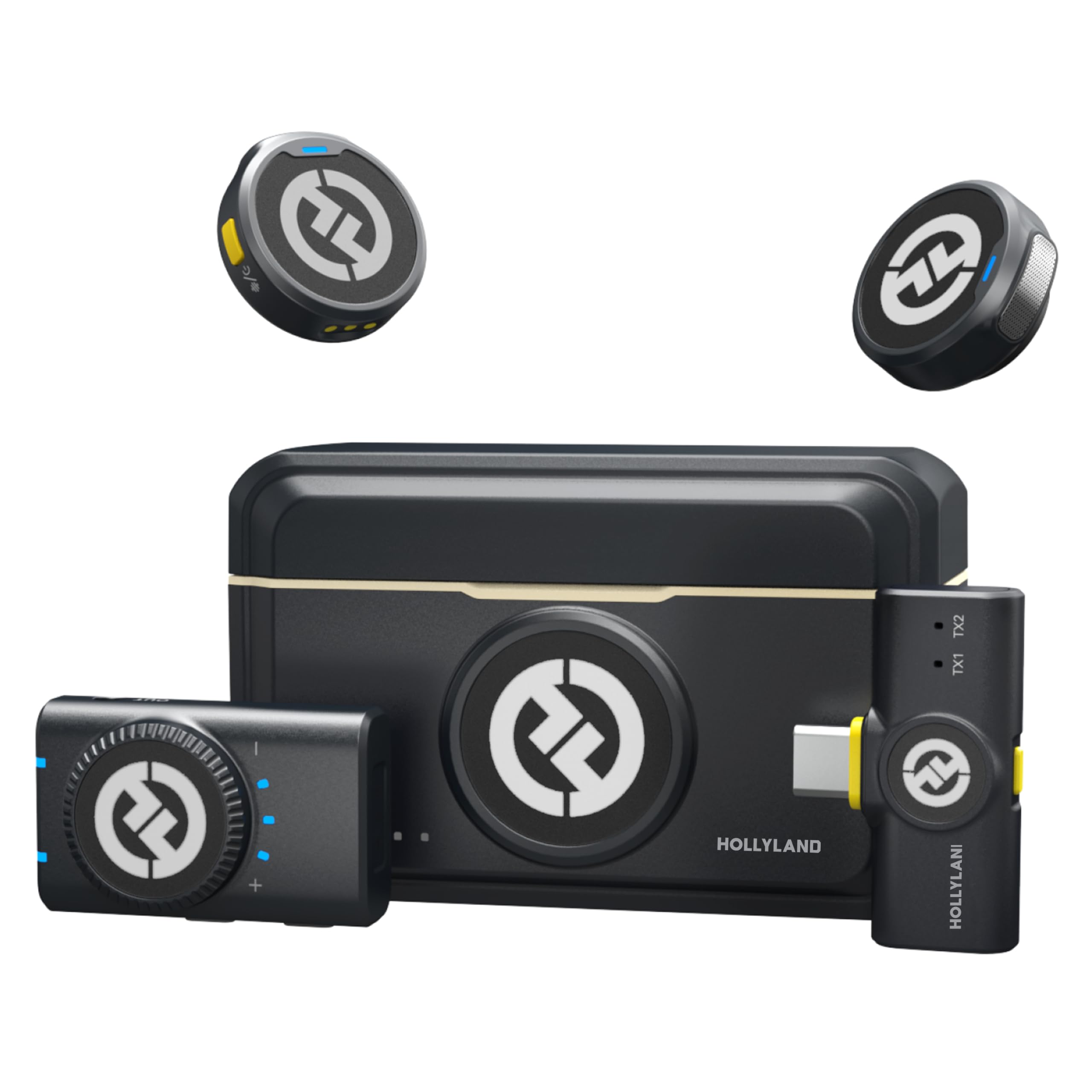
1. Hollyland Lark M2 Wireless Microphone
Our pick — 4.5+★ from 14,500+ verified ratings; the strongest balance of quality and price.
A nine-gram clip that makes your voice sound like you spent far more than you did.
Here is the defining number: a 9g transmitter. That is light enough to clip on a t-shirt collar or hang from the included necklace silicone case, and light enough that you forget it is there mid-sentence. The Lark M2 sits at the top of this list because the crowd favorite status is earned — 4.5+ stars across 14,000+ ratings, with sound clarity as the near-universal praise.
The audio format is the reason it sounds professional: 48kHz/24-bit (a recording standard that captures detail far beyond what a phone mic handles), paired with a 70dB signal-to-noise ratio that keeps background hiss low. It can also handle a maximum 115dB sound pressure level, which means shouting or a loud room does not distort the recording. One-click noise cancellation lives on the transmitter’s yellow button, so you can kill room tone without touching a laptop.
Range is where it separates from cheaper lavaliers. Hollyland rates it at up to 300m (roughly 1,000ft) line-of-sight, and the high-gain LDS antenna is designed to stop your own body from blocking the signal when you turn. Battery runs up to 10 hours with noise cancellation off, and the compact charging case recharges the whole set twice for a 40-hour total on the camera version. Pre-pairing at the factory means you unbox, power on, and talk.
What earns it the top spot
- 9g transmitter is light enough to forget you are wearing it
- 48kHz/24-bit audio with a 70dB signal-to-noise ratio
- Up to 300m line-of-sight range with a body-blocking-resistant antenna
- 40 hours of total use with the charging case
Where it asks for patience
- Mono and stereo switching only works over the 3.5mm camera jack, not USB
- Two transmitters in one kit means keeping track of small parts between shoots
Reach for this if: you appear on camera, move around, and want broadcast-clean voice without a desk mic in frame.
Think twice if: you record music in stereo — the stereo mode is camera-jack only.
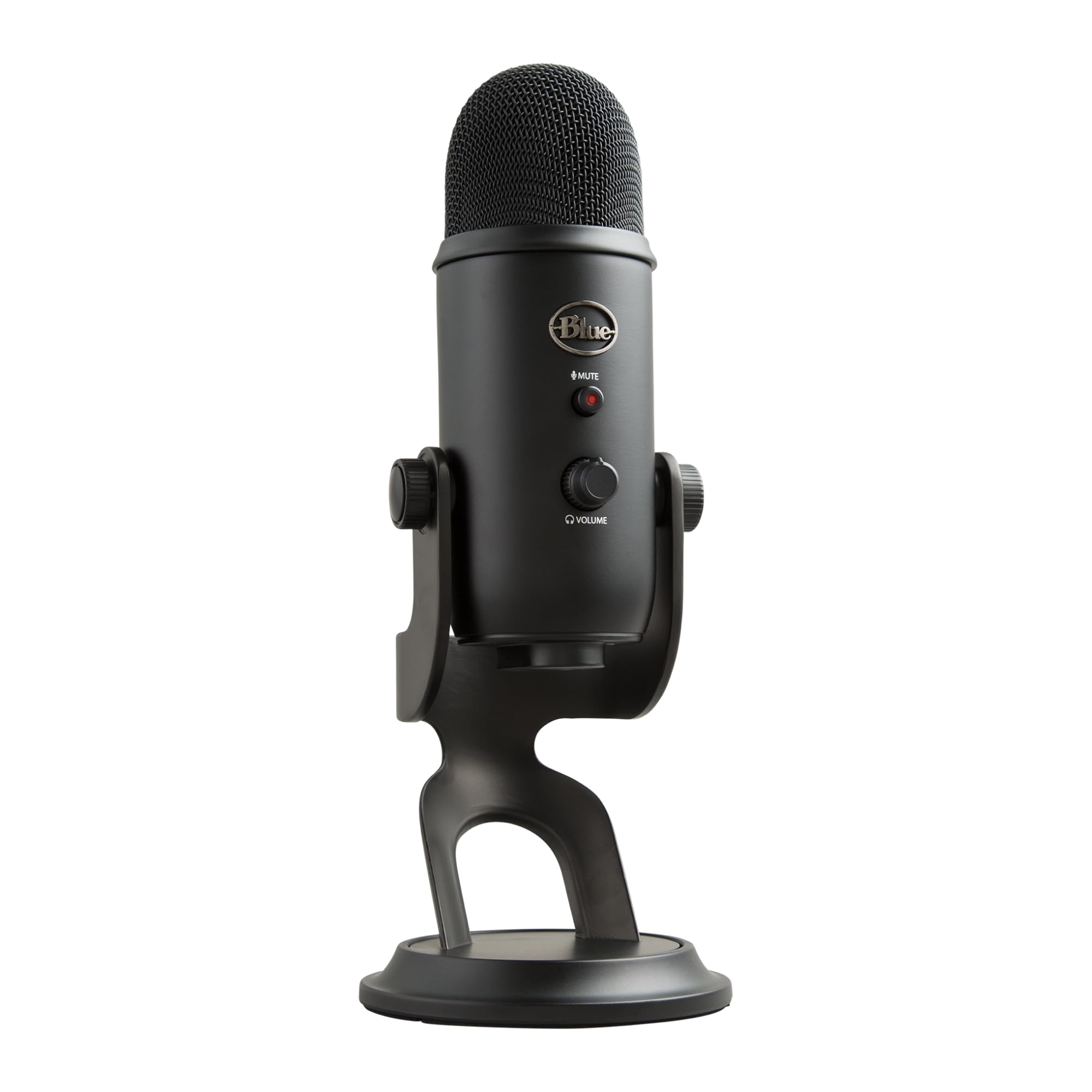
2. Logitech Creators Blue Yeti USB Microphone
Four pickup patterns in one desk mic, so a solo stream and a two-person podcast share the same hardware.
The Yeti has been the default desk mic for a reason: a custom three-capsule array (three separate mic elements working together) inside a metal enclosure. You get four pickup patterns — cardioid for one voice, omni for a room, bidirectional for an interview across the desk, and stereo for capturing width. That is four recording jobs normally needing multiple microphones.
Your frequency range runs 20Hz–20kHz, which covers the full span of human hearing, so deep voices and high consonants both land. Onboard controls for headphone volume, pattern selection, mute, and gain sit on the body itself, and no-latency monitoring means you hear yourself in real time without a delay throwing off your timing. Blue VO!CE software adds broadcast-style vocal shaping and effects if you want to tune the sound further. It is plug-and-play on PC or Mac through USB.
The honest caveat is durability. The build feels substantial, but buyers report the mixed feedback plainly — some units are still going strong while others give out after roughly seven months of use. Treat the stand and cable joints gently and it rewards you. Sound-wise it is sensitive enough to pick up every little thing in the room, so a quiet space and a little gain control go a long way.
Why streamers keep buying it: four patterns and real onboard knobs mean one mic covers solo commentary, interviews, and instrument recording without a mixer.
The catch to weigh: it is a desk mic — you sit close and stay there, so it suits a fixed streaming setup rather than a walk-around shoot.
Best fit: a seated streamer or podcaster who wants flexible patterns and physical controls on the desk.
Look elsewhere if: you need a clip-on mic for moving around the room — the Lark M2 above is the better tool for that.
3. Elgato Facecam 4K
The one camera here that streams 4K while keeping 60 frames per second of smooth motion.
Frame rate is the spec that decides whether your hand gestures look natural or stuttery. The Facecam 4K captures 4K resolution at 60 FPS, and that is where it pulls ahead of the YoloLiv YoloCam S3: 60 FPS versus 30fps. If you move a lot on camera, that difference shows.
The image comes from a premium Sony STARVIS 2 CMOS sensor (a light-sensitive imaging chip) paired with Elgato Prime Lens technology, and you get HDR support plus uncompressed video output. A built-in flash memory holds your settings so you are not re-tuning every session. Elgato’s free Camera Hub software handles the creative side — exposure, framing, and effects — and the 49mm lens filter thread lets you screw on a standard filter just like a DSLR lens.
Picture quality is the contested part. Some owners call it excellent and others say it does not match the marketing, with grain showing up in certain lighting. Set realistic expectations: this camera rewards a decently lit room and a stable auto or manual exposure. What you are really paying for is the motion smoothness and the manual headroom, in a package that mounts on your monitor over a detachable USB-C cable.
The motion argument: 4K at 60 FPS keeps fast gestures and on-screen movement clean — the spec that separates it from the 30fps cameras on this list.
Set up for it: give it light and lock your exposure, and the grain complaints fade; run it in a dim corner and you may see noise.
Pick this when: smooth 4K motion and manual image control matter more to you than plug-and-forget simplicity.
Second-guess it if: your room is dark and you will not add lighting — a bigger sensor helps more in low light.
4. YoloLiv YoloCam S3
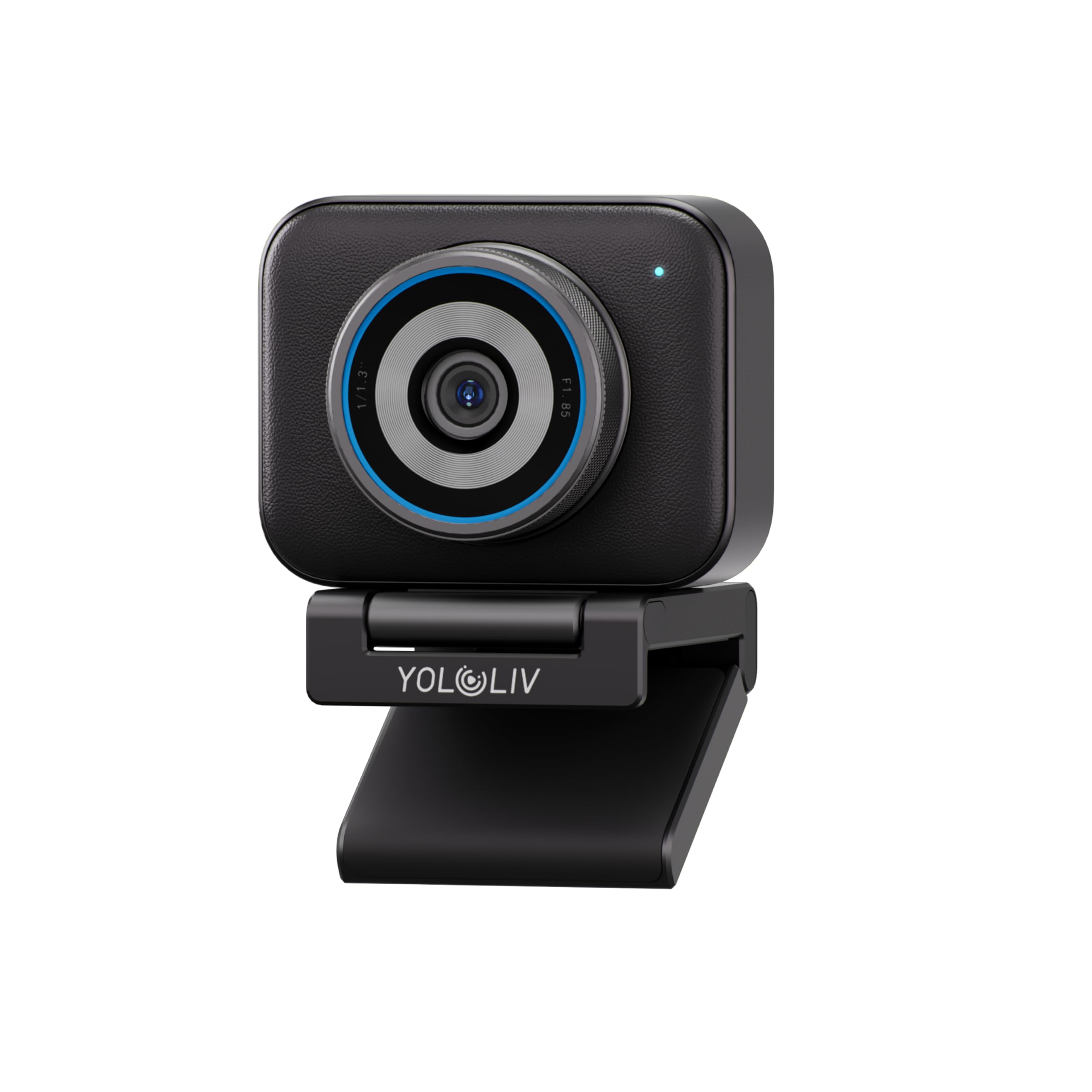
A sensor this large in a webcam body, built to make a dim room look like a lit studio.
The headline is a 1/1.3” sensor — the biggest on this list alongside the Insta360 Link 2 Pro — and sensor size is what ultimately defines image quality in lower light. It outputs uncompressed 4K at 30fps and 1080p at 60fps, so you pick detail or smoothness depending on your scene. Fast PDAF autofocus (phase-detect, which locks focus almost instantly) keeps close-ups crisp when you lean toward the lens.
Low light is where the aluminum body earns its place. The 1/1.3” Sony sensor handles normal room lighting well, and AI-assisted processing dials in smart exposure, white balance, and HDR while claiming 2.5x clearer faces in low light. The 82° field of view keeps you framed without cropping the room. The all-aluminum shell acts as a heat sink so you can stream continuously without the camera throttling, and the magnetic mount plus integrated 1/4″-20 thread fits most tripods.
Manual control is generous for a webcam — contrast, sharpness, saturation, exposure, white balance, and color grading are all adjustable, with YoloLiv’s own Picasso Resolve color engine currently on Windows only. Owners call the image quality the standout, and the natural background blur and solid metal build come up often. The trade-off is that this is a tuned camera, not a raw one: you will get the most out of it by spending a session in the settings.
Where the S3 wins
- 1/1.3” sensor holds up in ordinary room lighting
- Uncompressed 4K/30fps and 1080p/60fps options
- All-aluminum body manages heat for long streams
- Deep manual image controls and 4x digital zoom at 1080p
What to expect
- Top resolution tops out at 30fps, so fast motion is less smooth than the Facecam 4K
- Picasso Resolve color grading is Windows-only for now
Made for: the creator streaming in an ordinary room who wants depth and clean faces without a lighting rig.
Not the first pick if: you need 60fps at full 4K — go with the Facecam 4K for motion.
5. Insta360 Link 2 Pro
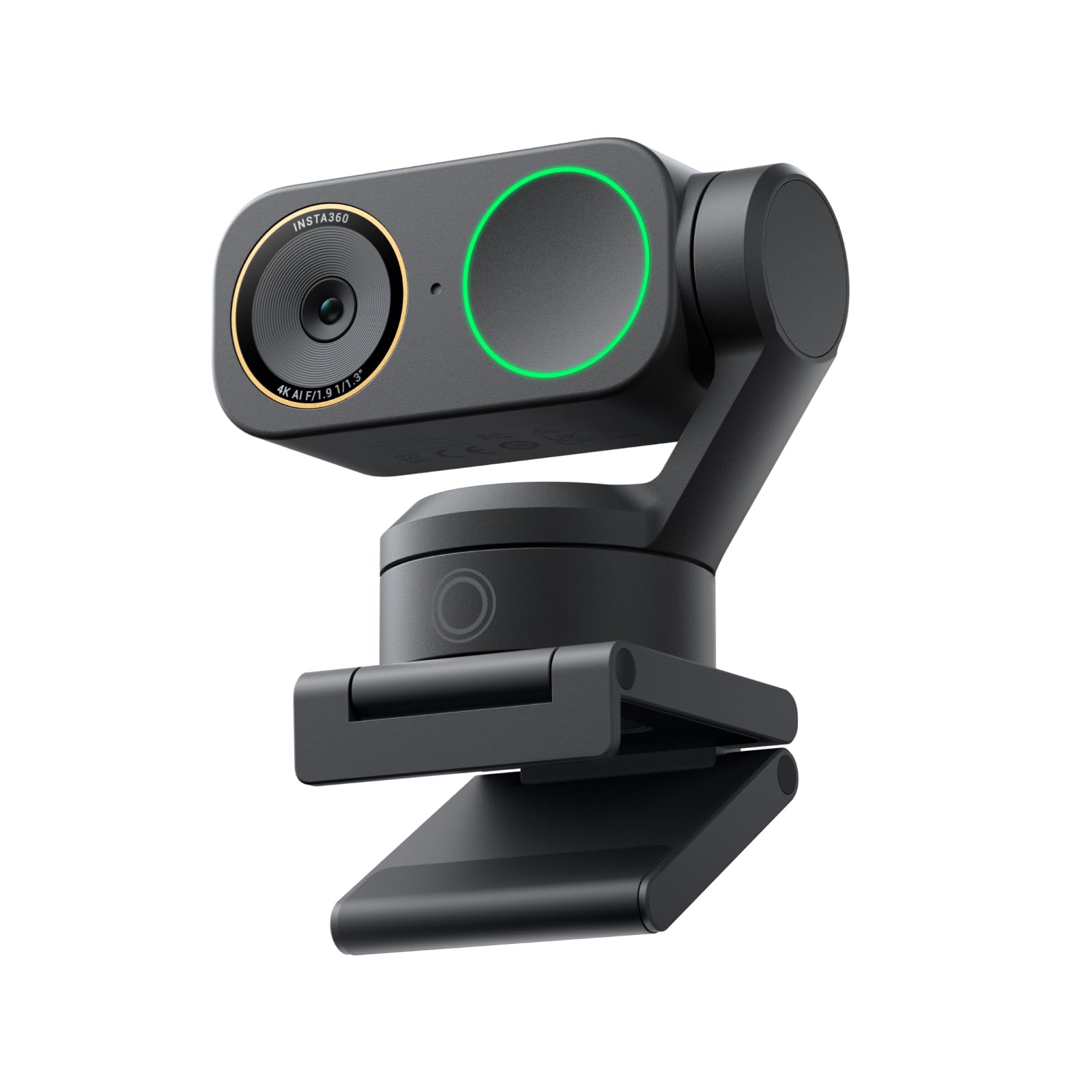
A camera that physically turns to follow you, so you can pace the room and stay in frame.
PTZ means pan, tilt, and zoom — three motors that move the camera itself, not just a crop of the image. The Link 2 Pro uses them to physically follow you around the room, and it does so with a 1/1.3” sensor for clean 4K in low light. Pair that with a redesigned dual-mic system with beamforming (which focuses pickup on your direction and pushes other noise down) and you can skip a separate mic for a talking-head stream.
Beyond the tracking, it pulls in useful modes: DeskView for showing documents, Whiteboard Mode, and 4K Portrait Mode for vertical streams. You can start tracking, zoom, or switch modes with simple hand gestures or from your phone, and Elgato Stream Deck integration lets you trigger presets from a control deck. Natural bokeh replicates a DSLR-style depth of field straight from the software, which is a look that usually requires a much bigger camera.
The mixed feedback is worth naming honestly: picture quality wins people over — crisp 4K and smooth AI tracking — but some owners hit software or performance snags. If you run on ARM-based Windows, note that this model is not compatible, and Windows Hello Face Recognition is not supported either. On standard Windows, macOS, Chrome OS, or Linux it connects over USB-C with no fuss.
The hands-free payoff: real pan and tilt motors follow you around the room, so a moving presenter never drifts out of frame.
One compatibility check first: ARM-based Windows machines and Windows Hello are off the table — confirm your system before you buy.
Suits you if: you teach, present, or demo at a whiteboard and want the camera to chase you instead of you chasing the frame.
Stay with a fixed cam if: you sit still for the whole stream — the moving motors add cost you will not use.
6. osee GoStream Deck HDMI Pro

Four cameras in, three platforms out, and a T-Bar to cut between them without a mouse.
This is the piece that turns a pile of cameras into a show. Four HDMI inputs and two HDMI outputs let you connect four sources and two displays for multiview and monitoring, and there are 2 Type-C ports for webcam input/output, SSD connection, and PC hookup. An Ethernet port streams directly, an SD card slot records or plays files, and 2 audio inputs plus a headphone output let you monitor levels while you go.
You can stream to 3 platforms at once — YouTube, Facebook, Zoom, or any RTMP server — over the Ethernet port, or push through OBS or vMix over USB instead. Both landscape and portrait modes are supported, so a vertical YouTube Shorts push and a horizontal live stream share the same box. A downstream keyer overlays logos and lower-thirds; an upstream keyer handles green screen, chroma key, and picture-in-picture.
The control surface is the reason to choose hardware: a hard panel with PVW/PGM (preview and program) buses, a T-Bar for manual transitions, and macros for repeatable sequences. Functionality and connectivity are what owners praise most, and the ability to run the whole production without a PC matters when your laptop is the thing that usually crashes. Ease of use gets mixed notes and the unit runs warm, so budget a learning session and give it airflow. Auto-switching also cuts cameras for you during a podcast.
Built for reliability under pressure: a physical panel with preview/program buses and a T-Bar keeps the show running even with no computer attached.
Plan for the warm-up: the deck generates meaningful heat and prefers a little breathing room on the desk.
Choose it if: you run two or more cameras and want hardware-level scene switching and multi-platform output.
Skip the hardware route if: you stream solo from one webcam — OBS alone does that job.
7. OBSBOT Tiny 3
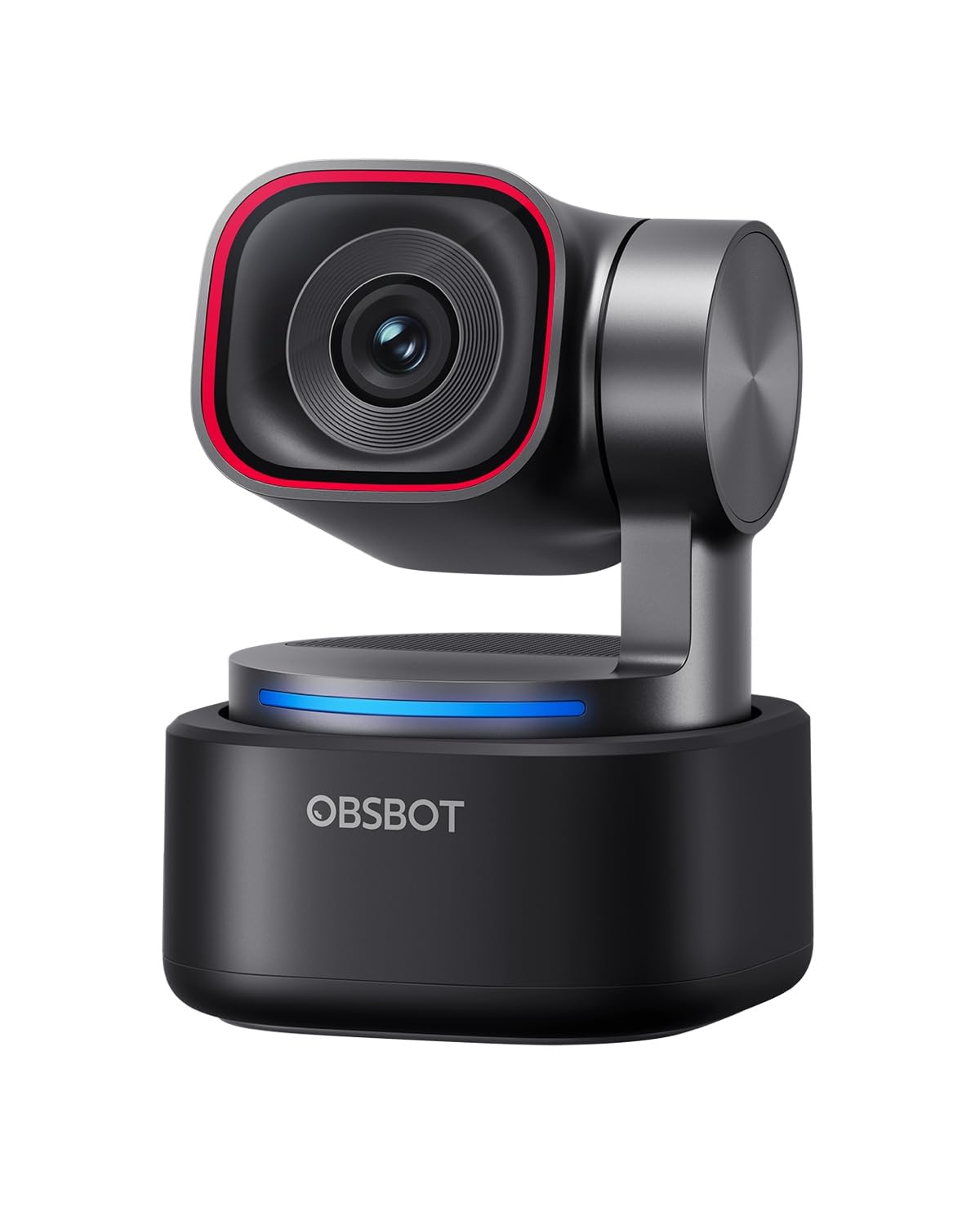
A tiny PTZ camera with three mics and enough AI to track you by voice command.
The Tiny 3 is 48% smaller and 34% lighter than its predecessor, yet packs a more powerful 1/1.28” CMOS sensor. It records 4K at 30FPS or 1080P at 120FPS — that 120 FPS option is unusually high for a webcam and suits slow-motion or fast action capture. Dual All-Pixel PDAF keeps focus sharp, a wide ISO range of 0–12800 with DCG HDR holds detail in low light, and the compact body still manages all of it.
Audio is the second half of the story. A triple-mic array pairs an omnidirectional mic for the whole room with two MEMS directional mics that pinpoint voices, feeding five audio modes so you can adapt to solo, group, or noisy setups. AI Tracking 2.0 can lock onto a single person, a group, or over 200 types of objects, and extra modes like Desk, Whiteboard, and Zone Tracking refine the framing.
what separates it from a plain webcam is hands-free control: you can wake it, track, zoom, and switch presets with your voice or a wave of your hand, so you stay in frame without touching a dial. OBSBOT Center (the camera’s companion app) handles beauty mode, background blur, a teleprompter, and pro calibrations like exposure gamma (how bright the image looks) and NVIDIA Maxine Eye Contact (software that nudges your eyes toward the lens). Owners mention mixed views on the software and motion — the core experience is loved, the polish is debated. If the gimbal (the motorized mount that moves the camera) behaves oddly, switch off gesture and voice control. It runs over USB-C on Windows 10 or macOS 11.0 and later.
What makes it stand out
- 1/1.28” CMOS with 4K/30fps and 1080p/120fps options
- Triple-mic array with five audio modes
- AI Tracking 2.0 covers people, groups, and 200+ object types
- Voice and gesture control plus Desk and Whiteboard modes
Worth knowing first
- Software and dynamics get mixed reviews, so expect tuning time
- Gesture and voice control can occasionally misfire — turn them off when they do
Well matched to: creators who want the camera to do the directing — tracking, framing, and audio modes included.
Less suited if: you want zero software fiddling and purely manual control.
8. Elgato Stream Deck + XL
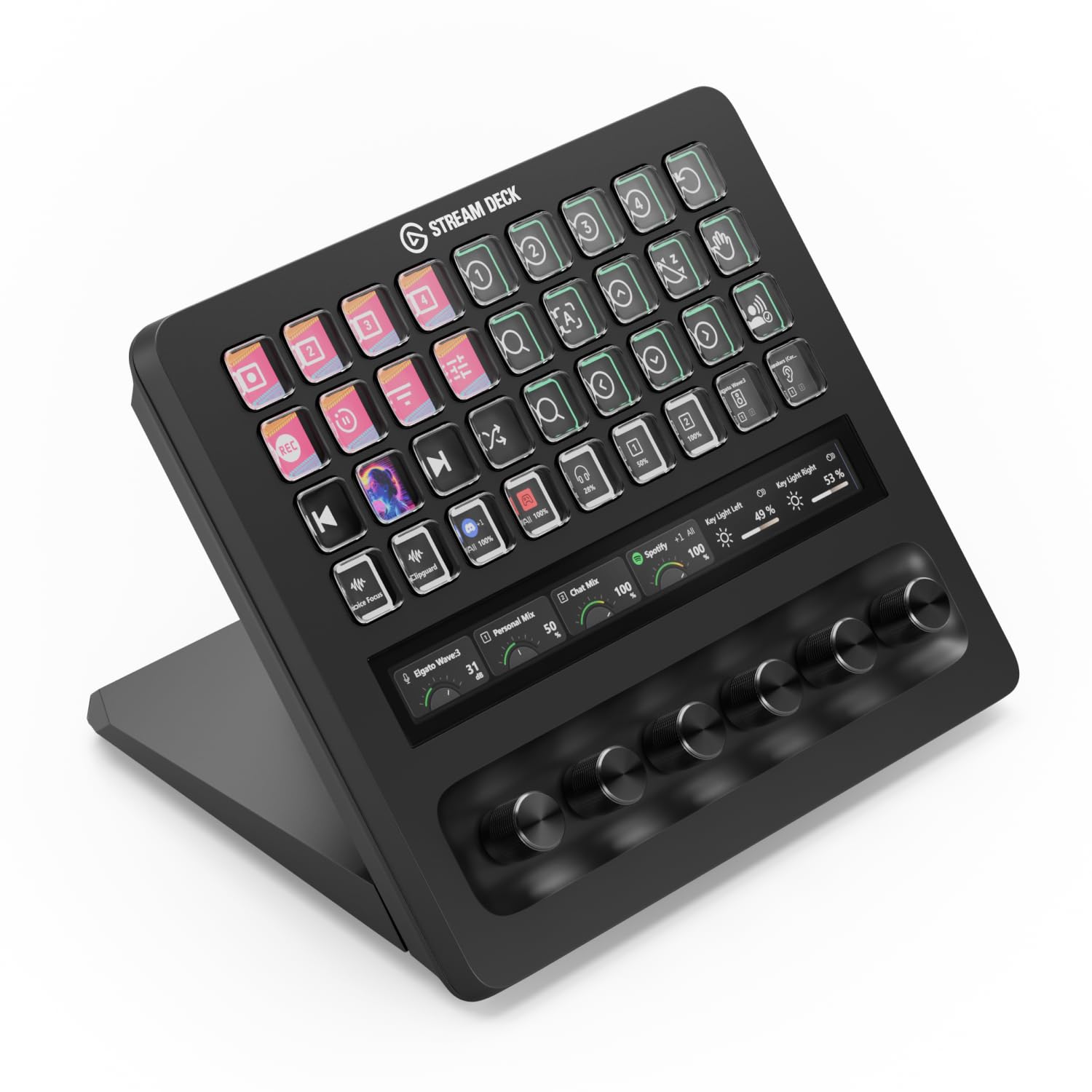
Thirty-six keys and six dials that turn a mid-stream scramble into one clean press.
Once your audio and camera are sorted, the remaining problem is speed. The Stream Deck + XL gives you 36 macro keys (assignable buttons that fire a command) plus six multifunction dials for precise level and setting tweaks. A touch strip display shows your key info in real time, and a swipe switches pages of actions so 36 keys become effectively unlimited.
You customize everything in the free Stream Deck app for PC and Mac, and Multi Actions let one press trigger an entire sequence — mic on, scene change, lower-third up, all at once. Hundreds of integrations connect DAWs, video switchers, and creative apps, with optional accessories like a Network Dock expanding connectivity. Unlimited custom profiles mean separate layouts for different shows or collaborators, and customizability is a big part of why it wins people over.
Performance and functionality are the strongest points, and controlling profile navigation from a single dial is a small detail that saves constant digging. The one recurring note is price — it is a premium accessory, and some buyers weigh whether the convenience justifies it. It runs over USB-C, weighs 2.4 pounds, and arrives with a USB cable in the box.
The workflow win: 36 keys, six dials, and Multi Actions mean a full scene transition is one press instead of a cursor hunt.
The honest trade-off: it is a premium purchase, and value-for-money is the mixed note among owners.
Right for you if: you run a live show and want tactile, one-press control over scenes and audio.
Hold off if: your stream is a single static camera and a keyboard shortcut already covers it.
9. Logitech Mevo Start Wireless Live Streaming Camera

A cable-free 1080p camera that streams over Wi-Fi and runs six hours on its own battery.
Streaming away from your desk is a different job. The Mevo Start records and streams in 1080p HD over Wi-Fi with no cable tether, and its built-in battery lasts up to six hours, or you can plug into power for continuous use. Sync up to three Mevo Start units for multi-camera streaming from the start, and the Mevo Multicam App controls them wirelessly with Auto-Director cutting between angles.
Audio comes from each camera’s built-in microphone, or you can connect external sound sources for a more advanced setup. The bundle adds a Signature Series case with a softshell exterior that resists abrasion and a fitted interior that stops buttons being pressed or ports damaged in transit. Video quality and ease of use are the things owners like most — it sets up fast and the picture looks clean.
Reliability is the honest variable. Some units run flawlessly while others prove unreliable, and connectivity is the recurring complaint. That makes this a strong pick for a travel streamer on good Wi-Fi and a weaker one for a location where the network itself is shaky. Go in knowing the Wi-Fi dependency and it delivers a portable, good-looking 1080p stream without a laptop.
Why it travels well
- Up to six hours on the built-in battery
- Syncs up to three cameras for multi-angle streaming
- Auto-Director in the app cuts between cameras for you
- Protective Signature Series case included
Know before you go
- It leans on Wi-Fi, so a weak network affects the stream
- Reliability varies between units — connectivity is the recurring gripe
Ideal for: the creator streaming on location who wants a cable-free 1080p camera and a multi-cam option in a bag.
Not your pick if: you need a fixed, rock-solid wired feed — stay desk-based.
10. RØDECaster Duo Compact Audio Production Studio
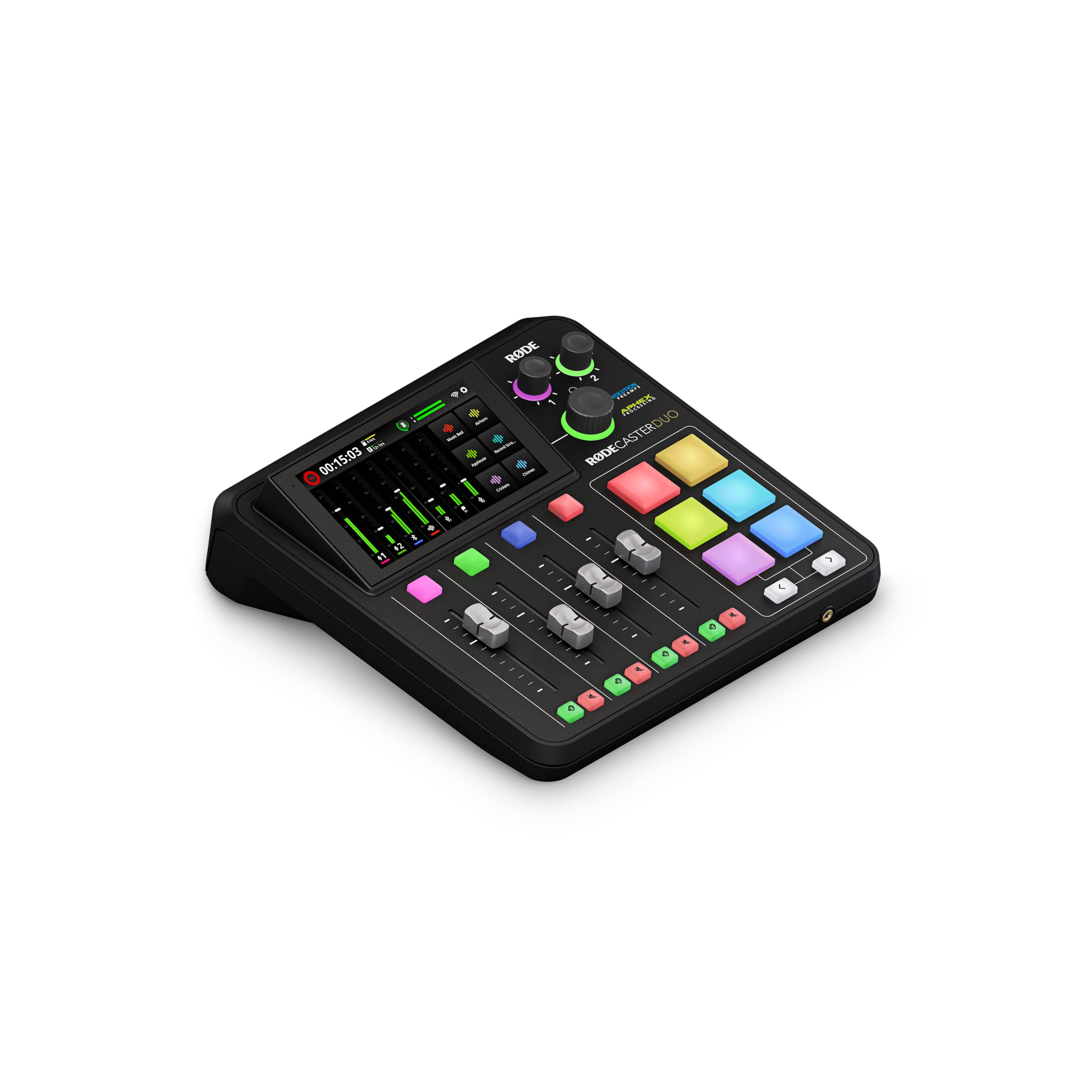
Four broadcast faders and a touchscreen that turn your audio chain into a hands-on console.
This is an audio production studio in one box: two high-quality Neutrik combo jacks for mics and instruments, four broadcast-quality faders, a high-resolution touchscreen with haptic feedback, and six SMART pads with bank switching. Under the hood, the Revolution Preamps run a 76dB gain with -131.5dBV EIN (a very low noise floor), so a quiet microphone still comes through clean and loud.
Studio-grade effects include APHEX processing — the Aural Exciter and Big Bottom — that shape voice without a separate plugin chain. A 3.5mm TRRS input lets you monitor through headphones or record through a headset. The programmable buttons for different effects and sounds are what owners appreciate most, and the console handles podcasting, streaming, music production, and content creation from the same surface.
Setup is the main thing to budget for. Getting it configured takes about 20 minutes, and some find the process difficult the first time, so plan a calm afternoon rather than a pre-stream panic. Reliability, sound quality, and value draw mixed notes in places, and software issues come up — this is a deep piece of gear that rewards learning it. Effectiveness and customizability are its strongest hands, and the 4-channel design keeps mics, music, and game audio separated.
Where it shines: four faders and APHEX processing give you a real mixing surface for multi-source audio in a compact footprint.
The honest cost: expect roughly 20 minutes of setup and a learning curve before the first clean recording.
Designed for: podcasters and streamers juggling multiple audio sources who want hands-on faders and onboard effects.
Overkill if: one microphone into one stream is all you need — a single USB mic covers that.
11. YoloBox Ultra

A 4K live studio with a switcher, encoder, recorder, and screen built into one box.
The Ultra replaces an entire desk. Inside: a switcher, a 4K encoder, a recorder, and an 8” touchscreen monitor, so you go live without a laptop, capture card, or extra software. Four HDMI inputs plus USB-C and USB-A give you 10+ sources, with one-tap switching, picture-in-picture, overlays, scoreboards, and instant replay. Auto-switching keeps a podcast cutting between cameras on its own.
Reach is the big draw. You can go live on 3 horizontal platforms (YouTube, Facebook, or other RTMP) or 2 vertical platforms (TikTok, Instagram) at once. Cellular bonding combines up to 5 network connections — 2 USB modems, 1 4G LTE, 1 Wi-Fi, and 1 Ethernet — to keep the stream alive when one link drops. NDI and SRT support enable low-latency remote production, with additional charges applying. ISO recordings save each input separately with adjustable resolution, frame rate, and bitrate for post-production.
Owners describe it as an all-in-one that gets impressively close to a full OBS setup without the computer, and multi-camera connectivity is a common strength. It is a serious broadcast tool for churches, schools, sports teams, and event producers — plan to spend time learning the workflows, and note the battery charging tip if the unit ever sticks on a flashing logo. For live events where reliability is the whole job, it earns its place at the premium end of this list.
The all-in-one case: switcher, encoder, recorder, and 8” screen in one 1kg box means one power cable and no laptop to crash.
The setup reality: it is a deep broadcast tool — give yourself time with the workflows before a live event.
Best for: event and venue producers who need multi-cam switching, cellular bonding, and simultaneous multi-platform output in one kit.
Too much machine if: you stream solo from one camera — a webcam and OBS do the job.
Know the Specs
Audio Format: 48kHz/24-bit and Signal-to-Noise Ratio
An audio format is written as sample rate and bit depth. 48kHz/24-bit captures a wide span of sound detail, which keeps your voice full rather than thin. Signal-to-noise ratio (SNR) measures how much louder the voice is than background hiss — a higher figure like 70dB means quieter gaps between sentences. Together they decide whether your stream sounds crisp or cheap.
Sensor Size and Field of View
A camera sensor is the chip that gathers light. A larger sensor — 1/1.3” is among the biggest on this list — pulls in more light, so low-light scenes look cleaner. Field of view (FOV) is how much of the room the lens sees; an 82° FOV keeps you framed with room around you, while a narrower FOV crops tighter. Bigger sensor plus sensible FOV is the recipe for a clean shot.
Frame Rate and Resolution
Resolution is the pixel count — 4K is sharper than 1080p. Frame rate (FPS) is how many still images the camera captures each second, and motion smoothness comes from it. 60 FPS keeps gestures fluid; 30 FPS is fine for a seated talking head. Some cameras offer a high frame rate like 120 FPS at a lower resolution, useful for slow motion.
Pickup Patterns and Connectivity
A pickup pattern is the shape of a mic’s hearing. Cardioid hears what is in front, omni hears the whole room, bidirectional hears front and back, and stereo captures width. Connectivity decides how the gear talks to your setup: USB-C and 3.5mm for mics and cameras, HDMI and Ethernet for switchers, frequency standards like 2.4GHz for wireless transmitters.
Common Questions
Do I need a separate microphone if my webcam has one built in?
Will a 4K webcam look better if my streaming platform caps quality?
What is the difference between a USB mic and a hardware mixer?
Can I stream without a laptop using a hardware switcher?
How much range do I need from a wireless lavalier mic?
Does a bigger camera sensor really matter for low light?
What does a capture card or switcher actually do?
Can I run multiple cameras on one YouTube stream?
How long can I stream before I need to recharge?
Do I need a control deck or can I just use keyboard shortcuts?
Will a PTZ tracking camera work with my video software?
The Bottom Line
For most creators, the youtube live streaming equipment winner is the Hollyland Lark M2 because a 9g clip-on transmitter with 48kHz/24-bit audio fixes the thing viewers notice first — your voice — without a desk mic in frame. If you want a fixed desk mic with four pickup patterns, grab the Logitech Blue Yeti. And for a room where the light is not ideal, the YoloLiv YoloCam S3 and its 1/1.3” sensor is the one to reach for.
Build outward from there: add a 4K camera that holds 60 FPS if you move a lot, a switcher if you run multiple cameras, and a control deck once your scene list gets long. Each pick here solves one problem — mic, camera, switcher, or control deck — and that is what makes a stream look professional.
How we choose
We do not accept paid placement. Every pick is matched to a real buyer and a real use-case; we do not hands-on test units.
Sources
Specifications: manufacturer listings and product documentation. Review insights: verified customer reviews, as of November 2026. Pricing: not shown on this page (it changes often); check the current price via the retailer link.
As an Amazon Associate, Tactical Gear Guy earns from qualifying purchases. This does not affect which products we feature.