Specs are compiled from manufacturer listings and verified buyer reviews and can change over time — please confirm the key details on the product page before buying.
If your young runner is slipping on the curve or landing flat in the long jump pit, the fix is usually a proper plate-and-pin shoe with the right size, not more practice. Youth track spikes put metal pins under the forefoot so the foot bites the track surface on push-off. This guide covers five real pairs, what each one is genuinely good at, and where each one asks you to compromise.
This guide is built by comparing the manufacturers’ published specifications and the patterns across verified customer reviews, so you get each pick’s real strengths and trade-offs instead of marketing spin.
Most first-time spike buyers trip up on sizing and pin count, not brand names. The shortlist below shows what each pair actually delivers for young athletes, so you can pick youth track spikes that fit right the first time and hold grip through a full season of practices and meets. One pair has a full carbon plate; another covers the widest size run of the group.
Top Picks


How to Choose Youth Track Spikes
Three things decide the right pair: a size that matches actual foot length, a pin setup that suits the events your kid runs, and a plate stiff enough for the event without being punishing. Get those right and the brand badge matters far less.
Size by foot length, not by school shoe size
Track spikes are cut snug on purpose so the foot cannot slide inside the shoe during a sprint start. Measure the foot in centimeters and match it to the maker’s size chart before you order. A Youth pair that feels roomy in the store is usually a Youth pair that will rub a blister by the second practice.
Pin count and event fit
More pins spread force across a wider patch of the forefoot, so an 8-pin plate bites harder out of the blocks. An 8-pin plate gives aggressive bite for sprints and jumps, while a 7-pin plate spreads the load a little differently. Both are legitimate; the choice depends on whether your athlete is exploding out of blocks or cruising distance laps.
Plate stiffness and upper material
A stiff plate under the forefoot returns energy on push-off, which is why carbon plates appear on sprint-focused pairs. Mesh uppers keep the shoe light and let heat escape. For a younger or newer athlete, a softer, more forgiving plate is easier on the calves while they build strength.
Replacement pins and tool
Pins wear down and occasionally snap. A pair that ships with spare pins and a wrench means you are not hunting for parts before a meet. Check the box contents before the first race, not after.
Side-by-Side Comparison
| Model | Best For | Size Range | Spike Pins | Plate | Amazon |
|---|---|---|---|---|---|
| Ifrich Boys Girls Track and Field Spikes★ Best Overall | First-season all-rounders | US1.5-12 | 8 spikes | — | Amazon |
| TURFO Teenagers Track and Field SpikesMost Versatile | Jump and hurdle events | — | 8 spikes | — | Amazon |
| AOLEXWU Track Spike Shoes | Multi-event school athletes | — | 8 spikes | — | Amazon |
| Carbon Plate 7-Spike Sprint Shoes | 100m, 200m and 400m racing | — | 7 spikes | Full-length carbon | Amazon |
| THESTRON Unisex Track Spikes | Widest size coverage | US1-12.5 | 8 spikes | — | Amazon |
Detailed Reviews
1. Ifrich Boys Girls Track and Field Spikes
Our pick — 4.0+★ from 950+ verified ratings; the strongest balance of quality and price.
The pair that gets a nervous first-season kid around the track without drama.
Ifrich’s pair runs across US1.5-12 in kids, men’s and women’s sizing, which makes it a flexible starting point for a family with more than one young athlete. Build quality is the standout: reviewers repeatedly describe the shoe as solid and well-made for the price.
You get 8 metal pins under the forefoot, plus spare pins and a wrench in the box. The upper is a breathable, lightweight material, so a hot afternoon practice does not cook the foot. Extra spikes in the bag means a snapped pin does not cost you a meet. Color options run from black and white through grey, green, blue, purple, red, pink and gold, so most kids find a pair they will actually wear.
The honest catch is fit consistency. Some buyers find the sizing true to the chart, others find it runs small — so treat the foot-length measurement as the real guide and size up if your child is between marks. Durability is the other thing to watch: this is a shoe for a season, not for three. For a middle-schooler running multiple events on a school team, that trade-off is easy to live with.
Where it delivers
- Build quality is the strongest thing about it — the shoe holds its shape and plate alignment through hard starts.
- US1.5-12 spans kids, men’s and women’s sizing in one listing, so most young athletes find a fit.
- Spare pins and a wrench come included, so a welded pin never benches a race day.
- Lightweight breathable upper keeps weight off a young athlete’s stride.
What to plan around
- Sizing feedback splits between true-to-size and runs small, so measure the foot rather than trusting the school sneaker size.
- Durability is a one-season story — the pins and plate wear with heavy weekly volume.
- Kids, men’s and women’s sizing share one listing, so read the chart closely before ordering.
Pick this if: your young athlete is new to spikes, runs a spread of events, and you want one well-made pair that covers a season of practice.
Look elsewhere if: you need a dedicated sprint plate for 100m and 200m racing — the carbon-plate option below is built for that.
2. TURFO Teenagers Track and Field Spikes
Aimed squarely at jumpers and hurdlers — not pure sprinters.
This is the TURFO pair pitched for speed, jump and hurdle events. The 8-spike system spreads grip across the forefoot so a hurdler landing off a trail leg still has traction underfoot. A breathable mesh upper gives support without bulk, which matters when the shoe is carrying a young athlete’s weight through a jump takeoff.
Appearance is what the reviews lead with — the colorwork lands well with younger runners, and that matters more than adults like to admit when a kid will only wear something they think looks sharp. The mesh upper and 8-pin plate suit both hurdle takeoffs and jump landings. If your athlete rotates between short hurdles and long jump, this is a natural fit.
The one practical snag is the sizing. Several buyers report this pair runs small, so order up a size or confirm the measurement before committing. If you buy at school shoe size you will likely send it back. Extra pins and tools ship in the box, so replacement is not a separate errand.
The sizing shortcut: measure the foot in centimeters, compare it to the maker’s chart, and go one size up if your child is anywhere near a half-size boundary.
Set it loose: hurdle and jump athletes who want an 8-pin plate and a mesh upper built for takeoff.
Hold back if: you cannot confirm the size run before a meet is coming up.
3. AOLEXWU Track Spike Shoes
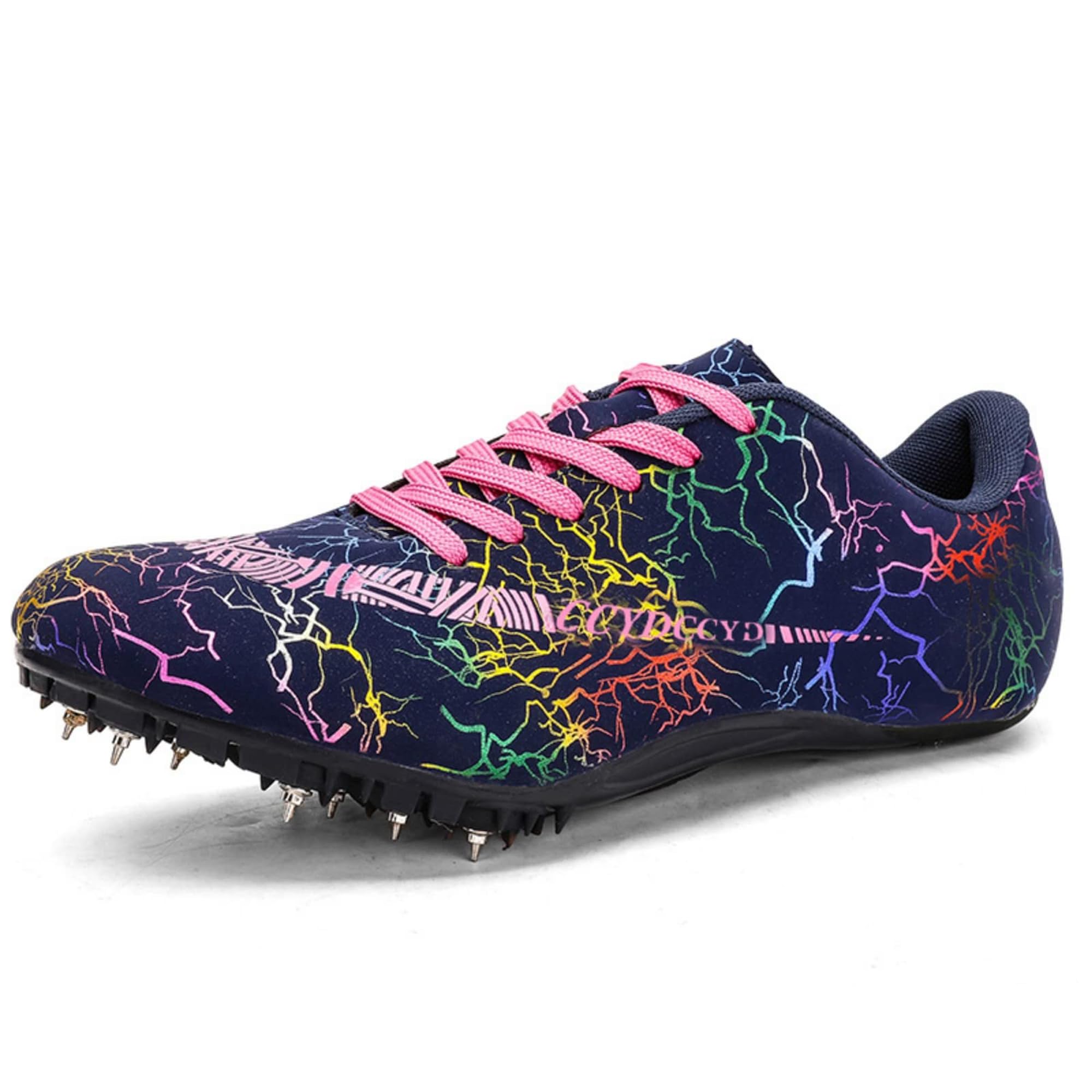
Built for the athlete who signs up for four different events at once.
AOLEXWU loads this shoe with an 8-spike configuration running the length of the forefoot for traction out of the blocks, plus a shock-absorbing midsole that takes the sting out of pounding laps. Mesh uppers with ventilation zones move warm air out during a long meet day. The maker lists grip across rubber tracks, grass and synthetic surfaces, which matters when you practice on one surface and race on another.
The cushioned upper is the detail that separates this from a pure sprint shoe — a sprinter will not care, but a distance runner will. If your young athlete switches between the 800m and long jump, this cushioning plus the 8-pin plate gives the best of both worlds. With an 8-pin plate and a cushioned midsole, it covers sprinting, hurdles, distance and jumping.
Sizing is the recurring friction. Several owners mention this shoe runs very small, so measure the foot and order up rather than trusting a school-shoe label. The mid-range rating reflects that fit uncertainty more than any fault in the shoe itself — where it fits, buyers rate the quality highly.
What the shoe does well: a cushioned midsole and mesh venting make this the more forgiving choice for a young athlete mixing distance laps with jumps.
Where it needs you: sizing runs small enough that confirming the foot length is not optional.
Go for it if: your athlete runs several disciplines and appreciates a little cushioning underfoot.
Consider the sprint-specific pair instead if: the only events on the schedule are 100m, 200m and 400m.
4. Full-Length Carbon Plate 7-Spike Sprint Shoes

Stiff carbon under the foot, aimed at the 100m, 200m and 400m.
The headline here is the full-length carbon plate running under the foot. A carbon plate is a stiff sheet under the forefoot that springs back on push-off, sending a sprinter’s energy forward instead of losing it in the shoe. It suits 100m, 200m and 400m racing — where a snappy plate pays off most — though the maker also lists high jump, long jump and long-distance running.
Carbon plates usually sit in the more expensive tier of track shoes. Here you get one without that usual leap, which is what pushes this into the top-value slot. Seven pins rather than eight is the only edge the other pairs have on this one. The plate stiffness is a genuine advantage for sprinting, and the slightly lower pin count suits athletes who want a lighter, snappier forefoot.
Fit is where this one earns its strong rating — customers note the shoe feels true and comfortable once the size is right. Sizing still disagrees across buyers, with some finding it runs small. Measure the foot before ordering and you sidestep the issue entirely.
The sprint argument
- Full-length carbon plate returns energy on every push-off, which is what makes it a sprint shoe.
- Purpose-built for 100m, 200m and 400m racing.
- Strong fit feedback and a premium-class plate without the premium-class markup.
- Lighter than an 8-pin shoe, so turnover stays quick.
Who should size up
- Sizing disagrees across buyers; some report it runs small.
- Seven pins rather than eight — the other pairs here give one more point of contact.
- Carbon plates are unforgiving if the athlete is not yet strong enough to load them.
Commit to it if: your sprinter wants a carbon plate and races mostly 100m, 200m and 400m.
Think twice if: the athlete is brand new to spikes and still building calf strength, since a stiff plate is harder to load.
5. THESTRON Unisex Track Spikes

The size run most likely to actually fit the small end of youth.
THESTRON carries US1-12.5, the widest size span in this group. If the other pairs stop short of a small foot, this one is where you finish. Eight pins plus spares and a tool ship in the box, and the upper is a comfortable, lightweight material that reduces pressure while holding support through turns.
Build quality is what buyers praise most. Build feels solid for the category, and the appearance holds up — reviewers point out the shoe still looks fresh after practice wear. Colors run across gold, silver, purple, blue, black, white, grey and yellow, so there is a shade for just about any young runner.
The honest limit is fit. Sizing disagrees across buyers, with some reporting the shoe runs too small — so check the foot length against the chart and go up a size when in doubt. Comfort also splits across buyers, with some finding it snug and supportive while others want a roomier fit. For a young athlete who falls at the small end of the youth range, that caveat is worth accepting.
The size-run advantage: US1-12.5 means THESTRON reaches down to the smallest feet on this list, plus up to US12.5 for an older sibling.
The star rating, honestly: THESTRON’s own listing pairs this with sibling models rated as high as 4.5, so this is a well-reviewed line even if this exact pair lands below that.
Reach for this if: a small-footed young runner can’t find a fit in the other pairs, or you need one listing that covers a range of ages.
Look elsewhere if: you have a dedicated sprinter who needs a stiff carbon plate under the forefoot.
Know the Specs
Spike Pins and Plate
Spike pins are the metal studs screwed into the forefoot of the shoe. More pins spread force across a wider patch of contact, which helps with traction out of a sprint start or a jump takeoff. The plate is the stiff layer under the pins, and it springs the foot back into the air. A carbon plate is the stiffest category and suits sprint events; a softer plate is more forgiving for newer or younger athletes.
Size Range and Fit
Track spikes should fit snug — foot slide inside the shoe wastes energy and causes blisters. Measure foot length in centimeters and match to the maker’s chart rather than using a school-shoe size. Several pairs here run small, so sizing up a half step is a sensible move for a growing foot. Youth-fit focus means the small end of the run is where the shoe has to work.
Upper Material and Ventilation
Mesh uppers are the standard on track spikes. Mesh is light and breathes, so heat escapes during a long meet day, and the shoe stays light on the foot. A lightweight upper reduces pressure on a young runner’s stride, which matters over multiple events. A cushioned midsole is the other option — it adds shock absorption for distance work but little for a pure sprinter.
Event Match
Sprints, hurdles, jumps and distance events each load the shoe differently. A sprinter wants stiffness and grip; a distance runner wants cushioning and a less punishing plate. If one athlete covers multiple events, a more flexible 8-pin shoe is the sensible default. If the schedule is 100m, 200m and 400m, a carbon plate is the better match.
Common Questions
Do youth track spikes fit the same as normal sneakers?
How do I size youth track spikes for a growing foot?
Are 8-spike shoes better than 7-spike shoes?
What does the carbon plate actually do on a sprint shoe?
Should young athletes use spikes for distance running?
How often do spike pins need replacing?
Can my child wear track spikes for school PE or on the playground?
Which youth track spikes in this group cover the widest size range?
Are replacement spikes and tools always included?
The Bottom Line
For most young athletes, the youth track spikes winner is the Ifrich Boys Girls Track and Field Spikes because its build quality, 8-pin grip and US1.5-12 size span make it a safe first pair for a school team. If your athlete is a dedicated sprinter, the Full-Length Carbon Plate 7-Spike Sprint Shoes deliver the stiff plate that 100m and 200m racing rewards. And for a small-footed young runner who can’t find a size elsewhere, the THESTRON Unisex Track Spikes reach all the way down to US1.
One last nudge: whatever pair you pick, measure the foot in centimeters before ordering. Fit is the single thing that causes the most returns in this category, and it costs nothing to check.
How we choose
We do not accept paid placement. Every pick is matched to a real buyer and a real use-case; we do not hands-on test units.
Sources
Specifications: manufacturer listings and product documentation. Review insights: verified customer reviews, as of November 2026. Pricing: not shown on this page (it changes often); check the current price via the retailer link.
As an Amazon Associate, Tactical Gear Guy earns from qualifying purchases. This does not affect which products we feature.