Specs are compiled from manufacturer listings and verified buyer reviews and can change over time — please confirm the key details on the product page before buying.
Your child’s helmet should absorb a fall, tighten onto a growing head, and keep goggles clear on the lift. Get those three right and the helmet stays level, the goggles stay put, and the complaints stop. Get them wrong and the shell tips back off the forehead on every run. Below are seven youth and junior helmets, sorted by what each does best, with the honest catch on every one.
This guide is built by comparing the manufacturers’ published specifications and the patterns across verified customer reviews, so you get each pick’s real strengths and trade-offs instead of marketing spin.
You will see exactly which shells carry ASTM F2040 certification, which models use MIPS, and how many vents each helmet runs. Every pick below is sized for youth or junior riders, so you can narrow the shortlist fast — this is the best youth snow helmet shortlist for a growing head.
Top Picks


How To Choose The Best Youth Snow Helmet
A youth snow helmet is not a shrunken adult helmet. It has to survive a fall from a smaller body at lower speeds, fit a head that changes size between seasons, and keep a child warm enough to stay out past one run. The most common mistake is sizing to this season’s head circumference and ignoring whether the dial has enough range left for next winter.
Start with the certification, not the colour
A snow helmet earns its keep through its safety standard. Look for ASTM F2040 on the label — that is the US standard for snow sports helmets. Some models also carry CE EN 1077, the European equivalent. If neither standard is named on the listing, treat it as an uncertified shell and skip it.
Measure the head, then trust the dial
Wrap a soft tape just above the ears and level around the widest part of the head. That circumference is what the helmet’s size chart wants. Then check whether the model has a rear dial fit system — a small knob at the back that tightens the internal cradle. That dial is what lets one helmet last two or three seasons.
Weigh the shell type
ABS shells (a hard, moulded plastic outer layer) are tough and common in budget-friendly and mid-range helmets. In-mold polycarbonate construction fuses a thinner plastic shell directly to the foam liner, which usually shaves weight. A lighter shell puts less strain on a small neck over a full day on the hill.
Count the vents and check the goggle clip
Vents let hot air out so goggles do not fog. More vents mean better airflow and less goggle fog, but more cold air on a sub-zero day — plush liners and earmuffs offset that. A rear goggle clip anchors the strap so the goggles stay seated instead of riding up mid-run.
Side-by-Side Comparison
| Model | Best For | Shell Material | Vent Count | Weight | Amazon |
|---|---|---|---|---|---|
| Comstock Kids Ski & Snowboard Helmet★ Best Overall | Beginner kids needing a tough, value-priced shell | ABS shell / EPS foam | 10 vents | 0.7 kg | Amazon |
| GROTTICO Ski Helmet (3 Sizes)Budget Champion | Families buying matching helmets for parent and child | ABS outer / EPS core | 13 vents | 0.45 kg | Amazon |
| OutdoorMaster Kelvin II | Youth and adults wanting max airflow | ABS outer / EPS foam | 14 vents | — | Amazon |
| OutdoorMaster Kids Helmet & Goggles Set | One-box kit for a first ski trip | Polycarbonate in-mold / EPS | 12 vents | — | Amazon |
| Odoland Kids Ski Helmet & Goggles Set | Kids 6–14 wanting a complete set with a carry bag | ABS outer / foam liner | 10 vents | — | Amazon |
Detailed Reviews
1. Comstock Kids Ski & Snowboard Helmet with ABS Shell
Our pick — 4.5+★ from 750+ verified ratings; the strongest balance of quality and price.
A hard ABS shell that shrugs off a beginner’s tumbles, at a price that leaves room for lift tickets.
The Comstock fits the widest range of first-season skiers. Its ABS shell (a tough moulded plastic outer layer) sits over an EPS foam liner (expanded polystyrene, the same shock-absorbing foam used inside bike and ski helmets). That combo takes a knock and spreads the force instead of passing it straight to the head. Ten vents and a moisture-wicking mesh liner keep a small head from overheating under a helmet and goggles on a long lift queue.
Where this one wins is the small details. The rear clip locks goggles down so your child is not pushing them back up every fifty metres. Plush ear pads and an adjustable chin strap mean the helmet stays on for a full day rather than getting ripped off at the first break. The adjustable fit system is built to grow with the rider across seasons.
The honest catch is weight and sizing. At 0.7 kg this is a heavier helmet than the in-mold lightweight options further down this list. It is also on the larger side for the smallest heads — several buyers find the shell runs big and that only the chin strap adjusts on the fit they received. If your child is on the younger end of the sizing chart, measure carefully and consider one of the in-mold picks instead.
Where this helmet earns its place
- ABS shell over EPS foam gives genuine impact protection for beginners
- 10 cooling vents plus moisture-wicking mesh keep the head cool and dry
- Rear goggle clip keeps eye protection locked in place mid-run
- Adjustable fit system stretches across seasons as your child grows
What to weigh before buying
- At 0.7 kg it is the heavier end of this shortlist
- The shell runs large for smaller heads; measure before ordering
Reach for this if: your child is a beginner or early-intermediate rider who needs a tough shell that survives learning-curve falls without eating the whole gear budget.
Size check first: the helmet runs big and the fit system is limited — measure the head circumference before you commit.
2. GROTTICO Ski Helmet for Men, Women, Youth & Kids
The certified, featherweight option that lets a whole family kit out in one order.
Carrying the ASTM F2040 snow helmet standard means this one is built with a reinforced ABS shell over a shock-absorbing EPS core — the certified baseline you want under a child’s head. But what makes it a real contender is the weight: 0.45 kg, which is light enough that a small neck does not feel it by the end of a long day. The three-size structure is the cleverest part: Small for kids five and older (50–54 cm), Medium for youth (55–58 cm), and Large for adults (59–61 cm), each with its own adjustment dial.
Fit is what people rave about here — it is the thing that gets praised most in the reviews, with the warmth and appearance close behind. The plush liner and removable ear pads can be pulled out and washed, which is a genuine win after a wet-weather day.
The takeaway: this is a family-helmet option, not a specialist one. It does not carry MIPS, and it does not have the deep feature list of the premium picks. What it does offer is certified protection, light weight, and a simple fit dial at a budget-friendly tier.
Light work everyday: the 0.45 kg shell is one of the two lightest in this group, and a small head barely notices it on a long day.
Buy-the-family move: the three-size spread from 50–54 cm up to 59–61 cm means a parent and a child can match helmets in one purchase, with a dial in each.
Go for it when: you want a certified helmet without spending much, and you are kitting out more than one head for the season.
Look elsewhere for: MIPS-level protection or the flushest ventilation toggle system — this is the straightforward option, not the feature-rich one.
3. OutdoorMaster Kids Ski Helmet, Adjustable Lightweight

Fourteen vents, a three-size ladder from kids to adults, and a fit that stays put.
If your child runs hot, complains about fogged goggles, and gets sweaty the moment the sun comes out on the lift, this is the helmet to beat. The vent apertures are purposefully shaped to let air flow while blocking freezing wind from hitting the head directly. An ABS shell over EPS foam holds the protection side of the equation together.
The Kelvin II is also the family-sized one. It comes in Small (48–54 cm), Medium (54–58 cm), and Large (58–62 cm), each with an adjustable dial — so it fits youth, adults, and everyone in between. Quality is what wins the review section by a country mile here, with fit right behind it. The detachable lining, earmuffs, and soft chin band pull out for washing and keep a cold head warm on a clear-winter day.
One honest point: the ABS shell here is the heavier construction than the in-mold picks, so if a very small head is the priority, go for the OutdoorMaster kids in-mold model instead. But for a rider who spans into teen sizes and wants airflow above all, this is the honest answer.
Airflow first: 14 vents is the outright highest count in this group, and the shape of the apertures keeps wind off the head rather than blasting it.
One helmet, whole family: Small at 48–54 cm through Large at 58–62 cm covers a kid and a parent from the same line.
Pick this one for: a sweaty, hot-natured rider who wants the most airflow available and a size that grows into the teen years.
Bear in mind: the ABS build is heavier than the in-mold options — a very young skier will feel that difference.
4. OutdoorMaster Kids Ski Helmet and Goggles Set
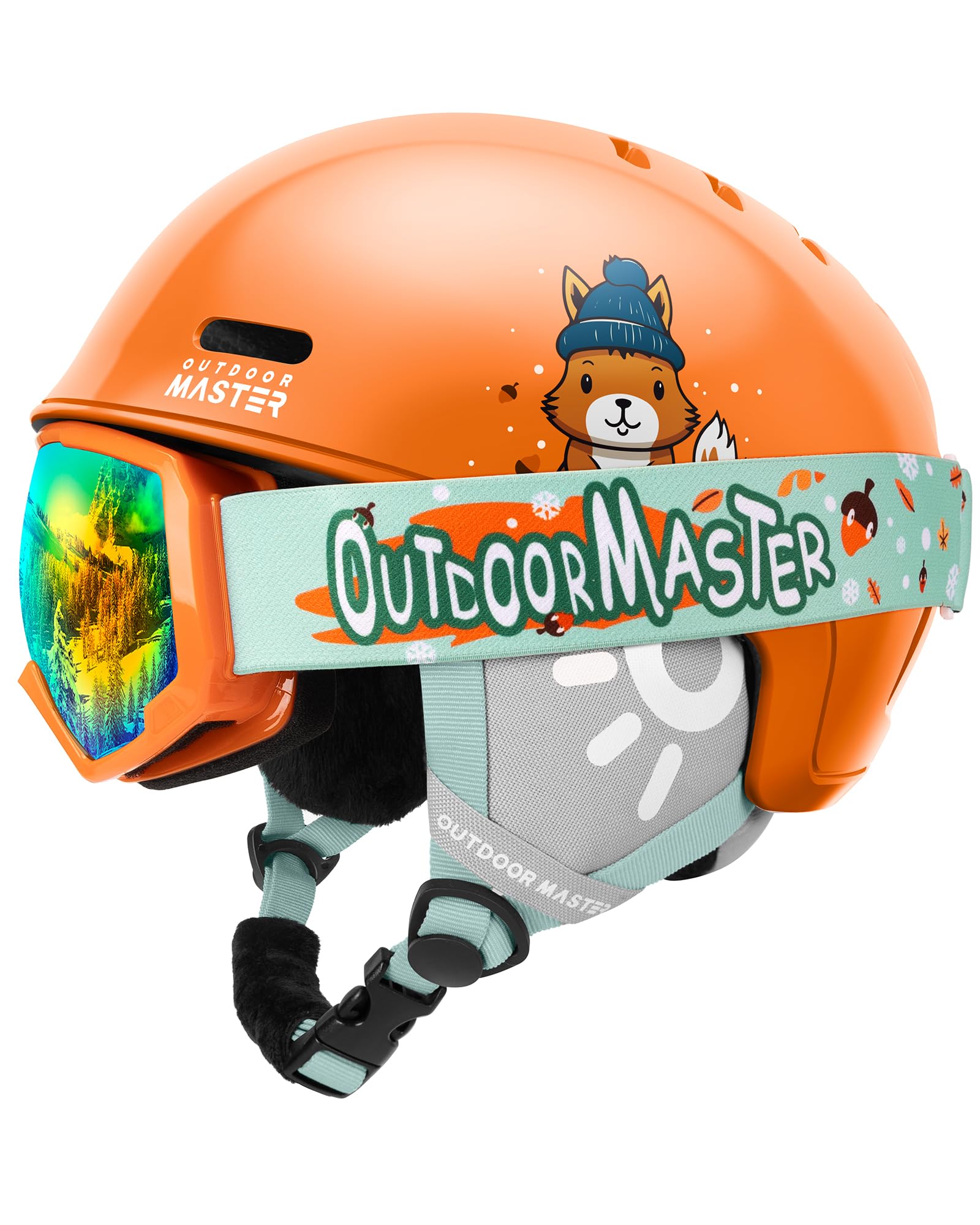
One box, one child, one ski trip — helmet and goggles that were built to fit together.
The advantage of buying the helmet and goggle together is fit. The listing is adamant there is no gap between the two, the goggles are shaped to sit flush against this specific helmet rather than hovering with a draught between them. The helmet uses in-mold construction — polycarbonate shell fused directly to the EPS foam liner — and meets ASTM F2040 standards, so the protection is certified.
The goggles themselves are the reason this set earns its place. They carry an anti-fog treatment and 100% UV protection on a double-layer lens, which matters on bright, sunny days and on cloudy days where flat light makes the snow invisible. Twelve vents in the helmet plus the goggles’ own venting system reduce fogging and keep vision clear. Fit is the other strong point — 22 people praised it in the review data, comfortably the second-most discussed aspect after quality. The rear dial tightens the fit, and there is a snap at the back for the goggle strap.
Worth knowing: the shell is built for the 5-years-and-older crowd, and the goggles are one size, so a very small face may find them roomy. A few buyers found the colour ran differently from the photos — not a safety issue, but worth knowing if the shade matters to your child.
The right buy for: a first-trip family who wants the helmet and goggles match each other perfectly, with certification and anti-fog lens sorted in one purchase.
Small caveat: the goggle lens is one size — a very small face will have some room around the edges.
5. Odoland Kids Ski Helmet with Goggles Set
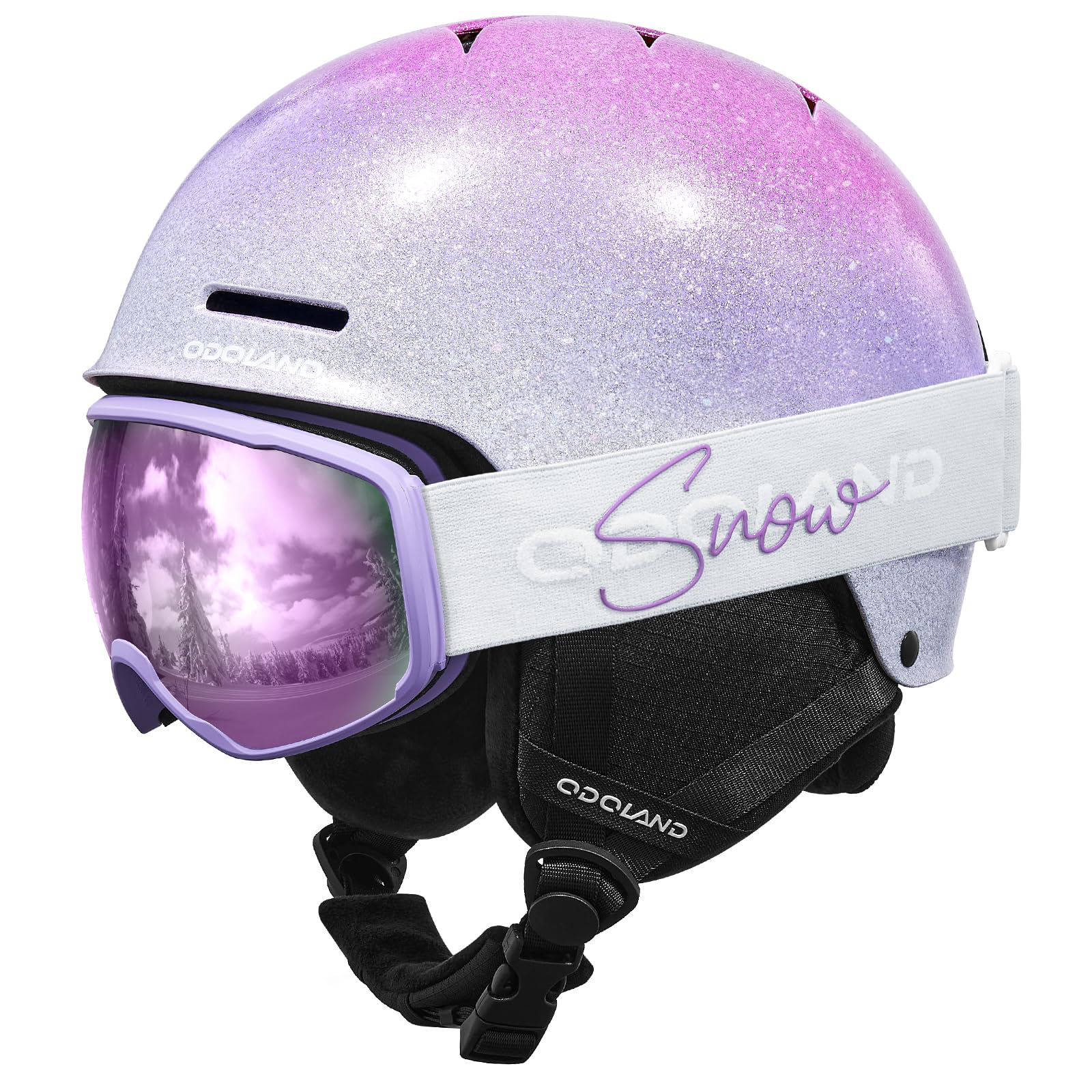
A two-in-one set for the six-to-fourteen crowd, carry bag included so it makes the car.
The Odoland targets the age six-to-14 window specifically, and that focus shows in what comes in the box: the helmet, the goggles, and a carry bag for getting it to and from the mountain. The ABS shell covers a foam liner, and 10 vent holes keep a good amount of air moving while blocking freezing wind. The goggles carry an anti-fog coating with UV protection — good for both sunny and cloudy days.
What shops well here is the fit-and-grow factor. The liner, ear pads, and chin band are all removable and adjustable, and the goggles have their own adjustable band. The most-discussed aspect in the feedback is the fit, with room for growth called out — which is exactly what a parent wants in a helmet meant to last multiple seasons. Appearance comes in second, and the value is a consistent third.
The honest note is that it is a set buy, not an a-la-carte one. If you already own good goggles, you are paying for a second pair. But for a family buying the first helmet, having a matched goggle with anti-fog coating and a carry bag in the same box saves a separate shopping trip.
Right for: a first-season 6-to-14-year-old whose family wants the helmet, the goggles, and a carry bag sorted in one order.
If you already have goggles: the bundle is what you are paying for — a goggles-optional pick earlier in this list will serve you better.
Know the Specs
Shell Construction: ABS versus In-Mold
An ABS shell is a hard, moulded plastic outer layer bonded to the foam liner — tough, common, and heavier. In-mold construction fuses a polycarbonate shell directly to the EPS foam liner, which usually saves weight. Neither is inherently better; ABS tends to suit budget-friendly builds, while in-mold is where the featherweight picks come from.
Vent Count and Adjustable Vents
More vents means more airflow and less goggle fog — but on a sub-zero day, all those openings can chill a head. A few helmets use a toggle slider so you can close off some vents when the wind picks up. A fixed vent count and an adjustable one solve the same problem from opposite ends.
Certifications: ASTM F2040 and CE EN 1077
ASTM F2040 is the US standard for snow sports helmets. CE EN 1077 is the European equivalent. A helmet that names either has been tested to a published impact standard — a helmet that names neither is not a certified snow helmet, whatever the listing says.
MIPS: What It Actually Does
MIPS — Multi-Directional Impact Protection System — is a low-friction layer inside the helmet that lets the shell rotate slightly relative to the head on an angled impact. It is a different kind of protection from a thicker shell. It is not on every helmet, and it usually sits at the premium end of the range.
Common Questions
What head measurement should I take before ordering a youth snow helmet?
Is an ABS or in-mold helmet better for a child?
Does a youth snow helmet need a rear dial fit system?
What does MIPS add, and is it worth it for a youth helmet?
How many vents should a kids’ ski helmet have?
Can a youth snow helmet be washed?
Do I need a goggle clip on the back of the helmet?
Should I buy a helmet-and-goggles set or buy them separately?
How long can one youth snow helmet last a growing child?
The Bottom Line
The youth snow helmet worth starting with is the Comstock Kids Ski & Snowboard Helmet — a tough ABS shell, 10 vents, and a rear goggle clip that make it the right first helmet for most beginners. If airflow is what you keep hearing about, grab the OutdoorMaster Kelvin II with its 14 vents. And for the family that wants certification and a dial that fits a whole head range, the GROTTICO Ski Helmet is the one to reach for.
How we choose
We do not accept paid placement. Every pick is matched to a real buyer and a real use-case; we do not hands-on test units.
Sources
Specifications: manufacturer listings and product documentation. Review insights: verified customer reviews, as of November 2026. Pricing: not shown on this page (it changes often); check the current price via the retailer link.
As an Amazon Associate, Tactical Gear Guy earns from qualifying purchases. This does not affect which products we feature.