Specs are compiled from manufacturer listings and verified buyer reviews and can change over time — please confirm the key details on the product page before buying.
Most kids who “can’t throw a spiral” are actually fighting a football that is too big for their hands. A youth-size American football fixes that: a smaller ball your child can wrap their fingers around, so the throw becomes about skill instead of grip. Below are nine balls sized for young hands, sorted by what each does best.
This guide is built by comparing the manufacturers’ published specifications and the patterns across verified customer reviews, so you get each pick’s real strengths and trade-offs instead of marketing spin.
The quick answer: the Wilson NFL Super Grip is the crowd favorite, with 4.5+ stars across 28,000+ reviews. Sizing is where most parents go wrong, so the guide below pairs every ball with a plain-English read on what fits which age. That is the whole point of this youth size american football breakdown.
Top Picks


How To Choose The Best Youth Size American Football
Buy the ball your child can grip with one hand across the laces. That grip test matters more than any spec on the box. If their fingertips barely meet the seams, the ball is going to twist on release and the spiral will die no matter how well they throw.
Diameter is the spec that matters, not the label
Diameter is the measurement across the widest belly of the ball. A junior ball sits around 11.5 inches in that measurement, while a true pee-wee ball can run as small as 5.4 inches. That gap tells you these are built for very different ages, despite both being sold as “youth.”
Size the ball to your child’s hand, not to the age on the packaging. A nine-year-old with smaller hands is better served by a smaller ball than by a junior-size one. A big twelve-year-old will outgrow a mini in a season.
Cover material decides how the ball feels in the cold
Composite leather is the standard on youth game balls — it is a synthetic cover with a tacky finish that mimics leather. It holds grip when a real leather ball stiffens up in November. PVC covers are the budget route: they work, but several owners describe them as slicker once a young player’s hands get sweaty.
Foam covers are for the earliest throwers only. They take the sting out of a dropped catch, which is exactly what you want for a child learning to look the ball in.
Air retention separates a good ball from a constant chore
Look for a butyl rubber bladder — a thick inner liner that holds air noticeably longer than a basic rubber one. It is the difference between checking pressure once a season and pumping the ball before every practice. Several cheap balls in this size range lose air fast enough that parents notice within days.
Laces and grip texture are the last check
Raised, pro-style laces give small fingers a place to lock in. Deep-pebble textures — the small bumps across the cover — add traction in rain. Both matter more than a licensed logo, though a favorite team logo does get the ball picked up more often.
Side-by-Side Comparison
| Model | Best For | Diameter | Weight | Cover Material | Amazon |
|---|---|---|---|---|---|
| WILSON NFL Super Grip Composite Football★ Best Overall | Ages 9-12, everyday backyard ball | 11.5 inches | 15.16 ounces | Composite with butyl bladder | Amazon |
| Marvel Avengers Spider-Man Youth FootballFan Favorite | Spider-Man fans aged 9 and under | 8.79 inches | 8.32 ounces | PVC with rubber bladder | Amazon |
| MACGREGOR Composite Football (Pee Wee)Budget Champion | Youngest players, budget-minded buyers | 5.4 inches | — | Composite leather | Amazon |
| Wilson NCAA Football (Youth) | Rec-league practice with a college look | 7 inches | 12.16 ounces | Composite with butyl bladder | Amazon |
| 3-Pack Soft Foam Footballs for Kids | Indoor play, parties, first catches | 8.5 inches | 11.2 ounces | PU-coated foam | Amazon |
| Franklin Sports NFL Official Youth Football | Young team fans who want the logo | — | 0.46 kg | Deep-pebble PVC | Amazon |
| PlayCoach Youth Football | Teaching routes to ages 6-9 | 9.5 inches | 10.4 ounces | Leather | Amazon |
| Franklin Sports Kids Grip-Rite 100 Junior | Team packs and all-weather practice | 6 inches | — | Molded rubber | Amazon |
| jiaonun Youth Size 6 Footballs (6-Pack) | Whole-squad practice balls with a pump | 10.5 inches | — | Composite faux leather | Amazon |
Detailed Reviews
1. WILSON NFL Super Grip Composite Football
Our pick — 4.5+★ from 28,500+ verified ratings; the strongest balance of quality and price.
The junior ball that has quietly become the default in a million backyards.
If your child is in fourth through sixth grade, roughly ages 9 to 12, this is the ball to start with. It measures 11.5 inches across the belly, which is the junior size Wilson builds for that exact age band. That is not a small ball — it is a real football, scaled so a nine-year-old’s hand can still find the laces.
Where it earns its keep is the cover. Wilson calls it Super Grip composite, a synthetic leather-textured shell with a tacky finish, and that texture is what wins people over. The ball also runs on a butyl rubber bladder — a thick inner liner that resists losing air — so it tends to stay firm between practices instead of going soft in the garage.
The one honest catch is long-term wear. Durability is the most-discussed point in the reviews and it splits both ways: plenty of balls survive a full season of backyard abuse, and some meet a fence or a driveway and start showing it. Air retention occasionally draws the same split verdict. Treat it as a seasonal ball, not an heirloom, and the value lands where you want it.
What carries this pick
- 11.5-inch junior diameter sized for the 9-to-12 age band
- Super Grip composite cover holds traction better than slick PVC
- Butyl rubber bladder for longer air retention between uses
- Sewn construction rather than a glued shell
Where it asks for care
- Durability feedback splits — rough pavement shortens its life
- Junior size is too big for a six-year-old’s hands
- Black and gold colorway is the only option here
Reach for this if: your player is between nine and twelve and needs one dependable ball for practice and backyard games.
Look elsewhere if: you’re buying for a five- or six-year-old — the 11.5-inch diameter will feel like a beach ball in their grip.
2. Marvel Avengers Spider-Man Youth Football
A Spider-Man ball light enough that a small kid actually throws it.
At 8.32 ounces and 8.79 inches across, this one is built for the under-nine crowd — the listing says so directly, aimed at boys and girls 9 and under. Compare that to the Wilson above at 15.16 ounces and it is a completely different object in the hand. A four-year-old can carry this one around by the laces.
The shell is a water-repellent PVC over an inner rubber bladder, stitched rather than molded. It arrives pre-inflated, though Capelli notes that balls naturally lose some air in transit or with temperature swings, so a top-off before the first throw is normal. Officially licensed Marvel artwork means the red Spider-Man graphics are the real deal, not a knockoff print.
Buy this for the kid who wants to carry it everywhere, not for the kid running a passing drill. The slick PVC cover is the trade-off — it works fine in backyard play but offers less bite on a cold, dry hand than a composite or leather cover.
The everyday reality: a light, grippy mini ball plastered in Spider-Man art beats a better-constructed ball your child never picks up. For a first football, enthusiasm is the spec that matters.
Best for: a Spider-Man-obsessed child aged nine or under who needs a ball they can hold in one hand.
Skip the swap if: you’re shopping for a twelve-year-old — this mini will feel like a toy in that grip.
3. MACGREGOR Composite Football – Pee Wee Multicoloured
The tiny, cheap starter ball that gets a toddler holding a football properly.
Here is the number that matters: 5.4 inches across. That makes this the smallest ball on the list by a wide margin — the Wilson Super Grip measures 11.5 inches, more than double it. For a preschooler or a small six-year-old, that tiny belly is the whole reason it works. Their hand can actually close around it.
MacGregor builds it with a composite leather cover and a tackified surface — a slightly sticky finish for grip control — and laces it double for extra hold. A nylon wound carcass, the layered string structure under the cover, is there to keep the shape and hold air. Construction is what the reviews praise most consistently, and the suitability for young kids runs a close second.
Two things to know before you buy. It ships deflated and the pump is not included, so add one to the cart or you’ll be improvising. And the grip gets mixed reactions — a tackified cover feels grippy dry but can turn slick in wet hands. Neither is a deal-stopper at this level; they are just the quirks of a very inexpensive starter ball.
Who it fits: a family buying a first football for a child under seven. The mini diameter and price make it the low-risk way to find out if they like the sport.
Pick this when: the ball is for the youngest player in the house and you want a real football shape without a full-size price.
Buy a pump too: it arrives flat, and without one the ball sits in the box.
4. Wilson NCAA Football (Youth)

Two white grip stripes and a 7-inch belly built for small fingers to lock in.
The detail worth knowing here is the double white grip stripes. They sit along the ball as finger guides, and the idea is simple: your child’s fingers land in the same place every throw, which makes a spiral repeatable. Pair that with a 7-inch diameter and 12.16 ounces of weight, and you get a ball sized between the tiny pee-wee options and the full junior Wilson above.
The cover is a sewn composite with an enhanced lining, and a butyl rubber bladder handles air retention. The tactile feel of this ball is what owners single out — a grip that bites without the sticky flypaper feel some tacky covers have. It also reportedly keeps its traction when the ball gets wet, which is more than most composite balls can promise.
Areas to watch: durability feedback splits, with a few reports of seams giving out at the laces, and air retention draws the same split verdict. Set expectations as a practice ball rather than a game ball, and size up if your player is already past sixth grade. Also check the listing carefully — the product name and image can mismatch because it’s sold under several variations.
What it earns: the grip stripes are a genuine teaching aid that most youth balls skip. For a young quarterback working on throwing mechanics, that beat a plainer cover.
Right for: a youth player learning to repeat a spiral who wants a college-look ball with finger guides.
Be careful with: the variation ordering — confirm the exact youth model on the listing before checking out.
5. 3-Pack Soft Foam Footballs for Kids
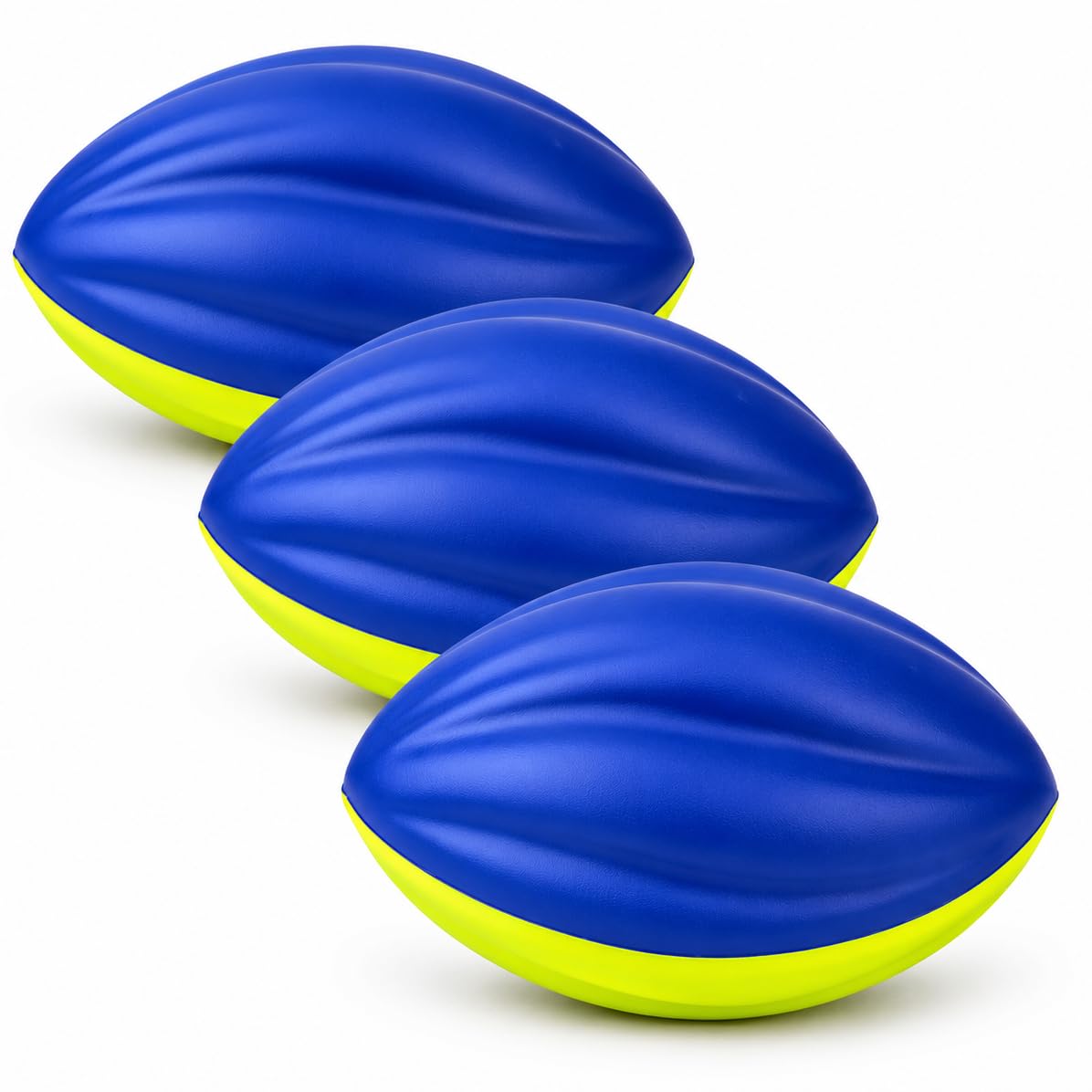
Three foam balls that turn the living room into a safe practice field.
Three balls, 8.5 inches each, all foam. That is the entire pitch, and for a family with toddlers or a rainy Sunday it lands. The PU-coated outer cover is a soft plastic skin over high-density foam, and the grooved grip lines run like a spiral so little hands have something to grab.
Here is where this set makes sense: a foam ball does not sting when a catch goes wrong. That is exactly the trait that matters when a five-year-old is learning to watch the ball into their hands. It’s also the ball you let fly across a driveway, a beach, a pool deck, or a hallway without worrying about what it hits on the way down.
The honest note — foam and hard plastic don’t mix well. Grip and durability both got mixed receptions from owners, and a few found the cover too slick to throw a real spiral with. If a real leather-look ball is the goal, this isn’t it. If teaching confidence and safe indoor play is the goal, the three-pack is a smart buy.
Why it lands with young kids
- Three 8.5-inch foam balls, so more than one child can play at once
- Soft PU-coated cover takes the sting out of a missed catch
- Grooved grip lines give little fingers a hold
- Safe for indoor, pool, beach, and gym use
The trade-offs to expect
- Foam doesn’t throw a tight spiral like a leather-look cover
- A few buyers report the cover wearing out quickly with heavy use
- Not a substitute for a real ball on the practice field
Suits: parents of toddlers and preschoolers who need a safe, indoor-friendly first football and want spares in the bag.
Doesn’t suit: a kid moving into rec-league play — foam won’t hold up to a real pass rush.
6. Franklin Sports NFL Official Youth Football

An officially licensed team ball with laces made for small, careful fingers.
The Franklin NFL Youth football comes in team-specific colorways — this one is a Detroit Lions version — so a young fan gets to carry their team’s logo into the backyard. That fan detail is the entire reason to go this route over a plain brown ball, and the deep-pebble PVC surface gives it a textured grip that survives cool weather better than a smooth shell.
Where the laces stand out: Franklin calls them “precision stitched,” designed so a child’s fingers align along the ball for spiral control. In practice that means a smaller hand finds the throwing grip faster than on a generic ball. A pump ships with the ball, which is not true of every youth football at this size.
How well the ball holds air and how long it lasts are the two things that decide whether it stays in your bag. Owners mention mixed results on both: some balls hold firm through a season, while a few arrive soft or lose air sooner than you’d like. That’s a familiar story for stitched PVC balls (a plastic cover sewn together in panels), so treat this as a fair-weather practice ball rather than a multi-season keeper.
What stands out: playability is what owners talk about most — actually playing with it, not admiring it. For a young fan, that’s the point.
Go with this if: your child follows a specific NFL team and would carry a logo ball everywhere.
Keep in mind: check the team colorway carefully on the listing — the NFL line spans many teams and the model you land on should match the fan you’re buying for.
7. PlayCoach Youth Football

Ten passing routes printed on the ball turn a backyard toss into a real lesson.
This one does something no other ball on the list does: it has a playbook printed on the cover. Ten basic passing routes sit right on the leather, so the huddle can point at a number and run it. For a parent teaching a child how a quarterback and receiver work together, that turns practice into a game with a goal.
The size fits that lesson: 9.5 inches at its widest, 10.4 ounces, with a leather cover and a bladder built to hold shape. It’s aimed at ages 6 to 9 and sized so smaller hands can wrap the laces and actually control the throw. The route design is endorsed by quarterback Drew Brees, and it ships deflated, so you’ll need a pump.
The one warning worth flagging is air. Air retention got the most negative attention of any point in the reviews, and the size also drew mixed notes — a few buyers found it smaller than they expected. It’s a coaching tool first, a backyard ball second. Buy it for the routes and the game plan; don’t buy it expecting a season-long practice ball.
The coaching edge
- Ten passing routes printed right on the ball cover
- 9.5-inch pee-wee size aimed at ages 6 to 9
- Leather cover gives a real football feel for young receivers
- Route design endorsed by quarterback Drew Brees
The fixes you’ll make
- Air retention is the recurring complaint — get a pump handy
- Ships flat, so the first throw waits for inflation
- A few found the ball smaller than the photos implied
The right call for: a parent who wants to teach route-running and huddle basics to a six- to nine-year-old.
Not for: a player who just wants to play catch — the routes and leather deserve a coach’s eye, not a shelf spot.
8. Franklin Sports Kids Grip-Rite 100 Junior Football

Six rubber junior balls that walk into a practice field and stay usable all season.
The design brief here is durability, and it shows. These are molded rubber footballs rather than stitched shells, made to survive grass, concrete, and cold weather without fraying. Each is 10 inches long and 6 inches wide, so it fits pre-teen hands, and the deep-pebbled surface with raised pro-style laces makes them easy to throw and catch.
The 6-pack arrives with a pump, and that’s the shape that makes sense: hand one to every kid in the lineup and let them play whether it’s raining or dry. A single molded rubber ball is a bit more utilitarian than a composite leather ball, but it’s the one you don’t worry about destroying.
One practical wrinkle: a few buyers found the balls impossible to inflate — which usually traces to a needle or valve issue, not the ball itself. The multi-pack ships deflated, so check that the pump’s needle sits snug before the first inflation. If it seats properly, the balls hold up well in everyday practice.
Who it’s really for: a coach or a parent with multiple kids who needs a full roster’s worth of balls, not one precious gamer. Size is the most-praised detail for pre-teen hands.
Buy this when: you’re outfitting a team, a PE class, or a family with several young players.
Think twice if: you only need one ball — a single junior ball at this size is cheaper than buying this set.
9. jiaonun Youth Size 6 Footballs (6-Pack with Pump)

Six composite-leather youth balls and a pump — a whole squad’s worth in one box.
The measurement that sells this set is 10.5 inches. That is the belly diameter of each of the six balls, sized for youth and junior players. Six balls plus a pump with a needle means a whole youth team can practice with one purchase, and a parent with a football-obsessed kid has replacements for the ones that go missing in the neighbor’s yard.
The cover is a textured composite faux leather with pro-style laces, and it’s a real step up from basic PVC. The texture pushes against the fingers, which helps young players hold a tight spiral. Jiaonun builds them to play in rain or sun, indoor or outdoor, which is the right pitch for a training bag.
The catch: air retention is the recurring complaint. Several sets ship with a ball that doesn’t hold pressure, and a pre-packaged set of six makes a single bad ball a bit harder to work around. If you’re putting together a practice set and can tolerate one dud, this is the biggest purchase on the list in terms of raw quantity. If you need six balls that all hold air from the start, order with a return window open.
The value read: you’re buying quantity plus a pump, and the composite cover is a genuine upgrade over plain PVC. That combination is what earns its place.
The obvious fit: a coach or league organiser stocking up on practice balls without stretching the budget.
The open risk: air retention varies across the set — check each ball and keep the return window handy.
Know the Specs
Diameter: The Real Size Signal
Diameter is the measurement across the widest belly of the football. On this list it runs from 5.4 inches on the MacGregor pee-wee up to 11.5 inches on the Wilson Super Grip. That is the number to trust when sizing a ball to a child, because a smaller diameter lets smaller hands wrap the ball and hold a grip. If your child’s fingertips can’t meet across the belly, size down.
Bladder: Why Air Matters
The bladder is the inner rubber liner that holds the air. A butyl rubber bladder — a thicker, less porous rubber — holds pressure noticeably longer than a plain rubber one, which is why Wilson uses it on both of its balls here. A weaker bladder means the ball sits in the garage and is flat by kickoff, so a pump is a genuine accessory worth having.
Cover Material: Composite vs PVC vs Foam
Composite leather is a synthetic cover with a tacky finish — the standard on youth game balls. PVC is the budget shell: durable and water-repellent, but slicker when a child’s hands sweat. Foam is for the earliest throwers, soft enough to make a dropped catch painless. Match the cover to how the ball will be used, not to how it looks in the photo.
Weight: What a Child Can Carry
Weight runs from 8.32 ounces on the smallest Marvel mini up to 15.16 ounces on the Wilson Super Grip. A lighter ball is easier for a young child to control and throw, but it also flies less like a real game ball. The heavy junior balls teach proper mechanics; the light minis get a young child throwing confidently.
Common Questions
What age is a junior size football actually for?
Is a size 5 youth football the same as a junior size?
Can a six-year-old throw a junior size football?
What is a butyl rubber bladder and why does it matter?
Do youth footballs arrive inflated?
Composite leather or PVC — which cover is better for a kid?
How long does a youth football typically last?
Is a youth football safe for indoor play?
Do I need a pump for a youth football?
Will a youth football fit in my kid’s backpack?
The Bottom Line
For most families, the youth size american football winner is the WILSON NFL Super Grip. Its 11.5-inch junior size fits the 9-to-12 age band, so your kid can grip and throw it without fighting the ball. The Super Grip composite cover gives real traction, and a butyl bladder (a rubber air chamber that holds pressure longer) keeps it inflated. Buying for a preschooler or a first-time thrower? The tiny 5.4-inch MACGREGOR Pee Wee fits small hands at a budget-friendly price. And if you coach a whole roster, the Franklin Grip-Rite 100 six-pack gives you six all-weather rubber balls plus a pump in one order.
How we choose
We do not accept paid placement. Every pick is matched to a real buyer and a real use-case; we do not hands-on test units.
Sources
Specifications: manufacturer listings and product documentation. Review insights: verified customer reviews, as of November 2026. Pricing: not shown on this page (it changes often); check the current price via the retailer link.
As an Amazon Associate, Tactical Gear Guy earns from qualifying purchases. This does not affect which products we feature.