Specs are compiled from manufacturer listings and verified buyer reviews and can change over time — please confirm the key details on the product page before buying.
Start with the helmet, then build the rest of the outfit around it. That is the short answer for anyone shopping for a young rider. Fit is not a detail you can guess at: a loose helmet slides forward over the eyes, and a boot that is a size off can slip out of the iron. Everything in this guide is chosen for kids who are genuinely riding, not dressing up for a photo.
This guide is built by comparing the manufacturers’ published specifications and the patterns across verified customer reviews, so you get each pick’s real strengths and trade-offs instead of marketing spin.
Some pieces here are certified head protection and some are everyday school clothing, so the guide separates them clearly. A parent shopping for youth riding gear usually needs one safe shell first and the rest can follow.
Top Picks


How To Choose The Best Youth Riding Gear
The order you buy things in matters more than the badge on the jacket. Head protection comes first, footwear second, and the clothing last. An uncertified hat and a smooth-soled shoe are the two failures that put a child on a pony at risk, however tidy the rest of the outfit looks.
Start with the helmet and check the certification words
A certified riding helmet carries a recognised safety standard, and that word on the listing is what you are paying for. The OutdoorMaster Equestrian Helmet lists the ASTM F1163-15 standard (a published helmet-safety specification for equestrian headgear), for instance. A cheap novelty hat in the same shape offers no such back-up. That standard line is what separates a protective helmet from a costume hat.
Measure the head, not the age
Age ranges on the box are a rough guide at best. What actually decides whether a helmet fits is head circumference in centimetres. The kids’ helmet here spans head sizes from 48 to 54 cm, split into an XS for 48 to 51 cm and an S for 51 to 54 cm. The adult-and-youth OutdoorMaster runs three shell sizes covering 50 to 62 cm. Take a soft tape measure around the widest part of the head, just above the eyebrows, and buy to that number.
Know your boot type before you spend
Young riders wear two kinds of footwear, and they do different jobs. A paddock boot is a short ankle boot, which is easier for beginners and everyday schooling. A tall field boot rises up the calf and gives the traditional show-ring look. Paddock boots often have a spur rest (a small ledge at the heel where a spur sits) and laces or a zip for a snug fit. Decide which one matches where your child actually rides before you buy either.
Side-by-Side Comparison
| Model | Best For | Type | Certification | Sizing Range | Amazon |
|---|---|---|---|---|---|
| OutdoorMaster Equestrian Helmet★ Best Overall | All-round head protection | Helmet | ASTM F1163-15 | S to L (50-62 cm) | Amazon |
| Adjustable Kids Equestrian HelmetBest for Little Kids | Small children age 2 to 6 | Helmet | SEI certified | XS to S (48-54 cm) | Amazon |
| HORZE Nora Girls JodhpursBest Schooling Breeches | Schooling and lessons | Riding pants | — | Youth sizing | Amazon |
| Dublin Altitude Zip Paddock Boots | Everyday riding comfort | Paddock boot | — | — | Amazon |
| TuffRider Starter Show Coat | Show day on a budget | Show jacket | — | Children’s sizing | Amazon |
| Ariat Kids Scout Zip Paddock | Long-term durability | Paddock boot | — | Little Kid/Big Kid | Amazon |
| TuffRider Starter Back Zip Field Boots | Show-ring tall boots | Field boot | — | Girls sizing | Amazon |
Detailed Reviews
1. OutdoorMaster Equestrian Helmet
Our pick — 4.5+★ from 250+ verified ratings; the strongest balance of quality and price.
The shell that carries the certification, the dial fit, and a sun visor all at once.
This is the one helmet here that covers a growing rider from 50 to 62 cm. The OutdoorMaster helmet carries the ASTM F1163-15 certification (a published safety standard for equestrian helmets), which means it is built to be protective headgear rather than a costume hat. Under the shell sits a high-density EPS inner core — expanded polystyrene, the crushable foam layer that absorbs impact — paired with a high-strength ABS outer shell. Most helmets at this price point name no safety standard at all.
The ABS shell and EPS liner take knocks and scuffs without cracking. The shell takes knocks and scuffs without drama, and the fit is genuinely adjustable rather than locked to one head. A rear dial system tightens the band around the skull, and the straps fine-tune under the chin, so you can snug it up as a child grows. Nine ventilation holes run through the shell to move air on warm days, and the built-in sun visor shades the eyes while cutting wind.
The sizing needs a tape measure. The listing offers three sizes — S at 50-55 cm and 470 g, M at 55-58 cm and 520 g, and L at 58-62 cm and 530 g — and the maker’s own guidance is to add 2 cm to the measured head circumference before choosing. That means a 52 cm head lands in the M rather than the S. Skip the measuring tape and some buyers do find it comes up a touch big. Measure first, add the 2 cm, and this stops being an issue.
Where it earns its keep
- Certified to the ASTM F1163-15 helmet standard, so it is real protective gear
- Rear dial plus adjustable straps let the fit grow with a young rider
- Removable, washable liner keeps a weekly-worn helmet fresh
- Nine ventilation holes and a sun visor for hot-day riding
- Three shell sizes from 50 to 62 cm cover kids and smaller adults
What to watch
- Buyers need to add 2 cm to the measured head size, or it can feel roomy
- Rated for ages 6 and older, so it is not a toddler’s first helmet
Reach for this if: you want one certified helmet that covers a growing rider across several seasons and adjusts as they go.
Look elsewhere if: your child is under six — the smaller kids’ helmet two spots down fits that head range.
2. Adjustable Horse Riding Kids Helmet
Built for the smallest heads on the yard, from 48 to 54 cm.
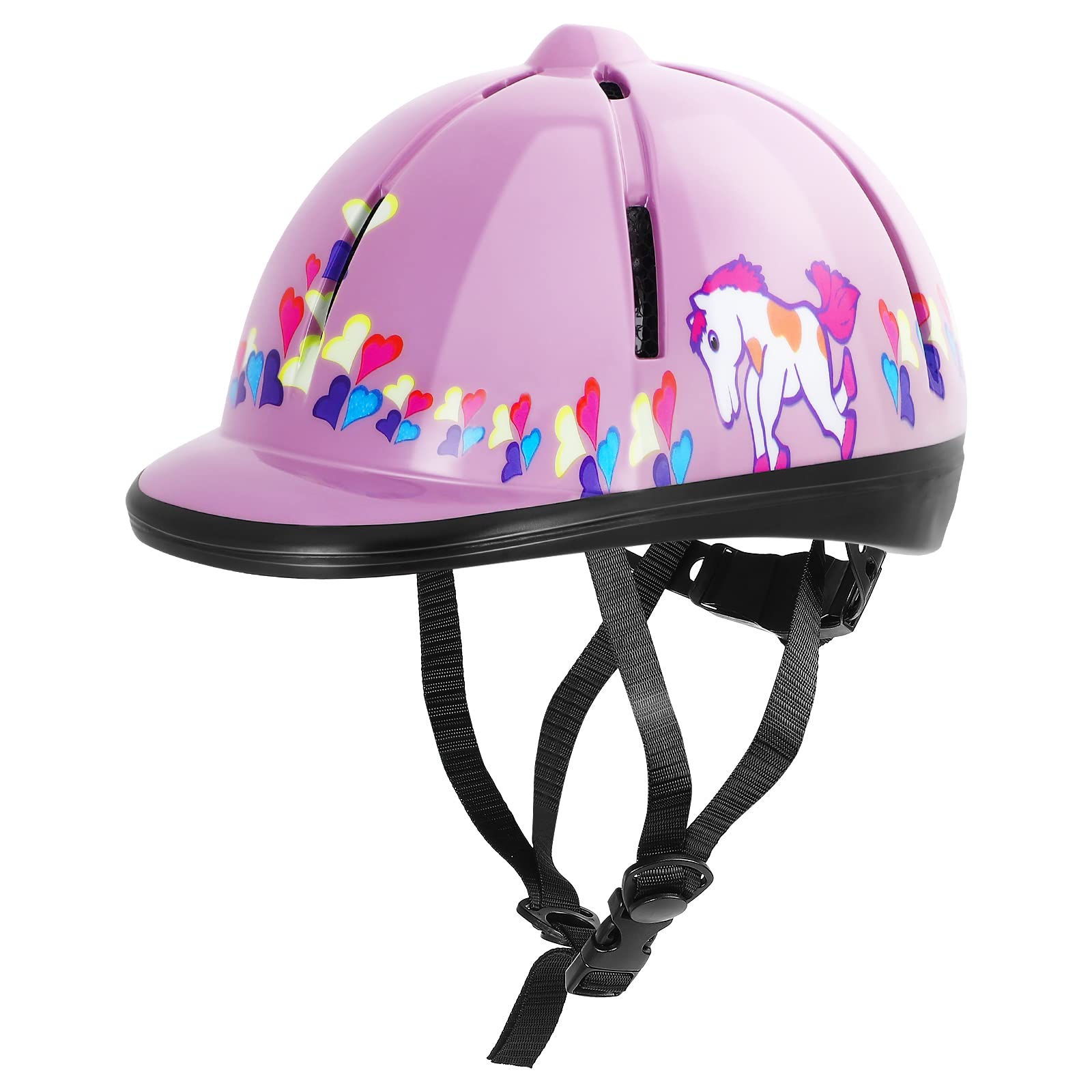
A two-year-old’s head will not fit an adult-and-youth shell, and that is exactly the gap this one fills. It is sized for children aged 2 to 6, with the head range split into XS at 48 to 51 cm (best for 2 to 4 year olds) and S at 51 to 54 cm (best for 4 to 6 year olds). It carries SEI certification, a recognised safety approval for riding helmets, so it is protective gear built for small riders rather than a toy. If you have a toddler just starting on a lead rein, this is the size that fits them.
What sells it to parents is the look and the lightness. The pink colour and the horse design are the parts kids actually get excited about putting on, which matters when you are persuading a four-year-old to wear a helmet at all. It is light enough to wear without complaint, and the adjustable chin strap goes on and comes off without a fight. The shell is tough PVC (a hard plastic outer) with ventilation holes around the edge and across the top, and the inside is fully padded and lined for comfort.
The limit is the PVC shell: a few buyers report cracks under hard use. The outer plastic is a workaday shell rather than a premium build, and a few owners have seen cracks develop with hard use. At the small-head end of the market, though, it does what it needs to. Measure the head, choose XS or S by the centimetre range, and check the strap tension each time before you lead them out.
Who it fits best: a first helmet for a 2 to 6 year old, where the priority is a certified shell that actually fits a tiny head and gets worn without a fuss.
The trade-off to know: the outer shell is basic and built to a budget, so treat it as a beginner’s helmet rather than one to hand down through several children.
Best match: parents of a toddler or young child who needs a certified first helmet in a genuinely small size.
Not the one for: an older child or a teen — the 54 cm ceiling won’t reach their head circumference.
3. HORZE Nora Girls Leather Jodhpurs
The everyday schooling pants that also look sharp enough for the show ring.
Jodhpurs take more wear than any other piece in the kit, so the leather knee patch and thick fabric are what matter here. The HORZE Nora is a jodhpur — a kid-sized riding trouser with a leather knee patch stitched on the inside of the leg, which is the part that grips the saddle and takes the wear. The fabric is on the thick side, and owners note it holds up to regular schooling and still looks presentable in the ring. These are the pants you buy once for lessons rather than several pairs of flimsier ones.
The fit is where the praise lands. Parents describe the cut as right, with the leg length landing where it should on a growing child. Colour is a repeated compliment too, and the value reads well against what you get. For a young rider doing weekly lessons who also wants to look tidy for a show, this single pair covers both jobs without a second spend.
The one real caution is sizing, and it cuts against the otherwise strong feedback. These run small enough that it pays to check the size chart carefully against a current measurement rather than buying their usual number. The thicker fabric can also show wear at the knees over heavy use. Neither is unusual for schooling jodhpurs, but buy the right size first and they last well.
The strong suit: thick, durable fabric with a leather knee patch, in a cut owners describe as fitting right on a young rider.
Before you order: these can run small, so match the size chart to a fresh leg and waist measurement rather than the child’s usual size.
Good for: the child who rides weekly and needs one pair of pants that works for schooling and looks right at a show.
Check first if: your child sits between sizes — size up, since these are cut close.
4. Dublin Altitude Zip Paddock Boots
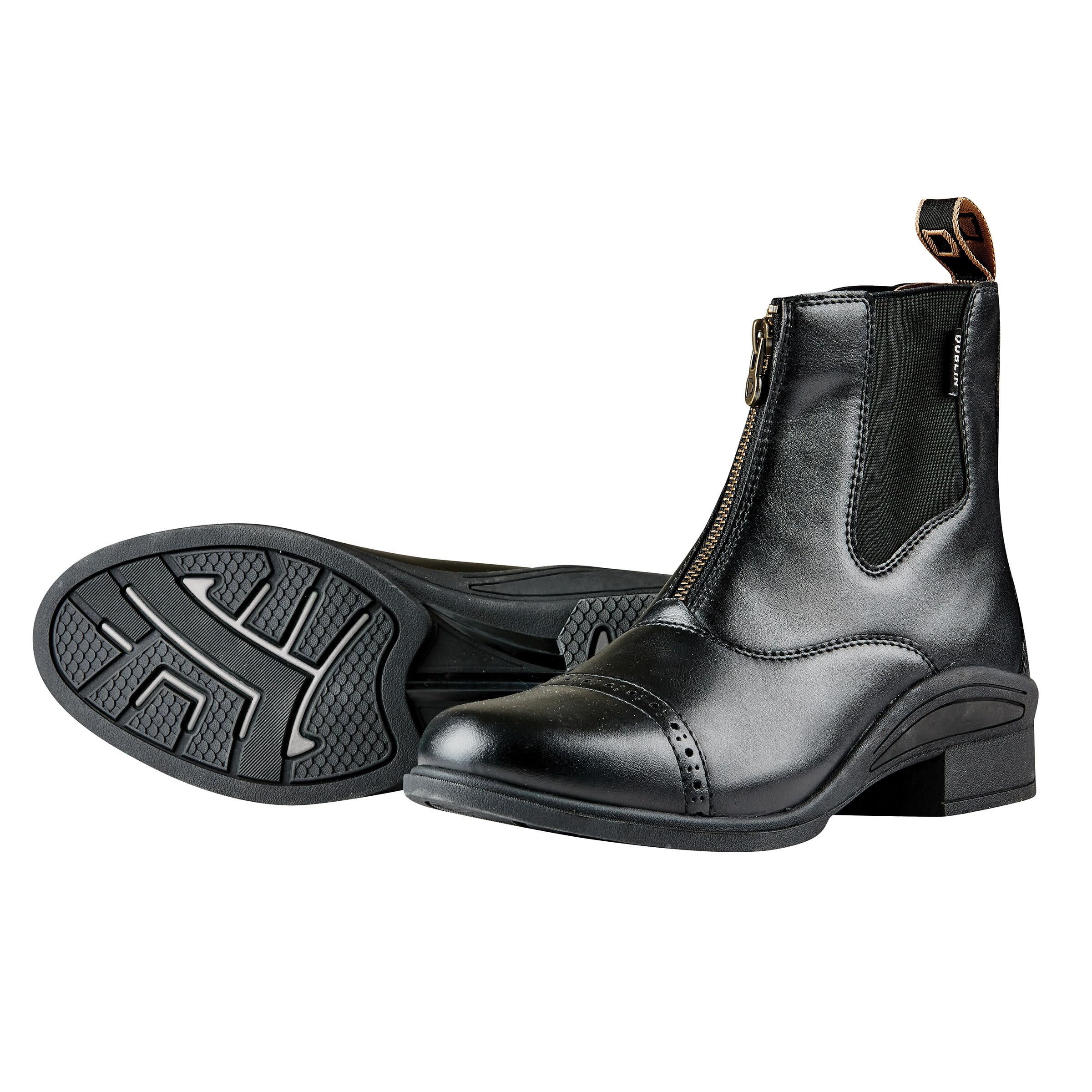
A zip instead of laces, and a memory-foam footbed for long days on your feet.
Some young riders never want to sit and tie laces before a lesson, and that is where a zip boot earns its place. The Dublin Altitude skips the laces entirely — you pull it on and zip up the side, which is faster and easier for a child getting ready in a yard full of horses. Inside sits an RCS PU footbed with memory foam, a cushioning layer that shapes to the foot, described here as an EVA cradle underfoot. The outer is a grained PU (a synthetic leather with a textured finish) built to look smart day in and day out.
Owners rate these well for looks and for actual riding use, and the value reads strong for what you get. They are comfortable enough to wear for a full lesson and tidy enough to pass at a low-level show. The zip closure also makes them quick to get on and off at the end of a wet day, which any parent who has wrestled a muddy lace boot off a tired child will appreciate.
The thing to plan for is the sizing. The feedback is mixed here, with some finding the fit right and others saying the boot runs narrow and comes up about a whole size small. Order by a measured foot rather than a guess, and expect to go up a size. That is the one hurdle; once past it, these are a comfortable, good-looking everyday boot.
Why it stands out: a side zip makes these quick to pull on and off, and the RCS PU memory-foam footbed adds comfort for a full lesson.
The sizing note: these can run narrow and about a whole size small, so go by a measured foot and size up.
Pick this for: a rider who wants a smart zip boot with a cushioned footbed for regular lessons.
Think again if: you have a wide foot — the fit runs narrow on this model.
5. TuffRider Children’s Starter Show Coat

The show jacket that looks far more expensive than it is.
A show coat only gets worn on the day, so the job is to look sharp without spending a premium. This one nails that. It is a light twill-weave competition jacket in 100% polyester, with a three button front, fully lined front, and double welt pockets with flaps. The double vented back lets it move with a young rider in the saddle instead of bunching. Parents describe it as looking like a much pricier jacket, which is exactly the point for a child who is only just starting to show.
It is built for beginners, and the styling is the part that gets the attention. Machine washable (no bleach, low iron) means a muddy or dusty show coat is not a crisis — you wash and hang it, ready for the next outing. For a first season in the ring, this covers the look without a big outlay on something a fast-growing child will soon outgrow.
The one thing to sort out before ordering is the fit, because it is the weak spot. Some find the jacket runs big while others find the sleeves very long, so measure the child’s chest and arm length and check the size chart rather than guessing. Get the size right and the coat does its job; the cut can simply be long in the arm on some builds.
Why it looks the part
- Three button front, double welt pockets, and double vented back for a classic ring look
- Light twill-weave polyester jacket that moves without bunching
- Machine washable for easy clean-up after a dusty show day
- Owners say it reads like a much pricier jacket
Sort the size first
- Fit is inconsistent — some find it runs big, others find the sleeves long
- Measure chest and arm length before ordering rather than guessing
Right for: a young rider heading to a first few shows who needs a smart coat without a big outlay.
Measure before buying: the sleeves and body can run long and big, so check the size chart against real measurements.
6. Ariat English Kids Scout Zip Paddock (Little Kid/Big Kid)

A boot that holds up over seasons, sized from little kid up through big kid.
When one boot has to survive several children or several years, the quality of the build is the whole decision. The Ariat Scout is a zip paddock boot covering Little Kid and Big Kid sizes, and owners keep coming back to how well it holds up over time. It looks smart, it is comfortable on a young foot, and it takes the knocks of weekly riding without falling apart. This is the pair you buy when you are tired of replacing cheap boots each season.
Ariat as a brand traces back to 1993 and builds footwear for equestrian, outdoor, and work use, which is the kind of pedigree you are leaning on with the higher price. Owners describe the quality as excellent and the boot as good value for what it is — because it lasts long enough that the cost per season comes down. For a serious young rider doing regular lessons, the durability is the feature that matters most.
Sizing is the wrinkle. While some find the boot fits perfectly, others find it runs very large, so order by a measured foot and be ready to size down. Get the number right and this is a boot that keeps going long after a cheaper pair would have given up. That is the trade you are making for the premium price.
The real draw: durability that owners rate highly, plus the comfort and smart looks to wear it lesson after lesson.
Order carefully: these can run very large, so measure the foot and size down if you are on the fence.
Worth it for: a family that wants one boot to last multiple seasons and possibly more than one child.
Size down if: the measured foot sits between sizes — this model tends to run large.
7. TuffRider Kid’s Starter Field Boots
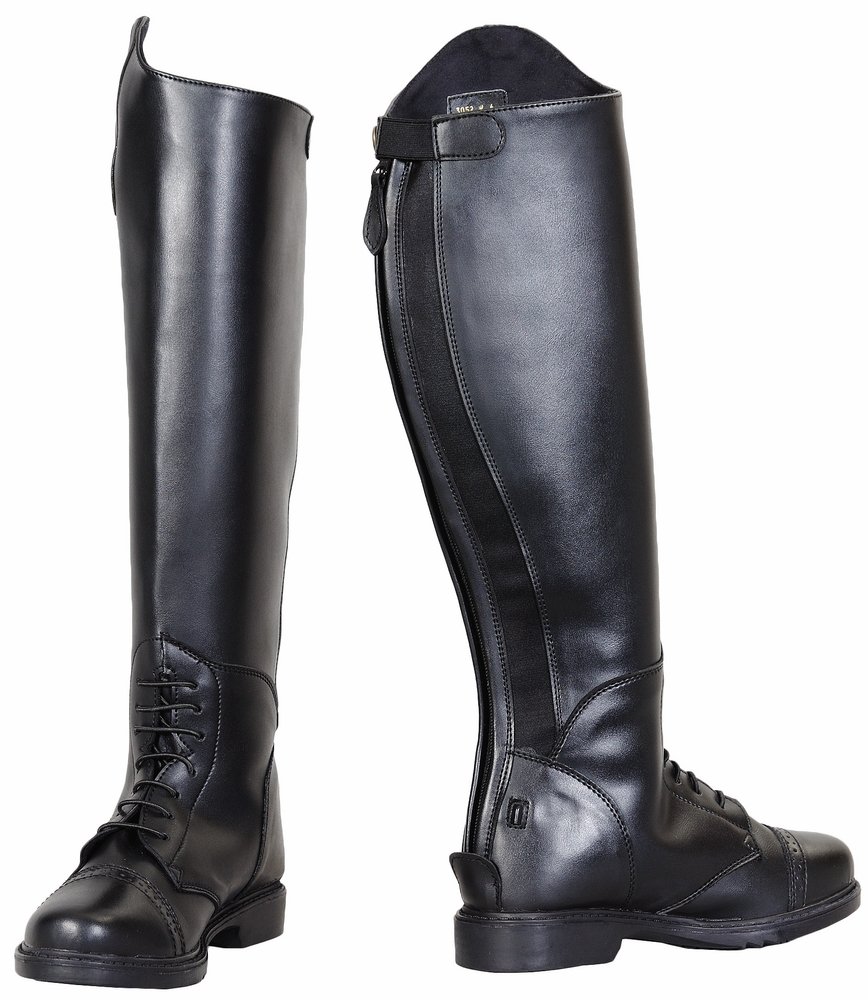
Tall boots with the show-ring silhouette, at a starter price.
A tall field boot is the traditional look for the competition ring, and this starter pair gets a young rider there without the cost of real leather. It is made in a water-resistant faux leather with the look and feel of leather, and it rises up the calf where a paddock boot stops at the ankle. A back zip makes it easier to get a tall boot on and off a child’s leg than laces would. Owners describe it as great-looking and very soft, with no breaking-in discomfort — a real plus in a tall boot.
For everyday use or for a competition, it covers both. The softness out of the starting gate means you are not battling a stiff boot during a child’s first lessons in tall boots, and the smart look lands well at a show. The value against what a leather tall boot costs is the clear draw. If your child is moving up from a paddock boot to the classic tall silhouette, this is the affordable way in.
The parts to plan around are the size and the calf fit. The sizing runs larger than standard, so measure rather than assume, and the fit feedback notes some find the leg too tight, so a slimmer calf may run snug. The durability is a mixed note too, with the boots holding up well for some and coming undone for others under hard use. Buy the right size for a growing calf and treat them as a starter show boot, and they do their job.
The appeal: tall, show-ring styling in soft faux leather you can wear from day one, with a back zip that’s easy to get on.
The fit caveat: sizing runs larger than standard and the calf can feel tight, so measure the leg and calf before ordering.
Reach for it if: your young rider wants the traditional tall-boot look for shows without the cost of real leather.
Check the calf if: your child has a slim leg — the fit can run tight there.
Know the Specs
Helmet certification standards
A certification like ASTM F1163-15 or SEI tells you the helmet has been made to a published safety standard rather than just shaped like a hat. It is the single most important line on any riding helmet listing, because a low-cost helmet with no standard named offers no back-up if there is a fall. Look for the certification words first, then the sizing.
Head circumference and fit
A riding helmet fit is decided in centimetres, not by age. Measure around the widest part of the head to get the number, then match it to the shell range. Some helmets, like the OutdoorMaster, advise adding 2 cm to the measurement before choosing a size — check the maker’s guidance, because it varies between helmets.
Common Questions
What does the ASTM F1163-15 certification mean on a riding helmet?
How do I measure my child’s head for a riding helmet?
Why does OutdoorMaster say to add 2 cm to the head measurement?
What is the difference between a paddock boot and a tall field boot?
Is a kids’ riding helmet safe for a 2 year old?
Do I need a show coat for early lessons or only for competitions?
Which is better for a beginner, synthetic leather boots or real leather?
How do I know if a boot or helmet size will fit before ordering?
Is it worth buying a cheaper helmet and a better jacket for a first show?
The Bottom Line
For most families, the first and most important pick is the OutdoorMaster Equestrian Helmet — it carries the ASTM F1163-15 certification, an adjustable dial fit, and a washable liner, which covers safety and comfort in one certified shell. If your child is a toddler or small for their age, the Adjustable Kids Equestrian Helmet fits a 48 to 54 cm head range and is SEI certified. And once the head is sorted, the TuffRider Starter Paddock Boots make a sensible first pair to get them into lessons. Start with the helmet, fit it to a measured head, and the rest of the outfit is easy.
How we choose
We do not accept paid placement. Every pick is matched to a real buyer and a real use-case; we do not hands-on test units.
Sources
Specifications: manufacturer listings and product documentation. Review insights: verified customer reviews, as of November 2026. Pricing: not shown on this page (it changes often); check the current price via the retailer link.
As an Amazon Associate, Tactical Gear Guy earns from qualifying purchases. This does not affect which products we feature.