Specs are compiled from manufacturer listings and verified buyer reviews and can change over time — please confirm the key details on the product page before buying.
A kids’ mountain bike has to survive one thing above all: a growing rider who outgrows every saddle and every hand-me-down. So the right pick is the one sized to your child’s height today and built with parts that hold up when the bike gets dumped in the yard. Below you’ll find the sizes, gearing, brake types, and frame materials that actually matter — and the picks that get them right.
This guide is built by comparing the manufacturers’ published specifications and the patterns across verified customer reviews, so you get each pick’s real strengths and trade-offs instead of marketing spin.
Height ranges and saddle specs do most of the choosing here, and every bike below is sorted by who it truly fits. This guide to the youth mountain bike covers frame size, brakes, gearing, and assembly so you buy right the first time.
Top Picks


How To Choose The Best Youth Mountain Bike
The most common mistake parents make is buying by age instead of by height. A ten-year-old who is 47 inches tall cannot safely ride a bike sized for a 58-inch rider, no matter what the box says. Start with your child’s barefoot height and standover clearance, then work backward to wheel size.
Match wheel size to height first
A 20-inch wheel typically fits riders around 45 to 55 inches tall, with a saddle you can adjust as they grow. A 24-inch wheel suits taller kids, roughly 54 to 66 inches depending on the model. Sit your child over the top tube, and you want a couple of inches of clearance so they can plant both feet when they stop.
Brakes decide how confident a rider feels
Disc brakes squeeze a rotor at the hub, so they keep stopping power when the rim is wet or muddy. V-brakes and linear pull brakes clamp the wheel rim instead, which is simpler and lighter but fades faster on a wet descent. For a child riding real trails, front and rear disc brakes are the safer setup.
Gearing and frame material shape the ride
A 7-speed or 21-speed drivetrain lets a young rider find an easier gear on a climb instead of standing on the pedals. A single-speed is simpler to maintain but harder on hills. On frames, high-carbon steel and Hi-Ten steel are heavier but tough, while aluminum cuts weight so a smaller rider can handle the bike on their own.
Side-by-Side Comparison
| Model | Best For | Wheel Size | Drivetrain | Brake Type | Amazon |
|---|---|---|---|---|---|
| Mongoose Argus Trail★ Best Overall | Fat-tire trail riding | 24 in | 7-speed | Mechanical disc | Amazon |
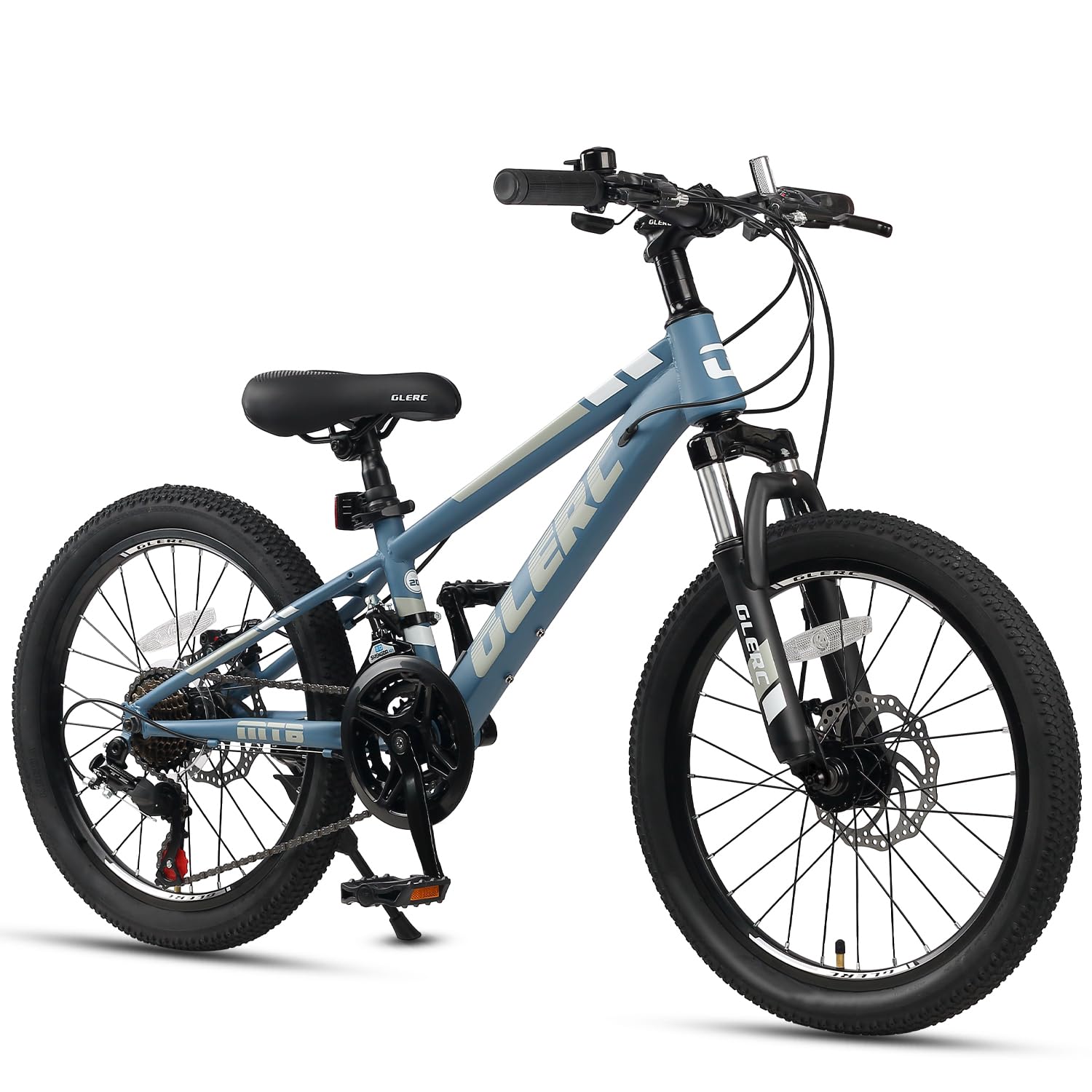
| Glerc 20 24 26 Inch Kids Mountain BikeTop Performer | Versatile multi-speed riding | 20 / 24 / 26 in | 21-speed | Disc | Amazon |
| Pipleo 20/24 Inch Kids Mountain BikeBest Value | Budget disc-brake value | 20 / 24 in | 7-speed | Front & rear disc | Amazon |
| Govet 20 Inch Big Kids Mountain Bike | Brand-name shifting on a budget | 20 in | Multi-speed | V-brake | Amazon |
| Pacific Mountain Sport | Newcomers to trail riding | 24 in | 18-speed | Linear pull | Amazon |
| BGGFNZ 24 Inch Single Speed | Zero-maintenance simplicity | 24 in | Single-speed | Disc | Amazon |
| WEIZE 20 24 inch MTB | Budget-friendly starter | 20 / 24 in | Multi-speed | V-brake | Amazon |
| RoyalBaby Aluminum | Lightweight handling | 20–26 in | 7-speed | Front & rear disc | Amazon |
| JOYSTAR NEO | Growing riders on a budget | 20 / 24 in | Single-speed | Caliper & coaster | Amazon |
| Mongoose Flatrock | Mixed youth and adult use | 24 / 26 / 29 in | 7-speed | Linear pull | Amazon |
| Schwinn High Timber | Light aluminum frame | 20 in | Multi-speed | Disc | Amazon |
Detailed Reviews
1. Mongoose Argus Trail Fat Tire Mountain Bike
Our pick — 4.0+★ from 350+ verified ratings; the strongest balance of quality and price.
Four-inch tires that roll over sand, snow, and gravel without flinching.
The Argus Trail puts the widest rubber in this whole lineup under your young rider — massive 4-inch-wide fat tires that grip dirt, gravel, sand, and snow. That is a full 1.65 inches of extra width over the 2.35-inch tires on the Pipleo 20/24, so loose ground that stops a skinnier bike keeps rolling here. Its frame is aluminum rather than the high-carbon or Hi-Ten steel most of the budget picks use, which keeps the bike manageable for a smaller rider while still taking varied terrain.
The 24-inch version is sized for kids from 4’8″ to 5’6″ tall. A 7-speed 1×7 drivetrain with a twist-grip shifter keeps shifting simple — one front ring, seven rear gears, twist to shift — so your child learns gear changes without a front derailleur to tangle with. Mechanical disc brakes squeeze a rotor at the hub instead of clamping the rim, so stopping power stays steady when the trail turns wet or muddy.
What wins people over is the grin factor. The paint job draws compliments, assembly goes smoothly, and the whole thing earns its keep as a sturdy trail companion. The honest catch is weight and speed — fat tires are heavy and slow-rolling compared with the 21-speed Glerc, so a child doing long paved rides or big climbs will feel the drag. This is a bike built to plow through the rough stuff, not to sprint on pavement.
Where the Argus Trail Shines
- 4-inch fat tires grip dirt, gravel, sand, and snow — the widest in this lineup
- Aluminum frame keeps weight down versus steel-framed budget picks
- Mechanical disc brakes hold stopping power in wet conditions
- 24-inch wheels sized for 4’8″ to 5’6″ riders
What You Give Up
- Heavy fat tires drag on long paved climbs
- 7 speeds can’t match a 21-speed on steep climbs
- Fat-tire rolling resistance slows acceleration
Reach for this if: your child rides real trails — dirt, gravel, sand, snow — and wants the widest grip in the lineup.
Look elsewhere if: most rides happen on pavement and you want easy climbing speed from a 21-speed drivetrain.
2. Glerc 20 24 26 Inch Kids Mountain Bike
Twenty-one gears that turn a steep trail climb into an easy spin.
If your young rider faces real hills, the gearing is why this bike earns its spot. A 21-speed drivetrain (21 gear combinations to pick from) gives a 6-to-12-year-old a much easier climbing gear than the 7-speed setups on the Mongoose Argus Trail and Pipleo — three times the gear options, so a low gear is waiting when the trail tilts up. Trigger shifters (levers you click with your thumb) snap through those gears precisely instead of twisting a grip. Glerc’s build quality is the most consistently praised in this guide.
The 20-inch version fits children ages 6–12, 45″–55″ tall, with a 21″–25″ inseam — check the inseam first, since it determines whether your child can reach the ground. The high-carbon steel frame handles off-road punishment, and the suspension fork soaks up vibration so hands and shoulders don’t take the beating on a rocky descent. At 30 lbs it’s on the heavier side, but still manageable for a rider this size.
Owners consistently come back to build quality and easy assembly, with sturdiness a close second. The recurring gripe is long-term durability — over time the front gear and drivetrain can wear on a bike ridden hard. Treat that as a fit note: an aggressive rider who hucks jumps every weekend will stress any entry-level frame, while a child on neighborhood and trail rides gets years of good service. For the widest range of riding, this is the one that does the most jobs.
Gearing verdict: 21 speeds is the largest range on this list, and it’s what separates the Glerc from every 7-speed pick here.
Size check first: the 20-inch fits a 45″–55″ height and 21″–25″ inseam — confirm both before ordering, since the frame is the one thing you can’t adjust later.
The pick that does the most: the Glerc covers paved paths, dirt trails, and hills with 21 gears and disc brakes, and it’s reliable enough for daily use.
The one caution: over years of hard riding the drivetrain can wear, so budget for a tune-up down the road.
3. Pipleo 20/24 Inch Kids Mountain Bike, 7 Speeds
Full disc braking on both wheels at a price that undercuts most rivals.
Disc brakes on the front and rear are often the first thing a budget bike drops — the Pipleo keeps both. That matters because a disc brake squeezes a rotor at the wheel hub rather than clamping the rim, so wet or muddy conditions don’t steal stopping power the way they can on the Pacific’s linear pull brakes. The 2.35-inch wide anti-slip tires are narrower than the Mongoose’s 4-inch fat tires but still provide reliable traction on mixed terrain.
Setup is genuinely quick — the bike arrives 90% pre-assembled with tools included, which is better than the 85% you get from WEIZE and JOYSTAR. The steel frame is built to resist rust, and the front suspension fork absorbs bumps on park paths and recreational trails. Choose the 20-inch for ages 6–10 at 4’0″–5’0″, or the 24-inch for ages 9–14 at 4’7″–5’5″.
What earns the praise is the engineering and the easy build — sturdiness, adjustability, and smooth gear shifting all come up repeatedly. There is a honest trade to weigh: the pedals are the weak link, with reports of them working loose over time. Check the pedal threads after assembly and tighten them properly, and that becomes a non-issue. For a family that wants disc brakes without stretching the budget, this is the one.
The smart-money read: front and rear disc brakes at this tier is the standout, and 90% pre-assembly means less time with a wrench in your hand.
Tighten the pedals: the pedal is the part that loosens on this bike — a proper tighten at setup heads off the complaint before it starts.
Best for: a first trail bike where you want disc braking on both wheels and a fast, simple build.
Skip if: you need more than 7 gears for serious hill climbing.
4. Govet 20 Inch High Tensile Steel Big Kids Mountain Bike
A low standover frame and genuine SHIMANO shifting parts at an entry-level price.
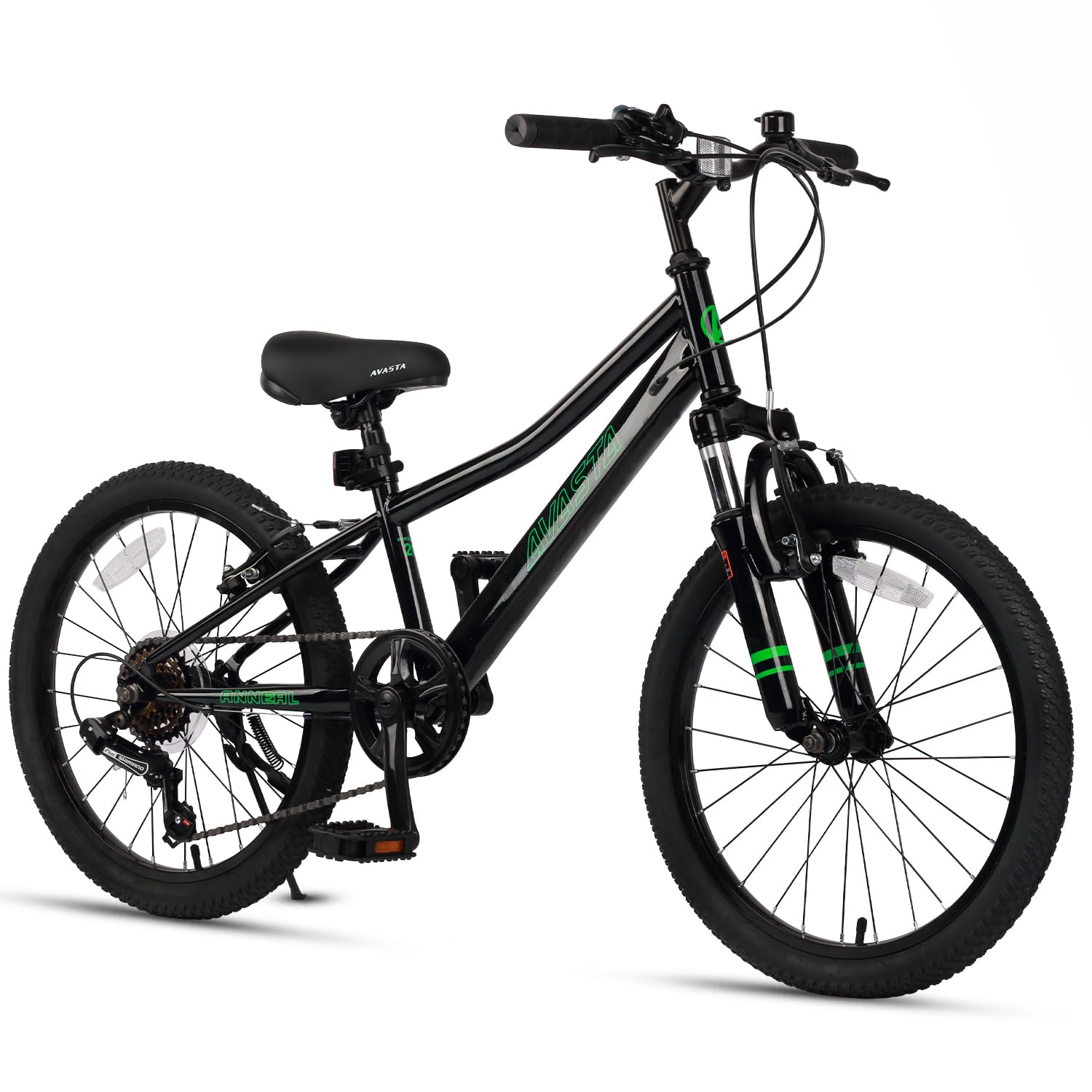
The Govet’s smartest move is mechanical, not cosmetic: a SHIMANO TX30 trigger shifter, a SHIMANO TZ500 rear derailleur, and a SHIMANO freewheel. Those are real brand-name drivetrain parts where many budget bikes cut corners. A trigger shifter uses a thumb lever instead of a twist grip, which some young riders find easier to click through gears. The dual V-brake setup splits braking between both hands — left operates the front wheel, right operates the rear.
The lower frame makes it easier for children to stand over and hop on and off, which builds confidence for a 6–13-year-old or a rider 45–59 inches tall. High-strength suspension fork and 20″x2.125″ tires handle rough roads, paths, and some dirt. It ships 85% assembled, needing only the front wheel, pedals, handlebar, kickstand, and saddle installed, and all tools are in the box along with a bell, reflectors, and a kickstand.
The consensus is that this a strong quality starter bike that looks good and delivers good value. Build quality has some variance — a few buyers hit thread issues — so inspect the bolt threads before you crank anything tight rather than forcing a stubborn one. It’s the kind of choice that gets a kid riding on a modest budget without feeling like a compromise.
What’s Smart Here
- SHIMANO TX30 trigger shifter, freewheel, and TZ500 rear derailleur
- Low standover frame for easy mounting
- Dual V-brakes split across both hands
- 85% assembled with tools, bell, reflectors, and kickstand included
Worth Knowing
- V-brakes fade faster than disc brakes when wet
- A few buyers hit thread issues, so inspect bolts before tightening
- 20-inch wheel suits riders 45–59 inches — not taller kids
Worth grabbing when: you want brand-name shifting and an easy-to-mount frame without paying a premium.
Think twice if: your child will ride wet trails where disc brakes have the edge.
5. Pacific Mountain Sport Bike, 24 inch
Eighteen speeds and a suspension fork tuned to soak up the trail’s rough edges.
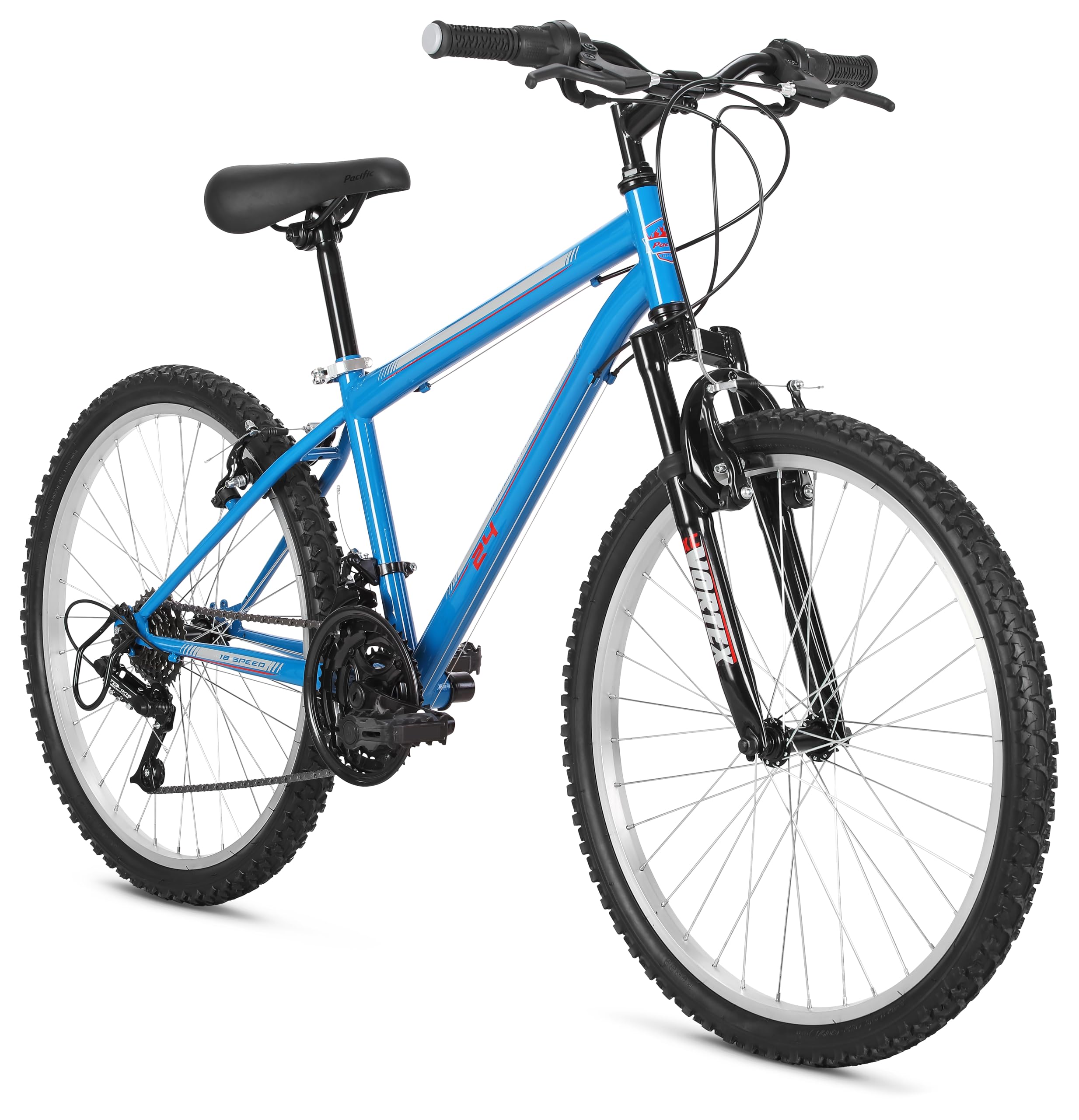
Pacific leans on gearing range here — an 18-speed drivetrain with twist shifters gives a young rider plenty of gears for climbing and cruising. The front suspension fork carries 50 mm of travel, the distance it can compress to absorb a hit, which softens the bumps, dips, and uneven ground that make longer rides uncomfortable. Its alloy steel frame is built for rocky, rough terrain.
The 24-inch model is built for riders 4’8″ to 5’4″ tall and pitched at mountain biking newcomers, so a first-time trail rider gets a stable, full-suspension-front platform to learn on. Front and rear linear pull brakes clamp the rims for stopping power, and knobby tires provide traction on dirt, gravel, or rugged trails. Twist shifters keep shifting intuitive for small hands.
Assembly experiences split sharply on this bike — some find it straightforward while others hit a frustrating build. If your tolerance for tinkering is low, budget a trip to a local shop to have it checked and dialed in. Once rolling, though, it’s a sensible first trail bike for a child who’s ready to leave the driveway.
Trail-readiness: 18 speeds and 50 mm of suspension travel make this a comfortable, forgiving platform for a new rider on uneven ground.
The build heads-up: assembly is the recurring split — some sail through it, some hit snags, so factor in a shop check if wrenches aren’t your thing.
Right for: a first-time trail rider between 4’8″ and 5’4″ who wants suspension and 18 gears to learn on.
Less ideal if: you’d rather not spend an afternoon on assembly or a trip to a bike shop.
6. RoyalBaby Kids Mountain Bike Aluminum Ultra-Light
An aluminum frame that takes the strain off a small rider’s legs and arms.
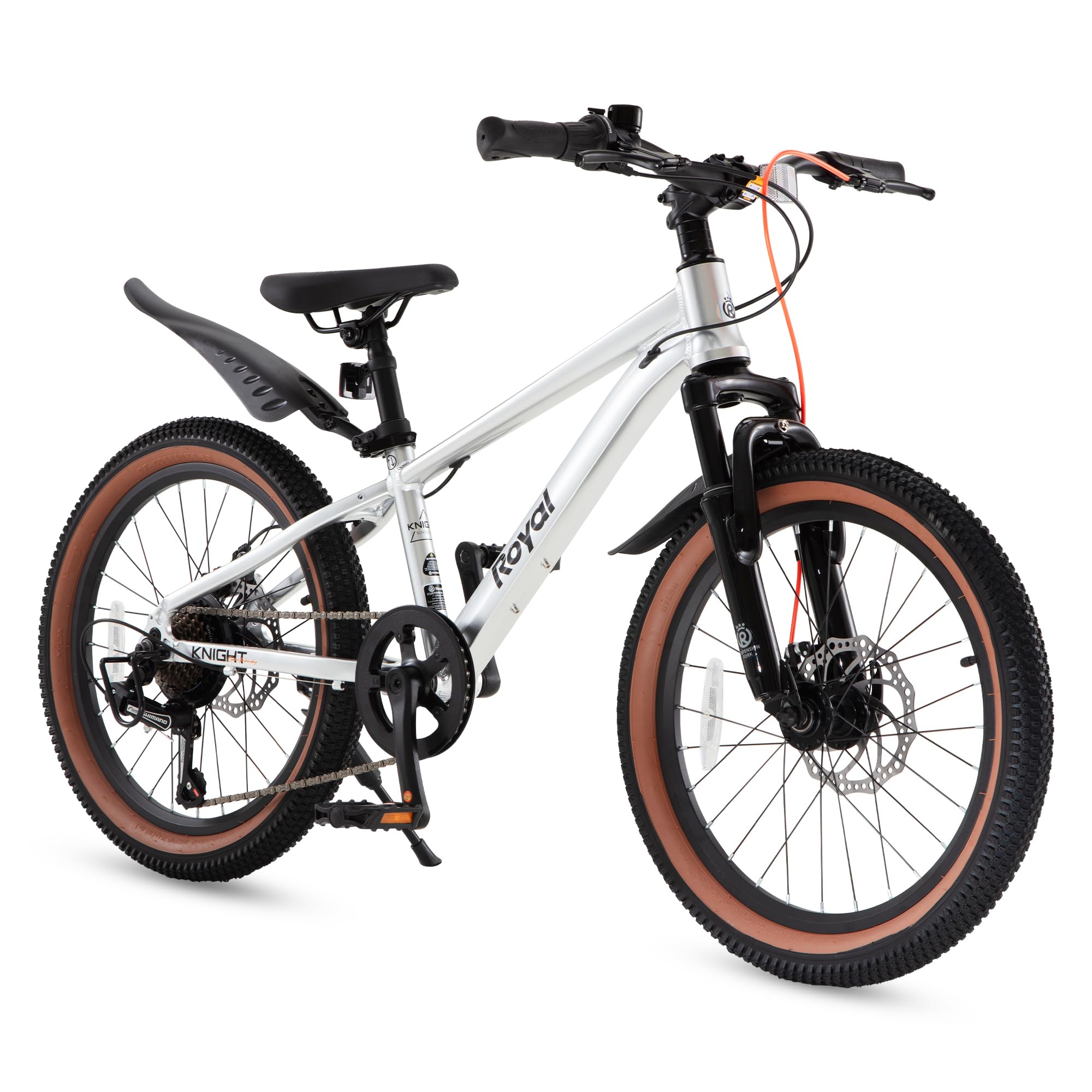
Weight is the whole story with the RoyalBaby. An aluminum frame is lighter than the high-carbon and Hi-Ten steel used on most budget bikes here, and the bike weighs 27.1 lbs. That reduction in heft means less fatigue on long rides and a bike a child can actually maneuver rather than wrestle. For a young rider who’s still building strength and control, that’s the difference between a bike they ride and one they dread.
It backs the light frame with a 7-speed drivetrain for hill climbing, a shock-absorbing suspension fork to reduce fatigue, and knobby tires for traction from city streets to rugged trails. Front and rear disc brakes give quick stopping power, plus non-slip pedals and grip-friendly handlebars for control. A height-adjustable seat grows with the child, and the package includes a bell, kickstand, mudguard, pump, and reflectors.
The overall read: good quality, a great starter model, and easy assembly that doesn’t require a shop visit. Value holds up well for what you get. It’s a light, well-equipped trail bike for a child who’ll grow into taller frames — and the included pump and mudguard save you buying them separately.
The Case for Lightweight
- 27.1 lbs — the lightest steel-free frame in this lineup
- Aluminum frame reduces fatigue on longer rides
- Front and rear disc brakes plus grip-friendly handlebars
- Ships with bell, kickstand, mudguard, pump, and reflectors
The Catch
- 7 speeds is modest compared with a 21-speed drivetrain
- At this premium tier you’re paying for the light frame
The light-frame choice: pick the RoyalBaby if your child needs an easy-to-handle bike and you value the included pump and mudguard.
Wait if: you need a wide gear range for steep climbs, where the 21-speed Glerc leads.
7. BGGFNZ 24 Inch Kids Single Speed Mountain Bike
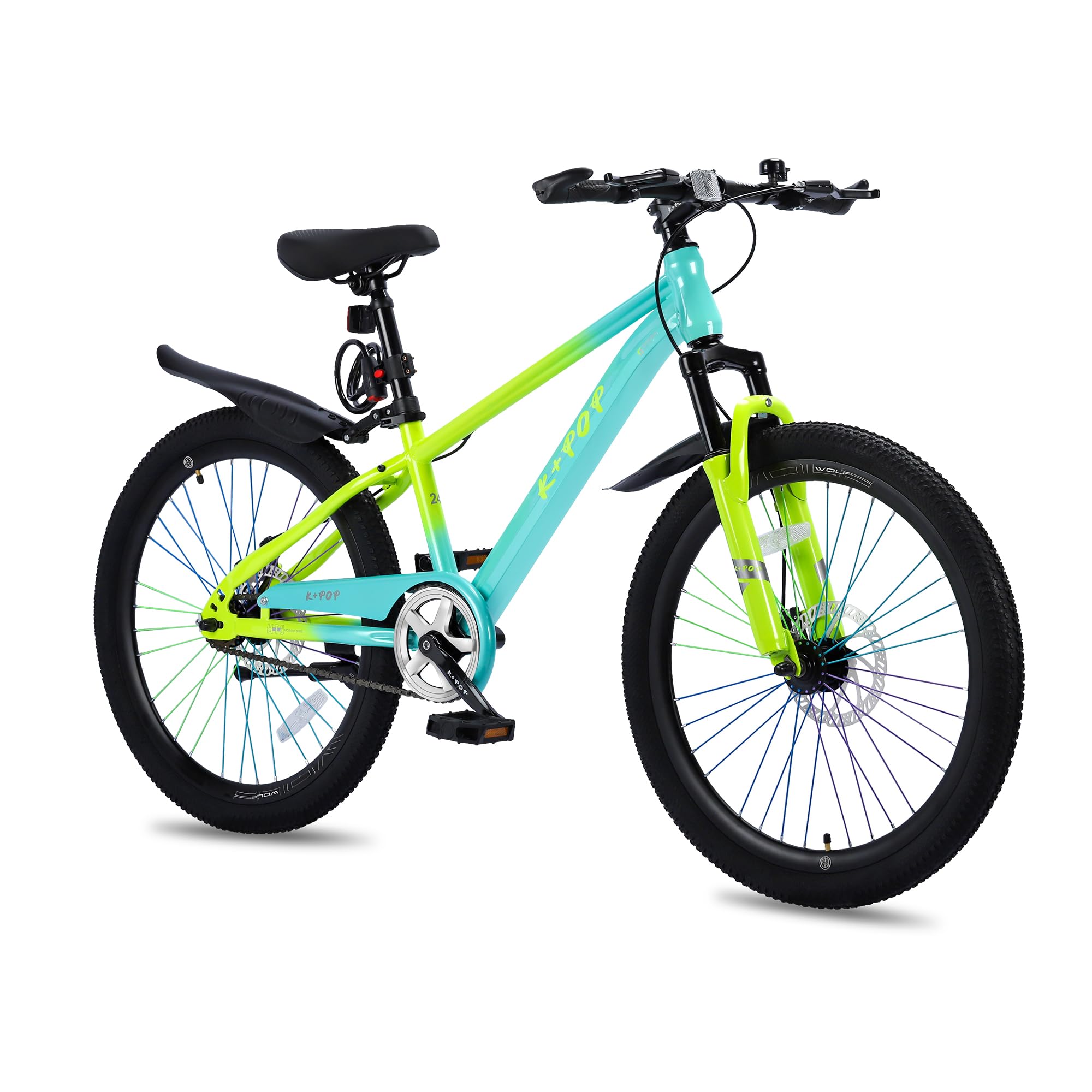
One gear, no derailleur to adjust, and less to break on a kid’s bike.
The appeal of a single-speed is what’s missing: no derailleur, no shift cables, no gearing to tune. For a family that doesn’t want to mess with adjustments, that’s a genuinely lower-maintenance setup. The carbon steel frame is built for commuting and recreational riding, and the rugged tread pattern grips pavement, dirt paths, and light off-road trails. It’s sized for ages 8–12 on a 24-inch wheel.
It doesn’t skimp on the safety kit — front and rear disc brakes deliver dependable stopping in rain, dust, or dry pavement. The front suspension fork absorbs potholes and curbs for a more comfortable commute, and the cushioned, height-adjustable saddle has a weather-resistant cover that’s easy to wipe clean. A lock comes in the box, so the bike is ready to ride and secure from day one.
Quality is the standout — buyers point to it being a solid fit for a ten-year-old. There is one mechanical note: the stability is mixed, with reports of the pedal unscrewing and coming off. Thread the pedals on properly at assembly and check them after the first few rides; that’s the single point worth watching. Beyond that, this is a low-stress bike for a rider who just wants to hop on and go.
Low-maintenance win: a single-speed drivetrain means no derailleur adjustments, which is a real advantage for a bike that lives outside.
Watch the pedals: the pedal is the part to secure — tighten it at assembly and recheck after the first rides.
Pick it for: an 8–12-year-old who wants a simple, tough bike with disc brakes and no shifting to fuss with.
Not for: hilly terrain where a single gear makes climbing hard work.
8. WEIZE 20 24 inch Mountain Bike Trail MTB
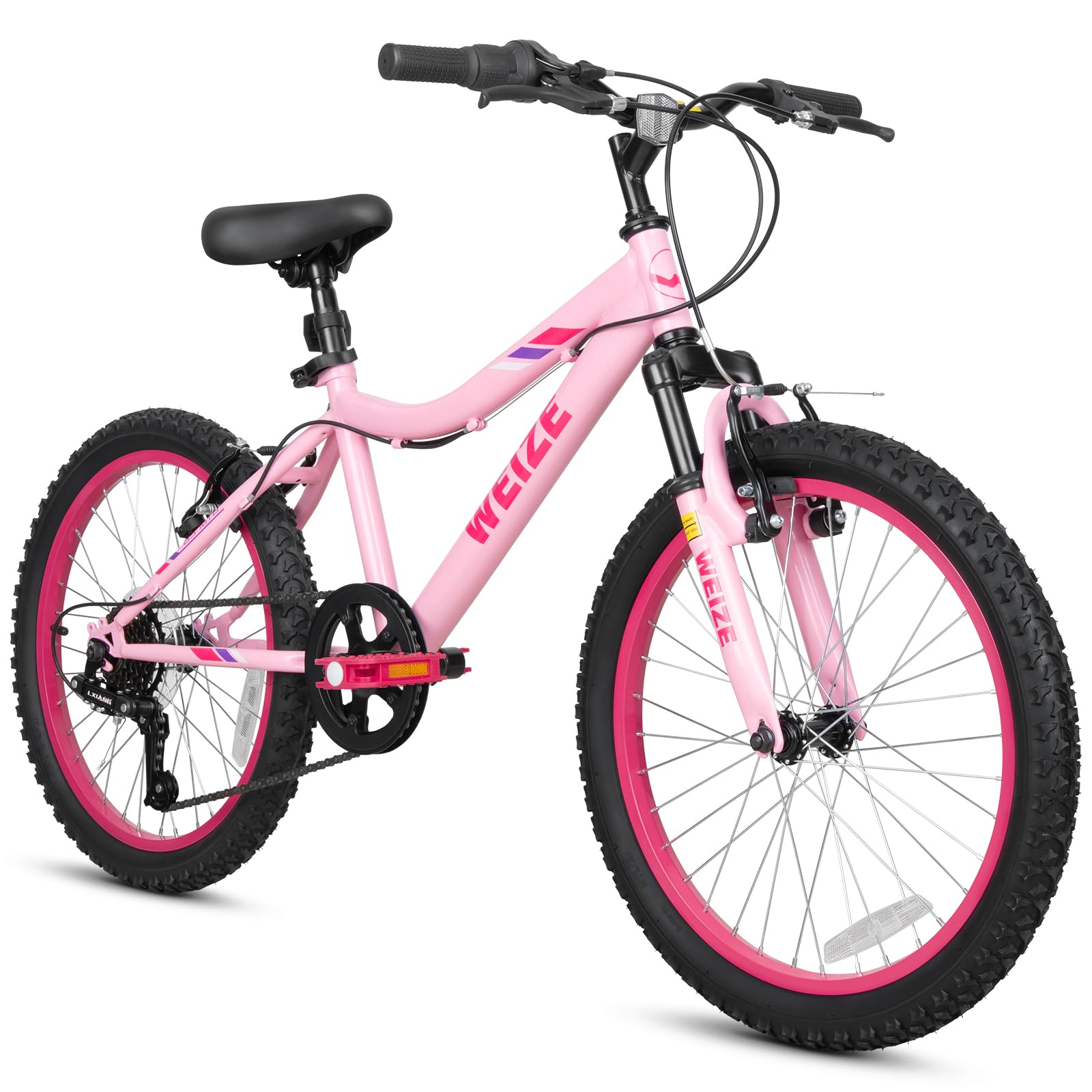
A clear two-size height guide that takes the guesswork out of picking a wheel size.
You can size the WEIZE without guessing, and that is what separates it. The 20-inch bike is built for ages 6–11 and riders 46–57 inches tall. The 24-inch bike suits ages 8–14 and riders 54–66 inches tall. The saddle is height-adjustable — 25–30 inches on the 20-inch, 27.2–33.1 inches on the 24-inch, measured from the ground to the top of the saddle — so the bike grows with your rider instead of being outgrown in a season.
The high-carbon steel frame is built for everyday durability, and the front suspension fork absorbs bumps and reduces vibration on neighborhood streets, park paths, and recreational trails. It arrives 85% pre-assembled with clear instructions and online video guidance, so the remaining setup runs about 20 minutes.
The strongest impression buyers share is value — the bike delivers a lot for what it costs, and children take to it quickly. Two areas split opinion: the size runs a touch small for some riders, so measure your child’s height and match it carefully to the chart. Brake and gear adjustment also take some finesse for a few owners, so plan a quick tune at setup. Get the size right and it’s a budget-friendly starter that does the job.
The size advantage: explicit height ranges and saddle measurements make this one of the easiest bikes here to size correctly.
Measure twice: the size leans small for some riders, and brake/gear adjustment takes finesse — match height to the chart and tune at setup.
Great for: a parent who wants clear height-based sizing and a speedy 20-minute setup at a budget-friendly price.
Be careful if: your child sits near the top of a size range — check the height chart carefully.
9. JOYSTAR NEO 20″ 24″ Kids Mountain Bike
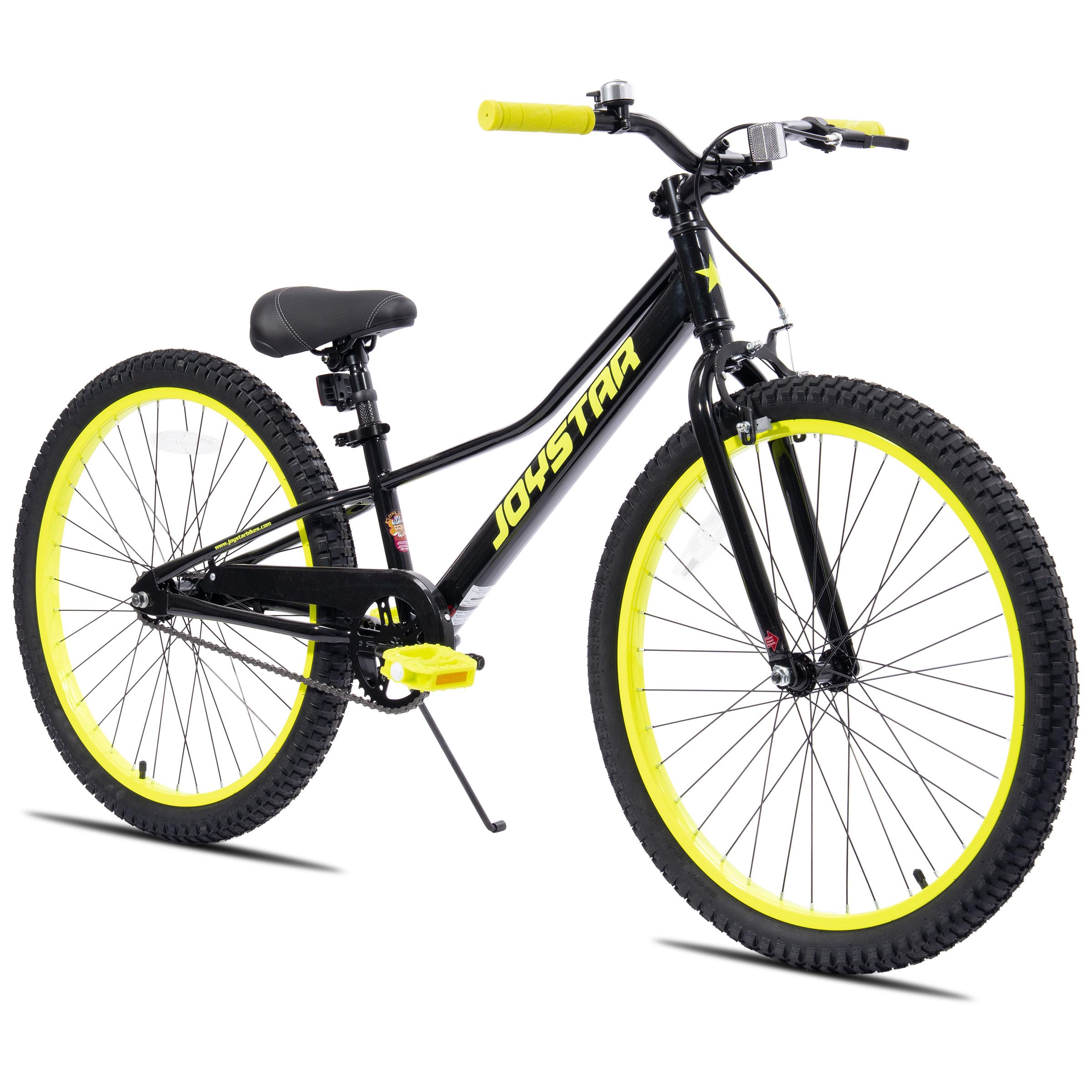
A quick-adjust saddle and a lifetime frame warranty that stretch your buying dollar.
The pitch here is longevity. A limited lifetime warranty on the frame backs the Hi-Ten steel build, and a quick-adjust saddle raises to accommodate growth spurts across multiple riding seasons. The 24-inch model fits children 52–62 inches tall, and the extra-wide 2.4-inch knobby tires give plenty of grip on wet pavement, loose gravel, and dry dirt.
Braking is dual: a rear coaster brake that engages when a child pedals backward, paired with a front caliper handbrake, so there are two independent ways to slow down. The shock-absorbing fork handles rocky paths and bumpy ground, and a built-in kickstand keeps parking tidy. It arrives 85% pre-assembled with all basic tools, ride-ready in roughly 20 minutes.
Honesty matters here. Quality is a genuine split — plenty of families love it while others find it lacking, and assembly instructions can be unclear on details like the kickstand. The tire and wheel quality is the weaker area to keep an eye on. It’s a pragmatic choice if the adjusted fit and the frame warranty are what you value, and you go in expecting to dial in the setup yourself.
Why It Grows With Them
- Limited lifetime frame warranty
- Quick-adjust saddle across growth spurts
- Dual braking: rear coaster plus front caliper handbrake
- 2.4-inch knobby tires grip wet pavement, gravel, and dirt
Where It Divides
- Quality is genuinely mixed across owners
- Assembly instructions can be unclear on the kickstand
- Wheel and tire quality is the weaker area
The longevity bet: the frame warranty and growing saddle make this a fit for a child who’ll ride for several seasons.
Only if you’re handy: unclear assembly guidance and mixed wheel quality mean a handy parent gets the most out of it.
10. Mongoose Flatrock Mountain Bike
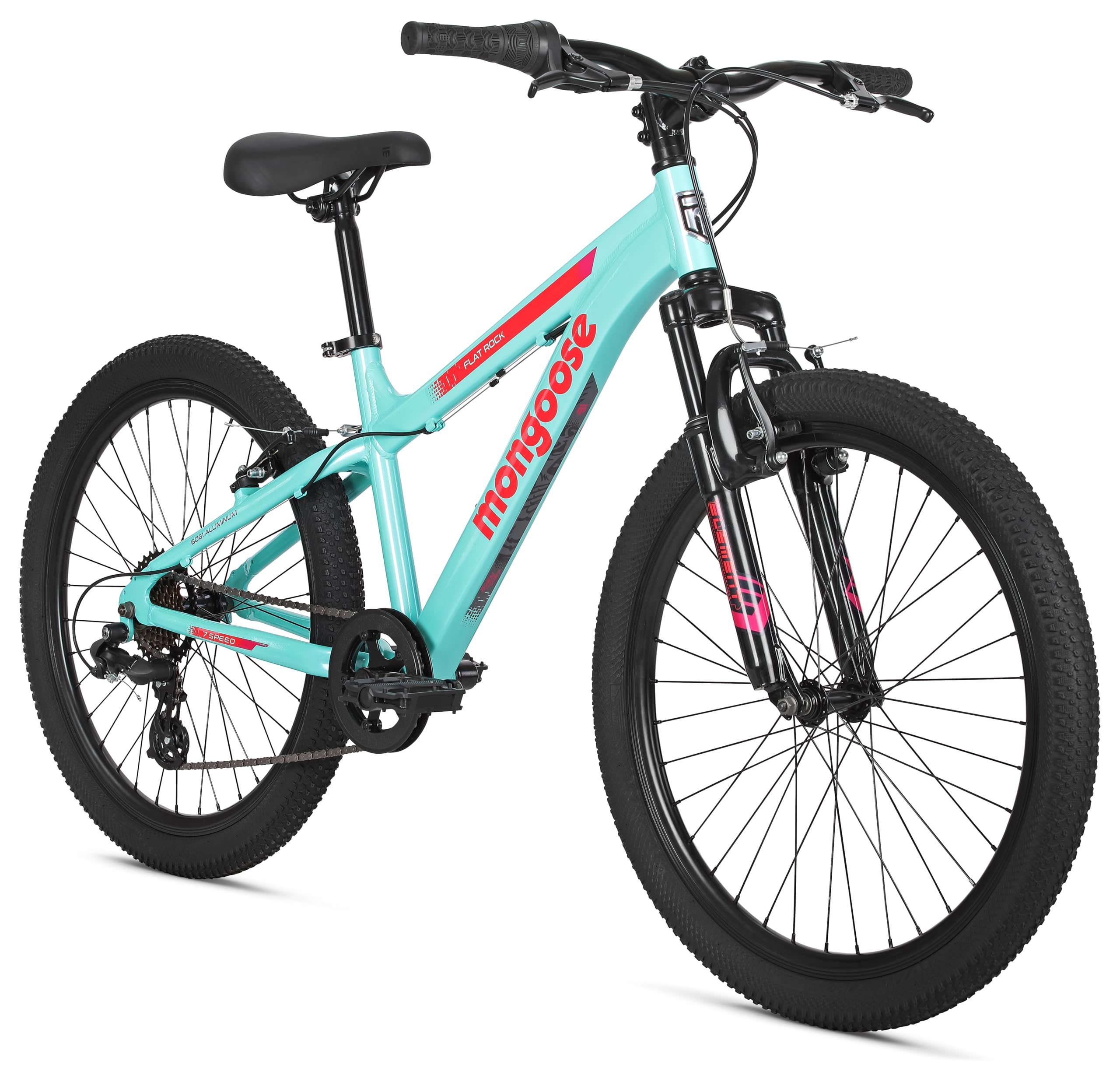
One frame that spans a 4’4″ teen to a 6’0″ adult across three wheel sizes.
The Flatrock’s trick is range. With 24, 26, or 29-inch wheels it fits riders from 4’4″ up to 6’0″ tall, which makes it the rare bike a growing teen and a parent can both ride. The aluminum mountain frame with a sloping top tube keeps the look modern and the frame lighter than steel, and knobby mountain tires plus a suspension fork handle singletrack and crushed gravel paths.
A 7-speed drivetrain with twist shifters covers climbs and descents, and linear pull brakes clamp the rims for stopping power on varied terrain. At 33.2 lbs, it’s a substantial bike for a younger or smaller rider. The sloping top tube helps standover clearance, though at that weight it’s a substantial bike for a younger or smaller rider.
Where the Flatrock wins is appearance — it looks the part on the trail and rides well. The larger honest note is that quality, value, and braking performance divide owners, and durability and gear adjustment show up as the weaker areas. It’s a fair choice for a shared family bike spanning teen and adult sizes, as long as you go in expecting to keep the gears and brakes tuned yourself.
Size flexibility: three wheel sizes covering 4’4″ to 6’0″ is the widest fit span here, so one bike can serve a growing teen and a parent.
The upkeep note: gear adjustment and braking are the areas that need attention over time, so plan on periodic tuning.
Built for sharing: the Flatrock suits a household where a teen and an adult both need a trail-capable bike and want one size that spans both.
Otherwise: a dedicated youth frame like the Glerc is easier for a smaller rider to control.
11. Schwinn High Timber Mountain Bike

A lightweight aluminum frame and alloy wheels from a name families grew up with.
Schwinn brings a lightweight aluminum mountain frame to the table, and that matters for a youth rider who needs a bike they can control rather than drag. The alloy wheel set and wide knobby mountain tires provide stability and balance across all terrains and weather, and an alloy crank delivers smooth gear changes with minimal maintenance. Twist shifters with a rear derailleur make gear changes quick and simple.
The 20-inch wheel setup here fits riders 4’0″ to 5’0″ tall, so confirm height before you buy. A quick-release seat post raises in seconds for easy adjustments as your child grows. It arrives 80% assembled, and finishing it takes a Phillips head screwdriver, 2.5–8mm Allen wrenches, an adjustable wrench, and pliers with cable cutters.
What earns the confidence is trail reliability and neighborhood cruising with a look that holds up. Assembly is the real variable — some builds are simple, others test your patience, so read through the instructions first and set aside a proper work session. It’s a solidly built youth trail bike from a familiar brand, best for a family that values the aluminum frame and doesn’t mind a real assembly afternoon.
What Backs the Premium
- Lightweight aluminum frame and alloy wheels
- Alloy crank for smooth, low-maintenance shifting
- Quick-release seat post for easy height changes
- Reliable for trails and neighborhood riding
Before You Commit
- Arrives 80% assembled — the lowest pre-assembly here, with a real tool list
- Assembly experiences vary; some builds take patience
- 20-inch wheel only fits riders 4’0″ to 5’0″
Best for: a family that wants an aluminum frame and alloy wheels from a trusted brand and is ready to spend an afternoon on assembly.
Look elsewhere if: you want a near-ready bike or your child is taller than 5’0″.
Know the Specs
Wheel Size and Height Fit
The wheel diameter (20, 24, or 26 inch) roughly maps to rider height, but the saddle and standover clearance are what confirm a safe fit. A 20-inch bike typically suits riders around 45–55 inches, while a 24-inch suits taller kids. Always check the inseam and standover before you buy, since a too-big frame teaches bad habits and a too-small one is quickly outgrown.
Brake Types Explained
Disc brakes squeeze a rotor at the wheel hub and hold stopping power when the rim is wet or muddy. V-brakes and linear pull brakes clamp the wheel rim, which is simpler and lighter but loses bite in wet weather. For a child who rides real trails, front and rear disc brakes are the safer choice; for neighborhood cruising, rim brakes are perfectly adequate.
Common Questions
What size mountain bike does my child need?
Are disc brakes better than V-brakes for a kids mountain bike?
How many gears should a youth mountain bike have?
How long does assembly take on a kids mountain bike?
Is an aluminum frame better than steel for a child’s mountain bike?
What is a fat tire bike good for?
Can a youth mountain bike fit both a child and an adult?
Do I need to tune the gears and brakes after assembly?
What should I check first on a new kids mountain bike?
The Bottom Line
For most families, the youth mountain bike winner is the Mongoose Argus Trail. Its 4-inch fat tires (very wide tires that float over soft ground) and aluminum frame handle dirt, gravel, sand, and snow with grip nothing else here matches. It also carries a 4.0+ star average across 300+ ratings. If you want the widest gear range for real hills, grab the Glerc 21-speed. And for a lightweight, easy-to-handle bike with an aluminum frame, the RoyalBaby is the one to reach for.
How we choose
We do not accept paid placement. Every pick is matched to a real buyer and a real use-case; we do not hands-on test units.
Sources
Specifications: manufacturer listings and product documentation. Review insights: verified customer reviews, as of November 2026. Pricing: not shown on this page (it changes often); check the current price via the retailer link.
As an Amazon Associate, Tactical Gear Guy earns from qualifying purchases. This does not affect which products we feature.