Specs are compiled from manufacturer listings and verified buyer reviews and can change over time — please confirm the key details on the product page before buying.
All five helmets here fit youth heads properly. What actually separates them is vent count, weight on a small neck, and whether the visor survives a season of being yanked on and off.
This guide is built by comparing the manufacturers’ published specifications and the patterns across verified customer reviews, so you get each pick’s real strengths and trade-offs instead of marketing spin.
Fit comes first, vents come second, and a detachable visor that actually reattaches comes third. Below you will find the full breakdown of the youth mountain bike helmet options worth your attention.
Top Picks

How To Choose The Best Youth Mountain Bike Helmet
A helmet that does not fit will not stay put in a crash. Before you look at colors or vents, wrap a soft tape around the widest part of your child’s head and write the number down. Every pick below lists a centimeter range, and that range is your first filter.
Measure the Head, Ignore the Age Label
Age ranges on helmet listings are a rough guide at best. One kid at nine has a bigger skull than another kid at twelve. Go by the centimeter range on the spec sheet — a helmet listed at 50-57 cm will not sit right on a head measuring 59 cm, no matter what the box says about ages.
Count the Vents Before You Count the Colors
Vents are the channels cut through the shell and foam that let hot air escape. A helmet with 23 vents moves noticeably more air than one with 15, and on a summer climb that difference is what decides whether the helmet stays on or gets carried in a hand. Fewer vents are fine for shaded trail riding; more vents suit exposed fire roads.
Check the Certification Line
Look for a helmet that states it meets the U.S. Consumer Product Safety Commission standard for bicycle helmets. That is the baseline for lawful sale in the United States. Some picks here also list CE or ASTM F1447, which are additional standards the maker tested against.
Decide If You Need Full Face
A full-face helmet adds a chin bar that protects the jaw and face. That matters for downhill runs, BMX parks and lift-access trails. It does not matter for a paved greenway loop. A convertible design lets you strip the chin bar for the easy days and bolt it back on for the park.
Side-by-Side Comparison
| Model | Best For | Head Range | Vents | Weight | Amazon |
|---|---|---|---|---|---|
| OnBros Kids Bike Helmet★ Best Overall | Everyday neighborhood riding | 50-57 cm | 15 | 240 g | Amazon |
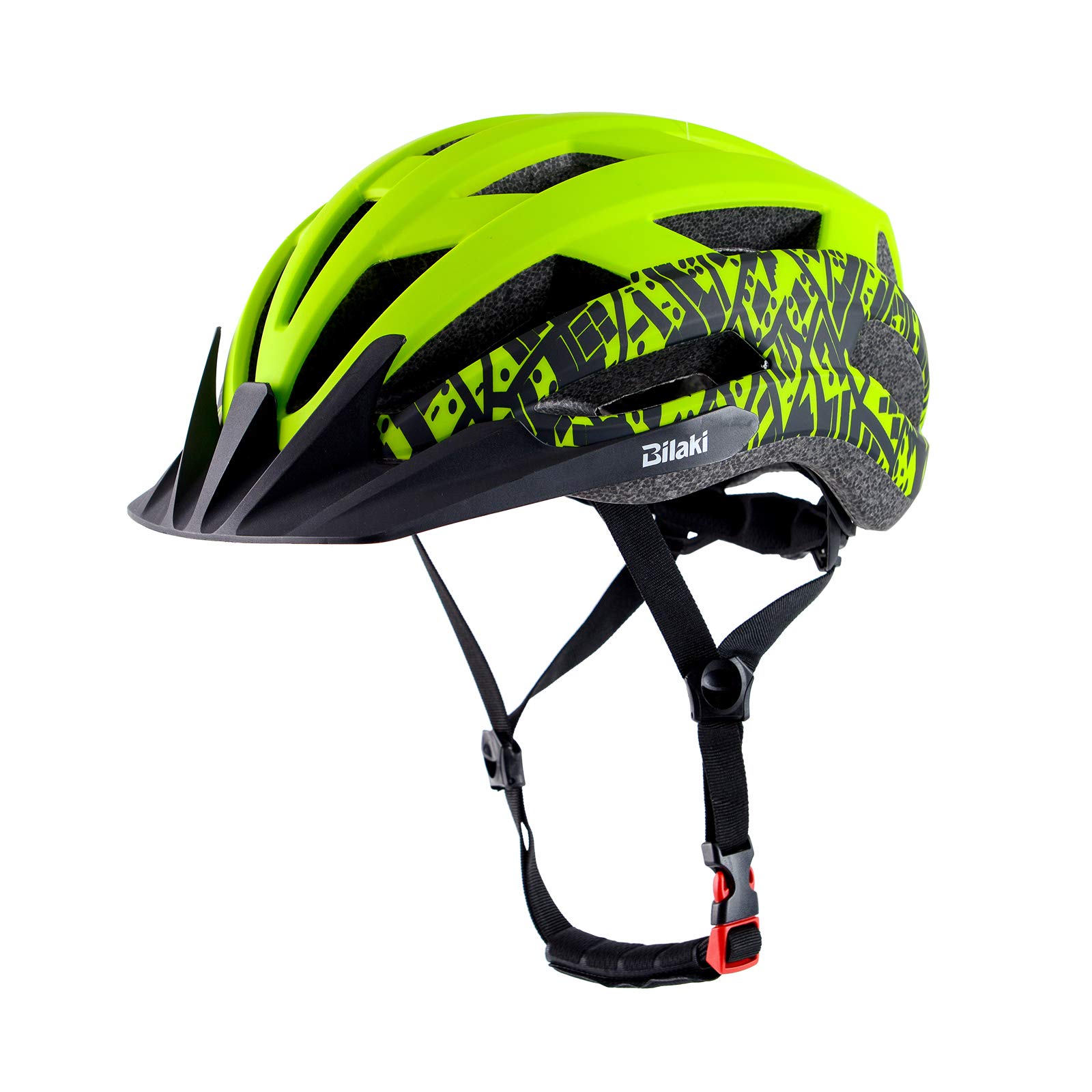
| Bilaki Youth Adult HelmetMost Ventilated | Teens and adults sharing a helmet | 54-58 cm / 58-61 cm | 23 | 7.68 ounces | Amazon |
| Bosoar MTB Helmet | Trail riders who film their runs | 55-61 cm | 15 | 330 g | Amazon |
| BATFOX LA303 | Growing kids who need a big range | 54-63 cm | 18 | 13.76 ounces | Amazon |
| Natuway 2-in-1 Full Face | BMX parks and downhill days | 20.25-22.05 inches | — | 14 oz / 10 oz | Amazon |
Detailed Reviews
1. Kids Bike Helmet Boys Girls Youth Visor Adjustable 50-57CM
Our pick — 4.5+★ from 900+ verified ratings; the strongest balance of quality and price.
A 240 g shell that fits heads from 50 to 57 cm and still costs less than a pizza night.
This one earns its spot on weight: 240 g for the full helmet, about the same as a large orange. On a small neck that matters, because a heavy helmet gets tipped back, worn loose, or quietly left in the garage. Once the chin strap is snug, this one disappears. The round dial at the back (a twist-fit adjuster) tightens as your kid grows through the 50-57 cm range, which the maker lists as roughly ages 5 through 14.
Underneath the shell sits a PC outer layer bonded over EPS foam, which is the dense grey material that crushes inward on impact to soak up the hit. The rear extends down the back of the skull for extra coverage there, and the maker states it meets both CPSC and CE standards. Fifteen vents run through the foam to let hot air out on a summer climb. The soft liner pulls out for washing, which is the difference between a helmet that smells fine in August and one that does not.
Buyers report that the fit wins them over: the dial and strap adjusters come up in reviews far more than anything else. The rainbow finish draws its own compliments, and the removable visor shades the eyes on bright mornings. The honest catch is the visor itself. Several reviewers report the visor snapping off within about five uses. Treat the visor as a fair-weather add-on, not a permanent fixture, and this helmet holds up fine.
What Earns It First Place
- 240 g is light enough that kids stop noticing it is on
- Back dial adjusts across the full 50-57 cm span as they grow
- Rear shell extends lower down the back of the head
- Removable washable liner keeps it fresh through summer
Where It Gives Ground
- The visor is the weak point — treat it gently
- This helmet has 15 vents; the Bilaki below has 23 vents
- Topped out at 57 cm, so bigger teens need another size up
Reach for this if: your rider is between 5 and 14 and mostly pedals neighborhood streets and paved trails.
Look elsewhere if: you need a shell that stretches past 57 cm or a visor that takes real abuse.
2. Youth Adult Bike Helmet
Twenty-three vents and 7.68 ounces — the airiest shell on this list for a teenage head.
Twenty-three vents against the OnBros’s 15 is not a marketing gap; it is eight extra channels for hot air to leave the shell. On a long climb in July that is the difference between a kid who keeps riding and a kid who stops to pull the helmet off. Weighing in at 7.68 ounces, this is one of the lightest options here, and the weight sits comfortably even after an hour in the saddle.
The sizing is the other reason this one earns its spot. There are two shells: a medium covering 54-58 cm for riders 12 and up, and a large covering 58-61 cm for teens and adults. That large size means a parent can hand this down as the kid’s head grows, or share it with an adult rider in the household. The dial at the back and the strap adjusters do the fine-tuning. The shell is PC over high-density EPS foam, and the maker states it complies with the U.S. Consumer Product Safety Commission standard for riders aged 5 and older.
Fit and build quality come up more than anything else in the owner feedback, and both land positive. Two detachable visors ship in the box, so you can swap one out or keep a spare, and the visor shields eyes from sun and rain without needing sunglasses underneath. A portable storage bag comes with it for tossing in a backpack. The trade-off is straightforward: the smallest size starts at 54 cm, so a younger or smaller-headed rider will swim in it. This is a teen-and-up helmet, not a first-grader’s helmet.
Size strategy: Two real shells beat one stretch-to-fit dial. The medium-to-large gap means a growing teen gets an actual fit rather than a compromise.
Fair-weather caveat: That 54 cm floor leaves out smaller kids entirely — measure before you buy.
The helmet that grows with a teenager: two sizes, 23 vents, and a spare visor in the box.
Not built for: a nine-year-old with a smaller head circumference.
3. Mountain Bike Helmet for Adult Men Women, Fit 55-61 Cm

A built-in action camera mount turns the trail ride into footage without a separate bracket.
Trail kids film everything, and this shell has an action camera mount built straight into the top. A GoPro-style camera bolts on with no third-party bracket and no strap winding around the foam. That mount is what separates it from the Bilaki above, which has no mount at all. The detachable visor clicks off in seconds when the ride shifts from shaded trail to open road.
This helmet weighs 330 g; the OnBros below weighs 240 g, and the Natuway full-face helmet weighs approximately 14 oz. The shell is an in-mold PC layer bonded with EPS foam, and the foam runs down the sides and back of the head for coverage on the areas most exposed in a fall. Fifteen large vents push air through on longer rides, and a chin pad sits along the strap to cut chafing on hot days. The maker lists it as CPSC compliant for age 5 and older and sizes it from 55-61 cm — wider than the OnBros’s 50-57 cm ceiling.
Build quality is the thing people keep coming back to in the feedback, and the fit dial earns specific praise for working on riders with thin hair who normally struggle to keep a helmet planted. The rear coverage gets called out as genuinely useful protection. The visor is the honest weak spot: it is easy to attach, but it does not sit as firmly on the shell as it could. If your trail kid wants footage and full rear coverage, this delivers both — just do not expect the visor to feel locked down.
Camera-ready trail shell: The built-in mount is the real reason to pick this over the Bilaki, and the 55-61 cm range covers older teens through adults.
The one snag: The visor attaches quickly but does not seat as firmly as it should — plan to reattach it now and then.
Pick this for the mount: if your rider wants trail footage and extra rear head coverage, nothing else here offers both.
Skip the visor fuss: if a rock-solid visor matters more to you than a camera bracket.
4. Bike Helmet, Mountain Bike Helmet for Men Women Adults Youth

Three shell sizes stretching to 63 cm — the option that survives a growth spurt without a repurchase.
Most youth helmets cap out around 57 or 61 cm and then you are shopping again. This one runs three shells: medium at 54-58 cm, large at 58-61 cm, and extra large at 61-63 cm. That extra-large shell is 61-63 cm, and for a family with a fast-growing teen it means one purchase that keeps fitting instead of two.
Some of that mass goes into the construction: a full-coverage polycarbonate outer shell fused to the impact-absorbing EPS liner. Eighteen wind tunnel vents with internal channeling push air through, and the padding and chin pad both pull out for washing. The maker states it meets U.S. CPSC, ASTM F1447 and E.U. CE standards.
The big visor is the standout comfort feature — long enough that it actually shades the eyes, which is the kind of small detail you only miss once it is gone. Comfort lands as the third most-discussed strength, and the helmet is regularly described as barely noticeable in wear. If there is a caveat, it is that heavier shells do feel different on longer climbs, and a smaller rider moving from a 240 g helmet will notice the extra mass on their head.
Built for the long haul: Three shells up to 63 cm and three safety standards on the spec sheet make this the pick for a teen who is still growing.
Heft to know about: This helmet weighs 13.76 ounces — expect a small rider to feel the difference at first.
Families with growing teens: the 61-63 cm extra-large shell saves a second purchase down the road.
Featherweight seekers: if minimum weight tops your list, look at the OnBros or the Bilaki instead.
5. Toddler and Kids Full Face Bike Helmet
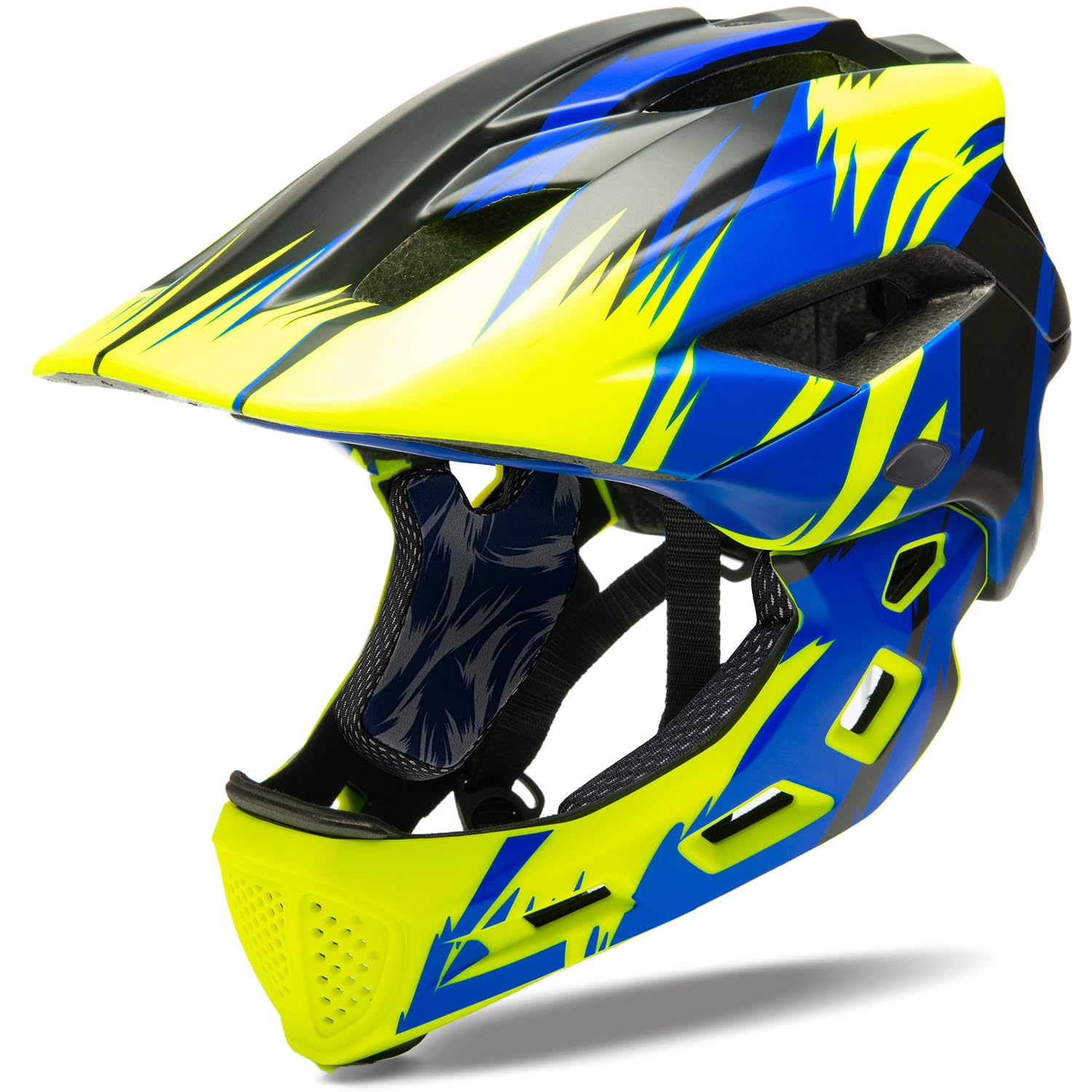
A chin bar that clicks off for the greenway and back on for the BMX park.
The headline here is the one-click switch. Press both side buttons and the chin bar comes off, turning a full-face helmet into a standard half shell. That means the same helmet handles a paved loop in the morning and a downhill run in the afternoon. Weight splits accordingly: approximately 14 oz as a full face and 10 oz as a half shell. The half-shell figure is approximately 10 oz and the full-face figure is approximately 14 oz; the OnBros is 240 g — which is what a chin bar costs you.
Coverage is the whole reason to go full face. The hard PC (polycarbonate) outer shell is bonded to high-density EPS foam (the crushable foam that absorbs impact), so it protects the jaw and face in a way no open helmet can. The maker states it meets CE and CPSC 16CFR&1203 physical testing plus the CPSIA chemical standard. The size range runs 20.25-22.05 inches, which the maker maps to roughly ages 3 through 12, adjusted at the chin straps and the back buckle. Two sets of face pads ship in the box plus an extra liner, so you always have a clean one while the other washes.
Buyers pick this one primarily for the level of protection — the full-face coverage against a half shell is the whole argument. Quality and fit land as the two strongest points in the feedback, and the colors earn their own mention. Face protection and long-term durability both sit more mixed: the chin bar and pads do their job, but the helmet asks for a little care to hold up over seasons of hard riding. For a kid spending real time in a bike park, that trade-off is the price of the extra coverage.
Why Families Choose It
- One-click chin bar swap between full face and half shell
- 14 oz full face and 10 oz half shell keeps the weight manageable
- Two face pad sets and an extra washable liner included
- Covers ages roughly 3 to 12 with strap and buckle adjustment
What to Plan Around
- Face protection and durability both land mixed in the feedback
- Full-face weight is approximately 14 oz
- Care and regular cleaning matter to keep it lasting seasons
For bike park kids: if your rider hits lift-access trails or a BMX park, the chin bar earns its place in the rotation.
For paved loops only: the extra mass and the mixed long-term durability are not worth the trade if you never leave the greenway.
Know the Specs
Head Circumference Range
This is the centimeter span the helmet will fit, measured around the widest part of the head just above the eyebrows. It is the number to check first. A 50-57 cm helmet will not sit right on a head measuring 59 cm — the dial at the back can only tighten so much. Measure, then match the range, not the age on the box.
Vent Count
Vents are the openings cut through the shell and foam that let hot air escape. More vents means more airflow, which matters most on exposed climbs and long summer rides. Fewer vents suit shaded trail riding where airflow matters less. On this list the count ranges from 15 to 23.
PC Shell and EPS Foam
The polycarbonate shell is the hard plastic outside that spreads an impact across a wider area. The EPS foam — expanded polystyrene — is the dense grey lining that crushes inward to absorb the force. Both work together. A helmet needs both layers to pass a CPSC impact test.
Fit Dial and Strap Adjusters
The dial at the back is a circular adjuster that tightens the internal cradle around the skull. The straps adjust where they run under the chin. Together they let one helmet fit a range of heads — and let it grow with your kid for a season or two before the range runs out.
Common Questions
How do I know which size helmet my kid needs?
Does a youth mountain bike helmet need to meet any safety standard?
How many vents should a kid’s MTB helmet have?
Is a full-face helmet overkill for a kid on a balance bike?
Can I wash the inside of a kids bike helmet?
When should I replace a youth helmet?
What is the difference between an open and a full-face helmet for kids?
Can I use a youth mountain bike helmet for skateboarding or scooters?
Why does the visor keep coming off?
The Bottom Line
For most families, the youth mountain bike helmet that makes the most sense is the OnBros Kids Bike Helmet: 240 g on a small neck, a dial that covers 50-57 cm, and a build that meets both CPSC and CE standards. If your rider sweats through every ride, the Bilaki opens 23 vents where most of the field runs 15 to 18. And if your teen is still growing, the BATFOX stretches all the way to 63 cm, so you buy once instead of twice.
Measure the head before you compare specs. Vents, colors, visors and the camera mount only matter once the shell fits the head it was bought for.
How we choose
We do not accept paid placement. Every pick is matched to a real buyer and a real use-case; we do not hands-on test units.
Sources
Specifications: manufacturer listings and product documentation. Review insights: verified customer reviews, as of November 2026. Pricing: not shown on this page (it changes often); check the current price via the retailer link.
As an Amazon Associate, Tactical Gear Guy earns from qualifying purchases. This does not affect which products we feature.