Specs are compiled from manufacturer listings and verified buyer reviews and can change over time — please confirm the key details on the product page before buying.
A wrong glove size or a loose helmet can turn a fun season into a miserable one. The picks below solve that: every item here is youth-sized, and both helmet picks come with a facemask already bolted on so you are not hunting for a cage on a separate order. Start with the Franklin NHL Kids Street Hockey Gloves — 4.5+ stars from 700+ buyers — if you just need hands protected for driveway hockey today.
This guide is built by comparing the manufacturers’ published specifications and the patterns across verified customer reviews, so you get each pick’s real strengths and trade-offs instead of marketing spin.
Kids’ hockey gear has one job: stay on during a fall and stay comfortable for a full session. Sizing trips up more parents than anything else, so this guide puts head circumference, glove measurement, and weight-based pad charts front and center. Below you’ll find the eight pieces worth your money when you’re shopping for youth hockey gear.
Top Picks


How To Choose The Best Youth Hockey Gear
Most returns in this category trace back to one mistake: buying by age instead of by measurement. A six-year-old and an eight-year-old can wear the same helmet. Two kids the same age can need glove sizes two steps apart. Measure first, then read the box.
Start With The Head, Not The Age
A helmet only protects if it sits snug, because a loose shell tilts and leaves a gap. The Bauer Prodigy combo fits heads from 18.8″ to 21″, and the Bauer Lil Sport combo covers 18.8″ to 20.4″. Wrap a measuring tape around the widest part of the skull, just above the ears, and that number tells you which one to buy. If a helmet slides down over the eyebrows on its own, it is too big, no matter what the age label says.
Gloves Are Measured, Never Guessed
Glove sizing runs from the tip of the longest finger to the midway point of the forearm. That single measurement decides whether your player needs a junior or youth pair, and it is the reason a glove that looks right in the photo can arrive feeling like a catcher’s mitt. When a listing offers several sizes, take the measurement twice before you pick.
Decide Street Or Ice Before You Spend
Street hockey gear and ice hockey gear are built for different surfaces. A plastic-shell goalie mask with a welded steel cage is meant for street and driveway play; a foam-lined ice helmet with a facemask is meant for the rink. Buying street gear for ice, or the reverse, is the fastest way to waste a season’s budget.
Buy Adjustable Where It Counts
Kids grow in bursts, so any piece that adjusts buys you time. Skates with a twist lever that changes size, sticks that slide from 18″ to 28″, and helmets with occipital adjustment all stretch across a growth spurt. Base layers and pads are the opposite — get the correct size now and hand them down later.
Side-by-Side Comparison
| Model | Best For | Item Type | Youth Sizing Detail | Defining Feature | Amazon |
|---|---|---|---|---|---|
| Franklin NHL Kids Street Hockey Gloves★ Best Overall | Driveway and street play | Glove pair | Youth, multiple sizes | Full-coverage high-density padding | Amazon |
| Franklin NHL Kids Folding Goals SetBest Starter Set | First-time players at home | 2 goals + 4 sticks + balls | Sticks adjust 18–28″ | Insta-Set fold-and-lock corners | Amazon |
| EALER Compression Shirt with Neck GuardBest Base Layer | Base layer under pads | Long-sleeve shirt | — | Built-in neck protection | Amazon |
| Bauer Prodigy Helmet Combo | Toddlers and little kids | Helmet + facemask | Fits 18.8″–21″ heads | Manual side-clip adjustment | Amazon |
| VPRO Ice Hockey Gloves | Serious young players | Glove pair | 8″ junior through 15″ | 5-layer nylon and TPU armor | Amazon |
| Bauer Lil Sport Helmet Combo | Teen and older youth skaters | Helmet + facemask | Fits 18.8″–20.4″ heads | Occipital fit dial | Amazon |
| TronX Stryker Adjustable Skates | Roller and inline hockey | Skate pair | Size dial adjusts the boot | Hi-Lo aluminum frame chassis | Amazon |
| Winnwell Cleansport NXT Starter Kit | Full beginner outfitting | 6-piece pad set + bag | S/M/L by age and weight | Shoulder, pants, glove, elbow, shin, bag | Amazon |
Detailed Reviews
1. Franklin Sports NHL Kids Street Hockey Gloves
Our pick — 4.5+★ from 750+ verified ratings; the strongest balance of quality and price.
The pair that keeps a driveway game from ending in a bruised knuckle — and at 8 ounces, barely there.
If your kid’s hockey happens on asphalt rather than ice, this is where the money should go first. The Franklin NHL Kids Street Hockey Gloves are built around full-coverage, high-density padding, which is the padding that takes the sting out of a stick check in street hockey. They are officially licensed NHL gloves rated for play with 2 5/8″ street hockey balls, so you are not guessing whether they are meant for the driveway.
What wins people over is the value — it is the most-praised quality of the glove by a wide margin — followed closely by how well it fits. The padding is flexible rather than board-stiff, which is what lets a small player keep a real range of motion and actually grip the stick instead of holding on like a mitten. The inside is soft enough that a child will keep them on for the whole game, and parents report they work even for living-room hockey on a rainy afternoon. At 8 ounces the pair is light enough that arm fatigue is not the reason your player quits.
Sizing is the one thing to get right before you click. The measurement runs from the end of the fingertips to the midway point of the forearm, and the gloves come in a range of sizes to fit children of all ages. Measure once with the hand flat and once with it relaxed, because a measurement taken while your kid is squirming will send you a size too small. It is worth knowing this glove is a street and roller piece — for ice-hockey demands like a pro-style palm, the VPRO pair further down the list is the step up.
Grip and padding
- Full-coverage high-density padding across the hand while staying flexible enough to move in
- Very light at 8 ounces, so young arms do not wear out mid-game
- Officially licensed NHL gear rated for 2 5/8″ street hockey balls
- Comes in a spread of sizes so you can match a real hand measurement
Sizing runs small
- Protection is the aspect buyers are most divided on — fine for street play, not a competitive ice glove
- Fit and sizing both draw mixed feedback, so a tape measure is essential
Young street players: driveway and street hockey where a growing player needs real hand padding without the ice-hockey price.
Ice league use: competitive ice hockey — the padding and palm are built for a ball, not a puck.
2. Franklin Sports NHL Kids Folding Hockey Goals Set
Two goals, four sticks and three balls for less than the cost of one rink-ready helmet.
Two goals, two adjustable street hockey sticks, two knee hockey sticks, one street hockey ball and two foam knee hockey balls all arrive in one box. That is a complete at-home setup — nothing else to buy before the first game. The goals measure 24 x 19 x 19 inches, a genuinely kid-sized target that folds flat so it disappears into a closet or the back of the car on the way to Grandma’s driveway.
The setup is what sells it. Insta-Set corner joints fold and lock into place, so you can have the whole thing standing in seconds and broken down just as fast. The sticks slide from 18″ to 28″, which means the same set works for a four-year-old and an older sibling, and the knee-hockey sticks let them play on their knees indoors before anyone ventures outside. Fun is the loudest theme in the buyer feedback, with gift-giving a close second — this is the box that gets opened on a birthday and used the same afternoon.
Be honest about the material before you buy. The frame is plastic and the set weighs 1.86 kg, so it is a practice toy, not a rink-grade goal. Durability is the point buyers split on — most say it holds up fine for backyard play, while some have had sticks break early. The other fork in the road is size: the 24-inch goal is perfect for indoor and small-yard games and too small for older kids taking real slap shots. Treat it as a first-stick set for a young beginner and it does exactly what it promises.
Folds for storage: one purchase covers goals, sticks and balls, and the fold-and-lock corners mean it gets used instead of gathering dust — the single biggest reason starter sets fail.
Thin net mesh: plastic frame, 1.86 kg total, kid-sized 24-inch goals. Households with older players or hard shooters should look at a sturdier net instead.
Driveway practice: you have a beginner aged roughly four to eight who needs a whole game in one box.
Regulation shots: your player is already ripping real shots — the plastic goal and sticks are built for practice pace.
3. EALER Hockey Compression Shirt with Neck Guard
One layer that solves two problems at once — a covered neck and elbow pads that stop sliding.
Most parents buy a neck guard and a base layer as two separate pieces. This shirt folds both into one garment. Buyers rave about the compression fit, and it is not about looks. A snug sleeve gives the elbow pad something to grip, so the pads stay where you strapped them instead of sliding down the arm mid-shift.
The neck protection is the reason it earns a place on this list at all. It sits close without the bulk of a separate collar, which matters because a bulky collar is the piece kids quietly take off the moment a coach turns around. Quality is the second-most-praised trait, and the shirt is described as the kind of item a hockey family keeps buying as their player grows. Layer it under shoulder pads and you have one less thing to remember at the rink.
The honest limit is information, not performance: the listing gives the fit, the neck guard and the long sleeve, and not much else in the way of material detail. Sizing also runs as a compression garment, which means it should feel tight rather than loose — if your kid hates snug clothing, a standard base layer will suit them better. For everyone else, this is the quiet piece that makes the rest of the equipment work properly.
Under jersey wear: any youth player whose elbow pads slide and whose neck guard ends up in the bag instead of on their neck.
Loose fit fans: your player refuses close-fitting clothing — a compression shirt is meant to hug, not drape.
4. Bauer Prodigy Hockey Helmet Combo with Facemask Cage
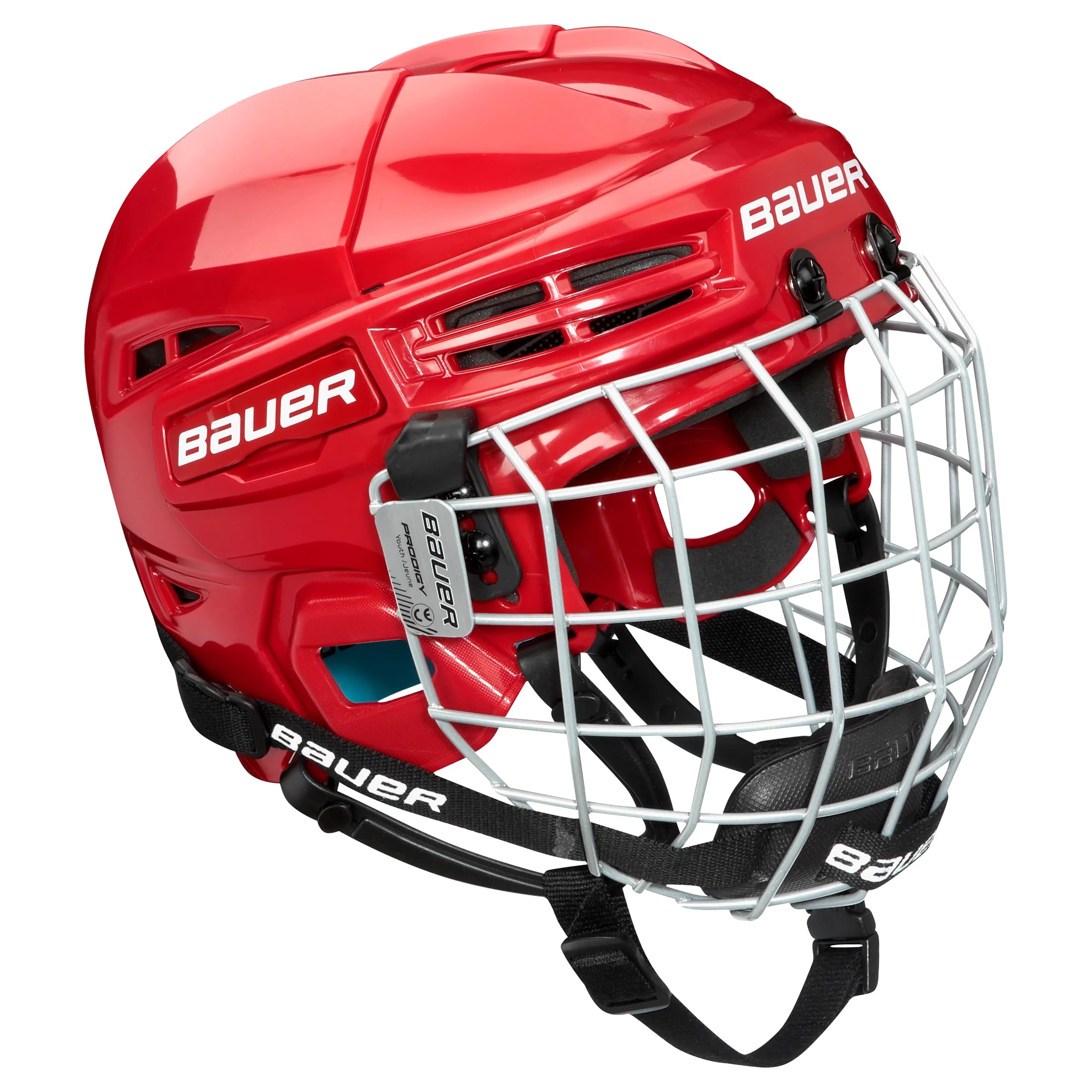
A first helmet that fits a toddler’s head without swallowing it — cage already attached.
Buying a helmet and a cage separately is how parents end up with a cage that does not line up with the shell. This combo arrives as one unit. The head range is 18.8″ to 21″, which is squarely toddler-to-little-kid territory, and Bauer lists it for a toddler to little-kid age range. That narrow window is the point: a helmet designed for a small skull sits low and snug instead of perched on top of a tiny head.
Adjustment is deliberately simple. You flip up the side clips and pull the shell open or closed by hand, so there is no dial to lose and no tool to find. The outer shell is plastic over a foam or expanded-polystyrene liner — the expanded polystyrene is the crushable foam layer that absorbs impact energy. Build quality is what buyers talk about most, and it shows: the helmet holds its shape and the cage stays put. Fit follows close behind, with parents of toddlers reporting it sits correctly on small heads.
Where this one hands off is age. Once your player is old enough to be a teen, the 21-inch ceiling on the sizing will run out, and the Bauer Lil Sport combo below covers a slightly different head range with a dial-based fit. Also worth mentioning: this is an ice-hockey helmet, not street gear, so keep it for the rink. For the under-ten crowd, though, it is the easiest helmet decision on this page.
Complete helmet set
- Cage and shell ship as one matched unit — nothing to align yourself
- Designed for 18.8″–21″ heads, the toddler and little-kid range
- Hand-adjustable side clips need no tools and no spare parts
- Crushable expanded-polystyrene liner under a plastic shell
Limited size range
- The 21-inch head ceiling will be outgrown by older youth players
- Built for ice hockey, so it is not a street or driveway piece
First-time skaters: the helmet to buy for a first-time skater still in the toddler-to-little-kid size band.
Older beginners: measure the head — if your child is already past 21 inches, this shell will not fit regardless of the age on the box.
5. VPRO Ice Hockey Gloves

Five layers of armor built to stop a puck, with a pre-bent shape that fits on day one.
This is the ice glove of the list, and the construction makes that clear. A nylon shell sits over shock-absorbing foam and TPU armor plates — TPU being a hard, flexible plastic that spreads an impact instead of letting it through. The maker claims that five-layer stack blocks 99% of impacts. Take that figure as the manufacturer’s own claim, not an independent test, and judge the glove on its layers and its shape.
Those layers are why this glove outranks the Franklin pair above for anyone skating on ice with a real puck. The palm is a double layer of leather, and the fingers come pre-bent in a 3D curve that mirrors a natural hand position, so there is no break-in week where every pass feels awkward. Airflow mesh and a sweat-absorbing liner keep hands from turning into a sauna under the glove, and the junior model is listed at 5 ounces while the 15″ senior runs 20 ounces. If your youth player is on the bigger end of junior sizing, they get real pad coverage without dragging a heavy hand around.
Where it gets tricky is the sizing. The line spans 8″ junior up to 15″ senior, and buyer feedback splits on whether the gloves run true or a touch small — worth measuring rather than assuming. Value also divides opinion, which is fair given the price sits above the Franklin pair. Buy this one when the ice game matters and the hand protection needs to match.
Recreational ice: the glove to graduate into once street hockey turns into ice hockey and a puck starts flying.
Elite speed play: sizing feedback is split, so size up if your player measures at the top of a range.
6. Bauer Lil Sport Hockey Helmet Combo

The dial at the back of the head is the feature that keeps a helmet from riding up mid-shift.
Most youth helmets adjust at the sides and hope for the best. This one adds occipital adjustment — a dial that contours the shell to the back of the skull — and that is the difference between a helmet that stays put and one your player keeps shoving back down. The head range is 18.8″ to 20.4″, so measure before you commit.
Under the polycarbonate shell is a lightweight EPP liner, which is a molded foam that springs back after an impact rather than crushing once. Multiple vents run through the shell to keep air moving, which a young skater will notice in a warm rink by the third period. The facemask arrives fully assembled, so the cage is already matched to the shell and there is no alignment puzzle. Bauer lists this for a teen age range, which puts it in a different lane from the Prodigy combo above — that one is for toddlers and little kids, this one suits an older, bigger youth head.
The listing is thin on paper, with no long review history to lean on yet. So buy it for the fit system and the assembled cage, not for a track record. If your player has a narrow head, know that the fitting adjustment makes or breaks comfort here. A dial that contours the back of the head will not fix a shell that is too wide across the temples.
Lightweight shell: occipital adjustment plus an EPP liner that rebounds, with the facemask already bolted on — three of the things parents usually end up buying or fitting separately.
Basic foam padding: a narrower head range of 18.8″ to 20.4″ than the Prodigy combo, so the bigger youth heads will need the other shell.
Toddler beginners: an older youth skater who needs a helmet that locks to the back of the head and stays there.
Contact leagues: your player’s head measures under 18.8″ — the toddler-focused Prodigy shell is the better start.
7. TronX Stryker Adjustable Roller Inline Hockey Skates
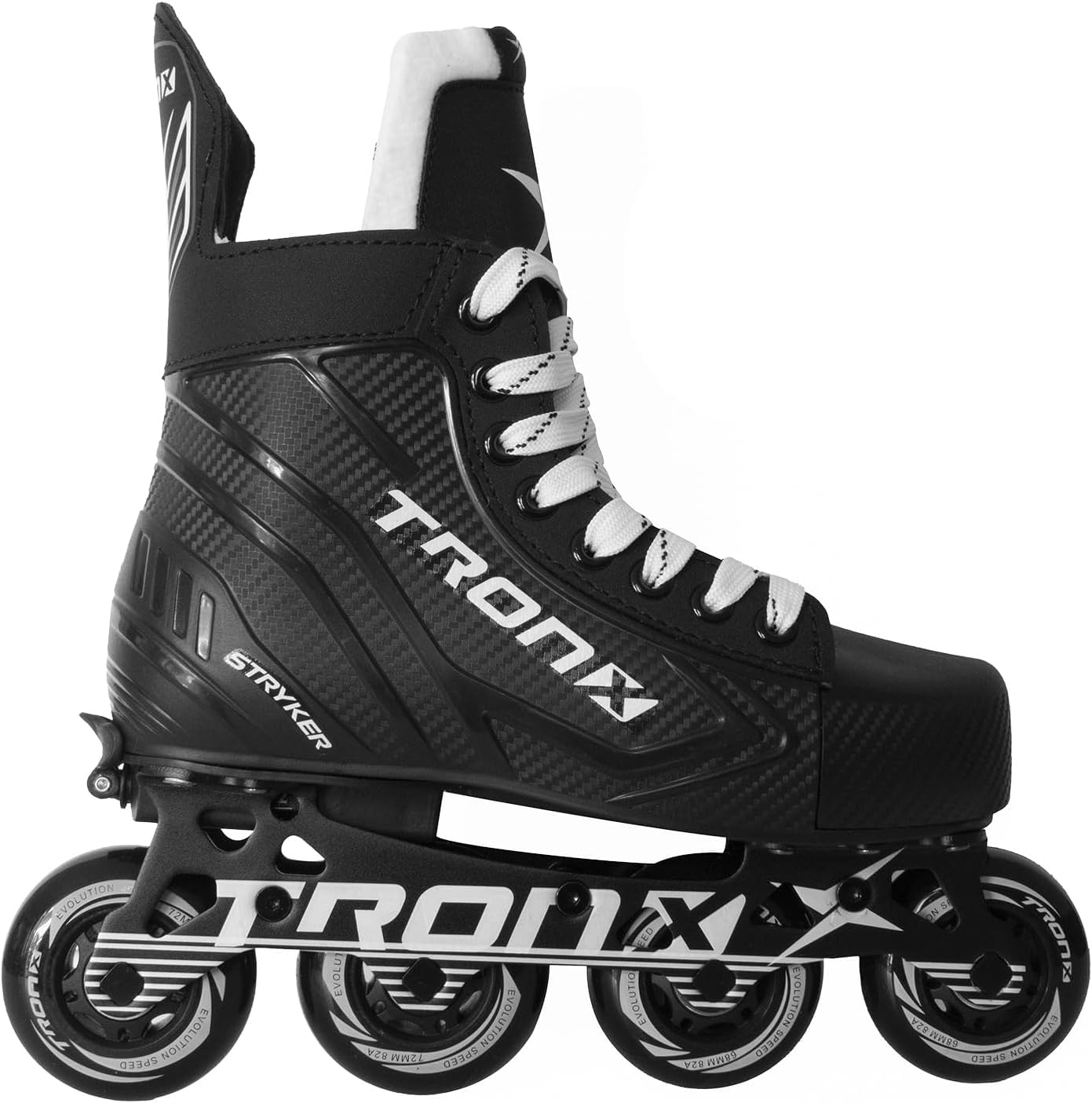
A skate that changes size with a twist — the answer to feet that grow every season.
A skate that only fits this month is a waste of money. The TronX Stryker solves that with digitized sizing printed on the side of the boot and a twist lever that changes the size on the fly. The manufacturer calls the twist lever one of the easiest size-adjustment systems to use, and that lever is why this skate earns a spot here.
Underneath is real hardware for the price. The frame is a Hi-Lo aluminum 6000 CNC chassis held with copper rivets, which sets bigger wheels at the back and smaller wheels at the front — a setup that balances speed with maneuverability as your player strides. The wheels are outdoor-rated 82A, and the bearings are pre-lubed ABEC-9 speed carbon, which is a smooth-rolling bearing grade for recreational skating. The one-piece boot uses an injected comp weave quarter package that gives moderate stiffness with enough flex for a recreational-to-intermediate player working on their stride, and the thick internal foams mean less break-in misery.
Two things to weigh. First, the boot is built for standard-width feet — buyer feedback is mixed on fit, and one direct note flags it as a poor match for wide feet. Second, TronX lists a specific size band in the SR 6–8 option (shoe size 7.5–9.5), so check the sizing chart rather than assuming the adjustable range covers any foot. For a growing roller-hockey player on a standard-width foot, this is the most practical skate on the page.
Adjustable sizing dial
- Twist-lever size adjustment on a digitized boot scale
- Hi-Lo aluminum 6000 CNC frame with copper rivets and bigger rear wheels
- ABEC-9 pre-lubed carbon bearings and outdoor 82A wheels
- One-piece boot with thick internal foams for a comfy first skate
Soft boot support
- Fit draws mixed feedback and wide feet are a poor match for the boot
- The adjustable range is listed per size band, not one-size-fits-all
For the household that is tired of rebuying: a standard-width growing skater in roller hockey who needs a skate to stretch across a season.
Growing kids: your player has wide feet — the standard-width boot is the wrong shape for them.
8. Winnwell Youth Cleansport NXT Hockey Pad and Bag Starter Kit

Shoulder pads, pants, gloves, elbows, shins and the bag — one order, no gap in the kit.
If you are outfitting a child from nothing, this is the box that skips the shopping list. It includes shoulder pads, hockey pants, gloves, elbow pads, shin pads and a storage bag — six items, with the helmet sold separately. Every key area gets coverage, so a beginner can step onto the ice for practice without a single missing pad. The NXT treatment is designed to keep air moving through the pads so they stay fresher between washes.
You size these pads with a real weight-and-age chart instead of guesswork. Small suits ages 4–6 and 40–60 lbs, Medium covers ages 5–8 and 45–65 lbs, and Large is for ages 6–9 and 50–70 lbs. Use weight first and age as the tiebreaker, since two kids the same age can differ by fifteen pounds. Value is the strongest theme in buyer feedback. Parents report the pads hold up through real falls and work much like pricier alternatives. Parents also note it is a good way to get a new skater used to wearing pads before they ever hit the ice.
The obvious gap is the one thing it does not include: a helmet. Budget for the Bauer Prodigy combo or the Lil Sport helmet above and you have a complete head-to-toe kit. The other limit is the size ceiling — Large tops out at age nine and 70 lbs, so this is a starter set for young beginners, not a long-term kit for a growing teen.
New youth players: you are outfitting a four-to-nine-year-old beginner and want every pad plus a bag in a single order.
Heavy checking: no helmet in the box, and the Large size ends at age nine and 70 lbs — older or bigger players need to shop piece by piece.
Know the Specs
Head Circumference And Helmet Sizing
Helmet fit is measured in inches around the widest part of the head, just above the ears. The two Bauer combos here cover overlapping but different windows: 18.8″ to 21″ on the Prodigy and 18.8″ to 20.4″ on the Lil Sport. That overlap is why you measure rather than buy by age — a head inside the shared zone could wear either, and a head above 20.4″ only fits the Prodigy. A helmet that tilts forward or lifts when your player looks up is the wrong size.
Glove Sizing From Fingertip To Forearm
Hockey gloves are sized on one line: from the tip of the longest finger to the midpoint of the forearm. That is the measurement the Franklin listing tells you to take, and it is the same measure that maps onto the VPRO line’s 8″ junior through 15″ span. Gloves that are too long let the fingers float off the stick; too short and the cuff rides up and leaves the wrist open. Take the measurement with a relaxed hand, because tension skews it.
Padded Gear Sized By Weight
Body pads follow weight first, age second. The Winnwell kit spells it out: Small for ages 4–6 and 40–60 lbs, Medium for ages 5–8 and 45–65 lbs, Large for ages 6–9 and 50–70 lbs. That structure exists because kids of the same age vary widely in mass, and pad coverage that fits a light six-year-old will not protect a heavy one. Check the weight first, then confirm the age band lines up.
Adjustable Sizing And Bearings On Skates
An adjustable skate changes shell length with a lever, letting one boot cover a range of foot sizes as a child grows. The TronX Stryker pairs that with a Hi-Lo frame — bigger wheels at the rear, smaller at the front — and ABEC-9 bearings, which is a bearing class rated for smooth, free rolling. A higher ABEC number points to tighter manufacturing tolerances, not to a specific speed, so treat it as a quality marker rather than a promised velocity.
Common Questions
How do I know which youth helmet size to buy?
Can a youth hockey glove be used for both street and ice hockey?
Should I buy a helmet and cage separately or as a combo?
What is included in a youth hockey starter kit?
Are adjustable skates good enough for a serious young player?
How tight should a hockey compression shirt fit?
Is a plastic goalie mask safe for ice hockey?
What age range do the youth pad sizes cover?
Do I need a neck guard shirt or a separate collar?
The Bottom Line
For most families shopping for youth hockey gear, the smart first buy is the Franklin NHL Kids Street Hockey Gloves. They give you full-coverage padding, an 8-ounce build and NHL licensing at a budget-friendly point. That protects a growing player’s hands without stinging on a piece they will outgrow. Starting from a bare driveway? Pair them with the Franklin Folding Goals Set and you have a full game for the price of one pad set. When the driveway turns into a rink, start with the Bauer Prodigy Helmet Combo for head protection. Measure the head first, because that 18.8″ to 21″ window is the one number that decides whether you buy this shell or the Lil Sport above it.
How we choose
We do not accept paid placement. Every pick is matched to a real buyer and a real use-case; we do not hands-on test units.
Sources
Specifications: manufacturer listings and product documentation. Review insights: verified customer reviews, as of November 2026. Pricing: not shown on this page (it changes often); check the current price via the retailer link.
As an Amazon Associate, Tactical Gear Guy earns from qualifying purchases. This does not affect which products we feature.