Specs are compiled from manufacturer listings and verified buyer reviews and can change over time — please confirm the key details on the product page before buying.
Start with a pair of tacky-palm receiver gloves. If your young player drops one more catch because the ball slides off a sweaty palm, the season stops being fun — and grip is the single thing that changes that fastest. Everything else on this page is about adding protection and practice gear around that core purchase, so you are not spending on pads and tees while the hands still slip.
This guide is built by comparing the manufacturers’ published specifications and the patterns across verified customer reviews, so you get each pick’s real strengths and trade-offs instead of marketing spin.
Every pick below is gear a young player will actually put on for practice and game day. Below are nine pieces of youth gear ordered by what earns its place, from sticky-palmed receiver gloves to padded girdles and kicking tees. Each pick is a piece of youth football accessories a young player will actually put on.
Top Picks


How To Choose The Best Youth Football Accessories
Kids’ gear is not just smaller adult gear: a youth glove is cut for a hand that is still growing. It is not. A young receiver’s hand is still growing, so a glove that fits like a second skin this month may be tight by October. Youth sizing has to leave room for growth, so fit decides whether a glove lasts the season.
Gloves: fit beats everything else
A receiver glove works by putting a tacky surface between the hand and the ball. If the glove is loose, the tacky palm slides instead of gripping. If it is too tight, fingers cannot close around the nose of the ball. Look for an adjustable wrist strap (a hook-and-loop closure you tighten) so one pair can be snugged down as a hand grows. A breathable back panel keeps sweat from turning the palm slick during a hot practice.
Base layers and sleeves: the layer under the jersey
Compression tights and arm sleeves are not decoration. They sit between skin and pads, which cuts down on rubbing against seams and keeps muscles warm on a cold morning. The number buyers check most is stretch — a sleeve that only fits one arm size will not survive a growth spurt. Flat seams matter too, because a raised seam under a shoulder pad digs in.
Pads, pants, and practice gear: what actually protects
A padded girdle is compression shorts with foam inserts over the hips, thighs, and tailbone. The foam thickness is the number that matters — thicker means more cushion but less freedom to run. Practice pants with factory-installed pads save you the job of threading pads into pockets before every session, which is the step kids skip when they are rushing out the door.
Team gear: flags and tees
Flag belts are bought in sets because flag football is played in teams. Check the player count in the listing — a 14-player set covers a full 7-on-7 squad with spares. Kicking tees matter for anyone practicing field goals or kickoffs, and the ones worth buying hold the ball at an angle without tipping over on contact.
Side-by-Side Comparison
| Model | Best For | Type | Key Material | Weight / Count | Amazon |
|---|---|---|---|---|---|
| AIGEVTURE Youth Receiver Gloves★ Best Overall | Everyday catching grip | Receiver gloves | Polyester | 0.13 kg | Amazon |
| Pixel Panda Youth Receiver GlovesBest Style | Style plus sticky palm | Receiver gloves | Silicone | 0.11 kg | Amazon |
| Newcotte Kids Arm Sleeves (12 Pairs)Best Team Buy | Team-wide sun and scrape cover | Arm sleeves | 76D milk silk | 12 pairs | Amazon |
| HANDLANDY Youth Receiver Gloves | Lightest pair in the bag | Receiver gloves | Tacky silicone palm, spandex back | 0.04 kg | Amazon |
| Youth Compression Leggings | Cold-morning base layer | Compression tights | Stretch knit | — | Amazon |
| YNSZAS Football Kicking Tee | Field-goal practice | Kicking tee | Silicone, steel arm, aluminum legs | 0.72 kg package | Amazon |
| Rebel 5-Pad Youth Girdle | Hip and tailbone coverage | Padded girdle | Polyester and spandex blend | 10MM EVA pads | Amazon |
| Champro Safety Practice Pants | Fast get-ready practice pants | Practice pants | 100% Polyester Dyno-Stretch | — | Amazon |
| MIUONO Flag Football Belt Set | 7-on-7 flag games | Flag belt set | 100% Nylon, vinyl flags | 14 players, 28 flags | Amazon |
Detailed Reviews
1. Youth Football Gloves
Our pick — 4.5+★ from 800+ verified ratings; the strongest balance of quality and price.
The pair that finally stops the ball from sliding out of a small hand.
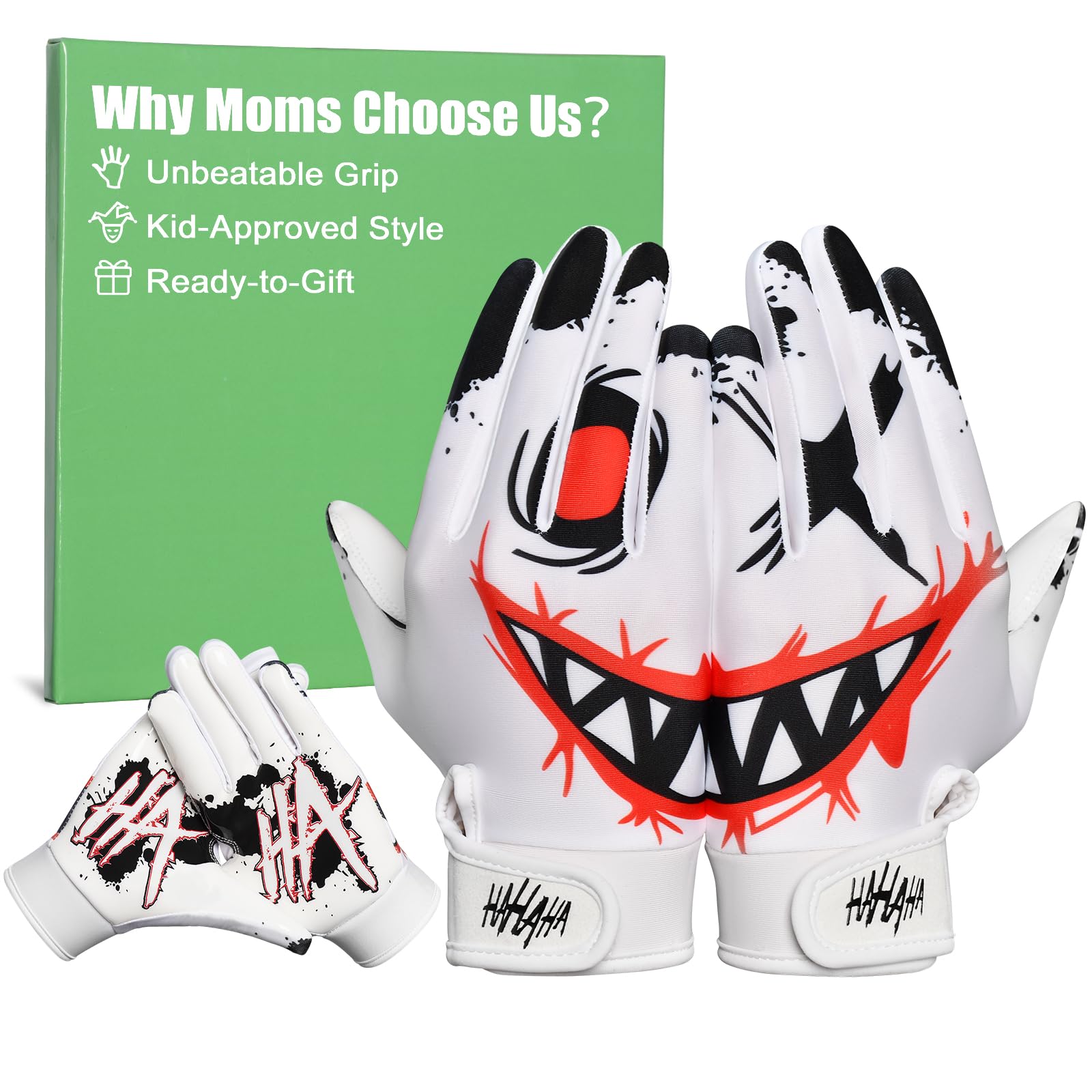
These are receiver gloves built for kids, and the fit is what carries them. The palm uses a tacky adhesive material that bites into the ball surface, so a throw that used to skip off the fingertips now sticks. The back is a textured breathable fabric, which matters on a hot afternoon when a sweaty hand turns a smooth glove into a slip hazard.
They close with an adjustable hook-and-loop wrist strap — that is the fabric strap you press together to tighten, so you can snug the cuff down instead of buying a new pair the moment a hand grows. They are ambidextrous, which means one pair covers either hand and you are not hunting for a left glove in a duffel bag. At 0.13 kg for the pair, they are a real glove with real material in them. Against the HANDLANDY pair at 0.04 kg, these carry noticeably more bulk — the trade-off for a thicker, more padded feel around the hand.
The colorway is a bold super-hero scheme in blue and red, and the colors hold in the wash rather than bleeding into a practice jersey. Fit is what wins people over most here — the sizing lands for little hands where a generic youth size often runs long in the fingers. The honest catch is durability: reinforced stitching is there, but a rough pair can wear at the seams over a season of daily reps. Treat them as game-and-drill gear rather than dirt-and-gravel play gloves, and they hold up fine.
Where these gloves earn their spot
- Tacky adhesive palm keeps the ball from slipping on contact
- Adjustable wrist strap tightens as a hand grows
- Ambidextrous pair works on either hand
- Breathable back panel keeps hands cool and dry
What to go in knowing
- Heavier at 0.13 kg than the lightest pair on this list
- Seams can wear with heavy daily use
- Super-hero colorway will not suit every player
Grab these if: you want the strongest all-around catching glove for a young receiver and fit is your top worry.
Think twice if: your player wants an ultra-light feel and prefers a plainer look.
2. Pixel Panda Youth Football Gloves
Bold cartoon patterns on the back, serious silicone tack on the front.
The palm here is the story. It uses advanced tacky silicone spread across the full palm rather than just the fingertips, which gives a young receiver a big grippy surface for stopping a fast throw. Full-palm coverage matters on a short, quick catch where the ball hits the middle of the hand rather than the fingers.
The build addresses the usual kid-glove weak point with reinforced stitching at the stress points — the spots where a glove pulls apart first. An abrasion-resistant construction is listed too, which is the material’s resistance to rubbing wear. At 0.11 kg for the pair, they sit between the heavier AIGEVTURE pair and the featherlight HANDLANDY set. The wrist strap is adjustable, and the glove is ambidextrous, so either hand works.
Comfort is handled by an ergonomic cut that follows the natural hand contour, plus moisture-wicking fabric that pulls sweat away from the skin. The patterns are the drawcard if you are buying a gift — birthdays and holidays are where this pair makes the most sense, because a kid who likes how the glove looks will actually wear it. The honest limit is that this is silicone-palm protection, not a heavy padded glove, so a player who wants a thick-feeling hand covering should look at the thicker option above.
What the silicone buys you: full-palm tack means the ball sticks even when the catch is sloppy or the throw arrives faster than expected.
The trade-off to weigh: a graphic-heavy glove shows dirt and scuffs faster, so plan on washing these more often than a plain black pair.
Reach for this one: if the player cares about how the gloves look and you want a gift that gets worn on day one.
Look elsewhere when: the priority is a thicker, padded hand feel over the boldest design.
3. Newcotte 12 Pairs Kids Arm Sleeves
Twelve pairs of sleeves in one bag — a whole roster sorted before the first practice.
If you help run a youth team, buying arm sleeves one pair at a time is a losing game. This bundle hands you 12 pairs in six colors — white, light gray, dark gray, royal blue, navy blue, and black — so a coach can hand out sleeves and match a jersey in one go. The fabric is 76D milk silk, a smooth, light knit that slips on easily and reads as cool against the arm rather than heavy.
Check the stretch on any sleeve, because these are built to give. The resting size is roughly 3.35 x 11.81 x 2.36 inches (about 8.5 x 30 x 6 cm). The maximum stretchable size is around 6.69 x 18.9 x 4.33 inches (about 17 x 48 x 11 cm) — a wide range that covers a lot of arm sizes. Durability wins people over most: they come through repeated washing and keep their shape. The colors are plain and the design is simple, which is exactly what a uniform kit wants.
The fit is where you need to read the listing. Some buyers find the sleeves spot on and others report they run small, so the practical move is sizing up if your player sits right at the top of a size bracket. They are listed for cycling, running, hiking, baseball, basketball, and gardening as well as the football field, so a pair that ends up too short for one player still has a job somewhere else in the family.
Why a coach would buy this: 12 pairs and a wash-durable knit mean the sleeve shortage problem disappears for a full season.
The sizing caveat: mixed fit reports mean you should size up at a bracket edge rather than assume the listed size is safe.
Made for: team parents and coaches outfitting a roster who want one purchase to cover everyone.
Not the pick for: a single-player household that only needs one pair in one color.
4. HANDLANDY Youth Football Gloves

Barely-there gloves at 0.04 kg that still stick to the ball.
The weight is the headline. At 0.04 kg this is the lightest glove in the group — against the AIGEVTURE pair at 0.13 kg, it is a much thinner, less padded build. For a young player who finds thick gloves clumsy, that drop in weight is the difference between a glove that feels like a second skin and one that feels like a mitt. The palm is a one-piece tacky silicone design that sticks to the ball surface, giving a kid confidence to reach for a throw rather than flinch.
The back is stretch spandex, a stretchy fabric that lets the hand flex, and it runs across the whole back of the glove for breathability. Double-stitch seams help the glove survive long practices. The hook-and-loop wrist strap (a strap that fastens with a hook-and-loop closure) tightens the cuff while keeping the wrist free to move. A terry cloth wipe on the back of the thumb — a small sweat patch a kid can drag across their forehead between plays — shows the maker has watched a real practice.
The snap button is a genuinely useful touch: clip the gloves together and hang them off a bag so they dry instead of festering in a damp pile. What owners flag most as a limit is the stickiness fading with hard use, and thin gloves do wear faster at the seams. That makes these a great starting glove for a first-season player learning to catch, and a less obvious choice for a player grinding through a full-contact season with no backup pair.
Reasons this stays in the bag
- 0.04 kg is the lightest pair here by a wide margin
- One-piece tacky silicone palm for confident catches
- Terry thumb wipe and snap hang loop
- Spandex back keeps hands cool and flexible
Reasons to buy a spare pair
- Stickiness wears off faster with heavy use
- Thin construction shows seam wear sooner
- Less padding than the heavier options
Best match: a first-time or smaller player who wants a glove that disappears on the hand.
Skip the shortcut: if you need one pair to last a full contact season, buy two of these rather than one.
5. Youth Boys’ Compression Leggings

The quiet layer doing the work under the pads on a cold morning.
Nobody notices compression tights until the morning is cold and the player is standing still on a sideline. These go on under a uniform and give a light, stretchy layer that keeps the legs covered without bulk under pads. The construction points are aimed at comfort under gear: flat seams reduce chafing where the fabric rubs against skin, and a wider elastic waistband keeps the fit snug so the tights do not slide down mid-drill.
Owners value warmth most here, and it comes from a soft stretch material described as light weight and skin friendly — not a thick thermal layer, but enough to take the bite off a morning. They also work as a base layer under football pants and under other sports uniforms on cold days. Durability holds up through washing, and the fit is the strongest signal across the listing.
The catch is sizing. Reports split, with some finding the medium spot on and others reporting they run small, so check the size chart carefully and lean toward the larger size if your player is between two. The waistband stitching is reinforced at the back seam, which is where a cheap pair usually gives out first, so that reinforcement is note if you have had tights split back there before.
The unglamorous job they do well: a warm, chafe-free base layer under pads that stays put through a full session.
Where to be careful: the size chart is the risk point, so measure rather than guess from age.
Good fit for: cold-weather practice and any player who layers under a uniform.
Not what you need if: you are shopping for outer wear that stands alone on the field.
6. Football Kicking Tee

A kicking stand that lets a kid groove the same swing over and over.
Field-goal practice needs repetition, and repetition needs a tee that puts the ball in the same spot at the same angle every time. This stand uses a silicone holder that can be set at different angles, so a young kicker can work a straight-on kick or an angled one. It is built to sit under any ball size, which means the same tee works for a youth ball now and a full-size ball later.
The frame is the reason it lasts: a steel arm, reinforced aluminum legs, and dual connections described as unbreakable, all mounted on a silicone holder. Package weight is 0.72 kg, light enough to carry to a park. It also arrives with a black storage bag and instructions, so it packs down into a gear bag without a screwdriver or a manual hunt. Durability is the second-strongest thing about it after build quality — buyers are getting seasons out of it rather than one practice.
Stability is the honest split. It holds the ball well for most, but a few report it tips over on contact, which is a fair caution for a young kicker who catches the tee as much as the ball. Set it on level ground and it does its job. For a beginner learning a kicking motion, the angle adjustment and the sturdy frame do more for skill-building than a flat spot on the grass ever will.
What it does for a young kicker: consistent ball placement at a chosen angle, so practice actually builds muscle memory instead of bad habits.
The one real caution: it can tip on contact, so a novice may knock it over more than expected — plan for level ground and a patient first session.
Pick this up if: your player is working on field goals or kickoffs and needs a repeatable setup.
Pass on it if: you only ever play flag football and never kick from a tee.
7. Rebel 5-Pad Youth Football Girdle with Cup Pocket
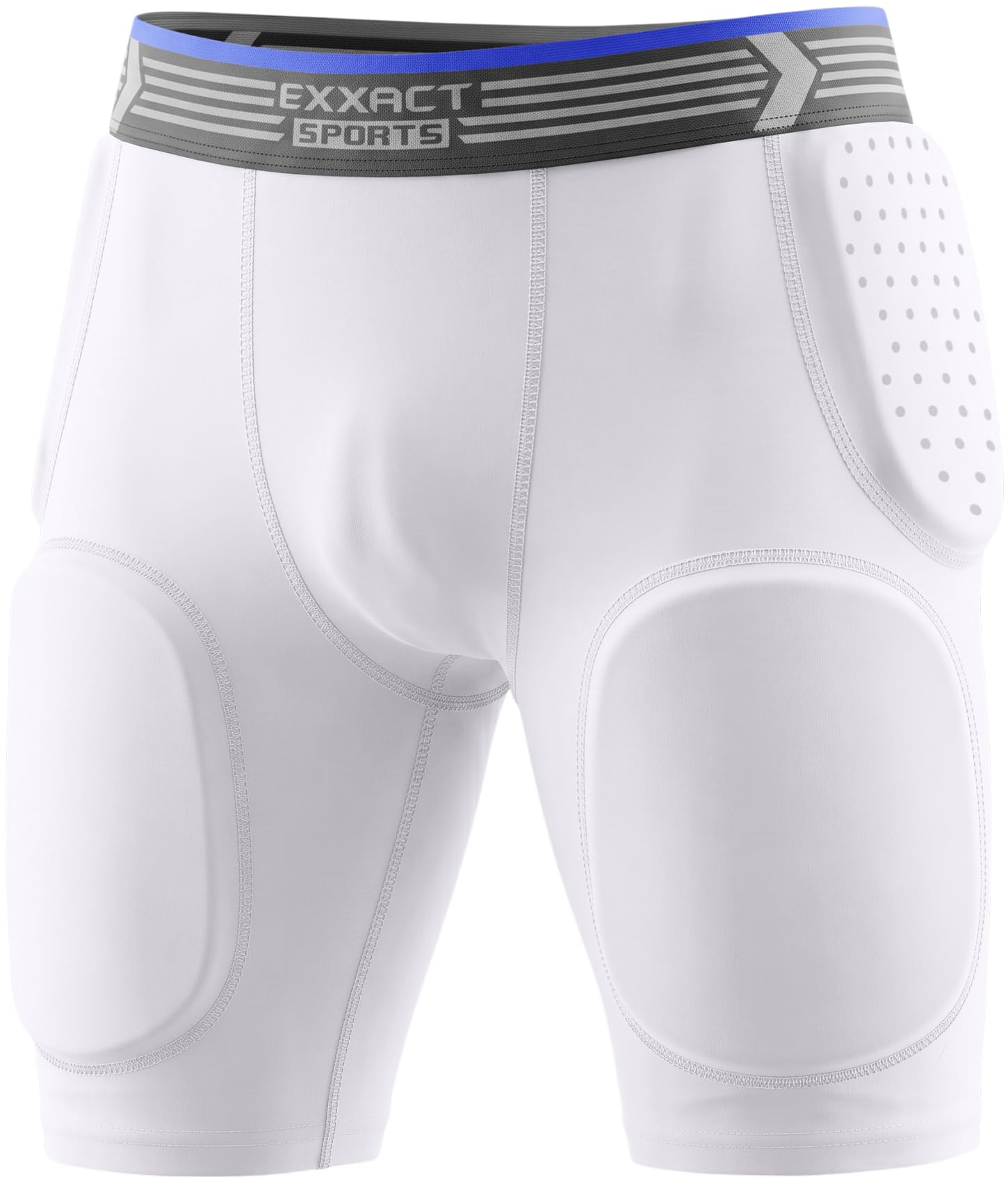
Five pads stitched into compression shorts — hip, thigh, tailbone, done.
This is the piece that turns a pair of compression shorts into real protection. It shields three zones with flexible 10MM EVA pads — that is a 10-millimeter foam insert, thin enough to move in and thick enough to take the sting out of a fall. The pads sit over the hips, the thighs, and the tailbone, and the hip and tailbone pads are perforated, which lets heat out instead of trapping it against the skin.
The thigh pads are contoured and semi-rigid, so they hold their shape against a hit rather than flattening. The fabric is a polyester and spandex blend with 4-way stretch, meaning it stretches in both directions and lets a player sprint, cut, and jump without the shorts fighting them. It pulls on like underwear and stays put with a soft elastic lining, so there is no adjusting mid-play. The built-in cup pocket is a practical detail that saves buying a separate holder.
The low-profile design is meant to sit under game pants, so it disappears under a uniform. Fit is the strongest point across the listing, and the protection reads well for goal-line and ground-contact situations. The catch is that sizing is genuinely split — some find it true to size, some find it too big — and durability is a mixed picture with a few reporting a rip. Your best move is to follow the size chart exactly and treat the girdle as a protective layer rather than something to wrestle in.
What makes it worth pulling on
- Five pads cover hips, thighs, and tailbone
- 10MM EVA foam stays flexible while it cushions
- Built-in cup pocket saves a separate purchase
- 4-way stretch fabric moves without restriction
Where it needs attention
- Sizing reports split between true-to-size and too big
- A few note rips with hard use
- Low-profile pads suit contact, not heavy collision
The right call for: a player heading into contact drills who needs hip and tailbone coverage under pads.
Check the chart first if: your player is between sizes, because the fit reports genuinely disagree.
8. Champro Boys’ Safety Integrated Boys Football Practice Pants

Pads already sewn in, so nobody is stuffing pockets ten minutes before practice.
The problem with most practice pants is the pad pocket. Pads slide, bunch, and get left at home. These come with factory-installed pads already sewn in, which removes the whole assembly step — the player pulls them on and is ready. The fabric is 100% polyester Dyno-Stretch double-knit, a stretch fabric built to flex with a running, crouching player rather than bind at the knee.
A built-in full-length covered web belt handles the waist without a separate belt to find in a drawer, which is the kind of detail that matters on a rushed morning. The size range is wide: adult sizes S through 3XL and youth sizes XXS through 2XL, plus a husky fit, in black or white. That breadth means a growing player and a coach buying for the whole roster can both order from the same listing.
Comfort and easy cleaning are the standout qualities — dirt lifts out in the wash rather than staining in, which matters when practice pants get grass-stained three times a week. They suit young players who need a durable practice layer and hold good value. The trade-off is that integrated pads are fixed, so the coverage is set where the factory puts it — fine for practice, less flexible than a girdle if you want to fine-tune pad placement.
The time it saves: no pad insertion before practice means a player is dressed and out the door faster.
The flexibility you give up: fixed pads cannot be repositioned or swapped, so a player who wants custom pad placement should pair a girdle with plain pants instead.
Built for: practice days when speed and simplicity beat customization.
Not the pick for: a player who wants to move pads around or adjust coverage.
9. MIUONO Flag Football Belts 14-Player Set

A full 7-on-7 squad in a box, flags and belts together.
Flag football lives or dies on the belt. This set covers 14 players — enough for two 7-on-7 squads or one squad plus spares — with 28 flags in bright red and yellow that are easy to spot against grass and turf. The belts are 100% nylon, adjustable, and 1.5 inches wide, so they sit snug on an adult waist and tighten down for a kid without feeling like a strap cutting in.
A plastic side-release snap buckle clicks closed and holds through cuts and quick breaks instead of popping open. That matters because a belt that falls off ends the play, and a side-release buckle keeps it on until the flag is pulled. The flags are reinforced vinyl — a tough, flexible plastic — attached with hook and loop (a fastening that grips when pressed together), so grabbing a flag takes light contact rather than a hard yank, and the belt stays on when the flag comes off.
Quality is the thing people like most, and the fit is reported as friendly across sizes. The honest caveat is durability on heavy use: the belts hold up for casual games but a few have reported them coming apart after a stretch of weeks of repeated play. For backyard games, PE class, and a weekly youth league, that is a fair trade for a set that outfits a whole squad. If you are running constant daily games, plan on these being a replaceable consumable rather than lifetime gear.
Why it works for a league: 28 flags, 14 adjustable belts, and a side-release buckle that holds through the whole play.
Where it wears thin: repeated hard play over weeks can wear the belts out, so treat the set as league gear rather than indestructible equipment.
Buy it if: you need to outfit two flag teams at once with matching red and yellow flags.
Think again if: you are buying for daily heavy play and expect years out of every belt.
Know the Specs
Grip and palm material
The palm is where a receiver glove earns its keep. A tacky silicone or adhesive palm creates a high-friction surface so the ball sticks on contact instead of glancing off. Full-palm coverage grips on short catches; fingertip-only tack suits a player with reliable hands already. A breathable back panel matters just as much — a hot hand produces sweat, and sweat turns a tacky palm slick, so airflow is what keeps the grip alive late in a practice.
Weight and fit
Glove weight tells you how thick the padding is. A lighter glove (in the 0.04 kg range) feels like a second skin and suits a young player who finds thick gloves clumsy. A heavier pair (closer to 0.13 kg) gives more material around the hand but can dull the feel. An adjustable hook-and-loop wrist strap lets you tighten the cuff as a hand grows, so one pair can carry a player through a growth spurt.
Pad thickness in a girdle
Padded girdles are measured by their foam inserts, and 10MM EVA is a low-profile pad — that is 10 millimeters of foam, thin enough to keep a player mobile and thick enough to cushion a fall. Perforated pads let heat escape. The coverage zones matter more than raw thickness: hip, thigh, and tailbone coverage is what keeps a player comfortable going to the ground, while a built-in cup pocket saves buying a separate holder.
Stretch fabric and sleeve sizing
Compression gear only works if the fabric stretches with the body. Four-way stretch means the fabric gives in both directions, so a player can sprint and cut without the material binding. Arm sleeves are sold with a resting size and a maximum stretchable size — that range, not the small number alone, is what tells you how many kids one pair can cover. Flat seams reduce chafing where fabric sits under a pad or a jersey.
Common Questions
How do I size youth receiver gloves when my kid is between sizes?
What is the difference between sticky silicone and adhesive tacky gloves?
Do youth football gloves help with catching for beginners?
How long do youth football gloves typically last?
Should my child wear a padded girdle under football pants?
Are integrated-pad practice pants better than separate pads?
How many flags come in a typical youth flag football set?
Do arm sleeves and compression tights help under football pads?
Should I buy a kicking tee for a young player learning field goals?
Can one set of arm sleeves fit multiple kids on a team?
The Bottom Line
For most families, the youth football accessories start with the gloves, and the pick that fits the widest range of young hands is the AIGEVTURE Youth Receiver Gloves — its tacky adhesive palm, adjustable wrist strap, and breathable back give a new receiver a real shot at a clean catch. If your player finds thick gloves clumsy, the HANDLANDY Youth Receiver Gloves at 0.04 kg are the lighter-feeling route to the same grip. For the layer that protects under pads, the Rebel 5-Pad Youth Girdle covers hips, thighs, and tailbone with 10MM EVA pads (foam pads that cushion impact) that keep a player mobile. Start with the gloves, then add the girdle and kicking tee as contact drills and field-goal practice arrive.
How we choose
We do not accept paid placement. Every pick is matched to a real buyer and a real use-case; we do not hands-on test units.
Sources
Specifications: manufacturer listings and product documentation. Review insights: verified customer reviews, as of November 2026. Pricing: not shown on this page (it changes often); check the current price via the retailer link.
As an Amazon Associate, Tactical Gear Guy earns from qualifying purchases. This does not affect which products we feature.