Specs are compiled from manufacturer listings and verified buyer reviews and can change over time — please confirm the key details on the product page before buying.
Buying a youth dirt bike is really a sizing decision, not an engine decision. A bike that is too tall gets dropped at the first stop, and a bike that is too small gets outgrown inside one season. So the first thing to check on any listing is seat height and wheel size, because those two numbers decide whether your rider can plant a foot and control the machine. This guide walks through five gas pit bikes that actually fit younger riders, from a 110cc automatic starter bike up to a full 125cc four-speed.
This guide is built by comparing the manufacturers’ published specifications and the patterns across verified customer reviews, so you get each pick’s real strengths and trade-offs instead of marketing spin.
Below you will find out which displacement suits which rider, how seat height and ground clearance change what a bike can handle, and where assembly and parts support really matter. Here is the honest breakdown of the best youth dirt bike for a first-time rider and a growing one.
Top Picks

How To Choose The Best Youth Dirt Bike
Start with the rider, not the spec sheet. Measure your child’s inseam, then look for a seat height they can reach with both feet nearly flat on the ground while sitting. A rider who cannot dab a foot at a standstill will be nervous every time the bike stops, and nerves are what cause tipped-over bikes in the driveway.
Seat height and wheel size decide the fit
Seat height is the distance from the ground to the top of the saddle, and it is the single number that tells you whether a bike is a youth machine or an adult one. Wheel size works alongside it: a 14-inch front and 12-inch rear wheel rolls over roots and ruts better than a small 10-inch setup, and it also raises the whole bike. If your rider is between sizes, a taller-wheeled 110cc often lasts two seasons longer than a compact 10-inch pit bike.
Transmission type changes the learning curve
An automatic transmission means twist the throttle and go, with no clutch and no shifting. A semi-automatic keeps a foot shifter but removes the hand clutch, which lets a rider learn gear changes without stalling. A full manual with a hand clutch is the last step, and it suits a rider who already understands throttle control. Match the transmission to the rider’s experience, because a manual clutch on a nervous beginner is the fastest route to a parked bike.
Engine size, clearance, and where you will ride
A 110cc four-stroke engine is the common youth size, and a 125cc gives more pull for a heavier or more experienced rider. Ground clearance is how much air sits under the frame, and more of it means you can cross ruts and rocks without banging the engine case. Four-stroke engines are the norm here because they run on pump gas and need less fuss than a two-stroke. Also confirm the bike is legal to sell in your state before you order.
Side-by-Side Comparison
| Model | Best For | Engine / Transmission | Seat Height | Wheels (Front/Rear) | Amazon |
|---|---|---|---|---|---|
| X-PRO Storm 125cc★ Best Overall | Older kids ready for a manual clutch | 125cc Zongshen / 4-speed manual | — | 14″ / 12″ | Amazon |
| X-PRO 110cc Semi-AutoEasiest First Ride | Graduating riders who need room to grow | 110cc / semi-automatic | — | 14″ / 12″ | Amazon |
| HHH DB X18 125CC | Big teens and adults who want top speed | 125cc / 4-speed manual | 33 inches | 17″ / 14″ | Amazon |
Detailed Reviews
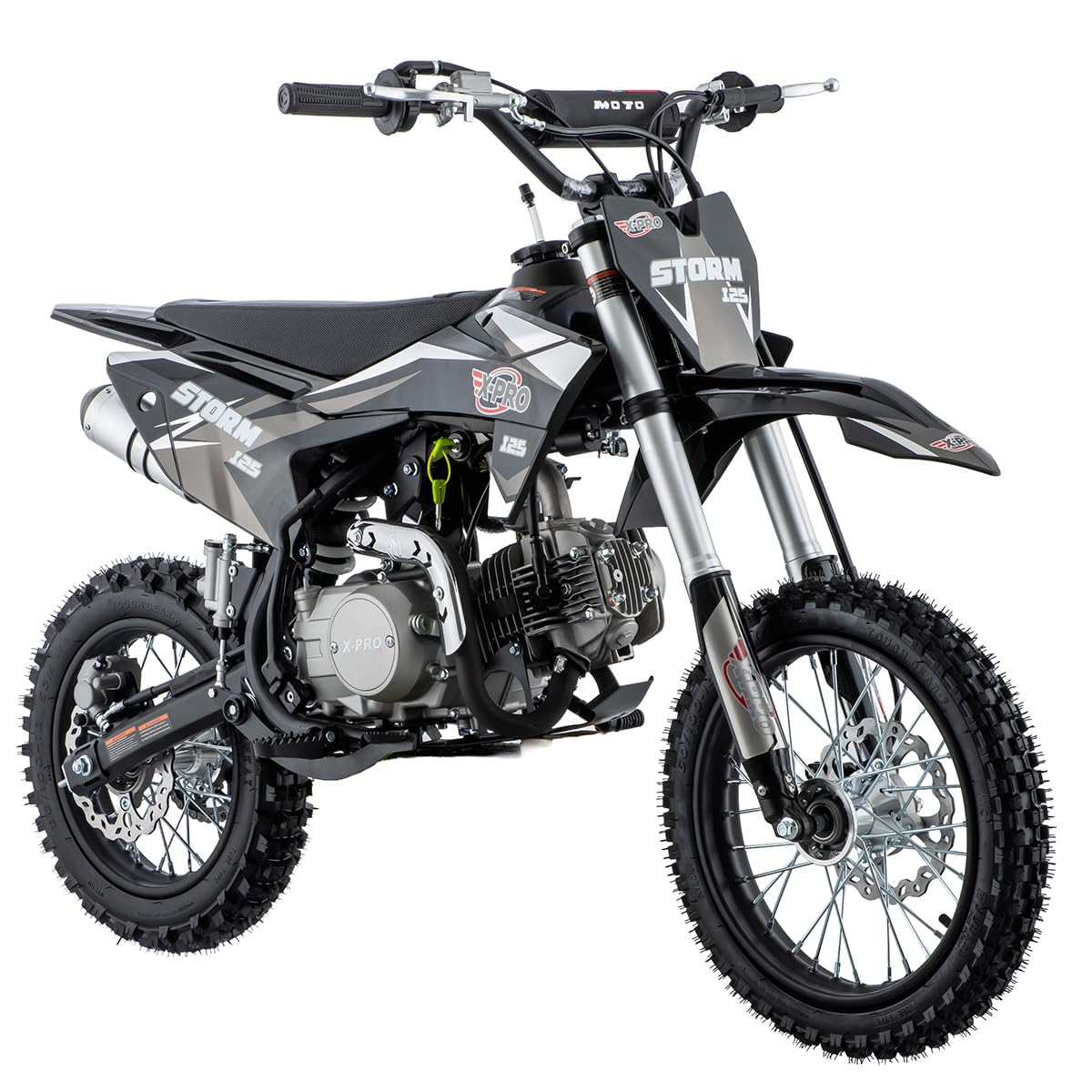
1. X-PRO Storm 125cc Zongshen Engine Kids Dirt Bike
Our pick — 4.0+★ from 100+ verified ratings; the strongest balance of quality and price.
The one that hands your rider a real clutch without handing over a full-size bike.
The Storm is the pick here for a rider who has already logged time on a smaller machine and is ready to learn clutch work. It runs a 125cc Zongshen engine, which is the larger of the two displacements on this list and the one that carries a heavier rider up a hill without bogging. The 14-inch front and 12-inch rear wheels roll over loose gravel and roots rather than skittering across them. It arrives in a steel frame built to take the bouncing that comes with frequent acceleration and braking on uneven ground.
What wins people over is the build quality, and that is the aspect it earns the most praise for. Buyers consistently describe it as a good kid-sized machine that feels worth the money. The honest catch is reliability, and it is the fairest way to describe it: feedback on long-term dependability is genuinely mixed, with some owners reporting components coming loose or failing over time. Budget for routine bolt checks and basic four-stroke upkeep rather than treating it as a ride-and-forget purchase.
Plan for a Saturday of assembly. The handlebar brackets, wheels, brakes, number plate, and fender all need fitting, and the box includes a manual and a tool kit to get you through it. At 255 pounds the bike is heavy enough that two adults make the crate-to-rollers job easier. One more practical note before you order: this model cannot be sold to California, so check your state’s rules first. It is the strongest all-around pick on this list because it balances a proven engine brand, real manual shifting, and big wheels in one machine.
Where the Storm earns its spot
- 125cc Zongshen engine gives more pull than the 110cc bikes here
- 4-speed manual transmission teaches real clutch control
- 14-inch front and 12-inch rear wheels handle rough ground
- Strong steel cradle frame built for hard acceleration and braking
What to weigh before buying
- Reliability feedback is mixed, so routine bolt checks are part of ownership
- 255 pounds is a two-person job to move around
- Cannot be sold to California
Reach for this one if: your rider has outgrown an automatic and wants to learn a clutch on big wheels.
Pass it by if: you want zero-shift simplicity or you live in California.
2. X-PRO Ember 110 Dirt Bike with Automatic Transmission
Big wheels on a small engine — the setup that buys your rider extra seasons.
Here is the smart compromise a lot of parents miss: keep the manageable 110cc engine but step up to the 14-inch front and 12-inch rear wheels. Compared with the Ember’s 10-inch setup, those wheels are meaningfully larger, and they lift the whole bike — which is exactly what gives a growing rider more room before they outgrow it. The manufacturer says the taller 14/12 wheel setup and extra ground clearance are what stretch the usable sizing window by roughly two years. That is the whole pitch, and it holds up.
The semi-automatic transmission is the other reason this one makes sense for a rider in transition. There is a foot shifter to learn gear changes, but no hand clutch to juggle, so a kid practices shifting without the stall-and-tip cycle that a manual clutch brings. The cradle steel tube frame is built to shrug off the jolts of repeated acceleration and braking, and the listing even notes the frame design makes bigger jumps easier to absorb.
Buyer reaction backs up the spec sheet here — the bike is consistently described as better than expected and a genuinely good starter machine, with value called out as the second strong point. Two things to know. Assembly is required for the handlebar brackets, wheels, brakes, number plate, and fender, so budget the time. And like its X-PRO siblings, this bike cannot be sold to California. The listing also points out it fits adults and big boys, so if your rider is already tall, check that fit before assuming youth sizing applies.
Why parents pick this configuration
- 14-inch front and 12-inch rear wheels extend the usable sizing window
- Semi-automatic teaches shifting without a hand clutch
- More ground clearance than a compact 10-inch pit bike
- Cradle steel frame built for jump and braking loads
Worth knowing up front
- Assembly is required before the first ride
- Cannot be sold to California
- Sized generously enough that tall riders should verify fit
The value read: the longest useful lifespan of any 110cc here, because the 14-inch front and 12-inch rear wheels delay the day your rider outgrows it.
The one caveat: it arrives as a crate, so the first afternoon belongs to assembly, not riding.
3. HHH DB X18 125CC Apollo RFZ Racing Dirt Bike

The grown-up end of the youth category — 55 mph and a 33-inch seat.
The DB X18 is the biggest and quickest machine in this group, and that is precisely why it belongs at the end of the list rather than the start. Its top speed is 55 mph, against the 30 mph of the compact 110cc pit bike, and it runs a 4-speed manual transmission with a hand clutch. The 17-inch front and 14-inch rear wheels are the largest here, and they sit under a heavy-duty twin spar steel frame. Ground clearance is 13.5 inches, so it clears obstacles that would stop a lower bike.
That combination of a 33-inch seat, 13.5 inches of clearance, and big wheels means this is really a youth-and-adult crossover rather than a pure kids’ bike. A rider who is not yet tall enough for a 33-inch saddle should stay with the lower DB14 or the big-wheeled 110cc. For a teen who has hit a growth spurt, though, this is the bike that will not need replacing next spring.
The suspension does the real work on trail: telescopic front forks and a mono-shock rear soak up obstacles, and the bike stays light enough for a newer rider to manage. Quality is what it earns the most praise for, and the assembly process draws positive feedback too — the bike arrives 70% assembled, and buyers report it going together readily. Running nicely and being great fun to ride come up again and again. The one honest caution is durability, where a share of feedback describes problems appearing early. Treat it as a machine that rewards regular checks rather than one you ignore between rides.
The case for the big bike
- 55 mph top speed, the quickest here
- 17-inch front and 14-inch rear wheels, the largest on the list
- 13.5 inches of ground clearance for rocky trails
- Heavy-duty twin spar frame with telescopic forks and mono-shock rear
The honest limits
- 33-inch seat height is tall for smaller youth riders
- Durability feedback includes early problems for some owners
- Manual clutch demands a rider who already has throttle control
Pick it for: the tall teen or adult-sized rider who wants maximum speed, clearance, and wheel size.
Leave it for later if: your rider cannot comfortably reach a 33-inch seat with both feet.
Know the Specs
Displacement and Transmission
Displacement, measured in cc, is the engine’s size, and 110cc is the standard youth figure while 125cc adds pull for heavier riders. The transmission type matters just as much as the number: automatic means no shifting, semi-automatic adds a foot shifter without a hand clutch, and manual gives full control. Match the transmission to experience: automatic for a first ride, semi-automatic to learn shifting, manual only once throttle control is solid.
Seat Height and Ground Clearance
Seat height is the distance from ground to saddle, and it decides whether a rider can plant a foot at a stop. Ground clearance is the air gap under the frame, and more of it means you can cross ruts without scraping the engine. A 28-inch seat with 11.40 inches of clearance suits a younger trail rider, while a 33-inch seat with 13.5 inches fits a taller teen.
Common Questions
What seat height should I look for in a youth dirt bike?
Is an automatic dirt bike better for a beginner than a manual?
What is the difference between a 110cc and a 125cc youth dirt bike?
Can I buy a youth dirt bike in California?
How much assembly does a crate-shipped dirt bike need?
Do youth dirt bikes have disc brakes or drum brakes?
Is a kick start or an electric start better for a young rider?
How much ground clearance do I need on trails?
Do bigger wheels really help a youth dirt bike last longer?
What maintenance should I expect on a gas youth dirt bike?
The Bottom Line
The best youth dirt bike for most families is the X-PRO Storm 125cc, because it pairs the largest engine here with genuine 4-speed manual shifting and 14/12 wheels — the full step up from an automatic. Its 4-speed manual with a hand clutch is the step that turns a rider who twists a throttle into one who shifts. If your priority is room to grow rather than raw displacement, the X-PRO 110cc semi-automatic is the smarter buy, with the same big wheels and a shifter that skips the clutch. And for a tall teen chasing speed and clearance, the HHH DB X18 125cc delivers 55 mph and 13.5 inches of clearance. Measure your rider’s inseam and pick the seat height they can dab a foot from, then choose the engine and transmission.
How we choose
We do not accept paid placement. Every pick is matched to a real buyer and a real use-case; we do not hands-on test units.
Sources
Specifications: manufacturer listings and product documentation. Review insights: verified customer reviews, as of November 2026. Pricing: not shown on this page (it changes often); check the current price via the retailer link.
As an Amazon Associate, Tactical Gear Guy earns from qualifying purchases. This does not affect which products we feature.