Specs are compiled from manufacturer listings and verified buyer reviews and can change over time — please confirm the key details on the product page before buying.
If you are shopping for a young catcher, the short answer is this: buy a mitt that arrives nearly game-ready and fits a smaller hand, because a stiff adult mitt will fight a kid all season. The Rawlings Renegade stands out as the easiest place to start, and the rest of this list covers the fastpitch catchers, travel-ball upgrades and beginner bargains that sit either side of it. Below you get real sizes, weight, break-in levels and the honest gripes that come with each one — plainly explained, no jargon.
This guide is built by comparing the manufacturers’ published specifications and the patterns across verified customer reviews, so you get each pick’s real strengths and trade-offs instead of marketing spin.
A youth catcher’s mitt has to cushion a still-growing hand, close with one squeeze and survive more than one season. Sizing, padding and break-in effort decide all three, and this comparison covers every one of those details on the best youth catching mitt.
Top Picks


How To Choose The Best Youth Catching Mitt
Start with the hand, not the brand. A youth catcher’s mitt is worn on the non-throwing hand, so a right-handed kid needs a “right hand throw” mitt that slides onto the left hand. Get the throw hand wrong and the mitt is unusable, no matter how good the leather is.
Get the glove size right for the age
Youth catcher’s mitts typically land between 32 and 33 inches around the circumference of the glove. A 32-inch or 32.5-inch shell is the common youth size, while a 33-inch mitt is roomier and often sized for older or adult hands. A 33-inch shell on a small hand leaves the fingers short of the pocket, so the mitt won’t close. A shell that’s too small gives a shallow pocket, and hard pitches pop out of it.
Understand break-in before you buy
Break-in is how much work it takes to soften a leather mitt into a shape that closes cleanly. “Ready-to-play” or “80% factory broken-in” means the mitt is mostly soft when it arrives, so a young player can use it in a game within days. A “stiff” mitt needs real work with a mallet or repeated catch play. For a kid still building grip strength, an 80–90% factory break-in beats a stiff pro-style shell every time.
Weigh palm padding against feel
Palm padding is the cushioning behind the catch surface that soaks up the sting of a fast pitch. Thick palm padding spares a young hand the sting, but it dulls the feel a catcher needs to frame a pitch. Cushioned palm pads and index finger pads are the two spots worth checking on any youth mitt.
Web type and wrist straps
A solid or closed web hides the ball from the hitter, which is why most catcher’s mitts use one. Wrist straps and elastic quick-fit systems keep the mitt locked to a smaller hand, so look for something adjustable rather than a fixed opening. For fastpitch players, a female-specific pattern with a narrower fit is worth seeking out.
Side-by-Side Comparison
| Model | Best For | Size | Break-In | Weight | Amazon |
|---|---|---|---|---|---|
| Rawlings Renegade Youth★ Best Overall | First mitt on a tight budget | 32 1/2″ | 90% factory | 16 oz | Amazon |
| HolyElks 33″ Catcher’s MittBudget Starter | Rec and slowpitch on a budget | 33″ | 80% factory | 1.1 lb | Amazon |
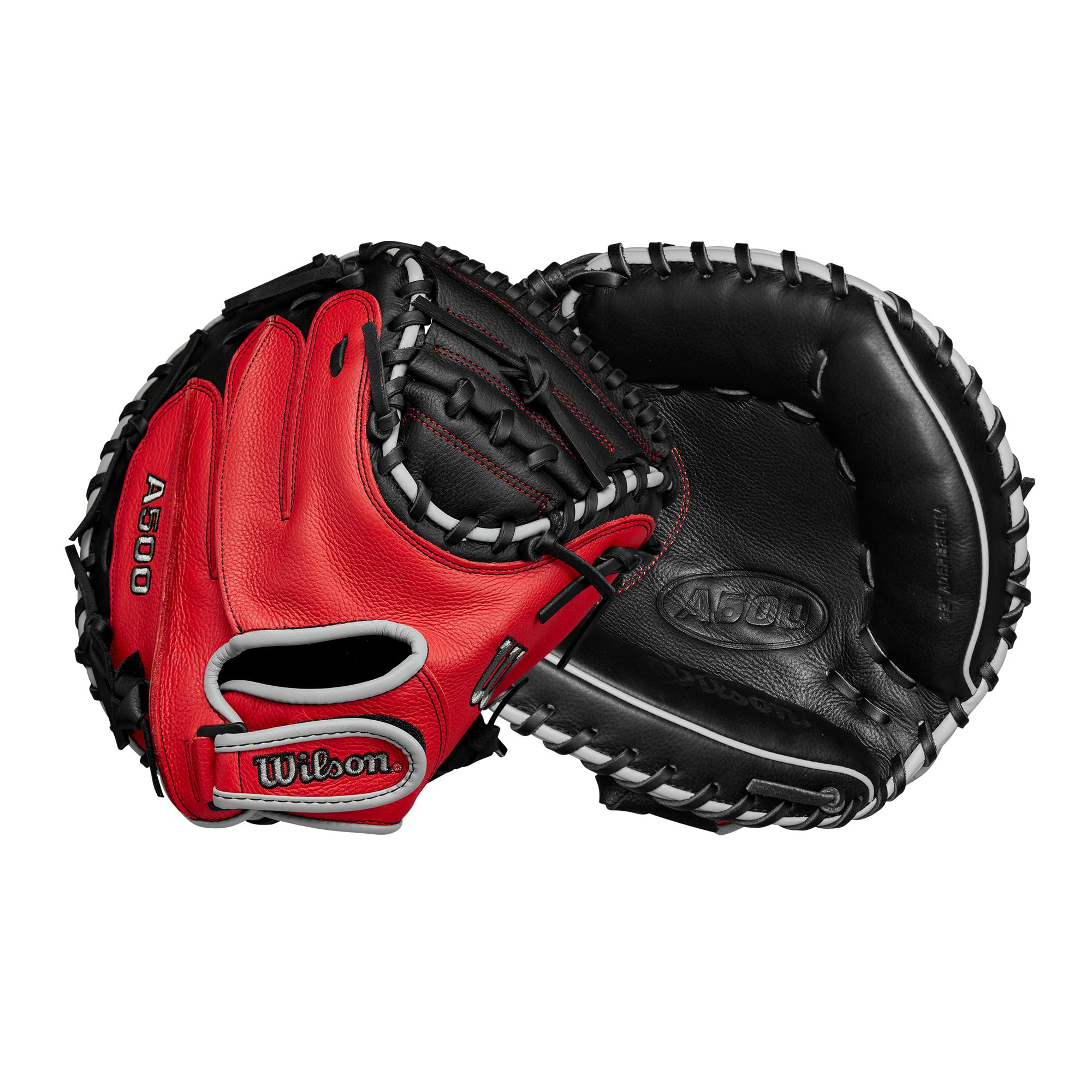
| Wilson A500 Catcher’s MittTop Grain Pick | Light mitt with a real leather shell | 32″ | Ready-to-Play | 1.3 lb | Amazon |
| Mizuno Prospect PowerClose | Small hands that need easy closing | Youth | Soft | 16 oz | Amazon |
| Rawlings Select Pro Lite | Fast break-in for competitive kids | 32″ | 20% player break-in | — | Amazon |
| All-Star Future Star | Fastpitch softball catchers | 32.5″ | Ready-to-Play | 1.2 lb | Amazon |
| Wilson A500 Siren | Fastpitch players wanting top grain leather | 32″ | Stiff | 1.4 lb | Amazon |
| All-Star The Focus Framer | Training reps and framing drills | 27″ | — | 1.3 lb | Amazon |
| Rawlings NXT Youth | Travel-ball catchers with smaller hands | 32.5″ | Ready-to-Play | — | Amazon |
Detailed Reviews
1. Rawlings Renegade Youth Baseball Glove
Our pick — 4.5+★ from 900+ verified ratings; the strongest balance of quality and price.
A 32 1/2-inch youth catcher’s mitt that shows up almost ready to catch.
The Renegade is the pick that gives you the least to worry about on day one. It arrives 90% factory broken-in with just 10% left for the player, so a young catcher can take it straight into a practice and start receiving pitches. The shell is a leather palm with a cushioned palm and index finger pads — the padding that sits behind the catch surface to soak up the sting of a hard throw.
Rawlings calls it ready-to-play, and the leather quality is what carries this mitt. The thing that wins people over is the overall build for the money: a solid 1-piece web hides the ball from the hitter, and the synthetic leather lining keeps it comfortable against the hand. At 16 ounces it has enough heft to feel stable behind the plate without dragging a kid’s arm down.
Here is the honest catch. Laces have been a mixed story on this mitt, with some owners seeing them break inside six months while others report no trouble at all. Fit opinions split too — it suits big and small hands alike, and plenty of 12-year-olds wear it well, but a very small catcher may find the shell roomy. Treat the laces as something to check each month and this mitt rewards you for years.
Why catchers keep coming back
- 90% factory break-in means game use in days, not weeks
- Real leather shell palm holds its shape through a season
- Cushioned palm and index finger pads soften hard pitches
- Fits both bigger and smaller hands, so it grows with a young player
The honest trade-offs
- Lace durability is inconsistent — check the lacing each month
- A genuinely tiny catcher may find the shell on the roomy side
Go with it if: you want one mitt that gets a young catcher behind the plate this week without a long break-in project.
Think twice if: your player is at the very small end of the youth range and needs the tightest possible hand fit.
2. 33″ Baseball Catcher’s Mitt
A big 33-inch shell for rec ball and slowpitch when the budget is the deciding factor.
The headline here is the size: a 33-inch circumference mitt, which is the roomiest shell on this list and the one that suits older or adult hands alongside youth players. It arrives 80% broken-in from the factory, so the bulk of the softening is already done and a kid can start catching right away. It weighs 1.1 pounds — the lightest full mitt here, noticeably lighter than the Wilson A500 at 1.3 pounds.
Padding is generous. Advanced palm padding engineered to absorb impact is the reason this one appeals to a parent worried about a young hand stinging on a bad pitch. The adjustable wrist strap and a plush hand guard cinch the fit down, and the classic 1-piece solid web keeps the ball hidden and the pocket stable.
The catch is the material, and it is a real one. The glove is built from faux leather with a synthetic lining, not real leather, and several buyers have called that out. Quality opinions divide — some find it perfectly good for rec play, others find it short of their expectations. If you want a genuine leather mitt that will hold shape for seasons, spend a tier more; if you need a dependable spare for practice reps and slowpitch, the 33-inch shell does the job.
What you are paying for: a large catch surface and impact padding at the entry level, which is exactly what a beginner or casual rec player needs.
What to accept: the faux leather build means the shape will soften faster than a real leather shell over time.
Best fit: a rec-league or slowpitch player who wants a big padded mitt for practice without spending much.
Look elsewhere if: you need a true leather glove that keeps its pocket over multiple seasons.
3. Wilson A500 Youth Baseball Catcher’s Mitt
Top grain leather and a 32-inch shell built to keep its pocket season after season.
Wilson builds this one for a player who is done with starter gear. The shell is top grain leather — the outer layer of the hide, which is the part that holds its structure — so the mitt should keep its shape rather than going floppy. Rolled dual welting runs through the finger backs to reinforce that structure, which is the engineering behind a pocket that stays consistent through countless catches.
It arrives ready-to-play, so there is no long break-in project. The Quick Fit wrist system is an elastic cinch that hugs the hand, and that matters for a young catcher who needs the mitt locked on through dives and tags. The two-piece closed web keeps the ball hidden from the hitter, and traditional rolled finger binding smooths the edges so there is less rubbing on young fingers.
Compare it directly to the Renegade: this mitt is 1.3 pounds against the Renegade’s 16 ounces, so it carries a little more weight in exchange for that top grain shell. Size is a 32-inch youth shell, tighter than the 33-inch HolyElks. It is the mid-range middle ground — real leather construction and a youth-tuned fit for a player who plans to keep catching.
Where it earns its place: top grain leather plus rolled dual welting means the pocket should hold shape for seasons, not one summer.
Where it asks more: at 1.3 pounds it has more heft than the lightest mitt here, and the 32-inch shell is not built for adult-sized hands.
Pick this one for: a young catcher who already plays regularly and needs a genuine leather mitt that keeps its form.
Pass if: you need a large 33-inch shell or you are shopping strictly to a starter budget.
4. Mizuno Prospect PowerClose Youth Baseball Glove

A soft, kid-friendly mitt with a V-Flex notch that lets small hands squeeze the pocket shut.
For a young catcher still building hand strength, closing the mitt is the whole ball game, and this is the pick built for it. The PowerClose design uses a V-Flex notch — a flex point built into the glove so it folds more easily — paired with Bio Soft leather that arrives soft rather than stiff. It is rated the softest break-in level on this list.
There is real protective thought in the build too. A Parashock palm pad sits behind the catch surface to cushion impact, and a buttersoft palm liner keeps the inside comfortable. The glove is stitched with professional-level lace, the same durable cord Mizuno uses on its pro models, so the webbing should hold. Young catchers can catch from the start with it, which is the whole point of a soft glove.
The one point of contention is fit. Some owners find it perfect and others find it too small, which is usually less about the glove and more about matching it to the right age. It weighs 16 ounces and comes in a left hand throw version, so check your throw orientation before you order. For a first- or second-year catcher with small hands, though, the easy squeeze is a genuine advantage over a stiffer pro-style shell.
Where it shines for young hands
- Soft break-in means the mitt closes easily from day one
- V-Flex notch adds a flex point so small hands can squeeze the pocket
- Parashock palm pad cushions the sting behind the catch
- Pro-level lace cord for durable webbing
What to keep in mind
- Fit splits between perfect and too small depending on the player’s hand size
- Check hand-throw orientation carefully before ordering
Right for: a beginner or small-handed catcher who needs a mitt that closes without a fight.
Not the one for: a larger teen who has outgrown a soft youth shell and wants a firmer, pro-style break-in.
5. Rawlings Select Pro Lite Series 32″ Catcher’s Mitt

A 32-inch pro-formed pocket with only a small player break-in left to do.
Rawlings engineered this mitt for the player who wants elite-feeling leather without the weeks of work. It arrives game-ready and needs only a 20% player break-in, so the remaining softening is a short after-school project rather than a season-long chore. The 32-inch size is chosen for coverage behind the plate, and the pro-formed pocket is shaped at the factory to hold a consistent target for pitchers.
Two details stand out. The cushioned palm pad handles the impact side of catching, and the youth pro taper fit narrows the glove toward the hand so a smaller player gets real control rather than a loose shell. The fully closed web hides the ball, and the blonde and black classic colourway looks the part of a serious catcher’s mitt.
It is a right hand throw mitt, so it goes on the left hand for a right-handed player. Compare it to the Renegade from the same brand at a similar tier: the Renegade is 90% factory done with 10% left to the player, this one asks 20% — a slightly longer but still short break-in in exchange for that pro-formed pocket. For a competitive youth player who wants a leather mitt that feels shaped from day one, that trade works.
The draw: a pro-formed pocket and youth taper fit give a small catcher a target that stays consistent and a glove that feels controlled.
The fine print: the 20% player break-in is more work than a fully ready-to-play mitt, so plan for a little shaping time before the first game.
Choose it when: you want Rawlings leather and a pocket that is already shaped, and you do not mind a short break-in session.
skip it if: you want a mitt that is ready with zero effort on day one.
6. All-Star Future Star CMW-FS-A Catcher’s Mitt
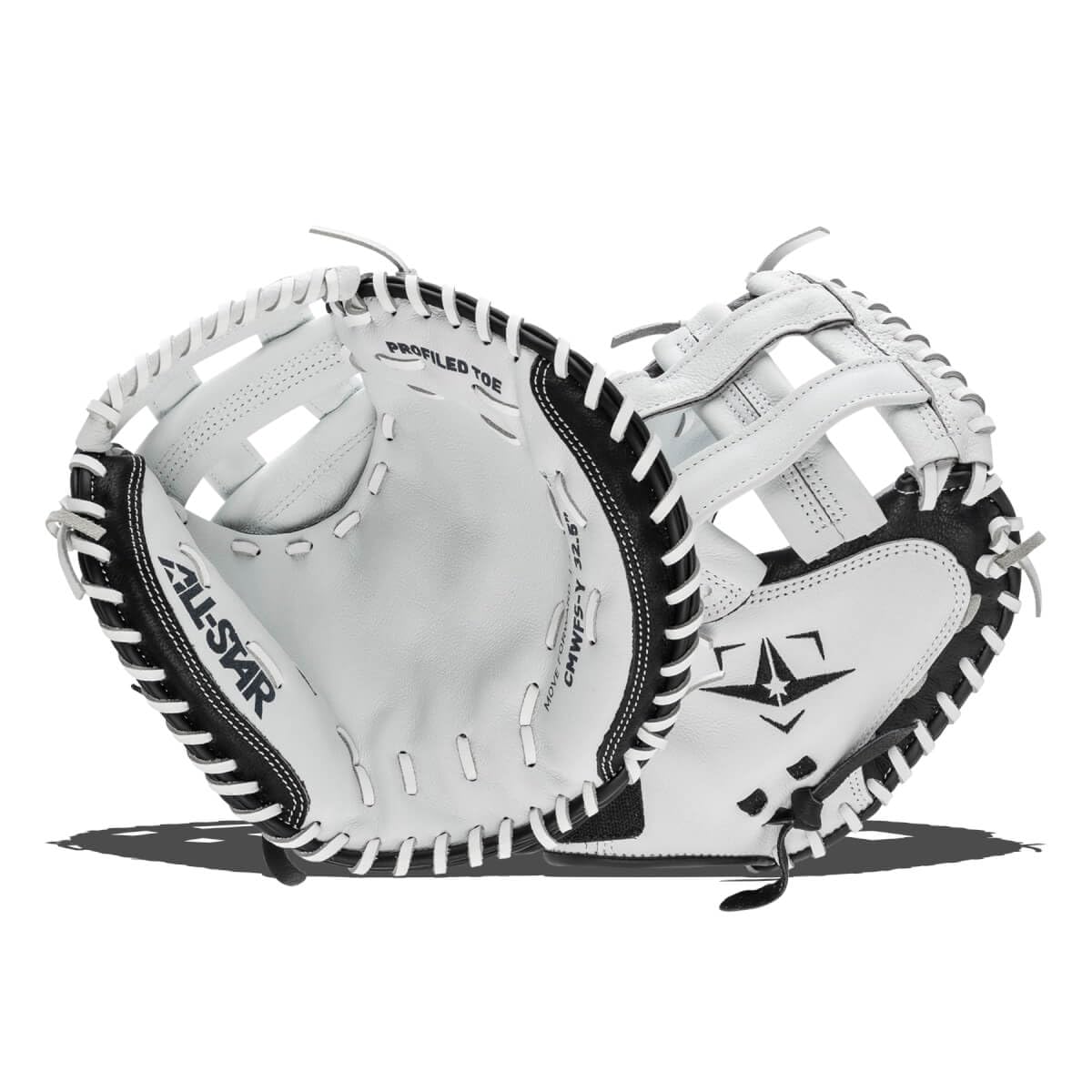
A 32.5-inch mitt built on a female-specific pattern for youth fastpitch catchers.
Fastpitch is not just baseball with a bigger ball, and this is the pick that recognises that. It is a 32.5-inch female-specific youth catcher’s model, with a lighter build that lets a young player break it in quickly. Weight is 1.2 pounds — lighter than the Wilson A500 Siren at 1.4 pounds, which matters when a catcher is squatting for a full game.
All-Star keeps the spec sheet honest: ready-to-play, an adjustable wrist strap to lock the fit, and an H-web pocket that is a common shape for softball catchers. Quality is what carries it — the construction feels solid and the glove needs almost no breaking in. A youth fastpitch catcher can take this behind the plate right away.
The trade-off is the pattern itself. The female-specific fit is the reason it shines for fastpitch, but it is also the reason it is not the right choice for a baseball catcher. If your player is a fastpitch softball catcher who needs a mitt tuned to a smaller hand and the softball, this is the cleanest match on the list.
Built for the right game: a female-specific 32.5-inch pattern is tuned for fastpitch softball rather than borrowed from a baseball mitt.
Know before you buy: the 1.2-pound build is light for a reason — it suits fastpitch, not a baseball catcher expecting a heavier shell.
Made for: youth fastpitch softball catchers who need a light, female-specific mitt that catches right away.
Wrong fit if: your player catches baseball, where this pattern is not the intended use.
7. Wilson A500 Siren Fastpitch Softball Catcher’s Mitt

Fastpitch leather for a catcher who wants the shell to hold up inning after inning.
This is the fastpitch mitt with the most leather substance on the list. Top grain leather construction is the reason it holds structure while staying reasonably light on the hand, and at 1.4 pounds it is the heaviest fastpitch option here. The 32-inch youth fastpitch shell suits a smaller catcher with a snug Quick Fit wrist — an elastic system that adjusts to hug the wrist so it stays put through the throw down to second.
Flat finger binding is the detail that will win over a catcher who plays with a finger outside the glove. It reduces the space between finger and glove back, so the finger rests more naturally and takes less pressure when it is placed outside the shell. That is a real comfort difference across a long game, not a cosmetic one.
Stiffness is the honest caveat. This mitt arrives stiff, and opinions on that split — some players want the leather firm so the pocket lasts, others want it soft from the start. Plan on a break-in period. What wins people over is the leather quality: a fastpitch catcher who puts in the shaping time gets a mitt that should reward her with a stable pocket.
The best of it: top grain leather and flat finger binding give a fastpitch catcher a durable shell plus real comfort for a finger-outside grip.
The honest catch: it arrives stiff, so a young player needs to spend time shaping it before it feels broken in.
Best for: a committed fastpitch catcher who wants durable top grain leather and does not mind a break-in.
Only if not: you need a mitt that is soft and ready the moment it comes from the start.
8. All Star The Focus Framer 27″ Catcher’s Training Mitt
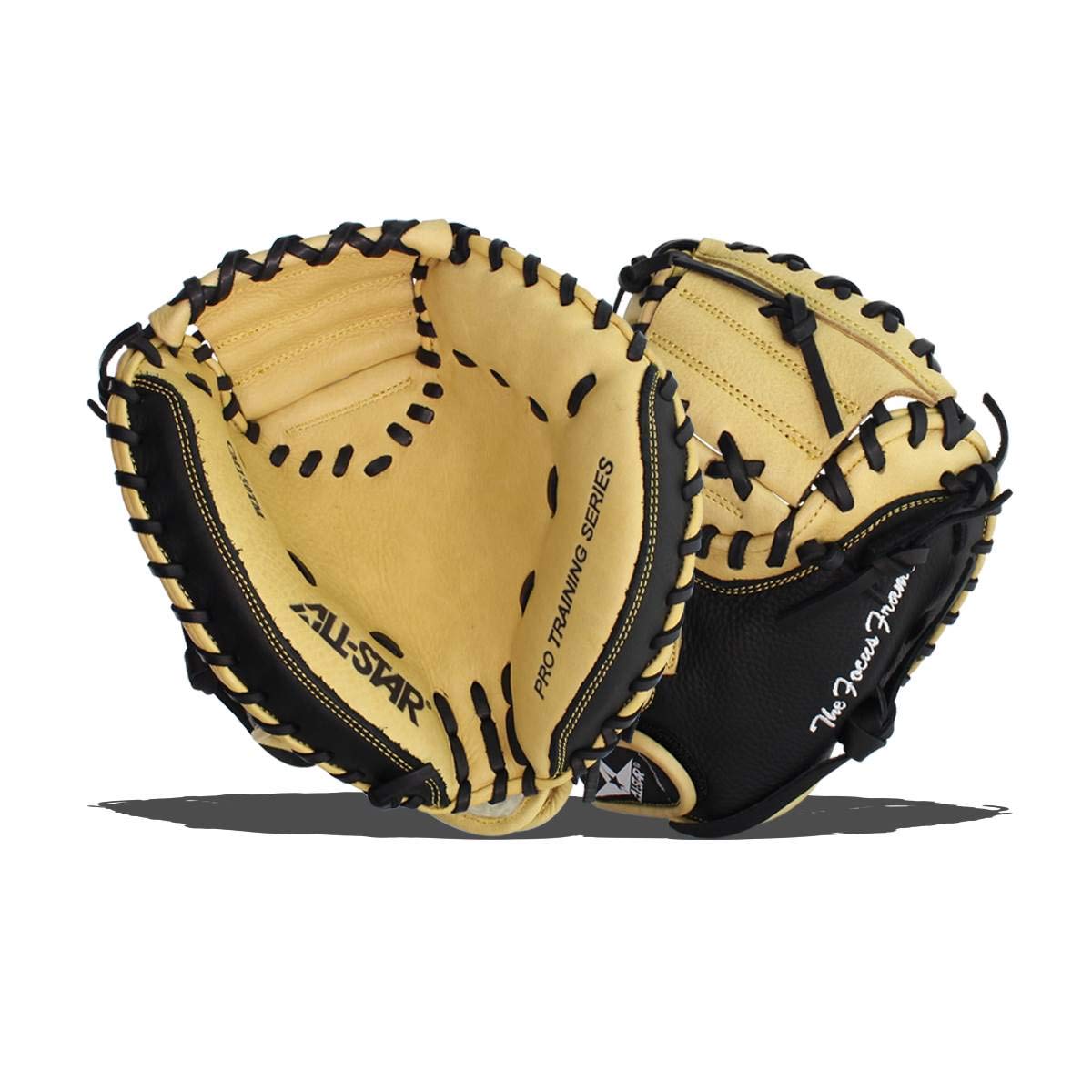
An undersized 27-inch mitt that forces a catcher to track every pitch dead centre.
This is not a game mitt, and it is not meant to be. At 27 inches around the shell it is deliberately undersized, and that small target is the whole training idea: with a tiny pocket, a catcher has to focus sharply on the ball and can’t lazily snag a pitch out of position. All-Star built it for faster ball speeds, so it is a tool for a catcher who already has the fundamentals and wants to sharpen framing and receiving.
Weighing 1.3 pounds, it feels substantial in the hand and is right hand throw only. The two-piece closed web hides the ball the way a game mitt does, so the training translates. Where the full-size mitts on this list give a young catcher margin for error, this one removes that margin on purpose.
The catch is obvious and worth saying plainly: a 27-inch shell is far smaller than the 32 to 33 inches of a true youth catcher’s mitt, so it is not the glove a kid takes into a game. Buy it as a practice tool to pair with a game mitt, not as a replacement. For a serious young catcher working on framing reps, it does a job nothing else on this list does.
What it is for: sharpening focus and framing with a deliberately tiny 27-inch target that punishes lazy receiving.
What it is not: a game-ready youth mitt — the undersized shell is too small to use behind the plate in a real game.
Buy it for: a catcher with solid fundamentals who wants a focused training mitt to sharpen receiving and framing.
Do not buy it as: the only mitt for a young player, since the 27-inch shell is far too small for game use.
9. Rawlings NXT Youth Baseball Catcher’s Mitt

A 32.5-inch travel-ball mitt with a narrower wrist and lowered finger stalls for small hands.
For young players who have outgrown the starter mitts, this is the upgrade. ContoUR Fit is the standout spec: a narrower wrist opening, lowered finger stalls and a contoured hand shape, all designed so a smaller hand gets a secure grip and quicker transfers. That is a real difference from a standard youth shell — a kid’s fingers reach the right spot in the stall instead of floating short of it.
The leather is Pro-Soft, which Rawlings says delivers a soft feel while keeping structure, and the mitt arrives ready-to-play. A padded thumb sleeve and an adjustable pull-lace wrist strap add control, and the 32.5-inch 1-piece solid web gives a stable catching surface and deep pocket for receiving. It is built for travel ball and competitive youth players, and the quality of that build is what carries it.
The honest note is durability. The palm has been flagged as wearing on at least one mitt within the first month, which is the kind of thing to keep an eye on if your player catches heavy practice volume. Otherwise this is the premium travel-ball choice, and it looks the part too. It is the most expensive mitt on the list, so it suits a family whose catcher is playing serious ball.
What the travel-ball player gets
- ContoUR Fit with a narrower wrist and lowered finger stalls suits smaller hands
- 32.5-inch solid web with a deep pocket for confident receiving
- Pro-Soft leather with a padded thumb sleeve for comfort
- Ready-to-play, so it is game-usable quickly
The one thing to watch
- Palm wear has been reported on a heavily used mitt within the first month
- The highest-tier price means it is aimed at serious competitive players
This is your mitt if: your catcher plays travel ball and needs a contoured shell tuned to a smaller hand.
Look at the Renegade instead if: you are outfitting a first-year catcher and do not need a premium travel-ball build.
Know the Specs
Glove size (32″ to 33″)
Glove size is the circumference of the mitt in inches. A 32-inch or 32.5-inch shell is the common youth catcher’s size, while a 33-inch mitt is roomier and often sized for older or adult hands. A 27-inch mitt like the Focus Framer is a training tool, not a game size. If a young hand swims in a big shell, closing the pocket becomes a struggle — pick the size that lets your player squeeze the mitt shut with control.
Break-in level
Break-in is how much softening a leather mitt still needs before game use. “Ready-to-play” or “80% factory broken-in” means it is close to game-ready on arrival. “90% factory, 10% player” leaves just a little shaping. A “stiff” mitt needs real work before it is comfortable. For a young catcher still building hand strength, an easier break-in usually means faster progress behind the plate.
Weight (1.1 to 1.4 lb)
Weight is the mitt’s overall heft. A lighter mitt, like the 1.1-pound HolyElks, is easier for a kid to hold up across a long game. A heavier shell, like the 1.4-pound Wilson Siren, tends to carry more leather and hold its structure. Balance matters most: a mitt heavy enough to feel stable but light enough that a young catcher isn’t fighting it in the ninth inning.
Web and palm padding
The web is the pocket shape between thumb and fingers — a solid or closed web hides the ball from the hitter, which is why most catcher’s mitts use one. Palm padding is the cushioning behind the catch surface that absorbs the sting of a fast pitch. Look for cushioned palm pads and index finger pads if your player is taking hard-thrown pitches, and check that the padding doesn’t make the pocket too stiff to close.
Common Questions
What size catcher’s mitt fits a 10-year-old?
Should a youth catcher’s mitt be stiff or soft?
What does right hand throw mean on a catcher’s mitt?
Is a fastpitch catcher’s mitt different from a baseball catcher’s mitt?
How long does a youth catcher’s mitt last?
Do I need a separate training mitt for my catcher?
What is palm padding on a catcher’s mitt and why does it matter?
How do I break in a new youth catcher’s mitt faster?
Can a youth catcher use an adult catcher’s mitt?
Does the web type on a catcher’s mitt matter?
The Bottom Line
For most families starting a young catcher, the youth catching mitt winner is the Rawlings Renegade because a 90% factory break-in with real leather and cushioned palm padding gets a kid behind the plate fast without a long project. If your player catches fastpitch, grab the All-Star Future Star for its female-specific 32.5-inch pattern. And for the committed travel-ball catcher, the Rawlings NXT with ContoUR Fit is the one to reach for. The Renegade is the safe first buy — a mitt that comes close to game-ready and fits a range of hand sizes, so it rarely sends you back to the store.
How we choose
We do not accept paid placement. Every pick is matched to a real buyer and a real use-case; we do not hands-on test units.
Sources
Specifications: manufacturer listings and product documentation. Review insights: verified customer reviews, as of November 2026. Pricing: not shown on this page (it changes often); check the current price via the retailer link.
As an Amazon Associate, Tactical Gear Guy earns from qualifying purchases. This does not affect which products we feature.