Specs are compiled from manufacturer listings and verified buyer reviews and can change over time — please confirm the key details on the product page before buying.
Your kid flinches behind the plate because the mask shifts, fogs up, or sits too loose — and that half-second of hesitation is where foul tips get through. A properly fitted youth catcher’s mask fixes most of that on day one: it stays put when your catcher turns to throw, keeps a clear line of sight on a low pitch, and stays light enough that a nine-year-old’s neck does not tire by the fifth inning. Below are nine masks and sets that actually deliver those three things, sorted by who each one truly fits.
This guide is built by comparing the manufacturers’ published specifications and the patterns across verified customer reviews, so you get each pick’s real strengths and trade-offs instead of marketing spin.
Fit is the one thing that decides whether a mask protects or just sits there, so every pick below is checked against real hat sizes and real head shapes. Here is the honest shortlist of the best youth catchers mask options, matched to the age and build of the player behind the plate.
Top Picks

How To Choose The Best Youth Catchers Mask
Three things decide whether a youth mask works: does it fit your catcher’s actual head, is it certified, and can your catcher see the ball out of the corner of the cage. Everything else is comfort on top of those three.
Start with the hat size, not the age range
Age labels on the box are a rough guide at best. A mask listed for youth might fit a 6 1/2″ to 7″ hat size, which covers some ten-year-olds and skips some big eight-year-olds entirely. Measure your catcher’s head circumference with a soft tape before you buy anything. A loose mask slides on impact — that is the failure you are trying to avoid.
Check for the NOCSAE mark
NOCSAE (the National Operating Committee on Standards for Athletic Equipment) sets the impact standard a catcher’s helmet has to pass. Several picks here carry that certification and say so on the listing. If a helmet listing never mentions NOCSAE, treat it as unverified and keep looking. This is the one spec you should not compromise on.
Hockey-style helmet or traditional mask
A hockey-style catcher’s helmet covers the ears and back of the head in one molded shell — more coverage, but heavier and warmer. A traditional two-piece mask is a steel cage on a harness: lighter, cooler, and easier to flip off between innings. Younger catchers often do better with the lighter traditional mask; older catchers who take more contact tend to prefer the full shell.
Set or helmet only
If your catcher is brand new to the position, a full set gets you a matched helmet, chest protector and leg guards that fit together in one purchase. If you already own the rest of the gear, a standalone helmet is the smarter buy and lets you put more of your budget into the mask itself.
Side-by-Side Comparison
| Model | Best For | Style | Weight | Certification | Amazon |
|---|---|---|---|---|---|
| Rawlings Velo 2.0 Catcher’s Set★ Best Overall | Youth players 12 & under needing full gear | 4-piece set | — | — | Amazon |
| Jadekylin Baseball Catchers Helmet MatteCompact Pick | Small heads that need glare-free matte | Hockey-style helmet, size Small | 1.16 kg | — | Amazon |
| All-Star Player’s Series Catching HelmetTop Performer | Teen catchers wanting a padded shell | Hockey-style helmet | 2.6 pounds | — | Amazon |
| Rawlings Renegade 2.0 Catcher’s Helmet | Athletes 15 & up, junior and senior | Hockey-style helmet | — | Meets NOCSAE | Amazon |
| Mizuno G4 Youth Samurai Catcher’s Helmet | Glasses and ponytails, ventilated comfort | Hockey-style helmet | 1.36 kg | Meets NOCSAE | Amazon |
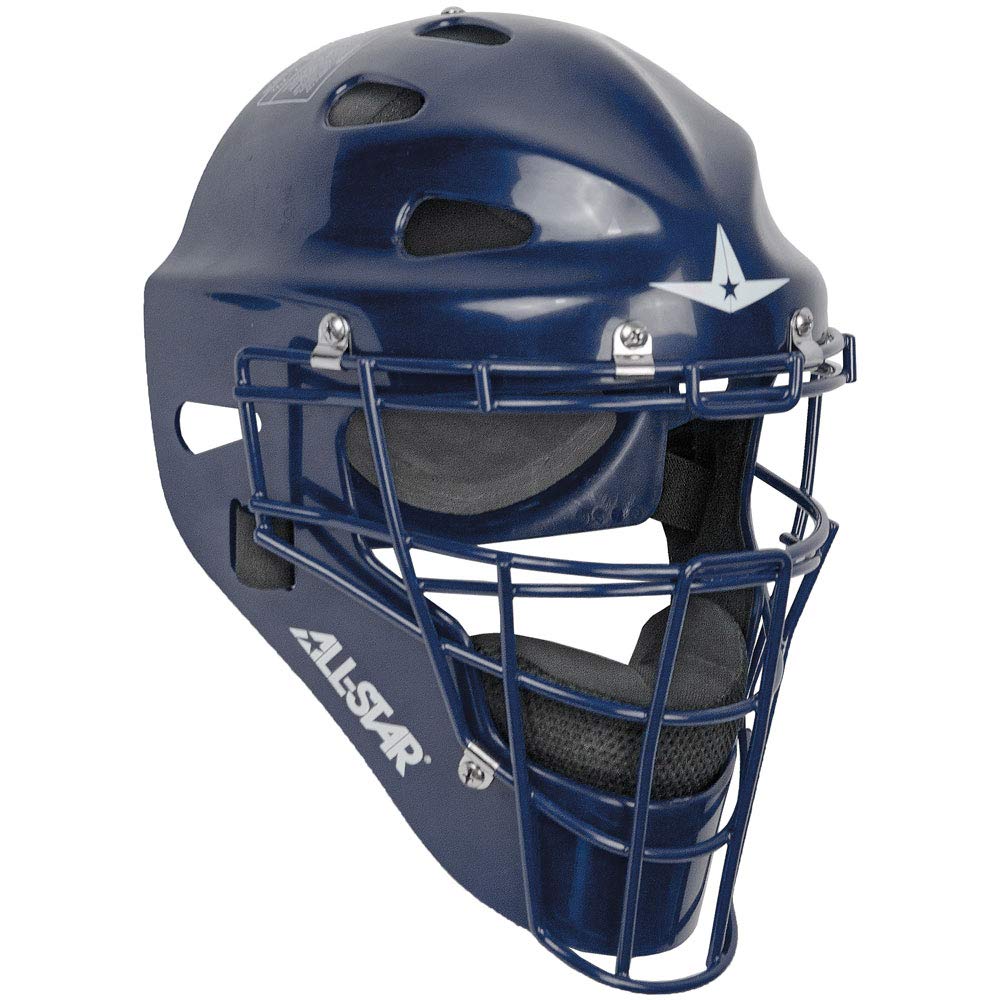
| All-Star Traditional Mask Hollow Steel | Lightest option, clear I-BAR vision | Traditional mask | 21 oz | — | Amazon |
| Easton Black Magic 3.0 Catcher Gear Set | Ages 6-12, full helmet plus guards | 3-piece set | — | NOCSAE certified | Amazon |
| All-Star Top Star Series Catching Kit | Ages 9-12, complete matched kit | 3-piece kit | — | NOCSAE approved | Amazon |
Detailed Reviews
1. Rawlings Velo 2.0 Catcher’s Set
Our pick — 4.5+★ from 450+ verified ratings; the strongest balance of quality and price.
One box covers a youth catcher from helmet to leg guards.
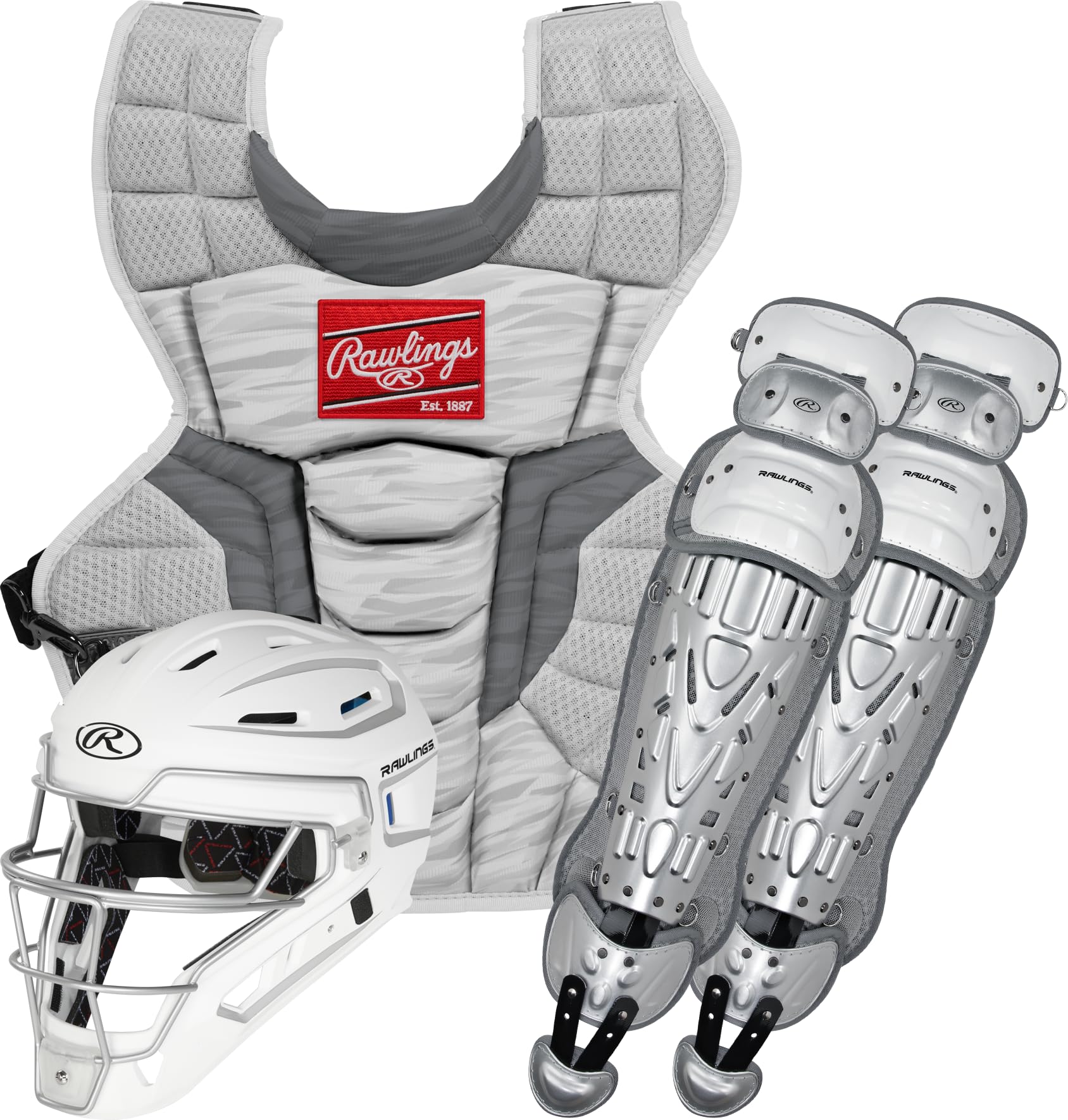
If you are outfitting a kid for the position for the first time, this is the pick that saves you a dozen separate decisions. The Velo 2.0 set puts a hockey-style catcher’s helmet, a 13 1/2″ chest protector, and 13 3/4″ triple-knee leg guards in the same box, and it is aimed squarely at players 12 and under.
What wins people over here is the overall build — the gear quality is what owners keep returning to, and it reads as a set made to be worn for several seasons rather than one. The helmet’s moisture-wicking liner and the chest protector’s heat-exchange ventilation work together to keep a catcher from cooking in a July doubleheader. Cooling matters more than any single spec, because an overheated catcher loses focus right when foul tips arrive.
The helmet itself uses a high-strength, impact-resistant cage set into a recessed frame, so the bars sit closer to the shell and out of your sightline. Fit is handled through a three-way adjustable back plate plus a redesigned chin strap, which lets you snug the shell down to a smaller head without it swimming.
Where the Velo 2.0 pays off
- Helmet, 13 1/2″ chest protector and 13 3/4″ triple-knee leg guards arrive as one matched set
- Helmet fits a 6 1/2″ – 7″ hat size, covering most youth catchers in one purchase
- Moisture-wicking liner and heat-exchange chest ventilation help a catcher stay cool through long games
- Three-way adjustable back plate and redesigned chin strap dial the fit in on smaller heads
- Arc Reactor Core foam in the chest protector blends impact-absorbing polyurethane with a polymer plate to spread force
The part to plan around
- The helmet is reported to come off easily, and ease of use gets mixed feedback — younger catchers may need a hand with the strap
- One set covers one player and one position — you are buying the whole rig even if you only need the mask
Best for: a family buying a first full set of catcher’s gear for a player 12 or under.
Think twice if: you already own a chest protector and leg guards and only need the helmet.
2. Jadekylin Baseball Catchers Helmet Matte
A matte shell built for bright sun and the small head squinting through it.
Glare is an underrated problem behind the plate. The matte finish on this shell cuts the reflection from field lights and afternoon sun, so your catcher is looking through the cage at the ball — not at a bright smear across the helmet. That single change is why it earns a spot here.
The shell is ABS plastic, the same hard plastic a lot of youth helmets use, with a matte surface over it. Wrapped foam padding inside is shaped to conform to the head and take impact force without leaving pressure points. At 1.16 kg it stays on the lighter side — noticeably lighter than the Mizuno G4 at 1.36 kg — which keeps a young catcher from fighting neck fatigue late in a game.
Size Small is the whole story, though. This one lives or dies on whether it matches your catcher, and the fit is set — there is no adjustability language here to work with. If your player is already moving into a bigger shell, this is not the one. If they are on the smaller side and playing under lights, the matte finish earns its keep.
Owners on the fit: the helmet accommodates an almost-9-year-old’s head comfortably, and quality is the trait that gets called out most. When the size lines up, people are happy.
The catch: it comes in Small only, so measure the head first and do not assume it will stretch into a bigger season.
Suits: a smaller youth catcher who plays under lights or in direct sun and needs the hood-style shell without the glare.
Not for: a player already at the top of the youth size range looking for room to grow.
3. All-Star Player’s Series Catching Helmet / Youth
The heaviest shell in this group, and the one a bigger teen may prefer because of it.
Let’s be direct about the number: 2.6 pounds. For a small kid, that weight is a reason to look elsewhere. For a teen with a fuller frame, a heavier shell that sits solidly can feel more substantial than a light one that rattles.
The shell itself is foam-padded inside, and it comes in a navy colorway with an adjustable strap — so you are not locked into a single fit. The adjustable strap runs around the harness and lets you tighten the shell against the head, which is the difference between a mask that moves with your catcher and one that slides on a mask shot.
This one is honest middle ground. It is not the lightest, not the most ventilated, and not the cheapest — but it is a padded, adjustable youth shell from a brand that has been making catcher’s gear for a long time, and the build quality holds up to regular practice use. If your catcher is on the older end of “youth” and has outgrown the light shells, this is a natural step up.
The weight trade: 2.6 pounds is real — heavier than the 1.8-pound Rawlings and the 21-ounce All-Star traditional mask. Factor your catcher’s build into that, not just their age.
What you get back: a foam-padded interior and an adjustable strap that lets you tune the fit rather than accept a fixed size.
Go with this if: your catcher is on the larger side of youth and you want a padded, adjustable shell that will not feel flimsy.
Pass if: your player is small enough that 2.6 pounds would be a burden behind the plate.
4. Rawlings Renegade 2.0 Catcher’s Helmet

The helmet that follows your catcher from junior sizes into the senior game.
The upgraded 2.0 shell here is designed for athletes 15 and up, and it comes in junior and senior sizes. That is a different audience than most of this list — it is the pick if the “youth” behind the plate is a high-school-aged catcher who still needs the smaller shell but plays at a serious level.
The upgrades over the original Renegade are worth naming. The shell now carries a moisture-wicking liner to keep sweat off the skin. The cage has higher impact resistance, and the chin pad is reshaped to fit more closely against the jaw. All of that is bracketed by the NOCSAE certification line — the helmet is tested to the standard, same as the Rawlings Players Series.
One caveat to weigh honestly: the listing gives no real usable dimensions for the shell, so you are relying on the junior and senior size labels to get the fit right. Check the sizing before you buy, and if your catcher sits right between junior and senior, ask which one they need before ordering.
What changed in 2.0: moisture-wicking liner, a higher-impact cage, and an upgraded chin pad — the three parts that matter most for comfort during long games.
The sizing blind spot: no usable dimensions on the listing, so junior and senior sizing labels are your only guide.
Made for: a 15-and-up catcher who needs a junior or senior shell and wants a current Rawlings design.
Not the pick for: a pre-teen playing rec ball — this is built for older, bigger athletes.
5. Mizuno G4 Youth Samurai Catcher’s Helmet

The Samurai’s ventilation earns its keep in July, when airflow is the whole game.
The G4’s strategic ventilation system is the feature that carries this helmet. A catcher crouches in the same sun-baked spot for seven innings, and a shell that moves air across the head keeps them thinking about the pitch instead of the heat. Layer in 3-layer EVA foam padding — a denser foam that spreads impact force — and a steel-framed mask built for durability, and you get a helmet that handles both the physical and the comfort side.
Fit is the strength that shows up most in owner experience. It fits snugly on most heads and specifically accommodates glasses and ponytails, which is a real thing parents ask about and rarely see listed. The 1.36 kg shell is heavier than the Rawlings Players Series at 1.8 pounds and lighter than the All-Star Player’s Series at 2.6 pounds, putting it in the middle of this group on weight.
Where you should look honestly: durability is the most mixed aspect of this helmet, with the back pads reported to come loose after about six weeks of heavy use. As buyers put it: “While some customers say it holds up well, others report issues with back pads falling out after six weeks of use.” A seasonal inspection of the padding keeps that from turning into a mid-game surprise.
Fits the kid nobody designs for: buyers report it works with glasses and a ponytail in place — rare for a hockey-style shell, and a genuine reason to pick this one.
Keep an eye on the pads: the back pads are the known weak spot over a long season, so check them before every game week.
Pick it for: a youth catcher who wears glasses or a ponytail and plays in heat — the ventilation and fit work together here.
skip it if: you want a shell that holds its factory-fresh padding for years without inspection.
6. All-Star Traditional Mask / Hollow Steel / Mesh Pads

Twenty-one ounces of hollow steel, and the clearest sightline on this list.
If you want the lightest thing on your catcher’s head, this is it: 21 oz, which works out to 1.3 pounds. Against a hockey-style shell at 2.6 pounds or 1.36 kg, that is a different category of weight. A young catcher who has been complaining about the helmet dragging will feel this one disappear.
The hollow steel cage is the reason it manages that. Hollow steel gets its strength from shape rather than solid mass, so the bars stay sturdy without the shell weight. The I-BAR VISION construction is the sightline piece — the bar arrangement is laid out so the catcher has a clear view on a low pitch. Built-in LUC pads sit inside the cage for comfort, and a DeltaFlex harness wraps around the back of the head to hold everything in place.
The trade-off is coverage. This is a traditional mask, not a full hockey shell, so it protects the face and forehead on a harness rather than wrapping the ears and back of the head. For a youth catcher who plays rec ball and needs to flip the mask off between innings, that is a feature. For heavy contact against older players, a full-shell helmet makes more sense.
The weight advantage: light is the trait buyers bring up most about this mask, and 21 oz is genuinely light for a catcher’s mask — the difference a young catcher feels through a full game.
Trade-off to accept: a traditional mask covers less of the head than a hockey-style shell, so pick this for smaller players or rec play.
Choose this for: a young catcher who plays rec ball and needs the lightest, clearest-view mask on the field.
Look past it if: your catcher faces older, bigger hitters and you want ear and back-of-head coverage.
7. Easton Black Magic 3.0 Youth Catcher Gear Set
A full three-piece set that grows with the kid rather than outgrowing them.
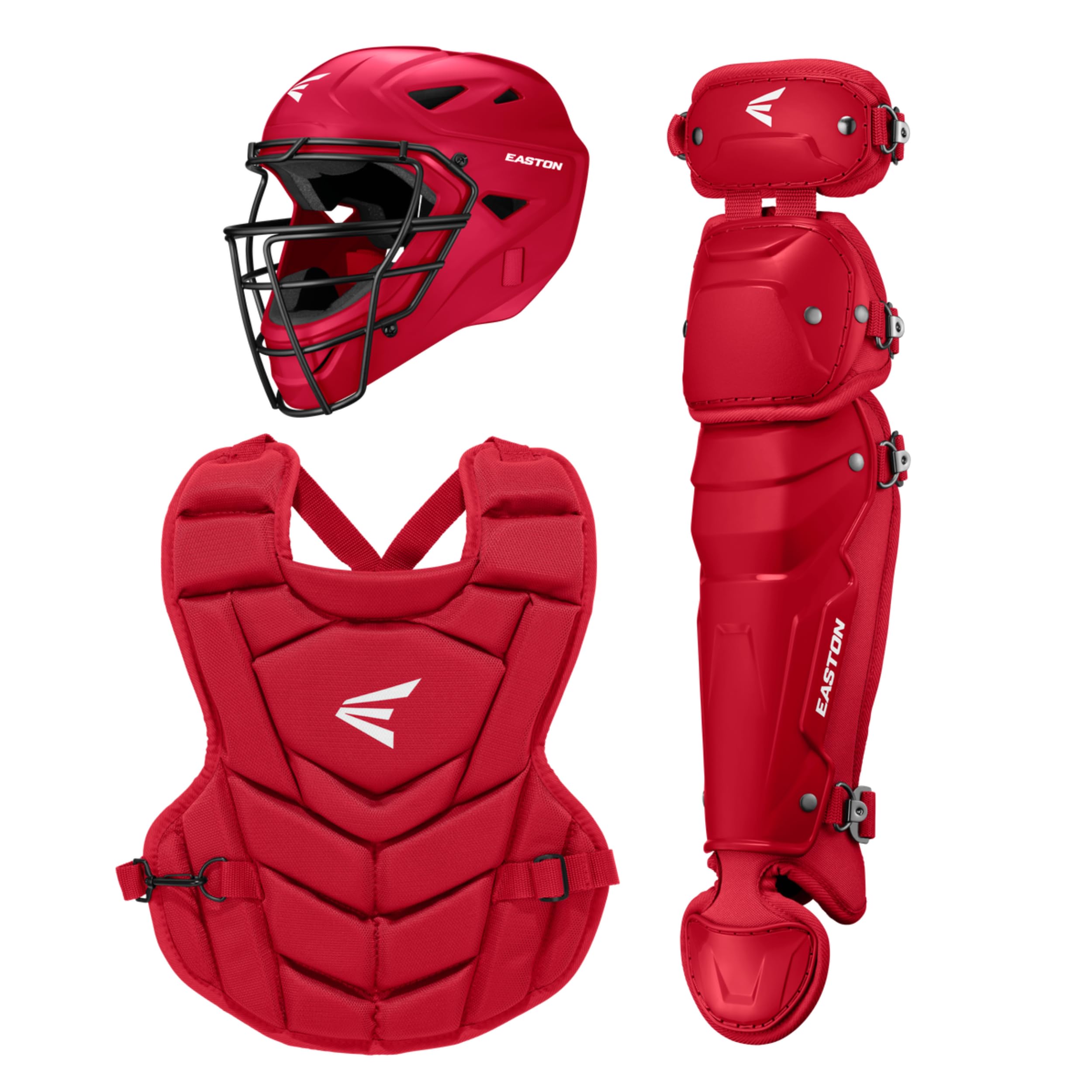
The youth-specific sizing here is the smart part: it comes in Youth Medium for ages 6-9 and Youth Large for ages 9-12. That means a family buying for a six-year-old and a family buying for a nine-year-old are pointed at different sizes, which is more than most sets bother to do. The helmet itself fits a 6 1/8″ to 7″ hat size, or 19 3/8″ to 22″ in circumference — measure the head and match it to that range.
The helmet uses a high-tensile steel mask with a centered viewport, which sets the cage so the bars sit out of the middle of your sightline. The full set is NOCSAE certified and meets all levels of play standards for baseball and softball. The chest protector is 13 1/2″ and built to resist bunching while keeping coverage, and the leg guards are 13″ and articulated so they bend with the catcher’s stance instead of fighting it.
Here is the part to size carefully: the chest protector runs smaller than it appears in the photos, and size is the most-mixed aspect of this set. Quality is where it wins people over, but if your catcher is long and lean, the chest piece may fit tighter than expected and you should look at the Youth Large even for a younger player.
What makes the Black Magic 3.0 work
- Three pieces — helmet, 13 1/2″ chest protector and 13″ leg guards — in a single youth-focused set
- Youth Medium (ages 6-9) and Youth Large (ages 9-12) let you size to the player, not just the age
- Helmet fits a 6 1/8″ – 7″ hat size and 19 3/8″ – 22″ circumference
- High-tensile steel mask with a centered viewport keeps the bars out of the sightline
- Articulated leg guards move with the catcher’s stance
- NOCSAE certified and meets all levels of play standards for baseball and softball
What to measure before ordering
- The chest protector fits smaller than it looks in the photos — long and lean players will want to size up
- The size gets more complaints than any other part of this set
Buy this if: you want a certified three-piece set for a younger player and you will measure the head before ordering.
Think twice if: your catcher is tall and slim — plan for the chest protector to fit snug.
8. All-Star Top Star Series Baseball Catching Equipment Kit
A matched kit where every piece is stamped with the same approval.
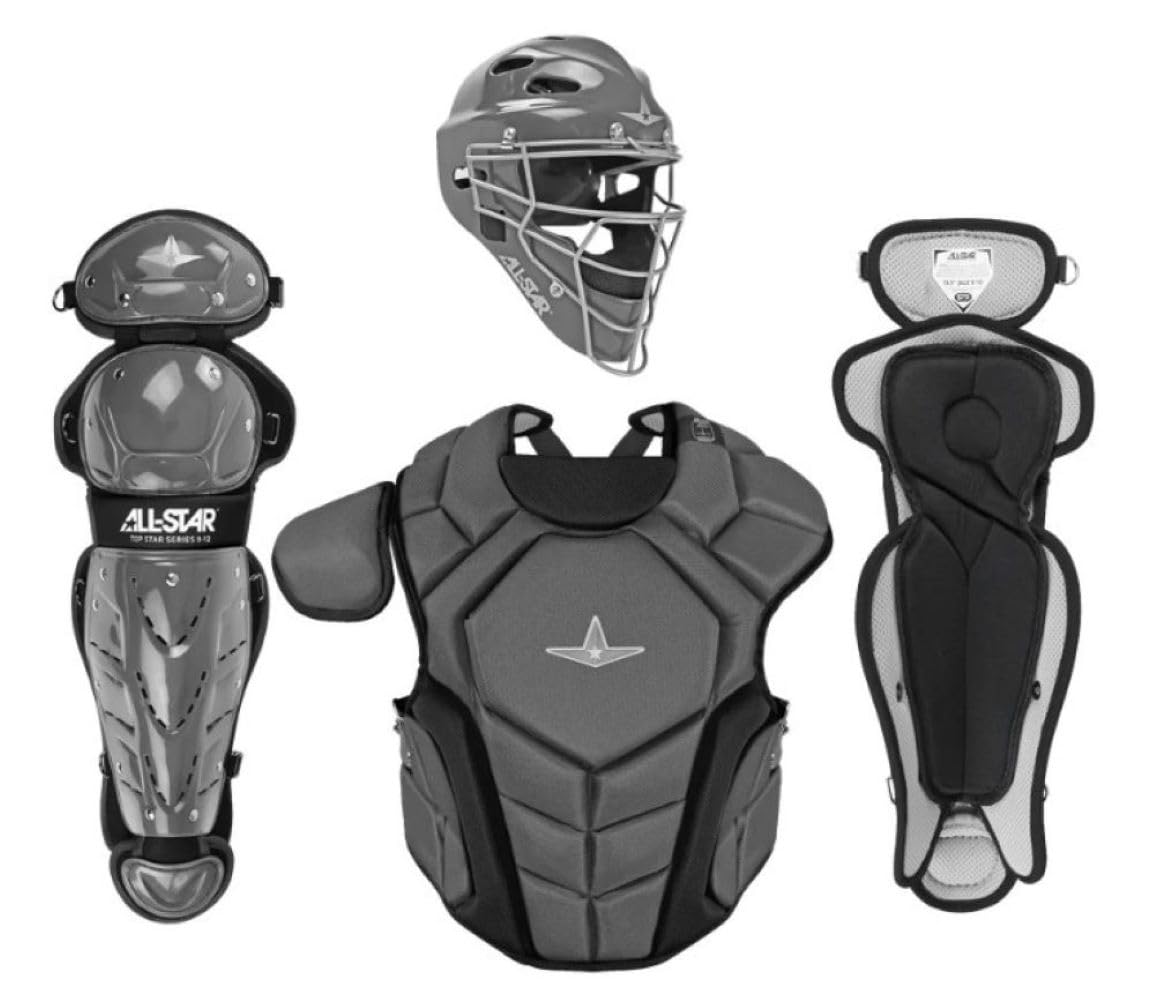
What separates this set is that the helmet is not the only approved piece in the box. The helmet is the NOCSAE-approved MVP3 at a 6 1/4″ – 7″ hat size, the chest protector is the NOCSAE-approved CPCC-TS-912 at 14.5″, and the leg guards are the LG-TS-912 at 14.5″. Matching NOCSAE approval across helmet, chest protector and leg guards is exactly what you want when you hand a nine-to-twelve-year-old the gear.
Fit is where this kit earns its spot — it lands squarely on the head and works for a seven-year-old as well as the recommended ages 9-12 range. The kit is all one colorway (graphite) with mesh fabric and foam construction, and it comes with a manufacturer’s warranty.
The practical catch is handling. A kit this complete is easy for an adult to put on and take off, but younger players may need help with some of the closures, so a player near the bottom of the age range should plan on a parent nearby. Once it is on, though, you have one purchase covering helmet, chest and legs, all at the same approval level.
The matched-approval advantage: all three pieces — MVP3 helmet, CPCC-TS-912 chest protector, LG-TS-912 leg guards — carry NOCSAE approval, which is unusual for a kit at this level.
Plan for a helper: the closures take some practice, and the youngest players in the age range will need a hand getting the kit on.
The right call for: a family who wants one matched kit where helmet, chest and legs all carry NOCSAE approval for ages 9-12.
Not ideal for: a seven-year-old who will be gearing up alone — the closures take practice.
Know the Specs
Hat Size (6 1/2″ – 7″)
Hat size is a head measurement in inches, and it is the number that decides whether a mask fits at all. A range like 6 1/2″ to 7″ covers most youth players — but the width of that gap matters. A narrow single size like Small has less room to give, while a range with an adjustable back plate lets you tighten down toward the small end. Measure your catcher’s head with a soft tape before buying and match it to the listing’s range, never to the age label alone.
NOCSAE Certification
NOCSAE (the National Operating Committee on Standards for Athletic Equipment) publishes the impact standard a catcher’s helmet is tested against. When a listing says it meets NOCSAE or is NOCSAE approved, that is your evidence that the shell has been tested to that standard. A helmet listing that does not mention NOCSAE at all is unverified, and for a piece of head protection you should not accept unverified. If you are buying a kit, check that each piece is certified, not just the helmet.
Hockey-Style vs Traditional Mask
A hockey-style helmet is a single molded shell that covers the ears and back of the head, with the cage built into the front — more coverage, more weight, more heat. A traditional mask is a steel cage on a harness that sits over the face, leaving the ears open — lighter, cooler, and easier to flip off between innings. Young catchers often do better with the lighter mask; older ones who take more contact benefit from the full shell.
Weight and Neck Fatigue
Weight matters more than most buyers expect. A catcher wears the helmet for a full game, crouching and rising inning after inning. Every extra pound sits on a young neck. This list runs from 21 oz (about 1.3 pounds) on the All-Star traditional mask up to 2.6 pounds on the All-Star Player’s Series. If your catcher complains about the helmet dragging, weight is the first spec to check.
Common Questions
Will a youth catcher’s mask fit my 9-year-old?
Does a youth catcher’s helmet need NOCSAE certification?
Is a hockey-style helmet safer than a traditional mask?
How much does a youth catcher’s mask weigh and does it matter?
Should I buy a full catcher’s set or just the helmet?
How do I know which size to order for an 11-year-old catcher?
Can I wear glasses under a youth catcher’s helmet?
How long should a youth catcher’s helmet last?
Is it OK to play softball in a baseball catcher’s helmet?
Can a traditional mask be worn by a youth catcher?
The Bottom Line
The Rawlings Velo 2.0 Catcher’s Set earns top place because it hands you a complete, matched youth rig — helmet, 13 1/2″ chest protector and 13 3/4″ leg guards — with ventilation and an adjustable back plate built in. If you already own the chest and leg guards and just need a lighter, certified shell, the Rawlings Players Series at 1.8 pounds and NOCSAE-tested is the sensible choice. For a catcher who wears glasses or a ponytail and plays in heat, the Mizuno G4’s fit and ventilation settle it. And if you want the absolute lightest mask on your catcher’s head, the all-steel All-Star traditional at 21 oz is the one to grab.
Everything behind the plate starts with a helmet that stays put — so measure the head, check the NOCSAE line, and buy the mask your catcher forgets they are wearing.
How we choose
We do not accept paid placement. Every pick is matched to a real buyer and a real use-case; we do not hands-on test units.
Sources
Specifications: manufacturer listings and product documentation. Review insights: verified customer reviews, as of November 2026. Pricing: not shown on this page (it changes often); check the current price via the retailer link.
As an Amazon Associate, Tactical Gear Guy earns from qualifying purchases. This does not affect which products we feature.