Specs are compiled from manufacturer listings and verified buyer reviews and can change over time — please confirm the key details on the product page before buying.
The fastest way to waste a youth season is buying a tee too wobbly to hold a ball, a ball that clears the fence, or a net a kid cannot set up alone. What actually moves a young swing forward is a tee that never wobbles, a ball that stays in the yard, and a net that catches the miss so practice does not turn into a search party. This guide separates the tees, balls, and nets that hold up to daily driveway reps from the ones that fail in the first month.
This guide is built by comparing the manufacturers’ published specifications and the patterns across verified customer reviews, so you get each pick’s real strengths and trade-offs instead of marketing spin.
You will see which items a young player can carry and set up without an adult, which ones survive daily contact, and which are simply not built to last. Here is the practical shortlist of youth baseball training equipment.
Top Picks


How To Choose The Best Youth Baseball Training Equipment
The single most common mistake parents make is buying a full-size adult training setup for a nine-year-old. Adult tees sit too high for a small stance, adult bats swing too heavy for young hands, and a nine-inch regulation baseball hit off a metal bat travels a lot farther than your fence. The fix is not buying less gear — it is matching tee height, ball flight, and bat weight to the kid you have now.
Match the height range to your player, not to the label
A batting tee is the one piece of equipment your kid will touch more than any other. What matters is the height range in inches, because that range decides how many seasons the tee stays useful. A tee that tops out at 37 inches runs out of height once a middle-schooler’s stance grows taller. A tee that reaches 43 inches covers a stance from first-practice crouch to a taller high school setup.
Decide if you need limited-flight or standard balls
Limited-flight training balls are designed to travel a shorter distance than a regulation ball, which makes them the practical choice for driveways and small yards. Standard practice baseballs give a truer flight path but demand real space. In a driveway or small lawn, limited-flight balls keep the session going instead of sending you into the hedge after every hit.
Pick a net width that matches how wild the pitching is
A net is only useful if it actually catches the miss. A seven-foot square catches most youth-level hits and errant throws; anything smaller turns a bad pitch into a sprint. Look at the frame material and the number of mesh layers, because those two numbers decide whether the net survives a season of hard contact or tears in the first month.
Add a fielding trainer only after the swing basics are set
Fielding gloves and trainers are a separate investment from hitting gear. A dedicated training glove with no pocket is designed to force the fielder to use both hands and feel the ball into the palm. That is a coaching tool, not a gameday glove, so buy it once the player has a reliable swing and is ready to work on defense.
Side-by-Side Comparison
| Model | Best For | Height / Size | Key Build | Weight | Amazon |
|---|---|---|---|---|---|
| Tanner Tee The Original★ Best Overall | All-around hitting base | 26″–43″ adjustable | Steel shaft, composite base | 6 lb | Amazon |
| SKLZ Premium Impact Limited-Flight BaseballsBest for Small Yards | Small-yard practice | Official baseball size | Dent-resistant composite | — | Amazon |
| LOMGWAYS Portable Batting TeeBest Grab-and-Go Tee | Grab-and-go practice | 25″–37″ adjustable | Powder-coated metal, rubber base | 5.75 lb base | Amazon |
| Rawlings Official League Practice Baseballs | Team and cage reps | 9″ diameter, 12 pack | Synthetic leather, raised seams | 3 lb (bag) | Amazon |
| Rawlings Great Hands Pancake Glove | Infield defense work | Adult and youth fit | Leather, zero pocket | 4 oz | Amazon |
| GoSports Pitching & Fielding Rebounder | Solo fielding reps | 57 x 34 inches | Powder-coated steel frame | 5.1 lb | Amazon |
| SKLZ Power Stick Training Bat | Bat speed and hand-eye | 30″ length | Aluminum, synthetic grip | 12 oz | Amazon |
| GoSports 7×7 Practice Net | Full-size backyard cage | 7 ft x 7 ft | Bow frame, polyester net | 13 lb | Amazon |
| BAGAIL 7×7 Training Net | All-in-one starter kit | 7×7 ft | 7-ply polyester, fiberglass tubes | 4.5 lb | Amazon |
Detailed Reviews
1. Tanner Tee The Original Batting Tee
Our pick — 4.5+★ from 11,000+ verified ratings; the strongest balance of quality and price.
The tee that outlives the player who first swung off it.
If you buy one piece of training gear this season, make it the tee that stays standing. The Tanner Original adjusts from 26 inches to 43 inches with one hand — enough range to follow a kid from a first-practice crouch all the way to a taller middle-school stance. That single spec is why it leads this list: it is the only tee here that does not need replacing when your player grows.
This tee stays put when a bat clips the top, and that steadiness comes from its weight. The steel shaft and composite base together weigh 6 pounds versus the Rawlings 12-pack of baseballs at 3 pounds. Buyers report it surviving being run over by a car, abuse that ends most other tees. The rubber Flextop cone (the flexible top that holds the ball) is the other half of the trick: it flexes on contact instead of fighting the bat, so your hitter feels the ball and not a stiff plastic thud.
Portability is not an afterthought. The weather-resistant composite base is light enough for a child to drag from garage to driveway alone, and the whole thing adjusts one-handed between swings, which matters when a coach is feeding a line of kids. A 4.5+ star average across 11,000+ buyers makes it the most-reviewed tee on this list. What wins people over is durability, and the second-strongest theme is value: this is the rare training tool that gets handed down rather than thrown out.
Why It Earns The Top Slot
- 26-inch to 43-inch range means one tee covers a growing player for years
- 6-pound steel-and-composite build stays put when the bat clips the cone
- Flexing rubber top gives a realistic feel instead of a hard plastic stop
- Adjusts with one hand between swings during group drills
What To Weigh Before Buying
- It is a tee only — no balls, no net, no carry bag in the box
- The 6-pound build is a touch heavy for the smallest players to lug far
Reach for this if: you want one tee that follows a player from t-ball age into high school without a second purchase.
Look elsewhere if: you need a complete practice kit in one box — this is the hitting foundation, and the balls and net come separately.
2. SKLZ Premium Impact Training Baseballs 6-Pack
Practice that stays in the yard instead of the neighbor’s gutter.
Six yellow balls that fly short on purpose. The high-visibility yellow also does the quiet work of tracking flight, which is how young hitters learn to read the ball off the bat.
Weight and density are tuned for a true flight path, so the feedback still feels like a real ball off a real bat. The composite construction is described as dent-resistant, and the consensus from owners is durability that stretches across years of constant use. What buyers like best is straightforward quality, closely followed by how well these work for everyday practice. Throwing performance ranks right behind — heavy enough to throw straight even into wind.
Official baseball size with an exterior texture makes the grip familiar, so the transition to a game ball later does not feel foreign. The trade-off sits on the value side, where opinions split: some find the six-pack a fair deal, others wish they got more balls for the outlay. Buy two packs if you plan on long sessions, because chasing down six balls gets old fast.
The real limitation: these are training balls, not game balls — the short flight is the whole point, so do not expect a regulation trajectory on a full-size field.
Worth it for: any parent whose practice space is a driveway, a small lawn, or a park corner where a regulation ball would end up in the street.
Not the pick if: you need a dozen regulation balls for team drills — the Rawlings 12-pack in this list covers that job.
3. LOMGWAYS Portable Batting Tee for Baseball/Softball
Screws together by hand, rides in its own bag, sets up anywhere.
No tools, no fuss — this one twists together like a jar lid. The spiral bottom design lets you screw the pole and base together by hand, then break it down just as fast when practice ends. It is the tee you keep in the trunk for impromptu park sessions.
Height runs from 25 inches to 37 inches, which suits teens and adults of varying skill levels. That range is shorter at the top than the Tanner’s 43-inch reach, so a taller middle-schooler will run out of tee before running out of swing. Where it holds its ground is the base: a solid rubber base weighing 5.75 pounds increases grip on the ground and keeps the tee from tipping or creeping forward on a hard swing. The powder-coated metal pole resists rust, and the included carry bag holds the base, pole, and rubber top together.
Feedback feel is tuned by a hand-rolled flexible top that reduces swing resistance and reacts the moment contact happens. The owner consensus is straightforward: it beats expectations on quality, and the sturdiness, easy assembly, and all-ages usefulness are what buyers talk about most. One recurring theme is cross-generational use — it works just as well for a child’s practice as for an adult’s. The lower height ceiling is the honest limit; if your player is already tall, spend up on a longer tee.
Best fit: families who want a tee that travels — the bag and tool-free assembly make it a trunk staple for weekend field trips.
Know going in: 37 inches is the top of the range, so it serves younger and mid-size players better than a high-schooler with a tall stance.
Grab it if: portability is your first priority and your player is still on the younger side.
Hold off if: you want a tee that will still fit three seasons from now — the 43-inch Tanner covers that growth better.
4. Rawlings Official League Practice Baseballs Bag of 12
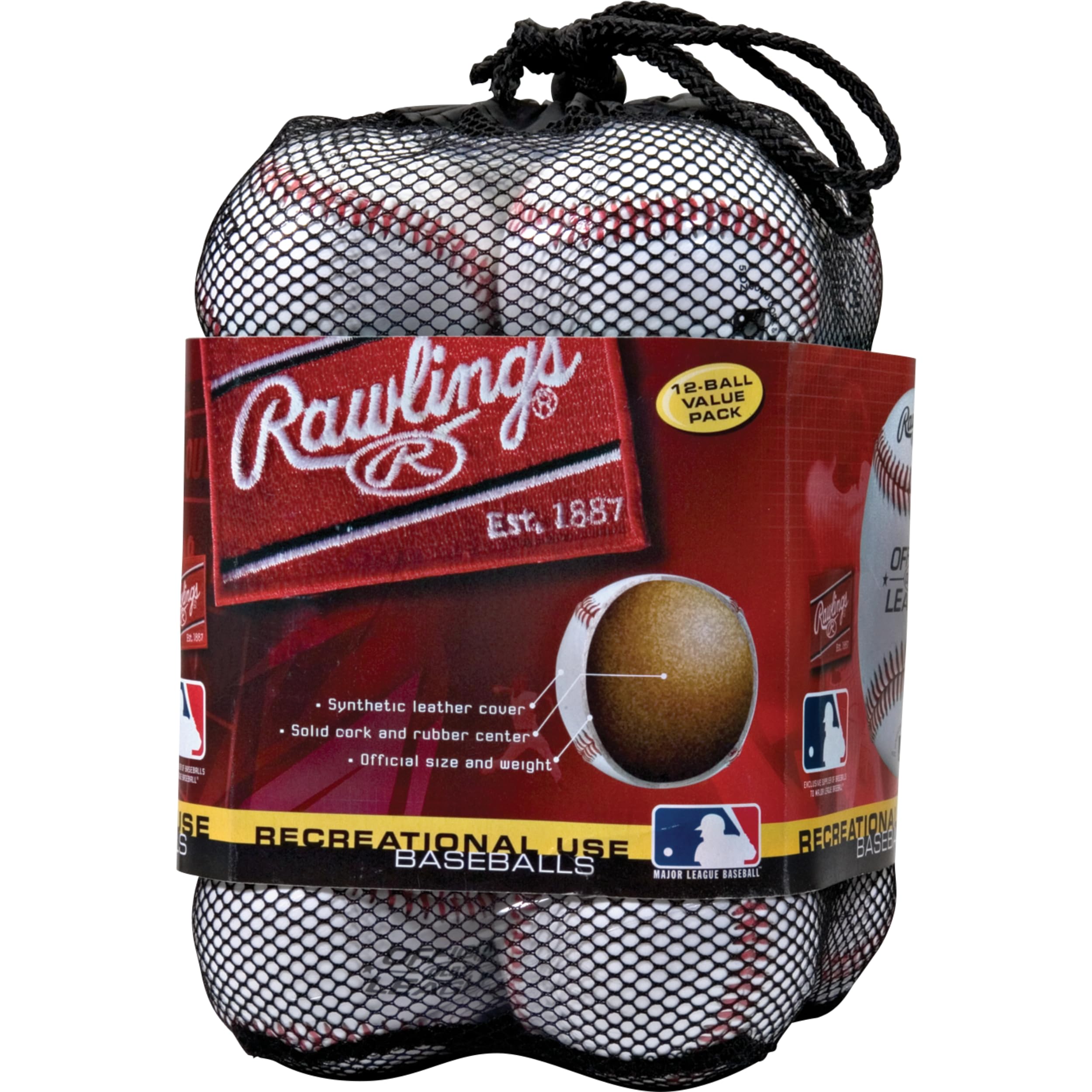
A dozen youth-league balls that live to get hit, not stay pretty.
A twelve-pack is the difference between a real practice and a session that dies every time a ball rolls under the car. Rawlings built this bag for recreational use, with a solid cork and rubber center that makes them fine for batting practice or a casual game in the yard. They are intended for ages 8 and under, which is the key spec — these are youth balls, not adult game balls.
The synthetic leather cover and raised seams make them easy to grip, and the mesh bag that holds all twelve keeps the whole set together in the garage. On the value side this is the most-attested pick in the list: a widely praised quality rating, with value ranking second in what buyers talk about. They go far when hit properly, which is exactly what a kid wants to see off the bat.
The one honest caveat is durability. As owners put it: “The durability receives mixed feedback – while some say they hold up well, others report they dent easily after 4-5 hits.” That is the trade-off for a soft youth ball — a synthetic leather cover on a cork and rubber core is built for the under-8 swing, not for a high-schooler’s metal bat. For the age group they are designed for, that is a fair deal.
Where the money goes: twelve balls and a carry bag in one box, aimed squarely at the 8-and-under crowd.
The honest catch: a harder swing can leave them dented, so keep them for the young player they were built for.
Buy these if: you are stocking a bag for a young team and need a full dozen practice balls that grip well and fly true.
Pass if: your player is older and swings a heavier bat — the limited-flight SKLZ balls handle harder contact better.
5. Rawlings Great Hands Pancake Training Glove

A glove with no pocket — on purpose — to force two-handed fielding.
Most gloves do the catching for you. This one refuses. The zero-pocket pancake design gives a young fielder nowhere to hide, so the ball has to be caught with two hands and felt into the palm rather than swallowed by a deep pocket. That is the entire coaching idea compressed into one piece of leather.
At 4 ounces it is not much heavier than a can of soda, so a young infielder can wear it through a full drill session without arm fatigue. The leather build matches what you expect from any Rawlings glove, and the fully closed web keeps the ball from sneaking through the catch. It fits both adult and youth hands and is worn on the left hand.
What it is best at is infield work — the training suitability and fielding performance are the themes buyers keep coming back to. The perfect fit comes up often too, and the value lands as another plus. It is a trainer, not a gameday glove, so expect to swap to a standard pocketed mitt when the real game starts. Used as a warm-up tool before a normal glove, this one sharpens soft hands fast.
The coaching angle: no pocket means no crutch — the fielder has to use both hands and center the ball every time.
The catch to know: it is strictly a trainer, so it will not replace your game glove on the field.
Right for: young infielders working on soft hands and two-handed catches before and after regular team practice.
Skip if: you need an actual gameday glove — this one is built for drills only.
6. GoSports Baseball & Softball Pitching and Fielding Rebounder

A throwing partner that never gets tired and never misses a rep.
This is the piece that lets a kid practice fielding without a coach standing there. Throw a ball into the rebounder and it comes back as a grounder or a line drive, so a young fielder gets real reps on footwork and catching technique. The 57 x 34 inch frame is compact enough for a driveway yet big enough to catch a scattershot throw.
The frame is powder-coated steel, and four U stakes anchor it into grass or dirt. On a driveway, you weigh it down instead of staking. Setup is a one-time job that runs about five minutes, and the legs pop off so it rides to the park in the car. A strike zone attachment turns it into a pitching target too, which stretches one frame across two skill sets.
The catch is real, and it is about stability. The heavier themes in buyer discussion point at sturdiness and steadiness under repeated contact rather than build quality as a whole, alongside split opinions on whether the money is well spent. Treat it as a backyard trainer that wants staking or weighing down, and it earns its place. Expect the frame to shift if you leave it loose on a hard surface.
The good trade: one frame returns both grounders and line drives, and the strike zone adds pitching work without a second purchase.
The honest caveat: the frame relies on stakes or weights to stay put — on pavement it will drift without ballast.
Choose it if: your player needs solo fielding reps and you have grass to stake it into.
Think twice if: you only have a paved driveway and no weight to hold the frame down.
7. SKLZ Power Stick Baseball and Softball Training Bat

A 12-ounce training bat built to make a young swing quicker.
Twelve ounces and 30 inches is a light, short bat — and that is the point. A lighter bat lets a hitter take more swings before fatigue sets in, which is how rotation speed and hand speed actually improve. The narrow-diameter barrel is aimed at small-ball training, so contact and hand-eye coordination get the workout rather than pure power.
Aluminum construction with a synthetic grip holds up to repeated use, and the one-piece build keeps the feel direct from handle to barrel. Owners describe it as effective for bat speed and hand-eye work, with hitting ability improving over repeated sessions. There is a fun factor too — it is a bat that gets brought out for plastic golf balls across the lawn as much as for tee work.
The honest caveat is on the balls, not the bat itself. Some owners mention that balls break easily under this bat, which makes sense for an underload training tool with a narrow barrel. Pair it with durable practice balls and it does its job. At 12 ounces, it is also no substitute for a game bat — it is the training tool that makes the game bat feel faster.
Where It Delivers
- 12-ounce weight means more swings before a player tires out
- Narrow barrel trains contact and hand-eye coordination
- Nimble 30-inch length suits a young, growing stance
What To Watch
- Some customers note balls break easily under the narrow barrel
- It is a training bat — not a replacement for a game bat
Pick it for: a player who wants quicker hands and a faster bat path without swinging a heavy load.
Not a fit if: you are shopping for a game bat — this one is a drills-only speed tool.
8. GoSports 7 ft x 7 ft Baseball & Softball Practice Net

A full wall of net that catches the miss and keeps the session moving.
Seven feet by seven feet is a lot of catching area. That size is why a bad pitch stops being a sprint — the net takes the hit whether it is a line drive off a tee or a wild throw from short. The bow frame sets up in about 90 seconds and breaks down into a carry bag, so the same net serves the backyard and the park.
The frame is metal and stakes anchor it into grass or dirt infield for stability. A strike zone attachment turns hitting practice into pitching practice, which is how one net covers both halves of a young player’s game. At 13 pounds the whole thing is car-portable without being a two-person job. The polyester netting and staked frame mean it is built for outdoor use rather than the living room.
Where it hits a limit is the netting’s lifespan. Most reviewers point out it holding up fine to weather, though a minority describe a tear showing up within a month. The ball rebound also draws mixed reactions, so this is not a rebounder — it is a catch net. Treated as a backstop, it does exactly what the backyard cage should do and spares the neighbor’s fence.
The core value: a full seven-foot square catches most youth-level hits and errant throws, saving you the retrieval walk.
The honest note: the netting can tear in a hurry for some buyers, so set it up in the grass rather than over concrete.
Good for: a backyard setup where a full-size catch net ends the foul-ball hunt for good.
Not the one if: you want a rebounder that returns the ball — this one stops it, it does not throw it back.
9. BAGAIL 7×7 ft Baseball & Softball Training Net

Everything a first backyard practice needs, packed into one box.
Most nets stop at the net. This one hands you the net, an adjustable batting tee, two strike zone targets, a baseball, four ground stakes, and a carry bag in the same kit. For a family starting from zero, that is the whole warm-up assembled before the first swing, with no separate shopping list.
The mesh is 7-ply knotless thickened polyester, which is where all that durability language comes from — the idea being that more layers resist wear under hard contact. The frame uses a heavy-duty steel rod with reinforced fiberglass tubes, and the removable bow frame sets up in about two minutes with no tools. Ground stakes hold it steady in wind, and the detachable frame packs into the bag for trips to the field.
What the buying crowd responds to is the sheer quality and the easy assembly, with the setup and take-down coming up again and again. The collection pocket earns its keep by stopping the ball before it rolls, so the drill keeps moving. The tee inside the kit adjusts to the player’s needs, and the pair of strike zones gives a young pitcher a target. It weighs 4.5 pounds versus the GoSports 7×7 net above at 13 pounds, which matters if it lives in the car. The netting is the one area where durability opinions split — a few describe wear showing up — so plant it in the grass and it will serve a season.
Standout spec: 7-ply polyester mesh paired with an adjustable tee and two strike zones — a full starter bag from one purchase.
The trade-off: net durability throws up mixed reports, so treat it as a backyard net and skip the concrete.
Best for: a family buying their first training setup who wants the tee and net together instead of two orders.
Think hard if: you already own a good tee — you are paying for a bundle whose hitting gear you may not need.
Know the Specs
Tee Height Range in Inches
The height range tells you how many seasons a tee stays useful. A span like 25 to 37 inches suits younger and mid-size players; a span reaching 43 inches follows a player into a taller middle-school stance. The lower number sets where a small hitter can crouch, and the top number caps what it can do for a growing one. Check the range against your player’s stance today and where they will be next spring.
Mesh Ply Count on a Hitting Net
Ply count means how many layers of material the netting is built from. More layers generally mean the net resists wear under hard contact, so a 7-ply mesh is built to handle repeated hits better than thinner netting. The frame material matters too — steel or fiberglass tubes hold shape in wind. A bigger net catches more misses, but weight goes up with size, so a car-portable net often trades some size for easier transport.
Limited-Flight vs Standard Balls
Limited-flight balls are designed to travel a shorter distance than a regulation baseball, which keeps practice inside a small yard. They are still official baseball size with a familiar grip, so throwing form does not change. Standard youth practice balls fly truer and farther, which means they need open space. Pick limited-flight for driveways and tight lawns, standard for cages and full-size fields.
Bat Weight in Ounces
Training bat weight drives how many swings a young hitter can take before tiring. A 12-ounce training bat lets a player take more reps and work on hand speed and rotation instead of muscle. That bat is not a game bat — it is the tool that makes the game bat feel quicker when the real swing takes over. Heavier bats build strength but tire a young player faster and shorten the session.
Common Questions
What tee height range does a young player actually need?
Will limited-flight training balls damage a regular bat?
Can a kid set up a hitting net alone?
What size net do I need for a youth practice space?
Is a zero-pocket training glove worth buying for a young infielder?
How heavy should a youth training bat be?
Do I need a tee and a net, or can one piece do both jobs?
Will a practice baseball dent quickly off a metal bat?
How do I keep a hitting net from tipping over in the wind?
The Bottom Line
Start your practice station with the one piece that will not let your player down. The Tanner Tee The Original is the right starting point for most families, because its 26-inch to 43-inch adjustment and 6-pound build keep it useful and standing through years of swings. Add the SKLZ limited-flight balls if your practice space is a driveway, and the BAGAIL 7×7 kit if you want the net, tee, and strike zones in a single purchase. Whatever you choose, size the tee, balls, and bat to the player you have now — the best setup is one a kid can carry, set up, and use without an adult.
How we choose
We do not accept paid placement. Every pick is matched to a real buyer and a real use-case; we do not hands-on test units.
Sources
Specifications: manufacturer listings and product documentation. Review insights: verified customer reviews, as of November 2026. Pricing: not shown on this page (it changes often); check the current price via the retailer link.
As an Amazon Associate, Tactical Gear Guy earns from qualifying purchases. This does not affect which products we feature.