Specs are compiled from manufacturer listings and verified buyer reviews and can change over time — please confirm the key details on the product page before buying.
You want your kid to get real swings in without begging an adult to pitch BP for an hour. A youth pitching machine solves that, provided its lowest speed setting is slow enough for a young hitter. Below you’ll find nine machines that can all run youth-friendly speeds, sorted by what each one is genuinely best at, so you can match one to your hitter, your yard, and your power situation.
This guide is built by comparing the manufacturers’ published specifications and the patterns across verified customer reviews, so you get each pick’s real strengths and trade-offs instead of marketing spin.
Every machine here pitches to kids, but they split sharply on power source, ball type, and how much setup you’re willing to do before each session. Here’s what to know before you pick a youth baseball pitching machine.
Top Picks


How To Choose The Best Youth Baseball Pitching Machine
The mistake most buying parents make is chasing a big top-speed number. A machine that claims 70 mph is useless to a seven-year-old if it can’t dial down to a gentle toss. What matters for youth work is the bottom of the speed range, how the machine handles a soft or dimpled ball, and whether you can set it up in the driveway without an extension cord running across the lawn.
Start at the bottom of the speed range, not the top
A young hitter needs pitches slow enough to track and time. Machines in this group start as low as 10 mph on the Zooka and 15 mph on the Heater Junior, which lets a first-year player see a ball they can actually put the bat on. Speed range also covers the jump to travel-ball pace later, so a wide window — like 10-70 mph or 15-48 mph — keeps the machine useful as your player grows.
Match the ball to the machine or void the warranty
Some machines are built around soft, light practice balls, and running regulation baseballs through them can wear the throwing mechanism faster. PowerNet, for example, states plainly that using balls other than its own Launch F-lite balls voids the warranty. Others, like the Heater Power Alley Pro and the JUGS PS50, are designed for real baseballs. Decide which ball you plan to feed it before you buy.
Decide where you’ll practice, then pick the power source
A 110V cord machine ties you to an outlet, which is fine in a garage or a backyard with power nearby. A battery-powered machine like the Zooka runs on its own internal battery, so a field, a park, or a cage with no outlet is fair game. A spring-loaded launcher needs no power at all. Pick the power source that matches where you actually practice.
Side-by-Side Comparison
| Model | Best For | Speed Range | Ball Type | Power Source | Amazon |
|---|---|---|---|---|---|
| JUGS PS50★ Best Overall | Coaches and serious youth programs | Up to 50 mph | Baseballs and softballs | 110V cord | Amazon |
| Heater Power Alley ProBest Value | Budget-friendly real-baseball practice | Up to 45 mph | Real baseballs | 110V cord (Power Station optional) | Amazon |
| Franklin Sports Total PitcherNo-Power Pick | No-power backyard fielding drills | Not listed | Baseballs, softballs, teeballs | Spring-loaded, no power | Amazon |
| MOXOW Sagitta | Complete backyard bundle with screen | Not listed | Baseballs and softballs | Not listed | Amazon |
| Heater Sports Junior | Kids ages 7-10 at home | 15 to 48 mph | Dimpled practice balls | 110V cord | Amazon |
| PowerNet Launch F-lite | Switching between baseball and softball | 40 to 90 mph at 25 feet | Launch F-lite balls only | Not listed | Amazon |
| Mound Yeti | Two-sport use with dual chutes | 30 to 60 mph | Baseballs and softballs | Not listed | Amazon |
| Zooka ZS740 | Cord-free practice anywhere | 10 to 70 mph | Baseballs, dimple, safety, tennis balls | Internal rechargeable battery | Amazon |
Detailed Reviews
1. JUGS PS50 Baseball and Softball Pitching Machine
Our pick — 4.5+★ from 70+ verified ratings; the strongest balance of quality and price.
The steel-bodied machine that throws baseballs and softballs — and shows you the ball the whole way.
What sets the PS50 apart from every other pick here is a small thing with big consequences: its patented “Always see the ball” delivery system. On most machines the throwing wheels hide the ball until the moment it fires, so a young hitter never learns to pick up the seams. Here the ball stays visible through the delivery, which is exactly what a developing batter needs to learn timing. It’s no accident this is the model so many coaches and youth programs lean on.
It throws both regulation baseballs and softballs, and it even arcs slowpitch softballs for older players in the family. Speed tops out at 50 mph, and a digital readout on the machine shows you the setting so you’re not guessing. The 50 lb solid-steel build gives it a planted, no-wobble feel, and the non-marking 9″ pneumatic tires let you roll it from the garage to the yard without tearing up the lawn. Comparing specs, it tops the Heater Power Alley Pro’s 45 mph ceiling at 50 mph, and it carries a footprint of 42 x 42 x 48 inches versus the Franklin’s 31.25 x 24 x 37.5 inches — noticeably more machine to store.
The trade-off is real: this is the heaviest-duty machine in the group, and the 50 lb steel frame plus a 110V cord means it wants a permanent home near an outlet. Setup is noted as easy, and the Quick-Snap legs and grip-and-go handle help, but this isn’t a throw-it-in-the-trunk machine. If your practice lives in the driveway or a team facility, that’s a non-issue. If you’re hauling to a different field every weekend, plan for the weight.
What earns it the top spot
- “Always see the ball” delivery keeps the ball visible so young hitters learn to track it
- Throws regulation baseballs, softballs, and slowpitch arcs
- Digital readout shows the speed setting at a glance
- 50 lb solid-steel frame stays planted; non-marking 9″ pneumatic tires protect the lawn
- 50 mph ceiling beats the Power Alley Pro’s 45 mph
Where it asks for patience
- The heaviest, most permanent setup of the group — 110V cord and a 50 lb frame
- More physical footprint to store than a spring-loaded launcher
Reach for this if: you’re a coach or a family with a fixed practice spot who wants one machine to carry a player from first swings to travel-ball pace.
Look elsewhere if: you need to practice at a field with no outlet every week.
2. Heater Power Alley Pro Real Baseball Machine
A lightweight real-baseball machine that adjusts height for grounders and pop flies.
If cost is the deciding factor and you still want your hitter seeing actual baseballs, this is the entry point. It fires regulation baseballs up to 45 mph — a bit short of the JUGS PS50’s 50 mph, but plenty for youth and most young travel players. The adjustability is the underrated part: you can change pitch height to practice fastballs, grounders, and pop flies, so one machine covers batting and fielding reps.
Its 15.7 lb frame makes it the lighter option by a wide margin — the Heater Sports Junior sits at 23.5 lb by comparison. That lightness is a genuine convenience for moving it around the yard, but the reported downside is worth knowing: the reliability picture is mixed, with some owners reporting the machine stops working after a stretch of use while others run it fine. For a family buying one machine to last a few seasons, that’s the question to weigh against the price.
The honest read: affordable, real-baseball, and easy to reposition at 15.7 lb — a solid value for a household that wants basic BP without a big outlay.
The catch: reliability is a coin-flip across the reviews, so go in eyes-open and treat the machine well.
Right for: the family that wants real baseballs at a low cost and will mostly practice at home near an outlet.
Think twice if: you need a machine that has to survive heavy, frequent, multi-season use.
3. Franklin Sports Total Pitcher
The only machine here that runs on your arm, not an outlet — a spring launcher for the backyard.
Spring-powered means no cord, no battery, no outlet — you pull it back and it launches. That makes it the easiest machine to grab for a quick fielding session in a small yard. It handles baseballs, softballs, and teeballs, adjusts to produce ground balls and pop flies, and ships with a detachable handled basket for collecting balls between reps. A color-coded speed chart on the unit helps you match the setting to the drill.
Where it gets challenging is durability and consistent effectiveness — the weld that holds the throwing arm is the reported weak point, with broken welds showing up in feedback. It also carries a shorter 90-day limited warranty than most machines here. Against the JUGS PS50, its smaller 31.25 x 24 x 37.5-inch footprint and no-power design make it far easier to tuck away, but it’s a lighter-duty tool meant for infield and fielding work rather than grinding daily batting practice.
What it’s built to do: turn a driveway or small yard into a fielding station with zero setup power — grounders, pop flies, and soft tosses on demand.
Where it strains: the weld on the throwing arm is the reported failure point, so this is a light-duty tool, not a season-long batting-practice workhorse.
Good match for: a parent who wants occasional fielding reps in a small space without running a cord.
Not the one for: heavy daily batting sessions or a player who’ll be feeding it hundreds of balls a week.
4. MOXOW Sagitta Pitching Machine
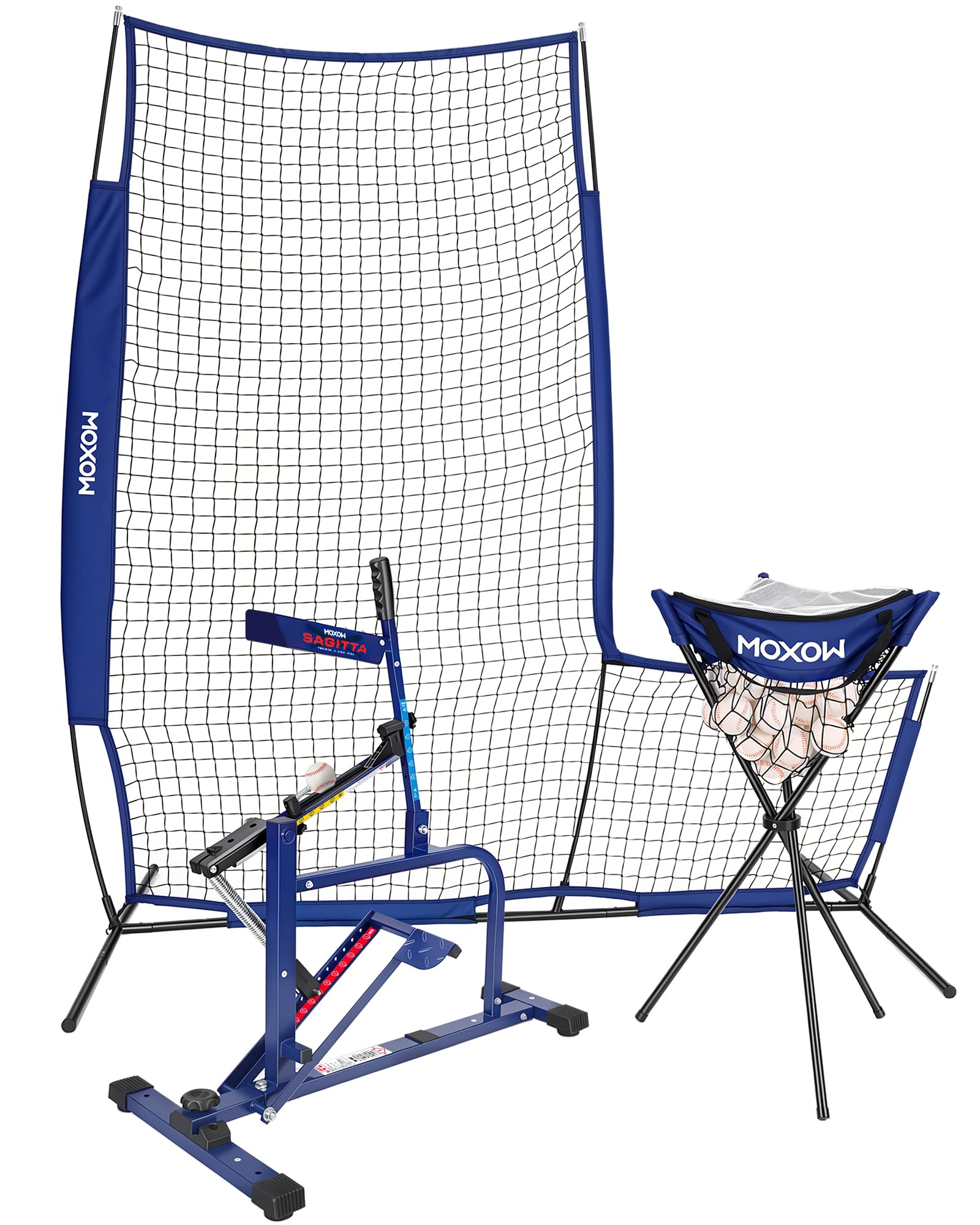
A complete backyard setup in one box — machine, ball caddy, and a 7×6 ft protective screen.
Most machines here make you buy the safety screen separately. This bundle includes the machine, a ball caddy that holds up to 50 baseballs or 30 softballs, and a 7×6 ft L-shaped protective screen in one package. If you’re setting up batting practice at home and want the pitcher protected from line drives and fast returns, that’s a meaningful head start.
The machine itself runs on three color-coded settings — Launch (A), Trajectory (B), and Power (C) — so a coach can dial in the pitch without reading a manual mid-session. A reinforced dual-function beam keeps the frame stable during throws and doubles as a carrying handle. The anti-tilt bar helps keep each pitch on target. It’s a newer model with a limited track record, so long-term durability isn’t yet proven — and it’s rated for a 90-day limited warranty, which is short for equipment this size.
The value angle: the included screen and ball caddy mean less add-on spending and a safer practice setup from day one — the screen and caddy are already in the box.
The open question: it’s a new design with a limited history, so its multi-season reliability is still unproven.
Pick it if: you’re building a home or backyard practice space from scratch and want the safety screen bundled in.
Hold off if: you want a machine with years of field-proven track record behind it.
5. Heater Sports Junior Baseball Pitching Machine

The dial-down machine built for young hitters — 15 mph on the low end, 12 balls fed hands-free.
For a beginner, the number that matters is 15 — the bottom of this machine’s 15 to 48 mph range, slow enough for a small hitter to track and time the swing. The 48 mph top then carries that same kid into travel-ball pace as they grow. A 12-ball automatic feeder delivers a ball roughly every 10 seconds, so practice keeps rolling without an adult hand-feeding each ball. It’s parents of 7-to-10-year-olds who most often point to this machine as the fit, and quality and value are the two things owners praise most.
The 1/4 horsepower DC motor keeps throws consistent, and the air-filled tires are fully enclosed for safety around young kids. A rugged tripod stand holds it steady. If you’re comparing to the larger JUGS PS50, this one is the more kid-tuned choice, but it also runs best on dimpled practice balls rather than regulation baseballs — worth knowing if you want your hitter seeing real leather.
Why parents of young players like it
- 15 mph low end is slow enough for a first-year hitter to make contact
- 12-ball automatic feeder fires about every 10 seconds hands-free
- Fully enclosed air-filled tires add a safety margin around kids
- 48 mph ceiling carries a player into travel-ball pace
Worth knowing before you buy
- Performs best with dimpled practice balls, not regulation baseballs
- Heavier at 23.5 lb than the Power Alley Pro’s 15.7 lb
Best fit for: a family with a 7-to-10-year-old just learning to hit, who wants hands-free reps in the yard.
skip it if: your hitter needs to practice against real baseballs.
6. PowerNet Launch F-lite Pitching Machine

Two interchangeable tripod setups turn one launcher into a baseball machine and a softball machine.
Here’s the spec that sets this apart: it simulates 40 to 90 mph speeds measured at 25 feet, across four adjustable settings. That’s the fastest simulated window in this group, and the 25-foot measurement is the detail to understand — the ball travels a shorter distance than game distance, so the reading reflects a launcher positioned closer to the hitter. Two sets of interchangeable tripod legs let you change the pitch height between baseball and softball, and the bundle includes 12 Launch F-lite balls split six baseballs and six softballs.
The one hard rule: this machine is calibrated for its own Launch F-lite balls only, and using other brands voids the warranty. Owners like how quickly it sets up and how accurately it places pitches, and switching between baseball and softball mode is a common praise point — versatility is the thing people value most. The flip side is that speed settings and durability come in for mixed feedback, so expect to fine-tune the settings to get repeatable results. The bucket is sold separately, so budget for your own ball storage.
The draw: a wide 40-90 mph simulated range and easy baseball-to-softball switching make it a shared-family machine — a son in baseball and a daughter in softball both get reps.
The caveat: you’re locked into one brand’s balls, and speed consistency takes some dialing-in.
Made for: a household with both a baseball player and a softball player who want one launcher for both.
Look past it if: you want to feed regular baseballs you already own instead of a specific brand’s balls.
7. Mound Yeti Baseball Softball Pitching Machine
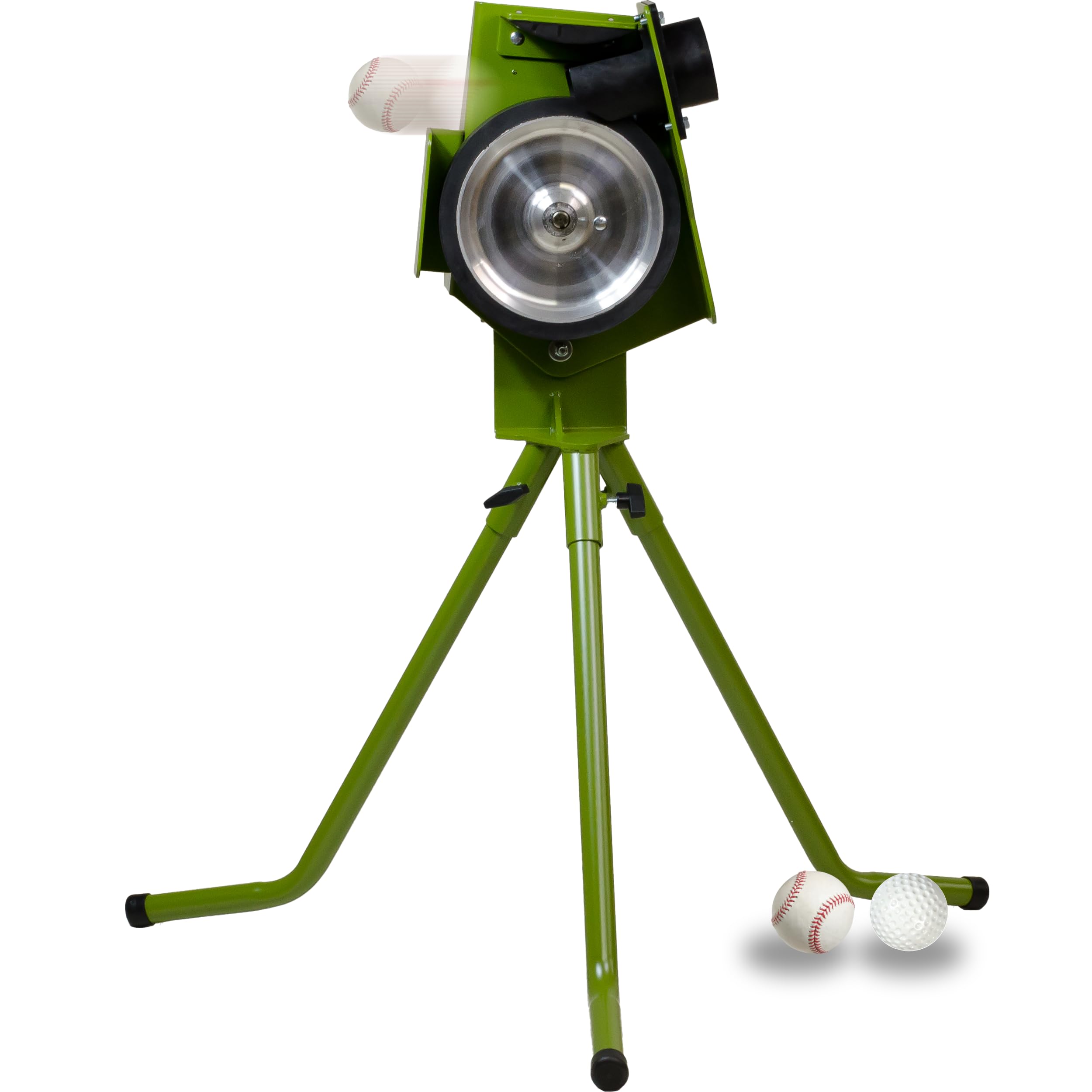
A single-wheel steel machine with two chutes, so baseball and softball changes are quick.
The neat trick on this one is the pair of chutes — one for baseballs, one for softballs — so switching sports is a matter of choosing a chute rather than re-rigging the whole machine. Speed runs 30 to 60 mph on a variable dial, which covers a youth player climbing up to machine-pitch league pace and throws both fastballs and grounders. Heavy-duty reversible steel legs let you change the pitch height, with a baseball release height of 37.5 inches and a softball release height of 27.5 inches.
At 50 lb, it’s built to stay stable, and the weight is the most debated point — some call it easy to move, others find it very heavy. Weigh that against the sturdy steel build and the two-year limited warranty, which is longer than most machines here. Owners value the quality and the money it saves over replacing broken budget machines, and it can run off a portable power bank if you want to get away from a wall outlet.
What stands out: dual chutes, a 30-60 mph range, reversible legs for height changes, and a two-year warranty — dual chutes, reversible legs, and a two-year warranty at a mid-tier price.
One thing to size: at 50 lb it’s a two-hand lift; if you’ll move it weekly, factor that in.
A smart fit for: a coach or family who wants quick baseball-to-softball swaps and a long warranty without a big outlay.
Pass if: you need a machine light enough for one person to carry far.
8. Zooka ZS740 Baseball Pitching Machine

The widest speed range here — 10 to 70 mph — and a battery that throws 700-900 pitches per charge.
For anyone who practices away from an outlet, the spec that decides it is the built-in battery. On a single charge this machine throws 700-900 pitches, enough for a full practice without hunting for an extension cord — a real advantage over every corded machine on this list. The telescoping tripod throws grounders, fly balls, line drives, and strikes, and it handles baseballs, dimple balls, safety balls, and tennis balls. The adjustable speed spans 10 to 70 mph, with the 10 mph floor giving a young beginner the slowest first tosses in this roundup.
Safety features matter when kids are around: a password lock and optic sensors keep an adult in control, and a pitch alert beeper warns the batter before each throw. The short tripod option is designed to replicate youth throwing angles. Reliability is the mixed note — some machines run for years with moderate use while others stop working after a while — so keep it clean, store it dry, and buy from a seller with easy returns. Its 38 lb frame is lighter than the 50 lb Mound Yeti but heavier than the Heater 23.5 lb Junior.
Why it suits traveling families: cord-free battery power plus a 10-70 mph range means it goes anywhere and grows with your player.
Be honest about this: reliability is inconsistent, so buy from a seller with easy returns and look after the unit.
The pick for: a family practicing on fields with no power who wants the flexibility of ten-to-seventy mph dialing.
Not for: buyers who want the longest proven service life over cord-free convenience.
Know the Specs
Speed Range and the Low End
Speed range is the window between the slowest and fastest pitch a machine can throw, in miles per hour. For youth work, read the bottom number first — a 10 mph or 15 mph low end lets a beginner see a pitch they can actually hit, while a high top end like 70 mph keeps the machine useful as the player grows into game speed. A wide range such as 10-70 mph covers more seasons than a narrow one.
Ball Type and Warranty
Machines are built around specific balls — some take regulation baseballs, others prefer soft, dimpled practice balls, and the PowerNet is calibrated for its own Launch F-lite balls. Feeding the wrong ball can wear the throwing mechanism and, on some models, voids the warranty. Match your intended ball to the machine before you buy.
Power Source
A 110V cord machine needs an outlet and ties you to a garage or powered backyard. An internal battery like the Zooka’s frees you to practice on any field, throwing 700-900 pitches per charge. A spring-loaded launcher needs no power at all, which suits quick fielding reps in a small space.
Automatic Ball Feeders
A ball feeder stores several balls and drops one into the throwing mechanism on a timer — the Heater Junior’s 12-ball feeder delivers about every 10 seconds. That removes the adult hand-feeding each pitch, so a young hitter gets continuous reps and the throwing pace stays even.
Common Questions
What speed should a pitching machine throw for a 7-year-old?
Can a youth pitching machine throw real baseballs?
Do I need an outlet to run a pitching machine?
Can one machine handle both baseball and softball?
What is an automatic ball feeder and is it worth it?
How much space do I need for a pitching machine at home?
Are pitching machines safe for young kids to be around?
How long does a pitching machine last?
Can I move a pitching machine to different fields?
Does a pitching machine replace a live coach throwing batting practice?
The Bottom Line
The youth baseball pitching machine that earns the top spot is the JUGS PS50, because its “Always see the ball” delivery, 50 mph ceiling, and baseball-plus-softball versatility make it the one machine that can carry a player from first swings to travel-ball pace. If you’re buying for a 7-to-10-year-old who needs a low 15 mph starting point, grab the Heater Sports Junior. And for cord-free practice on any field, the battery-powered Zooka ZS740 is the one to reach for — its 10-70 mph range and 700-900 pitches per charge make it the pick for fields with no outlet.
How we choose
We do not accept paid placement. Every pick is matched to a real buyer and a real use-case; we do not hands-on test units.
Sources
Specifications: manufacturer listings and product documentation. Review insights: verified customer reviews, as of July 2026. Pricing: not shown on this page (it changes often); check the current price via the retailer link.
As an Amazon Associate, Tactical Gear Guy earns from qualifying purchases. This does not affect which products we feature.