Specs are compiled from manufacturer listings and verified buyer reviews and can change over time — please confirm the key details on the product page before buying.
Here is the short answer: the Rawlings R16 Velo Reversible EXT is the helmet most youth families should buy, because it protects both the head and the chin with a face guard mounted on the helmet itself. The catch worth knowing up front is fit. No helmet here is a universal size, and a youth helmet only protects properly when the hat measurement lands in the right band. Get the size right and any of these five will do the job. Get it wrong and the padding slides, the jaw pad sits off-center, and your kid spends the season adjusting instead of swinging.
This guide is built by comparing the manufacturers’ published specifications and the patterns across verified customer reviews, so you get each pick’s real strengths and trade-offs instead of marketing spin.
The goal here is a youth baseball helmet with a face guard that fits on the first try and keeps the ears, jaw and chin covered. This straightforward buying guide to the youth baseball helmet with face guard keeps the focus on sizing, certification and how each guard attaches.
Top Picks


How To Choose The Best Youth Baseball Helmet with Face Guard
Buying for a young batter is a different job than buying for an adult. The helmet has to fit a growing head, the face guard has to sit where the chin actually is, and the whole thing has to survive a season of being dropped in a dugout bag. Three checks do most of the work.
Measure the hat size, not the age
Youth helmets are sold by hat size, not by a child’s age. Rawlings lists the R16 and the MACH Adjust at 6 3/8 in. through 7 1/8 in. on the junior sizing. Champro splits its range into Medium for 6½ – 7 and Large for 7-7½. EvoShield breaks it into four bands. Take the head circumference just above the ears and match it to the band. Sizing by age instead of hat size is the most common fit mistake in this category.
Look for NOCSAE certification on the helmet you buy
NOCSAE is the safety standard that batting helmets in organized play are built and certified to. All five picks here carry that standard, which is why they belong on a shortlist at all. Your league will ask for it, and a helmet without it can bench your kid in a tournament. Check the label inside the shell before the season starts.
Decide between a fixed mask and an adjustable guard
The face guard is where these helmets really part company. A fixed facemask comes attached and covers baseball or fastpitch softball, while an adjustable jaw piece lets a hitter tune the angle of coverage. If your child hits exclusively one way, a right-hand-batter specific design can offer cleaner sight lines at the plate. If your child switches sides, a reversible extension piece is worth the extra thought.
Side-by-Side Comparison
| Model | Best For | Stated Size Range | Weight | Guard Style | Amazon |
|---|---|---|---|---|---|
| Rawlings R16 Velo Reversible EXT★ Best Overall | Best Overall | 6 3/8 – 7 1/8 in. | — | Reversible EXT piece | Amazon |
| Champro HX Legend PlusBest Fit Range | Best Fit Range | 6½ – 7½ (M/L) | 16 ounces | Jaw guard | Amazon |
| Easton Alpha 3.0 | Best Budget-Friendly | — | 0.96 kg | Attached facemask | Amazon |
| EvoShield XVT 2.0 | Best Coverage Range | XS – L/XL (four bands) | 0.9 kg | Facemask | Amazon |
| Rawlings MACH Adjust | Best for Right-Handed Hitters | 6 3/8 – 7 1/8 in. | — | 9-setting adjustable jaw guard | Amazon |
Detailed Reviews
1. Rawlings R16 Velo Reversible EXT Batting Helmet
Our pick — 4.5+★ from 900+ verified ratings; the strongest balance of quality and price.
One helmet that flips its face guard to either side, so a switch-hitter never has to swap lids
If your child bats right in one at-bat and left in the next, this is the helmet the whole list was built around. The extension piece reverses from one side of the helmet to the other. That means the jaw coverage always sits on the side facing the pitcher, no matter which batter’s box your kid stands in. It removes the odd scramble where a young switch-hitter has to borrow a teammate’s helmet between at-bats.
What wins people over is the build. The Heat Exchange venting pushes hot air out of the shell and pulls cooler air through, so a mid-July game does not turn the helmet into an oven. The jaw pads are wrapped, which keeps them sitting flat against the jaw instead of bunching at the edge. A TPU rubber piece covers the flap hardware, so there is no exposed metal or hinge to press into the side of a cheek. Rawlings fits it to hat sizes 6 3/8 in. through 7 1/8 in., and it is NOCSAE certified for play.
The honest catch is adjustability, which is the one place buyers divide. Some find the reversing motion intuitive after a single try. Others find they need two hands and a moment of patience the first few times. Practice it at home before the first game rather than in the on-deck circle. It is a small learning tax on an otherwise strong youth helmet.
Where it earns the top spot
- Reverses to either side for right- and left-handed hitters
- Heat Exchange venting circulates cooler air through the shell
- Wrapped jaw pads stay flat against the jaw
- NOCSAE certified and fits hat sizes 6 3/8 in. to 7 1/8 in.
Where it asks a little patience
- The reversing motion takes a practice run or two to feel natural
- One size band only, so a very large youth head needs the MACH instead
Reach for this if: your child hits from both sides of the plate or you want one helmet that grows with a switch-hitter.
Look elsewhere if: your kid bats exclusively right and you would rather not pay for the reversible hardware.
2. Champro HX Legend Plus Batting Helmet
The helmet that stretches across the widest stretch of head sizes without a custom order
Champro built this one for the family that is buying a helmet mid-growth-spurt. Medium covers hat sizes 6½ through 7, and Large reaches 7 through 7½, so there is a real second size to step into when the first gets tight. That is a longer runway than the single junior band on the Rawlings picks. Compare the footprint here to the EvoShield XVT as well: the Champro shell measures 12 x 9 x 9 inches against 12.9 x 8.85 x 8.8 inches there. The Champro sits shorter front to back, which some parents find easier to slip into a gear bag.
Fit is the star. The shell is weight-tune and lined with impact foam, and the jaw pads are wrapped in a soft-touch moisture-wicking fabric. The contour-molded DRI-GEAR liner pulls sweat away from the skin on hot days, and a Bio-Fresh treatment is built in to keep the inside from going stale between washings. Vent holes at the top dump heat, so a hitter can keep a clear head in the box. A durable ABS shell takes high impacts, and the helmet meets the NOCSAE standard for all levels of play.
What this helmet is not is on-the-fly adjustable. The jaw guard is a fixed piece, so it works best for a batter who has settled on one side of the plate. For a switch-hitter, the R16 above is the better tool. And while Champro certifies it for both youth and adult head sizes, the large end of the band is adult territory, so measure before you order.
On the fit question: the two-band size spread is the real reason to pick this one, and the moisture-wicking liner makes it comfortable once it is on.
On the trade-off: a fixed jaw guard means a switch-hitter has to accept one-sided coverage or look elsewhere.
Confident call: the right pick for a growing player who needs a size to graduate into next spring.
Know this first: the jaw guard stays where it is set, so a two-sided hitter wants the Rawlings instead.
3. Easton Alpha 3.0 Batting Helmet with Face Guard
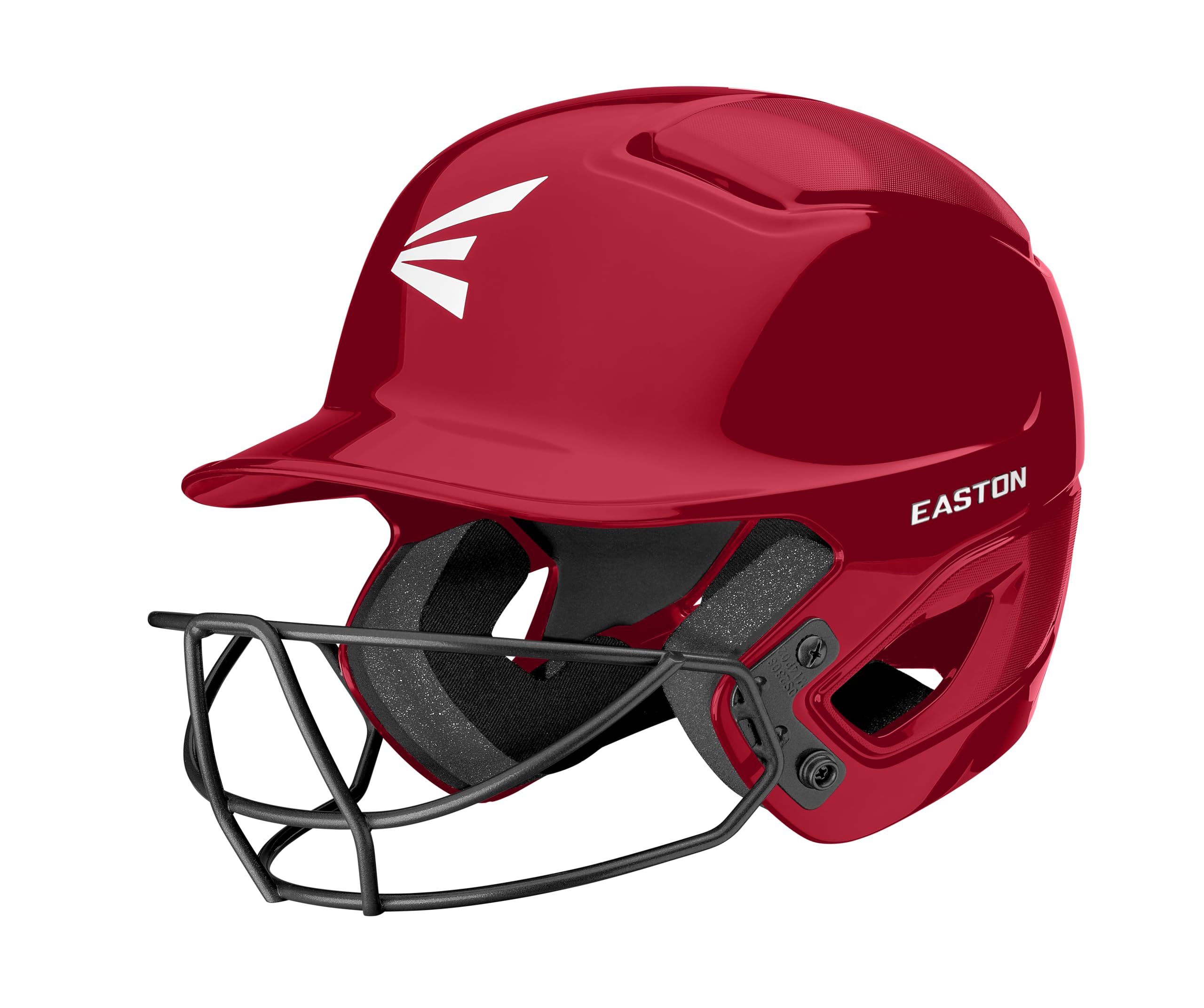
The value play that arrives with the mask already bolted on and covers baseball or fastpitch
Here is the one for a parent who wants the whole job done in a single purchase. The facemask comes attached to the helmet, not sold separately. It is designed to be used for either baseball or fastpitch softball, so a kid who plays both leagues does not need two lids. The ABS thermoplastic shell takes the impact in the box, and a dual-density foam liner cushions it while adding shock absorption. A Bio Dri liner pulls moisture off the skin on warm afternoons.
Weight is a fair reason to consider it too. The Easton tips the scale at 0.96 kg, against 0.9 kg on the EvoShield XVT. Both are close enough that no youth player will notice the difference, but the EvoShield sneaks ahead on paper if shaving grams matters to you. The Easton meets the NOCSAE standard for all levels of play. That matters for a helmet bought on a budget: certification is the same ticket to the field regardless of price tier. The ABS shell holds up for a full season of youth play, which is the realistic lifespan before a size change.
The one thing to check before it ships is color. Buyers split on whether the red matches the product photos, and a few find it reads differently in person. If your team has a strict uniform color, confirm the shade or pick a neutral finish. The mask itself is solid and the face coverage gets good marks. A color mismatch, though, is the sort of thing a kid notices on opening day.
Why it earns a spot: mask included, moisture-wicking liner, NOCSAE certified, and built for baseball or fastpitch in one helmet.
Where it gets honest: the color does not always match the photos, so verify the shade against your league uniform.
The smart value buy: best for a first-year player or a family buying masks and helmets in one shot.
Check before ordering: the color runs as described in reviews, which can matter if your team color is fixed.
4. EvoShield XVT 2.0 Batting Helmet with Facemask

Four size bands and a matte finish make this the most dialed-in fit on the shortlist
EvoShield does the measuring for you. Four bands cover the head: XS for 6½ in. and under, S/M for 6½ to 7 1/8 in., M/L for 6 7/8 to 7½ in., and L/XL for 7¼ to 7 7/8 in. That is the widest sizing ladder here and the reason this pick suits a family buying for two kids or one kid who is about to grow. Measure the head circumference just above the ears and match it to the chart. A proper fit means the dual-density padding lands where it should.
The shell carries a strategic venting plate at the top, and the dual-density padding is placed where comfort and protection matter most. Finish comes in two choices, high gloss and matte. The helmet is certified by SEI to meet NOCSAE standards, so it is legal for organized play. Weighing 0.9 kg, it edges the Easton on the scale by a slim margin. The dimensions come in at 12.9 x 8.85 x 8.8 inches, making it the roomiest shell in the group front to back. That extra depth gives a growing skull space to fit, but it also means the bag needs a little more room.
Durability is the honest caveat. Most buyers find this helmet tough through a full season, but a small fraction report a shell breaking within two months. That does not mean the helmet is weak: the bulk of owners use it through a full travel-ball summer without complaint. It does mean care in storage matters. Toss it in the trunk, and a hard plastic shell gets banged around. Store it in a padded bag rather than a loose dugout bin to avoid shell cracks.
What makes it worth the upgrade
- Four size bands from XS to L/XL cover nearly every youth head
- SEI certified to meet NOCSAE standards
- Top-plate venting pulls heat off the crown
- Dual-density padding placed for comfort and impact
What a careful buyer should know
- The broadest shell in the group requires a bigger carry bag
- A minority of buyers report early breakage, so store it with care
Where it beats the pack: the four-band sizing chart makes fit predictable, no guessing on hat size.
The honest limit: a large shell and a durability split mean it wants storage care a smaller lid might shrug off.
5. Rawlings MACH Adjust Baseball Batting Helmet with Jaw Guard

Nine jaw angles to fine-tune sight lines, built for the right-handed batter who wants full coverage
The pitch here is visibility. Nine adjustable jaw guard settings let a hitter angle the guard so it sits where it needs to without blocking the eyes. That is a level of tuning the fixed-mask helmets cannot match, and it is the reason this pick claims the top tier. Rawlings builds the jaw piece as a two-piece adapter and flap, set up specifically for right-handed batters. The IMPax foam liner absorbs and disperses force, with a moisture-wicking liner that runs under the wrapped jaw pads.
This is the Rawlings to pick when the R16’s reversible feature is not needed. It is set for a batter who stands on the right side, and the sizing runs junior from 6 3/8 in. to 7 1/8 in. on hat size. If your kid hits only one way, the adjustable jaw piece gives more sight-line control than a one-position mask. If your kid switches sides, the reversible R16 remains the better answer from the same maker.
what separates it is how it fits and adjusts. Owners mention the adjustability is the most-praised feature, and the padding is washable, so the inside stays fresh across a full season. Washable padding keeps the liner fresh through a full summer of twice-weekly games. It meets the NOCSAE standard (the safety benchmark youth leagues require) for league play.
Why this pick for a right-handed hitter: nine jaw settings make sight lines tunable in ways a fixed mask cannot offer, and the washable padding keeps the helmet usable season after season.
The honest trade: the right-hand design means a left-handed or switch-hitting player misses part of the value, though the helmet itself still fits and protects.
Choose this if: your batter hits right-handed and wants the most adjustable jaw guard in the group.
Choose another helmet if: your child bats left or switches sides, because a different Rawlings is built for that job.
Know the Specs
Hat size vs. age
Batting helmets are sold by hat size, not by age. A 6 3/8 in. helmet fits the same head whether the child is eight or eleven. Champro lists Medium for hat sizes 6½ – 7 and Large for 7-7½. Rawlings lists both the R16 and the MACH Adjust at 6 3/8 in. through 7 1/8 in. on junior sizing. EvoShield goes further with four bands from XS to L/XL. Take the circumference above the ears, then match to the band. Too loose and the helmet rides down over the eyes. Too tight and the padding presses.
NOCSAE certification and what it means
NOCSAE is the certification standard for baseball and softball batting helmets. Every pick here meets it, which is the minimum for organized play. EvoShield adds a SEI certification on top. That extra layer tells the buyer an independent body verified the manufacturing against the NOCSAE test. If your league checks certification, the helmet’s inside label is the proof. Without it, a coach can ask you to swap helmets, especially in tournament play.
Face guard styles and how they differ
A fixed facemask is bolted on and covers one position. A reversible extension piece flips to either side for switch-hitters. An adjustable jaw guard adds multiple angles of coverage, which is how the Rawlings MACH gets its nine settings. Each serves a different hitter. A switch-hitter wants the reversible piece. A one-side hitter wants an adjustable jaw piece for the best view.
Ventilation and liner moisture control
Two things keep a youth helmet usable across a summer. The first is airflow: Heat Exchange venting on the Rawlings R16 pushes hot air out, Champro uses vent holes at the top, and EvoShield runs a top-plate venting system. The second is the liner. Champro’s DRI-GEAR wicks sweat, Easton’s Bio Dri pulls moisture off the skin, and both Rawlings helmets use a moisture-wicking liner. A dry liner also keeps the inside from smelling by the end of the season.
Common Questions
How do I measure my child for a youth batting helmet?
Does a youth baseball helmet need NOCSAE certification for league play?
What is the difference between a facemask and a jaw guard?
Can a left-handed batter wear a right-hand-batter helmet?
How long does a youth batting helmet usually last?
Is a batting helmet safe enough without a separate chin strap?
Can a batting helmet be used for both baseball and softball?
How do I keep a youth batting helmet from smelling after a season?
Should I buy a helmet with a face guard or add one later?
How tight should a youth batting helmet feel on the head?
The Bottom Line
For most youth families, the winner is the Rawlings R16 Velo Reversible EXT. The reversible extension piece means the jaw coverage always faces the pitcher, whether your kid bats right or left. The Heat Exchange venting and wrapped jaw pads round it out for a full summer of play. If your child needs a wider fit spread, the Champro HX Legend Plus offers two size bands and a moisture-wicking liner that keeps a growing head comfortable. And for a right-handed hitter who wants the most tunable face guard, the Rawlings MACH Adjust delivers nine jaw positions and washable padding — the kind of durable, adjustable helmet that holds up across more than one season.
How we choose
We do not accept paid placement. Every pick is matched to a real buyer and a real use-case; we do not hands-on test units.
Sources
Specifications: manufacturer listings and product documentation. Review insights: verified customer reviews, as of November 2026. Pricing: not shown on this page (it changes often); check the current price via the retailer link.
As an Amazon Associate, Tactical Gear Guy earns from qualifying purchases. This does not affect which products we feature.