Specs are compiled from manufacturer listings and verified buyer reviews and can change over time — please confirm the key details on the product page before buying.
Your young player only needs a handful of things to walk onto that field ready — and most parents overspend on the wrong handful. The pieces that actually earn their place in the bat bag are the ones that protect a kid who is still learning to judge a fly ball, keep the sun out of their eyes during a 9 a.m. game, and haul cleats and a helmet without falling apart by June. This guide covers the youth baseball accessories that hold up from T-ball through the travel-ball years, with the real trade-offs spelled out so you can match the gear to your kid instead of guessing.
This guide is built by comparing the manufacturers’ published specifications and the patterns across verified customer reviews, so you get each pick’s real strengths and trade-offs instead of marketing spin.
Some accessories are worth spending a little more on because they guard the spots kids get hit — the face, the elbow, the hands. Others are pure convenience, and a budget-friendly pick does the job just as well. Everything below is sorted by what it actually does on the field, so you can find the right youth baseball accessories for your player without buying gear they will outgrow before it wears out.
Top Picks


How To Choose The Best Youth Baseball Accessories
Kids’ gear fails in two ways: it is too big and slides around, or it is too flimsy and gives out mid-season. Pick accessories that are sized for a smaller frame and built from material that survives dirt, rain and a hundred trips in and out of a car trunk. The sections below break down the specs that matter per item.
Safety gear first — the mask and the guards
A fielder’s face mask is the one accessory where weight and fit decide whether a kid keeps it on. Look for a mask built specifically for smaller frames and light enough that a young neck is not fighting it. Weight is listed in ounces; 15 ounces is light enough that most kids stop noticing it. Elbow guards work the same way — they only protect if they stay in place, so match the bicep and forearm measurements to the size chart rather than buying “youth” and hoping.
Eye protection and grip
Polarized sunglasses cut glare so a fly ball stops disappearing against a bright sky. For kids, an unbreakable flexible frame and an included strap matter more than lens tint, because a pair that falls off during a sprint is a pair that ends up in the dirt. Batting gloves come down to palm material and cuff fit — full-grain leather grips better, and a neoprene cuff keeps the glove from twisting on a small hand.
Bat bags — size the bag to the season, not to forever
A bag needs to hold a helmet, a glove, cleats, a water bottle and up to two bats. Capacity is measured in liters, and a fence hook lets the bag hang off the dugout instead of sitting in the mud. A separate shoe compartment keeps dirty cleats away from a clean jersey. If your player is in T-ball, a smaller bag sized for a first season usually fits better than an adult-sized one.
Matching the gear to your player’s age
Little League and T-ball players need smaller, lighter versions of everything. Youth-specific sizing in masks, guards and gloves is the single biggest upgrade over hand-me-down adult gear, because a loose mask or a spinning elbow pad gets taken off and left in the bag. Buy for the size your kid is right now, and treat the gear as something to replace as they grow.
Side-by-Side Comparison
| Model | Best For | Piece Count | Youth Sizing | Key Material | Amazon |
|---|---|---|---|---|---|
| Defender Fielder’s Wire Mask★ Best Overall | Infield face protection | 1 mask | Youth | Steel metal wire | Amazon |
| 3 Pack Kids Polarized SunglassesBest Value Pack | Sun glare on the field | 3 pairs | Ages 3–12 | TAC polarized lenses | Amazon |
| NURIBASE Batters Elbow GuardBest Arm Guard | Elbow protection at the plate | 1 guard | Youth (bicep 9.5–11.5″) | Nesting cushion hinge | Amazon |
| Rawlings CHAOS Backpack | Team-color gear hauling | 1 backpack | T-Ball & Youth | Ripstop + polyester | Amazon |
| Cienfy Forearm Elbow Guards | Forearm + elbow coverage | 1 pad | Youth | EVA foam | Amazon |
| ADUSASA Youth Bat Backpack | Budget bat + helmet carry | 1 backpack | Youth | 600D oxford + polyester | Amazon |
| LARIPOP Youth Baseball Bag | Wet cleats and rain | 1 bag | Youth | Heavy-duty polyester | Amazon |
| Easton Dugout Youth Backpack | First-time players | 1 backpack | Youth | Blend fabric | Amazon |
| Easton Walkoff Ethos Gloves | Bat control and grip | 1 pair | Youth S–XL | Full-grain leather palm | Amazon |
Detailed Reviews
1. Defender Fielder’s Wire Mask
Our pick — 4.5+★ from 500+ verified ratings; the strongest balance of quality and price.
A steel face guard light enough that young infielders stop noticing it is on.
If your kid is learning to catch a fly ball, the moment you actually worry about is the one where the ball comes down short and finds a face. The Defender answers that with a heavy-duty metal wire cage shaped specifically for smaller frames, so it sits snug instead of wobbling through a sprint. At 15 ounces, the mask stays off the neck’s radar — which is the whole game, because protective gear a kid wants to take off is protective gear that does nothing.
Visibility is where a wire mask lives or dies, and this one uses what the maker calls advanced wire geometry to push impact away from the face while keeping the line of sight open. That matters at shortstop, where the ball is judged off the bat and a blocked view costs a step. The stability comes from a head strap and a contoured youth fit, so the cage does not swing sideways when your player turns to track a pop-up. Sizing is listed as youth, with the cage at 6.5 inches long and 6.5 inches wide.
The practical bonus is that the adjustment range grows with the player — the strap tightens or loosens as a head gets bigger, so a mask bought in spring can still fit by fall. Cleanup is a damp cloth. For a young infielder learning to judge a fly ball, this is the piece that makes the position feel routine.
What earns the top spot
- 15 ounces keeps neck fatigue down for young players
- Steel wire cage shaped for smaller frames, not adult heads
- Adjustable head strap that grows with the player
- Wipe-clean metal finish, no special care needed
Where it asks a little
- It protects the face, not the head; a batting helmet is still a separate piece
Reach for this if: your player is fielding infield or outfield and you want the face guarded by gear they will actually leave on.
Look elsewhere if: you need a catcher’s mask — this is a fielder’s guard, and the strap and cage are built for fielding, not squatting.
2. 3 Pack Kids Polarized Sunglasses
Three pairs of polarized sport shades that end the lost-sunglasses argument for good.
Kids lose sunglasses, and a lost pair usually means a lost week of eye protection. Three pairs at this price means a spare in the bat bag, one in the car, and no scramble when a pair goes missing. You get three pairs of wrap-around shades for ages 3 to 12, so one can live in the bat bag, one in the car, and one in whatever pocket it survives the week in. The lenses are TAC polarized, which is the layer that blocks UVA/UVB rays and cuts the glare bouncing off grass, sand and water — the glare that makes a fly ball vanish against a bright sky.
The frames weigh only 20 grams each, so they sit on a small face without a pressure point behind the ears. More importantly, they are built flexible and unbreakable, which is the spec that matters when a kid sprints into a fence chasing a foul ball. Each set includes a frame strap so the glasses stay put during sports instead of sliding down the nose mid-play. The wrap-around shape also shields eyes from dust and wind, which is a real thing on a dry infield.
The fit question: sizing is the one honest soft spot. The glasses run on the small side for some kids, especially near the top of the 3–12 age range, so a taller 11- or 12-year-old may find them snug before they outgrow the sport.
Why it still earns the spot: quality is what wins people over here — the lenses and frames hold up far better than the price tier suggests, and the included strap is the difference between glasses that stay on and glasses that end up in a dugout lost-and-found.
The smart-buy call: grab this pack if you have more than one player, or one player who is hard on gear and needs a spare ready to go.
skip it if: your player is at the upper end of the age range — measure the fit first, because these lean small.
3. NURIBASE Baseball Batters Elbow Guard
A swing-friendly elbow pad that hardens on contact instead of staying stiff.
The trick with a batter’s elbow guard is that it has to protect without changing the swing. NURIBASE solves that with an engineered nesting cushion hinge that gives a full wrap around the elbow while staying flexible. The pad itself is an anti-collision design — hard and wear-resistant, but it flexes in the game and hardens when the ball hits. A top cantilever pad adds extra shielding up the arm, and the whole guard weighs 0.13 kg, so it does not drag a young arm through the zone.
Size is the spec to get right. The youth guard fits a bicep of 9.5 to 11.5 inches and a forearm of 6 to 7.5 inches, with S/M and XL versions for bigger arms. Hook-and-loop straps adjust to lock the pad down so it does not rotate on a swing. The inside fabric is breathable and skin-friendly enough to wear bare through a full game without turning into a sweat trap.
The honest trade-off: durability is genuinely mixed. Plenty of players put a full season through theirs without a problem, but a few have had straps give out early and velcro stop sticking.
Who it is for: the diving, crowding-the-plate hitter who keeps getting hit on the lead arm and wants protection that does not cost them bat speed.
Best match: a youth batter who crowds the plate and needs arm coverage that moves with the swing.
Worth knowing: check the bicep and forearm measurements against the chart — a pad that is a touch too big will slide, and that is the fit issue that shortens its life.
4. Rawlings CHAOS Backpack Bag

Thirty liters of gear space that organizes itself into a game-time shelf.
Rawlings built this one around the idea that a bat bag should do the sorting for you. The main compartment holds 30 liters of gear, and that main section converts to a game-time shelf when the bag is open, so a kid can see the glove and helmet without emptying the whole bag onto the dugout bench. There are five compartments in all, plus a dedicated glove pocket that keeps the most expensive piece of gear separated from cleats and water bottles.
The shell is ripstop and polyester with a tarpaulin bottom — the bottom is the part that sits in puddles on a wet field, and tarpaulin wipes clean. An external clip carries a glove or helmet outside the bag, and a strap holds batting gloves so they are not loose in the main pocket. Owners single out the ripstop shell and tarpaulin bottom, which hold up through at least two seasons of dugout use. A padded handle and shoulder straps do the carrying.
The size reality: size is the honest catch here. It is sized for T-ball and Little League and fits that gear beautifully, but travel-ball players with a full helmet, two bats and a catcher’s mitt will find it tight — the bat pockets especially run small.
The style bonus: the color range is wide enough to match a team uniform, which is exactly why kids ask for this one by name.
Fits best: a Little League or T-ball player who wants a bag in team colors with a place for everything.
Think twice if: your player is already carrying travel-ball volume — you will want a bigger main compartment than this one offers.
5. Cienfy Batter’s Forearm Elbow Guards

The guard that reaches past the elbow, down the forearm, where the pitch actually lands.
Most elbow pads stop at the elbow. This one runs longer — the package measures 10.87 inches because Cienfy built it as a padded sleeve that covers the forearm as well. The shell is EVA foam, a dense shock-absorbing material that spreads the impact out instead of letting it concentrate on one spot, wrapped around the joint in a padded layer that still lets the arm flex through a swing.
The fit is handled by dual hook-and-loop straps that adjust to different arm sizes and hold the pad in place while the batter is moving. Inside, the lining is a breathable nylon that stays skin-friendly against a bare arm. The material mix is 50% polyester, 40% EVA and 10% hook and loop, and the abrasion-resistant outer holds up to repeated use. For a batter facing slower pitching, the extra forearm coverage is exactly the zone that catches the ball.
Fit note: the guard is sized youth but runs roomy for some arms — the dual straps pull it in, but a small player may find it a bit big on the first wear.
What buyers like most: the protection and how it changes the at-bat. Batters who used to bail out on inside pitches report staying in the box once the forearm was padded.
Pick this for: a young batter who flinches at inside pitches and needs forearm coverage, not just elbow coverage.
Also consider: the lighter NURIBASE guard if your player only needs the elbow joint itself protected.
6. ADUSASA Youth Baseball Bat Bag Backpack
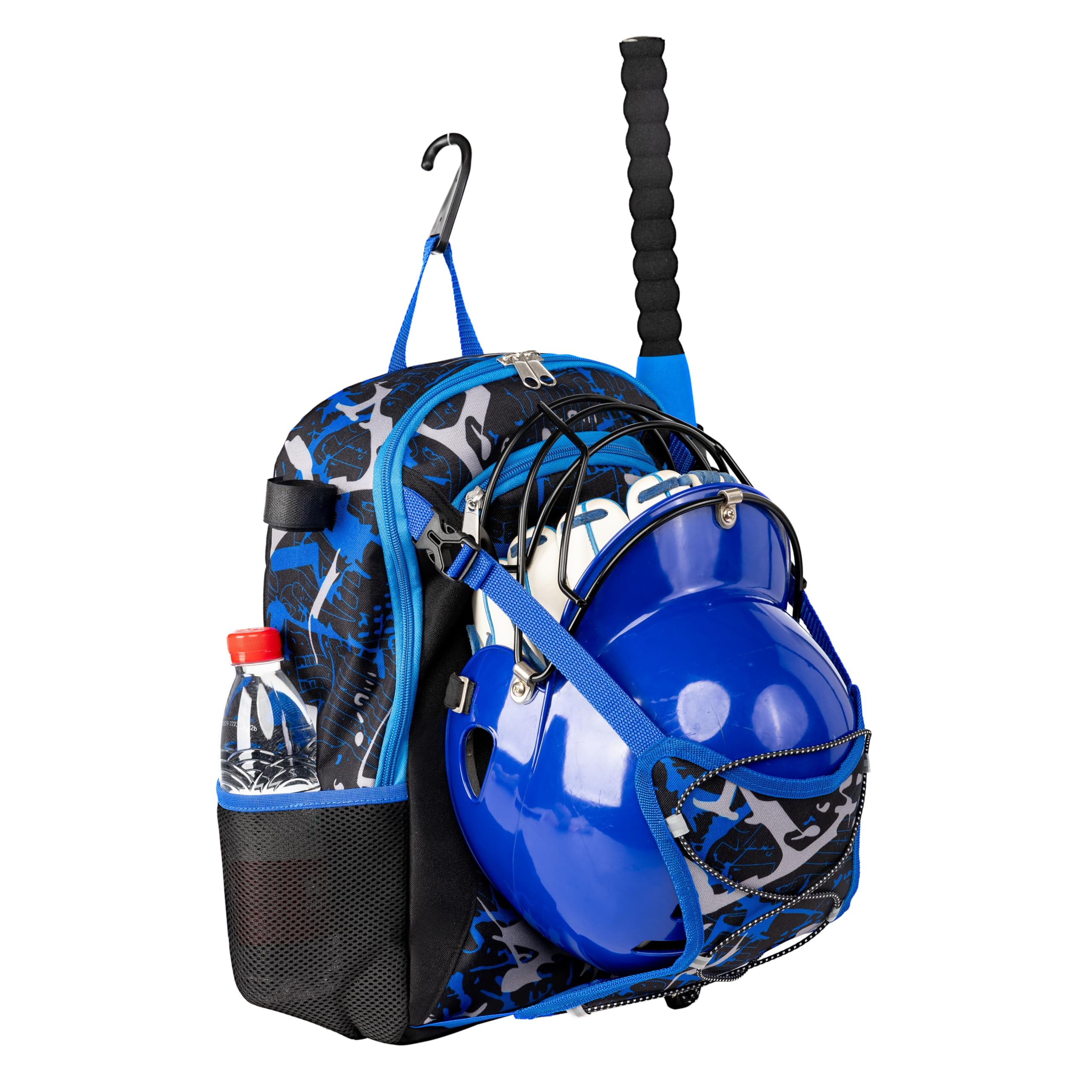
A featherweight first bat bag that swallows two bats and a helmet without complaint.
At 0.47 kg — that is one pound — this is the bag you hand a kid who is still small enough that a heavy pack is a real burden. It carries two bats, a baseball helmet, batting gloves, cleats, a cap and a catching glove in the main compartment, all while staying light enough to sling over a T-baller’s shoulders. An adjustable strap spreads the load, and a top handle gives a quick grab when the car is waiting.
The build is 600D oxford fabric with polyester, a dense woven material chosen to shrug off dirt, rain and mud, and the seams are sewn to hold a full load without tearing. For the dugout, there is an integrated fence hook so the bag hangs instead of sitting in the dirt, plus a front bungee cord to stash a cap or gloves in a hurry. Size is what people like most about this one — it fits exactly the gear a young player carries and no more. The bag measures 16 by 12 by 6 inches with two compartments.
The catch to plan for: two compartments means there is not a separate shoe section — wet or muddy cleats ride in with everything else unless you bag them.
Who it suits: a first- or second-year player who needs a simple, light bag and will not be carrying a full travel-load of gear.
Great starting point: a T-ball or early Little League player who needs a light bag that holds the basics.
Step up if: you need a dedicated cleat section — the bigger bags below have one.
7. LARIPOP Youth Baseball Bag

The bag that keeps muddy cleats away from a clean jersey and a dry helmet.
Once a kid plays in the rain, the cleat problem shows up fast: muddy shoes in the main compartment turn a clean uniform into a mess. LARIPOP fixes that with a dedicated waterproof shoe compartment that isolates dirty cleats from everything else. The bag holds bats, a helmet, gloves and personal items in a main section with organized pockets, and a built-in fence hook hangs it on the dugout rail so gear stays off the ground.
The shell is heavy-duty polyester with reinforced stitching, and the waterproof material keeps rain off the contents during a wet tournament. Two compartments, side pockets sized for bats and drink bottles, metal ventilation holes to dry gear out, and reflective strips for visibility in a dark parking lot round out the design. Capacity is what buyers appreciate most — the bag swallows a full set of equipment, which is why it works as well for softball as it does for baseball.
The hairline caveat: a handful of buyers found the fence hook missing or less functional than expected, so check yours on arrival — the hook is the one feature people disagree on.
Why it holds up: durable, spacious and easy on the wallet all at once, which is a hard combination to find in a large-format bat bag.
Made for: a player whose gear gets wet and whose cleats get muddy, and who needs a dry, separate shoe section.
Check on arrival: confirm the fence hook is there, since that is the one part where experiences vary.
8. Easton Dugout Youth Backpack

Easton’s do-it-all first bag, with a pocket for every piece of gear.
A good first bag has to answer one question: will everything fit and stay organized? The Easton Dugout keeps it simple. A main compartment holds a helmet, a ball glove and more, two mesh side pockets carry bats or water bottles, and a large front personal pocket holds the small stuff. The container is 16 inches of usable length, enough for youth gear without the bulk of an adult bag.
Comfort comes from padded back and shoulder straps with air mesh, so the weight sits on a T-baller’s shoulders without digging in. A fence hook lets the bag hang off the dugout rail, and custom metal zipper pulls make the zips easy to grab even with batting gloves on. The design is what people like most — it looks like a real ball bag and holds everything for a first season.
The honest caveat: it runs on the smaller side for some players — great for a Little Leaguer, but a growing travel player may outgrow the volume.
Where it shines: the two-compartment, striped-back structure makes packing fast, and the build quality holds through a full season of dugout life.
Start here: if your player is putting on the uniform for a first season and needs one reliable bag that covers the basics.
Move on if: you need a separate wet-shoe section or room for travel-ball volume — that is the bigger bags’ job.
9. Easton Walkoff Ethos Batting Gloves

The batting glove that puts a soft, tacky leather palm on a kid’s bat.
Bat control starts with the grip, and Easton builds this glove around a thick, tackified full-grain leather palm. Tackified means the leather is treated to stay grippy rather than slick, so a young hitter gets confident contact with the handle. The one-piece palm construction is stitched to hold through repeated swings, and double-layer leather reinforcement in the palm and thumb adds wear resistance where the glove takes the most pressure.
The fit is handled by an ergonomically designed one-piece neoprene cuff, thumb and wraparound strap that hug the wrist without a stiff break-in. The back of the hand uses cross-woven material fused with structured-flex silicone, which keeps the glove flexible through every swing. Sizes run from Youth Small through XL and Adult Small through XL, so a player can find a real fit instead of wearing gloves that twist. Each pair weighs 2.4 ounces.
The known limit: durability is the split point. Some players get a full season out of a pair, while others wear through the palm in under two months of daily batting practice.
Why it is on the list: the grip and the look. They match a bat cleanly and stand out in a dugout full of plain gloves.
Best for: the hitter who wants real grip and a secure wrist fit and treats a glove as a wear item to replace each season.
Weigh it against: heavy daily practice — a player batting every day may burn through a pair faster than a once-a-week player.
Know the Specs
Mask weight in ounces
A fielder’s mask weight is measured in ounces, and it is the number that decides comfort. A heavier cage pulls on the neck over a long game, and a young player ends up tipping their head or taking the mask off between pitches. Fifteen ounces is light enough that the mask fades from awareness, which is exactly when a kid keeps it on. Alongside weight, look at the cage width and length — a mask sized for smaller frames fits closer and moves less during a sprint.
Bicep and forearm measurements
Elbow guards are sized by two numbers, not by age. That is the bicep circumference and the forearm circumference, given in inches, and they decide whether the pad wraps snugly or slides. A youth guard built for a bicep of roughly 9.5 to 11.5 inches fits a small arm; an adult guard on that same arm will rotate in the swing. Measure both and match the chart. The right size stays put; the wrong size becomes a piece of gear the batter takes off between pitches.
Liter capacity on a bat bag
Bag capacity is measured in liters, which is a way of saying how much volume the main compartment holds. Thirty liters fits a helmet, glove, cleats and a water bottle with room to spare for most youth players. Number of compartments matters almost as much as capacity: a dedicated glove pocket or a waterproof shoe section keeps a clean jersey away from muddy cleats. A fence hook is the quiet hero — it lifts the whole bag off the dugout floor and keeps gear out of standing water.
Polarized lenses and UV protection
Polarized lenses have a filter layer that cuts glare bouncing off grass, water and sand, so a fly ball stays visible against a bright sky. TAC is one common type of polarized lens material, and a good pair blocks both UVA and UVB rays. For kids, the frame matters as much as the lens: a flexible, unbreakable frame survives a sprint into a fence, and an included strap keeps the glasses on the face during play. A wrap-around shape also shields eyes from dust and wind on a dry infield.
Common Questions
Is a fielder’s face mask safe to wear while fielding?
Do polarized sunglasses actually help a young baseball player?
What size elbow guard does my child need?
Do I need forearm coverage or just an elbow pad?
How big a bat bag does a T-ball player need?
Is a waterproof shoe compartment worth having on a bat bag?
What is the difference between a fielder’s mask and a catcher’s mask?
How long should youth batting gloves last?
Can youth sunglasses be worn under a helmet or mask?
Should I buy gear sized for now or sized to grow?
The Bottom Line
For most families, the winning youth baseball accessories pick is the Defender Fielder’s Wire Mask because 15 ounces of steel wire guard is the piece of gear that turns a scary infield position into a normal one, and the adjustable strap keeps it fitting as your player grows. If you want to cover three kids at once, grab the 3 Pack Kids Polarized Sunglasses so there is always a spare in the bat bag. And for the player whose gear gets wet and whose cleats get muddy, the LARIPOP Youth Baseball Bag is the one with the waterproof shoe section to match.
Across all nine picks, the gear kids actually keep on is the gear sized to their frame. A mask that does not wobble, a guard sized to the arm, a bag that swallows the gear without a fight — that is what earns its place in the dugout. Measure first, buy to that measurement, and the rest follows.
How we choose
We do not accept paid placement. Every pick is matched to a real buyer and a real use-case; we do not hands-on test units.
Sources
Specifications: manufacturer listings and product documentation. Review insights: verified customer reviews. Pricing: not shown on this page (it changes often); check the current price via the retailer link.
As an Amazon Associate, Tactical Gear Guy earns from qualifying purchases. This does not affect which products we feature.