Specs are compiled from manufacturer listings and verified buyer reviews and can change over time — please confirm the key details on the product page before buying.
The right yoga mat is the one your hands and feet stay planted on halfway through a pose. Thickness, width and how it rolls up all come second to that. This guide sorts nine real mats by what they actually do on the floor, so you can match one to your practice instead of guessing from a photo.
This guide is built by comparing the manufacturers’ published specifications and the patterns across verified customer reviews, so you get each pick’s real strengths and trade-offs instead of marketing spin.
You will see how grip changes once sweat enters the picture, why a thicker mat is not automatically a better one, and which surface stays put on hardwood. Below you will find the full breakdown of every yoga mat here, from cushioning depth to packed weight.
Top Picks


How To Choose The Best Yoga Mat
Pick your mat by your practice first, then by your body’s joints and frame. A hot yoga session and a slow evening stretch ask completely different things of the same rectangle of foam.
Start with grip, and be honest about sweat
Dry grip is easy — almost every mat has it when new. The real test comes once your palms dampen. A mat with a textured top and a wave or dot pattern underneath tends to hold its place better than a smooth sheet. If you sweat heavily, prioritise a mat whose makers specifically describe wet grip.
Match thickness to your joints, not to a trend
A 6mm mat gives most people enough cushion for knees and wrists. Going up to 10mm or 12mm adds plushness for kneeling postures and floor work. The trade-off is stability: the softer the surface, the more your standing poses can feel wobbly.
Check length and width against your own frame
Standard mats run 68 to 72 inches long and 24 inches wide. If you are tall or you take a wide stance, a 32-inch-wide mat buys you room to move without your hands drifting off the edge.
Weigh the material against how you will care for it
PVC mats are durable and easy to wipe down. TPE is lighter and often lower-odor. Natural rubber grips well but dislikes sun, soaking, and most soaps. Whichever you pick, expect a factory smell on day one — nearly all of these need airing out.
Side-by-Side Comparison
| Model | Best For | Thickness | Size (L x W) | Weight | Amazon |
|---|---|---|---|---|---|
| Gaiam Premium Yoga Mat★ Best Overall | Everyday practice with style | 6 mm | 68″ x 24″ | 3.1 lb | Amazon |
| Gaiam Thick Yoga MatBest Value | Joint-friendly floor work | 10 mm | 72″ x 24″ | 930 g | Amazon |
| Readaeer Double Color MatBest for Travel | Folding and travel | 6 mm | 72″ x 24″ | 700 g | Amazon |
| YOTTOY Extra Thick Mat | Knees and seated postures | 12 mm | 72″ x 24″ | 4 lb | Amazon |
| KEEP Extra Wide Mat | Wide stances and taller bodies | 7 mm | 72″ x 32″ | 2.8 lb | Amazon |
| Plyopic Ultra Grip PRO | Hot yoga and sweaty hands | 0.17″ | 72″ x 26″ | 2.4 kg | Amazon |
| Manduka eKOLite | Eco-minded flow practice | 4 mm | 71″ x 24″ | 5.2 lb | Amazon |
| Manduka PRO | Studio-grade stability | 6 mm | 85″ x 26″ | 3.4 kg | Amazon |
| Liforme Special Mat | Alignment-led practice | 4.2 mm | — | 2.5 kg | Amazon |
Detailed Reviews
1. Gaiam Premium Yoga Mat, 6mm Thick Print Mat
Our pick — 4.5+★ from 22,000+ verified ratings; the strongest balance of quality and price.
The crowd favourite: a 6mm printed mat that makes you want to unroll it.
Design is what wins people over here — the prints and colour range are the single biggest thing buyers talk about, and it is easy to see why when most mats are a dull slab of grey. At 6mm thick, the cushioning sits in the sensible middle: enough padding under your knees for floor work, not so soft that standing balances get mushy. It measures 68 inches long by 24 inches wide, which covers a standard practice without extra bulk.
Where it earns its keep is on the floor. The textured surface is described as sticky, and the dark colourways hide scuffs from studio asphalt and dusty gym floors. Gaiam states the material is 6P-free PVC, meaning it leaves out six specific plasticisers (DEHP, DBP, BBP, DINP, DIDP and DNOP). The honest catch is that this is a dry-surface mat — the grip feedback splits sharply once hands get clammy, so hot yoga is not its home.
One more practical note: the maker advises unrolling and airing the mat for 2 to 3 days before first use, because a harmless odour shows up out of the packaging. Do that and you skip the complaint most new owners run into. A link to a free downloadable yoga class comes in the box too.
What earns it first place
- Print designs and colour choices are the most-praised part of this mat by a wide margin
- 6mm thickness lands the middle ground between joint padding and standing stability
- 6P-free PVC formula and an included free downloadable class
- Dark colour schemes hold up against scuffs and dirt
Where it asks patience
- Grip gets divisive once your hands sweat — this is a dry-practice mat
- Needs 2 to 3 days of airing out before the new-mat smell settles
- Hand wash only, so no machine cleaning
Reach for this if: you want one good-looking, well-cushioned mat for home flows, Pilates and stretching, and you are not planning to sweat hard on it.
Look elsewhere if: hot yoga or a sweaty vinyasa is your regular — the mixed grip reports point you toward a wet-grip mat instead.
2. Gaiam Thick Yoga Mat
Ten millimetres of plush foam for knees that have had enough of hard floors.
If kneeling postures make you wince, this is the mat to start with. It is built from 10mm high-density NBR foam — a soft synthetic rubber that prioritises shock absorption over firmness — and describes itself as reducing pressure on knees, hips and joints. Thickness is the most-discussed trait of this mat by a long stretch, with comfort running right behind it.
The surface is textured foam rather than a sticky coating, so it keeps its place on most hard floors during dry workouts. That softer feel is the whole point: it is aimed at beginners, low-impact yoga, Pilates, stretching and physical therapy-style floor work. It rolls up fast and ships with an adjustable cinch strap, and at 930 grams it is a genuinely light mat to carry between rooms or classes.
The trade-off to go in aware of: soft foam is not built for abrasion. Some buyers report tearing and some report it sliding across smooth floors, so treat it as a comfort mat rather than a heavy-use one. A foam smell is present on opening and typically fades after 24 to 48 hours of airing.
Comfort-first maths: 10mm of NBR foam compares to the 6mm of the Gaiam Premium above — noticeably more cushion under the knees, noticeably less firmness when you stand on one leg.
Carry and care: 930 grams in the hand and a wipe-down with a damp cloth is all the maintenance it asks for. Hand wash only.
Your match if: your practice is on the floor — stretching, Pilates, low-impact routines on wood, tile or concrete.
Not your match if: you need a mat that resists wear from daily studio use or one that anchors hard on polished floors.
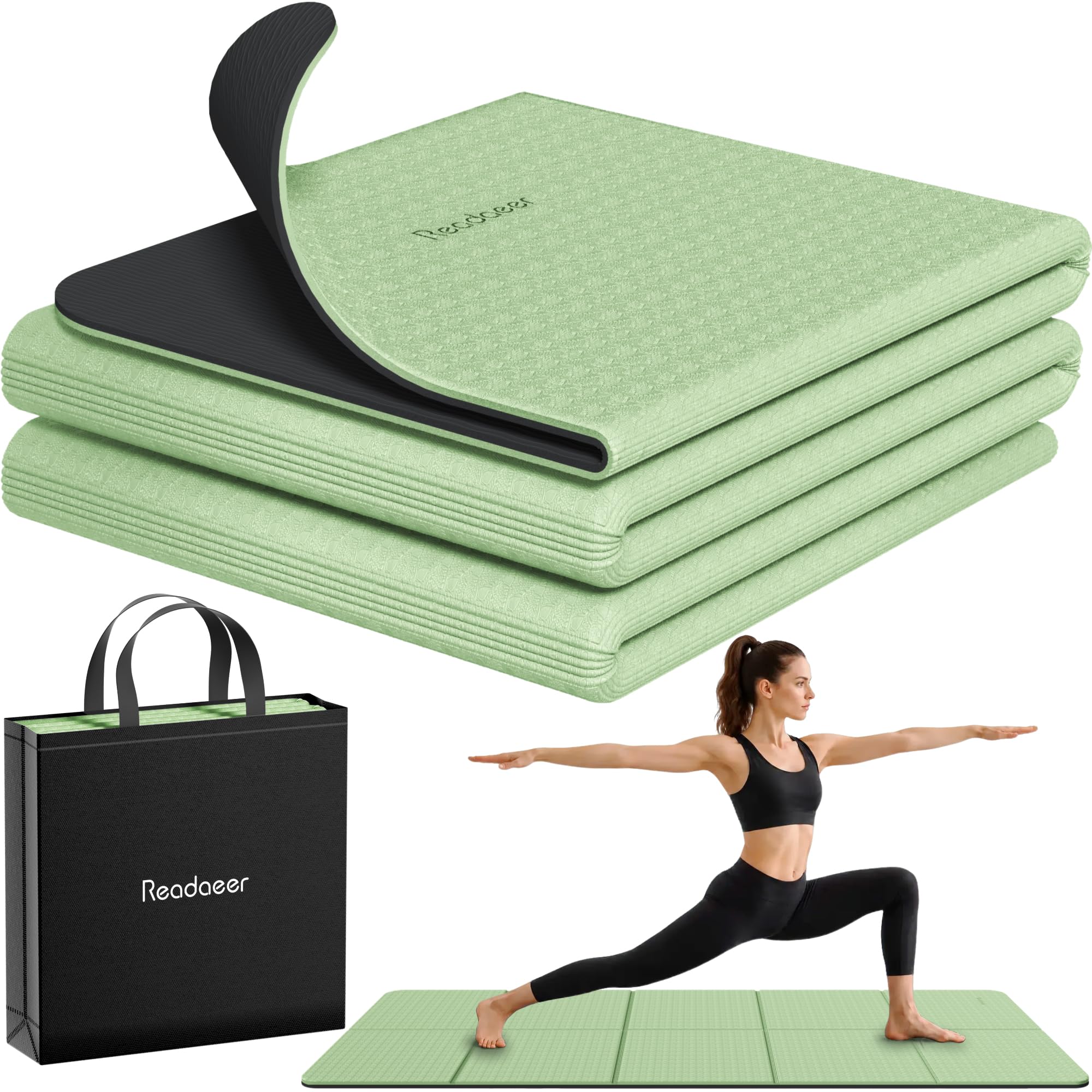
3. Readaeer Double Color Yoga Mat 6mm
It folds like a blanket instead of rolling — and that changes how you carry it.
Foldability is the reason this mat exists, and it is the thing buyers bring up most. Instead of a roll that fights your gym bag, it folds flat and drops into the included storage bag. At 700 grams it is the lightest mat in this lineup, and it measures 72 inches long by 24 inches wide with 6mm of TPE — a rubbery plastic that gives springy cushioning with less odour than PVC.
Both faces are textured for grip: a polygonal pattern on the side that touches your skin, a wave pattern on the side that meets the floor. Readaeer backs it with a 1-year warranty and pitches it for yoga, Pilates, stretching and muscle training, indoors or out. One thoughtful detail owners notice is that folding lets you keep one clean side facing up while the other takes the floor.
The honest limit is grip and size, both of which draw divided feedback. It is a solid travel companion rather than a studio workhorse, so do not expect it to behave like a heavy-duty mat under a hard sweaty flow.
Pack-list verdict: if your mat lives in a duffel bag or a car boot, a fold-flat 700-gram rectangle beats a roll every time.
Made for: gym-goers and travellers who want a mat that disappears into a bag.
Think twice if: you want a firm, anchored surface for intense daily flows.
4. YOTTOY Extra Thick Yoga Mat 12mm

Twelve millimetres of TPE: the mat you buy when kneeling hurts.
Doubling down on padding is the whole pitch. The YOTTOY runs 12mm thick against the 6mm of the Gaiam Premium — twice the depth of foam under your knees and wrists. That extra depth suits kneeling and seated postures, and quality is the trait owners praise most, with the cushioning close behind.
The surface uses granular protrusions to raise friction and soak up sweat, while a water-ripple texture on the reverse grips the floor. YOTTOY states the TPE is SGS and TUV certified for environmental safety, free of heavy metals like lead and cadmium and of 10 types of phthalate. It also claims the one-piece foam process leaves the mat waterproof and sweat-proof.
There is a real weight cost. At 4 pounds it is roughly 29% heavier than the 3.1-pound Gaiam Premium, so it stays home more often than it travels. Stability splits opinion too — some find it planted, others find it shifts. Wipe it with cold water and mild detergent, lay it flat to dry, and keep it out of direct sun.
Why the cushioning crowd loves it
- 12mm of TPE gives the deepest padding here for kneeling and seated work
- SGS and TUV certified for environmental safety, heavy-metal and phthalate free
- Granular top texture plus water-ripple underside for two-way grip
- Straps included for carrying to class, the office or camping
What to know before you commit
- 4 pounds is a lot of mat to haul around compared with lighter picks
- Stability feedback is divided — soft foam and firm balance do not always agree
- Hand wash only and must stay out of long sun exposure
Built for: anyone whose knees and joints need real padding on a hard floor, and who practices at home rather than on the move.
Weigh the bulk: this is the pick to skip if your mat has to travel to a studio several times a week.
5. KEEP Extra Wide Yoga Mat, 7mm Thick, 72″ x 32″
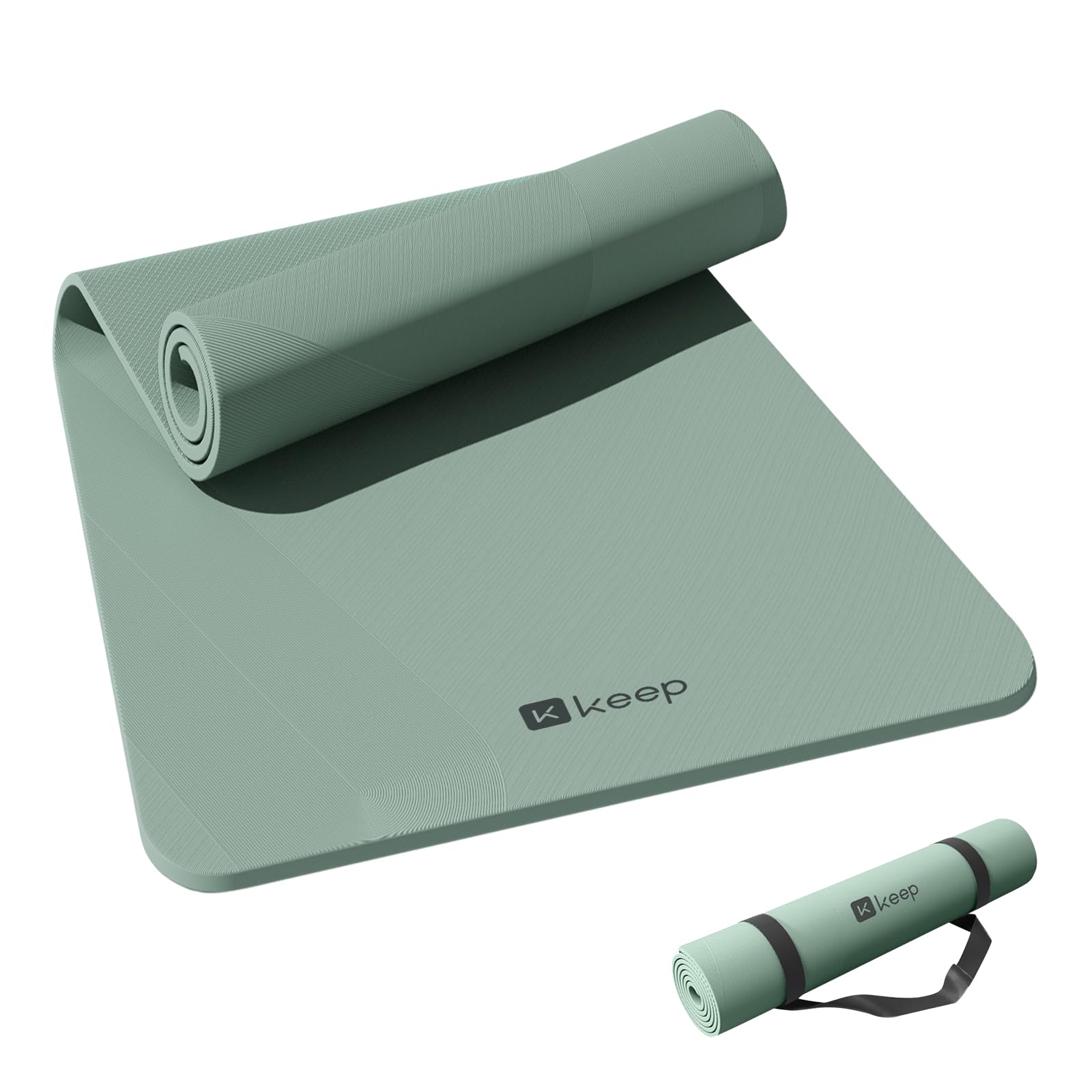
Thirty-two inches wide, so your hands never wander off the edge mid-flow.
Width is the whole argument here. At 32 inches across, this mat is a third wider than the 24-inch Gaiam Premium — 8 extra inches of floor for wide stances, tall bodies and dynamic movement. It is also 4 inches longer at 72 inches, so even a lanky practitioner can stretch out without hanging off the end.
The surface is built in two layers: a fingerprint-style anti-slip texture on top for precise control, and a full anti-slip pattern underneath so no corner sits loose. At 7mm thick, the TPE padding protects knees, elbows and joints without the pillow-soft feel of a 12mm mat. KEEP states the material is free of plasticisers and formamide, and at 2.8 pounds it stays light enough for a shoulder strap.
Your feet either trust this mat or they don’t, and that is the whole story. Grip is the most argued-about point in buyer reviews, and opinions on value for money and durability split too. To get the best from it, air it out before first use to clear any packaging odour, spot-clean with cold water, and keep it out of prolonged sun.
Room to move: 32 inches of width is the practical fix for anyone who has ever planted a hand on bare floor during a lunge.
Best for: taller practitioners and anyone who takes wide stances or practices with children and pets nearby.
Look at a grippier mat instead: if a locked-down surface matters more to you than extra floor space.
6. Plyopic Ultra Grip PRO Yoga Mat
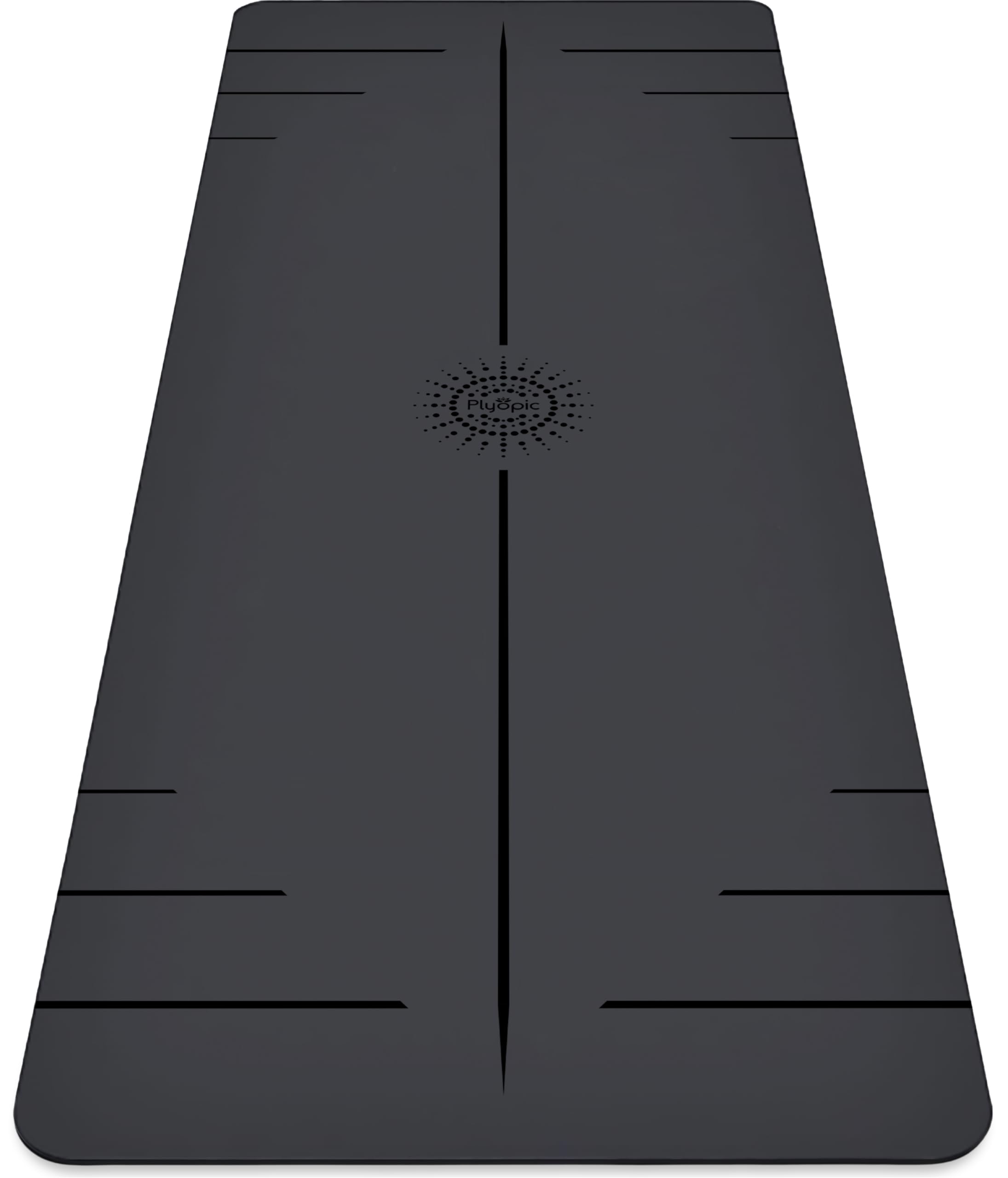
The mat for people whose hands betray them three poses into a hot class.
UltraGrip is the claim, and grip is the second-most-praised trait of this mat after overall quality. The pitch is specific: it holds contact as moisture builds, so sweaty sessions and hot yoga do not turn your hands into skates. That is the exact failure point the Gaiam Premium above struggles with, which makes this the natural step up for a heavy sweater.
PoseMap is the other differentiator. It prints reference points for hands, feet and centre across the surface, so you can check symmetry at a glance instead of guessing. Underneath, dense natural rubber cushions knees and wrists on hard floors, with an integrated fibre layer keeping it stable. It measures 72 by 26 inches, is vegan-friendly and PVC-free, and comes with a carry strap.
Cushioning is where opinions split — some find it soft, others find it thin. At 0.17 inches it is a firm, grounded mat rather than a plush one, and odour on arrival draws mixed notes too. Weigh 2.4 kg and it is not a featherweight.
The alignment edge: if you have ever wondered whether your hips were level, the printed PoseMap points answer it without a teacher walking over.
Firm, not floaty: this is a stability-first build — the opposite experience of the 12mm YOTTOY above.
Choose it for: hot yoga, sweaty flows, and anyone who wants alignment help built into the surface.
Pass if: you want deep plush padding under your knees.
7. Manduka eKOLite Yoga Mat 71″ – 4mm Natural Rubber
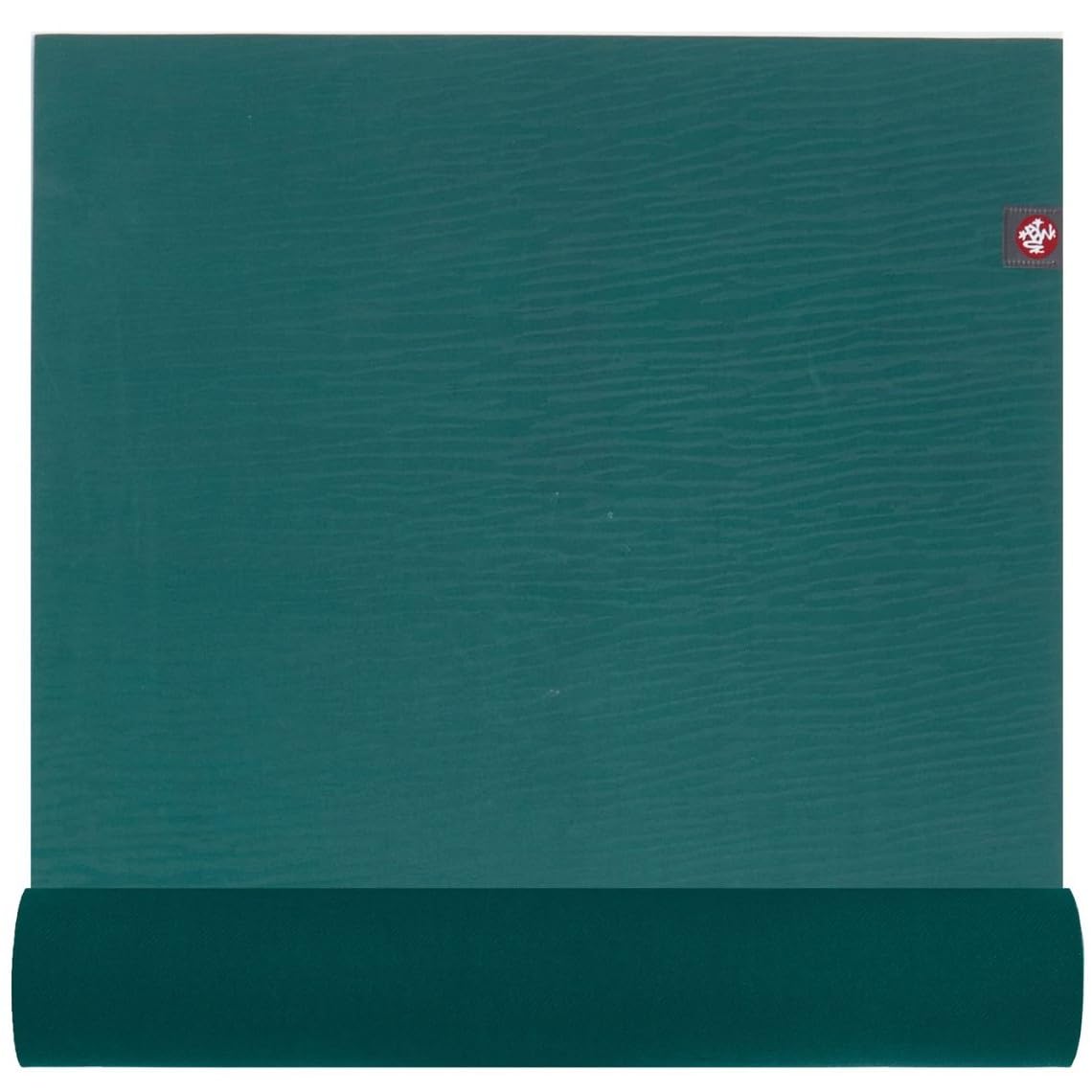
Natural tree rubber with a rippled surface that grips hard, then asks for care.
Material is the reason to look here. This mat is 100% natural tree rubber, 99% latex-free, with a closed-cell surface that keeps moisture and grime from soaking in. The rippled Catch-Grip texture is meant to hold you steady through both strong flows and slow holds. Quality is what owners praise most, and the colourways draw plenty of compliments.
At 4mm and 5.2 pounds, it is a firm, grounded mat built for smaller spaces and portable practice. It measures 71 by 24 inches. The open question is sweat: grip reports are mixed, and several owners find it loses bite once it gets damp, so hot yoga suits it better in cooler sessions than in a heated room.
Care is where natural rubber bites back. Manduka specifies its own Natural Rubber Yoga Mat Restore, five minutes of dwell time, then a wipe. No soaking, no sun, no soap, no garden hose, no vacuum, no washing machine. Durability reports are mixed as well, ranging from years of use to early peeling. Do the care routine properly and you give it the best chance.
The natural-rubber case
- 100% natural tree rubber, 99% latex-free, closed-cell surface
- Rippled Catch-Grip design for traction in strong flows and long holds
- 4mm and 71 x 24 inches — a firm, portable footprint
- Quality and appearance are what owners single out most
What the rubber demands
- Grip weakens when sweaty, so a hot room is not its strength
- Restricted care: no soap, no soaking, no sun, no machine washing
- Durability reads vary from long service to early peeling
Fits you if: you want a firm natural-rubber mat for cool-room flows and you will follow a specific cleaning routine.
Skip the hassle if: you want to sweat freely and then hose the mat down.
8. Manduka PRO Yoga Mat – 6mm, Lifetime Durability

Eighty-five inches of dense, closed-cell mat built for people who keep things for years.
Length is the headline. At 85 inches by 26 inches, this mat gives tall practitioners and big builds room that a 68-inch mat simply cannot. The 6mm cushioning is ultra-dense rather than soft — Manduka calls it studio-quality — and a no-slip dot pattern on the bottom keeps the mat fixed to the floor. The closed-cell surface seals out moisture, so sweat does not sink in.
The build is PVC from an emissions-free German facility and OEKO-TEX certified, and it is latex-free. Manduka backs it with a lifetime guarantee. Quality and length are what owners highlight most, and the thickness earns credit for knee protection.
Here is the trade-off, plainly: it weighs 3.4 kg and owners describe it as heavy. It is a mat that lives in one room, not one that rides to class in a tote. Grip also draws mixed reports, with some finding it slippery, and Manduka asks you to clean only with its own Yoga Mat Wash & Refresh.
One mat, one spot: buy this for a dedicated home practice area where the mat stays put, and the 3.4 kg stops mattering.
The right buy for: taller yogis and anyone who wants a single dense mat to keep at home long-term.
Wrong buy for: a mat that has to travel — this one is heavy and wants its own cleaner.
9. Liforme Special Yoga Mat

Grip that stays grippy when sweaty-wet, plus alignment guides printed into the surface.
Liforme builds this mat around GripForMe, a material the brand describes as holding its bite even through a sweat-soaked session. Comfort and grip are what owners praise most, and the alignment markers come up again and again as the feature that made practice click. It is 4.2mm thick and recommended for hot yoga, with a free yoga bag included.
The materials are eco-polyurethane and rubber, PVC-free and non-toxic, so the mat stays clean and hygienic between sessions. It is a firm mat — 4.2mm is grounding rather than pillowy — and thickness draws mixed reactions, with some finding it on the thinner side.
Care is straightforward but specific: hand wash only. Weighing 2.5 kg, it is a mat you keep at home or carry with the included bag rather than roll into a pocket. If alignment cues and wet grip are your two priorities, this is the pick that delivers both.
Two priorities, one mat: grip and alignment guides are the two things buyers mention most, and both point at the same outcome — better, more confident positioning.
Right for you: hot yoga and sweaty flows where alignment feedback matters.
Not for you: if you want a thick, plush mat for knee comfort.
Know the Specs
Thickness in millimetres
Thickness decides how much foam sits between you and the floor. A 4mm mat is firm and grounded; a 6mm mat adds cushioning for knees and wrists; anything from 10mm to 12mm turns plush and suits kneeling postures and floor work. The trade-off is balance — the softer the surface, the more a standing pose can wobble. Beginners on hard floors often prefer the thicker end, while experienced practitioners who hold long balances tend toward the firmer end.
Dry grip versus wet grip
Almost every mat grips when dry, so the meaningful question is what happens once your palms dampen. Mats with a textured top and a wave, dot, or full anti-slip pattern underneath tend to stay planted longer. If you sweat heavily or practice hot yoga, look for a maker who specifically describes wet grip, because a dry-only surface can go slick the moment moisture builds.
Mat materials: PVC, TPE, and natural rubber
PVC is durable, wipe-clean, and the base of many printed mats. TPE is a lighter, springier rubbery plastic, often lower in odour. Natural rubber delivers strong grip but dislikes sun, soaking, and most soaps. Each brings a care routine with it, so check the cleaning instructions before you buy — some mats are hand wash only and a few restrict your cleaner entirely.
Weight and packability
Light mats in the hundreds of grams suit gym bags and travel. Heavier mats in the kilos stay home and anchor better. A foldable mat travels differently from a rolled one, and a strap or carry bag makes the difference between a mat you take everywhere and one that never leaves the living room.
Width and length
Standard mats run 68 to 72 inches long and 24 inches wide. Extra-wide mats stretch to 32 inches, which gives wide stances and taller bodies room to move without hands slipping off the edge. Extra-long mats reach 85 inches for taller practitioners.
Odour and first use
Almost every new mat carries a factory smell. PVC and rubber mats typically need a few days of airing, and some foam mats clear in a day or two. Unroll it in a ventilated room before your first session and you avoid the most common early complaint.
Common Questions
What thickness of yoga mat is best for bad knees?
Do yoga mats really stay grippy when you sweat?
How long should a yoga mat be for a tall person?
Can I wash my yoga mat in the washing machine?
Why does my new yoga mat smell?
Is a wider yoga mat worth it?
What is the difference between PVC and TPE yoga mats?
How do I clean a natural rubber yoga mat?
Can I use a yoga mat for Pilates and floor workouts?
Is a heavy yoga mat better for stability?
The Bottom Line
For most people, the best yoga mat here is the Gaiam Premium Yoga Mat — 6mm of sensible cushioning, a textured non-slip surface, and the widest range of prints and colours in the lineup. It backs that up with 4.5+ stars across 22,000+ ratings.
If you sweat hard, the Plyopic Ultra Grip PRO is the upgrade that earns its place with wet-grip performance and PoseMap alignment lines. For joint-friendly floor work, the Gaiam Thick Yoga Mat delivers 10mm of plush NBR foam. And if you want the firmest, longest studio mat in the lineup, the Manduka PRO in 85 inches is the answer.
Pick by your practice, not by the picture on the box: grip first, then cushioning, then weight.
How we choose
We do not accept paid placement. Every pick is matched to a real buyer and a real use-case; we do not hands-on test units.
Sources
Specifications: manufacturer listings and product documentation. Review insights: verified customer reviews, as of November 2026. Pricing: not shown on this page (it changes often); check the current price via the retailer link.
As an Amazon Associate, Tactical Gear Guy earns from qualifying purchases. This does not affect which products we feature.