Specs are compiled from manufacturer listings and verified buyer reviews and can change over time — please confirm the key details on the product page before buying.
Kneel on the wrong yoga mat and your knees will complain by the second sun salutation. A pad thin enough to feel the floor through hurts your joints. A pad that grips the floor may still slide under a sweaty hand. A mat that rolls up easily can tear at the edges within weeks. Here is what the thickness number really means for your joints, and what the strap actually does during class.
This guide is built by comparing the manufacturers’ published specifications and the patterns across verified customer reviews, so you get each pick’s real strengths and trade-offs instead of marketing spin.
You will see the exact thickness, length, material, and strap style for each pick side by side, plus the honest grip and durability trade-offs. What follows is a straightforward shortlist of the yoga mat with strap options that solve the kneeling problem without sliding away mid-pose.
Top Picks


How To Choose The Best Yoga Mat with Strap
The first decision is not the brand. It is the thickness, because that single number decides what your body feels on the floor. A thin pad is stable but unforgiving on your knees and hips. A thick pad is kind to your joints but soft enough to shift your balance in standing poses. Know which routine you actually do before you pick.
Thickness: The Number That Decides Your Comfort
Thickness runs from about 0.25 inch up to a full inch, and each step changes the feel. A 0.25-inch mat keeps you close to the floor for balance, while a 1-inch mat gives deep cushioning under knees and hips. If you mostly kneel, sit, or do floor work, the extra cushion wins. If you hold long standing poses, thinner keeps you planted.
Material and Grip: What NBR and TPE Foam Do
NBR foam is soft, dense, and plush, and it is the material behind most very thick mats. TPE is a lighter closed-cell foam that resists sweat soaking in and wipes clean easily. Both come in textured surfaces, but grip depends on the floor and on your sweat. A mat that grips bare wood may still slide on tile, so always check the surface you plan to use.
The Strap: Carry Handle Versus Stretch Strap
Most mats here ship with an adjustable carrying strap that cinches the rolled mat for transport. A few offer a dual-use strap that also works as a yoga stretching strap, which gives you one more tool for hip and hamstring work. Check the strap style if you carry the mat between classes rather than leaving it rolled in a corner.
Side-by-Side Comparison
Every column below uses the same three measurements so you can scan them at a glance. Decide your thickness limit first, then look at length and weight for portability.
| Model | Best For | Thickness | Length x Width | Material | Amazon |
|---|---|---|---|---|---|
| Gaiam Thick Yoga Mat★ Best Overall | Knee-friendly floor work | 0.39″ | 72″ x 24″ | NBR foam | Amazon |
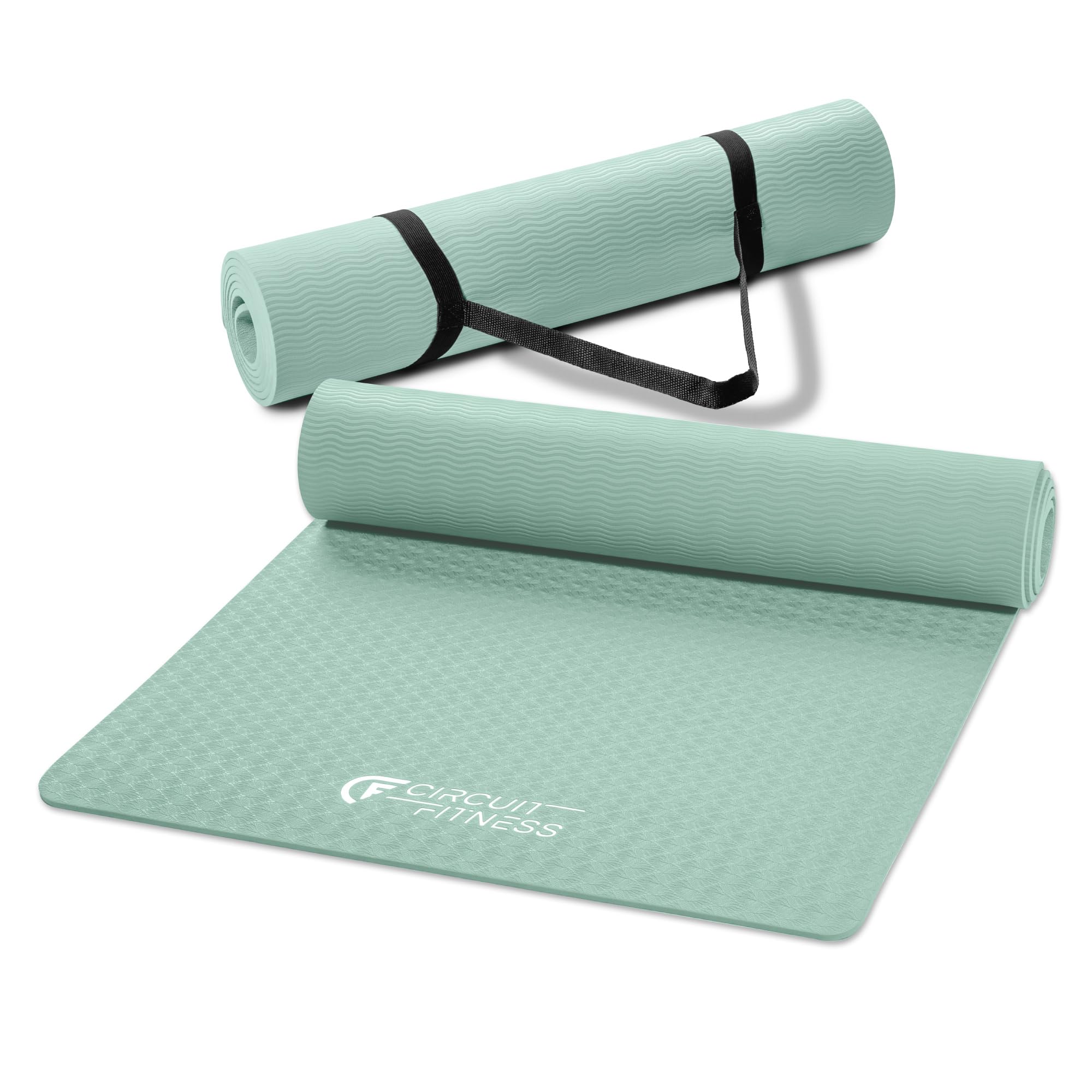
| Circuit Fitness by MarcyBest for Travel | Travel and storage | 0.25″ | 74″ x 24″ | TPE | Amazon |
| Fitvids All PurposeBest Value | Multi-exercise versatility | 0.25″ | 68″ x 24″ | High-density foam | Amazon |
| LOKATSE Home All Purpose | Moderate cushion, low cost | 0.4″ | 72″ x 24″ | NBR foam | Amazon |
| Tone Fitness 1″ Extra Thick | Deepest cushioning | 1″ | 72″ x 24″ | NBR foam | Amazon |
| YOTTOY Extra Thick | Certified materials | 0.5″ | 72″ x 24″ | TPE | Amazon |
| KEEP Extra Wide | Extra width for all poses | 0.28″ | 72″ x 32″ | TPE | Amazon |
| Retrospec Solana Extra Thick | Hot yoga and Pilates | 1″ | 72″ x 24″ | Foam | Amazon |
| Extra Long & Wide Thick Yoga Mat | Tall and wide users | 0.28″ | 84″ x 32″ | TPE | Amazon |
Detailed Reviews
1. Gaiam Thick Yoga Mat
Our pick — 4.5+★ from 46,500+ verified ratings; the strongest balance of quality and price.
A 10mm NBR foam mat that puts real cushion under knees and hips on hard floors.
Your knees, hips, and joints get real protection from the 10mm layer — about 2/5 of an inch of high-density NBR foam (a firm, shock-absorbing foam). That cushioning is why this mat sits at the top of the pile. The textured surface helps the foam hold its place on most hard floors during dry workouts, so your mat stays under you rather than skating toward the sofa. For beginner yoga, Pilates, stretching, or floor exercises at home, that soft, shock-absorbing feel is exactly what you want.
Carrying it is easy thanks to the adjustable strap included in the box, and the mat rolls up quickly for storage between rooms or trips to class. At 930 g (about 2 pounds) it is light enough to tuck under one arm and carry without a second thought. Cleaning takes one damp cloth because the foam is low-odor and easy to care for. The maker notes a foam smell may be present when you first unroll it and typically fades after airing out for 24–48 hours, so give it a day or two in a ventilated room before class night.
Where owners split is durability and stability. Some say the mat holds up a long time and stays put; others find the foam tears more easily and that it slides around on slick flooring. That softer, cushioned design deliberately trades some firmness for shock absorption, so treat it as a plush floor mat rather than a hard-wearing studio workhorse. On the value side, this is the strongest combination of rating and review volume in the whole roundup: 4.5+ stars across 46,000+ ratings.
What earns it first place
- 10mm NBR foam delivers deep cushioning under knees, hips, and joints
- Textured surface grips most hard floors during dry workouts
- Adjustable cinch strap and 930 g weight make it easy to carry and store
- Low-odor foam wipes clean with a damp cloth
Where it asks for care
- Some buyers report the foam tears and the mat slides on slick floors
- Initial foam odor may need 24–48 hours of airing before first use
- Soft cushioning favors comfort over firmness for standing balance
Made for: home floor work where knee comfort matters more than a rock-hard base.
The honest catch: that plush foam is the least durable option for high-sweat studio sessions — use it dry and it earns its keep.
2. Circuit Fitness by Marcy Yoga Mats
At 1.5 pounds, the lightest full-size mat here, with a 0.25-inch TPE surface for balance work.
Start with the weight: at 1.5 pounds this is the lightest full-size mat here, and it outweighs nothing in your gym bag. Compare it directly to the Tone Fitness at 3.8 pounds and the difference in your shoulder on the walk to the studio is obvious. The 0.25-inch thickness (6mm) keeps you close to the floor for balance and stability during standing poses, so it suits anyone who finds a soft mat too wobbly. And it runs 74 inches long — the longest of the compact models, nine percent longer than the Fitvids at 68 inches, which gives taller users more room to stretch out.
It is built from TPE, a closed-cell foam that resists sweat and moisture absorption. That matters if you work up a sweat on the floor: it wipes clean with a damp cloth instead of soaking up moisture like a sponge. The dual-sided texture is engineered to grip on hardwood, tile, or carpeted floors during bodyweight routines, and the included shoulder carry strap lets you sling it down the block or across a gym parking lot.
Grip is the honest watch-out. Some owners find it stays in place well during use, and others find it slippery on the floor, especially when new. The strap and the mat also collect a mixed response — fine for a quick commute, less comfortable on a long haul. Treat the first few sessions as a break-in period and let the surface settle.
Why it earns its slot: it is the lightest, longest mat in the compact tier and the TPE surface shrugs off sweat without a fuss.
Pick this if: you carry your mat to class several times a week and need it light on the shoulder.
Think twice if: you need deep knee padding across a long kneeling session — that quarter inch will not match a one-inch pad.
3. Fitvids Exercise Yoga Mat
A 68 x 24 inch, 1/4-inch foam mat for stretching, core work, and light yoga at home.
The Fitvids positions itself as a do-everything mat, and the numbers back the claim. At 68 inches long and 24 inches wide it gives people of most shapes and sizes room to move. The 1/4-inch foam cushions your spine, hips, knees, and elbows on hard floors while keeping you balanced, and the double-sided non-slip surfaces are there to help you avoid a slip mid-move. It weighs 2 pounds, which is light enough for a daily tote to the gym.
A free yoga mat strap is included, and the moisture-resistant surface washes with soap and water rather than needing careful handling. That simplicity is the real draw: you can wipe it down, roll it up, and head out without treating the mat like a delicate object. It is a work-first mat for stretching, core work, and everyday bodyweight sessions at home.
Be clear-eyed about the durability and thickness, though. Some owners mention the mat falling apart on first use, and others find the 1/4-inch padding not as deep as thicker alternatives. For a budget-friendly mat used for general exercise, most sessions go fine, but this is not a mat to buy if you kneel heavily or expect years of sweat-drenched studio work.
What you are really getting: a light, strap-equipped mat at a wallet-friendly tier for general movement and light yoga.
Reach for it when: you want one inexpensive mat for stretching and bodyweight workouts at home.
The trade-off: thickness and durability land behind the pricier picks — this is a starter mat, not a long-term one.
4. LOKATSE Home Thick Yoga Mat

0.4-inch high-density NBR foam that keeps your spine and hips off a hard floor during crunches and sit-ups.
The 0.4-inch high-density NBR foam is the thickest in the value cluster and it is built for one job: keeping your spine, hips, knees, and elbows off a hard floor. The 72 x 24 inch surface gives most body types room to work, and the anti-skid design pairs a ribbed side with a smooth side so one face grips the floor and the other meets your body. Comfort and cushioning are the aspects owners bring up most, and crunches, sit-ups, and push-ups are the kind of use the review pages describe.
You hand-wash this mat, and the maker offers a strong warranty through its own store. The included carrying strap plus the light build make it simple to move between rooms. Compared with the Gaiam above, it is slightly thicker at 0.4 inch versus 0.39 inch and offers the same classic NBR feel — a sensible stand-in if you want very similar cushion at a slightly different price tier.
The durability sits at mixed: some mats hold up well and others show signs of wear with use. Slippage gets a similar split response — good grip for many, less so for others on smooth floors. For a plush floor pad used mainly for stretching and bodyweight work, those two caveats are worth knowing before you commit to it as your only mat.
What buyers tend to value
- 0.4-inch NBR foam cushions joints for floor work
- Ribbed anti-skid surface grips the floor on one side
- 72 x 24 inch size fits most body types
- Lightweight build with included carrying strap
What to keep in mind
- Durability feedback is split between long wear and early signs of wear
- Slippage varies with the floor surface
- Hand-wash only care
Suits: anyone who wants a moderately thick, plush mat for stretching and core work at home.
Skip the shortcut: if you need aggressive grip for sweaty flow, a textured TPE surface will serve you better than this soft NBR.
5. Tone Fitness 1″ Extra Thick Yoga Mat

One inch of high-density NBR foam, the deepest cushioning in this roundup for kneeling and seated poses.
One inch of high-density NBR foam is the most cushioning in this roundup for kneeling, sitting, and lying poses. That is a serious step up from the Circuit Fitness at 0.25 inch and the Fitvids at 0.25 inch, and it is the mat to choose if your hips and knees ache after floor sessions. The 72 x 24 inch surface gives you room for Pilates, stretching, core training, and bodyweight work, and the textured face helps keep grip during controlled movements.
It is latex-free, wipes clean between workouts, and the included strap secures the roll for storage so it does not sit sprawled across your home gym floor. Portability and the carry strap both get a mixed reception — this is a thicker mat, so expect bulk as the price of that cushioning. At 3.8 pounds it is heavier than the compact picks, which you will notice on a long walk to class.
The real drawback is stability. The pad slides around on hardwood floors, and that soft cushioning is the trade-off for keeping you balanced in standing poses. Use it for kneeling and seated work where the plushness helps, and skip it for fast flows on slick wood.
The standout spec: a full 1 inch of NBR foam for joints that need the deepest padding available.
The honest limit: that same plushness lets the mat slide on hardwood and wobble in balance poses.
Best for: Pilates and floor stretching where deep knee and hip cushioning is the priority.
Not for: a high-tempo flow on slick wooden floors where you need the mat to stay locked down.
6. YOTTOY Extra Thick Yoga Mat

A cushioned TPE mat built around material safety and a no-slip texture.
You get support without wobble from the 12mm thickness (a half inch), which balances cushioning with stability better than the one-inch mats. The surface uses granular protrusions (small raised bumps) to increase friction and absorb sweat, while the water-ripple texture on the reverse grips the floor. That design is aimed at barefoot yoga, Pilates, and home workouts where you want your hands and feet to stay planted.
The material story is distinctive: the TPE is SGS and TUV certified for environmental safety, free of heavy metals and 10 types of phthalate, and formed in a one-piece foam process the maker describes as non-toxic and odorless. It is waterproof and sweat-proof, and cleaning takes a damp cloth, cold water, and mild detergent followed by flat drying away from direct sunlight. A strap is included for carrying it to the gym, office, or a camping trip.
Stability, durability, cleanability, and portability all land in mixed territory — some owners find it does not slip, others find it moves around. The 4-pound build is not the lightest on this list, and thicker TPE takes a bit more care to keep flat. Expect a little settling-in before it lies perfectly still.
Why it stands out: a certified, low-odor TPE surface at a half inch of cushion — a fair compromise between the plush one-inch pads and the firm quarter-inch ones.
Choose it if: material certification and a sweat-resistant surface matter to you as much as cushioning.
Look elsewhere if: you want zero movement on the floor — a textured bottom does not guarantee a locked-down mat everywhere.
7. KEEP Extra Wide Yoga Mat, 7mm Thick 72″ x 32″ Exercise Mat
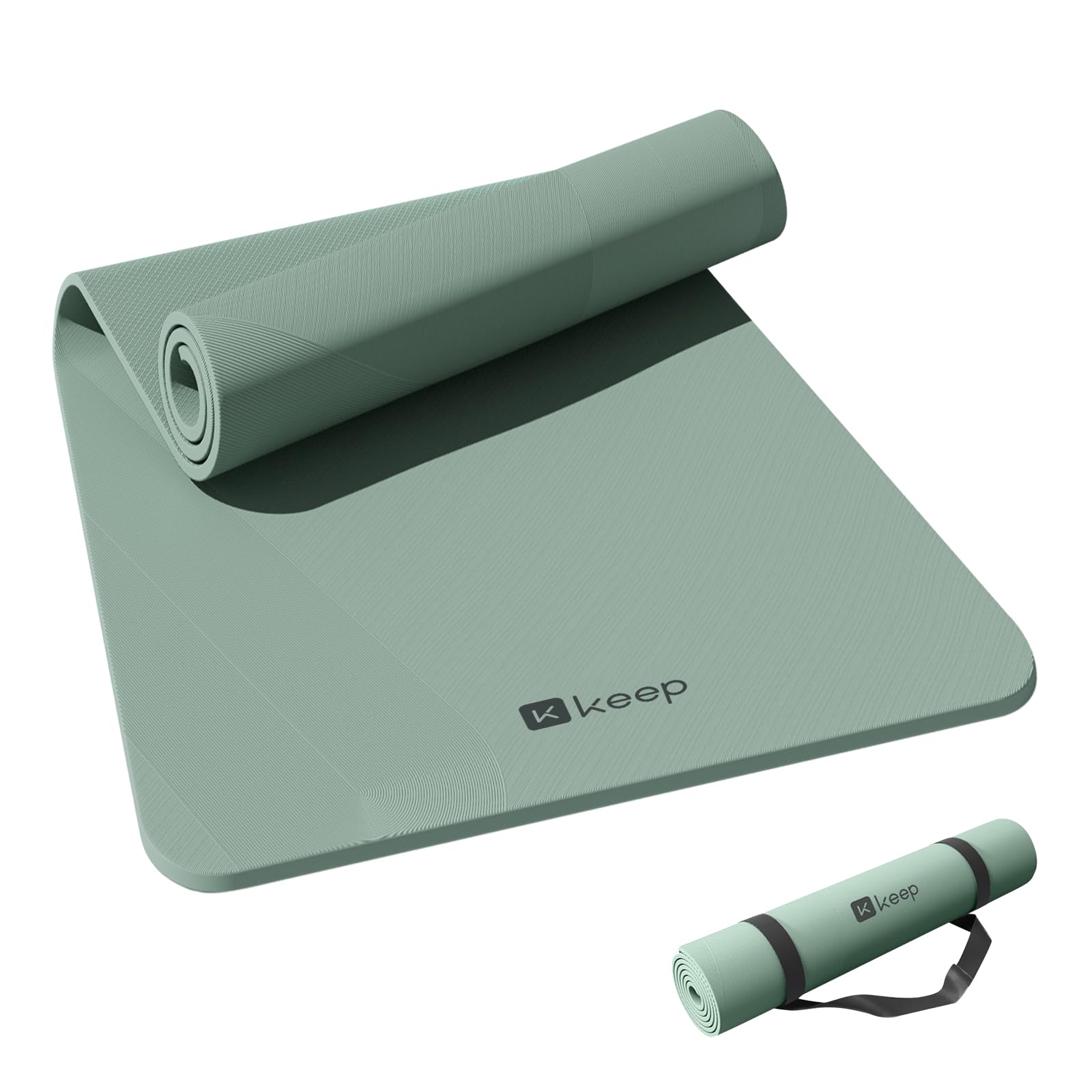
The extra-wide mat that gives broad shoulders and long limbs room to move.
32 inches of width is the defining feature — a full 8 inches wider than the standard 24-inch mats here, including the Gaiam and Tone Fitness. That extra space is what you notice in wide-legged poses, dynamic stretches, and anything where you would otherwise be worried about rolling off the edge. At 72 inches long it fits most users, and the 0.28-inch (7mm) padding protects knees, elbows, and joints while staying stable enough for balance work. At 2.8 pounds it stays carry-friendly, aided by the free adjustable polyester strap.
The TPE is free of plasticizers and formamide, and the double-sided non-slip texture pairs a fingerprint-like grip on top with a full anti-slip pattern on the bottom. The maker suggests airing it out before first use and spot cleaning with a cold damp cloth, avoiding long soaks and direct sun. Size and thickness are the two aspects owners bring up most when describing why it works for them.
Slip resistance is the split point. Some find no slipping issues, while others find it very slippery — more likely on very smooth floors or once sweat builds up. That is a fair caveat, not a dealbreaker, for a mat this wide at this value tier.
The case for the extra width
- 32-inch width gives generous room for wide poses and stretches
- 0.28-inch (7mm) TPE padding protects joints without heavy bulk
- Double-sided non-slip texture with polyester strap included
- 2.8 pounds keeps it portable for class
What to weigh up
- Slip resistance divides owners, especially on very smooth floors
- TPE needs airing out before first use to clear packaging odor
- Durability feedback is mixed over time
A strong match for: broad-shouldered or long-limbed users who keep running out of mat width.
Worth weighing: if you sweat hard during flow, plan to keep this mat on a high-traction floor.
8. Retrospec Solana Extra Thick Yoga Mat

A full inch of firm foam with a nylon carry strap, in the most visually praised finish here.
The Solana pairs a full inch of firm foam with a nylon carrying strap, and the appearance is the feature owners notice first — it is the most visually praised mat in this group. Underneath the look, that one-inch thickness eases the stress on joints, hips, hands, and knees, and the 72 x 24 inch surface gives you room for Pilates, stretching, and hot yoga. It is BPA free and free of phthalate, heavy metals, and latex.
Cushioning and ergonomics are its strongest suits — Pilates practitioners especially tend to feel the support. It weighs 2.2 pounds, which makes it lighter than the Tone Fitness at 3.8 pounds, so carrying it from home to the studio is easy and the strap does its job. Cleaning takes gentle soap, water, and a hang dry, without submerging it.
Durability and portability sit on the mixed side, and there is a known odor when you first unroll it — the maker suggests airing it for a day or two, which is common for foam mats. If visuals matter to you alongside cushion, this one earns its place. If you need the most rugged mat for daily abuse, look more toward the firmer picks.
The appeal: a firm one-inch pad with the best visual character here and a strap that makes it a pleasure to tote.
Ideal for: Pilates and floor practice where cushioning and color both count.
Not the one if: you cannot tolerate a break-in odor — plan a couple of airing days before your first session.
9. Extra Long & Wide Thick Yoga Mat
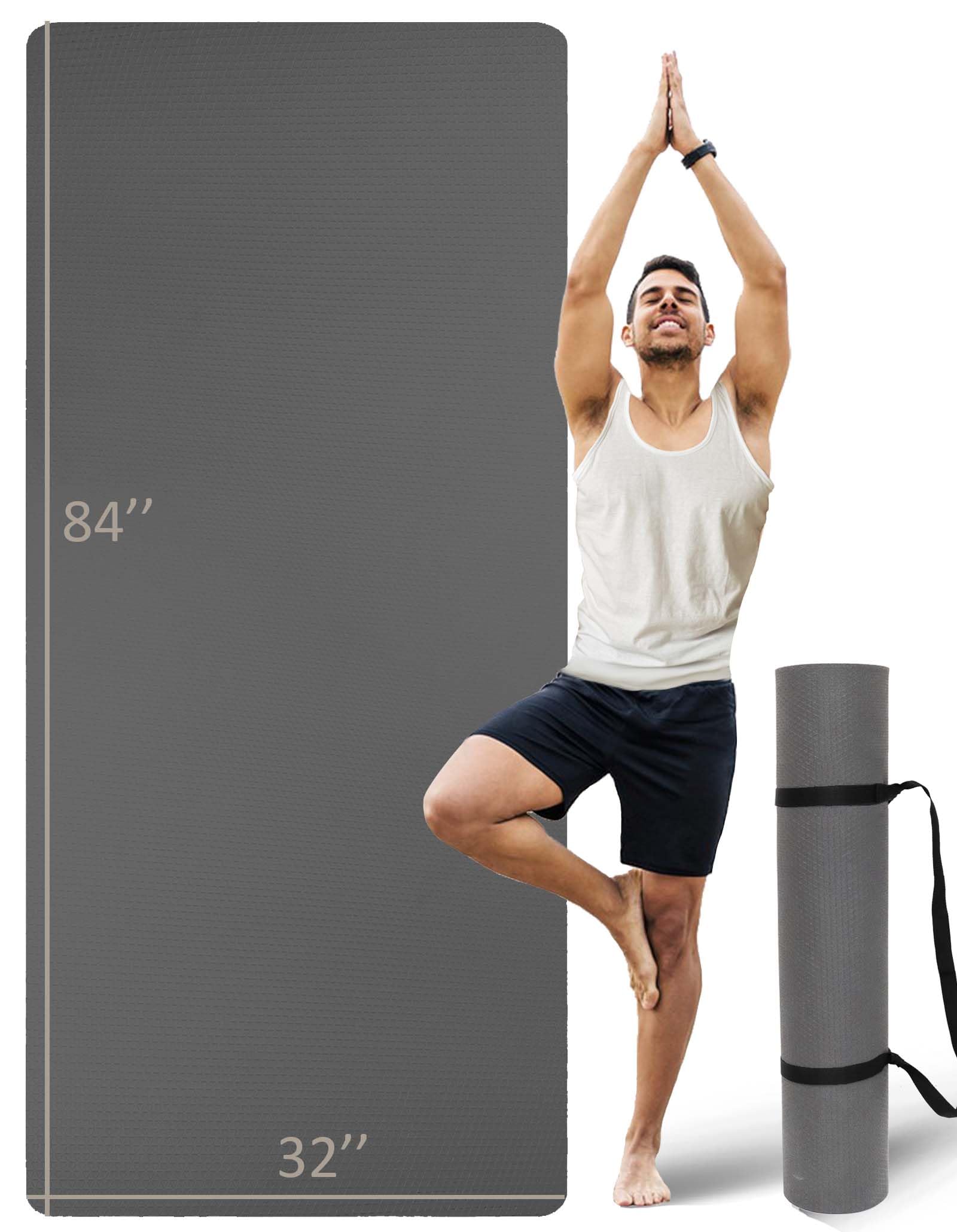
An 84 x 32 inch TPE mat that adds 12 inches of length over standard 72-inch pads.
An 84-inch length and 32-inch width is the largest mat here, and it solves the problem of a mat that ends before you do. Tall users who overrun the 72-inch mats — this is 12 inches longer than the Gaiam and Tone Fitness — finally get space for full-body stretches. The 0.28-inch (7mm) TPE padding and wavy undersides give excellent floor traction, and the special textured surface helps keep hands and feet from sliding when you sweat. Size and thickness are the two features owners mention most.
The strap is a real bonus: it works as a carry strap or as a yoga stretching strap, so you get one tool for transport and for hip and hamstring work. The TPE is latex-free and PVC-free with no heavy metals, and it unrolls pretty flat so you are not fighting curled edges in the first section. At 1.3 kg it stays carry-manageable for a mat this size, and one owner described it as perfect for 6’4″ men.
Durability is the mixed note — long-term wear is the least settled part of the record here. The oversized surface takes up more floor space at home, and a thin TPE this large can take a little time to flatten fully.
What makes it the tall-user pick
- 84-inch length and 32-inch width fit users who outgrow standard mats
- 7mm TPE padding with wavy non-slip underside
- Dual-use strap works for carrying and for stretching
- Latex-free, PVC-free TPE
What to accept
- Durability over the long term is an open question
- The oversized footprint needs more floor space
Right choice when: you are tall or broad and every standard mat feels a foot too short.
Downside to know: the extra size eats floor space — check your home workout area before you commit.
Know the Specs
Thickness and Cushioning
Thickness is measured in inches or millimeters, and it decides how much your knees and hips feel the floor. A quarter-inch mat is firm and stable for standing poses. A half-inch mat is a fair middle. A one-inch mat is the plush choice for kneeling, seated, and floor work. More cushion usually means less stability, so pick the level that matches your routine, not the biggest number.
Material: NBR Versus TPE
NBR foam is soft, dense, and very plush, and it is the favorite for extra-thick mats. TPE is a lighter closed-cell foam that resists sweat soaking in and wipes clean easily. NBR feels softer to kneel on, while TPE tends to hold up better to sweat and is easier to clean. Both come in textured finishes, but grip still depends on your floor and your sweat rate.
Common Questions
Is a 1-inch yoga mat too thick for standing balance poses?
What does NBR foam mean on a yoga mat?
Will the carrying strap hold a thick one-inch mat securely?
What is the difference between a carry strap and a stretching strap?
How long should a yoga mat be for a tall person?
Why does a new yoga mat have a smell?
How do I clean a yoga mat with NBR or TPE foam?
Will a thick mat stop my hands from slipping when I sweat?
Is an extra-wide mat better than a standard-width one?
The Bottom Line
Most people will be happy with the Gaiam Thick Yoga Mat: its 10mm NBR foam is the cushion that makes kneeling bearable, and the adjustable strap makes it a breeze to carry. If you want a light mat for class, grab the Circuit Fitness by Marcy at 1.5 pounds. And if you are tall and every standard mat feels short, the Extra Long & Wide Thick Yoga Mat at 84 x 32 inches solves that in one move. Match the thickness to your routine: 10mm NBR for kneeling comfort, 0.25-inch TPE for balance and portability, 84 inches for tall frames.
How we choose
We do not accept paid placement. Every pick is matched to a real buyer and a real use-case; we do not hands-on test units.
Sources
Specifications: manufacturer listings and product documentation. Review insights: verified customer reviews, as of November 2026. Pricing: not shown on this page (it changes often); check the current price via the retailer link.
As an Amazon Associate, Tactical Gear Guy earns from qualifying purchases. This does not affect which products we feature.