Specs are compiled from manufacturer listings and verified buyer reviews and can change over time — please confirm the key details on the product page before buying.
Most people buy the wrong yoga block height and then wonder why their wrists ache in downward dog. The fix is simpler than you think: match the block to your tightness, not to the color. A 4-inch block gives you more lift under the hands, a 3-inch block suits seated work and tighter spaces, and the material decides whether your palms stay put mid-pose or slide out from under you. Below you get nine blocks sorted by what they actually do well, from a foam pair that sells by the truckload to solid cork bricks that hold their shape under bodyweight.
This guide is built by comparing the manufacturers’ published specifications and the patterns across verified customer reviews, so you get each pick’s real strengths and trade-offs instead of marketing spin.
Your hands slip on a foam block the moment sweat hits it, and a cork block can feel too hard under your palm. Grip, density, and hand size decide which block you should buy. This breakdown of the best yoga blocks shows you how foam and cork behave under sweaty hands, which heights suit which poses, and why weight matters more than most listings admit.
Top Picks

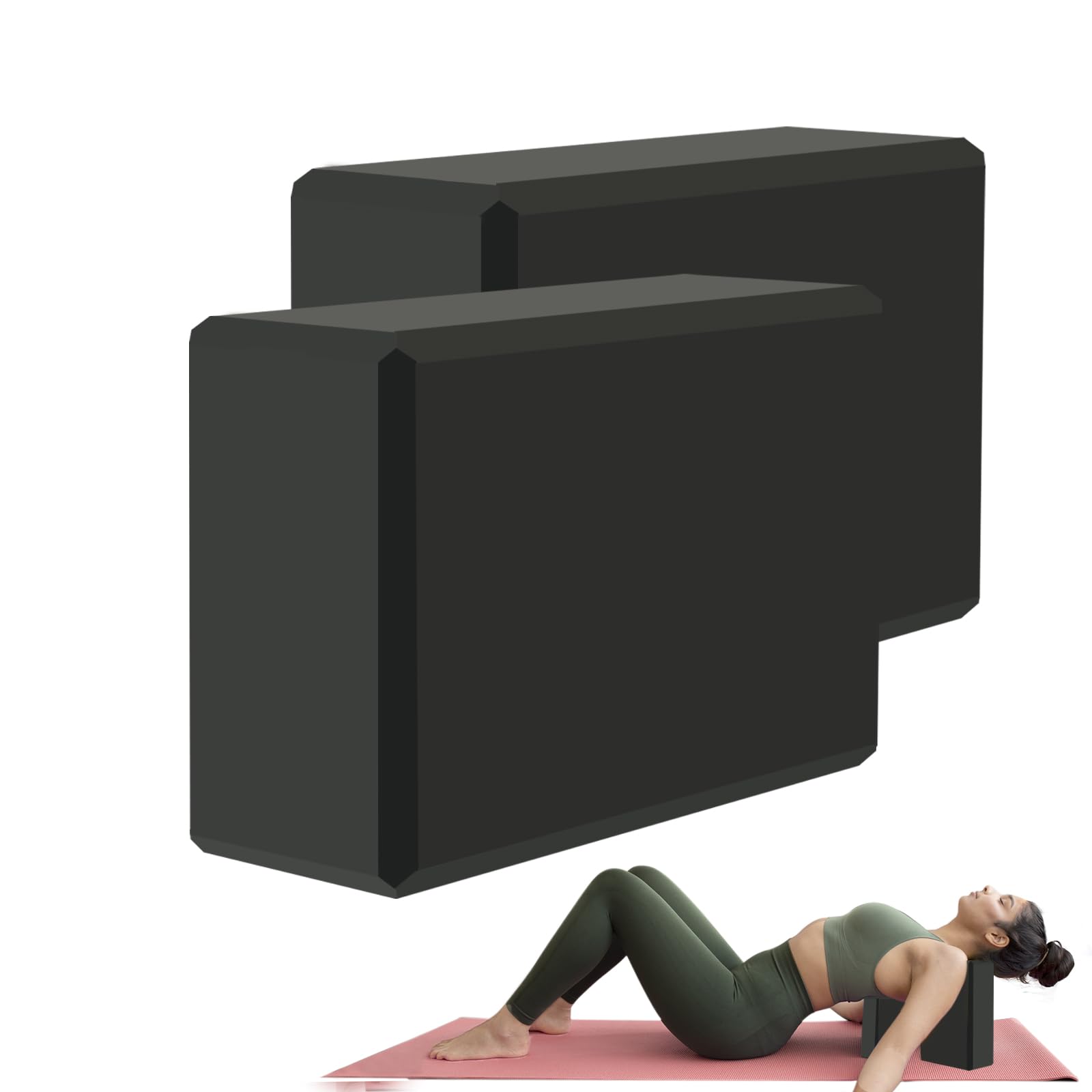

How To Choose The Best Yoga Blocks
You push against a yoga block, sit on it, and lean your full weight into it. So the two things that matter most are how firmly it holds its shape and how well it stays put under a sweaty palm. Color and packaging do not affect how the block performs. Once you settle on height and material, the rest of the choice falls into place.
Pick your height before anything else
Height is the number that decides how much lift you get. A 4-inch block raises your hands higher off the floor, which helps if your hamstrings or shoulders are tight and you cannot reach the mat comfortably. A 3-inch block is the more common middle ground — enough lift for most seated and standing work, and easier to grip for smaller hands. Many people keep one of each so a single pose can be made easier or harder without switching props.
Foam versus cork
EVA foam (a lightweight, spongy plastic foam) is the lightest option and the easiest to carry to class. It feels softer under the hands and comes in every color you can think of. Cork is heavier and denser, and it tends to feel more solid under bodyweight. If your hands get sweaty mid-flow, cork’s textured surface is often the difference between a stable pose and a slipping block.
Beveled edges and grip
Beveled edges are the rounded-off corners on a block. They give your fingers somewhere natural to wrap, which matters in poses where you grip the sides rather than rest on top. A non-slip surface plus those edges is what keeps the block from shooting out during a lunge or a twist.
One block or two
Two blocks let you work both hands at once, prop under both hips in a seated pose, or stack them for extra height. Most people starting out are better served by a pair, since a single block limits you to one side at a time. If you only ever use one under your seat for meditation, a single block is plenty.
Side-by-Side Comparison
| Model | Best For | Material | Size (L x W x Thickness) | Weight | Amazon |
|---|---|---|---|---|---|
| Gaiam Yoga Block 2-Pack★ Best Overall | All-level daily practice | Latex-free EVA foam | 9″ x 6″ x 4″ | 10.4 ounces | Amazon |
| MBKHFLL Yoga Block 2-PackBudget Pick | Tight budgets, basic poses | EVA foam | 9″ x 3″ x 6″ | 4.6 ounces | Amazon |
| MoKo Thin Yoga Blocks 2-PackMost Versatile | Multi-use beyond yoga | High-density EVA | 9″ x 6″ x 3″ | 9.17 ounces | Amazon |
| biguphate Yoga Blocks 2-Pack with Band | Travel and studio bag | Latex-free EVA | 9″ x 6″ x 3″ | 5.6 ounces | Amazon |
| KEEP Yoga Block 2-Pack | Recyclable, firm support | High-density EVA | 9.6″ x 5.9″ x 3″ | 7 ounces | Amazon |
| Hatha Cork Yoga Block | Meditation and restorative work | Portuguese cork | 9″ x 6″ x 3″ | 1.6 pounds | Amazon |
| Manduka Recycled Foam Block | Firm, durable studio block | EVA (50%-75% recycled) | 9″ x 4″ x 6″ | 0.9 pounds | Amazon |
| Volcano Cork Yoga Blocks 2-Pack | Sweaty hands, non-slip grip | Portuguese cork | 9″ x 6″ x 4″ | 2.04 kg | Amazon |
| Trideer Cork Yoga Blocks 2-Pack | Beginners with a guide | Cork | 9″ x 6″ x 3″ | 1.59 kg | Amazon |
Detailed Reviews
1. Gaiam Yoga Block 2-Pack
Our pick — 4.5+★ from 30,000+ verified ratings; the strongest balance of quality and price.
The four-inch pair that lifted a whole generation of stiff hamstrings off the mat.
If your hands cannot reach the floor in a forward fold, this is the block that solves it. Each block measures 9″ x 6″ x 4″ — that four-inch thickness is the taller of the two standard heights, so it gives your hands more room to rest and takes strain off tight shoulders and hamstrings. You get two in the pack, which means both hands are supported at once or both hips get a lift in a seated pose.
Gaiam builds these from a foam the maker describes as 50 percent denser than standard EVA blocks, and the surface is textured to hold a grip rather than let your palm skate. At 10.4 ounces for the pair they are easy to toss in a tote on the way to class. The beveled edges — those rounded-off corners — give your fingers a natural place to wrap when you grip the sides instead of resting on top.
The trade-off shows up in the long run: some owners find the foam softens or dents at pressure points after heavy repeated use, and a few wish it were firmer under a hard push. That is the honest cost of a block this light and forgiving on the hands. For a 4.5+ star block across tens of thousands of owners, the crowd has clearly made its peace with that trade.
What earns it the top spot
- Four-inch thickness gives noticeably more lift for tight hamstrings and shoulders
- Two blocks per pack so both hands are supported in one pose
- Textured, non-slip surface with beveled edges for a secure grip
- 10.4 ounces for the pair — light enough to carry to class
Where it softens
- Foam can dent at pressure points with heavy repeated use
- Not as firm under a hard push as cork or denser foam blocks
- Four-inch height can feel tall for seated work if you are already flexible
Grab this if: you want a forgiving, light pair that lifts your hands in standing poses and does not cost a fortune.
Look to cork instead if: you need a block that stays rock-firm under full bodyweight for years.
2. MBKHFLL Yoga Block 2-Pack
The lightest pair here — 4.6 ounces each, easy enough for a child to carry to class.
These blocks weigh just 4.6 ounces apiece, which makes them the featherweight option in this lineup. That lightness matters when you are already hauling a mat and a water bottle to a studio. At 9″ x 3″ x 6″, the three-inch thickness is the shorter standard height, so they suit seated work and tighter poses where a tall block would get in the way.
Owners tend to stand on them without the block giving way, which speaks to a sturdier core than the low weight suggests. The grip comes from beveled edges paired with a non-slip surface, so your fingers have an edge to hold onto. It is a basic, honest block — nothing fancy, and that is the appeal.
What you give up is consistency in how firm it feels. The density splits opinion: some find it solid and sure, others describe it as squishy under a hard press. A few note it dents more easily with rough handling. If you want a rock-firm block, look at the cork options further down; if you want a light pair to keep at home, these do the job.
What holds up: A stable foam pair at an entry-level price — you get two blocks, enough lift for basic poses, and edges shaped for a secure grip.
What to weigh: Firmness is the open question here. The block reads solid to most, but a softer feel under pressure is the recurring note, so treat it as a pick for light-to-moderate use rather than daily heavy loading.
Reach for it when: your budget is the deciding factor and you want a light pair for home stretching.
Step up if: you want a firmer, denser block for demanding standing poses.
3. MoKo Thin Yoga Blocks 2-Pack
A three-inch foam pair that ends up being used for far more than yoga.
The appeal of the MoKo pair is that it never sits idle. At 9″ x 6″ x 3″ it is the shorter standard height, and the high-density EVA foam gives it a firm, well-made feel the maker calls sturdy and durable. For a beginner who cannot quite reach a pose, the three-inch lift under the hands makes tight stretches reachable without overreaching.
Here is where it diverges from the rest: owners push it well past the mat. The blocks get used as risers for a rowing machine, as support under the hands for deficit pushups, and as general props around the house. That breadth comes from the flat, stable shape and the non-slip beveled edges. The pair weighs 9.17 ounces total, so it stores easily on a shelf.
The honest caveat is the thickness. Some owners find the three-inch profile thinner than they expected for certain seated poses, which is a height preference rather than a flaw. If you mostly do standing and floor work with your hands, it is a non-issue. If you want a tall block under your seat for meditation, the taller four-inch options suit better.
The winning quality: Owners rate build quality highest of all, and that firm, well-finished foam is what lets the pair double as a riser, a pushup block, and a stretching prop without feeling cheap. The versatility is the reason it stays out of the closet.
What to watch: Three inches is on the shorter side — great for hand support in standing poses, but seat support for meditation asks for more height.
This one earns its place if: you want a firm three-inch pair that works for stretching, floor exercises, and everyday use beyond the mat.
Skip the short profile if: you plan to sit on it for long meditation sessions.
4. biguphate Yoga Blocks 2-Pack with Stretch Band

The one that comes with resistance bands — and slips into a gym bag without a fight.
This pair stands out on weight: each block is 5.6 ounces, the lightest of the blocks in this roundup. The Gaiam pair weighs 10.4 ounces for the same count, so these are the pair to reach for when you are packing a bag for a class or a trip. At 9″ x 6″ x 3″, the three-inch height suits hand support in standing poses and floor stretching.
What sets the set apart is the two resistance bands thrown in. They let you layer band work onto the same session, which is handy if you stretch at home and want one kit rather than several. The foam is latex-free EVA with a smooth, non-slip surface, and the edges are cut into a beveled, contoured shape that sits naturally against your hand.
The maker is upfront that foaming and cutting leave small surface holes and slight size variation, which is normal for this kind of block rather than a defect. Some owners find the size or softness differs from expectation, so if firmness is critical, cork is the safer bet. For portability and the bonus bands, this pair is hard to argue with.
Why it travels well
- 5.6 ounces per block — the lightest pair in this lineup
- Two resistance bands included for layered stretching
- Beveled, contoured edges for a natural grip
- Latex-free EVA foam with a non-slip surface
What to expect
- Small surface holes and slight size variation are normal per the maker
- Softer foam feel than a cork block under a hard press
- Hand-wash only, so it needs more care than a wipe-down block
Pack this if: you want the lightest pair here plus bands for a complete home-and-studio kit.
Pass if: you want a firm, dense block that never flexes under bodyweight.
5. KEEP Yoga Block 2-Pack
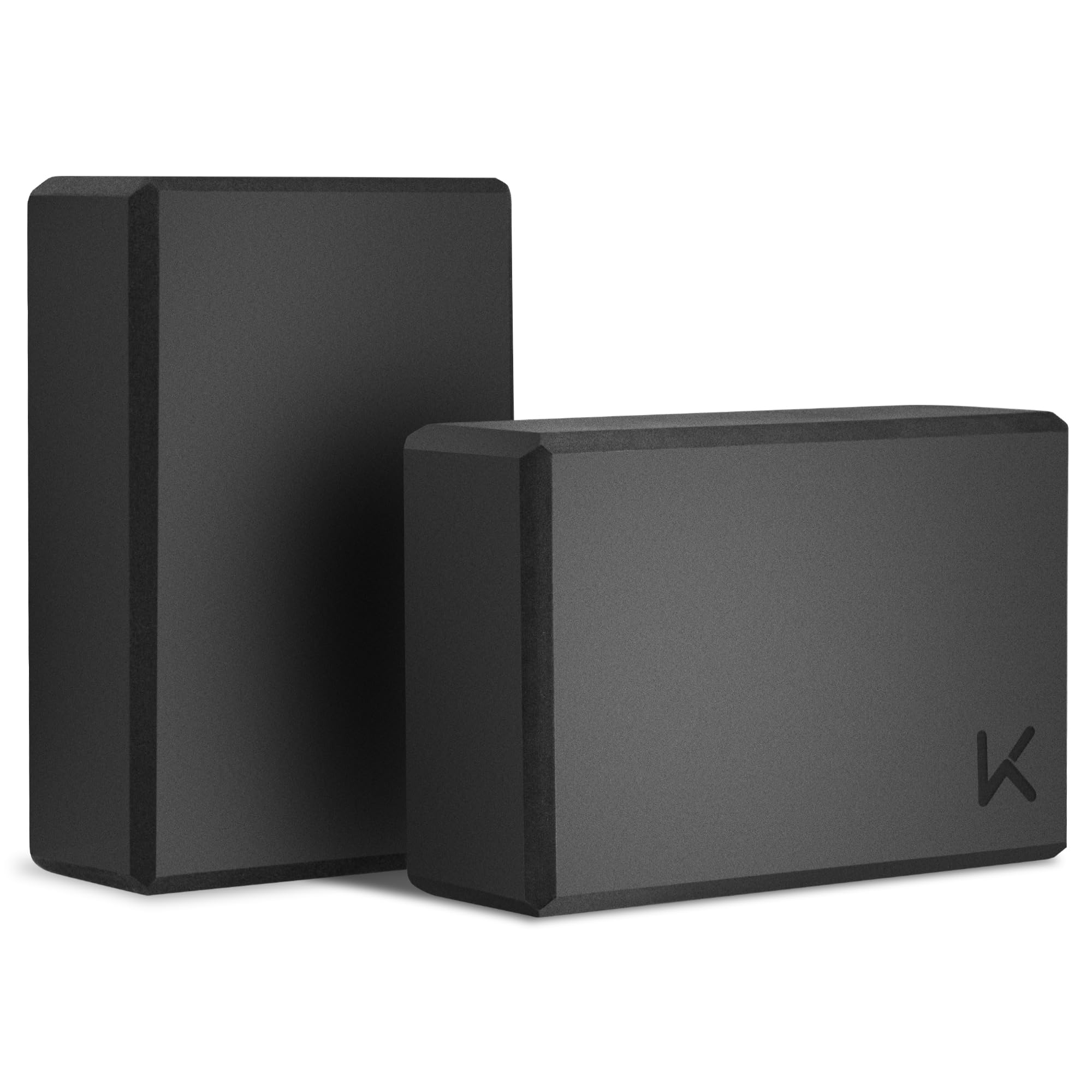
Recyclable foam with a closed-cell skin that shrugs off moisture.
The KEEP pair is built for people who care what the block is made of. The high-density EVA foam is recyclable and non-toxic, and the maker says it is free of chlorides, heavy metals, phenols, and latex. Each block weighs about 0.44 lb, light enough that a child can pick it up and grip it without trouble, yet the six-sided, eight-angle shape keeps it sturdy underfoot.
The surface is where it does its real work. A closed-cell treatment gives it a non-slip, textured finish that the maker says resists moisture, so a sweaty palm keeps its hold through a flow. The dimensions run 9.6″ x 5.9″ x 3″, a hair wider than a standard three-inch block, which gives you a little more surface under the hand.
Owners lean on these for Peloton yoga sessions and for post-workout stretching, and the durability score holds up over repeat use. A precisely cut foam means the edges stay supportive and the block resists deforming under weight. The gap to the top pick is height and brand weight, not function — a solid choice if firm, moisture-resistant foam is what you are after.
Firm where it counts: The closed-cell textured surface and denser foam cut combine to keep it steady and dry through sweaty sessions, which is exactly what a three-inch block needs to do.
One honest note: The three-inch height is the shorter standard, so it is best for hand support and floor work rather than tall seat lifts.
Choose it if: you want recyclable, moisture-resistant foam and a slightly wider surface under your hands.
Consider cork when: you want maximum firmness under full bodyweight.
6. Hatha Cork Yoga Block

A single solid cork brick that holds its shape under your full bodyweight.
This is a one-block purchase, and it is the one to pick if you sit for meditation. The block is 100% solid cork from Portugal, measuring 9″ x 6″ x 3″, and it weighs 1.6 lbs — heavier than any foam block here, which is exactly what gives it stability under your seat. The maker notes the cork is three times as hard as a foam block, so it will not squish down under load.
Where cork beats foam is the feel. The surface is odor-resistant and breathable, which keeps your hands drier through a long session, and the solid core holds its shape under bodyweight instead of denting. Owners praise the quality and durability most, and the block earns its keep in restorative work, backbends, and seated poses. The maker offers it in 3″ and 4″ thicknesses, so you can pick the lift that suits you.
The catch is the weight — 1.6 lbs per block is a real load to carry, and some find it shockingly heavy for a prop. Others find the size too big for their hands. At 1.6 lbs, it is a poor fit for a studio bag. If you want a block that stays put and holds firm under bodyweight, solid cork delivers that.
What wins people over: The solid cork build and its stability — quality and durability are what buyers single out, and the block’s firm surface delivers a grounded feel that foam cannot match.
The trade-off: At 1.6 lbs and with a big 9″ x 6″ face, it is a stay-at-home block. Plan on leaving it by your mat.
Best for the sitter: you meditate or do restorative poses and want one firm, stable block under your seat.
Not for the traveler: cork this dense is heavy in a bag.
7. Manduka Recycled Foam Block
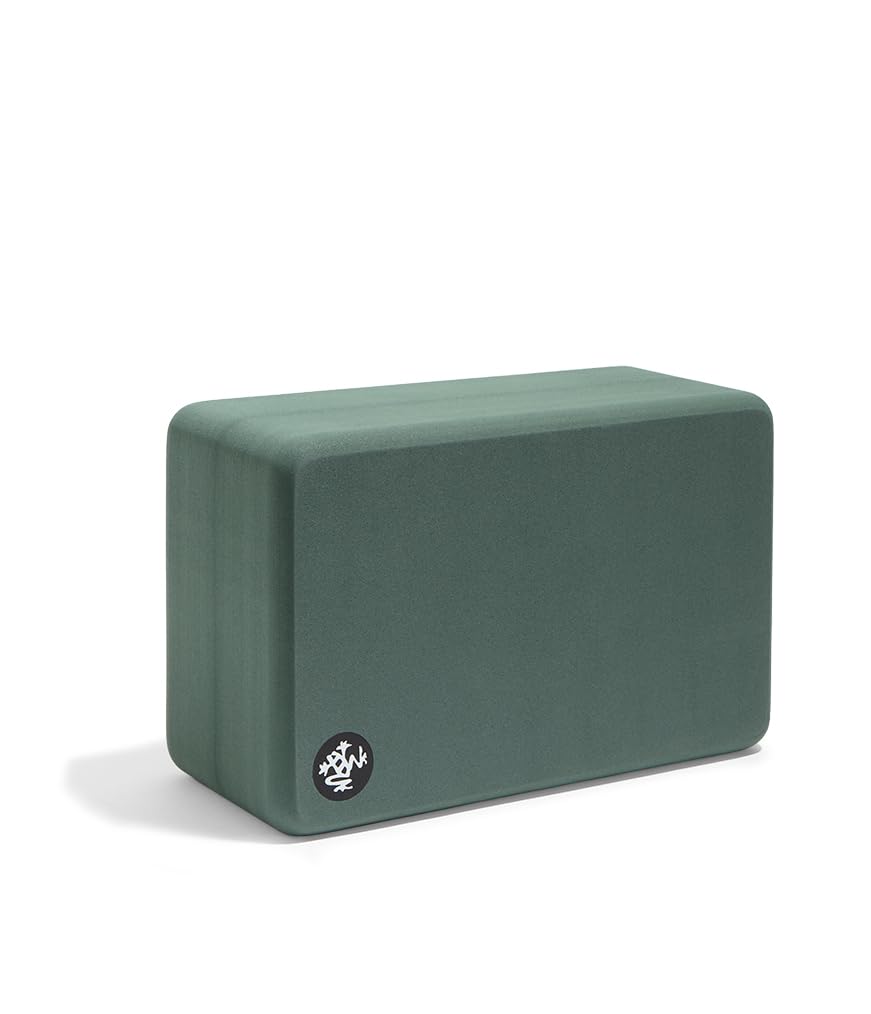
The studio-grade block that stays firm instead of going spongy.
If you have ever pressed into a cheap foam block and felt it give, this is the fix. Manduka’s block is 9″ x 6″ x 4″ — that four-inch height gives plenty of lift — and the high-density EVA foam reads firmer and less squishy than a standard block. It weighs 0.9 lbs, so it is still light enough to carry, but the density is the thing you notice first.
The contoured, slip-resistant edges are shaped for comfort in the hand, and the foam is made from 50%-75% recycled post-industrial and post-consumer EVA, which is a serious sustainability step for a foam block. Owners lean on it for barre, pilates, and restorative work, and they praise its firmness — softer than cork but not spongy like ordinary foam.
What owners rarely mention is wear: the block keeps its shape through steady use. The honest limit is price — this is a premium single block, so you pay for the density and the recycled build. For occasional stretching, a cheaper foam pair does the same job. For a single block that stays firm session after session, this is the pick.
Why the premium is earned
- High-density foam feels firm and non-squishy under load
- 50%-75% recycled EVA foam construction
- Four-inch height for solid lift in standing poses
- Contoured, slip-resistant edges for a comfortable grip
The honest costs
- Sold as a single block, so a pair means buying twice
- Premium build carries a premium tag
- Four-inch height is tall for seated work
Worth it if: you want one dense, firm block that feels studio-grade and lasts through steady use.
Think twice if: you need two blocks on a tight budget — a foam pair costs less.
8. Volcano Cork Yoga Blocks 2-Pack

Two four-inch cork blocks built for sweaty hands that refuse to stay put.
Cork’s texture is the whole story here. This is a two-pack of 100% cork blocks from Portugal, each 9″ x 6″ x 4″ — the taller four-inch height that gives more lift under the hands. The non-slip surface is what owners notice: it holds through a heavy flow where a foam block would start sliding.
The round edges are shaped for an easy grip so you keep control of the block in every pose, and the cork stays stable enough that it does not tilt when you press down. The density also means it does not crack the way thinner blocks can. Owners rate sturdiness highest — the sense that the block is more substantial than foam comes through in use.
Two things to weigh. Cork this solid adds weight, and some find it heavy to move around. A handful notice an odor from the cork that fades, though it is part of the material. Neither is a deal-breaker; they are the cost of a block that grips hard and stays put. For grip first, this pair is the one.
The grip is the draw: Owners single out sturdiness and non-slip stability, and the cork surface delivers exactly that — a block that holds its ground under a sweating palm.
What you accept: This is the heavier of the cork pairs here, and a natural cork smell can linger at first.
Go for it when: your hands sweat and you want two tall cork blocks that hold their grip through a hard flow.
Weigh the heft if: you carry your props to a studio every day.
9. Trideer Cork Yoga Blocks 2-Pack
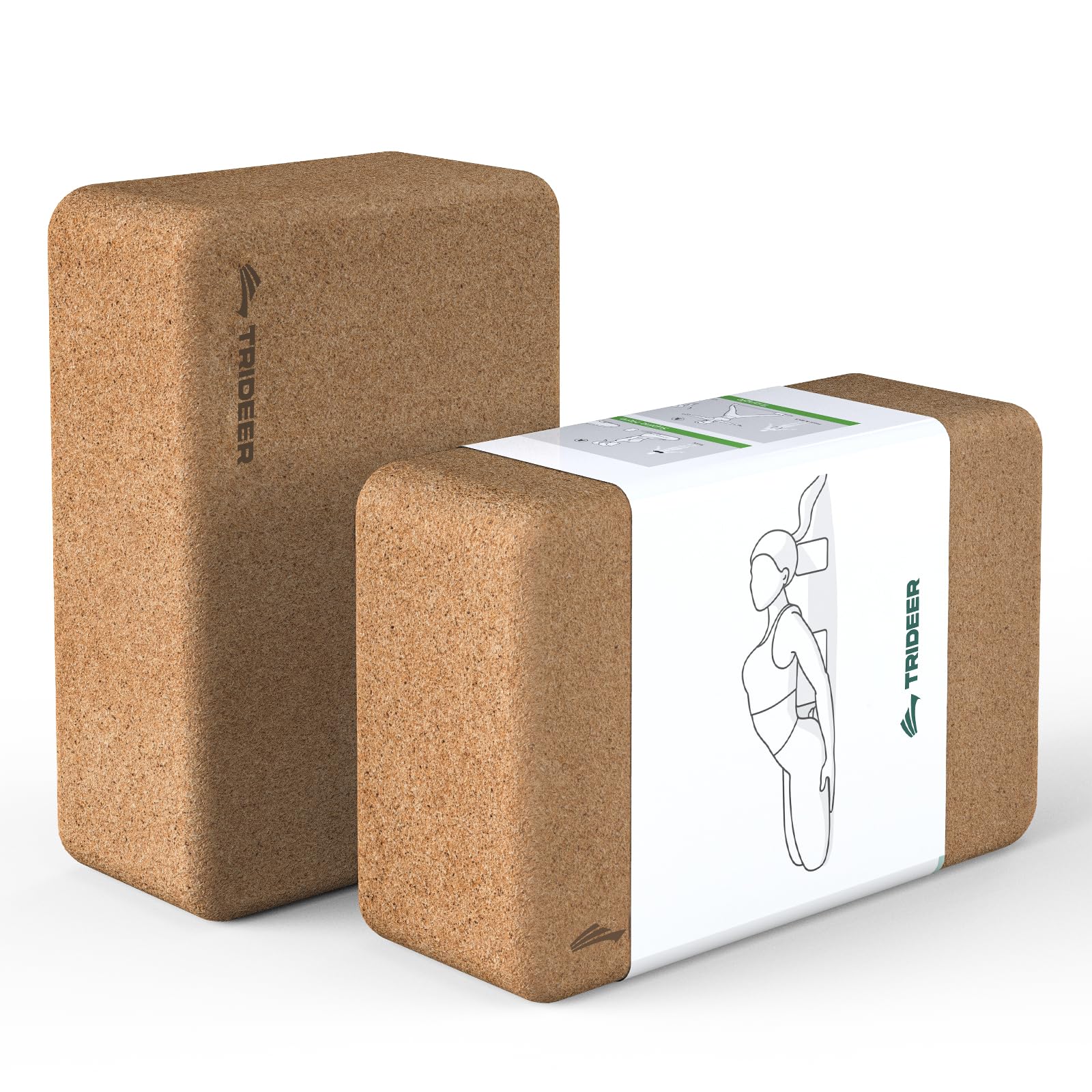
Two cork blocks plus a visual guide that shows exactly where to put them.
Trideer ships a two-pack of 9″ x 6″ x 3″ cork blocks with an illustrated exercise guide showing muscle engagement for beginners through advanced practitioners. That turns a prop into a starting point — you can see how to place the block before you press into a pose.
The cork itself is responsibly harvested without cutting down trees, and the maker says it meets California Prop 65 standards. The textured surface and contoured corners give a firm, non-slip grip, and cork runs about three times as hard as foam, so it does not distort under bodyweight. Owners value the sturdiness most — it holds their weight without shifting.
The weight is heavier than foam, and some find the 3-inch size smaller than expected for larger hands. Neither is a fault, just fit. If you want a starter kit with guidance built in and a block that stays firm, this pair delivers.
Where it shines: Owners praise the sturdiness and the stable, non-slip feel — the block holds steady in heart and hip opening postures without sliding.
A fit note: Three inches is the shorter height, and a few find it small for the hand; taller users may prefer a four-inch block.
Start here if: you are new to blocks and want a firm cork pair with a guide that shows you how to use them.
Size up in height if: you have large hands or tight shoulders that need more lift.
Know the Specs
Block Height (3-Inch vs 4-Inch)
Height is the measure from the floor to the top of the block, and it sets how much lift your hands get. A 4-inch block raises your hands higher, which helps if you are tight or cannot reach the mat comfortably. A 3-inch block is the shorter middle ground — plenty for most poses and easier to grip with smaller hands. Many people keep one of each to adjust a single pose without switching props.
Foam Versus Cork
EVA foam is a lightweight, spongy plastic that stays soft under the hand and travels easily. Cork is denser and heavier, and it holds its shape under bodyweight. Neither is “better” — foam suits light daily use and travel, while cork suits firm support and sweaty palms. If your hands slide in a flow, cork’s textured surface is the practical choice.
Weight and Portability
A lighter block is easier to carry to class; a heavier one sits stiller under your hand. Foam blocks here run from a few ounces up, while cork blocks weigh over a pound each. If your block lives in a bag, favor the lighter foam pairs. If it stays by your mat, a heavier cork block gives a more grounded feel.
Grip and Beveled Edges
Beveled edges are the rounded-off corners on a block, and they give your fingers a natural spot to wrap. Paired with a non-slip or textured surface, they keep the block from shooting out during a twist or a lunge. A block with sharp corners and a smooth surface is harder to grip securely when your hands are wet.
Common Questions
Should I buy a 3-inch or 4-inch yoga block?
Is cork better than foam for sweaty hands?
Do I need one yoga block or two?
How do I clean a yoga block?
Will a foam block dent or flatten over time?
What size yoga block fits my hands?
Can yoga blocks help with tight hamstrings?
Are cork yoga blocks heavy to carry?
Can I use a yoga block for pilates and stretching?
How long should a yoga block last?
The Bottom Line
For most people, the best yoga blocks winner is the Gaiam Yoga Block 2-Pack because its four-inch height gives tight hands real lift and its two-block pack covers both sides in one pose. If grip under a sweaty palm is your priority, the Volcano Cork Yoga Blocks 2-Pack holds its ground with that textured four-inch cork face. And for anyone learning as they go, the Trideer Cork Yoga Blocks 2-Pack pairs firm cork with a guide that shows where the block goes.
Whichever you choose, buy for your hand and your height first — a forgiving foam pair for daily stretching, or a firm cork brick for seated work and heavy press. Matching height and material to your body is what keeps the block steady through every pose.
How we choose
We do not accept paid placement. Every pick is matched to a real buyer and a real use-case; we do not hands-on test units.
Sources
Specifications: manufacturer listings and product documentation. Review insights: verified customer reviews, as of November 2026. Pricing: not shown on this page (it changes often); check the current price via the retailer link.
As an Amazon Associate, Tactical Gear Guy earns from qualifying purchases. This does not affect which products we feature.