Specs are compiled from manufacturer listings and verified buyer reviews and can change over time — please confirm the key details on the product page before buying.
Your mat is the one piece of gear you touch for the entire session, so the wrong one shows up fast — sliding hands in down dog, knees barking on hardwood, or a foam slab that tears by month three. What actually matters is narrower than the marketing suggests: how thick the cushioning is, what the top surface does once your palms get damp, and how much mat you get under your body for the poses you really do. The picks below are sorted by how they genuinely behave, not by how they photograph.
This guide is built by comparing the manufacturers’ published specifications and the patterns across verified customer reviews, so you get each pick’s real strengths and trade-offs instead of marketing spin.
Four things decide whether a mat suits your practice: thickness, grip, material and footprint. Each one is explained in plain terms below. A yoga and pilates mats choice depends on matching those four numbers to your body and your floor.
Top Picks


How To Choose The Best Yoga and Pilates Mats
Most first-time buyers assume thicker equals better. It doesn’t. Every mat trades joint cushioning against the firm reference your feet need to balance, and each pick here sits at a different point on that scale. Pick your practice style first, then match thickness, width and weight to it.
Match thickness to your knees, not your ambitions
If you have sensitive knees, wrists or hips and you spend time kneeling or seated, the padding matters more than anything else — the 12mm YOTTOY and the 10mm Gaiam Thick mat are built for exactly that. If your practice is standing balances and flows, a thin natural-rubber mat like the Plyopic at roughly 0.17 inches keeps you connected to the floor instead of wobbling on foam.
Grip is a sweat question, not a texture question
A textured surface helps when your hands are dry. Once you start sweating, the material matters more: cork gets tackier as it dampens, while closed-cell TPE and PVC can turn slick. If you run hot or practice hot yoga, weight your choice toward cork or a mat explicitly built for wet grip.
Width decides which poses you can actually do
A 24-inch mat is the standard and fine for most flows, but wide-legged poses, arm balances and anything done lying sideways will push your hands or feet onto the floor. A 32-inch or 36-inch mat gives you room to spread out — the trade-off is a bigger roll to carry and store.
Weight is the hidden daily cost
A mat you carry to a studio five days a week needs to be light. A mat that lives on your living-room floor can be heavy, and heavy often means it stays put. Decide whether the mat will travel or stay home before you weigh portability against stability.
Side-by-Side Comparison
| Model | Best For | Thickness | Size | Material | Amazon |
|---|---|---|---|---|---|
| Gaiam Premium Yoga Mat, 6mm Print★ Best Overall | Everyday home practice with a look you like | 6 mm | 68″ x 24″ | PVC (6P-free) | Amazon |
| Gaiam Thick Yoga Mat with Carry StrapBest for Aching Knees | Sore knees and low-impact floor work | 10 mm | 72″ x 24″ | NBR foam | Amazon |
| Readaeer Double Color Yoga MatBest Folding Mat | Folding and packing into a gym bag | 6 mm | 72″ x 24″ | TPE | Amazon |
| Circuit Fitness by Marcy Yoga Mat | Long-limbed practitioners on a tight budget | 6 mm | 74″ x 24″ | TPE | Amazon |
| YOTTOY Extra Thick Yoga Mat | Kneeling and seated poses on hard floors | 12 mm | 72″ x 24″ | TPE | Amazon |
| KEEP Extra Wide Yoga Mat | Broad shoulders and wide-stance work | 7 mm | 72″ x 32″ | TPE | Amazon |
| HAPBEAR Large Yoga Mat | Home gym floor work with room to sprawl | 6 mm | 72″ x 36″ | TPE | Amazon |
| Plyopic Ultra Grip PRO Yoga Mat | Hot yoga and sweaty palms | 0.17″ | 72″ x 26″ | Natural rubber + PU | Amazon |
| Body By Yoga Luxury Cork Mat | Tall bodies and heavy sweat sessions | 0.25″ | 80″ x 26″ | Cork + rubber | Amazon |
Detailed Reviews
1. Gaiam Premium Yoga Mat, 6mm Thick Print Mat
Our pick — 4.5+★ from 22,000+ verified ratings; the strongest balance of quality and price.
Six millimeters of cushioning wrapped in a print you might actually leave out on the floor.
This is the mat most people should start with, and the reason is unglamorous: it hits the middle of everything. The 6mm PVC layer is enough padding to take the sting out of kneeling poses on a hard floor, but thin enough that standing balance poses don’t feel like they’re on a mattress. At 68 inches long and 24 inches wide it’s the standard footprint — a real consideration if you are tall, because your hands will reach the floor in a long stride. It weighs 3.1 pounds, which is light enough to sling over a shoulder but substantial enough to lie flat when you unroll it.
The textured surface is where opinions split, and you should know that going in. On a dry floor with dry hands it holds well. Add real sweat — a hot room, a long vinyasa, summer without air conditioning — and the traction fades, so a towel on top is a sensible add-on rather than an indulgence. The material is PVC, specifically a 6P-free formula that skips six phthalates including DEHP and DBP, which is a meaningful detail if you care about what you’re pressing your face into. Expect a strong smell out of the shrink wrap; the maker asks for two to three days of airing out, and that is not an exaggeration.
What wins people over, more than any spec, is the design work — the print variety is the single most-discussed thing about this mat by a wide margin, and buyers also rate the value highly. The pattern hides scuffs and asphalt dust far better than a plain dark surface. Compared with the Circuit Fitness by Marcy mat, this one is 3.1 pounds against 1.5 pounds, so the Marcy is the travel-friendly pick if portability outranks cushioning for you.
Where it earns its keep
- 6mm padding softens knees and wrists without dulling your balance
- 68″ x 24″ standard footprint fits most class studio spaces
- 6P-free PVC skips DEHP, DBP, BBP, DINP, DIDP and DNOP
- Print designs stay looking good after repeated roll-and-carry
- Free downloadable yoga workout included with purchase
What to weigh first
- Grip fades once your hands get genuinely sweaty
- Needs two to three days of airing out before first use
- 68-inch length runs short for very tall practitioners
Worth buying if: you want one mid-weight mat for home flows, Pilates and stretching, and you like having a design you don’t mind looking at.
Think twice if: your practice is hot and sweaty or you’re over about six feet — a longer cork or rubber mat will serve you better.
2. Gaiam Thick Yoga Mat with Easy-Cinch Carrying Strap
Ten millimeters of plush foam for anyone whose knees have opinions about hardwood floors.
If kneeling poses send a jolt through your kneecaps, or you do floor-based Pilates, stretching and physical-therapy-style work on tile or concrete, this is the mat that solves that specific problem. The 10mm layer of high-density NBR foam is thick enough that your knees stop being the contact point, and the softer feel absorbs impact rather than returning it. It’s 72 inches long and 24 inches wide, against the Gaiam Premium’s 68 inches. The strap is a genuinely useful inclusion — it cinches the roll tight so it doesn’t unravel in the car.
Here is the trade-off, and it’s a real one: this much foam is soft underfoot, and soft is not what you want for standing balance poses. If your practice is mostly tree pose and warrior three, you’ll feel the wobble. The other honest note is durability. NBR foam this thick is the most fragile material on this list — long fingernails, a curious pet, or a rough drag across a garage floor can all tear it. Treat it as a floor mat that stays home rather than a studio commuter.
Comfort is the loudest theme with this mat, and it tracks with the 10mm build — thickness and comfort are the two things it does best, by a clear margin over everything else buyers talk about. It’s low-odor NBR, though the maker is upfront that an initial foam smell is normal and fades after a day or two of airing out. Compared with the Readaeer mat at 0.8 kg, this one weighs 1.27 kg, a difference you notice carrying it to the car.
The cushioning math: 10mm of NBR foam is the thickest cushioning on this list outside the YOTTOY’s 12mm, and it’s aimed squarely at joints rather than balance.
The real limit: foam this thick squirms on smooth floors during fast movement, and the same softness that saves your knees makes standing balances feel unstable.
Reach for this if: your sessions are floor-heavy — Pilates, stretching, core work, recovery — and joint comfort outranks balance precision.
Look elsewhere if: you need a mat that grips hard flooring during dynamic standing sequences or one that survives being hauled around daily.
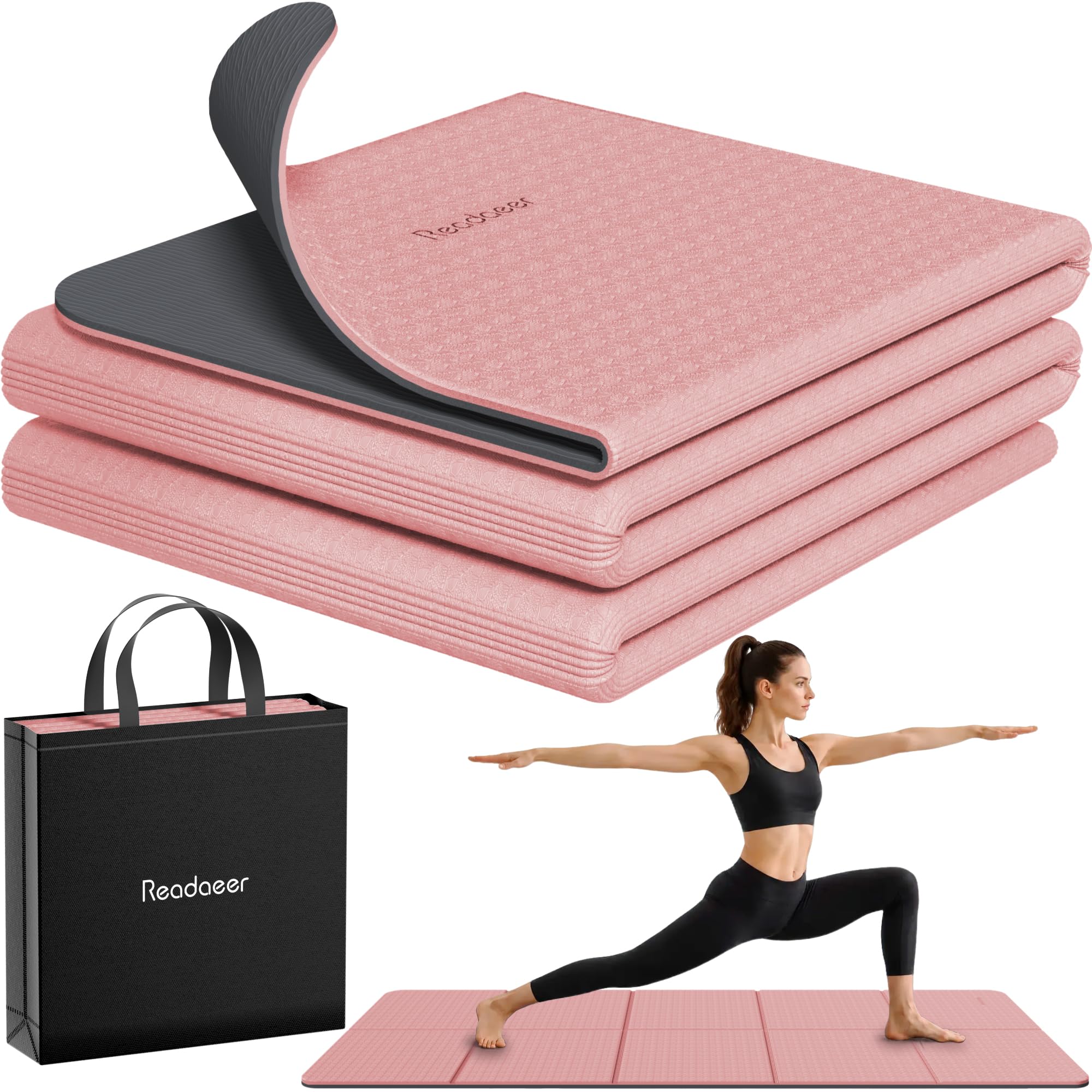
3. Readaeer Double Color Yoga Mat, 6mm TPE
The mat that folds into a square instead of rolling into a tube.
Rolling a mat means it wants to curl back up the moment you lay it down. This one folds, which means it lies flat immediately and slides into a bag like a folded blanket rather than a stubborn cylinder. Foldability is the thing buyers bring up most about this mat, and portability comes right behind it — which tells you who it’s for. If you carry a bag to the gym, do lunchtime sessions at the office, or want a mat that stores in a drawer, this solves that in a way a rolled mat can’t. It ships with a storage bag and carries a one-year warranty.
The 6mm TPE body is dense and springy, with cushioning that absorbs shock without the mushy feel of thick foam. It’s 72 inches long and 24 inches wide, so it fits most bodies. The double-sided design is the clever part: a polygonal texture on the skin side for grip, and a wave texture underneath to hold the floor. It weighs 0.8 kg.
Two honest notes. First, folding leaves crease lines, and over time those creases are where wear shows up first. Second, TPE grip is good dry and less good wet — this is a home-and-gym mat, not a hot-room mat. Size and grip both draw mixed reactions, so if you’re unusually tall or sweat heavily, size up or look at the cork option further down.
Why it stands out: foldability plus a 6mm TPE body plus a storage bag and a one-year warranty is a genuinely practical combination for a mat that lives in a bag.
The honest catch: creases are permanent once folded, and the anti-slip surface is built for dry practice rather than a sweaty room.
Best match for: commuters, small apartments and anyone tired of wrestling a curled mat flat before every session.
Not the one for: hot yoga practitioners or tall bodies who need extra length.
4. Circuit Fitness by Marcy Non-Slip Exercise Yoga Mat
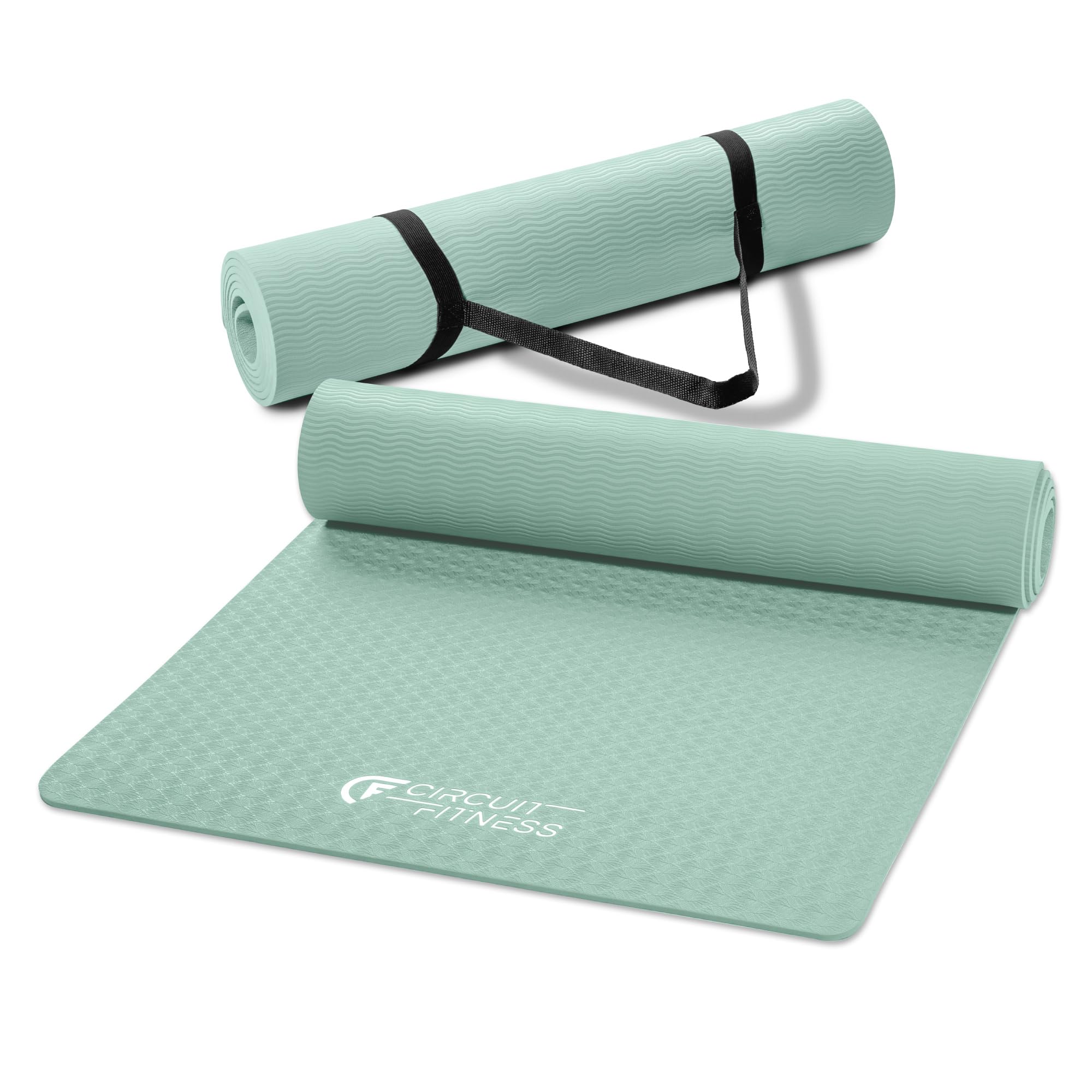
Seventy-four inches of mat for people whose hands kept landing on the floor.
Length is the whole argument here. At 74 inches this is the longest standard-width mat on the list, against the 72-inch picks and longer than longer than the Gaiam Premium’s 68 inches. If you’re tall, or your stride in a lunge or downward dog runs past the end of a normal mat, those numbers do real work. The 6mm TPE body gives you a quarter inch of support with enough firmness for standing balance, and the closed-cell construction means sweat sits on the surface rather than soaking in — a damp cloth wipes it clean.
Weight is the other number that matters: 1.5 pounds. That’s the lightest mat on this list, and at 1.5 pounds against the Gaiam Premium’s 3.1 — which makes it the obvious choice if the mat has to travel. It rolls up tight and includes a shoulder strap. The dual-sided texture helps hold hardwood, tile and carpet, though grip is the one area where reactions divide: some find it planted, others find it slides on smooth floors.
Comfort and value are what buyers settle on here, along with the extra room — the length comes up as a genuine surprise for people who expected a standard mat. The mint green finish is a small thing that people mention liking. For the price tier this sits in, getting 74 inches and closed-cell TPE is the value story.
Length delivered: 74 inches against the 68- and 72-inch mats, and it’s the lightest option here at 1.5 pounds.
Where it wobbles: on slick smooth flooring some users find it shifts, so a non-slip underlay or a textured floor helps.
Pick it when: your height or your stride has been overrunning a standard mat, and you want to carry it easily.
Pass if: your floor is polished tile and a mat that stays anchored matters more to you than length.
5. YOTTOY Extra Thick Yoga Mat, 12mm TPE

Twelve millimeters of foam — against the 6mm standard mats above.
This is the mat for anyone who has ever winced getting down onto a hard floor. At 12mm against the 6mm Gaiam Premium, that extra padding changes what kneeling and seated poses feel like — the pressure moves off your joints and into the foam. If your practice includes long seated stretches, meditation, or you’re recovering from a knee or hip injury, that cushioning is the reason to pick this over everything else on the list. It’s 72 inches long by 24 inches wide and weighs 4 pounds.
The surface is more thought-through than most. Granular bumps on the top side raise friction and absorb sweat, so your hands stay put once they get damp, while a water-ripple texture underneath holds the floor. The TPE material (a foam that is free of the usual PVC plastic) is SGS and TUV certified (two independent safety testing bodies) free of heavy metals including Pb and Cd (lead and cadmium) and ten types of phthalate (softening chemicals), so you are not breathing those in during a session. The one-piece foam process means it arrives essentially odorless — a refreshing change from PVC mats that need days of airing. It wipes clean with a damp cloth.
Now the honest part. Twelve millimeters of foam is a lot of foam, and that softness cuts both ways: standing balance poses feel less grounded, and the mat can shift under fast transitions. It’s also 4 pounds — fine to carry to the car, not something you want on a long walk to a studio. Quality is what buyers rate highest on this mat, with cushioning second, and it’s easy to see why when the padding is this generous.
What the 12mm buys you
- 12mm of thickness against a standard 6mm mat for kneeling and seated poses
- SGS and TUV certified TPE, free of heavy metals and ten phthalates
- One-piece foam process means it arrives effectively odorless
- Granular top texture absorbs sweat, water-ripple base grips the floor
- Strap included for carrying to class, office or camping
Where 12mm costs you
- Soft enough that standing balances feel less stable
- 4 pounds is heavy for a daily studio commute
- Hand wash only, and it must stay out of direct sunlight
Suits you if: joint protection is your number one concern and your practice leans toward kneeling, seated and restorative work.
Skip the 12mm if: you’re chasing balance-pose stability or you carry your mat on foot to class several times a week.
6. KEEP Extra Wide Yoga Mat, 7mm, 72″ x 32″
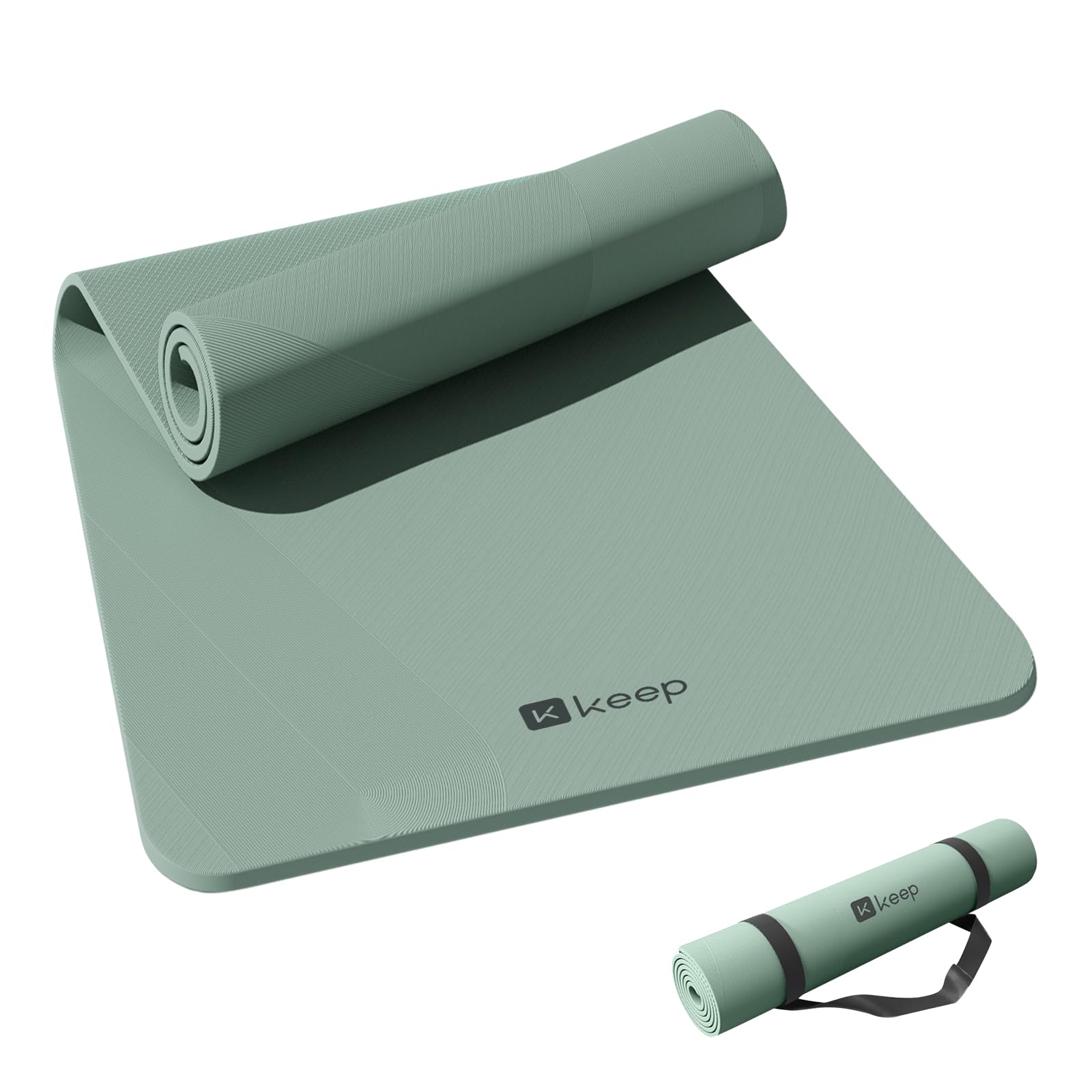
Thirty-two inches of width against the standard twenty-four — enough that your hands stop landing on the floor.
Thirty-two inches wide versus the standard twenty-four is the decision this mat asks you to make. That 32-inch width is the difference between a wide-legged forward fold that fits on the mat and one where your feet hang off the edge. If you’re broad-shouldered, do a lot of mat-wide poses, or practice with a child or pet wandering through, the extra room is the point.
The double-sided texture is well thought out: a fingerprint-style pattern on top for precise foot placement and a full anti-slip pattern underneath so no corner lifts. The TPE is free of plasticizers and formamide, and the mat spot-cleans with cold water. It comes with an adjustable polyester strap. The one thing to plan for is the size — 32 inches of mat is a bigger roll, so check your bag and your storage corner before committing.
Quality and size are what buyers single out about this mat, quality most of all, and the width is what converts people who were skeptical. Two honest caveats: value and slip resistance both draw mixed reactions, and the surface is at its best dry — on a very smooth floor or in a sweaty room, expect to reset your hands. If you need serious wet grip, the Plyopic below is the specialist.
The width advantage: 32 inches against a standard 24-inch mat, and it’s the reason to choose this over a same-thickness pick.
The maintenance note: it must air out before first use to clear packaging odor, and it needs a spot clean rather than a machine wash.
Fits you if: you have broad shoulders, do wide-stance work, or share your practice space with a pet or a small child.
Not ideal if: you’re short on floor or storage space, or you sweat hard and need a surface that grips when wet.
7. HAPBEAR Large Yoga Mat, 72″ x 36″ x 6mm
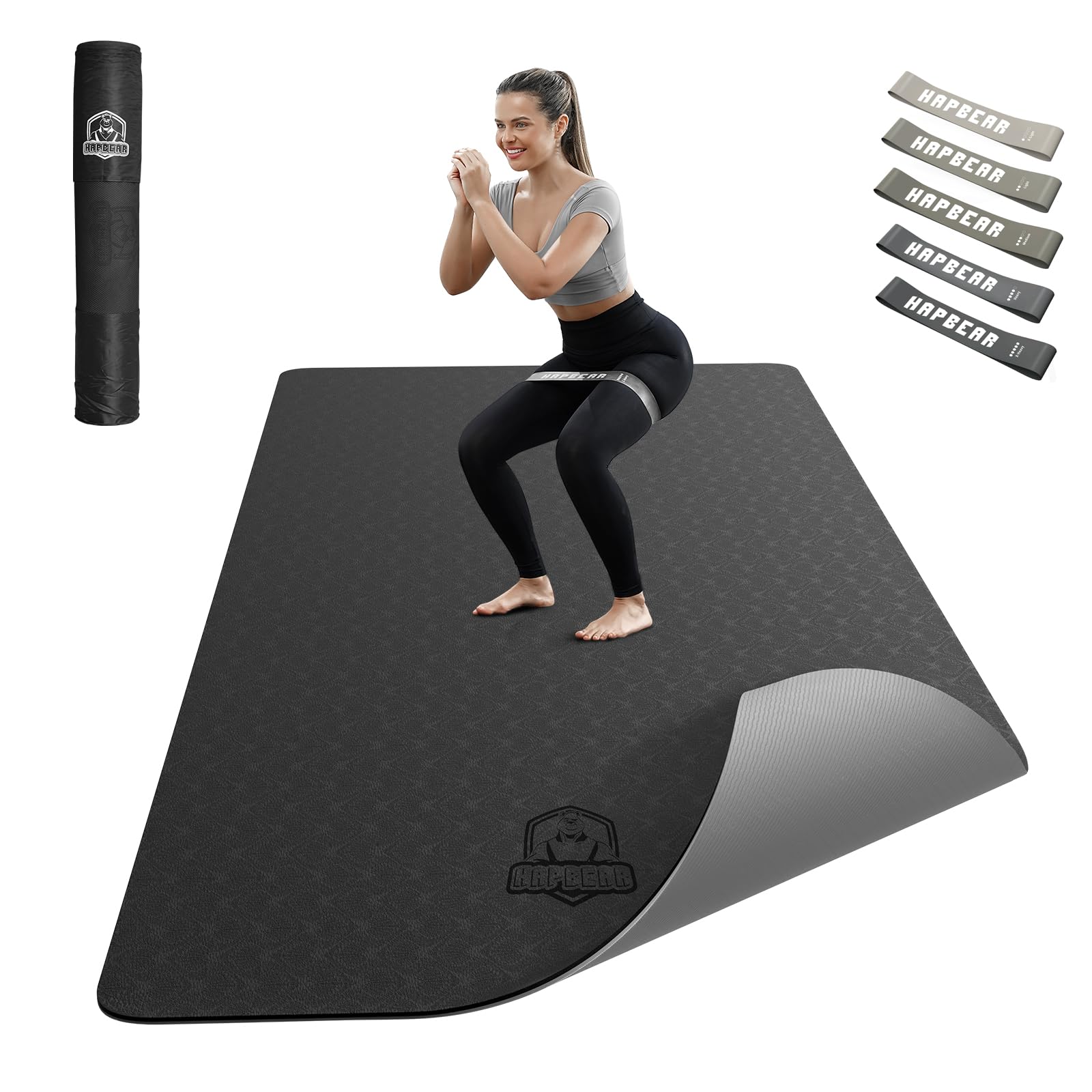
A 36-inch-wide practice floor that turns your living room into a studio.
The headline is the footprint: 72 inches by 36 inches, against the standard 24-inch mat width. That’s a genuine living-room-gym proposition — you can lay out into a full wide-legged stretch, do floor Pilates with your arms out, or work through a bodyweight routine without your hands leaving the mat. If your “studio” is the space between the sofa and the coffee table and you want room to move, this is the one on this list that gives you the most of it. It’s 6mm thick in TPE and weighs 1.2 kg.
The double-sided textured surface is designed to stay put on smooth floors, and the maker is explicit that it’s not for use on carpet — worth knowing before you order. Cushioning at 6mm is moderate: enough to ease knee and wrist strain during holds, not enough to swallow your balance. A carry bag is included, along with resistance bands.
Quality and size are the two things this mat is praised for most, and they’re the right two for a large-format mat. The honest friction points are thickness perception and traction on smooth surfaces, both of which draw split reactions — if you’re coming from an extra-thick mat, 6mm will feel firm. And the 36-inch roll is bulky, so it’s a mat you store rather than tuck in a backpack.
The case for the extra width
- 36 inches wide gives you room for wide-legged poses and full-body floor work
- 72 inches long fits most body heights without overhang
- Carry bag and resistance bands included with the mat
- TPE surface wipes clean and stands up to frequent home use
Before you commit
- Not for use on carpet, per the maker
- 6mm reads as thin if you’re used to a plush mat
- A 36-inch roll takes real storage space
Built for: home workout spaces where you want mat-wide movements and don’t mind a larger roll.
Wrong pick if: your floor is carpeted or you need to fold it into a bag for the gym.
8. Plyopic Ultra Grip PRO Yoga Mat
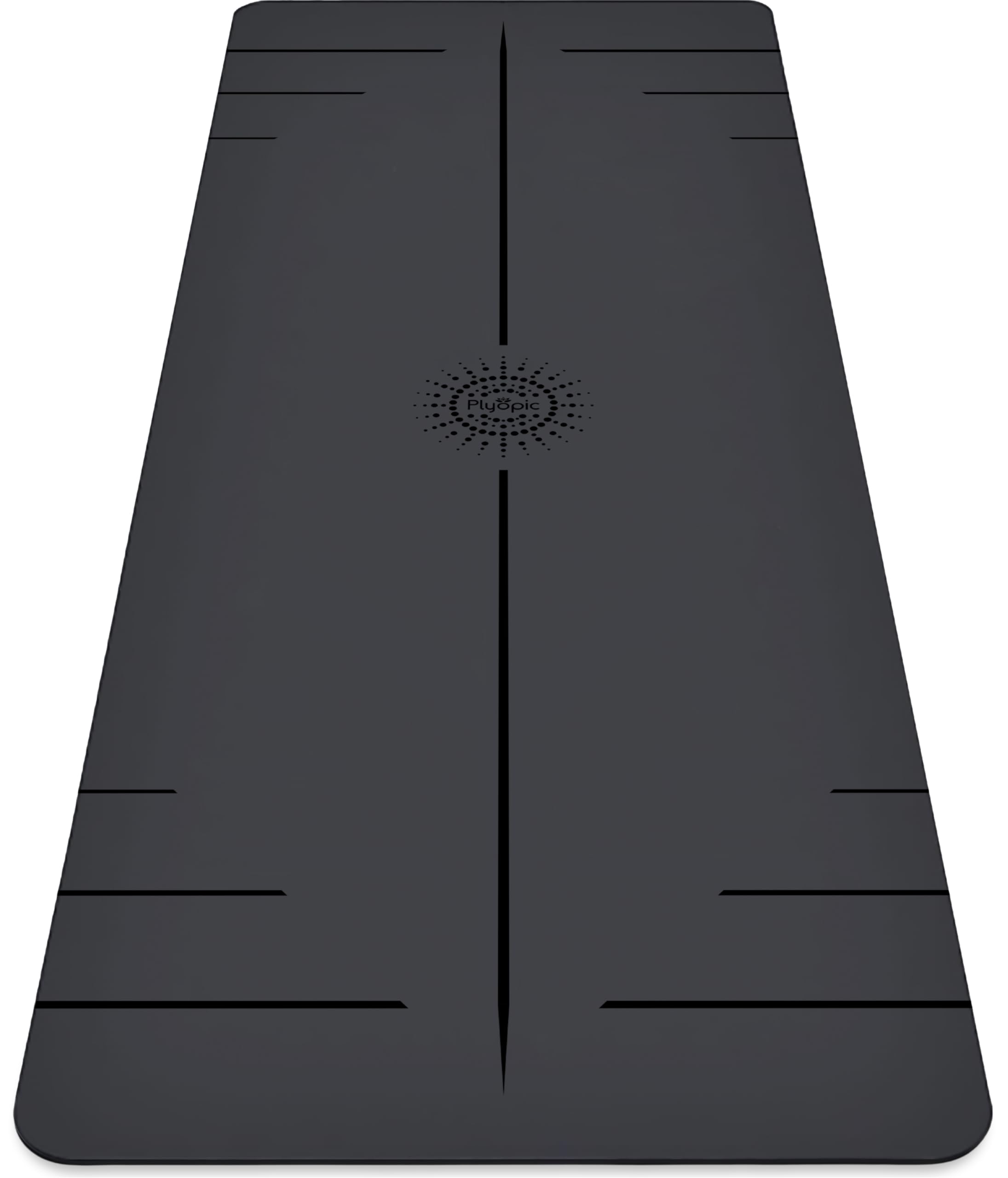
Built for the moment sweat starts and every other mat lets go.
Sweaty palms are the reason this mat exists. The UltraGrip surface is a mix of natural tree rubber and eco-PU, designed to hold contact as moisture builds — which is exactly the condition where the TPE and PVC mats above start to feel slick. If you practice hot yoga, live somewhere humid, or simply sweat through a long flow, this is the specialist pick on the list. It’s 72 inches long and 26 inches wide, against a standard 24-inch mat, and weighs 2.4 kg — heavy enough to feel planted, light enough for a carry strap to handle.
The alignment system is the other half of the pitch. PoseMap gives you reference points for hands, feet and center across thousands of poses, so you can check your symmetry without a mirror. Whether you use it or ignore it, it doesn’t interfere with the surface. The mat is vegan-friendly and PVC-free.
Grip is what this mat is known for, and it’s the second most-discussed thing about it behind overall quality — buyers specifically call out that it holds with sweaty hands, which is the whole reason to pay the premium. The honest trade-off is cushioning. At roughly 0.17 inches (about 4 mm) it is a thin mat by design, so it suits hot yoga and balance work but not a tender spine on a hard floor. While the natural rubber softens the pressure under knees and wrists, it is not a plush mat. The natural rubber also carries some initial scent, which fades with airing.
Wet-grip specialist: the dry-and-wet grip is the spec that justifies this mat, and it’s where the closed-cell TPE picks can’t compete.
The cushioning compromise: roughly 0.17 inches keeps you grounded for balance poses but offers far less padding than a 6mm or 12mm mat.
For you if: you sweat hard, practice hot yoga, or need alignment reference points to check your symmetry.
Choose another mat if: joint cushioning is your priority — the natural rubber is dense, not plush.
9. Body By Yoga Luxury Cork Yoga Mat, 80″ x 26″
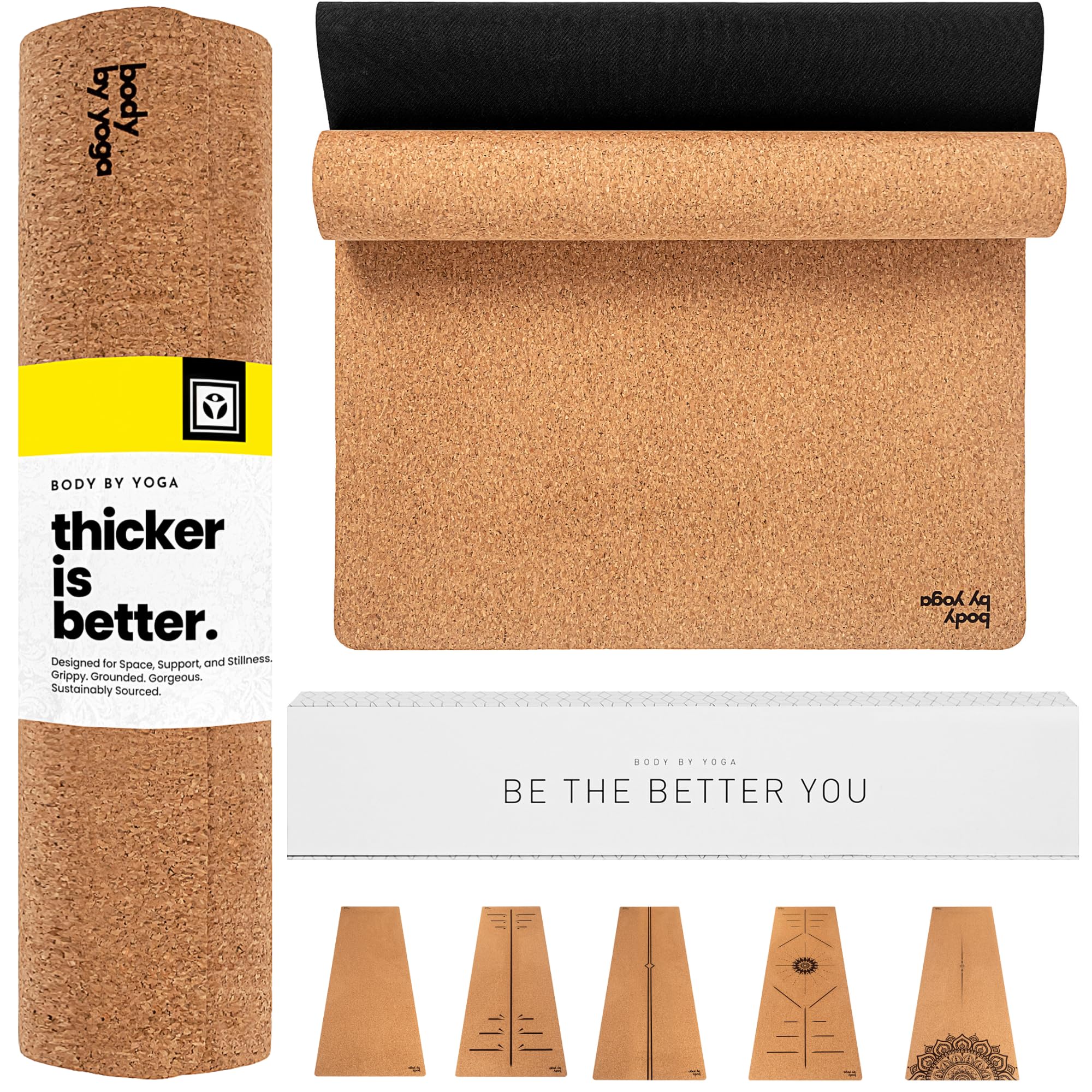
Eighty inches of cork and rubber — the longest, heaviest mat here.
Eight feet of mat is the number that matters if you have ever had your heels or hands slide off the end of a 68-inch mat. At 80 inches long and 26 inches wide, this is the longest mat on the list against the 72-inch picks, and it’s the only one that truly accommodates a tall body through a full stride. The cork surface is the second reason to pick it: natural cork gets tackier as it dampens, so a sweaty session makes this mat grip harder rather than worse. It’s a cork-and-rubber build, and 0.25 inches thick.
Then there’s the weight. At 9.9 pounds, this is by far the heaviest mat here — the maker is explicit that the weight is deliberate, providing stability and helping the mat stay put. That’s true, and you’ll feel the difference in a standing balance. But 9.9 pounds is a mat you keep at home or in a studio locker, not one you walk to class with every day. That weight is the single most-noted drawback by a wide margin, and it’s a fair one.
Cork’s other advantage is upkeep: it resists moisture buildup and wipes clean with water, so it doesn’t hold sweat the way porous rubber does. Knee support and grip are the two things buyers value most after overall quality, and the thickness cushions knees while keeping you stable. If you’re tall, sweaty, and practice at home, the combination of 80 inches, cork grip and joint support is hard to replicate. If you commute by foot, it isn’t the right mat.
Right for: tall practitioners and heavy sweaters who practice at home and want a mat that stays planted.
Wrong for: anyone carrying a mat to a studio on foot — 9.9 pounds is a real haul.
Know the Specs
Thickness: The Cushioning vs Stability Trade-Off
Thickness is measured in millimeters, and it decides how much your knees and wrists are protected versus how grounded you feel in standing poses. A 6mm mat is the middle ground most people settle on — enough to soften a hard floor without turning balance poses into a wobble. A 10mm or 12mm mat is for kneeling, seated and restorative work where joint comfort comes first. A thin mat around 0.17 to 0.25 inches keeps you connected to the floor, which is what balance-focused practice and alignment work want.
Material: What TPE, PVC, NBR and Cork Feel Like
TPE is a closed-cell synthetic that stays dry to the touch and wipes clean, and it’s the most common material on this list. PVC is denser and grippier when dry but can turn slick with sweat, and good PVC mats skip certain phthalates. NBR foam is the softest and plushest, which makes it ideal for joint cushioning but the most prone to tearing. Natural rubber is dense and stable with strong grip. Cork gets tackier as it dampens, so it suits sweaty and hot practice, and it wipes clean rather than absorbing sweat.
Size: Width and Length Change What You Can Do
Standard mats are 24 inches wide and 68 to 72 inches long. Length matters most for tall bodies and long strides — 74 to 80 inches gives you room where a 68-inch mat runs out. Width matters for wide-legged poses, arm balances and floor work: 32 or 36 inches stops your hands and feet from spilling onto the floor. The cost of extra size is the roll you carry and the space it takes to store.
Grip: Dry Versus Wet Performance
Grip is a working condition, not a fixed rating. Many textured surfaces hold well when dry and lose traction once sweat builds. If you practice hot yoga or sweat heavily, look for a mat that specifically addresses wet grip — cork and PU surfaces do — and pair any mat with a towel if the room gets steamy. On very smooth floors, a textured base helps the mat itself stay anchored.
Common Questions
Is a 6mm mat thick enough for Pilates on a hardwood floor?
Will a wider yoga mat fit in my regular mat bag?
Why does my new yoga mat smell so strong?
Is cork better than TPE for hot yoga?
How do I clean a yoga or Pilates mat?
Can I use a yoga mat for Pilates and floor workouts?
How long should my mat be if I am tall?
Does mat weight tell me anything useful?
What is the difference between a yoga mat and a Pilates mat?
Do alignment lines on a mat actually help?
The Bottom Line
For most people, the yoga and pilates mats pick is the Gaiam Premium 6mm Print Mat. Its 6mm PVC cushioning, 68-inch length and textured grip cover yoga, Pilates and stretching without forcing a compromise — and it’s the crowd favorite, sitting at 4.5+ stars across 22,000+ owners. If your knees need real padding, the Gaiam Thick 10mm mat turns down the sting on hard floors. And if you sweat hard or practice hot yoga, the Plyopic Ultra Grip PRO is the mat built for the moment every other surface lets go.
How we choose
We do not accept paid placement. Every pick is matched to a real buyer and a real use-case; we do not hands-on test units.
Sources
Specifications: manufacturer listings and product documentation. Review insights: verified customer reviews, as of November 2026. Pricing: not shown on this page (it changes often); check the current price via the retailer link.
As an Amazon Associate, Tactical Gear Guy earns from qualifying purchases. This does not affect which products we feature.