Specs are compiled from manufacturer listings and verified buyer reviews and can change over time — please confirm the key details on the product page before buying.
You want a yellow tennis shoe that actually looks yellow on court and still holds your foot through a lateral slide. That combination is rarer than it should be, because many bright colorways pair a narrow last with a thin outsole. This guide covers four men’s yellow tennis shoes that clear both bars, from a classic track-inspired low-profile pair to a stability shoe built for frequent play.
This guide is built by comparing the manufacturers’ published specifications and the patterns across verified customer reviews, so you get each pick’s real strengths and trade-offs instead of marketing spin.
The picks below sort by what you actually do on court — lateral support, outsole grip, and how the upper treats a wider foot. Every option here is a real yellow colorway, so you can find the right yellow tennis shoes for men without guessing at the shade.
Top Picks

How To Choose The Best Yellow Tennis Shoes for Men
The biggest mistake men make here is buying a yellow running shoe and taking it onto a hard court. Running shoes are built to go forward. Tennis asks your foot to stop, plant sideways, and push back the other way dozens of times per set. That outsole difference matters far more than the color.
Start with the outsole, not the upper
A tennis shoe lives or dies on its outsole, the rubber bottom that grips the court. You want a rubber compound that survives abrasive hard courts and a tread pattern that lets you slide and stop without skidding out. An all-court or all-ground label on the box is your signal that the maker tuned the rubber for court abrasion rather than pavement walking.
Match the shoe’s support style to your foot
A stability shoe gives you a firmer platform under the arch so your ankle does not roll outward on a wide reach. A neutral shoe lets your foot move naturally and suits a player with a steady, balanced stance. If you have had ankle trouble on lateral slides, lean toward the stability side rather than the lightest pair on the shelf.
Weigh the shoe against how often you play
Shoe weight is a real trade-off between quickness and durability. A lighter pair helps you recover faster between points, but a lighter build often means less rubber and less cushioning underfoot. Players on court several times a week will get more out of a slightly heavier shoe that keeps its structure than from the lightest option in the colorway.
Mind the fit on a bright colorway
Yellow shoes are often built on a narrow last, and colorways disappear fast once a size sells out. Read sizing notes before you order, especially if you wear a wide or a half size. When a listing says the shoe runs narrow, that is your cue to consider going up rather than trusting your usual number.
Side-by-Side Comparison
| Model | Best For | Rated | Weight | Surface | Amazon |
|---|---|---|---|---|---|
| Onitsuka Tiger Serrano★ Best Overall | Style-first low-profile play | 4.7 | — | — | Amazon |
| Kricely Trail Running / Court Sneaker | Everyday multi-sport wear | 4.1 | — | Trail, court, road | Amazon |
| Diadora B.Icon 2 AG | All-level club players | 4.2 | 2.13 lb | Hard or clay | Amazon |
| Mizuno Wave Enforce Court AC | Frequent play, stability | 4.3 | — | All court | Amazon |
Detailed Reviews
1. Onitsuka Tiger Serrano Men’s Size
Our pick — 4.5+★ from 150+ verified ratings; the strongest balance of quality and price.
A low-slung 1970s track spike reborn as the sharpest yellow shoe here.
The Serrano is the pick if you want a yellow tennis shoe that looks like nothing else on the baseline. Its design traces back to classic track and field spike shoes of the 1970s, and the special outsole curves upward toward the front and wraps subtly around the sides. That wraparound shape gives the shoe its distinctive profile from every angle — the yellow reads clearly on court rather than fading into a beige midsole.
What wins people over most is simply how it looks: appearance is the aspect owners bring up most, followed by style. The 150+ ratings settle at 4.5+ stars, which is the strongest score in this group and the reason it takes the top spot. It is also the crowd favorite for a low-profile, retro silhouette rather than a bulky modern court shoe.
The catch is fit. The slip-on-style construction runs narrow for a good share of wearers, and the shoe is priced in premium territory for a canvas-feel low-profile silhouette. If you have a wide foot, order up or try a wider court shoe like the Diadora below. For a narrow-to-average foot that wants the look, this is the pair.
What It Does Well
- Highest rating in the group at 4.5+ stars — the style-first pick most buyers rate favorably
- Track-spike heritage gives it an unmistakable low-profile silhouette
- Curved, side-wrapping outsole is the defining visual detail
- Yellow colorway is loud and legible on a hard court
Where It Trips Up
- Runs narrow — wide-footed players should size up or look elsewhere
- Value is mixed given the premium price tier
- Low-profile build offers less underfoot cushioning than a stability court shoe
Pull these on if: you want the sharpest-looking yellow shoe on the court and your foot is narrow to average.
Order up a half size if: the listing’s narrow-fit reputation worries you, since the low-profile last leaves little room.
2. Kricely Men’s Trail Running Shoes

One yellow shoe for the trail, the treadmill, and a quick set of tennis.
If you want a single yellow sneaker that handles a hike, a jog, and a casual knock-around, the Kricely is the one to grab. The mesh knitted upper lets air move through so your feet do not overheat, and a 3D-structured midsole aims for stable support with shock absorption. A non-slip rubber outsole with an aggressive grip pattern rounds out the package — it is the multi-sport option, not a dedicated clay-court shoe.
Quality is the thing the review pages come back to most, with appearance, value, color, and light weight all landing on the positive side. The shoes draw plenty of compliments on their looks, and the yellow clearly holds its own. At 4.0+ stars from a very large pool of owners, it is the best-tested option in this article by a wide margin.
Comfort and fit are the honest split. Some wearers find the cushioning plush and cloud-soft, while others say they feel everything they step on and find the shoe too narrow. Think of this as a light, breathable everyday sneaker that will get you through a friendly match — not a shoe built for a five-set baseline grind. Wide-footed players should size up.
Where it shines: breathability plus an aggressively gripped rubber sole at a budget-friendly tier — the mesh knit keeps feet cool on a warm court, and the non-slip tread holds firm on both trail and hard surface.
The honest limit: cushioning splits opinion, and the shoe leans narrow. Players who need firm lateral support on a hard slide will be better served by the Diadora or Mizuno picks.
Best for the do-everything guy: a hiker, jogger, and casual tennis player who wants one yellow sneaker for all three.
Not your match if: you log serious hard-court hours and need a firmer, more supportive platform.
3. Diadora Mens B.Icon 2 All Ground Tennis Sneakers Shoes
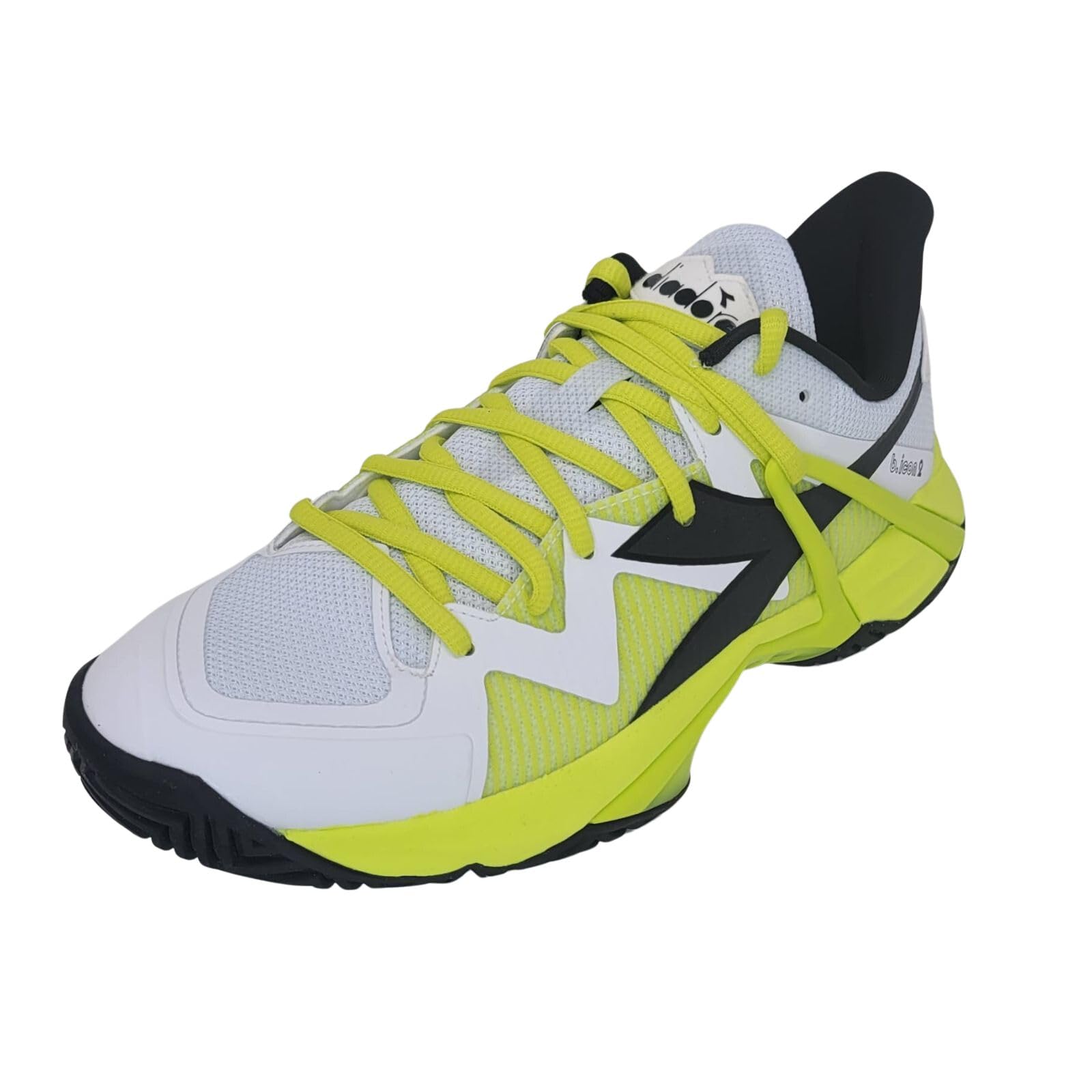
A genuine club-court shoe that happens to come in bright yellow.
The B.Icon 2 AG is built for all-levels players and works on both hard surfaces and clay. That all-ground labeling is the detail that matters most here — it means Diadora tuned the outsole for court abrasion rather than pavement. You get a purpose-built tennis sneaker in the mid-range tier, and the shoe weighs 2.13 pounds.
Owners come away impressed with the quality, comfort, and stability, and the looks and value land on the positive side too. The stability element is the real draw: on a lateral slide, a firmer base underfoot keeps your stance planted instead of skating. That makes it a strong first serious tennis shoe for a club player moving up from running sneakers.
Fit is the one split. Some wearers find the sizing perfect; others say it runs too tight in both width and length. The safe move is to size up if you are between sizes or lean wide. Weighed across the field, this is the value pick — a dedicated all-court shoe at a mid-range price.
Why it earns a spot: all-ground outsole tuned for hard courts and clay, plus a stability-focused build at 2.13 pounds. For an all-levels player who wants a real tennis shoe without going premium, this is the smart buy.
Watch the sizing: reports of tightness in width and length mean the listed size is not always the right one — go half a size up if your foot runs wide.
Choose this for value: the club player who wants a true all-court shoe in yellow without the premium outlay.
Only snag: the tight fit runs across width and length, so plan your size cautiously.
4. Mizuno Men’s Wave Enforce Court Shoe

A stability-first court shoe for the player who lives at the baseline.
This is the premium pick, and it is aimed squarely at frequent players who want lightweight stability. MIZUNO ENERZY is the cushioning foam, and the MIZUNO FOAM WAVE plate is the wave-shaped midsole piece that returns energy with each step. A flat, outrigger X10 rubber outsole — an X10 compound plus an extended edge for lateral support — is tuned for on-court stability and durability. It suits tennis or pickleball, so a dual-court player gets one shoe for both.
Comfort is what earns the most praise across reviews, with traction next, then light weight and support. The cushioning gets called responsive without being chunky, which tells you the underfoot ride stays springy rather than mushy. At 4.0+ stars, it is the highest-rated stability shoe in this group and the pick for players logging serious court time.
The one honest concern is longevity. The reviews divide here: some buyers report solid tread life, while others say the outsole wore through in two weeks of hard-court play. Frequent hard-court play is abrasive on any outsole, so keep an eye on the tread wear if this becomes your everyday shoe. Fit also splits opinion, so try before committing if you can.
The play-maker’s shoe: ENERZY cushioning, a FOAM WAVE plate, and an outrigger X10 outsole make it the most stability-focused yellow court shoe here. Comfort is the top score to beat.
Durability question mark: lifespan reports range from solid to short-lived — a fairness-by-design risk, not a dealbreaker, but one worth tracking if you play often.
Reach for this if: you play multiple times a week and want cushioning plus active stability on every lateral push.
Look elsewhere if: maximum outsole longevity is your top priority — the long-term tread reports are mixed.
Know the Specs
Outsole Grip and Court Abrasion
The outsole is the rubber bottom of the shoe, and it decides how well you stop, slide, and push off. On a hard court, that rubber grinds down fast, so brands tune the compound for abrasion rather than pavement walking. Look for an all-court or all-ground label — it signals the rubber was built for the slide-and-stop rhythm of tennis, not just straight-line running.
Cushioning and Energy Return
Cushioning is the foam under your foot that absorbs impact, and energy return is how much spring that foam gives back on push-off. A wave-shaped plate or a foam midsole with rebound helps keep you fresh through a long match. Too much foam can feel chunky, so the goal is a springy ride that still lets your foot feel the court — a balance the Mizuno explicitly targets.
Stability versus Neutral Support
A stability shoe has a firmer base and extra support on the outer edge to keep your ankle from rolling on a wide reach. A neutral shoe lets the foot move naturally for players with a steady stance. If lateral slides have tweaked your ankle before, the firmer platform is worth the slight extra weight; if you are balanced and light on your feet, a neutral build feels quicker.
Shoe Weight and Upper Materials
Weight in pounds and the upper material — whether it is mesh knit or a closer-fitting low-profile build — affect both breathability and recovery. A mesh upper moves air to keep feet cool; a lighter shoe helps you reset between points. The trade-off is that lighter builds often carry less rubber and less underfoot protection, so weigh weight against how often you play.
Common Questions
Can I wear yellow running shoes for tennis?
Do these yellow tennis shoes run narrow?
What does all court or all ground mean on a tennis shoe?
Which of these is best for a frequent tennis player?
Are these shoes suitable for pickleball too?
How much does the Diadora B.Icon 2 AG weigh?
Will the yellow color fade or chip on court?
Should I buy a dedicated court shoe or a multi-sport sneaker?
How do I pick the right size in a yellow tennis shoe?
Do these shoes work on clay courts?
The Bottom Line
For most players, the yellow tennis shoes for men winner is the Onitsuka Tiger Serrano because it pairs the group’s top rating with an unmistakable low-profile yellow look. If you want a true all-court shoe at a mid-range tier, grab the Diadora B.Icon 2 AG. And for frequent play with serious lateral stability, the Mizuno Wave Enforce Court is the one to reach for.
How we choose
We do not accept paid placement. Every pick is matched to a real buyer and a real use-case; we do not hands-on test units.
Sources
Specifications: manufacturer listings and product documentation. Review insights: verified customer reviews, as of November 2026. Pricing: not shown on this page (it changes often); check the current price via the retailer link.
As an Amazon Associate, Tactical Gear Guy earns from qualifying purchases. This does not affect which products we feature.