Specs are compiled from manufacturer listings and verified buyer reviews and can change over time — please confirm the key details on the product page before buying.
Yellow lenses are the cheapest upgrade you can make to your night driving, and the right pair softens harsh oncoming headlights into a warmer amber tone. The wrong pair just tints everything yellow and does nothing about glare. This guide separates the two, using published specs and what owners actually report after weeks behind the wheel.
This guide is built by comparing the manufacturers’ published specifications and the patterns across verified customer reviews, so you get each pick’s real strengths and trade-offs instead of marketing spin.
Night driving glasses are not a magic fix, and no yellow lens removes every headlight glare. What a good yellow pair does is boost contrast on wet, foggy, or poorly lit roads. SUNGAIT and DUCO both state a light transmission figure over 75%. Here is how to pick the right yellow sunglasses for men by checking VLT, polarization strength, and hinge type before you buy.
Top Picks


How To Choose The Best Yellow Sunglasses for Men
Buying yellow lenses is not like buying normal sunglasses. A dark lens is easy to judge — you put it on and the world gets dimmer. Yellow lenses are judged the opposite way: the good ones keep light coming through while stripping out the harsh blue-white glare that makes headlights and wet asphalt painful. That difference in light transmission, not frame shape, is where your money should go.
Look at VLT before anything else
VLT stands for visible light transmission, the share of available light the lens lets reach your eye. For night driving you want a lens that lets most light through while still cutting glare. SUNGAIT publishes a VLT over 75% on its yellow lens, and DUCO lists over 75% light transmittance with mild 10% polarization. Those figures tell you the lens is built to stay bright in the dark, which is the whole point. A dark polarized lens may look sharper in the showroom photo, but its low VLT dims the road after sunset.
Understand what polarization does at night
Polarization is a filter that blocks light bouncing off flat, shiny surfaces — wet roads, hoods, dashboards. In daytime sunglasses it is a big plus. At night, full polarization can be too much because it cuts light you need. That is why DUCO deliberately uses mild 10% polarization instead of full filtering. Meanwhile LUENX and SUNGAIT both build their yellow lenses with a polarized anti-glare coating aimed at headlight glare. Mild polarization suits near-dark rural roads, while a polarized anti-glare coating suits mixed streetlight and headlight glare.
Check the frame and hinge for daily abuse
These glasses live on a dashboard, a sun visor, or the front pocket of a work bag. Metal hinges hold up better than pinned plastic. A spring hinge — the type that flexes outward when you open the arms — keeps the fit snug without squeezing your temples. Aluminum-magnesium frames and TR90 (a flexible, lightweight plastic used in sport glasses) both survive being dropped in a truck cab far better than rigid thin plastic.
Match the lens to your actual drive
Clear dry highway at night calls for a lens that filters headlight glare without going dark. Rain, fog, and snow change the job: yellow lenses boost contrast against gray, wet surfaces, which is why both LUENX and DUCO position their yellow tint as an all-weather enhancer. If you ride or cycle, photochromic lenses (lenses that darken automatically when UV light hits them) give you one pair that works at noon and dusk.
Side-by-Side Comparison
| Model | Best For | Lens Type | Stated Light Transmission | Weight | Amazon |
|---|---|---|---|---|---|
| FEISEDY Retro Square Aviator B4158★ Best Overall | Vintage style and everyday wear | Yellow-tinted square aviator | — | 1.82 ounces | Amazon |
| LUENX Aviator Polarized UV400Best Value | Night driving on a tight budget | Polarized yellow with anti-glare coating | — | 2.82 ounces | Amazon |
| FEISEDY Night Driving B2294Night Specialist | Spring hinge comfort for long drives | Polarized yellow night vision | — | 2.82 ounces | Amazon |
| SUNGAIT Ultra-Lightweight Polarized | Day and night driving in one pair | Polarized yellow, high transmission | Over 75% VLT | — | Amazon |
| Polarised Night Driving Yellow Tinted | Fog and rain contrast | Polarized yellow anti-glare | — | — | Amazon |
| OULAIQI Polarized Night Driving | Long commutes and road trips | Polarized yellow tinted | — | — | Amazon |
| VICTGOAL Photochromic Sport | Cycling and mixed daylight riding | Photochromic PC with UV400 coating | — | 30g frame | Amazon |
| Bircen Night Vision Metal Glasses | Hours-long comfort behind the wheel | TAC lens, yellow tint | — | — | Amazon |
| DUCO Polarized Night Driving | All-weather road contrast | Yellow with mild 10% polarization | Over 75% transmittance | 0.88 ounces | Amazon |
Detailed Reviews
1. FEISEDY Retro Square Aviator Sunglasses B4158
Our pick — 4.5+★ from 750+ verified ratings; the strongest balance of quality and price.
The square aviator that skips the sci-fi look and still cuts the glare.
You can wear these to a bar or a job site without looking like you borrowed safety gear. The FEISEDY pair puts its yellow tint inside a 70s square aviator shape — a double bridge across the top, a smooth plastic frame, and soft nose pads — so it reads as a style choice, not a gadget. At 1.82 ounces versus its sibling FEISEDY night driver at 2.82 ounces, it is the lighter of the two on your face. The frame also packs down to 6.1 x 2.36 x 0.59 inches, so it slips into a glovebox or jacket pocket without a bulky case.
What makes it the top pick is that the frame quality holds up where it counts. Owners consistently single out the build and the retro shape as the two things they like most, and the fit works across different face sizes rather than pinching at the temples. Buyers report the lenses pull double duty — clear enough for low light and useful in daytime sun — which is why so many describe them as a pair they keep reaching for. Amazon’s own review summary puts it plainly: the durability feedback is mixed, some frames feel solid and some may not last long if you are rough with them. That is the honest trade-off on a plastic frame at this tier.
What lands with owners
- Build quality and the 70s square-aviator shape are the two most-praised traits.
- At 1.82 ounces versus the other FEISEDY pair at 2.82 ounces, it is the lighter of the two.
- Fit works across several face sizes; the smooth plastic frame stays comfortable.
- Yellow tint suits both evening driving and daytime wear, so one pair covers more ground.
Where it asks for care
- It is a plastic frame with durable hinges, not a spring hinge — treat the arms gently.
- Durability feedback is genuinely mixed, so this is a good daily pair rather than a rough-and-tumble one.
Pick it for: a stylish everyday yellow lens you can wear to work, drive home in, and not look like you borrowed it from a garage.
Look elsewhere if: you need a spring hinge or a frame built for being tossed around — the plastic arms want a case.
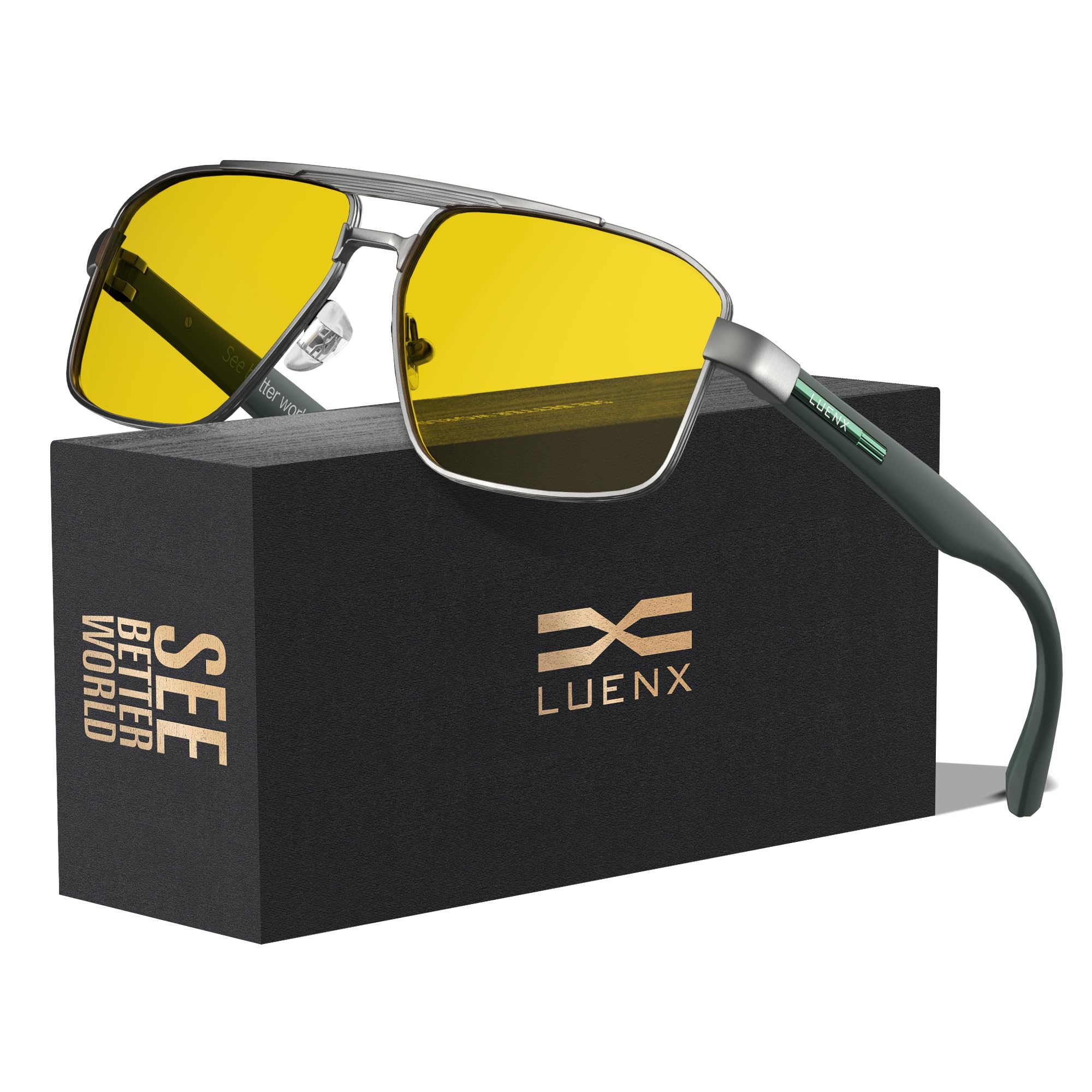
2. LUENX Aviator Sunglasses Polarized UV400
A yellow aviator that looks like it cost far more than it does.
If you want the classic metal aviator look with a yellow lens, this is the pair to start with. With a 4.5+ rating across 700+ ratings, it also performs like a favourite — the most repeated comment in the review pages is that these look like high-end glasses rather than a budget pick. The build quality is the thing buyers praise most, followed closely by the value, and that pairing is rare at this tier.
The lens is a polarized yellow with a special anti-glare coating, aimed squarely at the two things that ruin a night drive: oncoming headlights and bright streetlights. There is also a fade feature that dims the brightest hits without blacking out your view — useful when a truck’s high beams catch you on an unlit road. You get a soft pouch, a cleaning cloth, and a polarization test card in the box, so you can check the lens is genuinely polarized rather than trusting the label. It weighs 2.82 ounces, the same as the FEISEDY night driver below, so neither is a featherweight — though both stay comfortable on long drives.
Here is the follow-up question worth asking: is a polarized lens the right call for every night? Full polarization can cut light you want in near-darkness. LUENX aims the coating at glare specifically, and its owners mention the fade feature keeps visibility intact. The common owner observation is that the glasses look good enough for everyday wear and still work when the sun drops, which is a hard balance to strike. Durability gets positive feedback rather than mixed, so the metal hinge and lightweight arms hold up under normal use.
Where the money lands: metal hinge, soft nose pads, polarized yellow lens, pouch and test card — a complete kit rather than a bare pair of glasses.
The honest caveat: 2.82 ounces is mid-weight for sunglasses; it is not the ultralight option on this list, so if temple pressure bothers you, look at the DUCO below.
Reach for this if: you want the aviator silhouette, a genuinely polarized yellow lens, and the accessories to keep them clean.
Think twice if: you only drive in true darkness and prefer the mild-polarization approach over a fully coated lens.
3. FEISEDY Night Driving Glasses B2294
Built around a spring hinge that flexes instead of pinching on long hauls.
The feature that defines this pair is the spring hinge — the flex mechanism in the arms that lets them open wider than a fixed hinge. On a four-hour drive, that is the difference between a snug fit and a headache. The frame is a lightweight aviator measuring 65mm across and 49mm tall, and the yellow polarized lens is aimed at exactly the job its name promises: sharpening your view at night, on cloudy days, and in rain. It also works for night hunting, motorcycling, and biking, so it is not a one-trick pair.
Buyers consistently report good build quality and that the glasses work well during the day too, not just after dark. The lens reduces glare from headlamps and picks up road markings and signage that a bare eye misses on a wet road. The frame is 2.82 ounces, matching the LUENX above, and it packs into a 6.77 x 2.95 x 2.24 inch footprint that is a touch bulkier than the retro square FEISEDY. Glare reduction and night-vision performance are the areas where buyers split — some find the effect strong, others find it subtler than expected. It is worth knowing that before you buy, because this lens softens glare rather than eliminating it.
What it does well: the spring hinge and ergonomic frame keep pressure off your temples over a long drive, and the yellow tint helps in rain, fog, and low sun.
What to expect honestly: this is a glare-softener, not a headlight eraser — if you want dramatic night-vision results, no lens at this tier delivers that.
Best suited to: drivers who log serious hours and need the arms to give rather than grip.
Not your pair if: you want a featherweight frame — the 2.82-ounce build is sturdier than it is airy.
4. SUNGAIT Ultra-Lightweight Polarized Sunglasses
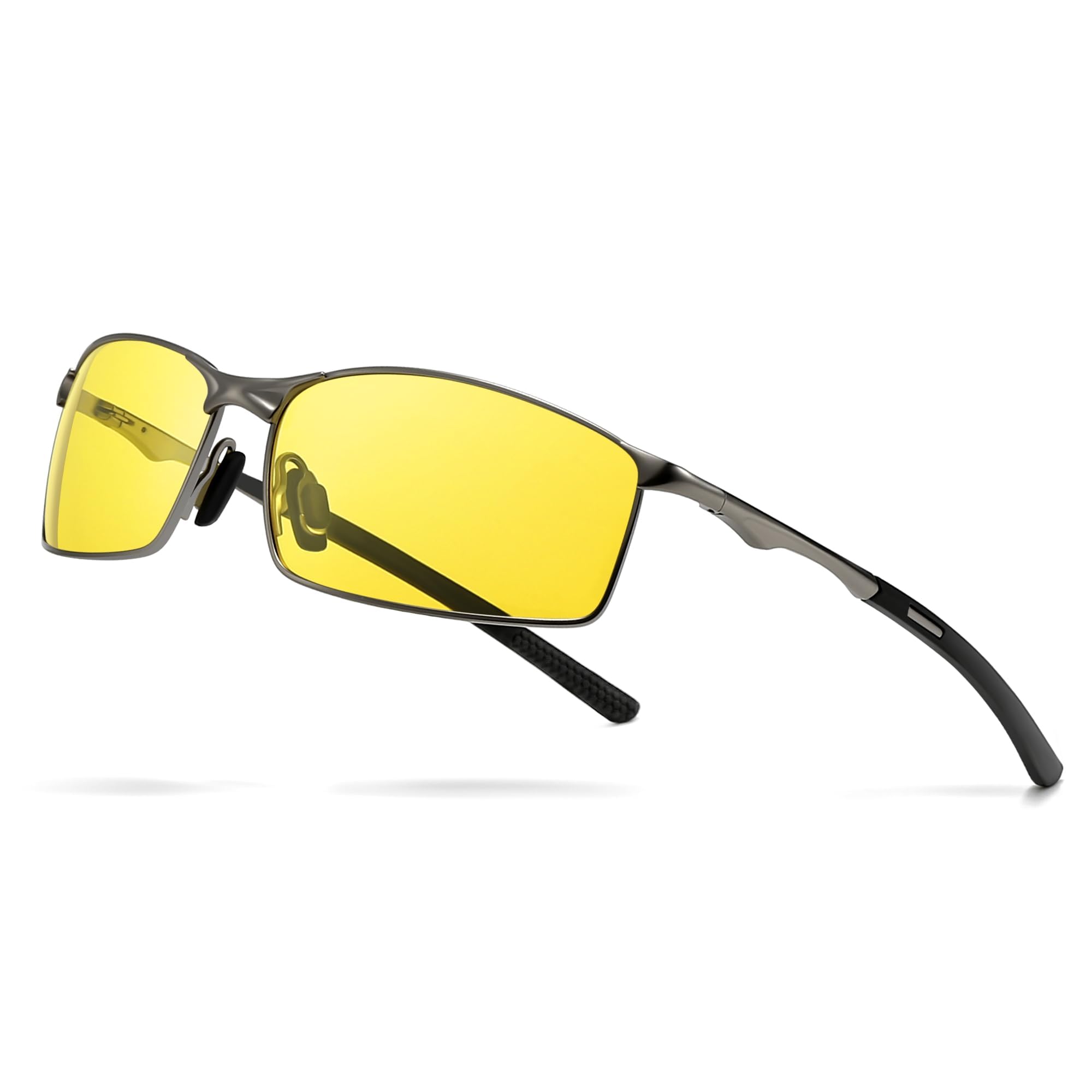
The pair you can leave on from dusk until the headlights come on.
You can see how bright this lens really is before you buy, which most yellow-lens makers never tell you. The yellow-tinted lens is polarized (a filter that cuts glare off wet roads and hoods) with a visible light transmission over 75% — meaning more than 75% of available light reaches your eye. That number is what keeps these usable at night without going dark, and it also explains why the same lens works in daytime, overcast, rainy, snowy, and dawn or dusk conditions. DUCO publishes a comparable over-75% figure, and both are worth checking on the spec sheet.
You get a clear view of the road because the rectangular metal frame stays narrow, so a huge lens blank does not fill your peripheral view. A spring hinge (a flexing joint that lets the arms give with your head) keeps the fit from clamping. Quality and value are the traits buyers call out most, and the durability story is strong — a full year of use without breaking comes up in the reviews, which is more than most plastic frames in this guide can claim. It also holds up for fishing and golf, so it earns a spot in a tackle box or golf bag as easily as a car console.
Where this pair gets debated is lens size. Some buyers want a bigger lens for more coverage area, and this rectangular shape is on the trimmer side. That is a fit preference rather than a flaw — if you have a wide face or just like a big-lens look, size up your expectations. Everyone else gets a clean, bright lens, a metal spring hinge, and a stated 75%-plus transmission figure that backs up the night-driving claim.
Why it earns the day-to-night slot
- States its visible light transmission at over 75% — the clear, checkable fact that most rivals skip.
- Survives a full year of daily use without breaking, per owner experience.
- Spring hinge and rectangular metal frame suit driving, fishing, and golf alike.
The catch worth knowing
- Lens size is on the smaller side; wide faces may feel they want more coverage.
- Metal frame is sturdy but asks for normal care, not a toss into a bag pocket.
Choose this for: one pair that stays useful at noon and at 9pm without you swapping lenses.
Skip if: you need a big-lens wrap that blocks sidelight from your peripheral vision.
5. Polarised Night Driving Glasses Yellow Tinted

Tuned for the nights when rain turns the road into a mirror.
Wet asphalt, fog, and a low sun on a rainy evening are the worst case for driving vision, and this pair aims squarely at them. The polarized yellow lenses are built to filter excessive glare and lift contrast, so road signs, lane markings, and obstacles read more clearly in foggy or rainy conditions. If your commute runs through weather rather than clear dry highway, that is the exact job this lens is set up for.
The honest part is this: glare reduction is the trait buyers argue about most on this pair, and the feedback is mixed. Some drivers find the effect real, others report little reduction in glare and say the lens does not do much for oncoming lights. Quality feedback is split too. That does not make it a bad pair — it makes it a specific one. Contrast on a gray, wet road is where a yellow lens earns its keep, and this is a lower-volume pick than the top names here, so the sample of experience is smaller.
Treat it as a second pair or a seasonal pick. A driver who wants one lens for everything is better served by the SUNGAIT or the LUENX. A driver who wants a cheap contrast boost for rain and fog has a reasonable, targeted option here.
Good match for: commuting in rain, fog, and low sun where contrast is the problem, not a single bright headlight.
Look past it if: your main complaint is oncoming high beams at night — buyers are split on how much this lens fixes that.
6. OULAIQI Polarized Night Driving Glasses

Made for the driver who is still on the road two hours after sunset.
OULAIQI designs this pair around extended time behind the wheel. The lightweight frame is aimed at comfortable everyday wear, so it suits commuting, road trips, and long drives rather than a quick hop to the shop. The yellow-tinted polarized lenses are set up to reduce distracting glare from headlights, streetlights, and reflective surfaces, and the design carries into rain and fog as well as clear nights. It is a unisex fit, so it works for a shared car as readily as a personal one.
What separates it from the budget picks is the emphasis on wearability over the whole driving session. The frame is built to disappear on your face rather than remind you it is there, which is the right priority if you are logging hours. The polarized yellow lens handles the standard glare sources — oncoming headlights, streetlights, and reflective road surfaces — and the low-light design means you are not fighting a dark tint while trying to read the road.
This is the newer, lower-volume option in this guide, so there is less of a track record to lean on than the FEISEDY or LUENX pairs. If you want thousands of reviews before you commit, this one is thinner on history. If you just want a comfortable polarized yellow lens for a long commute at a reasonable mid-range price, the specs line up well.
The core spec that matters: polarized yellow lens, glare reduction aimed at headlights, streetlights, and reflective surfaces — the standard night-driving set.
What to weigh: fewer buyers have put it through the wringer than the established picks, so expect less crowd-verified data on durability.
Made for: commuters and road-trippers who want a light, polarized yellow lens for the full drive, not just the last mile.
Not the safest bet if: you want a long review history behind your purchase — this one is newer to the shelf.
7. VICTGOAL Photochromic Sunglasses

The only pair here that changes its own tint as the light shifts.
Photochromic means the lens darkens automatically when UV light hits it, and lightens again when the sun drops. For a cyclist or runner, that is one pair for a noon ride and a dusk finish, without swapping glasses at the car. The lens is a polycarbonate build with a UV400 coating, which blocks harmful UVA and UVB rays while shielding your eyes from mud and dust on the trail. The frame is TR90 — a flexible lightweight plastic — and the whole thing weighs 30g.
There is also a built-in myopia frame, a small insert that snaps near the nose clip so you can ride with your prescription lenses fitted inside. No tools are needed. That makes this the practical pick for anyone who normally has to choose between clear vision and eye protection on the bike. Quality and fit are the traits buyers praise most, and the non-slip rubber temples plus adjustable nose pad keep the glasses planted on rough terrain rather than sliding down your face.
The trade-off is the transition itself. How dark the lens gets depends on UV intensity, and the visibility and tinting feedback from buyers is mixed — some find the darkening just right, others wish it went darker in bright sun. On a fully overcast day it will not black out, and in full noon sun it is not a blackout lens either. Set your expectations around shifting contrast rather than max-dark performance.
Standout capability: photochromic auto-darkening puts a single pair across a whole day of outdoor light, plus a no-tools myopia insert for prescription wearers.
The realistic limit: the tint transitions with UV strength rather than locking to a fixed darkness, so midday sun may feel less dark than a dedicated dark lens.
Built for: cyclists, runners, and climbers who want one lens that adapts as the light changes on the route.
Wrong tool for: pure night driving — this is a daytime sport lens, not a headlight glare filter.
8. Night Vision Glasses for Driving Bircen
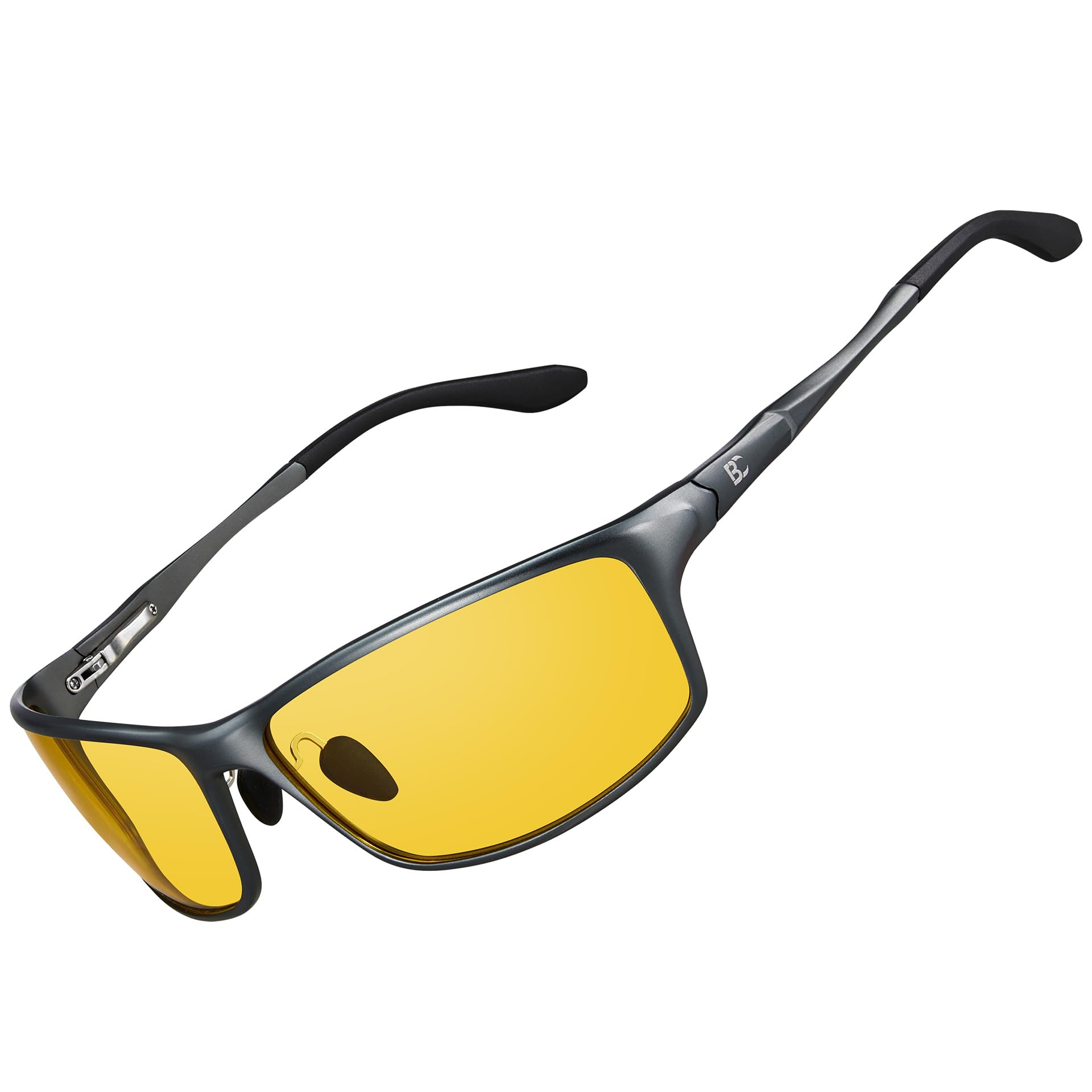
The pair you forget you are wearing three hours into a night drive.
You can wear these for hours without a headache, and that comes from the hardware rather than the lens. The frame is built from an aluminum-magnesium alloy (Al-Mg — a light, stiff metal commonly used for thin eyewear frames), with a sturdy reinforced structure, a comfortable nose pad, and a spring hinge that flexes with your head instead of clamping. The lens is a TAC build (a layered polarized material that keeps things thin and optically flat). Customers note staying headache-free and wearing them for hours without discomfort, which is the exact complaint most night-driving glasses invite.
The lens is tuned to reduce nighttime glare effectively, and buyers rate the build quality and value highly. It is a men’s fit, and the metal construction gives it a cleaner look than a chunky plastic frame — something that matters if you are wearing them from the office to the car. The Bircen name behind it sits alongside the other metal-frame picks here, so you are not gambling on an unknown label.
One thing it is not: a photochromic or auto-darkening lens. It does one job — cutting night glare — and asks you to keep a separate pair for the beach. If your single need is a comfortable, metal-framed anti-glare lens that does not dig in over a long trip, this fits neatly. If you want one lens for every hour of daylight, the VICTGOAL above covers more ground.
Top choice for: drivers who prioritise all-night comfort — the Al-Mg frame, nose pad, and spring hinge combine for a fit that does not fight your head.
Not for you if: you want a single pair for both bright sun and night driving, since this is a dedicated night lens.
9. DUCO Polarized Night Driving Glasses
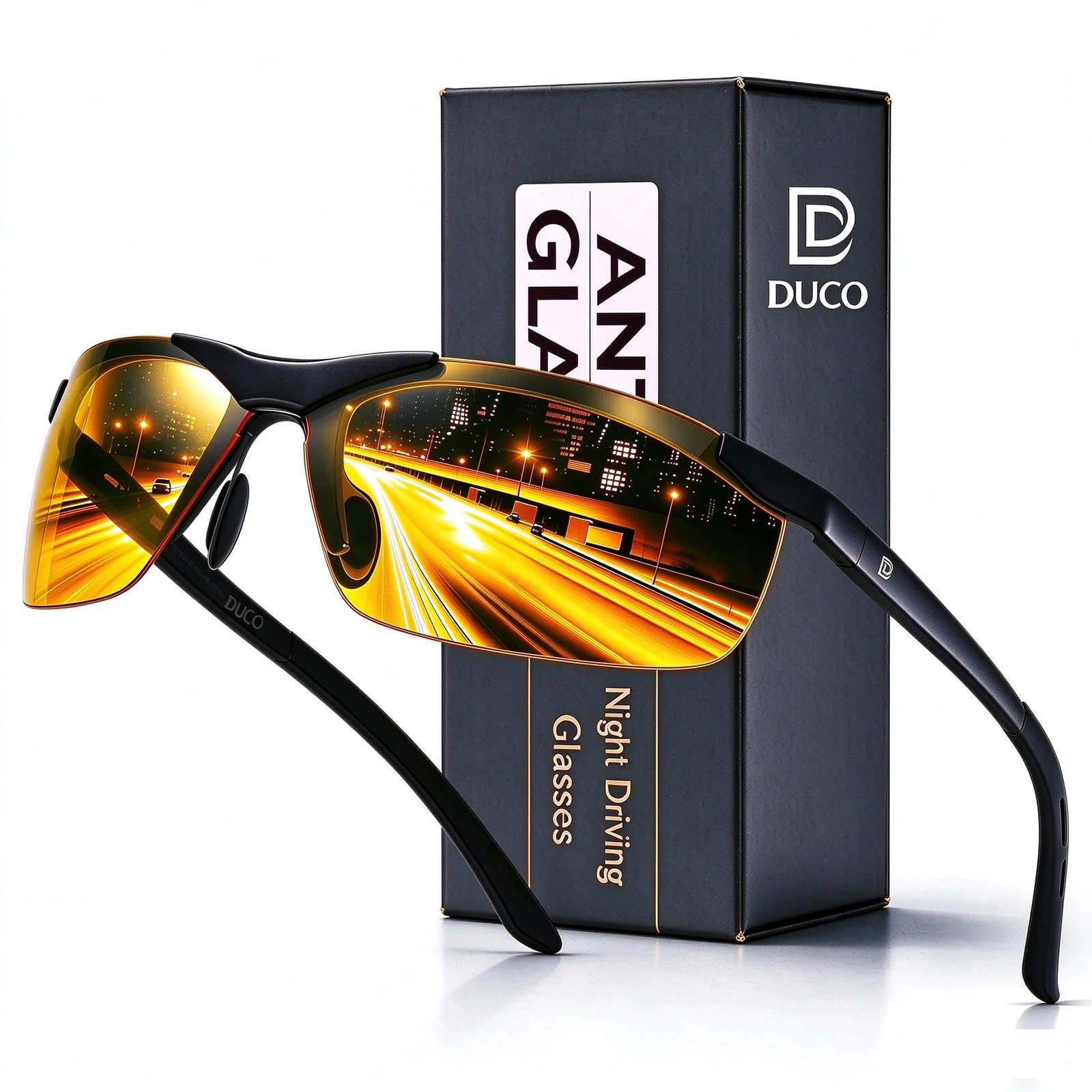
The engineers’ answer: mild polarization, high transmission, and 0.88 ounces on your nose.
Most yellow-lens makers either polarize fully or not at all. DUCO takes the middle road on purpose. These lenses use mild 10% polarization with over 75% light transmittance, so you keep maximum nighttime visibility while still filtering the reflected glare off wet roads and hoods. That is a deliberate design choice rather than a shortcut — full polarization needs a dark tint that is unsafe after sunset, and DUCO says so plainly. If you have ever tried a dark polarized lens at night and found the road fading, this is the fix.
The frame is where it separates from the rest of the pack. Aluminum-magnesium temples weigh so little they create no pressure, and the whole pair weighs just 0.88 ounces versus the 2.82-ounce FEISEDY and LUENX frames. Dual-screw hinges and rubber ear grips hold them steady, and adjustable nose pads prevent the pressure marks that show up after a long drive. The high-contrast yellow lens filters harsh blue light to sharpen contrast on gray, wet days, so rain, fog, and snow all become more readable. Buyers consistently rate glare reduction and lens quality as the two things that justify the cost.
The catch: this is a direct-wear wrap-around frame, not a fit-over. If you need to wear them on top of prescription glasses, DUCO makes a separate Fit Over series and you should look there instead. And if you want a lens that also handles bright midday sun, you will still need a second pair.
Why it earns the most precise build here
- 0.88 ounces — the lightest pair in this guide, with Al-Mg temples built to eliminate pressure.
- Mild 10% polarization plus over 75% light transmittance keeps the road visible without full darkening.
- Dual-screw hinges, rubber ear grips, and adjustable nose pads resist pressure marks on long drives.
- Yellow lens lifts contrast in rain, fog, and snow, not just under headlights.
Know before you buy
- It is a direct-wear frame — not a fit-over for prescription glasses.
- Mild polarization is deliberate, but if you want full polarization for daytime sun, this is not that lens.
Made for: drivers who want the least weight on their face and the most reasoned approach to night polarization.
Step away if: you need a fit-over pair for prescription glasses — DUCO’s separate series covers that case.
Know the Specs
VLT (Visible Light Transmission)
This is the percentage of available light that actually reaches your eye through the lens. For night driving, you want the number high — over 75% on the SUNGAIT and DUCO yellow lenses means most of the light still gets through while glare is filtered out. A low-VLT lens on a dark road is the opposite of helpful, so check this figure before anything else.
Polarization Strength
Polarization filters reflected light off flat surfaces like wet roads and hoods. Full polarization is great in daytime sun, but at night it can cut light you need. That is why DUCO uses mild 10% polarization instead of full. LUENX and SUNGAIT use a polarized yellow lens aimed at glare while keeping transmission high. Match the polarization level to how dark your commute actually gets.
Frame Material
TR90 is a flexible lightweight plastic used in sport glasses, and aluminum-magnesium is a stiff, thin metal used in lightweight driver frames. Both survive daily handling better than thin rigid plastic. The FEISEDY retro square uses a smooth plastic frame, which is comfortable but asks for a case. Aluminum-magnesium and TR90 frames outlast thin rigid plastic that cracks at the hinge after a season in a hot cab.
Hinge Type
A spring hinge flexes outward when you open the arms, which keeps the fit snug without clamping your temples. A fixed metal hinge is simpler and, when it is a dual-screw build, very stable. On a long drive, the hinge is what keeps the glasses comfortable at hour three, so it deserves a look beyond the lens spec.
Common Questions
Do yellow lens sunglasses actually help with night driving glare?
Are fully polarized lenses safe for night driving?
What does VLT over 75% mean on night driving glasses?
Can I wear yellow sunglasses for daytime driving too?
What is the difference between a spring hinge and a regular hinge?
Can I wear night driving glasses over my prescription glasses?
How do I know if a lens is genuinely polarized?
What is a photochromic lens and who is it for?
Do yellow lenses help in rain, fog, or snow?
How light is too light for a frame on a long drive?
The Bottom Line
For most buyers, the yellow sunglass pick that balances style, build, and price is the FEISEDY Retro Square Aviator B4158 — it wears a yellow lens in a vintage frame that works from the office to the car, and at 1.82 ounces it is the lightest of the two FEISEDY pairs here. If night-driving glare is your main problem and you want the cleanest lens spec, the DUCO Polarized Night Driving pairs mild 10% polarization with over 75% light transmittance at just 0.88 ounces, which is the most reasoned approach to night use on this list. And for a cyclist who wants one lens across a whole day of light, the VICTGOAL Photochromic Sport does the job with a built-in myopia insert (a clip-in slot for prescription lenses) and TR90 frame (a flexible, light plastic).
The honest nudge: if you drive at night more than a couple of times a week, buy a dedicated yellow night lens like the DUCO or the LUENX and keep a separate dark pair for daytime sun. The single-pair compromise never beats a lens built for the job.
How we choose
We do not accept paid placement. Every pick is matched to a real buyer and a real use-case; we do not hands-on test units.
Sources
Specifications: manufacturer listings and product documentation. Review insights: verified customer reviews, as of November 2026. Pricing: not shown on this page (it changes often); check the current price via the retailer link.
As an Amazon Associate, Tactical Gear Guy earns from qualifying purchases. This does not affect which products we feature.