Specs are compiled from manufacturer listings and verified buyer reviews and can change over time — please confirm the key details on the product page before buying.
In flat light, snowfall, or late-afternoon shade, a yellow lens is the one upgrade that changes what you can actually see. Yellow tint lifts the contrast on snow so ruts, ice patches, and other people’s edges stop blending into one white blur. This guide covers the yellow-lens goggles worth buying, sorted by what each one does best.
This guide is built by comparing the manufacturers’ published specifications and the patterns across verified customer reviews, so you get each pick’s real strengths and trade-offs instead of marketing spin.
Flat light hides the bumps and dips in the snow, and a yellow lens brings those contours back so you can read the terrain. That is the whole point of shopping for the best yellow lens ski goggles. Here is what to know before you buy.
Top Picks


How To Choose The Best Yellow Lens Ski Goggles
Yellow goggles live or die on one number and one fit decision. Get those right and the rest of the spec sheet barely matters. Here is the short version before the reviews.
Read the VLT number first, not the colour name
VLT stands for visible light transmission — the percentage of available light a lens lets through to your eye. A yellow lens here typically runs around 77% to 78% VLT, which is a bright, low-light lens built for storms, snowfall, and shade. Dark mirrored lenses in the teens let almost nothing through, which is why they go black on a cloudy run. If you ski mostly under grey skies, the high-VLT yellow is the lens you will reach for.
Decide if you need a second lens
Several picks ship with a spare lens in the kit, which lets you cover both storm light and bright sun without buying again. A second lens only helps if you will actually swap it, so check how the swap works: magnetic systems let you change in seconds without tools, while older clip systems usually stay in the bag. If you ski one resort in one season, a single yellow lens is often enough.
Check OTG fit against your own glasses
OTG means over-the-glasses — the frame has cut-in grooves so your prescription specs sit underneath instead of pressing into your face. Not every OTG frame clears every glasses frame. If you wear glasses on the hill, treat OTG as a hard requirement and read the frame description closely rather than assuming the label covers you. Riders with bare eyes can ignore this entirely and focus on field of view.
Match the strap and frame to your helmet
A goggle that slides on a helmet is worse than useless — it lets cold air funnel in and fogs the lens. Look for an adjustable strap with a silicone grip strip on the inside, which is what keeps the band locked against a smooth helmet shell. Long straps fit over helmets and beanies; short ones may not. If you ride with a helmet every time, this is not a detail you can skip.
Side-by-Side Comparison
| Model | Best For | Lens VLT | Lens Swap | OTG Fit | Amazon |
|---|---|---|---|---|---|
| ZIONOR Lagopus★ Best Overall | Everyday all-mountain value | — | — | Yes | Amazon |
| Giro Women’s MoxieBest For Narrow Faces | Women’s small-to-medium faces | 77% (yellow) | 2 lenses included | Yes | Amazon |
| Meeloog MagneticWidest Field Of View | Wide spherical vision | — | Magnetic | Yes | Amazon |
| YH212 OTG Snow Goggles | Day-to-night lens swapping | 78% (yellow) | Magnetic | Yes | Amazon |
| VCOROS YH212 | Eight-magnet quick swaps | 78% (brightening) | Magnetic | Yes | Amazon |
| VCOROS YH865 | Top-scoring contrast lens | 78% (yellow) | Magnetic | Yes | Amazon |
| Odoland Magnetic Set | Full kit with carry case | — | Magnetic | Yes | Amazon |
| Giro Roam | Contrast in changing light | — | — | — | Amazon |
Detailed Reviews
1. ZIONOR Lagopus Ski Snowboard Goggles
Our pick — 4.5+★ from 20,500+ verified ratings; the strongest balance of quality and price.
The crowd favourite: helmet-compatible, OTG-ready, and UV-protected.
The ZIONOR Lagopus earns the top slot on volume — a 4.5+ star rating across 20,000+ owners, more real-world winter mileage than anything else in this group. That volume matters because it means the fit questions you will have are already answered somewhere in the listing. The double-layered lens design (two lens layers with a trapped air pocket between them) is the standard anti-fog build, and it is the first thing a cold-day skier should look for.
What wins people over here is quality, and the fit numbers back it up: the adjustable strap runs to a 39-inch maximum circumference, which is generous enough to sit around a helmet rather than squeezing inside it. The triple-layer padding foam — three stacked foam bands that seal against your face — is what keeps spindrift out on a windy lift ride. Owners also consistently report these fit over prescription glasses — the deciding factor for skiers who assumed OTG goggles were a specialty purchase.
The honest catch is fogging. Anti-fog performance is the one area where feedback splits rather than unites, so treat ventilation as something you manage rather than something the goggle does for you. Keep the lens clean, do not wipe the inside with a glove, and let the goggle air out between runs. For the money and the track record, this remains the easy all-mountain first purchase.
Where the Lagopus earns its keep
- Double-layered lens construction traps an insulating air gap to slow fog build-up
- Strap stretches to a 39-inch maximum circumference so it clears most helmets
- Three-layer face foam suits skiers, snowboarders, and snowshoers alike
- Rides comfortably over prescription glasses without pressing on the frames
- UV protection carries you through high-altitude glare and wind-blown snow
What to keep in mind
- Anti-fog results vary for owners more than any other trait
- No spare lens in the box, so one lens covers your whole season
Go for it if: you want one proven goggle for mixed resort days and you wear glasses underneath.
Manage this instead: the anti-fog side needs help from airflow, so vent the goggle rather than sealing it away in a warm pocket.
2. Giro Women’s Giro Moxie Ski Goggles
A women’s-cut goggle with a 77% yellow lens and a spare for storm days.
The Moxie’s headline figure is the yellow lens at 77% VLT — that percentage is the share of available light reaching your eye, and it puts this squarely in the low-light, flat-grey category. You also get an amber pink lens at 41% VLT for mixed-cloud days in the same box. Two lenses for one purchase is the real value story here, because most riders end up buying a second lens later anyway.
The frame is built small to medium with a women’s-specific cut, and the fit sentiment in the reviews leans toward women with a smaller face. The EXV frame design widens the field of view so you are not turning your head to catch a snowboarder cutting across your line. Double-layer face foam with a microfleece facing does the sealing, and there is silicone on the inside of the strap — a grip strip that keeps the band from creeping up on a smooth helmet shell. If you wear a Giro helmet, this is designed to pair with it.
Durability is where opinion splits rather than settles. Some owners find them hard-wearing across seasons while others question how long they will hold up, so expect a lighter build than a race-tier goggle. The anti-fog coating draws consistently strong low-fog reports, the trait owners mention most after quality. Pick this for the lens choice and the face fit; look elsewhere if you want something that feels indestructible in the hand.
The two-lens play: a 77% yellow lens for night and storm paired with a 41% amber pink lens for mixed cloud gives you the whole day in one box — that is the feature that carries this pick.
Reach for this if: you have a small-to-medium face and want both a storm lens and a mixed-light lens without a second order.
Look elsewhere if: you want a heavy, overbuilt frame — this one is built light and reads that way.
3. Magnetic Ski Goggles with 2 Lenses
The spherical lens that bulges your view outward and swaps lenses on magnets.
Most goggles in this group use a cylindrical lens — curved top to bottom but flat across. This Meeloog uses a spherical lens, which curves in both directions like a section of a ball. The practical result is a wider peripheral view and less distortion toward the edges, so your eyes do less work scanning the fall line. At 6 ounces it is light enough that you forget it is on your face, and the soft TPU frame flexes instead of fighting your cheekbones.
The magnetic lens swap is the other real feature. Magnets let you pop one lens and seat another in seconds, so the second lens in the kit actually gets used instead of sitting in a bag. UV400 protection — the rating that blocks the UVA and UVB wavelengths that burn at altitude — runs through the lens, and a ventilation system moves warm air out to slow fog. The OTG design clears most prescription frames.
Here is the honest part: this is a newer listing with a thin review base, so you are buying on the spec sheet and the spherical-magnet formula rather than a long track record. That is not a flaw in the goggle, just in the certainty you get. If you want the geometry advantage and can live without years of crowd data behind it, the Meeloog is a strong technical pick.
The geometry argument: cylindrical lenses dominate this price band, so a spherical lens with a magnetic swap stands out as the technically ambitious option here.
Built for: riders who want maximum peripheral vision and hate fiddling with lens clips in cold weather.
Weigh this: the review history is short, so treat it as a spec-driven buy rather than a crowd-endorsed one.
4. YH212 OTG Snow Goggles
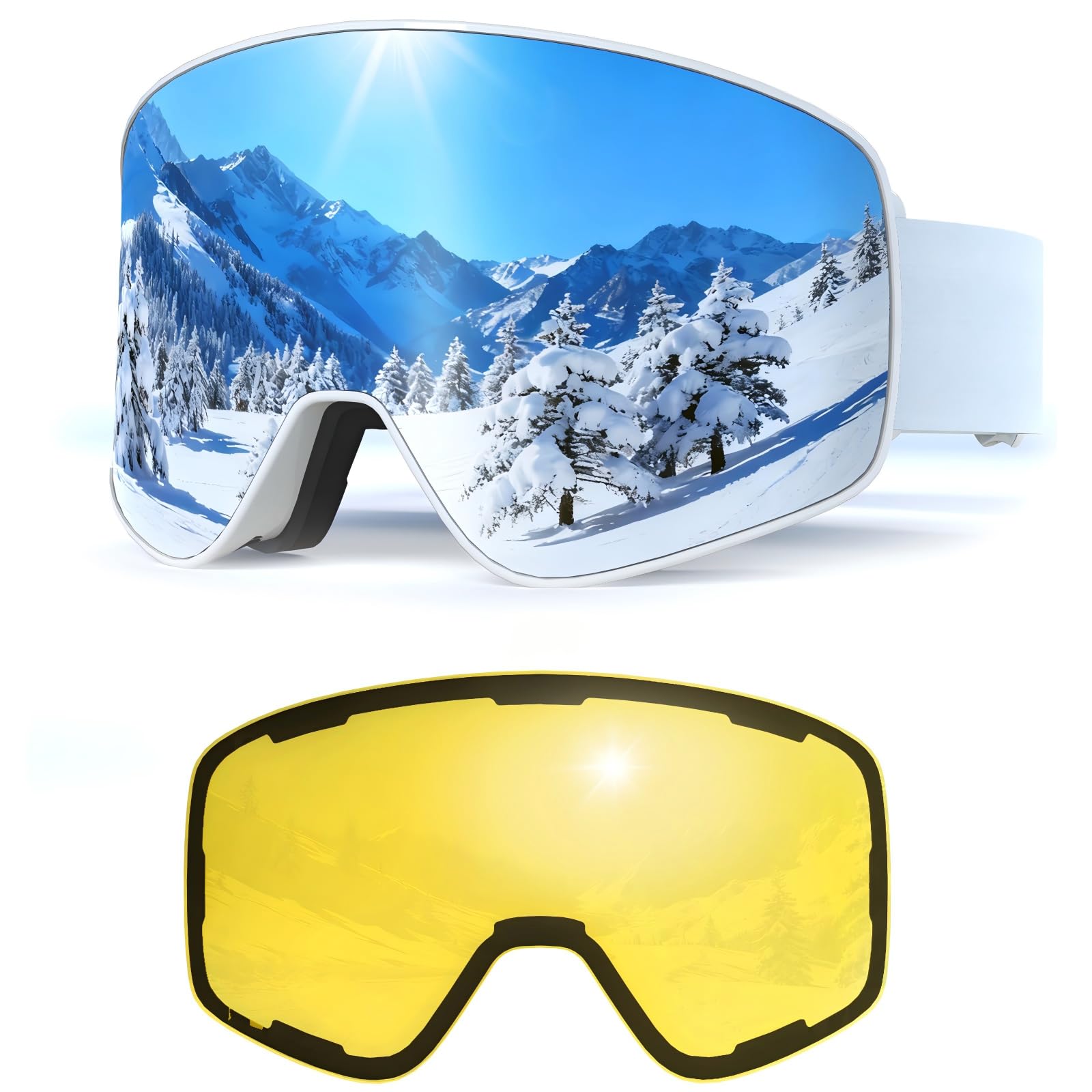
The kit that pairs a 78% yellow lens with a dark mirrored one for bright days.
Buy this and you get two lenses with a job split: a yellow lens at 78% VLT for night and storm, and a silver mirrored lens at 13% VLT for full sun. That 78-to-13 spread covers the whole range of winter light, from a whiteout to bluebird glare. The colour options run a similar pattern across frames, with mirrored lenses at 13%, 16%, or 19% VLT paired with the same 78% yellow.
The anti-fog build is the detail worth knowing. Outward lens is hardened to resist scratches, while the inner lens uses Italian CA material — the grade a lot of premium goggles specify because it holds its anti-fog property longer than cheap coatings. A two-way ventilation system pulls heat out and drags fresh air in, which is what keeps that inner surface from misting over on a climb. The magnetic swap system lets you change lenses quickly when the light turns, and the TPU frame stays flexible in the cold.
OTG grooves are cut into the frame for glasses wearers, and the extra-long elastic strap with an inner silicone strip locks onto a helmet so it does not slide. The one thing to note is that the listing is new, so there is no long history of how the Italian CA coating holds up over multiple seasons. Choose this for the lens range and the sun-to-storm coverage rather than for proven longevity.
The sun-and-storm split: a 13% mirrored lens for glare and a 78% yellow for storms is the widest usable lens spread in this group, and it means one purchase covers the whole season.
Suits: skiers who ride in wildly different light across a trip and refuse to buy two pairs of goggles.
The trade-off: with a fresh listing, no one has proven how the anti-fog coating ages.
5. VCOROS Magnetic Ski Goggles YH212
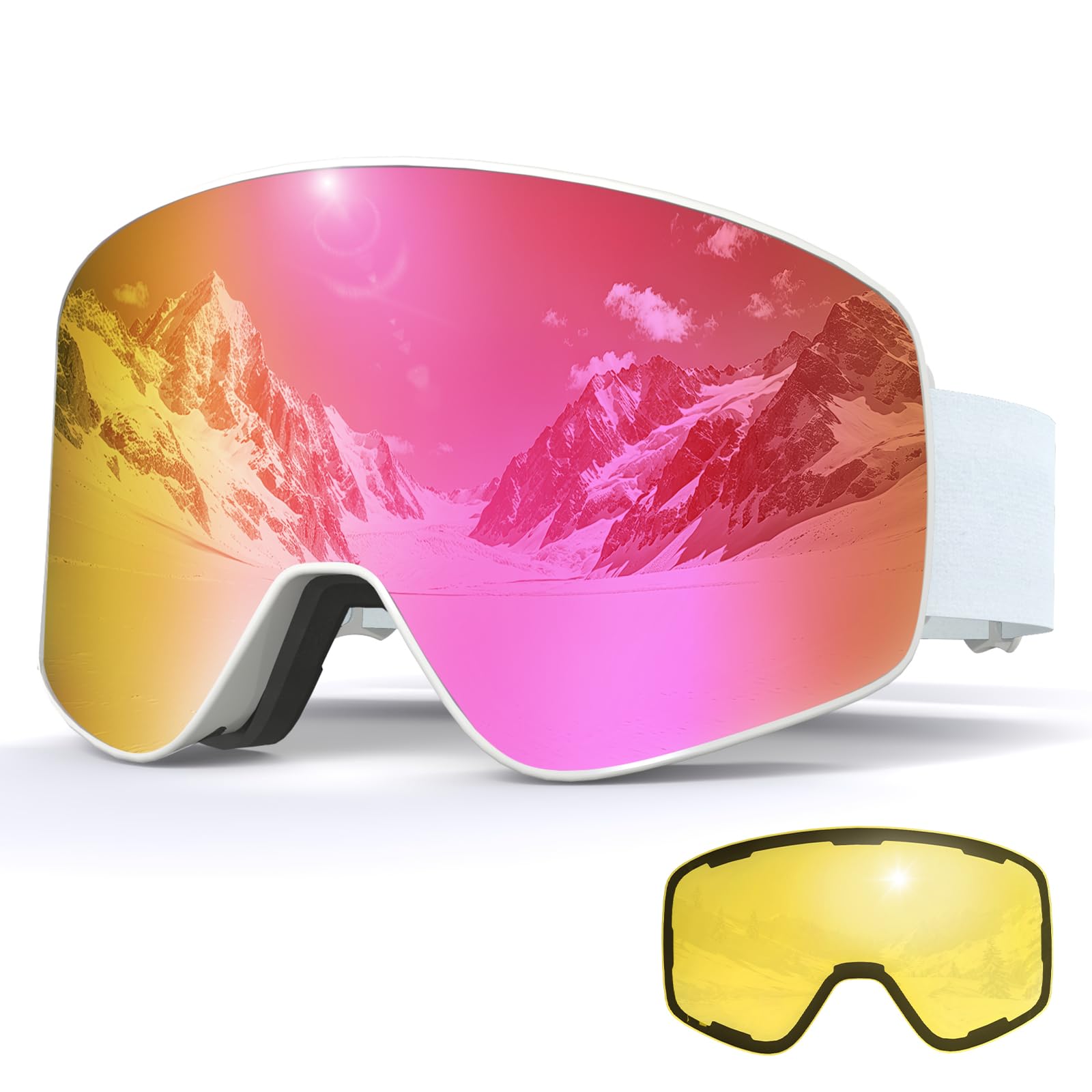
Eight magnets hold the lens, so the swap happens without pulling off your gloves.
The number to know here is eight — the count of built-in magnets seating the lens to the frame. More magnets means more contact points between lens and frame, which is what lets you yank a lens off and press another on in seconds, gloves still on. You can switch from a brightening yellow at 78% VLT to a dark REVO-coated lens at 7%, 13%, 14%, 16%, or 19% VLT depending on the frame colourway you pick.
That brightening lens at 78% VLT is the low-light option — the one you want when snow is falling and the light is flat. REVO coating means a reflective multi-layer film on the lens surface that cuts glare, and the 100% UV400 protection underneath it blocks the burning wavelengths. The soft TPU frame with triple-layer breathable foam sits against your face without pressure points, and the OTG shape takes prescription glasses in stride.
The dual-ventilation system disperses heat to keep fog from forming, and the extra-long strap carries anti-slip silicone inside the band to grip a helmet shell. As with the other new listings in this range, the rating base is small — this is a spec-sheet purchase rather than a settled one. But the eight-magnet system plus the 78% brightening lens makes it the cleanest low-light kit at its tier.
Why the swap system matters
- Eight magnets seat the lens with more grip than a two-point clip setup
- A 78% VLT brightening lens handles snowfall and shaded runs
- Soft TPU frame and triple-layer foam reduce pressure on the face
- Dual ventilation fights fog from the inside out
Where it stops short
- Thin review history, so long-term magnet retention is unproven
- Which VLT you get depends on the frame colourway you choose
Pick it when: changing lenses with cold hands is your least favourite part of a ski day.
Think twice if: you want a long-standing model with years of owner feedback before you commit.
6. VCOROS Magnetic Ski Goggles YH865

The highest-rated goggle on this list, with nine magnets and a 78% yellow lens.
The YH865 holds the strongest score in the group at 4.5+ stars, and its two-lens kit is what earns it. You get a detachable yellow lens at 78% VLT — the bright low-light option — plus a full REVO-coated main lens in your chosen colourway at 13%, 14%, 16%, or 19% VLT. Nine built-in magnets lock the lens to the frame, one more contact point than the YH212 above, so the swap is tool-free and glove-friendly.
Both lenses are double-layer with an anti-fog coating, and a dual ventilation system handles the air exchange. The soft TPU frame with triple-layer breathable foam spreads pressure across the face instead of pinching at the temples, and the OTG design adds clearance for glasses. An extra-long adjustable strap with anti-slip silicone sits secure over any ski or snowboard helmet, and 100% UV400 protection covers harsh high-altitude sun. When the light goes flat and grey, the yellow lens is the one that pulls terrain definition out of the wash.
The trade-off is the review base — this is a small but strongly scored set, not a deep history. Compare on the numbers and the nine-magnet build makes its case either way.
The nine-magnet edge: it holds the highest rating in this group at 4.5+ stars and adds a ninth magnet over the YH212, which is the small margin that makes lens swaps feel instant.
The strongest fit: a rider who wants the best-rated goggle here and swaps between a 78% yellow and a dark REVO lens through the day.
The caveat: the review base is thin compared to the top pick, so you are trusting the spec sheet.
7. Odoland Magnetic Ski Goggles Set
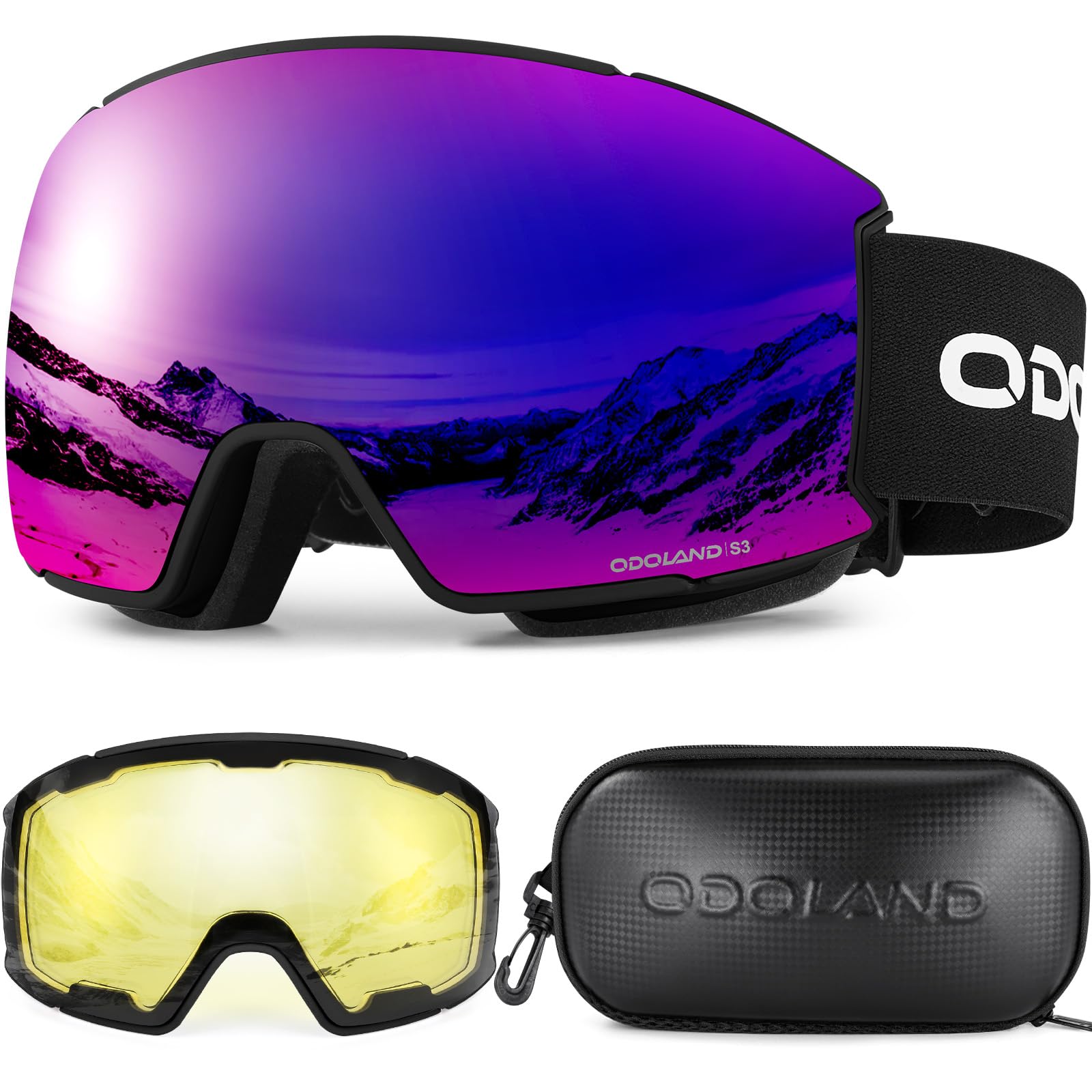
Ten magnets, a spherical lens, and a carry case in one of the best-rated kits here.
What separates the Odoland is how much comes in the box. You get the goggle, a detachable yellow lens, a carry case, and a carry pouch — so the second lens travels protected instead of loose in a backpack. The 10-magnet system is the highest magnet count on this list, which is the most contact points holding a lens down when you are bouncing through chop.
The lens is spherical, built from PC (polycarbonate) with CA and UV400 protection. A spherical lens curves in two directions for a wider view, and the human-engineering design behind it is aimed at clear sight rather than tunnel vision. The dual spherical build also works with the ventilation setup to reduce fog, and the OTG design fits adults and youth with or without glasses.
The TPU frame bends rather than cracks, which matters if the goggle gets crushed in a bag, and the high-density triple-layer foam pushes heat away from the face while keeping the seal against the elements. Adjustable elastic straps fit almost any helmet. What you should know: the 4.5+ star top score rests on a very small review base, so treat it as promising rather than proven. For a kit with a case and a spare lens, the package is what you are buying.
What ships in the box
- Goggle, detachable yellow lens, carry case, and carry pouch
- 10-magnet system outnumbers every other goggle on this list
- Spherical PC lens widens peripheral view
- Bendable TPU frame survives being crammed in a bag
- Triple-layer foam spreads pressure and moves heat out
Set your expectations
- Tiny review base for the rating it carries
- Spec lists no VLT figure for the yellow lens
Best for: skiers who want the yellow lens and its spare arriving protected with a case from day one.
But note: the top rating rests on very few voices, so the kit contents are the safer reason to buy.
8. Giro Roam Adult Snow Goggles

A unisex Giro with an amber-based tint that pulls definition out of shifting light.
The Roam’s story is the lens tint. Giro builds it around an amber-based tint that adds contrast and definition across the changing light you meet over a full day out. That amber base is the same family as yellow — it lifts the edges of bumps and ice rather than flattening them into white. If you ski from first chair to last run and the light swings from grey to golden, this tint does the job through the whole arc.
The frame is contoured and the strap is adjustable, so it pairs cleanly with a snow helmet and should stay put over a beanie. It comes in a unisex One Size fit across a range of frame and lens colourways, which means the fit is not sculpted to a specific face shape the way the Moxie is. Owners single out eye protection as the standout positive, report no fogging problems, and rate quality consistently.
What you give up is the interchange system. There is no separate yellow lens in the box and no magnetic swap, so this one tint covers your season. For a rider who wants a known brand and a contrast tint without fiddling, that simplicity is a feature. For a rider who wants to switch from a bright yellow to a dark mirrored lens on a sunny afternoon, it is a limit.
The one-tint approach: a single amber-based lens means no swapping, no lost spare in the car, and no decision to make on the lift — the goggle just works across the day’s changing light.
Choose it for: a helmet-wearing rider who wants a Giro contrast tint and would rather not juggle a second lens.
The limitation: one lens only — no bright-yellow and dark-mirrored rotation in the kit.
Know the Specs
VLT — Visible Light Transmission
VLT is the percentage of available light a lens lets reach your eye. A high-VLT lens — the 78% yellow lenses in this group — passes a lot of light, which is why it brightens a storm and why it is the wrong lens on a blazing day. A low-VLT lens in the teens blocks most of the light and suits full sun. Match the number to the weather, not the colour name.
Yellow Vs Amber Lenses
Yellow and amber tints do the same job: they filter the light so contrast on snow sharpens, which helps you see ruts, ice, and other skiers in flat light. Different brands land at slightly different VLT figures — the Giro Moxie yellow runs 77% while the VCOROS and YH212 yellow lenses sit at 78%. That gap is small; the bigger variable is which lens you can swap to when the sun comes out.
Magnetic Lens Swap
A magnetic system uses magnets in the frame to seat the lens, so you can swap without tools or clips. Magnet count matters for grip: the picks here range from 8 to 10 magnets. More magnets means more contact points, which is what keeps a lens from shifting as you ride. Buying a goggle with a swap system only pays off if you use the second lens, so pick one where the spare handles a light condition you actually ski.
OTG And Face Fit
OTG stands for over-the-glasses — the frame has cut-in grooves so your prescription specs sit under the lens without pressing into your face. Not every OTG frame clears every glasses frame, so read the listing before you buy if you wear glasses. If you ride bare-eyed, face fit and the foam seal matter more. A triple-layer foam build spreads pressure and keeps out spindrift on a windy lift.
Common Questions
Is a yellow lens actually better than a dark mirrored lens for skiing?
What VLT should I pick for storm days versus sunny days?
Do yellow lens goggles work over prescription glasses?
How do magnetic lens swaps hold up on a chairlift?
Will these goggles fit over my helmet?
Why do my goggles keep fogging up?
What is the difference between a spherical and a cylindrical lens?
Do I need two lenses or is one yellow lens enough?
Does the strap material matter for helmet use?
How long should a yellow ski goggle lens last?
The Bottom Line
The safest buy for most skiers is the ZIONOR Lagopus — a 4.5+ star record built over 20,000+ owners, a 39-inch strap that clears most helmets, and triple-layer foam that seals out spindrift. If you want the best-rated goggle in this group and swap lenses often, the VCOROS YH865 pairs a 78% yellow lens with nine magnets and a 4.5+ star rating. And for a women’s small-to-medium fit with both a storm and a mixed-cloud lens in the box, the Giro Moxie is the one to reach for. Whichever you choose, the deciding number is the same: a yellow lens in the high 70s VLT is what makes flat light readable.
How we choose
We do not accept paid placement. Every pick is matched to a real buyer and a real use-case; we do not hands-on test units.
Sources
Specifications: manufacturer listings and product documentation. Review insights: verified customer reviews, as of November 2026. Pricing: not shown on this page (it changes often); check the current price via the retailer link.
As an Amazon Associate, Tactical Gear Guy earns from qualifying purchases. This does not affect which products we feature.