Specs are compiled from manufacturer listings and verified buyer reviews and can change over time — please confirm the key details on the product page before buying.
Buying a yellow gas can sounds simple until you are standing in the aisle holding two cans that look identical and wondering which one will actually pour cleanly. The right pick depends on what you are fueling and how often. A diesel tractor and a five-gallon mower tank need very different cans, and the wrong pick turns every refill into a spill you clean up with rags and regret.
This guide is built by comparing the manufacturers’ published specifications and the patterns across verified customer reviews, so you get each pick’s real strengths and trade-offs instead of marketing spin.
Yellow is not a style choice here: it is the industry’s label for diesel, so every pick below is a yellow can rated for diesel fuel. Below you will find the steel can that lasts decades, the plastic one with a thumb trigger, and the wheeled tanks for serious volume. If you want the short answer, the Best Yellow Gas Can for most people is a metal Type I can with a flame arrestor and a self-closing lid.
Top Picks

How To Choose The Best Yellow Gas Can
Here is the thing almost nobody tells you before your first fill: the color of the can is regulation, not decoration. Yellow means diesel, red means gasoline. Pour gasoline into a yellow can and you have created a container that you — or anyone else in the shop — will grab at the wrong moment. Every can here is built and labeled for diesel, so start by confirming that matches what you actually burn.
Steel versus plastic decides how long the can lives
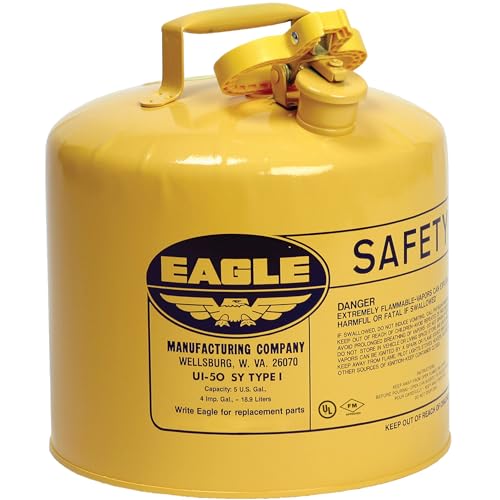
Steel cans like the Eagle use galvanized metal with a powder-coat finish, which resists rust, dents, and scratches. That is why a metal can can sit in a shed for years and still work. Plastic cans are lighter and cheaper to move around but can crack if they are dropped or left in hard sun. If you want a can that survives a decade in a shed, buy galvanized steel.
The spout is where the mess actually happens
Most gas can complaints come down to the pour. A Type I can (one opening for both filling and pouring) like the Eagle relies on a single gasketed spout cap that self-closes, so that seal is the whole system. A Type II can (a separate vent plus a hose and trigger) like the Surecan adds a separate vent, a hose, and a thumb trigger so you can start and stop the flow. Plastic designs with a SmartControl spout advertise up to 3 gallons per minute, which is fast — and fast only helps if the spout aims where you point it.
Match capacity to how much you actually burn
A 5-gallon handheld can weighs over 40 pounds when full of diesel, so carrying it up a ladder or across a yard gets old quickly. The wheeled caddies here range from 14 gallons up to 30 gallons and put that weight on 6-inch wheels instead of your shoulder. Size for a full week of diesel use, not the biggest number on the shelf.
Side-by-Side Comparison
| Model | Best For | Capacity | Material | Weight | Amazon |
|---|---|---|---|---|---|
| Eagle 5 Gallon Type I★ Best Overall | Lifetime shed storage | 5 gallons | Galvanized steel | 6.3 pounds | Amazon |
| Scepter 5G SmartControlFastest Fill | Fast fills on yard tools | 5 gallons | Plastic | — | Amazon |
| Surecan 5 Gallon Type II | Controlled one-hand pouring | 5 gallons | Plastic | 4.3 pounds | Amazon |
| GAOMON 14 Gallon Fuel Caddy | Multi-vehicle refueling | 14 gallons | High-density polyethylene | 24.3 pounds | Amazon |
| PAMBEE 15 Gallon Fuel Caddy | Dock and boat fueling | 15 gallons | High-density polyethylene | 23.1 pounds | Amazon |
| TUFFIOM 30 Gallon Caddy | Fleet and equipment yards | 30 gallons | Metal | — | Amazon |
Detailed Reviews
1. Eagle 5 Gallon Type I Yellow Safety Gas Can for Diesel
Our pick — 4.5+★ from 950+ verified ratings; the strongest balance of quality and price.
The steel can you buy once and hand down to whoever inherits the tractor.
If you want a diesel can that simply keeps working, this is the one. It holds 5 gallons and weighs 6.3 pounds empty, so it is heavy enough to feel solid in your hand but still light enough to carry to the mower. The body is hot dipped 24-gauge galvanized steel with a baked-on powder-coat finish, which is the reason it resists rust, dents, scratches, and chipping instead of slowly going brittle like plastic.
What wins people over is the build, and it is not close — quality is by far the most-discussed strength in this can’s reviews. The safety engineering is the part that matters most, though. A non-sparking flame arrestor inside the spout helps keep liquid inside the can from igniting and stops flames from spreading back up the spout, which is the exact scenario a plastic can cannot address. The gasketed spout cap closes itself to seal against leaks, and the cap assembly opens automatically to vent internal vapors so the diesel pours instead of glugging. Eagle also lists it as meeting OSHA Standard 1910.106 and NFPA code 30, and it carries FM, UL and ULC approval.
The trade-off is honest: this is a Type I can, meaning one opening handles both filling and pouring. With no separate vent and no trigger, you tip and wait rather than control the flow. Durability and leak resistance both come back mixed in owner feedback, and the recurring note is that the spout seal needs care — keep the gasket clean and it holds; let grit build up and you will see weeping. At 6.3 pounds empty it is also the heaviest handheld here, well above the Surecan’s 4.3 pounds, which you will feel on a long walk back from the shed.
Why the steel earns its place
- Galvanized 24-gauge steel with a powder-coat finish resists rust, dents, and scratches
- Non-sparking flame arrestor helps stop internal vapor from igniting
- Self-closing gasketed spout cap seals against drips and vents vapors
- Meets OSHA 1910.106 and NFPA code 30, with FM, UL and ULC approval
Where it asks patience
- Type I layout means one opening for both fill and pour — no separate vent
- No thumb trigger, so you tip the can and manage flow by hand
- The spout gasket needs cleaning to keep the seal honest
Buy it if: you want a diesel can that sits in a shed for a decade and still seals, and you don’t mind a slow, steady pour.
Think twice if: you refill a mower every other day and want trigger control — the Surecan is built for that instead.
2. Scepter 5G Gas Can
A five-gallon diesel can that moves fuel at three gallons a minute when the spout cooperates.
Speed is the pitch here, and the numbers back it up. The integrated air vent in the spout lets fuel flow at up to 3 gallons per minute, which turns a mower refill into a short job rather than a slow trickle. A rear handle gives you a second grip point for tipping, and the 5-layer plastic construction is built to hold vapor in and keep diesel fresh longer. It is listed as EPA and CARB compliant and carries a child-safety feature, and at 12 inches wide by 16 inches high it stores in a shed corner without eating shelf space.
The SmartControl spout is the whole story, and owner experience splits right down the middle. Ease of use and leakage are the two things people talk about most, and both come back genuinely divided — plenty of buyers find it simple to handle, while others find the spout awkward enough that fuel ends up where it shouldn’t. The flame mitigation device inside the spout (a screen that helps block internal vapor ignition) is worth knowing about: it adds a layer of protection rather than being a gimmick.
So judge it by your filler neck, not by build quality. If you are filling a chainsaw or a mower with a wide, forgiving opening and you want the pour over with, it does the job fast. If your filler neck is small or recessed, that same fast flow and spout design are where the frustration comes from — practice the pour over a drain pan once before you trust it over a hot engine.
The real draw: 3 gallons per minute through a vented spout is the quickest fill of any handheld can on this list, and the rear handle makes a full 5-gallon can easier to tip than the single-grip Eagle.
The catch: the spill-proof claim depends entirely on the spout seating right, and the owner feedback on ease of use and leakage is split evenly enough that you should test your first pour carefully.
Reach for this if: your equipment has a wide filler neck and you want refills done in seconds.
Look elsewhere if: you are topping off something with a small or awkward opening — the flow rate works against you there.
3. Surecan 5 Gallon Type II Safety Can

The trigger-and-hose design that lets you stop the diesel mid-pour.
At 4.3 pounds empty, this is 2 pounds lighter than the Eagle, and that difference shows up on the walk to the mower. The trick is the layout. This is a Type II can, so filling and pouring use separate paths, and a built-in self-venting mechanism keeps the flow steady instead of gulping air. The 9-inch hose rotates downward so you can aim the stream at the opening, and the ergonomic thumb trigger starts and stops the flow under your finger — you release pressure and the diesel stops. A 3-year limited warranty backs it, which is the longest coverage on this list.
The 5-gallon body measures 13.1 inches wide by 15.61 inches high, so it stands upright on a shelf without wobbling. What you are paying for is thumb-trigger control, not steel durability. Where the metal can relies on a gasket and gravity, this one gives you a valve you operate with one thumb. For anyone refilling a tractor or a generator with a recessed neck, that is the difference between a clean job and a rag in each pocket.
The catch is that a hose and trigger add parts, and parts are where plastic cans eventually give trouble. The rotating spout also needs a deliberate seating each time so it seals before you squeeze — this is a can you learn, not one you hand to a neighbor cold.
Best match for: anyone fueling equipment with a tight, angled, or recessed filler neck who wants to stop the flow on command.
The honest limit: the extra hose and trigger mean more to maintain, and the spout must be seated properly before every pour.
4. GAOMON 14 Gallon Portable Fuel Caddy with Siphon Pump

A wheeled tank that turns six refills into one trip across the yard.
The first thing to know is that this is not a can you carry. At 24.3 pounds empty it is far past the Surecan’s 4.3 pounds, and once it holds 14 gallons you are rolling it, not lifting it. Two 6-inch wheels and a molded top handle handle that job, and the high-density polyethylene body is UV-resistant, corrosion-resistant, and scratch-resistant — so leaving it in a truck bed or by a shed door doesn’t ruin it.
The siphon pump is the reason to buy it. A stop-and-go pump handle moves fuel at 2 gallons per minute in siphon mode, so you fill and empty without ever hoisting a heavy container above your shoulder. Two brass shut-off valves, one at the tank and one at the hose, let you disconnect the line cleanly with no fuel spillage. Owners consistently find it easy to use and genuinely functional, and storage capacity feedback is mixed — some say it holds more than 15 gallons, others note it has to sit higher than whatever you are filling for the siphon to work.
That last point is the real limit. A siphon needs gravity, so the tank has to be above the target or the pump has to do all the work. Plan for it on a truck bed or a raised bench and it is brilliant; set it on the ground next to a low ATV tank and you will fight it. The 16-inch width by 14-inch height footprint also takes real floor space, unlike a handheld can.
The case for it: 14 gallons on 6-inch wheels with a 2-gallons-per-minute siphon and dual brass shut-off valves solves the one problem handheld cans never fix — the weight of a full tank.
The catch: it needs to sit higher than the tank you are filling, so a low fuel port means lifting it or working the pump harder.
The right buyer: someone with several diesel machines, a truck bed to park it in, and no interest in lifting a full can ever again.
Wrong buyer: anyone with one mower and a small shed — the footprint and 24.3-pound empty weight are more bother than they are worth.
5. PAMBEE 15 Gallon Fuel Caddy
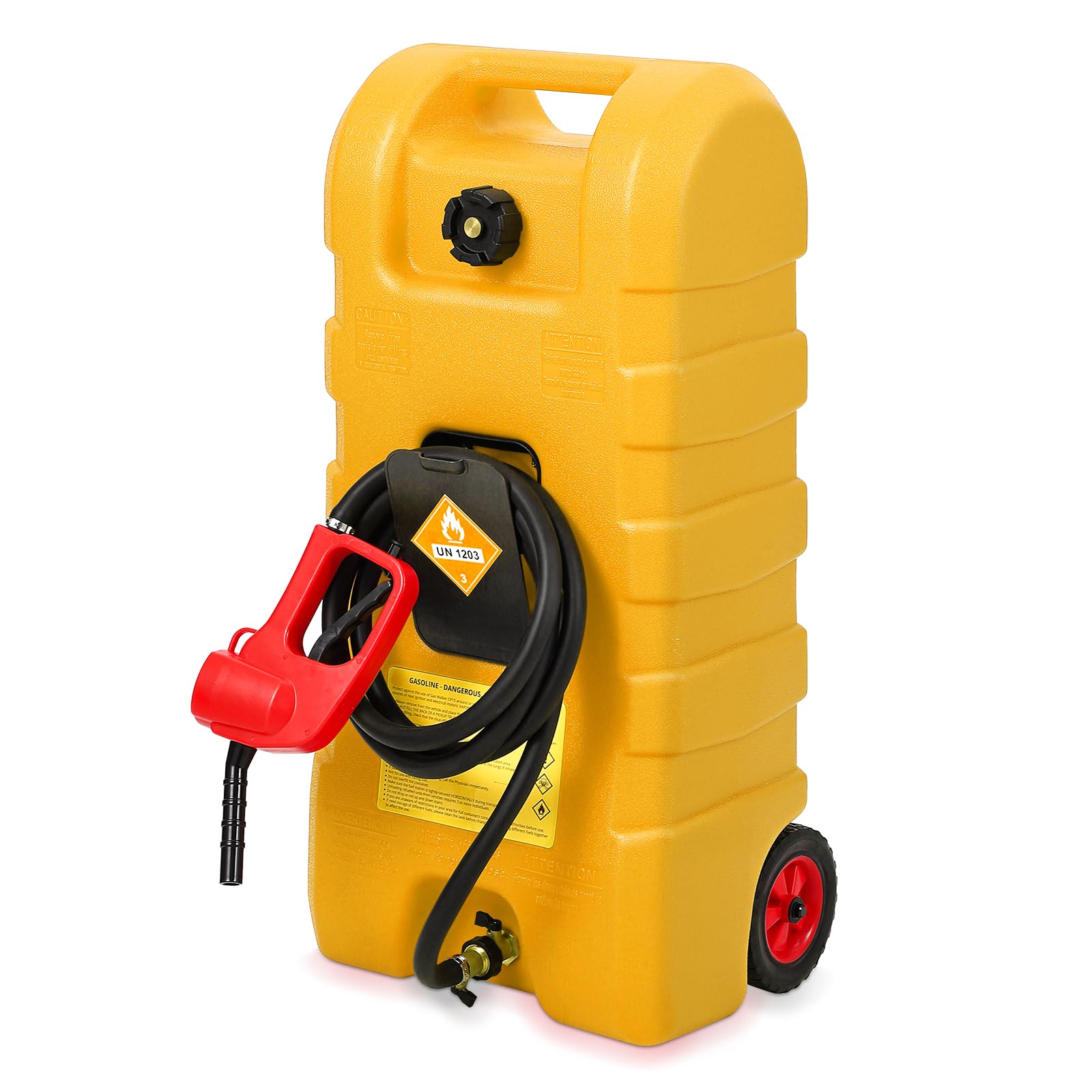
Fifteen gallons of diesel on wheels, built for the walk from dock to dinghy.
The body and nozzle are high-density polyethylene, so rust never enters the conversation, and the 10-foot hose is automotive-grade rubber with its own holder so it doesn’t drag in the dirt. At 23.1 pounds empty it is the lightest of the big caddies here, though still firmly a roll-it-not-carry-it product.
Two operating modes set it apart: siphon and gravity-drive. In siphon mode it moves fuel at 3 gallons per minute, and the maker is upfront that the rate depends on how hard you squeeze the pump — press slowly and the diesel comes out slowly. Two brass shut-off valves, one at the tank and one at the hose, let you break the line without losing fuel, which is the single most useful safety detail on any caddy. Buyers report it working well, and its portability comes up as the standout — one camper’s feedback describes being able to travel further with their rig because of it.
The 16.14-inch width by 34-inch height makes it the tallest unit in this comparison, so measure your truck bed or shed doorway before it arrives. And be realistic about the pump: it rewards a firm, steady squeeze, so if you want push-button speed, a gravity-fed pour with the tank raised is the calmer way to run it.
Where it shines: dock-to-boat fueling, where the 10-foot rubber hose reaches across a gunwale and the 15-gallon tank covers a full weekend.
Measure twice: at 34 inches tall it needs headroom a standard shelf will not give it.
6. TUFFIOM 30 Gallon Portable Gas Caddy
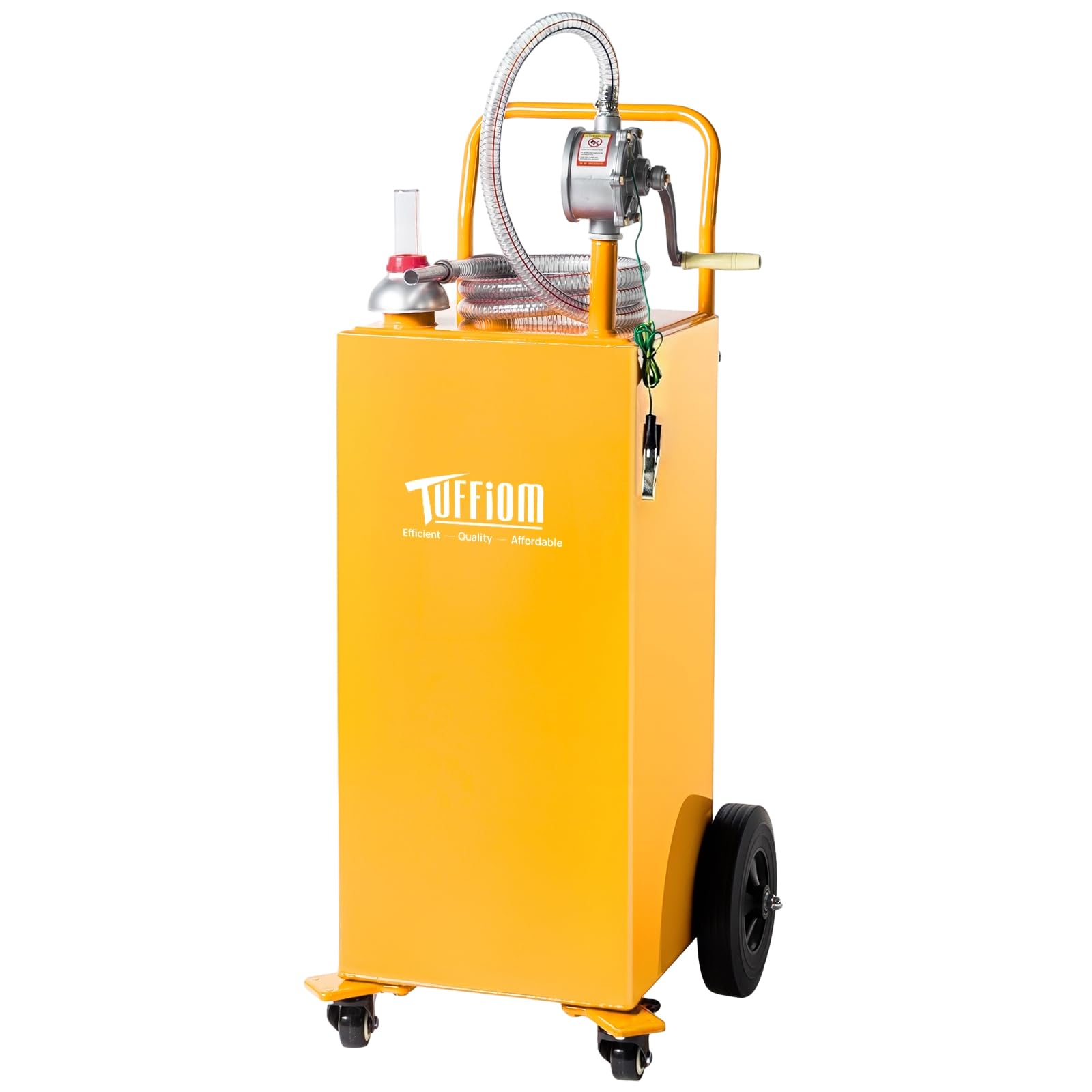
The one you fill once a month and roll between a dozen machines.
- 30 gallons of diesel capacity — six times a 5-gallon handheld can — for equipment yards and small fleets.
- An anti-static grounding clamp handles the charge friction builds up during transfer, a detail the other caddies skip.
- Four wheels, two of them swivel casters, with a pushable handle, so a full tank steers instead of fighting you.
- The reversible hand pump pulls leftover fuel out of the 8.9-foot kink-free hose and back into the tank, so nothing is wasted.
- A vent and oil level gauge lets you read how much is left without opening anything.
The honest part is the wear on the pump and hose. Owner feedback on this caddy is mixed in a specific way: some report the pump seizing up after around ten uses and the clear fuel hose cracking inside a week. Capacity feedback is divided too, with some saying it doesn’t hold the 35 gallons they expected. None of that makes it a bad tank — the heavy-duty iron body is sturdy and hard to deform, and it works well for tractor and motorcycle refueling — but it is a machine with wear parts, so expect to keep an eye on the hose and pump.
Buy it if volume is the whole point and you want static protection and swivel steering while you move 30 gallons around. skip it if you want a can to grab and go — this is the largest, least portable item here, and it belongs on pavement or packed gravel, not a grassy slope.
The standout spec: 30 gallons with an anti-static grounding clamp and a reversible pump is a serious fueling station, and no other pick on this list carries that static-discharge protection.
The honest risk: the pump and clear hose are the wear points, so budget for a replacement line eventually and store it out of hard sun.
Made for: equipment yards, small farms, and anyone refueling many diesel machines from one central tank.
Not for: a single mower and a cramped garage — the size and the wear parts only pay off at volume.
Know the Specs
Type I versus Type II cans
A Type I can has one opening for filling and pouring, with a gasketed cap that seals and self-vents. It is simpler and has fewer parts to break. A Type II can separates the fill and pour paths and adds a vent, hose, and usually a trigger, which gives you flow control at the cost of extra parts. Neither type is better — pick Type I for fewer parts, Type II for trigger control.
Flame arrestor and flame mitigation
A flame arrestor is a metal element inside the spout that helps keep liquid inside the can from igniting and stops flames from traveling back up the spout. Metal cans like the Eagle use one. Plastic designs often use a flame mitigation device instead, which helps prevent internal vapor ignition. Both are safety layers worth having.
Flow rate in gallons per minute
GPM measures how fast fuel leaves the can. A fast rate only helps when the spout fits the filler neck you are pouring into. Note that on a manual siphon, the maker sets the ceiling and your squeeze sets the actual speed.
Steel versus high-density polyethylene
Galvanized steel with a powder coat resists rust, dents, and scratches and survives years of shed life. High-density polyethylene is lighter, rust-proof, and UV-resistant, which suits wheeled tanks left outdoors. The trade-off is that plastic can crack and steel can dent, so buy for where the can will live.
Common Questions
Can I put gasoline in a yellow gas can?
What does the flame arrestor on a metal diesel can actually do?
Is a Type I or Type II diesel can easier to pour?
How much does a full 5-gallon diesel can weigh?
Do I need a wheeled fuel caddy or is a handheld can enough?
Why does my siphon caddy stop pumping when the tank sits low?
What do the brass shut-off valves on a fuel caddy do?
Will a metal diesel can rust if I leave it outside?
What does EPA and CARB compliant mean on a plastic diesel can?
Can I use a diesel caddy for kerosene or light oil?
The Bottom Line
For most people, the yellow gas can worth buying is the Eagle 5 Gallon Type I, because galvanized steel with a flame arrestor (a screen that blocks flame from reaching the fuel), a self-closing spout cap, and OSHA and NFPA compliance (the safety standards for fuel containers) make it a can you buy once and stop thinking about. If a controlled pour into a tight filler neck is your daily reality, the Surecan 5 Gallon Type II gives you a thumb trigger and a rotating spout the Eagle cannot match. And when the job is moving serious volume across a yard or a dock, the PAMBEE 15 Gallon Fuel Caddy puts the weight on wheels and reaches across a gunwale with its 10-foot hose — that is the one to reach for when lifting a full can stops being an option.
How we choose
We do not accept paid placement. Every pick is matched to a real buyer and a real use-case; we do not hands-on test units.
Sources
Specifications: manufacturer listings and product documentation. Review insights: verified customer reviews, as of November 2026. Pricing: not shown on this page (it changes often); check the current price via the retailer link.
As an Amazon Associate, Tactical Gear Guy earns from qualifying purchases. This does not affect which products we feature.