Specs are compiled from manufacturer listings and verified buyer reviews and can change over time — please confirm the key details on the product page before buying.
You want a yellow monitor that holds up in a firefight, not just a pretty shell that stutters. These two Pixio panels are the real deal: a 24-inch 1080p option running at 200Hz and a 27-inch 1440p pair of pixels hitting 180Hz. Both pack a Fast IPS panel for crisp colors and wide viewing angles, so you don’t lose the image when you tilt your head. This guide breaks down which size fits your desk and your graphics card, then digs into the specs that actually change how the screen feels.
This guide is built by comparing the manufacturers’ published specifications and the patterns across verified customer reviews, so you get each pick’s real strengths and trade-offs instead of marketing spin.
Both monitors use AMD FreeSync to match the screen to your GPU, and both offer 1ms GTG response time to keep ghosts out of the action. Weigh the refresh rate against resolution before you pick the best yellow computer monitor for your setup.
Quick Picks
- Pixio PX278 Wave Yellow 27 inch 180Hz Quad HD — Best Overall
- Pixio PX248 Wave Yellow 24 inch 200Hz FHD — Fastest Refresh
How To Choose The Best Yellow Computer Monitor
A yellow monitor is a desk statement first and a performance tool second. You are buying the colorway because you want the rig to pop, but you still need the screen to keep up with your mouse. The two Pixio models here are the main options for that exact look, and they split on size, resolution, and speed. Size, resolution, and refresh rate are the three calls that decide the rest.
Refresh Rate: Smoothness You Can Feel
Refresh rate is how many times per second the screen redraws the picture. The 24-inch PX248 runs at 200Hz, which is 200 redraws every second. The 27-inch PX278 runs at 180Hz. Both are far above the 60Hz of a standard office screen, so fast pans and flick shots stay crisp instead of smearing. In competitive shooters, the PX248’s 200Hz edge over the PX278’s 180Hz is the one to weigh.
Resolution and Screen Size
Resolution is the pixel count. The PX248 is 1920 x 1080 pixels (FHD), which packs a lot of pixels into a 24-inch frame so the image looks tight. The PX278 is 2560 x 1440 pixels (1440p) across 27 inches, giving you more room for detail and more desktop space for windows. The trade is that 1440p asks more of your graphics card than 1080p does.
Panel Type and Response Time
Both use a Fast IPS panel, which is a screen technology that keeps colors accurate and the image readable when you view from an angle. Response time is how fast a pixel changes color, listed here as 1ms GTG (grey-to-grey) on both. That speed is what keeps ghosting trails out of fast motion. Adaptive Sync, branded here as AMD FreeSync, matches the screen’s refresh to your GPU’s frame output to cut screen tearing.
Ports, Stands, and Mounting
You get more ways to plug in with the PX278: one DisplayPort 1.4 and two HDMI 2.0 ports (standard video cables for PCs and consoles), plus a VESA mount adapter in the box (a bracket for wall or arm mounting). The PX248 gives you one HDMI 2.0 and one DisplayPort 1.4. Check what your PC or console outputs before you buy, and decide if you want to wall-mount or keep the included stand on the desk.
Side-by-Side Comparison
Detailed Reviews
1. Pixio PX278 Wave Yellow 27 inch 180Hz Quad HD Gaming Monitor
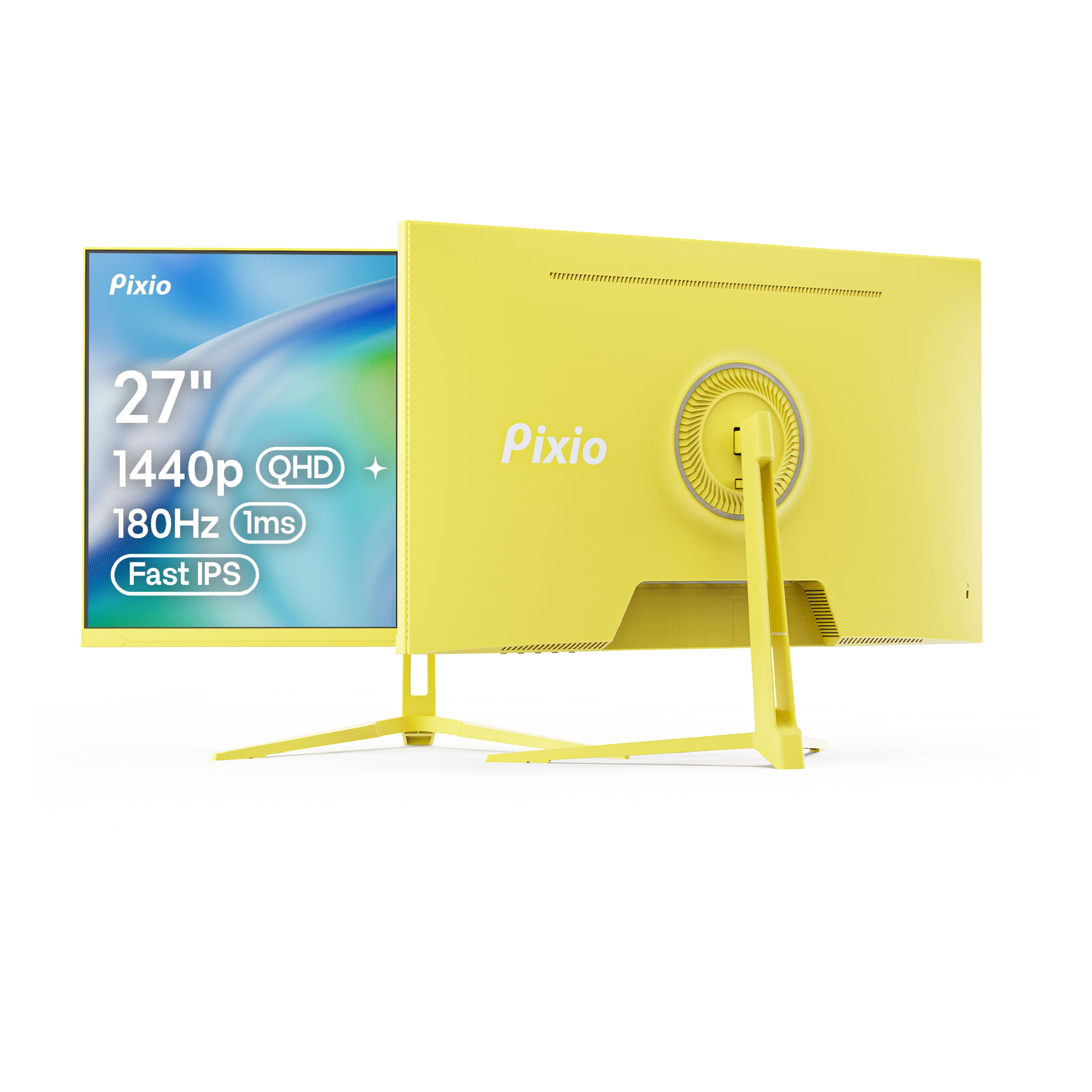
The bigger panel that trades a little speed for a lot more pixel detail.
The defining number here is 2560 x 1440 pixels across a 27-inch Fast IPS screen. That is 1440p, a step up from the 1080p of its smaller sibling, and it means more detail in textures, sharper text for work, and more room to park two windows side by side. If your desk has the depth for a 27-inch panel, this is the one that makes a yellow rig look like a serious workstation.
Where it gives ground is raw speed. It refreshes at 180Hz, while the PX248 hits 200Hz. Both clear 60Hz office screens by a wide margin, so fast pans still stay clean. The 1ms GTG response time helps here too, since it is the figure that keeps ghost trails off moving objects. Pair it with AMD FreeSync and the picture syncs to your graphics card to cut tearing.
Brightness and color are the quiet wins. This panel is rated 350 cd, higher than the 300 cd on the 24-inch, and it covers 135.76 on the gamut figure versus 112.44, so colors read richer and brighter in a room with daylight on the glass. Owners find it crisp, reliable, and quick to set up, and the general quality is the thing that wins people over. The recurring gripes are the stand height, which does not adjust, and the built-in speakers, which are fine for alerts but not for much else.
What earns its keep
- Crisp 2560 x 1440 detail across a 27-inch Fast IPS panel
- Brighter 350 cd image than the 24-inch sibling
- VESA mount adapter, DisplayPort cable, and stand included
- AMD FreeSync keeps fast motion tear-free
Where it asks for patience
- Stand height does not adjust, so you cannot raise the screen
- Built-in speakers are adequate rather than good
- 180Hz trails the 200Hz of the smaller PX248
- 1440p asks more of your graphics card than 1080p
Reach for this if: you want a 27-inch 1440p panel that doubles as a bright, detailed work screen and a fast gaming display.
Look elsewhere if: you need to raise the screen to eye level, since the stand height is fixed and the speakers are basic.
2. Pixio PX248 Wave Yellow 24 inch 200Hz FHD Gaming Monitor
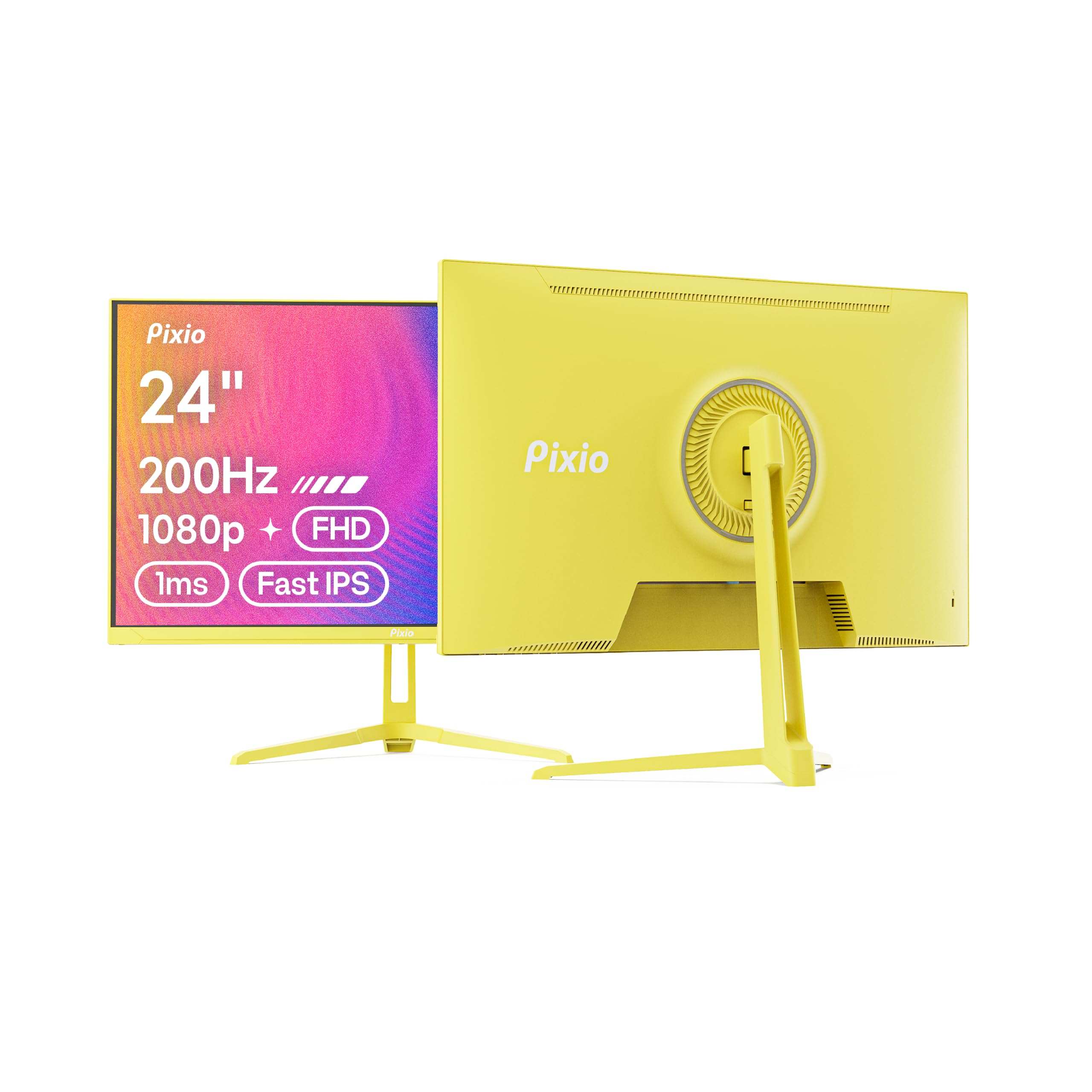
The compact speed demon for players who count every frame.
Start with the number that sets this one apart: 200Hz. That is 200 screen redraws per second, above the 180Hz of the larger PX278, and it is the edge that shows up in flick shots and fast turns. The 1ms GTG response time backs it up by keeping ghosting off moving targets. If you play competitive shooters on a card that runs 1080p comfortably, this is the faster path.
The 24-inch frame holds 1920 x 1080 pixels, which keeps the image tight and does not strain your graphics card the way 1440p does. It covers 112.44 on the gamut figure and is rated 300 cd brightness, so it is a touch less rich and less bright than the 27-inch panel. On a normally lit desk, the 300 cd versus 350 cd gap is hard to spot. Adaptive Sync here is AMD FreeSync, and you get one HDMI 2.0 and one DisplayPort 1.4 to feed it.
Owners agree on the look and disagree on the long haul. Buyers report setup is quick and the yellow color gets warm feedback. Long-term function is mixed, and as owners mention, “The functionality receives mixed reviews – while some say it works well, others report it stops working after six months.” The built-in speakers split the same way: fine for system sounds, not for real audio. Buy it for the 200Hz panel and the yellow colorway; the speakers are an afterthought.
Speed-first value: you get 200Hz and a 1ms response in a 24-inch 1080p shell, the highest refresh between the two, so fast-motion games stay smooth without pushing your GPU into 1440p territory.
Sound and long-haul caution: the speakers are a stopgap and the durability feedback is mixed, so keep an eye on the screen and plan your audio separately.
The short version: a 24-inch 1080p panel at 200Hz for players who want the fastest refresh and a yellow bezel on a modest desk.
Worth knowing: the built-in speakers are basic and the long-term reliability reports are mixed, so buy it for the panel and give it a stable spot.
Know the Specs
Refresh Rate and Response Time
Refresh rate is how many times per second the screen redraws. The PX248 runs at 200Hz and the PX278 at 180Hz, both well above a standard 60Hz office panel, so fast camera pans read clean. Response time, listed as 1ms GTG on both, is how fast a pixel flips color, and it is what keeps ghost trails off moving objects. These two figures decide how the screen behaves in a firefight.
Resolution and Brightness
Resolution is the pixel count: 1920 x 1080 on the PX248 and 2560 x 1440 on the PX278. More pixels means more detail and desktop space. Brightness, rated 300 cd on the 24-inch and 350 cd on the 27-inch, decides how well the image holds up in a bright room. Higher numbers read clearer with daylight on the glass. Color gamut, listed at 112.44 and 135.76, describes how wide a range of colors the panel can show.
Common Questions
Is 200Hz better than 180Hz for gaming?
Do these yellow monitors work with an NVIDIA graphics card?
What cables come in the box with the PX278?
Can I mount a yellow Pixio monitor on a wall?
Is 1440p worth it over 1080p on a 27-inch screen?
Do these monitors have built-in speakers?
How many HDMI and DisplayPort inputs does each have?
Can I adjust the height on these monitors?
What does the 1ms GTG response time actually mean?
Is 350 cd brightness enough for a bright room?
The Bottom Line
For most setups, the yellow computer monitor winner is the Pixio PX278 Wave Yellow. It pairs a 27-inch 2560 x 1440 Fast IPS panel (sharp, color-accurate screen) with a brighter 350 cd image and a 180Hz refresh, so you get detail and speed in one. If competitive speed is your whole game and your card runs 1080p comfortably, grab the Pixio PX248 Wave Yellow for its 200Hz panel. For the fastest refresh in a compact frame, the PX248 is the pick.
How we choose
We do not accept paid placement. Every pick is matched to a real buyer and a real use-case; we do not hands-on test units.
Sources
Specifications: manufacturer listings and product documentation. Review insights: verified customer reviews, as of November 2026. Pricing: not shown on this page (it changes often); check the current price via the retailer link.
As an Amazon Associate, Tactical Gear Guy earns from qualifying purchases. This does not affect which products we feature.