Specs are compiled from manufacturer listings and verified buyer reviews and can change over time — please confirm the key details on the product page before buying.
If you want a yellow coffee maker, the hard part is not finding one — it is finding one whose yellow is genuinely yellow and still looks that way after months of steam and coffee splashes. That is the whole test here. On this list the ceramic pour-over is the safest buy: its dyed-through clay body holds its warm ochre tone, and owners rave about the build. The stove-top pot below has the opposite problem, and you should know about it before you commit. Every pick below is a real yellow-bodied machine, matched to a different way of brewing.
This guide is built by comparing the manufacturers’ published specifications and the patterns across verified customer reviews, so you get each pick’s real strengths and trade-offs instead of marketing spin.
Yellow appliances split into two camps — dyed-in ceramics and painted metal — and the paint is where most buyers get burned. Glazed ceramic holds its yellow through daily steam; painted aluminium and coated plastic stain first. Below you will find the six strongest options for a yellow coffee maker that earns its spot on the counter and holds its colour.
Top Picks
How To Choose The Best Yellow Coffee Maker
Start with the body material, not the shade. A coffee maker gets blasted with hot water and steam every day, and the way its yellow is applied decides whether it still looks bright next year. Glazed ceramic is fired at high heat with the glaze formed into the surface itself, so the colour sits inside the material. Painted aluminium and plastic coatings sit on top, which is why you will see honest complaints about staining on the metal pot below.
Match the brew method to your mornings
A pour-over drips one cup slowly and gives you full control over pour speed. A drip machine does the work for you with a warming plate. A moka pot builds pressure on the stove for a strong, espresso-like shot. Capsule machines and semi-automatic espresso machines are the fastest to operate but commit you to their capsules or a grind-and-tamp routine. Pick the brew method you will run every morning, then pick the yellow.
Cup size and counter footprint
“Cups” on these listings are not the same unit. The Holstein measures 5 cups as 25 oz total, while the Bialetti builds its 6-cup capacity in small espresso shots. Check the ounce figure when you brew for more than one person. Then measure your counter: the compact machines here range from a narrow pour-over cone to a 14-inch-deep capsule unit, and a warming plate or a tall frothing wand needs clearance above.
Glass care and filter costs
A glass carafe is the most common breakage point on any drip machine, so treat it as a wear item and handle it with both hands. Reusable filters save you from buying paper, but they need a rinse after every brew. Paper filters, like the 40 included with the ceramic cone, give a cleaner cup at a small ongoing cost. Paper buys a cleaner cup; reusable buys a rinse after every brew.
Side-by-Side Comparison
| Model | Best For | Brew Type | Capacity | Filter Type | Amazon |
|---|---|---|---|---|---|
| HYAXGM Pour Over Ceramic (Yellow)★ Best Overall | Colour that stays put | Pour Over | 15.2 ounces | Paper | Amazon |
| Holstein Housewares 5 CupBest Value | Small kitchens and dorms | Drip Coffee Machine | 5 cups | Reusable | Amazon |
| Bialetti Rainbow Moka Pot | Stove-top espresso | Moka Pot | 6 cups | Reusable | Amazon |
| Delta Q MiniQool | Capsule convenience | Espresso Machine | 1 liters | — | Amazon |
| XIXUBX Espresso Machine | Latte art at home | Espresso Machine | 34 fluid ounces | Reusable | Amazon |
| Nespresso Vertuo Pop+ | One-touch coffee and foam | Espresso Machine | 25.4 fluid ounces | Reusable | Amazon |
Detailed Reviews
1. HYAXGM Pour Over Ceramic Coffee Maker (Yellow, V02)
Our pick — 4.5+★ from 200+ verified ratings; the strongest balance of quality and price.
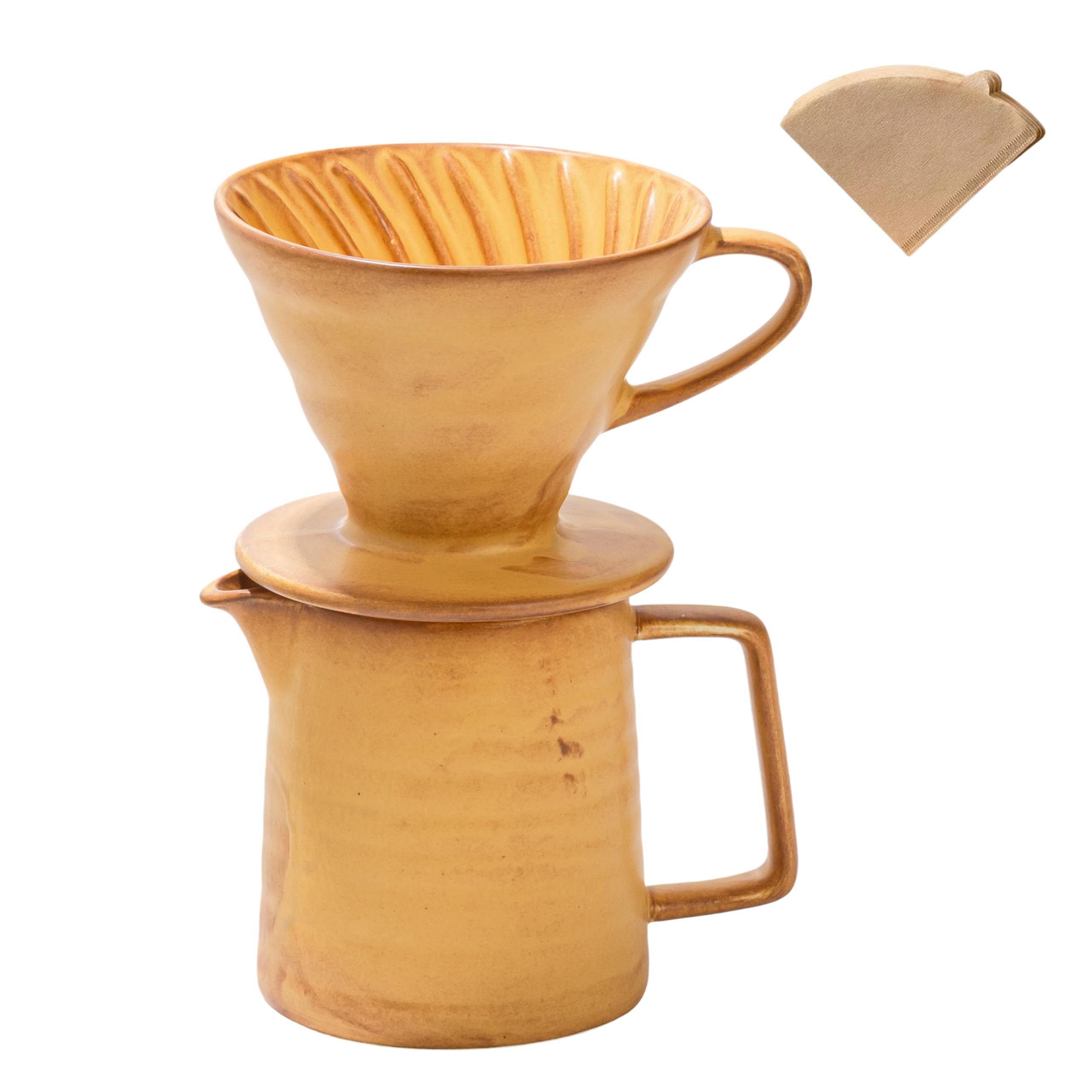
The ceramic cone whose yellow is baked into the clay, not painted over it.
This is the pick for someone who wants the yellow to be the point, not an afterthought. The body is fired clay, roasted at roughly 1000 to 1200 degrees, and the glaze forms naturally in that heat — so the warm aged ochre tone runs through the piece rather than sitting on the surface. No two units come out identical, which is the opposite of a stamped plastic shell. It holds 15.2 ounces, enough for one generous mug or a top-up for two.
Brewing is fully manual: you set the ceramic dripper on the matching pot, drop in one of the 40 included 02 paper filters, and pour. That slowness is the feature. Ceramic keeps the brew temperature steadier than glass, so the coffee does not cool mid-pour. Buyers keep telling the same story — this thing beats a French press for a clean, bright cup, and it looks good enough to leave out on the counter instead of hiding in a cabinet. The shape reads vintage rather than novelty, and it cleans up with a rinse.
Here is the honest arithmetic. At 1.8 pounds and 3.9 by 5.3 by 7.1 inches, it takes up real shelf room, and it is heavier than the 2.2-pound Holstein drip machine nearby despite holding fewer ounces. Ceramic also chips if you knock the pot against a sink edge, so wash it with care. It is a one-to-three-person brewer, not a carafe for a dinner party. If you want push-button coffee before you have opened your eyes, keep reading — this is not that machine.
What holds up over time
- Glaze formed in the firing, so the yellow is part of the body, not a coating that can flake
- Ceramic walls hold brew temperature steadier than glass, keeping the cup warm to the last sip
- 40 paper filters ship in the box, so you are brewing the day it arrives
- 15.2-ounce capacity serves one to three people from a single pour
Where it asks more of you
- Fully manual pour-over — no timer, no warming plate, no autopilot
- Ceramic is breakable and heavier than the small drip machines here
- Paper filters need replacing once the 40 run out
Buy this when: you want a counter piece whose yellow is a permanent material choice and you enjoy the ten-minute pour-over ritual.
Think twice if: you need a programmable machine to have coffee waiting when you wake up.
2. Holstein Housewares 5 Cup Coffee Maker
Dorm-room coffee that pours early and does not need a paper filter.
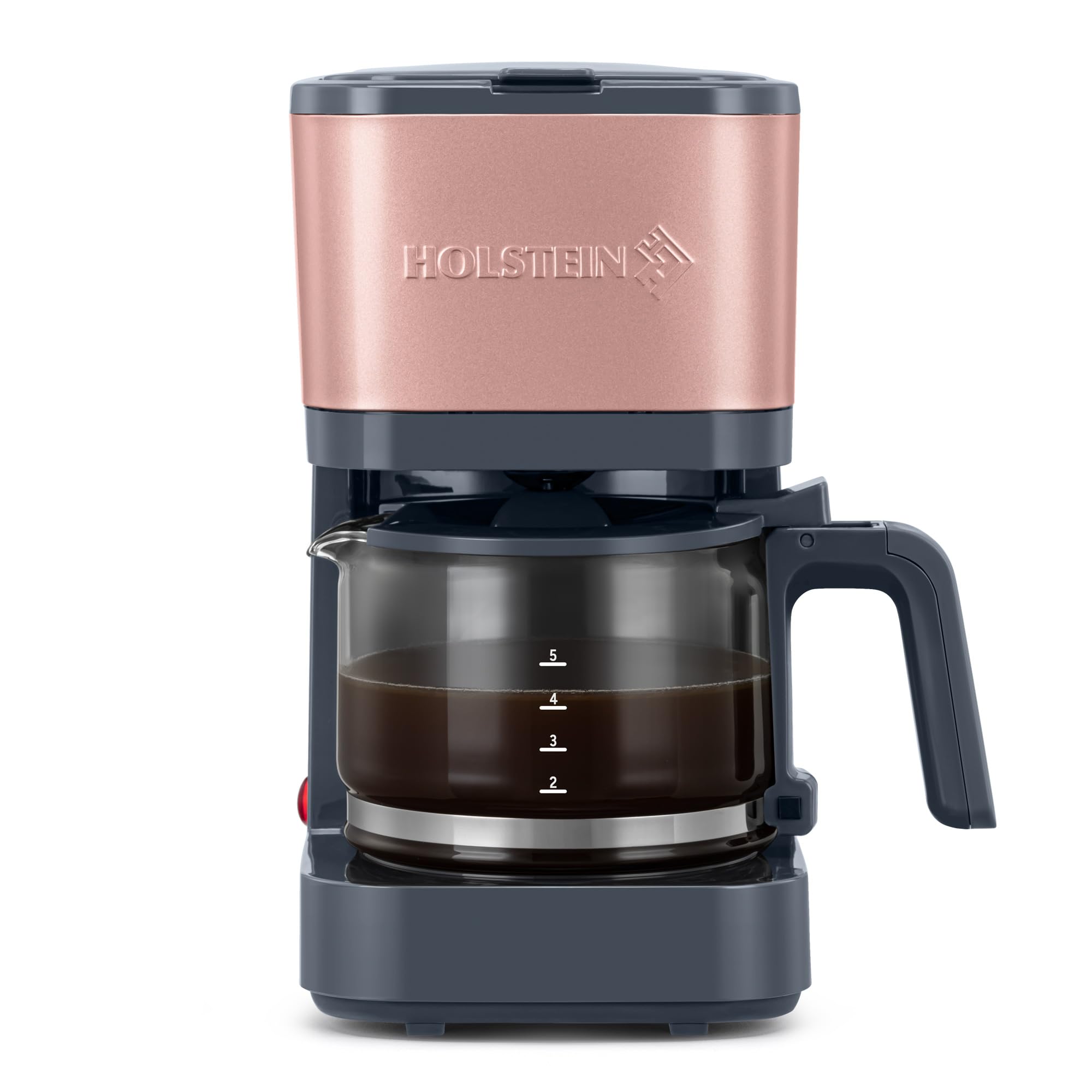
The number that matters here is 25 ounces — that is the total brew this compact drip machine produces, split into 5 cups. Pour a mug before the cycle finishes thanks to auto pause and serve, so you are not standing around waiting for the last of the water to drip through. One button, a full-view water window to stop you overfilling, and a non-stick warming plate that keeps the rest of the carafe hot. It measures 6.6 by 9.7 by 10.9 inches and weighs 2.2 pounds, so it tucks onto a counter or a dorm shelf.
That footprint is the thing owners talk about most — it is built for the kitchen where nothing else fits. The dark grey and rose gold combination gets steady compliments, and the permanent filter means you never buy papers again. Brew quality lands in “solid everyday cup” territory rather than café standard. One catch the listing copy hides: this is the model whose photo you have to read carefully, because the accent colour on this variant is rose gold, with the grey body doing the heavy lifting on counter appeal.
The recurring gripe in the review pages is the glass carafe, which a few owners have had shatter in use. Size that honestly: it is the weak component, not the whole machine, and treating the pot like glass — both hands, no clinking against the sink — is the fix. Expect to replace it if it does take a knock. The bigger honest note for yellow hunters: this is not a yellow machine, so if colour purity is the whole reason you are reading, look at the ceramic cone instead.
Who it fits: Dorm dwellers, apartment kitchens and single-brew households that want push-button coffee and zero filter spend.
The trade-off: The 25-ounce carafe and glass construction want gentle handling, and the colour story is grey and rose gold rather than true yellow.
Reach for this if: counter space is the real constraint and you want reliable drip coffee with no ongoing filter cost.
Look elsewhere if: a genuine yellow body is non-negotiable for your kitchen.
3. Bialetti Rainbow Moka Pot

Six shots of stovetop espresso from a yellow pot that fits an RV drawer.
Espresso without a plug. This is a moka pot — a two-chamber aluminium brewer you set on a burner, where steam pushes hot water up through the grounds and out the spout as a strong, syrupy shot. It holds 6 cups in moka terms, which means six small espresso servings rather than six mugs, and it works on gas, electric and glass ceramic stovetops. Made from aluminium with Bialetti’s patented safety valve and an ergonomic handle, it weighs 602 grams, so it travels easily and lives happily in a camper, a small kitchen or a rented flat where counter space is tight.
Brewing takes minutes and the method is simple: fill the base with water, add ground coffee to the basket, screw the halves together and heat. Cleaning is a rinse under the tap — no detergent, no dishwasher, which protects the finish. What owners like most is the build; it feels more substantial than the generic moka pots on the shelf, and the yellow body makes it a display piece rather than a utility item.
Now the caveat you came here for. The yellow finish is a coating rather than anodised colour, and repeated stovetop heat is hard on it — the honest reports describe the paint staining over time. That is a cosmetic decline on an otherwise solid brewer, not a failure of the pot. You can slow it by never scorching the base and rinsing promptly. It is also a hand-wash-only, manual-heat brewer: no timer, no keep-warm, no margin for a forgotten flame. Buy it for the ritual and the looks, and accept that the yellow will age with you.
The case for it: Real espresso pressure from a burner, a 602-gram aluminium body that travels, and three stovetop types supported.
The catch: The painted yellow finish is the wear item here — stovetop heat and coffee residue gradually dull and stain it.
Best for: Small-space cooks and campers who want stovetop espresso and are happy to hand-rinse a pot.
Not for: anyone who cannot tolerate a yellow that darkens with use, or who wants a programmed brew.
4. Delta Q MiniQool Coffee Machine

A fully automatic yellow capsule machine that runs at 19 bars.
For the buyer who wants yellow on the counter and a coffee in under a minute, this is the shortcut. It is fully automatic, running Delta Q capsules through a 19-bar pressure system — bar being the measure of pump force, and 19 of them is enough to push a rich, velvety crema out of a sealed capsule. The machine lets you program your preferred pour size for espresso, lungo, tea or herbal infusions, so your cup comes out your way every time. It holds 1 liter of water in a removable tank and stores 7 used capsules in an internal bin.
The design is the selling point beyond the brew: compact, modern, and genuinely yellow rather than yellow-adjacent. There is an adjustable cup tray so a short espresso glass or a taller mug both sit close to the spout. The internal capsule bin means you empty one container instead of fishing foil pods out of the machine every day.
The real constraint is the ecosystem. This machine is engineered exclusively for Delta Q capsules. That means your coffee choice is limited to what that pod range carries, and you cannot tip in ground coffee for a weekend experiment. Delta Q is not the widest-stocked pod brand in every region, so check local availability before you commit. There is also no built-in milk frother here — the espresso is black unless you add your own.
What it solves: Push-button espresso with no grind, no tamp and a capsule bin that keeps cleanup to a single empty.
Where it constrains you: Delta Q capsules only, no milk frother in the box, and a pod range you cannot swap out.
Pick this if: you already rely on Delta Q pods or want the simplest route to espresso from a bright yellow machine.
skip it if: you brew fresh-ground coffee or expect a steamed-milk cappuccino from one appliance.
5. XIXUBX Espresso Machine with Milk Frother
Twenty bars, a PID controller and a steam wand — all in yellow.
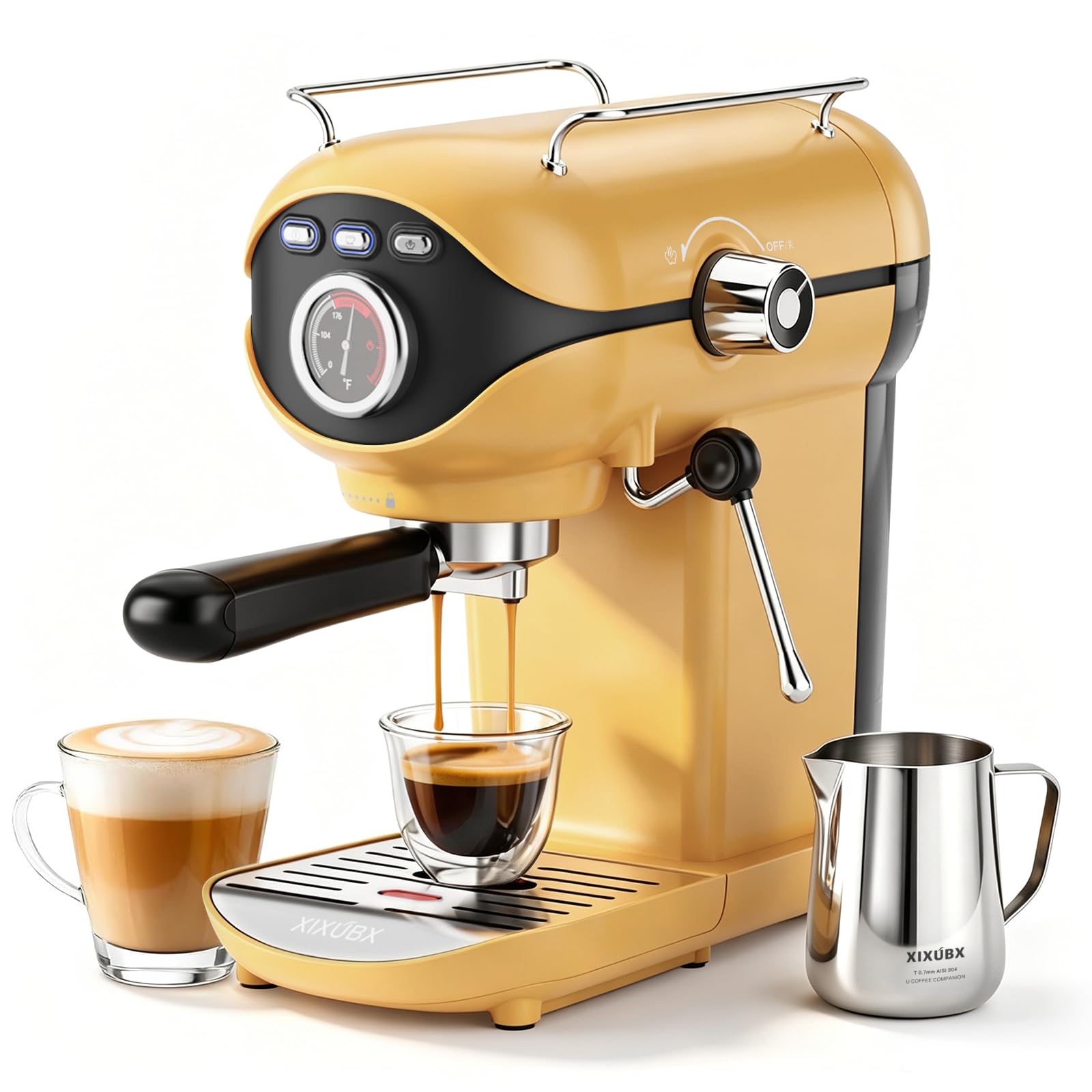
This is the most capable brewer on the list for anyone who wants real espresso with milk. It is semi-automatic, meaning you grind and tamp the coffee yourself and the machine handles pressure and temperature. The 20-bar pump works with gentle pre-infusion — a short low-pressure soak of the grounds before full pressure hits — which evens out the extraction and builds a golden crema. The PID controller (a chip that holds the water at a set brewing temperature) smooths out the swings that give cheaper machines a burnt or sour edge. Capacity is 34 fluid ounces in the tank.
Then there is the steam wand, and it is the reason to look here rather than at the capsule machine above. It produces dense microfoam — the fine, paint-like milk texture you need for latte art — so cappuccino, latte and mocha are on the table every morning. Brewing runs 22 to 30 seconds from a single button, with one press for a single shot and a different press for a double. It also auto-preheats on startup, and a 51mm one-cup filter, two-cup filter, portafilter, tamper with spoon and cleaning needle all ship in the box. Owners consistently describe it as far from toy-like in the hand, especially given how compact the vertical body is.
At 7 pounds and 11.4 by 6.7 by 11.8 inches it is a chunky little block — compact vertically, but give it depth on the counter. The heating side is the honest weak spot: it warms quickly but sometimes needs a couple of runs to reach the temperature you want, so pull a blank shot to pre-warm the group. Figure in a burr grinder if you do not own one, because pre-ground coffee will not get you to café flavour with this machine.
Why coffee people rate it
- 20-bar pressure plus pre-infusion gives an even extraction and a golden crema
- PID temperature control holds the brew steady, cutting burnt and sour notes
- Steam wand froths real microfoam for latte and cappuccino
- One button covers single and double shots in 22 to 30 seconds, with auto-preheat
- Full starter kit included: two 51mm filters, portafilter, tamper and cleaning needle
The fine print before you buy
- Needs a decent grinder and your own tamping — this is not a capsule machine
- Heating speed is the recurring note; it may need more than one run to reach temperature
- 7 pounds and 11.4 inches deep, so plan counter depth
The one to buy if: you want proper espresso and steamed milk from a compact yellow machine and do not mind grinding and tamping.
The sticking point: it needs a separate grinder and a warm-up run or two before the first shot lands where you want it.
6. Nespresso Vertuo Pop+ with Milk Frother

Mango yellow and one-touch foam — the easiest crowd-pleaser on this list.
If the yellow is the point and you want it in a design-forward shell, this is the sharpest-looking machine here. The Pop+ brews five sizes — 5, 8 and 12-ounce coffees plus single and double espressos — hot or over ice, all from Vertuo capsules. The Aeroccino3 milk frother comes in the box and turns out hot or cold foam in a few seconds with one touch, which is what makes a proper cappuccino or latte without any steam-wand technique. Heat-up is listed at 30 seconds, with a descaling alert to remind you when a clean is due. The removable 25.4-fluid-ounce water tank sits on the side for easy refilling, and the drip tray adjusts to short espresso cups.
You get rich, smooth coffee with a thick layer of foam on top, according to buyers. That foam is the real talking point, and the included tasting pack lets you try the range before you commit to a pod order. The Vertuo line lists over 40 permanent specialty coffees, so variety is there once you settle in. At 7.9 pounds and 14 inches deep, it takes the most counter space here, so check your counter depth first.
Two honest notes. This is a capsule-locked machine — Vertuo pods only, no ground coffee — so your ongoing cost and choice depend on that pod range. And the recurring complaint in the review pages is noise: it runs loud for its size, which matters in a bedroom or a shared flat. Reliability gets a mixed read, with some units going quiet after a while, so buy from a seller with clear support terms. For the looks, the foam and the convenience, it still earns its place.
What everyone raves about: The easy foam and the looks — it is the best-dressed yellow machine on this list, and the Aeroccino does the milk work for you.
What to weigh: Vertuo pods only, a 14-inch footprint, and a brew cycle that runs louder than you would expect.
Made for: Capsule-coffee fans who want a stylish yellow espresso machine and easy milk foam included in the box.
Not the one for: fresh-ground brewing, small counter depth, or anyone sensitive to machine noise.
Know the Specs
Three numbers decide whether a yellow coffee maker suits you: capacity, brew type and filter type. Get capacity, brew type and filter type right, and the yellow is the easy part.
Cups vs ounces
A “cup” on a coffee listing is not a mug. The Holstein counts its 5-cup capacity as 25 ounces total, so figure a mug per person when you split the carafe. The Bialetti’s 6 cups are small espresso shots, not full mugs. The ceramic pour-over lists 15.2 ounces and the Nespresso 25.4 fluid ounces, which are close to a single large mug. Read the ounce figure every time and ignore the cup label.
Pressure in bars
Bar measures how hard the pump pushes water through the coffee. The Delta Q runs at 19 bars and the XIXUBX at 20, both enough for espresso with a real crema. Lower pressure machines tend to taste flat. Pre-infusion — a short soak before full pressure — helps evenness and shows up on the XIXUBX.
PID temperature control
A PID is a temperature chip that holds the water at a steady brew temperature instead of letting it swing. Swings are what give espresso a burnt or sour edge. The XIXUBX lists a PID; simpler machines do not, which is why pre-warming with a blank shot becomes a useful habit on anything budget.
Paper vs reusable filters
Paper filters give a cleaner cup and need replacing. Reusable filters save money but need a rinse after each brew. The ceramic cone ships with 40 paper filters; the drip, moka and espresso machines here use reusable filters. Paper filters cost money per brew; reusable filters cost a rinse each time.
Common Questions
Will the yellow on a coffee maker fade or stain over time?
How many cups does a 6 cup moka pot actually make?
Can I use ground coffee in a Nespresso or Delta Q machine?
Do I need a separate grinder for the XIXUBX espresso machine?
Which yellow coffee maker is best for a small apartment kitchen?
Is a moka pot stronger than a drip coffee maker?
How do I clean a ceramic pour-over cone?
Why does my espresso machine taste sour or burnt?
Does the Nespresso Vertuo Pop+ come with a milk frother?
Can I put my glass carafe in the dishwasher?
The Bottom Line
Want a yellow coffee maker that stays yellow? The HYAXGM ceramic pour-over is the pick for most buyers. Its colour is baked into the fired glaze, so steam and coffee cannot strip it, and the 15.2-ounce capacity fills a solo mug or two. Want espresso with real foam from a compact yellow body? The XIXUBX espresso machine leads on pressure at 20 bars and adds a steam wand for milk. And if you just want fresh-tasting pod coffee from a machine that looks the part, the Nespresso Vertuo Pop+ pairs the best-looking yellow shell here with a frother in the box. Buy for the yellow, but commit to the brew method you will run every morning. The brew method outlasts the novelty of the colour.
How we choose
We do not accept paid placement. Every pick is matched to a real buyer and a real use-case; we do not hands-on test units.
Sources
Specifications: manufacturer listings and product documentation. Review insights: verified customer reviews, as of November 2026. Pricing: not shown on this page (it changes often); check the current price via the retailer link.
As an Amazon Associate, Tactical Gear Guy earns from qualifying purchases. This does not affect which products we feature.