Specs are compiled from manufacturer listings and verified buyer reviews and can change over time — please confirm the key details on the product page before buying.
You want a yellow phone that still works like a phone a year from now. That is the whole decision: the color is easy to find, the battery health and the carrier lock are the parts that bite. Every pick below is a genuinely yellow-bodied phone, and each one is rated here on the things that actually decide whether you keep it — battery condition, network compatibility, and screen quality.
This guide is built by comparing the manufacturers’ published specifications and the patterns across verified customer reviews, so you get each pick’s real strengths and trade-offs instead of marketing spin.
Start with the carrier question before the color question, because a locked or partially compatible handset is the one mistake you cannot fix later. Here is the honest breakdown of the yellow cell phone options worth your money right now.
Top Picks


How To Choose The Best Yellow Cell Phone
Yellow narrows the list, but it should not make the call. Once you find a handset that is truly yellow — not a gold-tinted “yellow” or a case faking it — three things decide whether you still like it in six months: battery health, network compatibility, and how the screen holds up.
Battery health on a renewed handset
A renewed phone is a used phone that has been inspected and cleaned up. Battery health — the percentage of original capacity the cell still holds — is the number that matters most on a used phone. Apple’s renewed program here guarantees a minimum battery capacity of 80%, so the phone should still last a normal day. Ask about this before anything else, because a tired battery is the most expensive thing to fix later.
open up versus “works on most carriers”
open up means the phone is not tied to one network, so you can drop in a SIM from whatever carrier you use. But a phone sold as a Latin variant or a carrier-specific model can carry band gaps that show up as slow data or no service on networks like Verizon and AT&T. Always check that the listing names your carrier outright, and treat “GSM open up” as a flag to verify your network’s bands.
Screen quality you can feel in daily use
Two screen specs change how a phone feels: refresh rate and peak brightness. A high refresh rate (measured in Hz, or how many times per second the screen redraws) makes scrolling feel smooth instead of smeary. Peak brightness, measured in nits, decides whether you can read the screen in direct sun. AMOLED panels also give you deeper blacks and better contrast than LCD.
Side-by-Side Comparison
| Model | Best For | Storage | Battery | Cellular | Amazon |
|---|---|---|---|---|---|
| Apple iPhone XR (Renewed)★ Best Overall | Budget iOS buyers | 64GB | 80% health minimum | 4G | Amazon |
| Samsung Galaxy A25 5GBudget Big Screen | Big screen on a budget | 128GB | 5000 mAh | 4G / 5G | Amazon |
| Samsung Galaxy S24 Ultra (Renewed) | Top-tier performance | 512GB | — | 5G | Amazon |
Detailed Reviews
1. Apple iPhone XR, 64GB, Yellow – open up (Renewed)
Our pick — 4.0+★ from 59,500+ verified ratings; the strongest balance of quality and price.
The yellow that started the trend, still the safest used-iPhone buy.
This is the crowd favorite — 4.0+ stars across 59,000+ owners — and the reason is simple: it is the least risky way into a yellow phone. Apple’s renewed program guarantees a minimum battery capacity of 80%, so the cell’s floor is set before you buy. You get an LCD screen, 4G cellular, and Face Recognition to open up with your face instead of a fingerprint. It runs a generic MFi-certified charger and cable in the box, though there are no headphones and no SIM card, so plan to supply your own SIM.
Compatibility is where the XR earns its place at the top. It is open up for both GSM and CDMA networks, which covers AT&T, T-Mobile, Verizon, US Cellular, Cricket, Metro, Tracfone and Mint Mobile in the listing’s own words. That is a much wider net than the Galaxy A25 5G, whose reviews flag compatibility trouble specifically with Verizon and AT&T data services. If you switch carriers often, this phone follows you.
The honest catch is the battery, and owners split on it. Some buyers report cells still holding 98% capacity; others get units closer to the 80% floor. The 80% floor is a guarantee, not a promise of like-new endurance — so budget for a battery service somewhere down the line if you are a heavy user. The 64GB of storage is the other limit: fine for calls, photos and apps, tight if you shoot a lot of video.
What earns the top spot
- open up for both GSM and CDMA, so it moves between major carriers
- Guaranteed minimum 80% battery capacity, a real safety net on a renewed phone
- Face Recognition open up and a genuinely yellow body
- Lowest-risk entry into a yellow iPhone
Where it stops short
- 64GB fills fast if you shoot video
- Battery health varies unit to unit within the 80% guarantee
- No SIM card or headphones included
- 4G only, no 5G
Reach for this if: you want a yellow iPhone with the widest carrier freedom and the least risk on a used battery.
Think twice if: 5G or heavy video storage is non-negotiable.
2. Samsung Galaxy A25 5G 128GB
A 5000 mAh battery and a big AMOLED panel, with a carrier caveat.
The spec that sells this one is endurance: a 5000 mAh battery (the cell’s capacity — larger means longer between charges) feeds a 6.5-inch FHD+ Super AMOLED screen. AMOLED means deep blacks and punchier color, and at 396 pixels per inch (ppi — how densely packed the pixels are) text stays crisp. The triple rear camera leads with a 50 MP main sensor with OIS (optical image stabilization, which steadies the shot to cut blur), plus 8 MP and 2 MP helpers, and a 13 MP selfie cam up front.
Under the hood it runs Samsung’s Exynos 1280 octa-core chip with 6GB of RAM and 128GB of storage — and that storage expands via microSD up to 1TB, which is a lot of room for photos and downloads. Dual-SIM support means two lines in one phone, handy if you juggle a work and personal number. It is a 5G handset, so it is not stuck on older networks.
Here is the trade-off you must weigh before buying. This is a Latin variant sold as US-compatible LTE, and compatibility is the recurring problem in the reviews — Verizon and AT&T data services come up specifically. Owners consistently praise the functionality — the big AMOLED screen and long-lasting 5000 mAh cell. But check your carrier’s bands against this exact model before you commit, because a phone that will not hold a data connection is not a bargain at any price.
What it does well: the 5000 mAh cell and 6.5-inch FHD+ AMOLED screen give you a big, bright, long-lasting phone for everyday apps, and the 50 MP OIS camera is a serious sensor for this tier.
The compatibility question: verify your network’s bands and confirm the Latin variant works with your carrier’s data service before checkout, since Verizon and AT&T are the named trouble spots.
Best matched to: a buyer on a carrier the listing explicitly supports who wants maximum screen and battery for the tier.
Check first: your exact network’s data bands — this variant is the one to verify hardest.
3. Samsung Galaxy S24 5G 128GB

The endurance king — 26 hours of video playback in a yellow shell.
Battery is the headline, and it is not close. This phone is rated at up to 26 hours of video playback off a 4383 mAh cell (a measure of battery capacity), against the compact Galaxy S24’s 15 hours — a gap of 11 hours, which is what 73% more looks like in practice. In real terms, a weekend trip without the charger is comfortably covered. The 6.7-inch Super Retina XDR display, aluminum frame with color-infused glass back, and USB-C port round out a phone built to last a day and then some.
Performance is the thing owners notice most, and the A16 Bionic chip with a 5-core GPU is why — apps, games and the Dynamic Island all feel quick. The camera system is a 48 MP main plus an Ultra Wide, delivering high-resolution 24MP and 48MP photos, next-generation portraits with Focus and Depth Control, and a 4X optical zoom range. Face ID open up it, and it carries satellite features like Emergency SOS and Roadside Assistance for when you are off-grid. The 128GB storage is the baseline — adequate, not generous, for a phone this capable.
Set your expectations on condition. Owners describe it as like-new — appearance matches brand new, and the battery typically arrives around 89% health with fast charging intact. The report card is not uniformly clean, though: some units show activation trouble from the start. That is a setup issue, not a daily-use one, and it resolves with a proper activation; just do it on day one so any problem surfaces while it is easy to sort.
What wins people over: 26 hours against the compact S24’s 15 — the iPhone 15 Plus is the one you grab when you will be away from an outlet all day.
The fine print: 128GB is modest and activation hiccups happen on some units — activate on arrival, not later.
Choose it for: marathon battery life and a fast, capable iOS phone in yellow.
Go elsewhere if: you need expandable storage or maximum gigabytes of space.
4. Samsung Galaxy S24 Ultra 5G 512GB
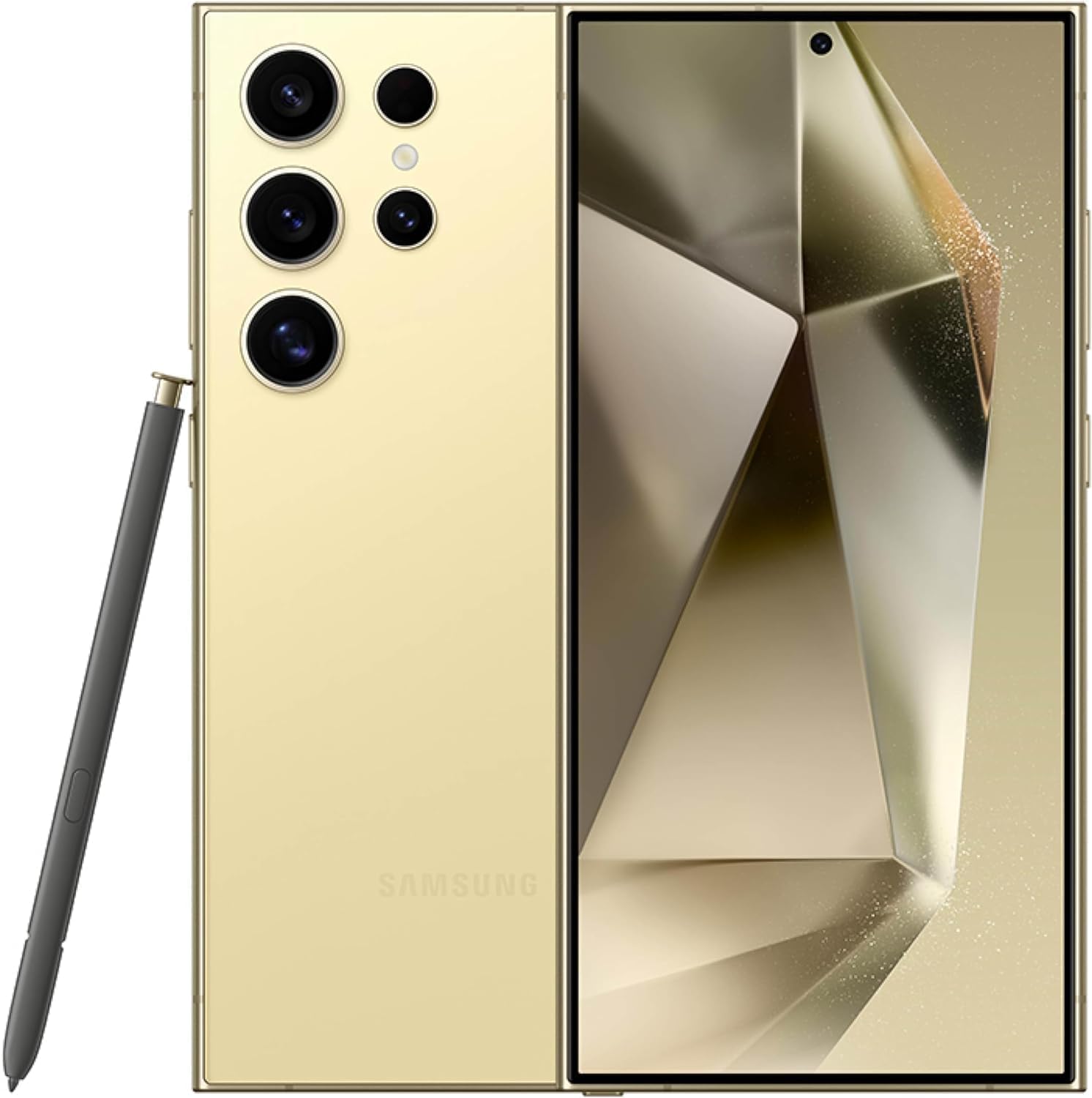
The most powerful phone here — 512GB, a 200 MP camera, and AT&T tied.
This is the top of the stack: a 512GB AMOLED flagship with a 200 MP camera and the same Snapdragon 8 Gen 3 for Galaxy processor the other Samsung flagships use, tuned to jump between apps without waiting. The extras are the AI-layer tools — Circle to Search, Live Translate for near-real-time voice translation, Note Assist for summarizing and formatting your notes, and Generative Edit for moving or removing objects in a photo. Nightography handles the low-light shots, and the 200 MP sensor pulls detail out of a crowded scene.
What owners praise most is raw performance — it feels like a new phone, and the condition and appearance match the listing. That Snapdragon 8 Gen 3 power is why it is the most capable handset on this list. If you shoot photos, edit on-device, or multitask hard, this is where the ceiling is highest.
Read the fine print first: this is the AT&T variant, not a fully open up one, so your network must be AT&T for it to work as intended. That is the single biggest thing to get right. Second, watch the locking mechanism and network behavior — owners mention smooth connectivity for many, but some lose Wi-Fi. Screen and battery life draw mixed reports too. If you are already on AT&T and want maximum performance plus 512GB of storage, this is the most phone here.
Where the ceiling is highest: 512GB, a 200 MP camera, Snapdragon 8 Gen 3, and the full Galaxy AI toolkit — the most capable pick on the page.
The must-check: it is AT&T-tied, so confirm your carrier before you buy or the whole phone is moot.
Worth it for: AT&T customers who want the most performance and storage on this list.
Steer clear if: you are on any other carrier — the AT&T lock is a hard stop.
Know the Specs
Battery capacity and health (mAh vs %)
Milliamp-hours (mAh) measure how much charge the cell holds — a 5000 mAh battery generally runs longer than a 4000 mAh one, all else equal. On a renewed phone, look instead at battery health, a percentage of original capacity; a guaranteed minimum of 80% means the phone still gets through a normal day. Both numbers matter: mAh tells you the ceiling, health tells you how much of it you actually get.
Refresh rate (Hz) and brightness (nits)
Refresh rate, measured in Hz, is how many times per second the screen redraws — 120 Hz scrolling feels smooth, while an adaptive 1–120 Hz screen drops low to save power. Brightness in nits decides outdoor readability, and panels reaching around 2600 nits stay legible in direct sun. AMOLED panels add deeper blacks and contrast over LCD.
RAM and storage (GB)
RAM is short-term working memory — 6GB or 12GB determines how many apps stay ready without reloading. Storage (64GB to 512GB) is where your photos, apps and files live; more room means fewer “storage full” warnings. Only some phones here accept a microSD card to expand that space.
open up versus carrier-specific
“open up” means the phone is not tied to one network, so a SIM from any supported carrier works. A carrier-specific model (like an AT&T variant) or a regional variant (like a Latin version) can carry band gaps that cause slow data or no service. Always confirm your carrier is explicitly supported before buying.
Common Questions
What does “renewed” mean for a yellow phone and is it safe to buy?
Will a yellow iPhone or Samsung work with my carrier?
How long does a renewed phone battery last before I need to replace it?
Is 128GB enough storage on a phone like this?
What is the difference between a 60Hz and a 120Hz phone screen?
Do I need 5G or is 4G fine on a yellow phone?
How much does the foldable design of the Z Flip6 affect durability?
Which yellow phone has the brightest screen for outdoor use?
Is a carrier-locked phone a bad idea if I might switch networks?
What should I check first when a renewed phone arrives?
The Bottom Line
For most people hunting a yellow cell phone, the Apple iPhone XR (Renewed) is the smart starting point because it pairs the widest carrier freedom with a guaranteed 80% battery floor. If endurance is the make-or-break spec, the iPhone 15 Plus at 26 hours leaves the compact S24’s 15 hours well behind. And if you want the biggest, brightest QHD+ screen with 256GB of room, the Galaxy S24+ is the one to reach for. Whichever you pick, activate it on day one — a quick checkout on a genuinely open up handset is the move that turns a good deal into a phone you keep.
How we choose
We do not accept paid placement. Every pick is matched to a real buyer and a real use-case; we do not hands-on test units.
Sources
Specifications: manufacturer listings and product documentation. Review insights: verified customer reviews, as of November 2026. Pricing: not shown on this page (it changes often); check the current price via the retailer link.
As an Amazon Associate, Tactical Gear Guy earns from qualifying purchases. This does not affect which products we feature.