Specs are compiled from manufacturer listings and verified buyer reviews and can change over time — please confirm the key details on the product page before buying.
If you want one answer: buy the structure that survives your worst winter night, not the one that looks nicest in a summer photo. A greenhouse only earns the “year round” label when its panels trap heat, its frame holds snow, and its vents let you dump humidity before it turns to frost on your leaves. Everything below is judged on those three things.
This guide is built by comparing the manufacturers’ published specifications and the patterns across verified customer reviews, so you get each pick’s real strengths and trade-offs instead of marketing spin.
You will see twin-wall versus four-wall panels, aluminum versus cedar frames, and vent counts that decide whether your tomatoes cook or breathe. By the end you will know which size and build actually fits your yard and your winter, and the right year round greenhouse stops being a guess and starts being a measured choice.
Top Picks
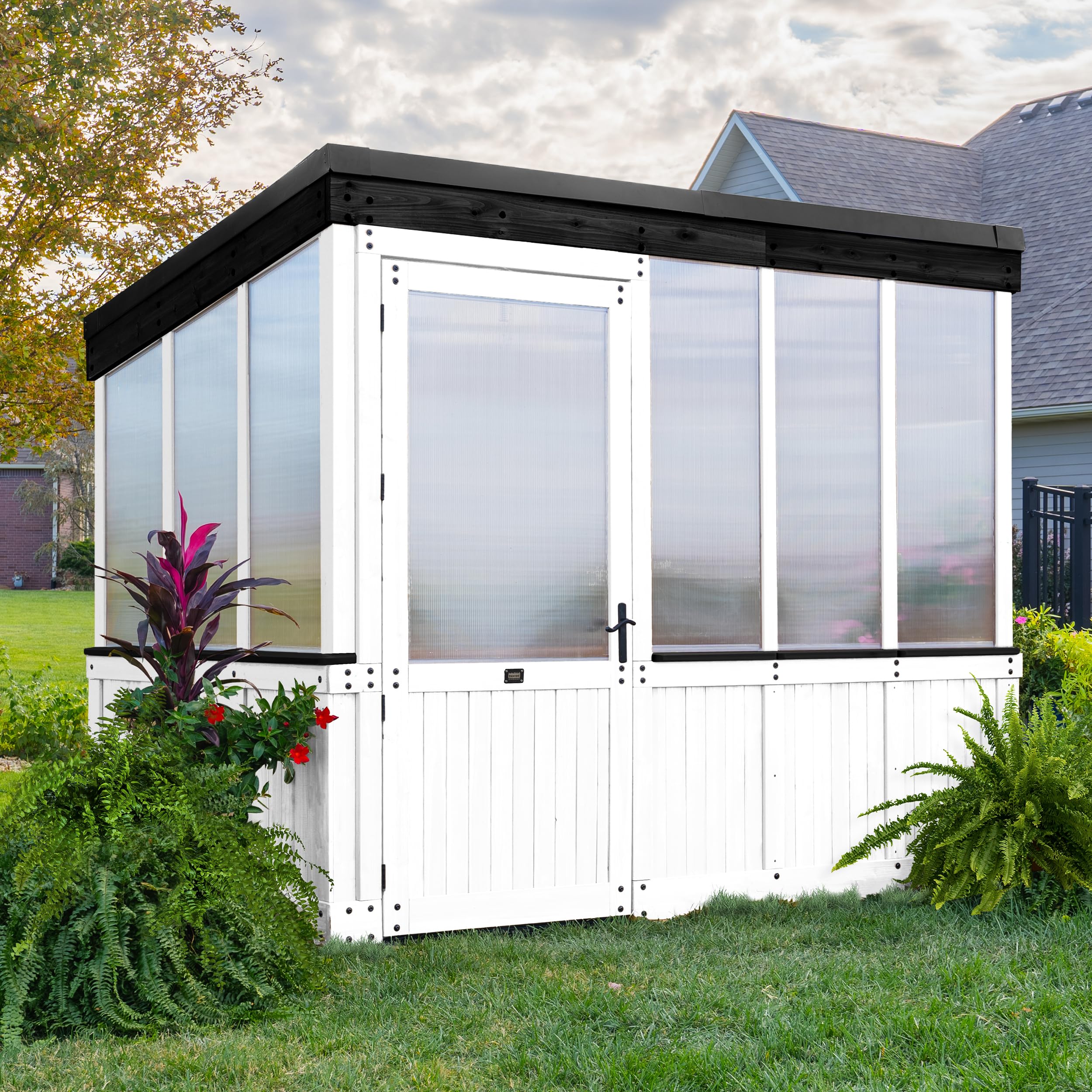

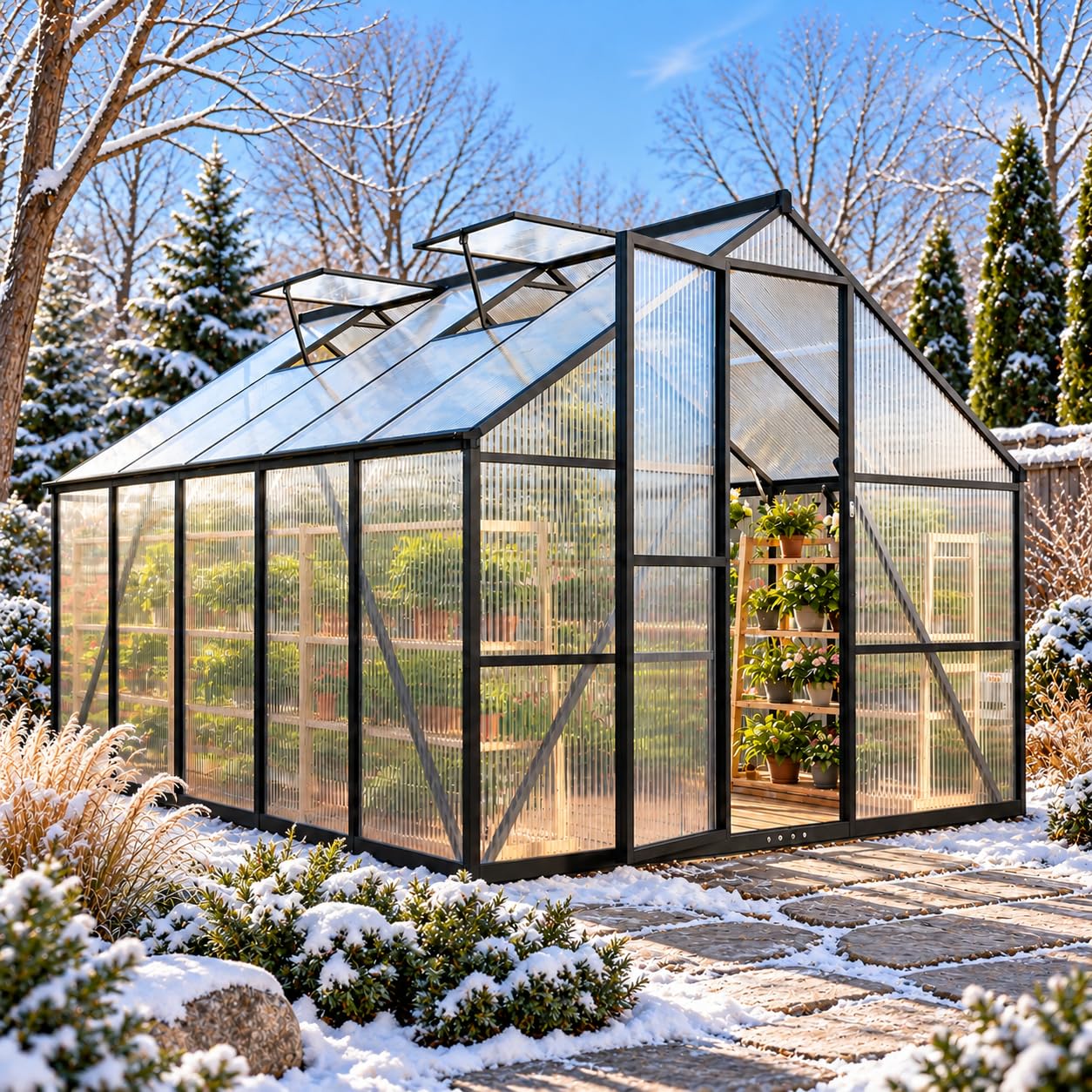
How To Choose The Best Year Round Greenhouse
The mistake almost every first-time buyer makes is shopping by footprint first. Square footage is the easy number to compare, so it wins the attention. But a big greenhouse with thin panels and one vent will still freeze your seedlings in February and steam them in July. Choose the envelope and the airflow first, then pick your size.
Panel walls decide how much heat you keep
Twin-wall polycarbonate means two sheets with a trapped air gap between them — the gap is the insulation. Four-wall panels add more internal chambers, so there is more still air between you and the outside cold. The Backyard Discovery Willow lists commercial-grade 4-wall panels on its roof and windows and states a 30% heat-retention improvement over standard double-wall. That is a manufacturer figure, but it points at the right priority: count the walls before you count the shelves.
Frame material and anchoring carry the snow and wind numbers
Aluminum frames resist rust but are light, so they depend on you burying or bolting the base down. Cedar and other wood frames are heavier and resist decay naturally, which helps in wind but means more weight to move during assembly. Look for a stated snow load in psf (pounds per square foot) or a wind rating in mph — those are the numbers a bad storm tests. A frame with no published rating is a frame you are trusting on faith.
Vents and doors are your humidity control
Cold air holds less moisture, so a sealed greenhouse in winter fogs up fast. Adjustable roof vents let warm damp air escape before it condenses on leaves and invites mold. Two vents give you more control than one; four-level or five-level adjustable vents give you finer tuning than a simple open-shut panel. A lockable door is not just security — it lets you seal the structure tight on the coldest nights.
Match the footprint to your real planting plan
A 6’x12′ walk-in fits two narrow beds and a center path. An 8’x16′ lets you run staging shelves down one side and still stand comfortably. Interior height matters too: a peak around 8 feet keeps you from stooping, and a taller doorway makes wheelbarrows, pots, and mobility aids practical. Pick the size you can actually reach every plant in, not the biggest one your yard allows.
Side-by-Side Comparison
| Model | Best For | Frame Material | Footprint | Vents | Amazon |
|---|---|---|---|---|---|
| Backyard Discovery Willow 9′ x 6′★ Best Overall | Four-season growing with power and water built in | Wood (cedar) | 9′ x 6′ | 2 | Amazon |
| VEIKOU 6’x12′ Rivet StructureBudget Standout | Long narrow plots on a tight budget | Aluminum | 6′ x 12′ | 2 | Amazon |
| FLY BY YAN 8×10 FTBest Rain Management | Rain collection and roomy walk-in space | Aluminum | 8′ x 10′ | 2 | Amazon |
| IDEALHOUSE 8×10 FT | Lightweight kit that two people can raise | Aluminum steel | 8′ x 10′ | 1 | Amazon |
| YITAHOME 12x6FT | Sliding-door access in a narrow footprint | Aluminum | 12′ x 6′ | 2 | Amazon |
| Esimote 10×12 FT | Maximum floor space for the money | Aluminum | 10′ x 12′ | 1 | Amazon |
| Palram Canopia Oasis Hex | A garden centerpiece with proven light transmission | Aluminum and galvanized steel | 7′ x 8′ | 1 | Amazon |
| Modern Shade 6.5’x12′ Wooden | Standing tall with power and water on tap | Wood (cedar) | 6.5′ x 12′ | 4 | Amazon |
| HOWE 8x16x7.5 FT | Serious hobby growing with a published wind rating | Aluminum | 8′ x 16′ | 4 | Amazon |
| Yardenaler 8×16 FT Wooden | Wood-frame charm with a wide adjustable roof | Wood | 8′ x 16′ | 2 | Amazon |
| AMERLIFE 12 x 10 x 8-Ft Hybrid | Fast group build with big usable volume | Aluminum | 12′ x 10′ | 2 | Amazon |
| Jocisland 10 x 13.2-Ft Wooden | Pre-assembled panels for a fast first season | Cedar wood | 10′ x 13.2′ | 2 | Amazon |
Detailed Reviews
1. Backyard Discovery Willow Greenhouse Kit
Our pick — 4.5+★ from 100+ verified ratings; the strongest balance of quality and price.
The only kit here with a 2,800-pound roof snow rating.
That snow number is the whole argument. Per the manufacturer, Pro-Tect testing backs a 2,800-pound or 30-inch snow load and winds up to 100 mph — provided you anchor it as the manual specifies. Compare that to the AMERLIFE hybrid at 18 psf or the HOWE at 20 psf, and you can see this is a different class of structure. For a buyer in a region that gets real accumulation, that is the single spec worth paying for.
The panels matter just as much. Commercial-grade 4-wall polycarbonate covers the roof and windows, and Backyard Discovery states it retains 30% more heat than standard double-wall panels. More walls means more trapped air between you and the frost, so overnight heat lingers instead of leaking straight out. Cedar framing adds natural decay resistance and real heft — 571 pounds of it, against the IDEALHOUSE kit’s 107.6 pounds.
Then there is the interior, which is where this kit stops feeling like a kit. You get 54 square feet of floor and 13 linear feet of fixed staging shelves, plus a built-in workstation. The PowerPort runs 3 electrical outlets and 3 USB ports for seed mats and lights, and interior and exterior hose hook-ups mean you water without dragging a can through the door. A temperature-activated exhaust fan handles forced ventilation and pairs with one easy-open window. What wins people over most is build quality, and the pattern holds: the pieces fit, hardware comes complete, and even the fan and louvers line up. It has earned 4.5+ stars across 100+ ratings, and the doorway is wide enough that walkers and wheelchairs clear it.
Where it earns its keep
- Pro-Tect rating covers a 2,800-pound or 30-inch snow load and winds up to 100 mph when anchored right
- 4-wall polycarbonate roof and windows with a stated 30% heat-retention gain over double-wall
- PowerPort with 3 outlets and 3 USB ports, plus interior and exterior hose hook-ups
- 54 square feet of floor and 13 linear feet of fixed staging shelves
- Pre-cut, pre-drilled, pre-stained cedar with BILT app instructions
What to plan around
- 571 pounds means a delivery and build day you should staff properly
- The PowerPort needs its own power source, which is not included
- White stain saturation can vary between units, per the maker
Buy this one if: you garden through hard winters and want heat, light, water, and power handled in one cedar structure.
Weigh first: that 571-pound shipping weight and the pre-build anchor work are not a solo weekend job.
2. VEIKOU 6’x12’ Greenhouse
A 12-foot run of walk-in growing space for the price of a garden shed.
At 142.2 inches long and 72 inches wide, the VEIKOU gives you a long narrow aisle — the layout that suits a fence line or a side yard. The 4mm twin-wall polycarbonate panels are the insulation story here: two layers with trapped air between them, plus a stated boost to sunlight refraction. The frame is powder-coated aluminum, so rust is off the table, and the maker recommends tie-down kits to add wind resistance beyond the frame’s own weight.
Ventilation is cleverer than most kits in this range. The roof vent uses a pole-less pulley mode rather than a fixed four-position hatch, and you can mount it in any panel and choose its position during the build. That flexibility matters because vent placement decides which corner of a long greenhouse collects damp air. A metal handle and lockable door give you a tight seal on cold nights and a secure structure the rest of the year.
One honest note on the assembly side: the instructions are the recurring pain point, and some builds have arrived with bent pieces. The parts that do go together are reported to be sound — owner consensus centers on quality, with that aspect drawing the most positive attention. Go into this one with patience, a second pair of hands, and the expectation that you may need to straighten a panel before it slides in.
The value read: you are getting 142.2 inches of run, twin-wall 4mm panels, and a positionable vent for entry-level money. If your budget is the hard limit, this does the core job of keeping plants above freezing.
The catch to budget for: weak instructions and possible bent panels push the true cost into weekend hours, so plan the build for a calm day.
Reach for this if: your plot is narrow and long, and you want a sealed, lockable twin-wall structure without spending premium money.
Look elsewhere if: you need a build that goes together without head-scratching — step up to the Jocisland or AMERLIFE instead.
3. FLY BY YAN 8×10 FT Greenhouse
Rain running off the roof gets channeled into gutters instead of down your neck.
Built-in rain gutters are the detail that separates this 8’x10′ from most of the field. Runoff is carried away from the structure and the surrounding garden area, which keeps your mulch in place and stops water sheeting into the beds on a stormy night. Pair that with UV-coated panels that block harmful solar radiation while still letting sunlight through, and you have a structure designed for plants that need light without scorch.
You get a walkable interior that still eats a serious square of yard: 119 inches long by 97 inches wide. Two roof vents and a lockable door give you airflow control plus a secure seal. The maker claims the slide-in panel system was refined through 500+ tests and speeds setup by 40% while boosting stability by 35% — manufacturer figures, but slide-in panels do go up faster than bolt-together walls.
Buyers report the inside stays warm even on cold winter days, which is the exact test this article cares about. Sturdiness and overall value lead what people praise, and the size reads as generous once it is up. The friction point is assembly clarity: the build is fine for some and frustrating for others, so schedule it for good weather with two people. An aluminum frame at this footprint also wants a solid anchor before the first windy season.
Why it stands out: the gutter system is a practical winter advantage — frozen puddles against the base speed up frame damage, and this design avoids them.
The trade you make: instruction quality is uneven, so budget time for figuring out the panel order yourself rather than following the manual blindly.
Fits best: gardeners who want a mid-size walk-in that keeps rain off the base and holds warmth when temperatures drop.
Think twice if: you want a single-session build with crisp directions — the documentation here divides opinion.
4. IDEALHOUSE 8×10 FT Greenhouse
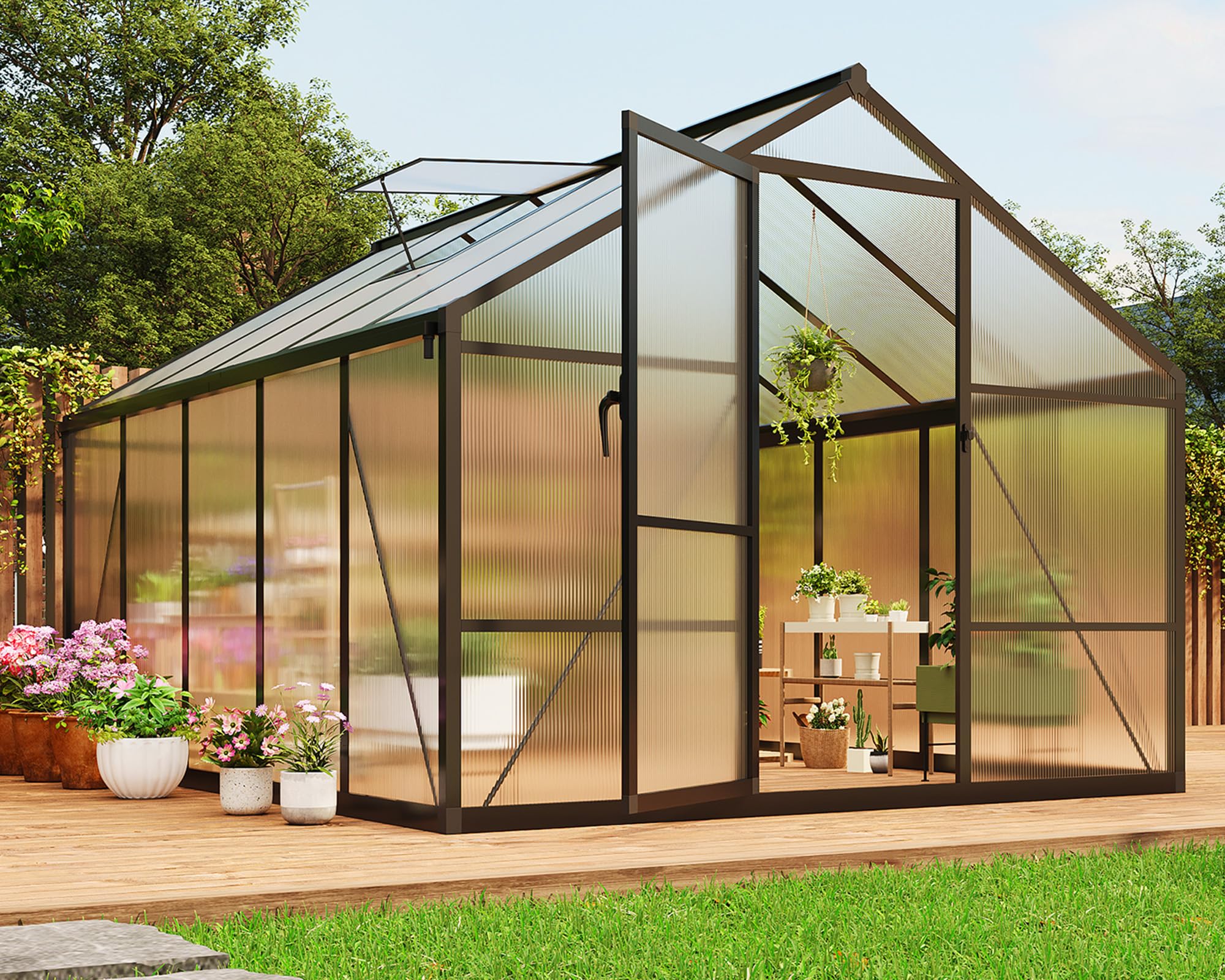
The lightest full-size kit here by a wide margin, for buyers who assemble alone.
At 107.6 pounds, this is roughly a fifth of the Backyard Discovery’s 571 pounds. That gap is the practical difference between a kit one person can move and one that needs a crew. A lighter package makes delivery, positioning, and re-anchoring far easier — especially if your garden is at the back of the property behind a gate.
Underneath the light weight, the build is honest for the tier. Panels are 720g/m² polycarbonate, and the frame is aluminum steel, which the maker says delivers stability in heavy rain and gale conditions. The maker claims the slide-in panels build 40% faster and 35% more secure than conventional methods — unverified, but slide-in panels are why this kit goes up quickly. A water gutter system runs along the sides for drainage, and one adjustable top vent handles airflow.
Quality is the thing owners keep returning to, and the greenhouse is reported to be genuinely sturdy once it is anchored. Assembly, though, splits opinion cleanly — some builds go smoothly and others take all day. That’s a pattern, not a defect in your particular box, so read the manual twice before you start. The part ships in two separate boxes, so check you have both before you schedule the build.
Why it’s a sensible middle pick
- 107.6 pounds total makes it the most manageable full-size kit to move and position
- 720g/m² polycarbonate panels with an aluminum steel frame
- Side gutter system handles drainage
- One adjustable top vent and a lockable door
Where it runs short
- Assembly time varies widely in owner reports
- Only one vent, so airflow control is coarser than the 2- and 4-vent options
- Arrives in two separate boxes that may not land on the same day
Its natural buyer: a solo gardener who wants a full-size walk-in and can handle a variable build day.
One honest limitation: a single vent means you will lean on the door to move air on muggy afternoons.
5. YITAHOME 12x6FT Polycarbonate Greenhouse
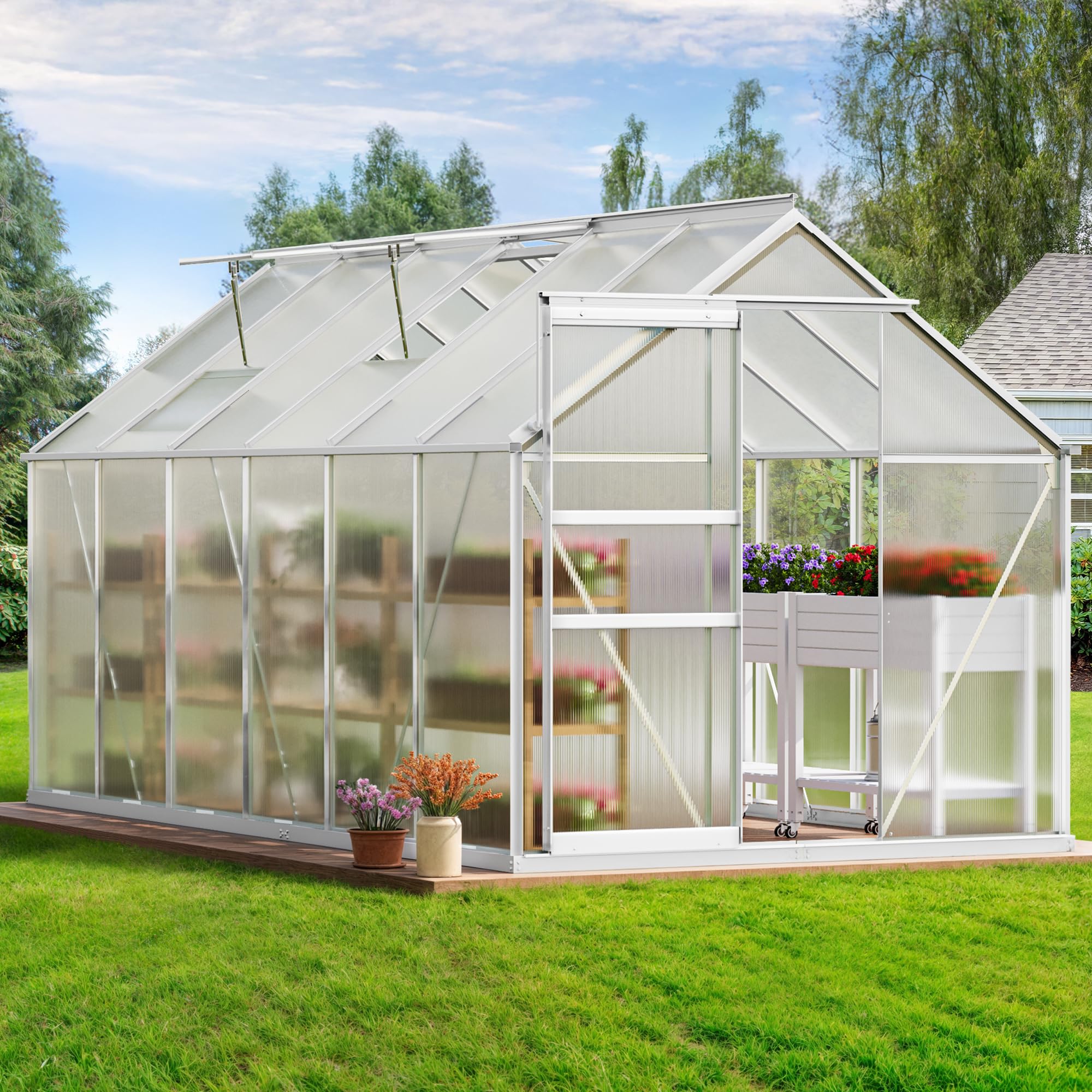
A sliding door that tucks away, in a greenhouse built for a long narrow run.
Sliding doors cost nothing to swing, because there is nothing to swing. On a 144-inch run like this one, a door that tracks sideways saves the arc of clear space you would otherwise lose in front of a hinged door. It also means you can walk in with arms full of pots. The 4mm double-wall polycarbonate boards are UV treated, and the maker states they block 99% of UV radiation while protecting your plants.
You get a sturdy frame: an aluminum alloy with reinforced rods on the sides and diagonal rod fixation for stability. Two adjustable skylights open to various angles for airflow, and the top-tilt roof line is designed to shed wind and drain water. YITAHOME recommends setting the bottom frame in a pre-dug trench with the included expansion screws, and applying glass glue where the polycarbonate meets the frame for tighter water protection — that’s extra work, but it’s the difference between a sealed build and a leaky one.
Owner experience leans positive on the build itself: easy to assemble and works well once up, with one report of saving plants through a winter. Durability is the open question, since opinions land on both sides of sturdy-for-the-long-haul. The kit also ships in two packages that can arrive at different times, so wait for both before starting. A door lock is an add-on, not included.
The layout advantage: 144 inches of length in a narrow footprint, with a sliding door and two adjustable skylights. If your garden strip is long and thin, this shape wins.
The trade: a build that rewards trenching and glass glue means more prep time up front, and the parts may arrive in two deliveries.
Best match: a narrow side-yard plot where a hinged door would block the path.
Go elsewhere if: durability at full wind exposure is your top concern — the wood-framed picks are heavier and stiffer.
6. Esimote 10×12 FT Greenhouse
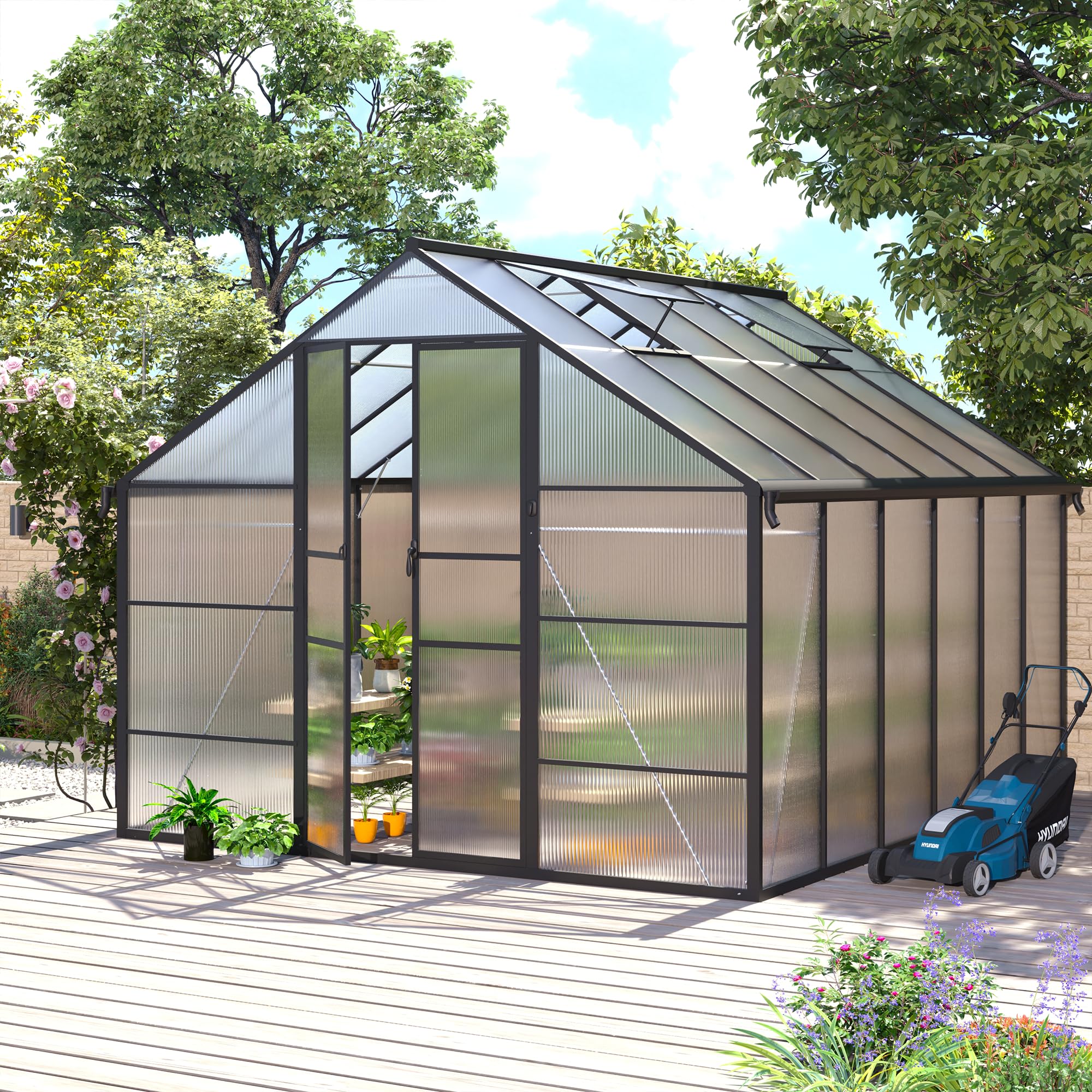
A 10’x12′ footprint with a 78.3-inch doorway, which is the tallest door on this list.
Doorway height is an overlooked decision spec. This kit clears 78.3 inches, so you walk in upright with a wheelbarrow rather than ducking. The overall envelope is 120.1 inches wide by 142.7 inches deep, and the frame rises to 98 inches at its highest point — the kind of headroom that lets indeterminate tomatoes climb.
The single roof vent is adjustable through 5 levels, so you tune airflow precisely rather than choosing between open and shut. A lockable sliding door with a metal handle gives you a secure seal. The drainage channels built into the base redirect rainwater and can be piped out for irrigation, which is a nice extra on a structure this size. The aluminum frame has reinforced side walls and base, and the manual tells you to anchor into soil or concrete to make the wind resistance real.
Buyers are consistently struck by how much room the 10’x12′ delivers, and the value per square foot reads strongly. Assembly is the honest sticking point — some sessions go smoothly while others stretch out. Durability also varies across the reports. Treat the build as a full day with two people and you’ll be inside the happy group.
The draw: 10 feet by 12 feet with a 78.3-inch door and a 5-level vent, anchored on a reinforced aluminum base. If you want usable volume over cosmetics, this delivers.
Be ready for: a day of assembly and the anchoring work — without a solid footing, an aluminum frame this large will move in a gale.
Good fit for: growers who want maximum floor space and a tall door so tools and carts roll in and out.
Check first: that you have the concrete or soil footing the manual requires for wind resistance.
7. Palram – Canopia Oasis Hex Greenhouse
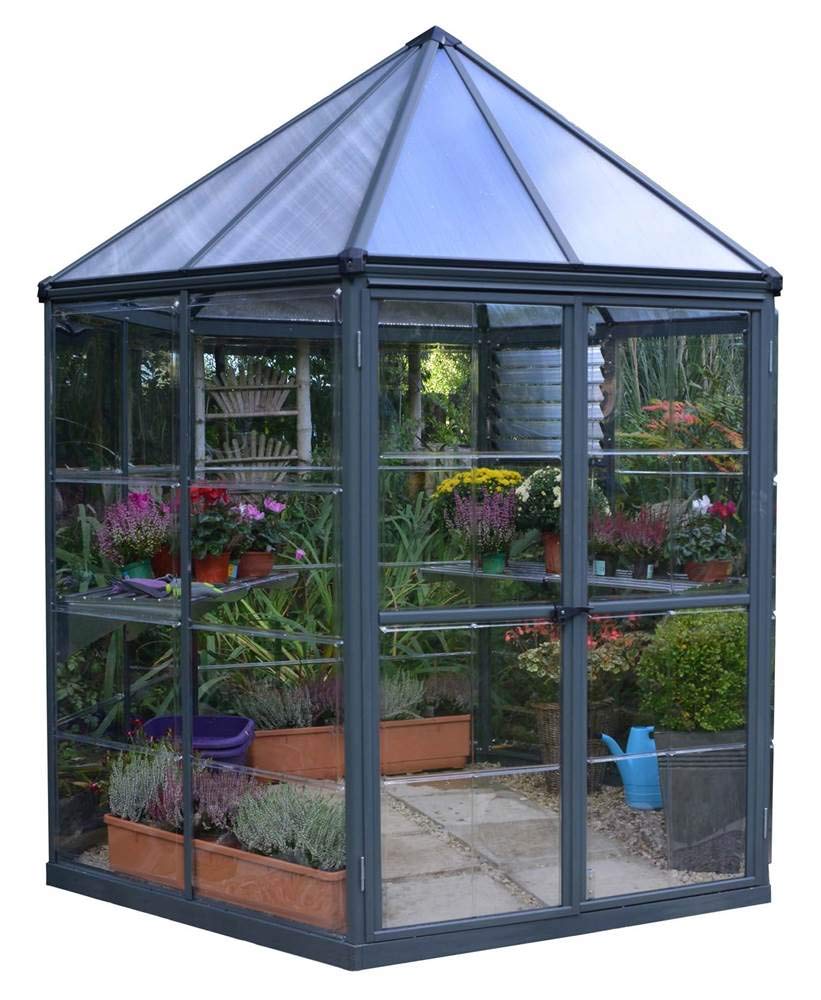
A hexagonal footprint that transmits more than 90% of the light that hits it.
Light transmission is the spec that drives plant growth in every season, and Palram states its panels clear more than 90% transmission with 100% UV protection. The panels are polycarbonate — the maker calls them virtually unbreakable — and they are 100% UV protected against discoloration and shattering. Paired with the hexagonal shape, that means light enters from more angles than a boxy kit allows.
The frame is powder-coated galvanized steel and aluminum, and Palram says it withstands winds up to 55 mph and heavy snow loads when properly assembled. That’s a firm number to plan your site around. The adjustable side louvre window gives you airflow and humidity control, and the built-in gutter handles drainage. Installation runs on a sliding panel assembly with all hardware included, so the fit itself is designed to be beginner-manageable.
What people praise most is the way the structure performs as a living space — it reads as a feature in the garden as much as a growing environment. Some builds arrive with missing parts, so do a full inventory before you start. The mixed notes center on panel rigidity, which is the trade-off of a hexagon that relies on frame geometry more than thick walls.
Where the value sits: 90%+ light transmission, 100% UV protection, and a 55 mph wind rating in a shape that looks like it belongs in the garden. The aesthetic is a real part of why buyers choose it.
The catch: inventory your parts before building — a missing fitting mid-build is the fastest way to lose a weekend.
Choose it if: luminosity and looks rank high, and your plot sits in a calmer corner without punishing wind.
Look at the HOWE instead if: you need a published snow load in psf and a bigger footprint for the same money.
8. Modern Shade 6.5’x12′ Wooden Greenhouse
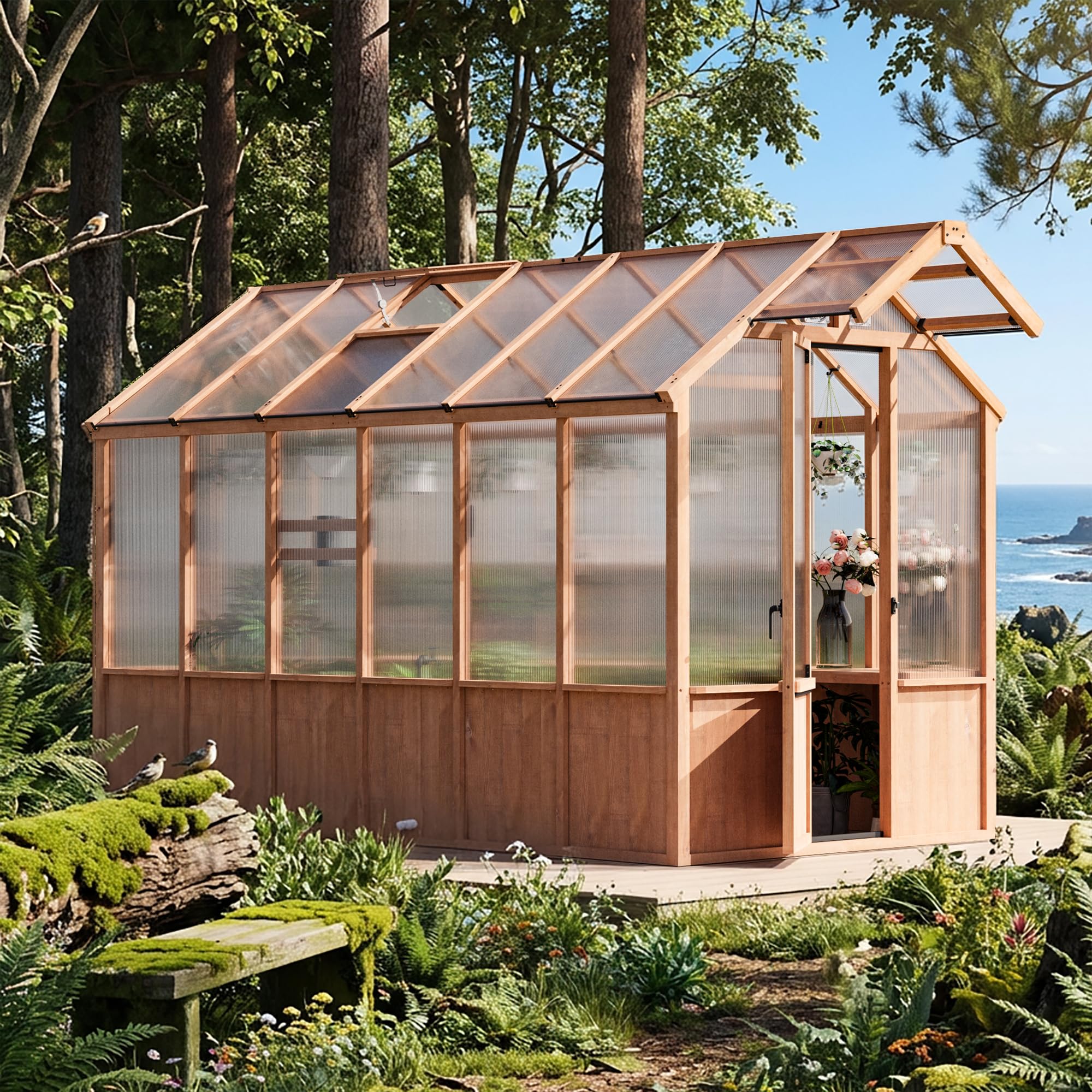
An 8-foot peak that the maker says stands a foot taller than 95% of competitors’ peaks.
An 8-foot peak height means you stand, stretch, and reach the roof vents without a step stool. The comfort that buys you on a warm day is real. The frame is FSC-certified cedar, which resists decay and adds weight — 427 pounds on the Yardenaler, and this one is built on the same cedar principle. There is also an architectural overhang roofline that the maker says reduces splashback, keeps panels cleaner, and shelters the doorway.
The practical extras put this in a different category from a plain kit. A fully integrated faucet kit with internal piping and a 1/2-inch brass faucet brings water inside, with a US-standard hose interface. A power strip adds USB and USB-C charging ports plus 2 standard outlets. Four fans in a front-to-back symmetrical arrangement circulate air through the full length of the build. The roof uses 6mm polycarbonate panels for thermal retention, and a window pull rod located under the vents lets you close the roof windows from a comfortable standing position.
Owners describe the structure as sturdy with good value for the size. The cedar scent is a real detail buyers mention positively — it reads like a workshop, not a shed. Shelving and workspaces are built in, which turns the 6.5’x12′ footprint into a working garden room rather than just an enclosure.
Why this one is worth the step up
- 8-foot peak for stand-up comfort, which the maker says is a foot above 95% of competitors
- FSC-certified cedar frame with an architectural overhang roofline
- Integrated faucet kit with 1/2″ brass faucet and US-standard hose interface
- USB, USB-C, and 2 standard outlets on the power strip
- Four fans in a front-to-back symmetrical arrangement
- 6mm polycarbonate roof panels with a window pull rod for easy vent control
Think about this before ordering
- Wood framing is heavier and wants a solid, level ground prep
- More built-in systems means more plumbing and wiring to install
- The long, narrow shape may not match a wide open site
Best for: buyers who want a stand-up garden workshop with water and power already planned for, in a cedar frame.
Consider size instead if: you need maximum growing footprint rather than maximum systems per square foot.
9. HOWE 8x16x7.5 FT Polycarbonate Greenhouse
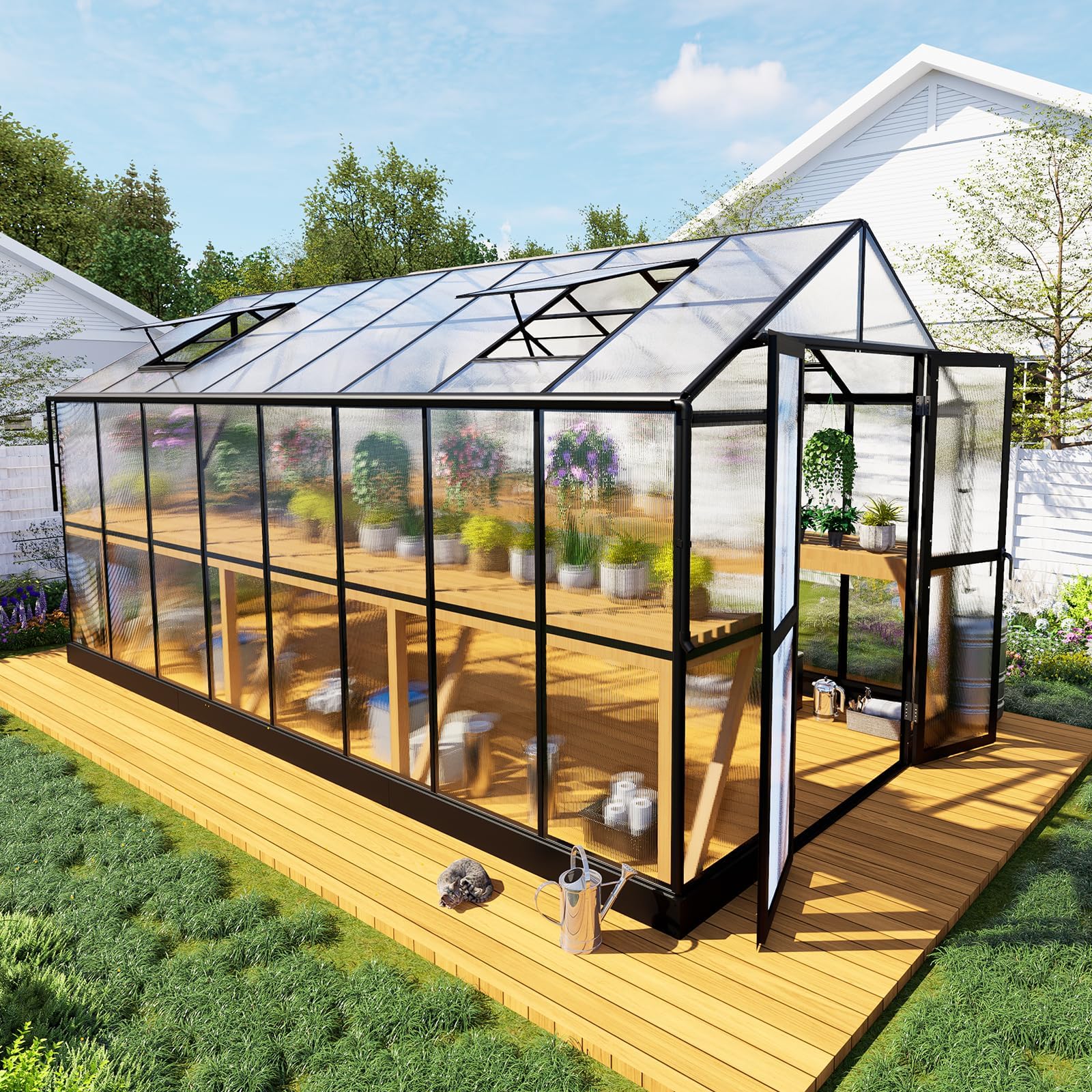
Four adjustable vents on an eight-by-sixteen frame built to survive winter storms.
Vent count is where greenhouse airflow gets decided, and this is one of only two picks with four. Four-level adjustable roof vents, opened together with the two swing doors, let you flush out damp air across the full 16-foot length. That matters most in winter, when you cannot simply prop a door in bright sun without dropping the internal temperature.
The structural numbers back it up. HOWE states a wind rating of 60 mph and a snow load capacity of 20 psf, anchored by 4 corner posts and 2 middle posts you bury in soil or concrete. The frame is 1.5mm rust-resistant aluminum, and panels are 6mm twin-wall translucent polycarbonate with a stated 99.99% UV protection. That is a serious structural spec for a hobby greenhouse. The 4-corner drainage holes with attached pipes let you collect rainwater straight into a barrel or manifold.
Fit is the element that will make or break your week. With pre-installed hardware and slide-in panels, you can conceivably finish a 15-hour build in two long days with three people. The maker recommends keeping screws in a box so nothing gets lost mid-build. Owners describe the finished structure as good quality and well-designed for the money, and the appearance stands out. Assembly can stretch, so book the time and expect it.
The structural headline: a stated 60 mph wind rating and a 20 psf snow load, with 4 vents and 2 swing doors on a 16-foot frame. That is the combination to buy for a windy, snowy site.
The honest limit: a 15-hour build across three people is a real commitment — plan the weekend and rope in the helpers.
Pick it when: your site sees real wind and snow, and you want published ratings along with four vents for humidity control.
Keep looking if: you cannot give up a working weekend to the build.
10. Yardenaler 8×16 FT Greenhouse
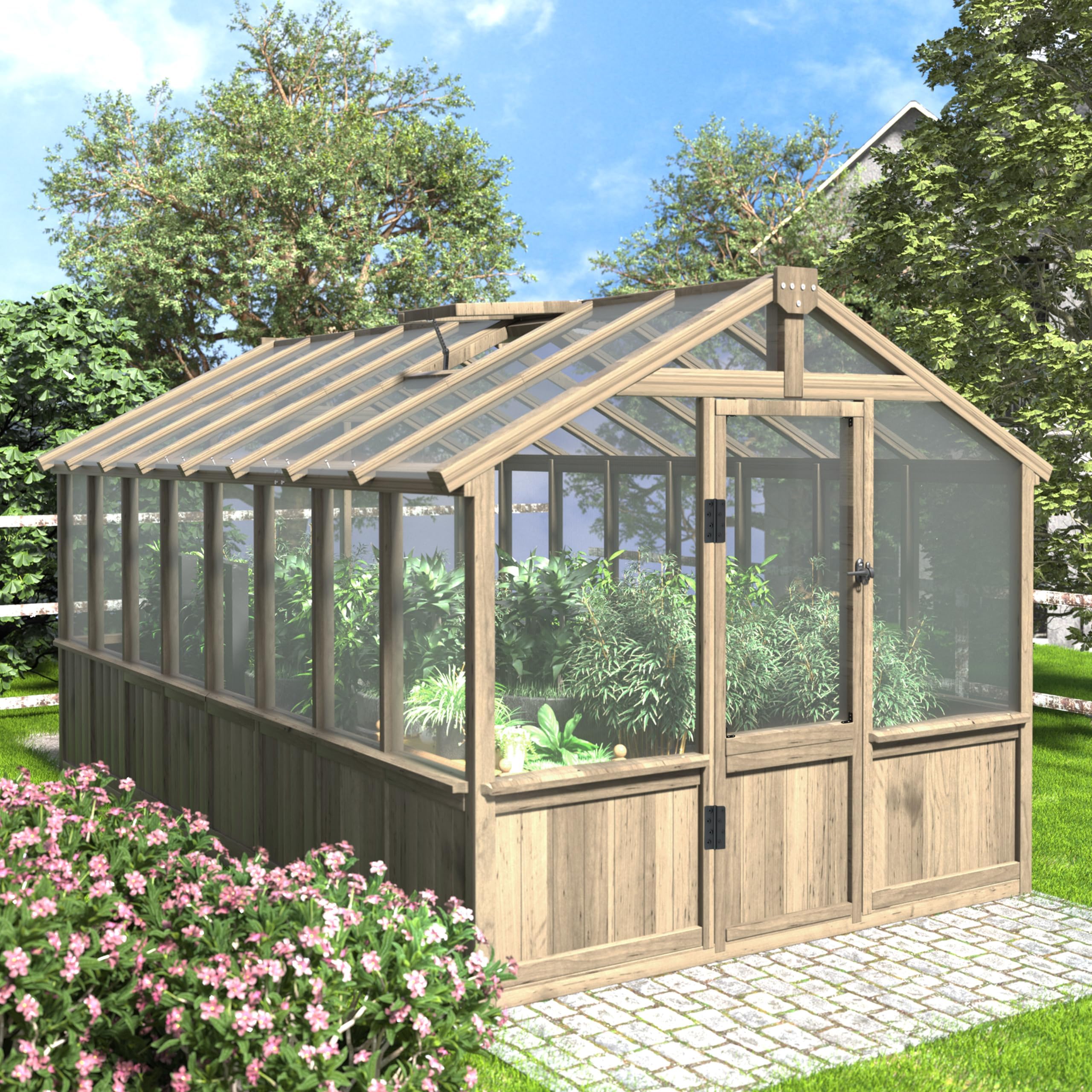
A 190.2-inch wood-frame run with a roof that opens to 45 degrees.
The adjustable roof is the defining feature here — hinged at the joint so you can dial the opening to any angle up to 45 degrees, and the maker states the maximum. That range gives you genuine control over temperature balancing and air circulation rather than a binary open-or-closed vent. Combined with multi-layer polycarbonate panels that offer high light transmission and UV protection, the balance between warmth and airflow is better than most fixed-roof kits.
The wooden frame gets a sturdy base support and reinforced construction for stability through weather. But wood adds weight — 427 pounds total — so plan the build with help and a level site. Door size is 29.1 inches by 71.4 inches, which is generous enough for tools and bins but not as tall as the Esimote’s 78.3-inch door. The maker also flags a check before ordering: confirm that greenhouse installation is allowed where you live.
The footprint is what buyers notice first. You get a very long growing space, and the size draws the most enthusiastic response. Value for the volume reads positively as well. The recurring friction is assembly and instructions — the layout is capable of producing a stubborn build day. If you plan for that and accept the anchoring and leveling work up front, the finished space is the reward.
What you are buying: a 190.2-inch wood-frame run with a roof that opens to 45 degrees and multi-layer polycarbonate panels. The length alone is a distinct advantage for row planting.
The cost of all that space: 427 pounds of frame and the strongest assembly and instructions friction on this list — plan and budget the time.
Great for: a serious grower with a long plot who wants a wood finish and an adjustable roof for airflow tuning.
Do not choose it if: assembly support is scarce and you expect a straightforward build.
11. AMERLIFE 12 x 10 x 8-Ft Hybrid Polycarbonate Greenhouse

435 cubic feet of growing room that three people can raise in about six hours.
Assembly time is the most valuable number on this kit. The maker states three DIYers can build it in about 6 hours with the quick-connect framing, which is also claimed to cut install time by roughly 50% and boost stability by about 35%. Even discounting the claim, a roofed structure built in one day is a real benefit compared with the multi-day wins below.
The panels are hybrid — a mix of clear and translucent polycarbonate for high impact resistance, UV protection, and strong light transmission. Two adjustable roof vents handle airflow, and integrated gutters channel and collect rainwater to help manage humidity. The reinforced aluminum frame with thickened supports is rated for winds up to 56 mph and snow loads up to 18 psf. There’s an unusual extra, too: spear-shaped bird spikes to keep birds from perching on the frame.
What people respond to first is how it looks and how it feels once lit up — appearance and quality are both high points in the owner record. Durability is the point to watch: some builds hold strong through weather, while others have lost a roof panel. The value split is similar, so the honest reading is that this is a beautifully finished fast-build kit whose long-term durability under extreme weather depends on getting the anchoring right from day one.
Where it wins: quick-connect framing, 435 cu. ft. of usable space, and a one-day team build. If build time matters, this is the top of the list.
What to safeguard: 18 psf of snow load is on the low side for heavy-snow areas — anchor well and keep the roof clear in deep drifts.
Right pick for: families or neighbors who can put three people on the build and want the biggest walk-in volume in one session.
Look past it if: you expect the heaviest snow loads — the 20 psf HOWE rates higher there.
12. Jocisland 10 x 13.2-Ft Wooden Greenhouse
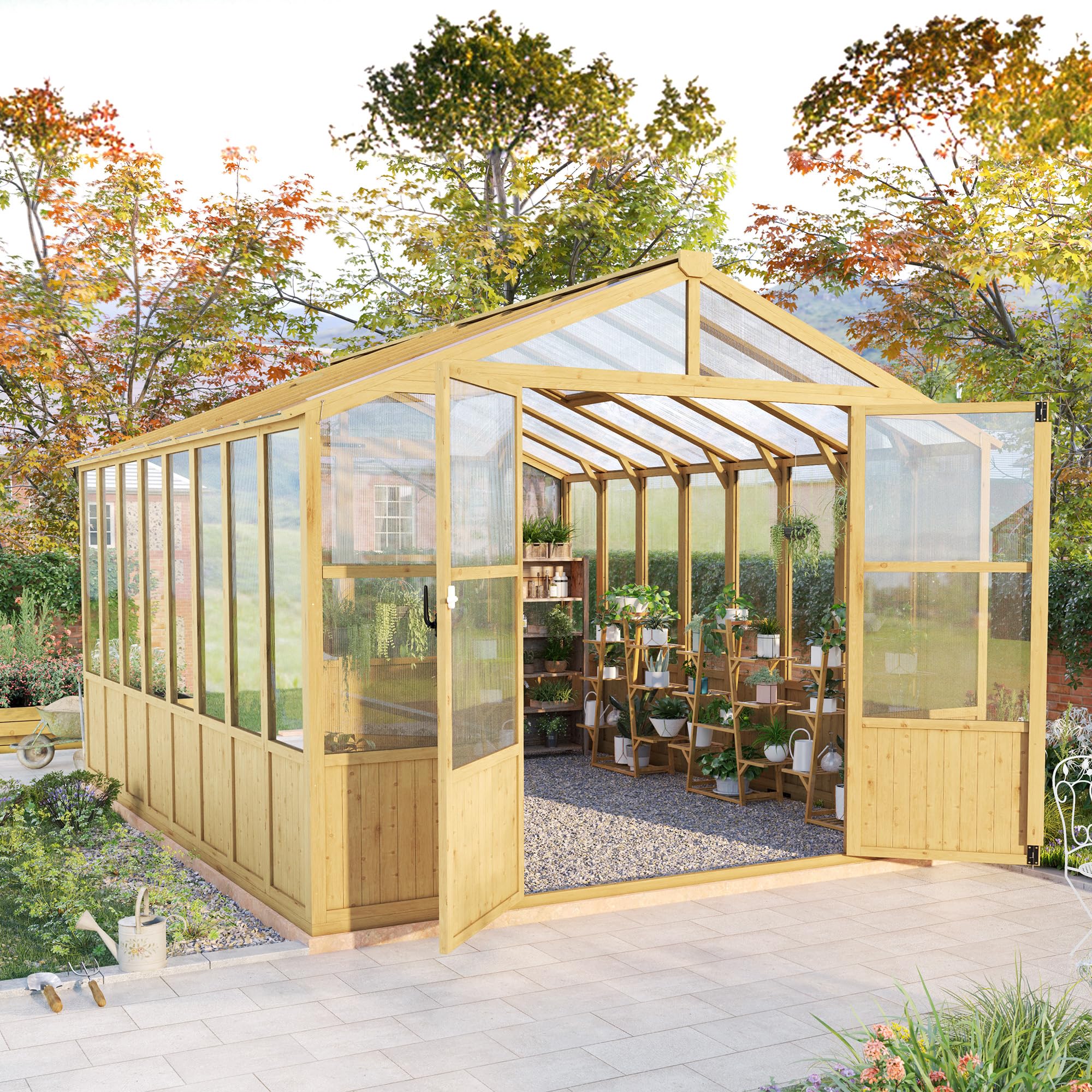
Walls, doors, and windows arrive pre-assembled — you just connect the panels.
Most greenhouse kits ask you to build the walls from scratch. This one ships with the walls, doors, and windows already assembled, so the job becomes connecting pre-built panels with the included hardware rather than sorting through hundreds of loose fittings. That design choice earns this the easiest start on the list, and owners respond to it strongly: assembly is the number-one thing people praise.
Cedar framing handles the structural side, with metal hardware and strong wind resistance for stability across seasons. The measurements are generous in every direction — a 5.45ft (166cm) wall height and a 7.68ft (234cm) peak give you real stand-up room. Two adjustable windows and two doors give you fine temperature and humidity control, and the two-door setup means you can vent crosswise on a hot day.
Sunboard panels handle insulation and UV protection, keeping the interior temperature stable and your plants safe from harsh rays without shutting out light. The quality reads as a step up — one customer compared it favorably to aluminum options — and the appearance is a selling point in its own right. With two doors and 13.2 feet of run, this is a greenhouse you will want to spend time in.
The reason to pick it:Pre-assembled panels and cedar framing make this the fastest first build on the list. Two doors and two windows give you cross-ventilation, and the 7.68ft peak keeps you upright while you work.
The honest catch: a wooden frame at this footprint means a level, solid pad is essential — cedar is heavy, so plan the ground prep as carefully as the build.
Best match: first-time greenhouse owners who want a wood-framed walk-in without a week of loose-fitting assembly.
Weigh this first: the site needs a proper level base before delivery, since cedar frames settle unevenly on soft ground.
Know the Specs
Panel wall count and thickness (twin-wall vs 4-wall vs 6mm)
Twin-wall means two polycarbonate sheets with a trapped air gap; four-wall adds more internal chambers of still air. That still air is the insulation — more chambers means slower heat loss overnight. Thickness works the same way: a 6mm panel holds more insulating air than a 4mm panel. On this list, the Backyard Discovery Willow uses 4-wall panels on its roof and windows, while most aluminum kits run 4mm twin-wall and the cedar Modern Shade runs 6mm roof panels.
Snow load in psf and wind rating in mph
A snow load stated in psf (pounds per square foot) tells you how much weight the roof is engineered to hold before it deforms. A wind rating in mph tells you the maximum sustained wind the frame is designed for — provided the base is anchored as instructed. A frame with no published rating should be treated as untested. Anchoring into soil or concrete, as several kits require, is what turns the rating into real protection.
Vent count, vent type, and door configuration
Adjustable roof vents are your humidity valve. Two vents handle cross-ventilation better than one, and four let you clear damp air across a long footprint. Vent type matters too: a pulley-operated vent that can be mounted in any panel gives more placement freedom than a fixed four-position hatch. Doors count as ventilation too — a sliding door saves swing space while two swing doors let you open the greenhouse wide.
Frame material: aluminum, cedar, or galvanized steel
Aluminum resists rust and stays light, which makes assembly manageable but means wind resistance depends on anchoring. Cedar and other wood frames are heavier and resist decay naturally, which helps in wind but raises the shipping weight and the build effort. Galvanized steel, used on the Palram frame, adds stiffness at the joints. Match the material to your site’s wind and snow rather than to how it looks in a photo.
Common Questions
Will a twin-wall polycarbonate greenhouse stay above freezing in winter?
Do I need to anchor my greenhouse into concrete or can I just set it on soil?
How many roof vents do I really need on an 8×16 greenhouse?
Is a cedar wood frame better than an aluminum frame for a year round greenhouse?
Will a polycarbonate greenhouse damage my plants by blocking too much light?
Does a snow load rating in psf include the weight of the greenhouse itself?
Can I run power and water inside a year round greenhouse?
Can a wooden greenhouse kit stay up through a windy winter?
Do I need to assemble a greenhouse alone, or should I hire help?
Can I replace or add a vent to a greenhouse after I’ve built it?
The Bottom Line
For most buyers, the year round greenhouse winner is the Backyard Discovery Willow 9′ x 6′ because its commercial-grade 4-wall polycarbonate roof and windows claim 30% better heat retention than standard double-wall, and it is rated to carry 2,800 pounds of snow on a cedar frame that will outlast most aluminum kits. The crowd numbers back that up: 4.5+ stars across 100+ ratings.
If you have a long, narrow plot and want a sealed twin-wall walk-in without premium money, the VEIKOU 6’x12′ does the job — its 142.2-inch run and pulley-mounted vent give you real airflow control at the entry level. And for a site that sees serious wind and snow, the HOWE 8×16 is the one to reach for — a stated 60 mph wind rating, 20 psf snow load, and four adjustable vents on a 16-foot frame that genuinely handles humidity.
How we choose
We do not accept paid placement. Every pick is matched to a real buyer and a real use-case; we do not hands-on test units.
Sources
Specifications: manufacturer listings and product documentation. Review insights: verified customer reviews, as of November 2026. Pricing: not shown on this page (it changes often); check the current price via the retailer link.
As an Amazon Associate, Tactical Gear Guy earns from qualifying purchases. This does not affect which products we feature.