Specs are compiled from manufacturer listings and verified buyer reviews and can change over time — please confirm the key details on the product page before buying.
This guide covers the sharpeners that actually restore a working edge, from a powered belt machine to a pocket-sized file you can carry in the garden shed.
This guide is built by comparing the manufacturers’ published specifications and the patterns across verified customer reviews, so you get each pick’s real strengths and trade-offs instead of marketing spin.
You will see which sharpeners handle mower blades and which are built for pruners and shears, plus the grit and angle details that decide how fast the edge comes back. The quick comparison below covers the best Yard Tool Sharpener options for both jobs.
Top Picks

How To Choose The Best Yard Tool Sharpener
The first decision is what you are actually sharpening. A mower blade needs a broad, low-angle grind and enough tool body to hold steady on a heavy piece of steel. Pruners, loppers and hedge shears need a narrow abrasive you can run along a curved edge. A tool built for one job often struggles on the other, so start there.
Grit rating tells you how much metal comes off
A coarse grit removes metal quickly, which is what you want on a blade that has not been sharpened in years. A fine grit polishes and hones an edge that already has its shape. Dual-grit tools give you both ends of that in one body, which is why so many sharpeners here list two numbers, such as a coarse 325 grit beside an extra fine 1200 grit.
Preset angles versus adjustable angle jigs
A sharpener with a preset angle slot removes the guesswork — you lay the blade in the slot and pull. An adjustable jig goes further, letting you dial the angle between 15° and 45° to match the blade in front of you, which matters most on mower blades that carry a specific factory angle.
Powered or hand-held
Electric sharpeners do the work with a motor and abrasive belts, so a dull axe or mower blade comes back fast. Hand-held files and carbide stones are slower per stroke but need no power, pack easily and cost far less. Pick powered if you sharpen often and have a pile of tools waiting; pick hand-held if you maintain a few pruners a season.
Grip, guard and safety
Sharpening puts your hand close to a bare edge. An oversized handle that fits a gloved hand, plus a hand guard between your knuckles and the blade, are genuine safety features rather than marketing extras. Look for those before you look at anything else.
Side-by-Side Comparison
| Model | Best For | Type | Grit | Weight | Amazon |
|---|---|---|---|---|---|
| Work Sharp MK2 Electric Knife Sharpener★ Best Overall | Fast restoration of dull axes and mower blades | Electric belt | Medium | — | Amazon |
| SHARPAL 103N All-in-1Most Versatile | One tool for shears, pruners and mower blades | Carbide and ceramic | Medium | 176 g | Amazon |
| Muldale Dual Grit Titanium FileBest for Curved Edges | Curved pruner and lopper edges | Hand file with strop | Coarse | 8 ounces | Amazon |
| SHARPAL 127N Diamond File | Pocket carry and dry sharpening | Diamond file | Coarse | 160 g | Amazon |
| SHARPAL Pocket Knife & Garden Tool Combo | Field kit and gifting | Carbide, ceramic, diamond | Coarse, Fine | 1.5 pounds | Amazon |
| FELCO Model 905 | Keeping pruner blades in trim | Carbide stone | Coarse, Fine | — | Amazon |
| Stihl 3-in-1 Sharpening Tool | Garden shed and field touch-ups | Hand-held, 3-in-1 | Fine, Medium | 2.82 ounces | Amazon |
| SporGain Mower Blade Sharpener & Balancer | Sharpening and balancing mower blades | Adjustable jig kit | — | 4.86 pounds | Amazon |
| All American Sharpener Model 5005 Gen 2 | Precise repeatable mower blade edges | Adjustable jig | Coarse | 16 ounces | Amazon |
Detailed Reviews
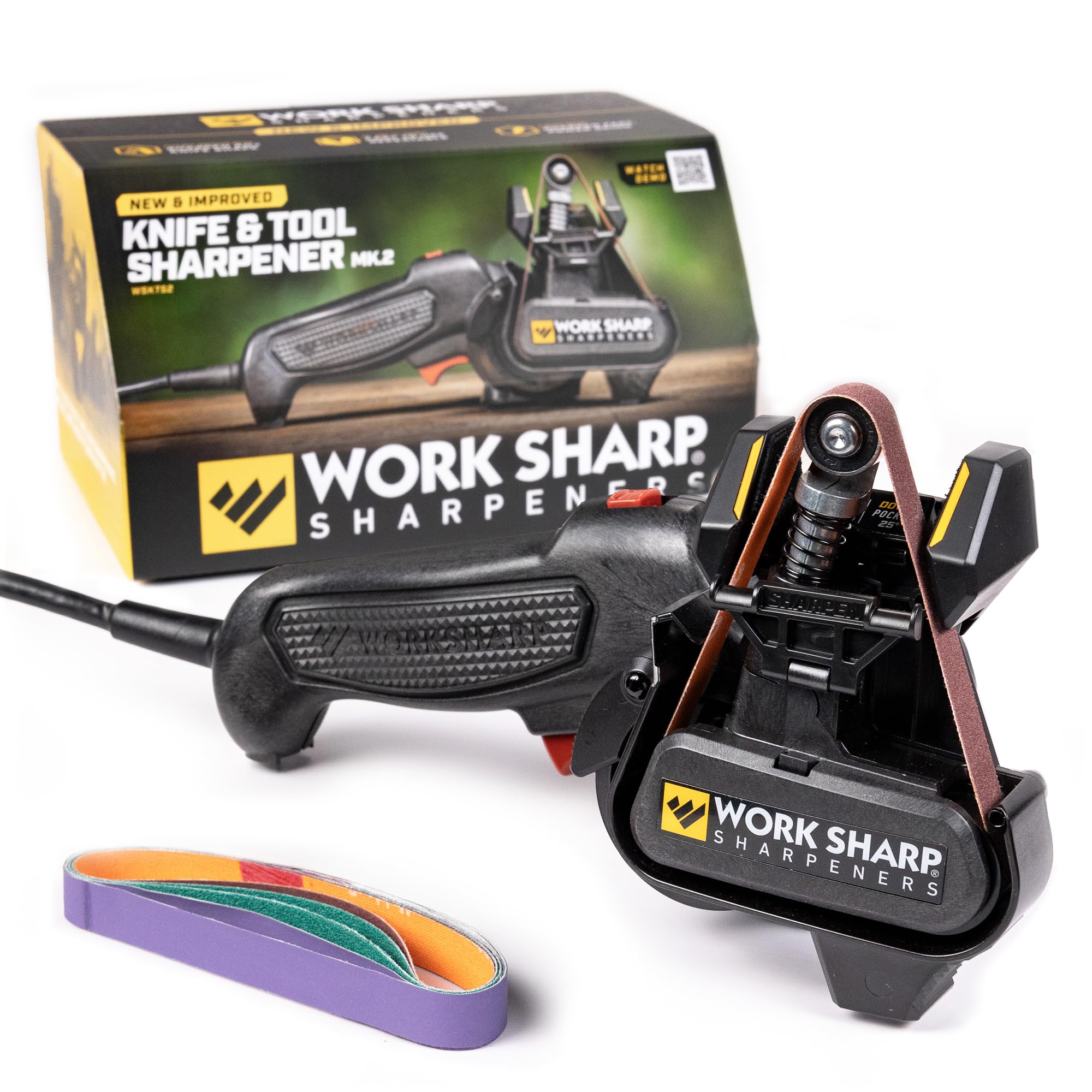
1. Work Sharp MK2 Electric Knife Sharpener
Our pick — 4.5+★ from 8,000+ verified ratings; the strongest balance of quality and price.
A two-speed motor drives flexible abrasive belts, so a rusted axe edge comes back to a working blade in minutes.
Here is the reason this one lands at the top: it sharpens with sanding belts rather than a fixed stone, so the abrasive conforms to whatever curve the blade has. That flexibility is what lets one machine touch kitchen knives, serrated knives, scissors, axes and lawn mower blades. The two-speed motor is the second half of the story — the slower setting gives you control on a delicate kitchen edge, and the higher setting drives through heavier work like an axe or a mower blade.
The most-praised part of this machine is simple raw performance, and the pattern across owner feedback backs it up: knives come back razor-sharp in minutes instead of after long sessions over a stone. Ease of use runs a close second, and the edge guide that supports the blade all the way to the tip is why. You set the blade in the guide and draw it through; the machine holds the angle for you, which is exactly what a first-time sharpener needs.
The catch is consumables. The belts are the wear part, and durability of those belts gets mixed feedback — they are abrasive material doing hard work, so expect to replace them over time. Budget for spare belts as a running cost. And at 7.02 inches long and built mostly of plastic, this is a bench machine, not something you toss in a tool bag for the far end of the property. The 3-year warranty covers the unit itself.
Where it pulls ahead
- Two-speed motor gives control on kitchen knives and power for axes and mower blades
- Flexible belts wrap the blade edge instead of grinding one flat spot
- Edge guide supports the blade to the tip, so the angle stays consistent
- Backed by a 3-year warranty and built in Work Sharp’s Oregon facility
What to plan around
- Abrasive belts wear and need replacing — budget for spares
- Bench-bound and plastic-bodied, so it stays in the shed
- Overkill if you only touch up a pair of pruners twice a year
Buy this one if: you own a mixed pile of dull edges — axes, mower blades, kitchen knives — and want one machine that handles all of them without you learning a freehand skill.
Think twice if: you sharpen a single pair of shears and want something you can slip into a pocket.
2. SHARPAL 103N Sharpener
Five sharpening surfaces and three angle slots in one hand-held bar, for a fraction of a powered unit.
The 8.46-inch body carries three preset angle slots, a tungsten carbide bar and a ceramic bar — that is your coarse edge-setting and your fine honing in one implement. Set a pruner blade in the matching slot and draw; you are not judging an angle by eye. It handles both single and double beveled blades, which is why the list of tools it covers runs from mower blades and loppers through to axes, machetes and hedge shears.
Where the 103N wins people over is sheer ease of use, with versatility right on its heels. Seconds rather than minutes gets an edge back, and the rubber over-molded handle and base keep it steady even with gloves on. The oversized handle and large hand guard matter here — your knuckles sit behind a guard rather than beside a bare cutting edge. SHARPAL rates the carbide and ceramic bars to a 10,000-times field-use standard, so the abrasive is not the weak point.
Two honest notes. The included instructions are thin, so budget five minutes to work out which slot suits which blade before you start dragging steel through it. And at 176 g it is a solid handful — noticeably heavier than the 160 g SHARPAL 127N file further down, which buys you the extra surfaces but costs you pocket comfort. The size itself draws mixed feelings; some find it larger than pictured.
The value read: one bar covering three angle slots, a carbide bar and a ceramic bar is a lot of capability for a hand tool — this is the pick that replaces a drawer of separate stones.
The honest snag: the instruction sheet is the weak link, not the abrasive. Read up on slot choice first and it sharpens as advertised.
Reach for this if: you want one compact hand tool that covers pruners, loppers, shears, axes and the mower blade without power or setup.
Look elsewhere if: you need guidance in the box — the instructions assume you already know the angles.
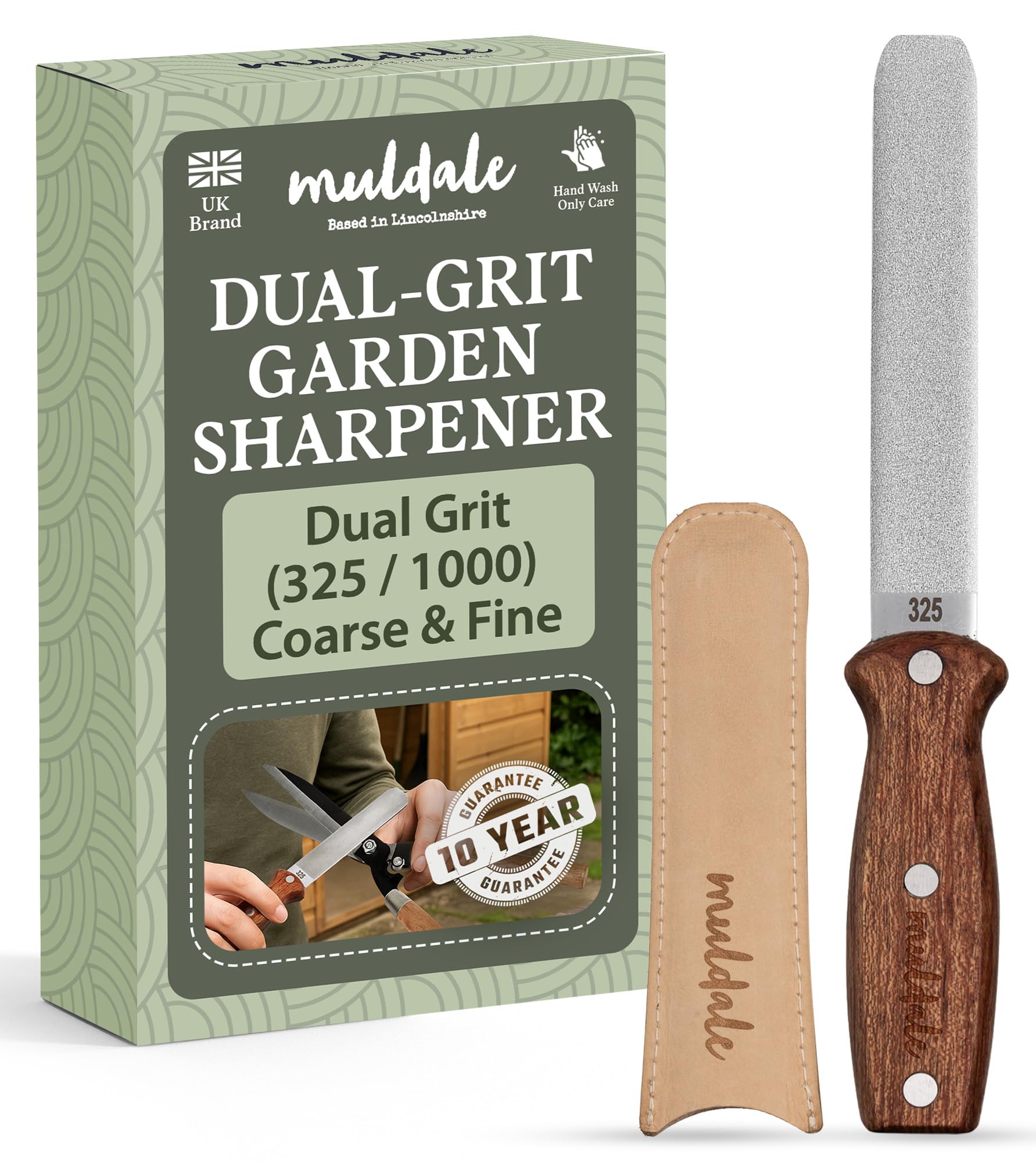
3. Garden Tool Sharpener Dual Grit
A curved five-inch blade that follows the sweep of a pruner edge instead of missing it.
Flat files have one problem on garden tools: a pruner blade is rarely straight. This one curves through the 5-inch blade, so the abrasive keeps contact on concave and convex edges where a flat file would skate past the contact point. Two grits do the work — a 325 grit coarse side for a blade that has gone properly dull, and a 1000 grit fine side to finish and hone the edge afterwards.
What you will not find on most sharpeners in this list is the leather strop in the box. Running the blade over it after sharpening polishes and aligns the edge, and that is the step that turns a sharpened edge into a clean cutting one. The full tang carbon steel blade runs through the entire rosewood handle, pinned with three brass rivets — a construction that speaks to a tool meant to sit in the shed for years rather than a season.
You pay for that finish with length. At 3.5 by 2 by 9.75 inches and 8 ounces, it is the longest package here — next to the SHARPAL 103N at 8.46 by 2.95 by 1.34 inches, most of that extra length goes into the handle and gift-box presentation.
what separates it: the strop (a leather strip that polishes the edge). Very few hand sharpeners include one, and it is the difference between a rough ground edge and a finished one.
The size question: the long handle gives excellent control, but it takes up drawer space a compact bar does not.
Best for: gardeners with curved pruners, loppers and shears who want a finished edge and a strop in the same box.
The one caveat: the longer body and gift packaging make it a shed tool, not a pocket carry.
4. SHARPAL 127N Dual-Grit Diamond Sharpening Stone File

Diamond grit on a full tang steel bar, small enough to live in a jacket pocket.
This file cuts fast because monocrystalline diamonds (lab-grown diamond crystals) are bonded along a full tang stainless steel bar (a solid metal bar that runs the full length of the handle). Two surfaces cover the two jobs: a 325 grit coarse side (45 micron — a larger abrasive particle) for setting an edge on a blade that has lost its shape, and a 1200 grit extra fine side (12 micron — a finer particle) for honing it back to a clean cut. No oil, no water — you sharpen dry and wipe it down.
The build quality is what earns the most praise here, and the cut quality follows it closely. At 160 g it is 16 g lighter than the 176 g SHARPAL 103N, which is the difference between a tool you leave in the shed and one you carry. The genuine cowhide leather sheath does double duty: it protects the diamond surface in transit, and the leather face works as a strop to polish the edge after you have finished filing.
Durability is the split opinion. Some owners describe it as built to last; others find the diamond surface does not hold up over the long term. Treat the coating with care — do not drop it on concrete, do not bear down hard — and it performs. On price, buyers generally see good value here.
Why it earns a slot
- 325 grit and 1200 grit on one bar, dry-sharpening with no oil or water
- Leather sheath doubles as a honing strop
- 160 g and slim enough to carry into the garden or on a hike
Fair warning
- Diamond durability is a split verdict — a delicate surface, not a beater tool
- Small surface area means a mower blade takes patience
Pick this for: a kit that travels — pruners in the field, a knife on a hike, a quick touch-up anywhere.
Pass if: you are starting on a badly chipped mower blade and want bulk material removed fast.
5. SHARPAL Pocket Knife Sharpener Combo

Two sharpeners, a fire starter, a whistle and a greeting card in one box.
This pack pairs the 6-in-1 Pocket Knife Sharpener and Survival Tool with the all-in-1 garden and mower blade sharpener — the same format that covers pruners, loppers, shears, axes and machetes. Between the two tools you get 8 sharpening parts across 5 preset angle slots and 3 kinds of abrasive: carbide, ceramic and a diamond rod. That is a wide spread of blade shapes from straight edge to serrated.
The survival tool doubles as a field accessory, carrying an all-weather fire starter and a super loud emergency whistle. The fire starter, whistle and greeting card in the box make the gift intent plain. Buyers who use it in the field report it holds up to knives of all sizes, and the compact size is what they mention most.
Note the weight. At 1.5 pounds for the pack, this is far heavier than a single hand sharpener and not the one to carry if lightness matters. It is a kit that lives in a pack or a shed drawer. SHARPAL rates the carbide, ceramic and diamond abrasives in this pack to the same 10,000-times field-use test.
The kit logic: two tools and three abrasive types mean only one box to buy for a household that sharpens knives, pruners and mower blades.
The weight caveat: 1.5 pounds is the cost of the extra tools, fire starter and whistle.
You’ll want this: as a gift for someone who works between the garden and the outdoors, or as one box that covers both jobs for yourself.
Not ideal if: you want minimum weight in your pocket — this pack is a drawer resident, not a keychain item.
6. FELCO Model 905 Sharpener-Carbide Stone
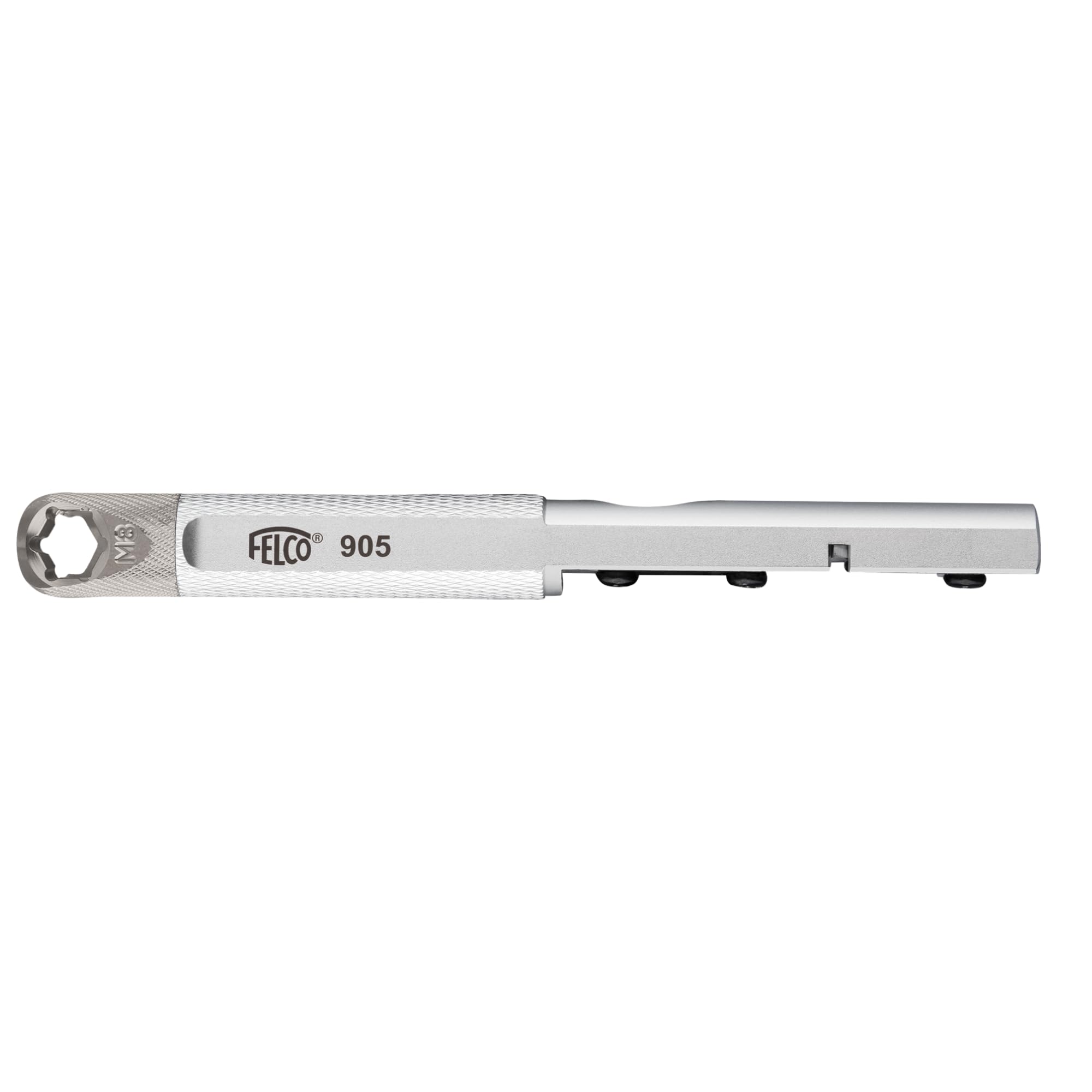
A pocket-sized carbide stone built for one job: keeping bypass pruners cutting clean.
FELCO makes pruning tools, and this sharpener is designed to maintain the blade on them — the maker’s own wording is that it keeps an ideal cutting edge and sharpens the blade optimally. The carbide stone carries coarse and fine grit so you can follow a dull edge with a finishing pass. At 2.95 by 0.31 by 1.55 inches it disappears into a pocket or a tool pouch and comes out when a pruner starts tearing bark instead of slicing it.
Quality is what buyers fixate on, and effectiveness comes right behind it. The consistent theme is that it does exactly what it says on a pruning shear without drama. That narrow focus is the point — it is not trying to grind an axe, and it does not pretend to.
The value question splits opinion: some find it well worth what it asks, others consider it expensive for what is essentially a small stone. That is an honest call to make for yourself. If you run FELCO pruners, the fit is the reason to buy it; if you run budget shears, a cheaper multi-surface bar will do the same work.
Why the narrow focus works: a carbide stone sized for pruner blades does not need setup, angle slots or power — it just rides the bevel you already have.
The value conversation: small, single-purpose and priced above basic bars. The fit with FELCO tools is what justifies it.
Right for: anyone who owns FELCO pruners or loppers and wants the matching maintenance stone in a pocket.
Reconsider if: you sharpen mower blades and axes too — this one is a pruner specialist.
7. Stihl 0000 881 9801 Schärfwerkzeug Sharpening Tool 3-in-1
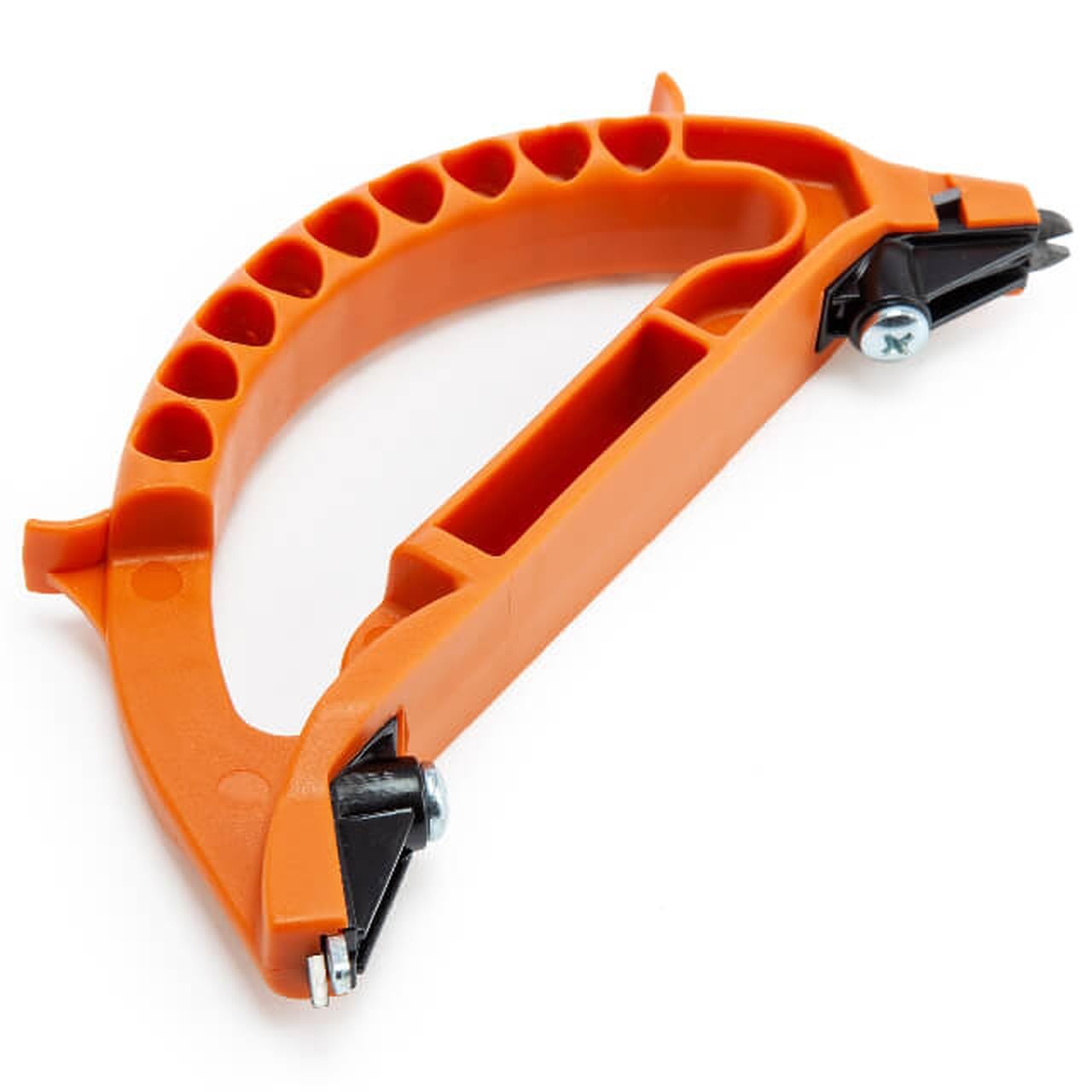
A 2.82-ounce three-in-one that earns its place by staying light in the hand.
Stihl builds chainsaws and forestry gear, and this tool carries that working-tool character. Fine and medium grit sit on one body with an ergonomic shape meant for extended use, and the maker lists pruners, secateurs, axes, hatchets, knives and household scissors as fair game. At 2.82 ounces it is lighter than every other hand sharpener here — the SHARPAL 103N weighs more than twice as much — so it will not tire your wrist during a sharpening session.
What owners describe is a tool that just performs: hand clippers and garden scissors come back to a working edge, and it handles a wide spread of tools without fuss. The quality reads as solid for a plastic-bodied sharpener, and there is no power or setup required.
The limitation is depth. This is a fine and medium touch-up tool, not a coarse grinder. A badly chipped axe or a mower blade that has gone years without attention will take a long time here. For a garden shed that already owns a mid-weight bar or a file, it slots in as the quick hand tool.
What works in its favour
- 2.82 ounces — the lightest hand sharpener on this list
- Fine and medium grit in a 3-in-1 body for touch-ups
- Ergonomic shape designed for extended hand use
- Handles pruners, secateurs, axes, hatchets, knives and scissors
Where it runs out
- No coarse grit, so heavy restoration is slow work
- Among the smaller-capability tools here, suited to upkeep rather than repair
Go for it if: you want a lightweight, no-fuss touch-up tool that lives in the shed and handles everything from clippers to scissors.
Leave it if: your blades have gone properly dull and need a coarse grit to bring back the geometry.
8. Lawn Mower Blade Sharpener & Balancer
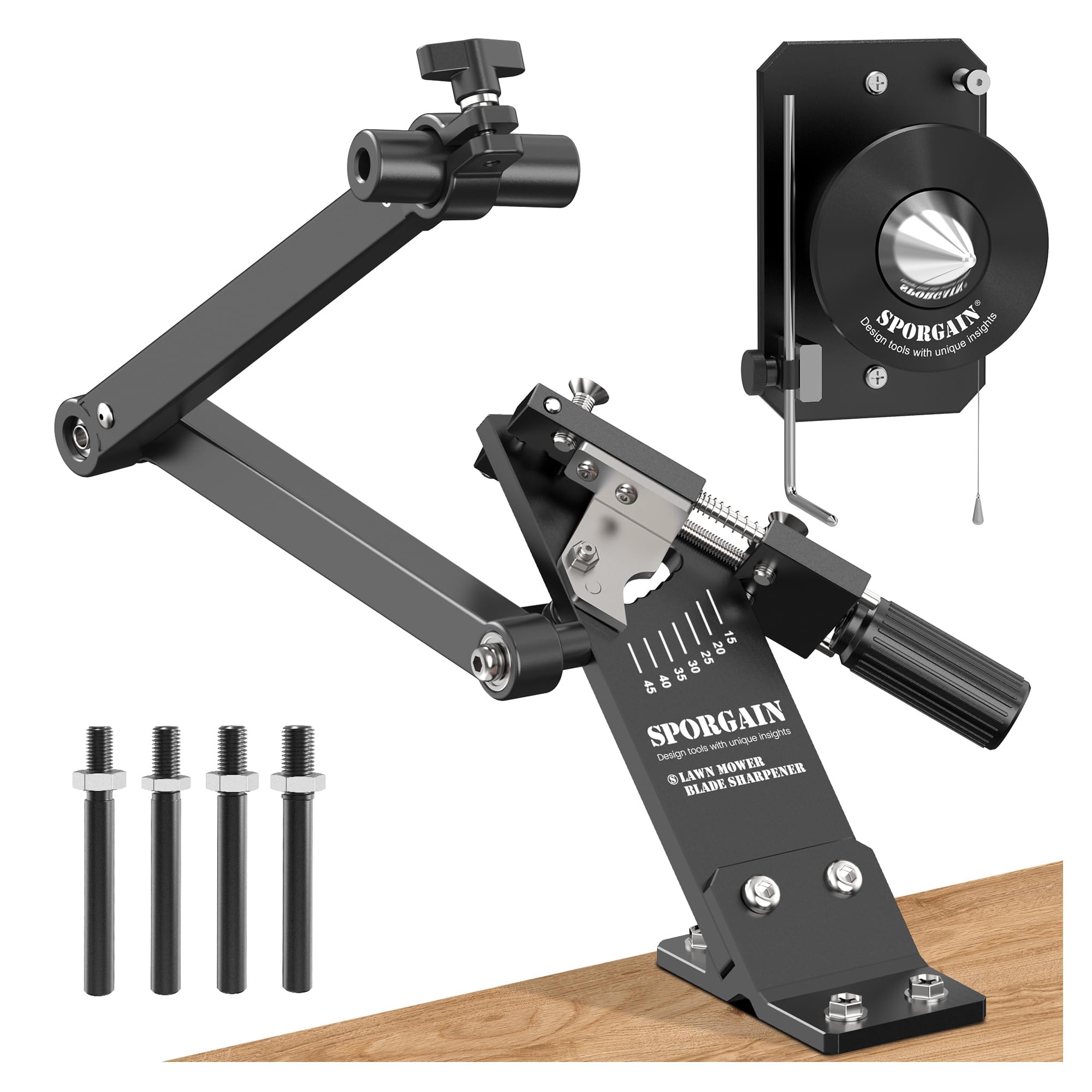
Two jobs in one box: hold the mower blade at your angle, then check it still balances.
Sharpening a mower blade is only half the maintenance — a blade ground unevenly will vibrate the whole deck. This kit pairs an adjustable sharpening jig with a magnetic balancer, so you grind to the angle the blade actually carries and then confirm it hangs true. The jig holds the blade with ball bearings and a 25 mm enlarged handle, and the angle dials between 15° and 45° for a stepless adjustment you set without specialist knowledge.
At 4.86 pounds the kit is the heaviest item here, and that weight is thick metal doing a holding job. The workflow is what owners single out — functionality first, build second, then the sharpening result. The blade stays put under a steady handle, and the balancer shows you whether your work was even. Both the jig and the balancer are compatible with a wide range of blades and need no extra tools to operate.
Two areas where customer experience is genuinely mixed. The balance feature itself divides opinion — some find it impressive, others consider it of limited use. Adjustability also gets a spread of feedback, and sturdiness attracts complaint. Taken against a large happy majority, this reads as a kit that works well for most mower owners but has weak points worth knowing about.
What earns the slot: the paired jig and balancer turn a fiddly two-step job — grind then check — into one sitting with proper workholding.
The soft spots: balance and adjustability draw mixed feedback, and sturdiness is the recurring complaint. Expect a solid mid-level jig, not a workshop-grade fixture.
Fits best for: mowing a season’s worth of lawn on your own blades and wanting the balancing step covered in the same box.
Look past it if: you only sharpen one blade a year, or you want a machined fixture with no mixed feedback.
9. Authentic All American Sharpener Model 5005 Gen 2
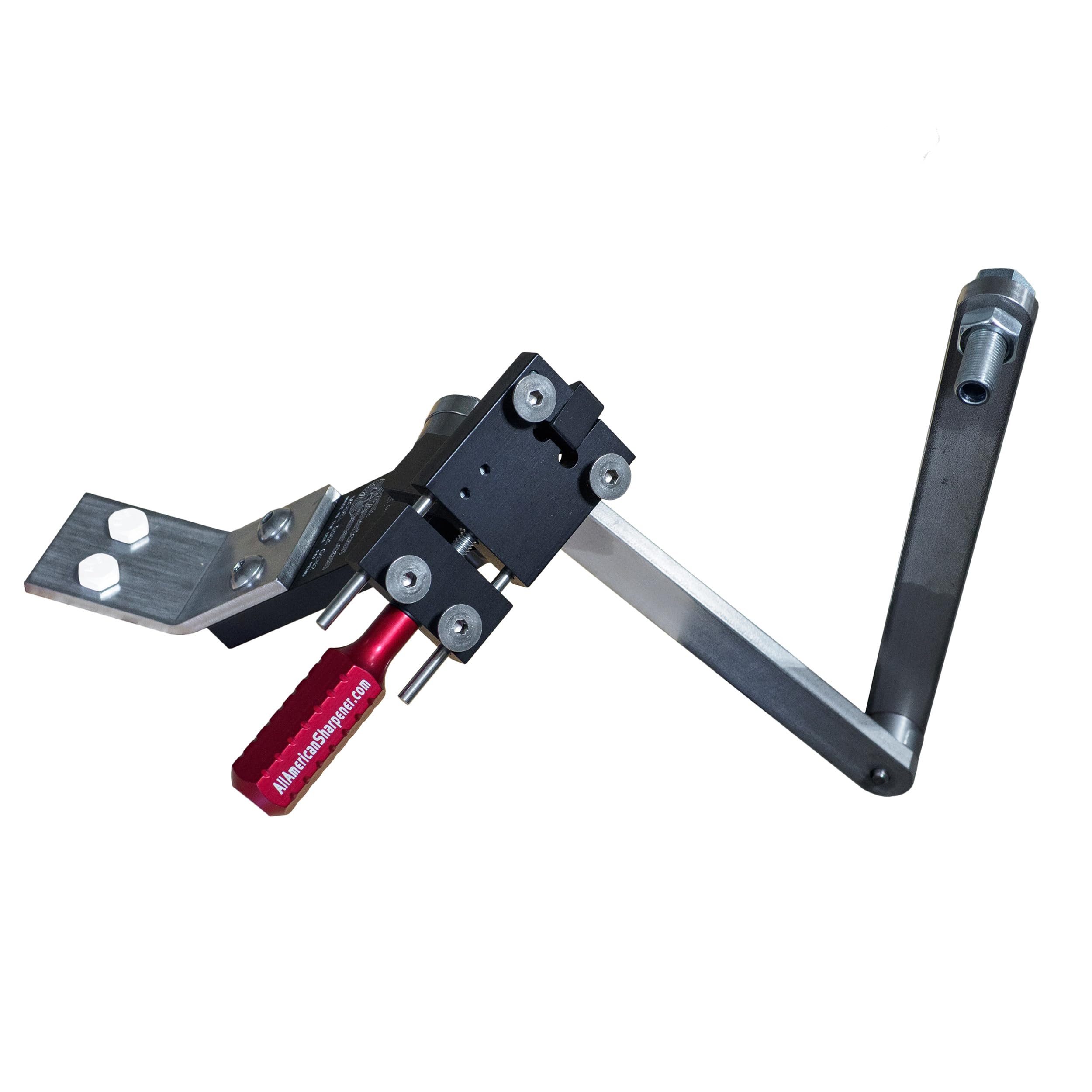
A machined anodized aluminum jig that holds a mower blade at the exact angle you set.
This is the mower-blade specialist. The body is anodized aluminum and stainless steel, 16 ounces, 14 by 10 by 4 inches, and it adjusts between 15° and 45° so you can match the factory angle on straight, mulching and high-lift blades. You bring the power — a cordless grinder mounts to the jig and the jig controls the angle. That design is what makes it completely portable: no bench, no cord, just the grinder and the jig wherever the mower is parked.
Quality is what buyers praise most, and performance comes right behind it. The consistent theme is precision: a repeatable angle every time the blade goes in. Sharpening speed also earns mention — one owner reported setting a mower blade to a sharp 30-degree angle in under 20 seconds. Build quality and the American-made claim round out the longer feedback, and the lifetime warranty is a real backstop on a metal fixture.
The price is the conversation. Value for money is the most-mixed aspect of this product — some find it well worth the outlay, some find it pricey — and this is the premium end of the mower-blade tools here. The honest question is how many blades you sharpen a year. For a lawn-care round or a serious property, the precision repays it. For one blade once a season, the SporGain kit covers the same job for less.
Where the precision comes from
- 15°-45° adjustment matches straight, mulching and high-lift blades
- Anodized aluminum and stainless steel body that holds angle under a grinder
- 16 ounces and portable — no bench or cord needed
- Lifetime warranty from the maker
The honest counterweight
- Premium-priced, and value is the most-divided point in feedback
- You supply the cordless grinder; the jig alone will not cut
- Single-purpose — no pruner or shear work here
The precision pick: professional lawn care and large properties where repeatable 15°-45° mower blade angles save real time.
The trade-off: the premium end of the price range for a tool that only does mower blades, and your own grinder does the cutting.
Know the Specs
Grit rating explained
Grit is the size of the abrasive particles on the sharpening surface, and the number works backwards from what you might expect — a lower number means coarser. A coarse 325 grit takes metal off quickly to restore a dull or chipped edge. A fine 1200 grit hones and polishes. Buyers see grits like 325, 1000 and 1200 on the tools here, plus broader labels like medium and fine; a dual-grit tool gives you the coarse and the fine in one body.
Sharpening angle
Angle is the tilt of the abrasive against the blade, and it decides how the edge cuts. A garden pruner carries one bevel angle; a mower blade another. Preset slots hold a fixed angle so you cannot go wrong by eye. Adjustable jigs dial between 15° and 45° so you can match any blade you own, which is what you want on mower blades where both sides must be ground the same.
Carbide, ceramic and diamond
Three abrasive materials recur across this list. Tungsten carbide is a hard bar that sets an edge fast. Ceramic is finer, used for honing. Diamond — as monocrystalline diamond bonded to a steel file — cuts through hard steel and works dry. A strop, either leather or a leather sheath face, polishes the edge afterwards to finish the cut.
Why a blade balancer matters
After sharpening a mower blade, the two cutting ends must weigh the same. If they do not, the blade vibrates and can stress the spindle. A balancer, often a magnetic cone, shows you whether the blade hangs level. The SporGain kit pairs a sharpening jig with a balancer for exactly this reason.
Powered belts versus hand files
An electric belt sharpener does the work with a motor and moving abrasive; a hand file or carbide bar requires your own strokes. Powered machines restore badly dull edges quickly and suit a pile of tools. Hand-held tools travel, need no power and cost less, but take longer on heavy restoration. Match the type to how often and how much you sharpen.
Common Questions
Can a knife sharpener also sharpen mower blades and pruners?
What grit do I need for a dull mower blade?
Do I have to remove a mower blade before sharpening it?
Why does a mower blade need balancing after sharpening?
Is a diamond file better than a carbide stone for garden tools?
Do these sharpeners need oil or water?
How long do the abrasive parts last?
Can a hand sharpener restore a chipped axe edge?
Is an electric belt sharpener worth it over a hand file?
Do I need a special grinder for a mower blade jig?
The Bottom Line
For most people, the yard tool sharpener winner is the Work Sharp MK2 because its two-speed motor and flexible belts cover a pile of dull edges — axes, mower blades, kitchen knives — in one bench machine, and a 3-year warranty stands behind it. If you prefer a hand tool that travels, grab the SHARPAL 103N, whose three preset angle slots and carbide and ceramic bars handle pruners, shears and mower blades with no power. And for mower blades that need precise, repeatable angles, the All American Sharpener Model 5005 is the one to reach for.
One last nudge: buy the tool that matches how many blades you actually sharpen. If you only touch up a pruner twice a season, a hand bar or file is the right tool and will not sit idle. If you keep several mower blades and axes in rotation, the powered machine earns its place on the bench.
How we choose
We do not accept paid placement. Every pick is matched to a real buyer and a real use-case; we do not hands-on test units.
Sources
Specifications: manufacturer listings and product documentation. Review insights: verified customer reviews, as of November 2026. Pricing: not shown on this page (it changes often); check the current price via the retailer link.
As an Amazon Associate, Tactical Gear Guy earns from qualifying purchases. This does not affect which products we feature.