Specs are compiled from manufacturer listings and verified buyer reviews and can change over time — please confirm the key details on the product page before buying.
You want your beds and lawn watered on a schedule while you are at work, on vacation, or just asleep — and you want the connection at the faucet to stay dry. That is the whole job of a yard sprinkler timer. The picks below are sorted by what actually breaks first on these units: the inlet fitting, the valve, and the battery door. Start with the RAINPOINT metal-pipe timer if you want the simplest set-and-forget unit, or jump to a two-zone model if one faucet needs to feed two different areas.
This guide is built by comparing the manufacturers’ published specifications and the patterns across verified customer reviews, so you get each pick’s real strengths and trade-offs instead of marketing spin.
Every timer here screws onto a standard outdoor faucet and runs on AA batteries, so the differences come down to fitting material, zone count, and how easy the dials are to read. Here is how each one holds up as a yard sprinkler timer for real garden duty.
Top Picks


How To Choose The Best Yard Sprinkler Timers
The spec sheet on these timers looks nearly identical across brands: program a start time, pick a frequency, set a duration, walk away. The differences that actually matter show up in month two and three, when the faucet has been under pressure the whole time and the unit has baked in the sun. Shopping on fitting material and zone count gets you further than shopping on the picture on the box.
Start with the inlet and outlet material
A metal fitting resists cross-threading and stripping better than a plastic one, especially if you take the hose off and on through the season. If your outdoor faucet is old or slightly corroded, a brass inlet with a proper gasket is the difference between a tight seal and a slow drip down the wall. Every pick here lists its fitting material — check that column before anything else.
Decide how many zones you really need
One zone means every hose on that faucet drinks on the same schedule. Two zones means you can run the vegetable bed on a short daily cycle and the front lawn on a longer, less frequent one — from the same spigot, without moving hoses. If you have a soaker hose and a sprinkler head both coming off the same faucet, two zones is worth the extra setup time.
Match the pressure and flow rating to your watering style
A drip irrigation line needs far less flow than a spinning sprinkler head, and a gravity-fed rain barrel is a different job entirely from a normal pressurized faucet. Look at the listed pressure range and flow rate and compare it to what your setup needs. Timers with a bigger bore and a full-flow valve lose less water volume on the way through, which matters most on long hose runs.
Side-by-Side Comparison
| Model | Best For | Zones / Outlets | Fitting Material | Settings | Amazon |
|---|---|---|---|---|---|
| RAINPOINT Metal Pipe Timer★ Best Overall | Set-and-forget single-faucet watering | 1 outlet | Brass, Metal | 24 | Amazon |
| Brass Sprinkler Timer (QUOBAS)High Pressure Pick | High-pressure setups and RV hoses | 1 outlet | Brass | 5 | Amazon |
| Unistyle 2 Zone TimerTwo-Zone Value | Two areas off one faucet | 2 zones | Plastic | — | Amazon |
| Insoma 2-Zone SGW06M | Budget two-zone with manual control | 2 zones | ABS plastic | 5 | Amazon |
| MOES 2 Zone Water Timer | No-app, no-Wi-Fi households | 2 outlets | Brass, Polycarbonate | — | Amazon |
| RAINPOINT Outdoor Metal Timer | Rugged single-zone for drip lines | 1 outlet | Metal | 9 | Amazon |
| Insoma Brass Inlet 2-Zone | Big-display two-zone programming | 2 zones | Plastic | — | Amazon |
| Orbit 62067 2-Pack | Two faucets, one purchase | 1 outlet each (2 pack) | Plastic | 3 | Amazon |
Detailed Reviews
1. RAINPOINT Sprinkler Timer
Our pick — 4.5+★ from 350+ verified ratings; the strongest balance of quality and price.
A solid brass inlet and outlet built to hold a seal under outdoor pressure all season.
The number that puts this one on top is the pipe itself: a 100% metal water pipe rated to withstand up to 116 PSI without bursting (PSI is pounds per square inch — the measure of how hard the water pushes against the fitting). That metal pipe is what stands between your faucet and a leak, and it is why this timer holds up where plastic-bodied units start weeping. The 3/4″ brass inlet uses an anti-twist lock thread rated for 800N of pull (newtons, a measure of force), so a hose dragged across the lawn does not yank the connection loose.
Watering automation here covers real ground. You set frequency from every 1 to 12 hours or every 1 to 7 days, and a duration anywhere from 1 minute to 3h59min. That spread covers a daily veggie-bed soak and a twice-weekly lawn cycle from the same unit. Away on vacation? The rain delay pushes your schedule back 24H, 48H, or 72H in one tap. A manual mode runs from 1 minute up to 8 hours for the quick top-up, then hands control back to your program without a re-setup. For a broader look at what’s in this class, see our full spec breakdown on the Amazon page.
What wins people over is how little thought the programming takes — a 4.5-inch screen walks you through the 24 settings, and the brass build needs no seasonal fussing. Where it earns its keep is leak-free running and a full-bore metal ball valve that passes a generous flow to drip lines and single heads instead of choking it. The one thing to weigh is the water-flow rating, which some owners find softer than the rest of the unit promises. It is a fit decision: big multi-head sprinkler systems demanding maximum gallons may want more bore, while drip lines, soaker hoses, and single heads are right at home.
What works in the elements
- 100% metal water pipe rated to withstand up to 116 PSI
- Pure brass 3/4″ inlet with anti-twist lock thread rated for 800N
- 24 settings and a 4.5-inch display for quick programming
- Rain delay at 24H/48H/72H plus manual watering up to 8 hours
Where it asks patience
- Flow rate is the most-discussed mixed point — fine for drip, less punchy for big systems
- Single outlet means every hose on that faucet waters on the same schedule
Built for the long haul: Ideal if your yard runs on a hose and sprinkler head off one faucet and you want a metal-bodied timer to survive the season.
Two zones instead: If you need separate schedules for the veggie patch and the front lawn, step over to a dual-zone unit rather than splitting hoses.
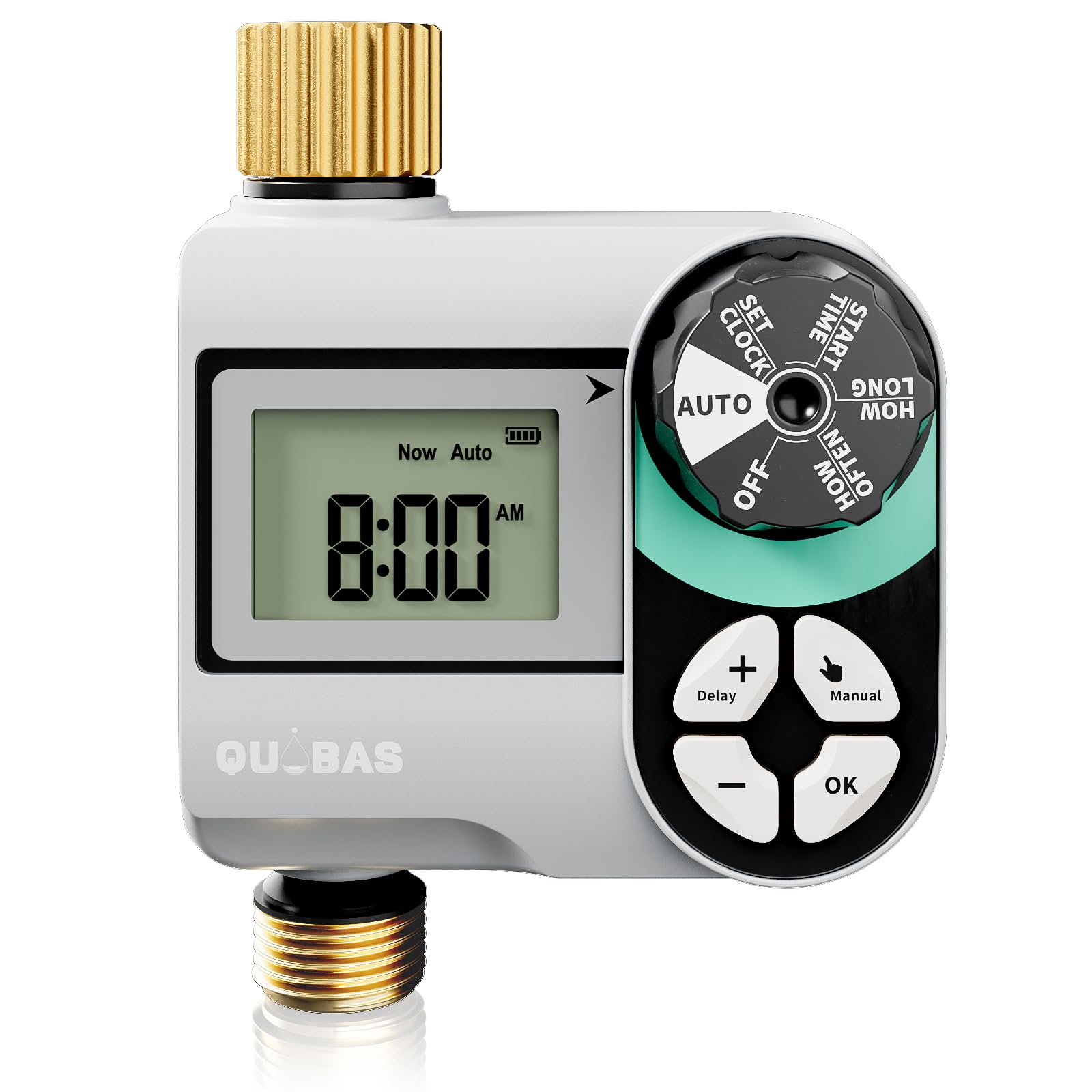
2. Brass Sprinkler Timer QUOBAS WT11
The pressure ceiling is the headline here, not the schedule options.
It holds the highest working ceiling in this lineup, operating from 8 up to 120 PSI — a few pounds above the RAINPOINT metal-pipe unit’s 116 PSI inlet rating. On a normal household faucet you will not notice the gap. On a long run with a hefty sprinkler head at the end, or an RV water hookup, that extra headroom shows in a steady spray instead of a dribble. Both the inlet and outlet are pure brass, so the seal against a standard 3/4″ hose, faucet, or RV hose is corrosion-resistant all season.
Programming is straightforward rather than fancy. You set start times, a watering duration from 1 to 240 minutes in one-minute steps, and a fixed interval of every 1 to 12 hours or every 1 to 7 days. That is a tighter menu than the RAINPOINT’s 24-setting system, but it covers lawn, soaker hose, and drip setups without menu-diving. The rain delay covers 24, 48, or 72 hours, and it runs on 2 AA alkaline batteries with a 10-12 month life — a full season and change per pair if you swap in fresh cells at the start.
The recurring gripe on this model is leak-proofness — some units seal beautifully, some need a second look at the gasket and thread tape. When the gasket and thread tape seat properly, owners describe a timer that just runs: automatic cycles without you standing over the spigot. One practical note — a 5-setting menu means fewer schedule slots to juggle, which is a plus for a simple routine and a limit if you like granular control.
Best use case: A pressurized faucet feeding an RV hose, a greenhouse line, or a lawn sprinkler where flow needs to stay honest at higher pressure.
The honest catch: Sealing is the aspect buyers most often have to fiddle with on install. Get the gasket and thread tape right first time and it stays dry.
Reach for this if: You need the highest pressure rating in this group and a pure brass fitting on both ends.
Look elsewhere if: You want maximum schedule flexibility — the tighter menu and single outlet keep it simple, not granular.
3. Unistyle Heavy Duty Sprinkler Timer 2 Zone with Brass Inlet
Two independently programmable zones, one rotary knob, and brass outlets that split your watering plan in half.
Here is the spec that solves the biggest daily annoyance with one-outlet timers: two independently programmable zones, each with its own start time, duration of 1 to 360 minutes, and frequency of every 1 to 23 hours or every 1 to 15 days. That means the tomato bed gets a short daily soak while the front lawn runs on a longer, less frequent cycle — bad either way if you are sharing one hose and moving it each morning. Both outlets are brass, and the unit fits standard 3/4-inch faucets and hoses.
The screen is 2.5 inches, which is smaller than the RAINPOINT’s 4.5-inch face, but the single rotary knob covers the gap — no menu trees to memorize, just turn and set. Pressure range is 0.5 to 8 BAR (7.25 to 116 PSI), with a flow rate of 35 L/min (9.25 GPM), so a normal sprinkler head or drip line gets what it needs. Rain delay pauses your schedule for 1 to 7 days, and when it ends the original plan picks up on its own — no reprogramming.
Two safety touches earn their keep outdoors. A low battery indicator shows remaining power and the valve automatically closes when the cells fade, so you are not left with a stuck-open line. The child lock stops accidental button presses from wiping a program. The one honest limit: this body is plastic, not the all-metal build of the two single-zone units above. Treat it as an indoor-outdoor install and avoid leaving it on a line under heavy pressure for months on end. Programming is where it earns praise — the knob and large-enough screen make setup quick even for a first-timer.
Two zones without the fuss
- 2 independently programmable zones with brass outlets
- Single rotary knob and 2.5-inch LCD for fast setup
- Rain delay 1-7 days with automatic resume
- Low battery valve-close and child lock built in
What to plan around
- Plastic body rather than the metal build of the single-zone picks
- Child lock disarm is a double-press on the AUTO interface — learn it once
The two-zone starter: Right call if you have two areas off one faucet and want separate schedules without an app.
For all-metal duty: If the unit lives on a pressurized line year-round, a brass-bodied single-zone timer is the sturdier bet.
4. Insoma 2-Zone Sprinkler Timer SGW06M
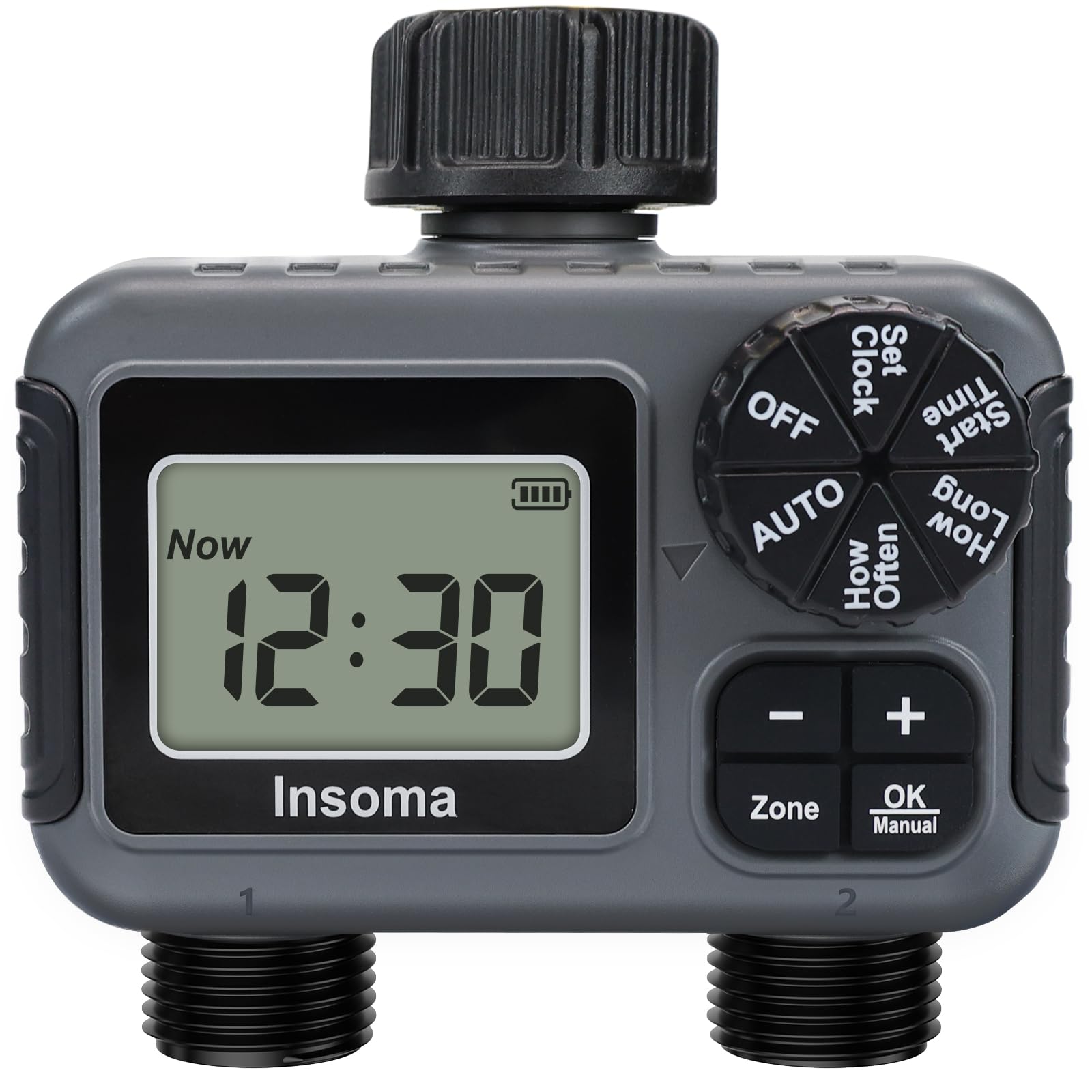
Two independent channels, three manual modes, and a 360° rotating interface that makes install on a tight faucet easier.
Installation is often the part people dread. This one handles it with a 360° rotatable interface — the body spins so you can seat it on a tight faucet without fighting the wall — plus two 1/2″ quick hose fittings in the box that connect to any standard 3/4″ or 1/2″ garden hose. That flexibility is a real help on a crowded spigot where a rigid timer body would not clear. Once on, you get two independent channels with start times from 1 minute to 23h 59min and frequencies from 1 hour to 24 hours or every day to every 7 days.
Manual watering has three modes here, which is one more than most of the picks above — use the Zone button to hit Zone 1, Zone 2, or both, then set a run from 1 to 59 minutes without touching your saved schedule. Rainy delay pauses for 1 to 7 days with a 3-5 second hold on the “+” button. The leak-proof side is well thought out: the connector is 30% reinforced nylon rated for 7.25 PSI to 116 PSI, and it ships with a metal filter, three sealing gaskets, thread tape, and a rubber ring on the battery cover to keep moisture off the cells.
The honest weak spot is battery life — the most-discussed concern on this model, with reports of a set running out in about a month. The low battery alert flashes on the screen and the valve closes automatically to avoid a stuck-open waste, so you are warned rather than surprised. If you can live with more frequent AA swaps, the value is strong: the functionality is what earns the praise here, and the waterproof LED display keeps time and battery level readable. This is the choice for someone who wants two zones on a tight budget and will keep spare batteries on the shelf.
Installation advantage: The 360° rotating body and included quick fittings cut the fiddliest part of setup on a cramped faucet.
Battery reality: Budget for more frequent AA changes. The valve closes on low battery so nothing floods, but the cells do not stretch as far as the other two-zone units here.
Buy it if: Two zones on a budget and a rotatable install are your priorities, and you do not mind stocking AA batteries.
Think twice if: You want to set it and leave it for a full season — a timer with a longer battery stretch is the better fit.
5. MOES 2 Zone Water Timer CR02
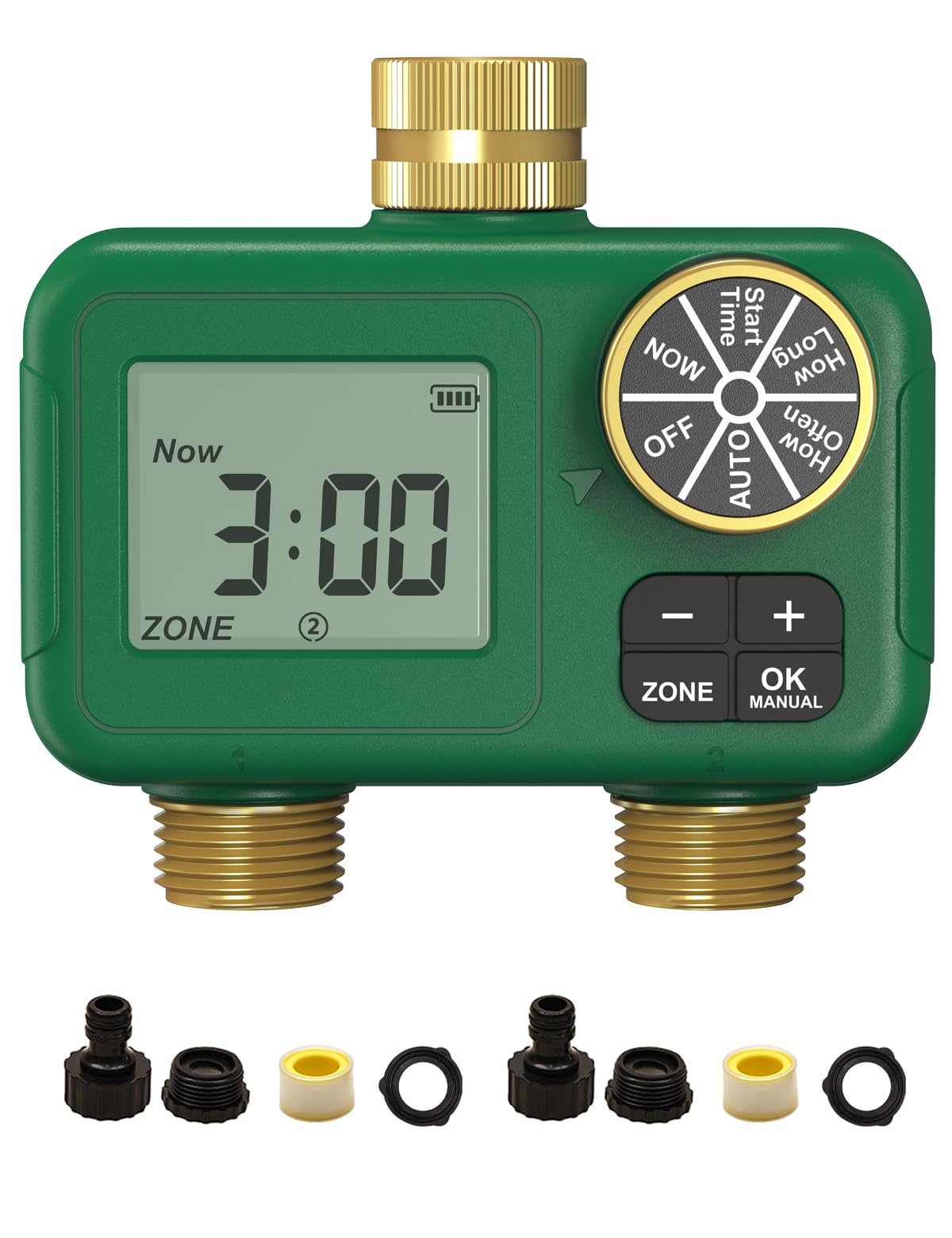
For anyone who wants two independent zones on one faucet and zero apps, hubs, or pairing rituals.
The point of this timer is what it does not need: no Wi-Fi, no app, no hub, no Bluetooth. Two hoses connect to one outdoor faucet, and you program each outlet on its own — separate start times, run times, and frequency — so the garden bed and the lawn area run on different clocks without you moving hoses. Brass inlet and outlet connectors make the connection stronger than common plastic fittings, which is the part that usually gives out first.
Rain delay is generous at 1 to 15 days, wider than the 24/48/72-hour windows on several picks here, and manual watering starts on demand. It runs on 2 AA alkaline batteries, and the maker recommends against rechargeable cells for this unit. The 6.4-ounce body keeps the whole thing light enough to spin onto a faucet one-handed.
Brass is only half the battle — the rest is install technique. Confirm your faucet size, seat the gasket, align the threads, and hand-tighten; a cross-threaded brass fitting leaks just as readily as plastic. And this design wants normal faucet pressure. Low-pressure systems, long hose runs, clogged filters, or a gravity-fed rain barrel can reduce flow enough to hurt sprinkler coverage, so it is not the choice for a rain-barrel feed. On a standard pressurized spigot, setup and operation are the two things owners talk about most, and both land on the easy side.
Suits the app-averse: A good match if you want two independent zones on one faucet and refuse to add another phone app to your life.
Skip for gravity feeds: A rain barrel or a very long low-pressure run will starve the flow this timer needs to work well.
6. RAINPOINT Sprinkler Timer Metal

The metal-bodied single-zone built to sit outside through wind and rain.
Build quality is the thing here, and the numbers back it: a pure brass swivel inlet with metal thread and a built-in metal filter, rated for a max working pressure of 180 PSI — the highest ceiling in this whole group. A heavy-duty weatherproof shell is meant to sit outdoors year-round and take wind and rain without cracking. The brass swivel inlet also lets you spin the unit onto the faucet at an easy angle, and raw tape around the threads seats the connection tighter to hold off leaks.
The large LCD shows watering time, frequency, and power level in one glance, so you are not scrolling to check status. Rain delay covers 24, 48, or 72 hours, and manual mode runs up to 8 hours without wiping your saved program. Its compact, non-bulky body is a plus on a crowded spigot, and it fits drip irrigation setups well.
Two honest points to weigh. The display is a mixed bag — some units read clearly, some render the screen hard to see, so angle and sunlight matter. And long-term durability has drawn more scrutiny on this model than on the others, with a share of units giving up sooner than the metal build suggests. It is still the tougher call for drip lines or a single sprinkler head that needs maximum pressure headroom. If you want a weatherproof unit and a straightforward schedule, you can do a lot worse.
The standout spec: 180 PSI max working pressure and a 360° brass swivel inlet make this the pressure-headroom choice for a single-zone setup.
The fair caveat: Screen legibility and long-term durability are the two aspects that split opinion most. Mount it where the sun does not wash out the display and keep it out of standing water.
Strongest single-zone build: Go here for a drip line or one sprinkler head on a high-pressure faucet that needs a rugged metal body.
Want more schedule slots: The 9-setting menu is leaner than the position-one RAINPOINT, so a schedule-heavy routine belongs there.
7. Insoma Water Timer 2 Independent Zones

Two zones and a large screen that shows every setting at once.
This is the easiest timer here to read at a glance. The large LCD lays out watering time, frequency, and power level together, so you can confirm a program without cycling through screens. Under that display sit two independent zones that run separately or simultaneously — toggle Zone 1, Zone 2, or both with the Zone button. On a faucet shared by a greenhouse line and a lawn sprinkler, that split is the whole reason to buy it.
Programming runs from start time through a frequency of every 1 hour to 23 hours or every 1 day to 15 days, with each duration set between 1 and 360 minutes. Rain delay pauses the schedule for 1 to 15 days and resumes it on its own afterward. Manual mode covers 1 to 360 minutes without disturbing the preset, and a child lock keeps curious kids and pets from reprogramming your beds. The brass inlet and outlet pair with the IPX5 waterproof rating — a measure of how well the body resists water spray from any direction — and an added seal ring on the battery cover isolates moisture.
The honest caution is durability, where opinions split: some units feel very sturdy, others gave out well before three months. Treat the brass fittings gently, seat the gasket cleanly, and do not over-tighten — a cross-thread has killed more valves than rainfall ever will. The battery side is more reassuring, with 2 AA alkaline cells running over 6 months. Setup and intuitive programming are what earn praise here, so this suits someone who wants two zones without a learning curve.
The display-first pick: Choose it if you want two independent zones and a screen that shows all settings without a second look.
Handle with care: Brass fittings and a gentle install matter here — over-tighten and the durability question gets answered for you.
8. Orbit 62067 1-Outlet Programmable Digital Hose Watering Timer 2-Pack
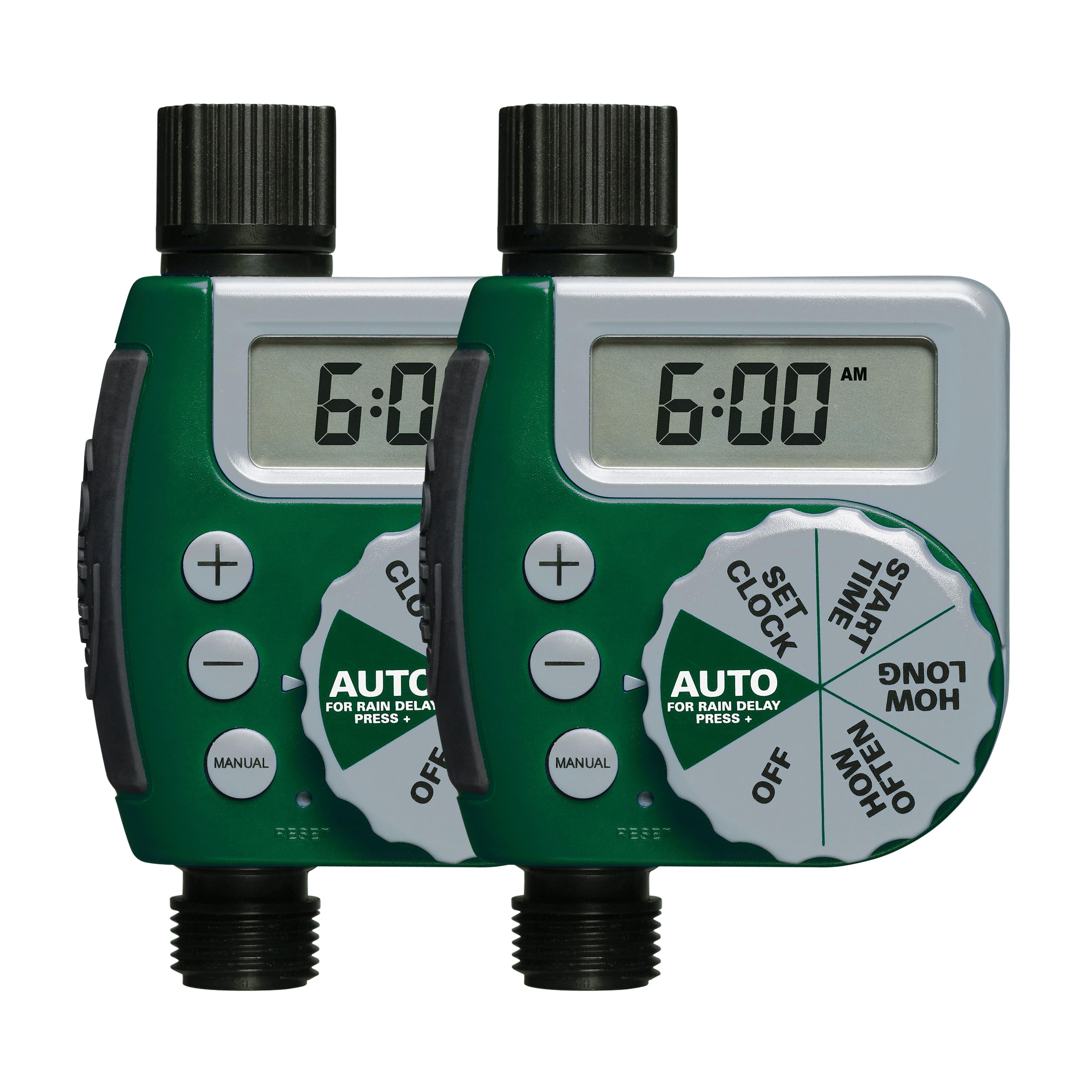
One box, two timers, for a yard with two faucets to cover.
The spec that matters here is the count: you get two 1-outlet timers in the pack. If your yard has a front and back spigot, that means two separate watering spots covered from one purchase instead of two shopping trips. Each unit turns a plain faucet into a programmable sprinkler system, and a water-resistant body handles typical outdoor weather. Setup is a few steps on a large LCD that stays easy to read.
You get start time, duration, and frequency to set per unit, plus a built-in rain delay that pauses for 24, 48, or 72 hours. A detail that saves real frustration: the timer keeps its program even when you change the batteries, so a mid-season cell swap does not mean re-entering every setting from scratch. The 3-setting menu keeps things simple — this is a timer for someone who wants automatic watering and does not want to fiddle with fine-grained options. The larger LCD and simple, adjustable watering make it a good match for potted gardens and multiple containers around a patio.
On battery life, this one holds up over a full summer on a set, which is where it earns its keep for a set-and-forget yard. Value lands well with owners, and the versatility for potted plants is where it draws the most praise. The one limitation to weigh: it is a single-outlet design, so a yard wanting two schedules from one faucet at once needs a two-zone unit instead. If you have two faucets, though, this pair does the job without a shared-schedule compromise.
Why the pair makes sense
- Two 1-outlet timers in one pack for front and back faucets
- Program is retained through battery changes
- Rain delay at 24/48/72 hours built in
- Large LCD for quick, readable programming
Know before you order
- Each unit is single-outlet — two schedules on one faucet needs a two-zone model
- Lean 3-setting menu favors simplicity over fine control
Best for two faucets: Buy this if you have two spigots and want automatic watering on both without buying two different timers.
Not for one-faucet splits: If both zones come off the same faucet, step up to a dual-zone timer instead.
Know the Specs
Working Pressure (PSI)
PSI stands for pounds per square inch — how hard the water pushes against the fitting. A higher rating, like the 180 PSI ceiling on the RAINPOINT outdoor metal timer or the 120 PSI on the QUOBAS brass unit, means more headroom before the body or seal gives way. On a standard faucet you will rarely max it out, but a high rating is insurance on a long, high-pressure run. Match the rating to your supply; a gravity-fed rain barrel pushes far less than a municipal spigot.
Fitting Material (Brass vs Plastic)
The inlet and outlet are where these timers fail first. Brass threads resist stripping and cross-threading when you take a hose off and on, and they seal more reliably against an old faucet. A plastic body is lighter and usually cheaper, but the threads are softer — hand-tighten and use the gasket rather than cranking it down. Check the fitting material in the comparison table before you pick, because it decides how long the connection stays dry.
Zones and Outlets
One zone runs every hose on that faucet on a single schedule. Two independent zones let you give the veggie bed a short daily cycle and the lawn a longer weekly one, all from the same spigot. If you have two faucets, a two-pack of single-outlet timers covers both. If both lines share one faucet, a two-zone unit saves you moving hoses all season.
Rain Delay and Manual Mode
The rain delay pauses your programmed schedule for a set window — 24 to 72 hours on many units, up to 15 days on others — so you do not overwater in a wet spell. When the delay ends, the schedule resumes on its own. Manual mode runs a one-off watering without wiping your saved program, useful for a dry patch or a quick drink for a new plant.
Common Questions
Will a hose timer fit my outdoor faucet?
Do I need two zones or is one enough?
What do the PSI numbers mean and how much do I need?
How long do the batteries last in a hose timer?
Will a rain delay wipe out my watering schedule?
Can these timers handle a drip irrigation line?
Do I need Wi-Fi or an app to use one of these?
How do I stop my hose timer from leaking at the connection?
What does IPX5 waterproof mean on a garden timer?
Can I water manually without deleting my program?
The Bottom Line
For most yards, the yard sprinkler timers winner is the RAINPOINT metal-pipe timer because a 100% metal pipe rated to 116 PSI and an anti-twist brass inlet are the two things that decide whether your connection survives the season. If your faucet runs high-pressure water to an RV or greenhouse line, the QUOBAS brass timer at 120 PSI gives you the top of the pressure range. And if one faucet feeds two different areas, reach for the Unistyle 2-zone timer — brass outlets and a single knob keep two schedules running without an app.
Two things tip the buying decision. First, decide how many zones you actually water off one faucet — that single question rules out half the list. Second, check the fitting material before anything else, because a brass inlet is what keeps the wall dry once the pressure comes on. Pick for your faucet count and your water pressure, and any of these eight will water your garden while you get on with your day.
How we choose
We do not accept paid placement. Every pick is matched to a real buyer and a real use-case; we do not hands-on test units.
Sources
Specifications: manufacturer listings and product documentation. Review insights: verified customer reviews, as of November 2026. Pricing: not shown on this page (it changes often); check the current price via the retailer link.
As an Amazon Associate, Tactical Gear Guy earns from qualifying purchases. This does not affect which products we feature.