Specs are compiled from manufacturer listings and verified buyer reviews and can change over time — please confirm the key details on the product page before buying.
Buying a yard leaf blower is really a decision about three things: how much air volume you can get, how long you can run before you stop, and how much weight you are willing to carry. Volume is measured in CFM (cubic feet per minute — the size of the air stream), and speed in MPH (miles per hour — how hard that stream hits). Match CFM and MPH to your lot size and fall cleanup takes an afternoon, not a weekend. Get it wrong and you will be recharging a battery at the halfway point of your driveway.
This guide is built by comparing the manufacturers’ published specifications and the patterns across verified customer reviews, so you get each pick’s real strengths and trade-offs instead of marketing spin.
Below are corded, battery and gas machines ranked by CFM and runtime, with the catch on each one stated plainly. My full breakdown of the best yard leaf blower covers airflow, runtime and the weight you will feel by minute twenty.
Top Picks


How To Choose The Best Yard Leaf Blower
Your lot size and outlet access decide if you need corded, battery or gas — not the biggest CFM number on the box. A quarter-acre lot with a short driveway and a few flower beds needs far less machine than a half-acre with a long fence line and oaks dropping wet leaves every October. That gap in square footage and leaf load is what points you to a corded unit, a battery unit or a gas backpack.
Airflow first, speed second
CFM is the width of the air stream and MPH is its punch. A high-CFM blower moves a wide wall of air that pushes a leaf pile down the driveway in one pass. A high-MPH, low-CFM blower is better at digging debris out of cracks and off wet hardscape. Most buyers of a yard leaf blower feel the CFM difference first, because it decides how many passes you make.
Where the power comes from
Corded electric runs as long as your extension cord reaches and never asks for a charge — but you are tethered, and the cord is a tripping hazard around hedges. Battery models free you from the cord and cut the noise, at the cost of a runtime clock that starts the moment you pull the trigger. Gas backpack blowers carry their own fuel and deliver the biggest numbers on this page, but they add pull starts, mixed fuel and engine maintenance to your season.
Weight you actually carry
Handheld blowers list the tool weight, but batteries and fuel add on top. That is why a corded unit can feel lighter than a battery kit with a 4.0Ah pack seated in it. If you have shoulder or back concerns, hold the machine before you commit to a long session — and look at cruise control, which locks the trigger so your hand is not squeezing for twenty minutes straight.
Noise and neighbor politics
Battery and corded electric machines run far quieter than gas, which matters if you clean up early on a weekend. Some cordless models publish a decibel figure directly, and lower is friendlier at dawn. Gas backpack blowers are the loudest option here and best saved for daytime hours.
Side-by-Side Comparison
| Model | Best For | Airflow (CFM) | Power Source | Weight | Amazon |
|---|---|---|---|---|---|
| WORX WG520 Turbine★ Best Overall | Daily clearing on a budget | 600 cfm | Corded electric | 6.4 pounds | Amazon |
| Greenworks 40V 550 CFMBest for Dawn | Quiet dawn cleanup | 550 cfm | 40V battery | 5.1 pounds | Amazon |
| CRAFTSMAN V20 RPSpace Saver | Compact storage and light work | 410 cfm | V20 battery | — | Amazon |
| ECHO PB-2520 | Handheld gas reliability | — | 25.4cc gas | — | Amazon |
| EGO POWER+ LB6703 | Long runtime, mid power | 670 cfm | 56V battery | 11.7 pounds | Amazon |
| EGO POWER+ LB8803-2 | Biggest cordless airflow | 880 cfm | 56V battery (two) | — | Amazon |
| Husqvarna 350iB Leaf Blaster | Cordless power near gas | 800 cfm | 40V battery | 10 pounds | Amazon |
| PRORUN PBB2884 | Large lots, gas backpack | 1020 cfm | 75.6cc gas | 32.8 pounds | Amazon |
| ECHO PB-9010T X Series | Maximum clearing force | 1110 cfm | 79.9cc gas | — | Amazon |
Detailed Reviews
1. WORX 12 Amp Turbine Electric Leaf Blower WG520
Our pick — 4.5+★ from 12,500+ verified ratings; the strongest balance of quality and price.
Six hundred CFM from an outlet, and the cord is the only thing that slows it down.
You get real clearing power with no battery runtime clock ticking against you, thanks to 600 CFM (cubic feet per minute — the volume of air this turbine fan pushes out of a 12 Amp motor). That is a genuinely wide stream for a handheld corded machine, and it is why this one takes the top spot on a page full of battery kits. A 6.4-pound body keeps the carry manageable during a long session, and 110 MPH (miles per hour — the speed of the air stream) gives enough bite to lift leaves off wet pavement.
There is no battery to charge and no gas to mix, which means an early Saturday start costs you nothing but an extension cord. The two-speed control lets you dial down for a walkway and open it up for the big pile by the curb. Compared with the CRAFTSMAN V20 RP below, this machine moves 600 cfm against 410 cfm, so you finish a wide driveway in noticeably fewer passes.
The catch is the cord itself. It limits you to the reach of your extension run, and dragging it around hedges and flower beds is the part that wears on your patience. The blower body is also long — 40 inches front to back according to the listing — so tight garden nooks ask for a slower, more careful swing.
What earns the top spot
- 600 CFM and 110 MPH from a 12 Amp turbine fan — real volume, not just speed
- No charging, no gas, no pull starts — it fires up the moment you plug in
- 6.4 pounds keeps the carry light for a corded unit
- Variable-speed control for controlled work around beds and hardscape
Where it asks something of you
- Tethered to an extension cord, so your reach defines your cleanup zone
- The 40-inch body needs a thoughtful swing in tight planting
Go this way if: you have outlets within cord distance and want constant power without a battery meter.
Pause if: your lot runs deep into the yard with no outlet nearby — a battery or gas machine will serve you better.
2. Greenworks 40V Electric Leaf Blower
The one you can run at 7 a.m. without a neighbor leaning over the fence.
Seventy-eight decibels is the headline here. That is a murmur compared with gas, and it is the reason this Greenworks machine suits early cleanups, shared driveways and anyone with a sleeping household. Behind the quiet, a 40V brushless motor delivers 550 CFM and 130 MPH, which is enough to push wet leaves and driveway gravel rather than just dry oak litter.
Your arm stays fresh through the session because this is the lightest pick on this page at 5.1 pounds. Against the EGO LB6703’s 11.7 pounds, that difference is the whole story on a slope or a long border. The cruise control lets you release the trigger and just steer, and a turbo button spikes power on demand for the stubborn pile at the garage door.
The honest limitation is runtime. A full 4.0Ah battery is rated for 20 minutes of continuous blowing, and buyers report it lands anywhere from there to half an hour depending on how hard you lean on the trigger. If your cleanup runs long, budget for a second battery or a mid-session break.
What wins people over: the quiet, low-weight package — it clears patios, decks and flower beds without either the noise or the arm strain of bigger machines.
What to plan around: the 20-minute continuous runtime figure is real, so a big lot will want a spare pack on the charger.
Reach for this if: quiet operation and a light carry matter more to you than raw clearing volume.
Look elsewhere if: you are clearing a half-acre in one go and refuse to swap batteries midway.
3. CRAFTSMAN V20 RP Cordless Leaf Blower CMCBL730P1
A compact cordless kit that hangs on the wall and starts every time.
At 14.77 inches across, this is a genuinely small machine — against the WORX WG520’s 40-inch length, it stores in a fraction of the shelf and swings easily in tight space. A brushless motor delivers up to 410 CFM and 110 MPH, with a boost button that opens the throttle when a pile needs a shove rather than a nudge.
Runtime is rated up to 24 minutes, and the 5.0Ah pack charges between sessions. WeatherGuard shielding helps protect the tool body from moisture and dust, though the listing is clear that it does not cover the battery or charger, so bring those inside. A VERSATRACK hook lets you hang the blower straight on the wall system, which keeps a garage floor clear.
This is a light-duty machine and it is honest about it. Compared with the EGO LB8803-2’s 880 cfm, the CRAFTSMAN’s 410 cfm half is a different class of clearing — fine for a walkway, a deck or a small lawn, slower on a big leaf drop.
The case for the small footprint
- Compact enough to hang on a garage wall and swing in tight corners
- Boost button for stubborn debris; trigger control for finesse
- 5.0Ah battery and charger included in the kit
- WeatherGuard shielding on the tool body for dusty, damp storage
Keep expectations sized
- 410 CFM is light work — a large leaf drop will take multiple passes
- WeatherGuard covers the tool only, so battery and charger stay indoors
Its lane: small lots, walkways and decks where storage space is tight and the leaf load is modest.
Not its lane: a big autumn drop across a wide yard, where the airflow gap to the larger cordless machines shows.
4. ECHO PB-2520 25.4cc Handheld Leaf Blower
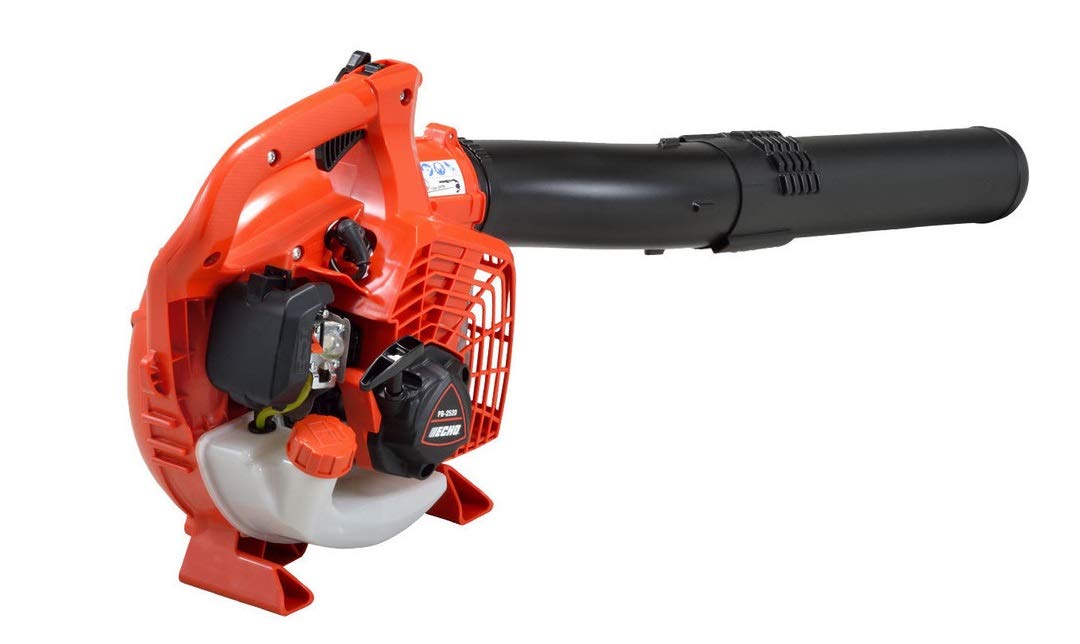
A gas handheld that owners trust to fire on the first pull.
This is the old-school handheld formula: a 25.4cc gas engine in a light body, no cord, no battery meter. What the review pages keep returning to is how easily it comes to life and how light it feels in the hand — the kind of machine you grab for a quick pass without a charging routine. Its performance reputation rests on leaf clearing specifically, not on gravel or snow.
Reach for it when your cleanup windows are short and frequent: a border swept up before guests arrive, a porch cleared on a windy afternoon. There is no runtime limit as long as you keep fuel on hand, which is the whole reason gas handhelds still sell. The body measures 19 inches long, so it tucks into a shed shelf more easily than a backpack unit.
The recurring gripe is the blow tube working loose over time — treat the connection gently and check it before a session. That is a durability note on one part, not a verdict on the engine, and it is the trade-off a gas handheld makes for its light build.
The honest read: for short, frequent cleanups this is a simple, no-charge, easy-start tool — the quality reputation on this machine is strong.
The thing to watch: the blow tube connection is the weak link over months of use, so seat it firmly and inspect it.
Pick it for: quick handheld gas passes where easy starting and low weight matter most.
Skip if: you want zero engine maintenance or you are clearing very large volumes in one session.
5. EGO POWER+ Cordless Electric Leaf Blower LB6703

Eighty minutes on one 4.0Ah pack — that is the whole pitch of this EGO.
Most cordless blowers hand you twenty-something minutes. The LB6703 is rated up to 80 minutes on a single 4.0Ah battery, and that single figure reshapes your day: you can clear a long fence line and still have charge for the driveway. Turbo mode reaches 670 CFM and 180 MPH, and the variable-speed dial lets you lock a working speed between 250 and 530 CFM so you are not holding the trigger for an hour.
Charging is quick at 55 minutes on the included CH3200 charger, so a lunch break tops the pack back up. The tapered and spread nozzles let you switch between a tight jet for crevices and a wide fan for open lawn, and the brushless motor keeps vibration down over a long session. It runs on the same 56V ARC Lithium batteries as other EGO tools, so one pack can serve the whole shed.
It is the heaviest battery handheld here at 11.7 pounds — against the Greenworks 40V at 5.1 pounds that is more than double the carry, and your arm will feel it by the end of the lawn. Buyers also report the runtime can drop toward 20 minutes when you lean hard on turbo. Set it on a slower dial speed and the 80-minute figure holds up much better.
Why it is a long-session tool: 80 minutes of rated runtime and a 55-minute charge mean the battery stops being the bottleneck.
The trade-off you carry: 11.7 pounds in one hand is real, so plan shorter sessions if you have shoulder strain.
The right match: large lots where runtime beats everything else and you want one battery ecosystem.
Second thoughts if: you need a featherweight machine for a quick patio pass.
6. EGO POWER+ Cordless Electric Leaf Blower, 880 CFM, LB8803-2

Eight hundred eighty CFM from a battery — this is gas territory without the gas.
Here is the head-to-head that matters: the LB8803-2 pushes 880 cfm at up to 200 MPH, while the CRAFTSMAN V20 RP tops out at 410 cfm. That is more than double the air volume, and it turns a two-pass leaf drop into one broad push. The same machine also moves air far faster than the WORX WG520’s 110 MPH — 200 MPH against 110 MPH leaves the corded unit well behind on lifting wet, stuck leaves.
Two 4.0Ah batteries give it up to 90 minutes of runtime, which is the longest on this page. A digital display shows blower performance, battery charge status and cruise-lock in real time, so you always know how much charge you have left. Cruise control locks a chosen speed anywhere from 270 to 700 CFM, and the tapered and spread nozzles let you swap between a tight blast and a wide sweep.
What earns the praise is performance and raw power — the machine clears wet leaves, caked grass and gravel without flinching. The mixed reports are about battery life and weight: run it in turbo and the batteries can drop to around 20 minutes each. On a heavy machine, that is the price of 880 CFM in your hand.
Why this clears faster
- 880 CFM and 200 MPH outclass every battery handheld here
- Two 4.0Ah batteries give up to 90 minutes of rated runtime
- Digital display tracks charge and cruise-lock in real time
- 5-year tool warranty and 3-year battery warranty
What you carry for it
- Turbo drains the batteries fast — around 20 minutes each is common
- Heavy enough that shorter sessions suit some arms better
Built for: big yards where you want the most cordless airflow on the page and can manage the battery clock.
Check yourself first: if you favor a light, one-handed machine, the extra weight is the deciding factor.
7. Husqvarna Leaf Blaster 350iB Cordless Blower
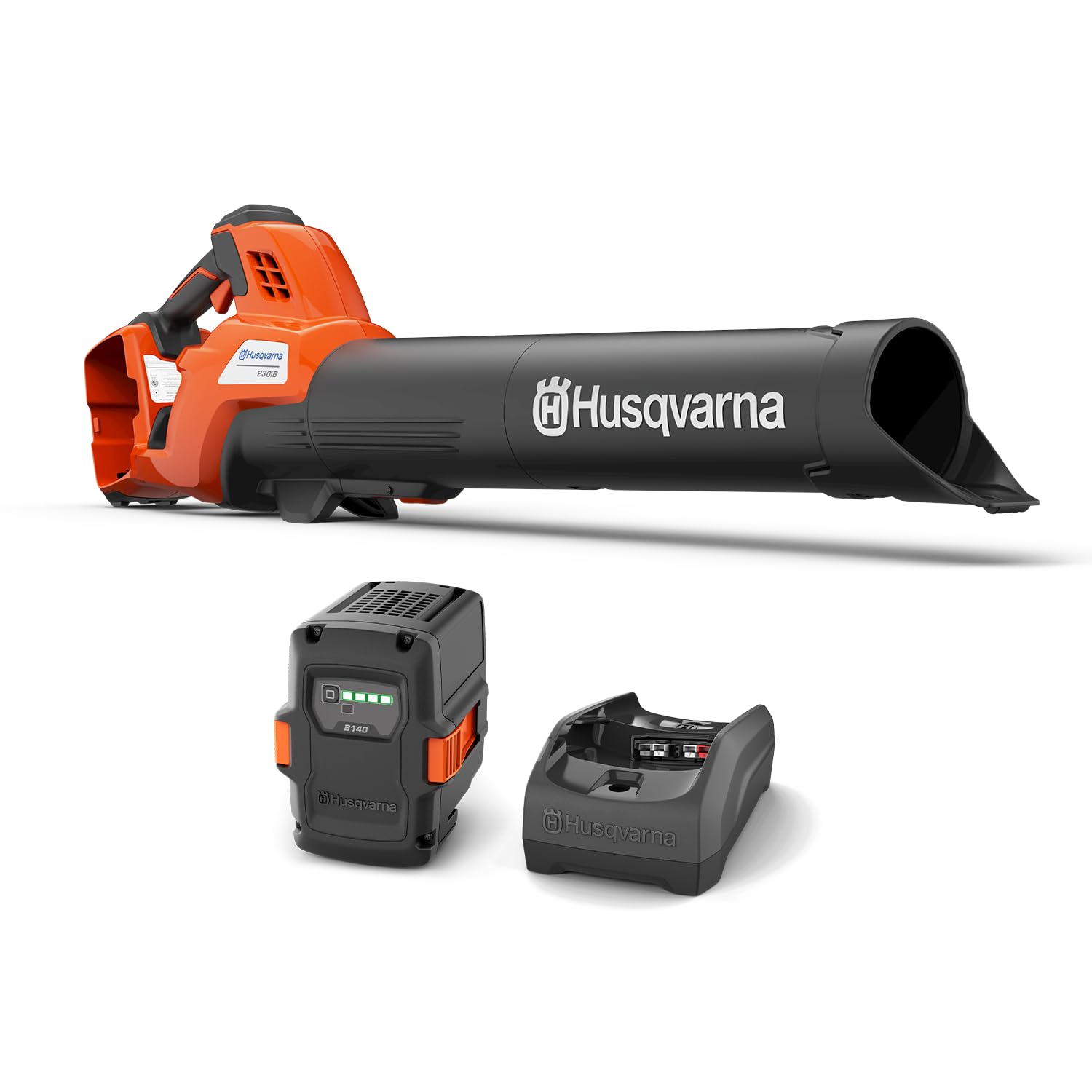
Eight hundred CFM and 200 MPH in a 10-pound body you can actually swing.
Husqvarna’s brushless motor generates 800 CFM and 200 MPH, and owners describe it as a match for gas-powered blowers — the kind of force that walks a wet leaf pile down the driveway rather than nudging it. Power boost mode adds 20 percent more when debris is stuck down, and a built-in debris scraper loosens the wet, sticky leaves that laugh at airflow alone.
Where it wins on weight: 10 pounds with the 7.5Ah BLi30 battery, and the button-and-cruise-control layout means cleanup is a press and a steer rather than a constant squeeze. It runs quiet enough that neighbors barely register it on a weekday morning. The keypad starts it instantly, no choke, no pull cord.
Battery life is the debate point, as it is with every big cordless blower. Owners split between lasting a good stretch and about 30 minutes of real work, depending on speed. Run it in boost the whole session and you land on the short end. The full kit ships with battery and charger in one package, and battery appearance can vary.
What the power crowd agrees on: 800 CFM of brushless force that moves leaves like a gas unit, with a debris scraper for the stubborn ones.
The honest limit: heavy boost sessions eat the battery, so a second pack or a slower cruise speed stretches your window.
If you want cordless force close to gas: this is the pick, with an in-one-box battery and charger.
If runtime is king over raw force: a longer-running battery model may suit you better than the biggest airflow.
8. PRORUN 75.6cc 1020 CFM Backpack Leaf Blower PBB2884

A gas backpack that delivers over a thousand CFM and lets your arms rest.
A 75.6cc 2-cycle engine pushes 1020 CFM at 240 MPH — enough volume and speed to move a serious leaf drop across a large property. The backpack frame puts that engine on your shoulders with padded straps instead of in one hand, which changes how long you can work. Owners repeatedly praise the power; the machine moves piles of leaves with authority, and it starts on the first or second pull.
The practical case is big-lot volume. There is no battery to swap and no cord to drag across the yard. If your cleanup runs to hours on acreage, the backpack form factor and the raw airflow are what you are buying, and it is priced as the friendliest gas backpack of the three here.
The honest caveat is durability at the edges. Over months, the pull cord and vibrating fasteners are the recurring notes — a loose screw or a worn cord, not a dead engine. It also weighs 32.8 pounds fully fueled on your shoulders, so a quick trim of a small walkway is not its job. This machine earns its keep on big, long jobs.
What it does well: 1020 CFM and 240 MPH from a backpack that clears large leaf piles and starts easily.
Where to watch: check the fasteners and the pull cord over time — the value is strong, but it asks for a little attention.
The fuel-and-forget choice: for acreage cleanup where airflow volume is the whole game.
Think twice if: you want a grab-and-go tool for a small patio — the 32.8-pound fuel-loaded carry is more machine than that job needs.
9. Echo 220 MPH 1110 CFM Backpack Blower PB-9010T

Eleven hundred ten CFM of gas backpack — the biggest stream here, built to clear acreage fast.
A 79.9cc 2-stroke engine drives 1110 CFM at 220 MPH, the largest air volume on this page. That headroom matters on heavy, wet autumn drops and on long fence lines where every pass counts. It is a professional-class machine, with a tube-mounted throttle that keeps your hand out on the nozzle where the work happens, plus a throttle lock so you set a speed and steer.
Owners describe force that pushes bricks around and walks 3/4-inch crushed gravel across the driveway, and it clears massive leaf piles in a hurry. For a commercial-lot or a large residential property, that combination of volume and reach is exactly what shortens the job. The backpack frame distributes the engine’s weight across your shoulders for a full-day session.
This is a serious gas tool and it costs you in effort: 2-stroke fuel mix, pull starts, exhaust and the loudest operation in this lineup. It is overkill for a patio. The reward is the raw speed of clearing you get when the volume is unconstrained — this is a machine for the jobs that would stall a battery unit.
Why it clears so fast
- 1110 CFM at 220 MPH — the highest airflow here
- Tube-mounted throttle and throttle lock for hands-on control
- Backpack frame shares the engine weight across your shoulders
- Clears heavy wet leaves and even small gravel with authority
What it asks in return
- Gas engine means fuel mixing, pull starts and louder running
- More machine than a small patio or quick cleanup needs
For the heavy-volume job: large lots and commercial clearing where the biggest air stream ends the session sooner.
Not for the small yard: if your cleanup is a few beds and a walkway, a handheld electric does it with less fuss.
Know the Specs
CFM (Cubic Feet Per Minute)
This is the size of the air stream — the volume of air leaving the nozzle each minute. A higher CFM moves a wider wall of air and pushes leaf piles faster with fewer passes. For most buyers it is the number to weigh first, because CFM sets how wide a swath you clear per pass.
MPH (Miles Per Hour)
This is how fast that air travels — the punch behind the stream. High MPH lifts heavy, wet or stuck debris off hard surfaces. A blower with moderate CFM but strong MPH is the tool for digging leaves out of gravel and cracks, while a high-CFM unit is the tool for moving whole piles.
Runtime And Battery Capacity
Battery blowers list runtime in minutes on a given pack, usually a 4.0Ah capacity — ampere-hours, a measure of how much charge the pack holds. Runtime figures assume a moderate working speed; lean on turbo and the clock shortens. That is why the same cordless machine can feel all-day at a cruise speed and brief at full throttle.
Loaded Weight And Form Factor
The spec sheet lists tool weight, but batteries and fuel add more on top. A handheld carries it all in one hand; a backpack spreads it across both shoulders. On long sessions, cruise control and a backpack frame cut fatigue more than a pound or two of listed tool weight.
Common Questions
Is a corded or battery yard leaf blower better for daily cleanup?
How long does a cordless leaf blower actually run on one charge?
How many CFM do I need to clear wet leaves?
Does higher MPH matter more than CFM?
Are battery leaf blowers as powerful as gas?
Can I use a leaf blower to clear snow and gravel?
How loud is a cordless leaf blower compared to gas?
Should I choose a handheld or backpack leaf blower?
Do I need to mix fuel for a gas backpack leaf blower?
What does a 4.0Ah battery mean on a leaf blower?
The Bottom Line
For most yards, the best yard leaf blower is the WORX WG520 — 600 CFM and 110 MPH of turbine airflow from a cord, with no battery clock to fight. If quiet dawn cleanups and a light carry matter most, the Greenworks 40V gives you 550 CFM at 78 dB in a 5.1-pound body. And when you need the biggest cordless stream, the EGO LB8803-2 pushes 880 CFM at 200 MPH with two batteries for up to 90 minutes.
Match CFM and power source to your lot size, and fall cleanup takes one pass instead of three.
How we choose
We do not accept paid placement. Every pick is matched to a real buyer and a real use-case; we do not hands-on test units.
Sources
Specifications: manufacturer listings and product documentation. Review insights: verified customer reviews, as of November 2026. Pricing: not shown on this page (it changes often); check the current price via the retailer link.
As an Amazon Associate, Tactical Gear Guy earns from qualifying purchases. This does not affect which products we feature.