Specs are compiled from manufacturer listings and verified buyer reviews and can change over time — please confirm the key details on the product page before buying.
If your Yamaha cart is sluggish off the line and you are topping up watery lead-acid cells every few weeks, the fix is a lithium pack that weighs a fraction of the old bank and holds its charge. The short answer: the Cloudenergy 48V 105Ah kit is the strongest all-round pick for 48V carts, and the Mehrpow 36V 105Ah covers the older 36-volt carts that the big 48V kits leave out. Below you get the voltage and capacity that actually fits your cart, the charge time you can live with, and the honest catch on each pack.
This guide is built by comparing the manufacturers’ published specifications and the patterns across verified customer reviews, so you get each pick’s real strengths and trade-offs instead of marketing spin.
Lithium swaps change how a cart feels, charges, and holds a hill — so match voltage, Ah, and BMS amps to your controller before you buy. This breakdown of the best Yamaha golf cart batteries shows what each kit really delivers.
Top Picks
How To Choose The Best Yamaha Golf Cart Batteries
The first thing that trips up a Yamaha owner is voltage. Your cart’s motor and controller were built for one voltage — 36V or 48V — and a lithium pack has to match it. Put a 48V pack in a 36V cart and you risk the controller; put a 36V pack in a 48V cart and it simply will not run right. Check the label on your old bank or your owner’s manual before you order anything.
Voltage first, capacity second
Once voltage is settled, capacity in amp-hours (Ah) sets your range. A 50Ah pack suits short neighborhood loops and a handful of holes. A 100Ah or 105Ah pack carries you through a full round with margin left over. Bigger capacity also means more weight, so a 105Ah pack runs heavier than a 50Ah one — factor that in if you like a light, nimble cart.
The BMS amp rating decides your hills
The BMS (battery management system — the circuit board that guards the cells) has an amp rating that caps how much current your cart can pull at once. A 100A BMS is fine for flat courses. A loaded four-seater climbing a steep grade needs more headroom, which is why the 200A and 250A packs earn their place on hilly terrain. Check your controller’s peak draw against the BMS rating before you commit.
Side-by-Side Comparison
| Model | Best For | Voltage / Capacity | BMS Amps | Included Charger | Amazon |
|---|---|---|---|---|---|
| Cloudenergy 48V 105Ah LiFePO4 Kit★ Best Overall | Most Yamaha 48V carts | 48V (51.2V) / 105Ah | 250A | 58.4V 20A | Amazon |
| Mehrpow 36V 105AhBest for 36V | 36V carts wanting big range | 36V / 105Ah | 200A | 25A | Amazon |
| Lithova 48V 50Ah Metal CaseMetal Case Pick | Short loops, tight bays | 48V / 50Ah | 120A | 58.4V 15A | Amazon |
| DC HOUSE 48V 50Ah Mini | Compact fit, flat courses | 48V / 50Ah | 100A | 48V 18A | Amazon |
| Mehrpow 36V 105Ah Systems | Steep-hill 36V carts | 36V / 105Ah | 200A | 43.8V 25A | Amazon |
| DC HOUSE 48V 100Ah Metal Case | Long range, full rounds | 48V / 100Ah | 200A | 48V 18A | Amazon |
| Elefast 48V 105Ah Kit | Touchscreen monitoring | 48V / 105Ah | 200A | 58.4V 18A | Amazon |
| OGRPHY 48V 100Ah | Fast charge, remote diagnostics | 48V (51.2V) / 100Ah | 200A | 58.4V 18A | Amazon |
| HumsiENK 48V 100Ah 2-Pack | Big builds, twin packs | 48V / 100Ah (x2) | 200A | Not included | Amazon |
Detailed Reviews
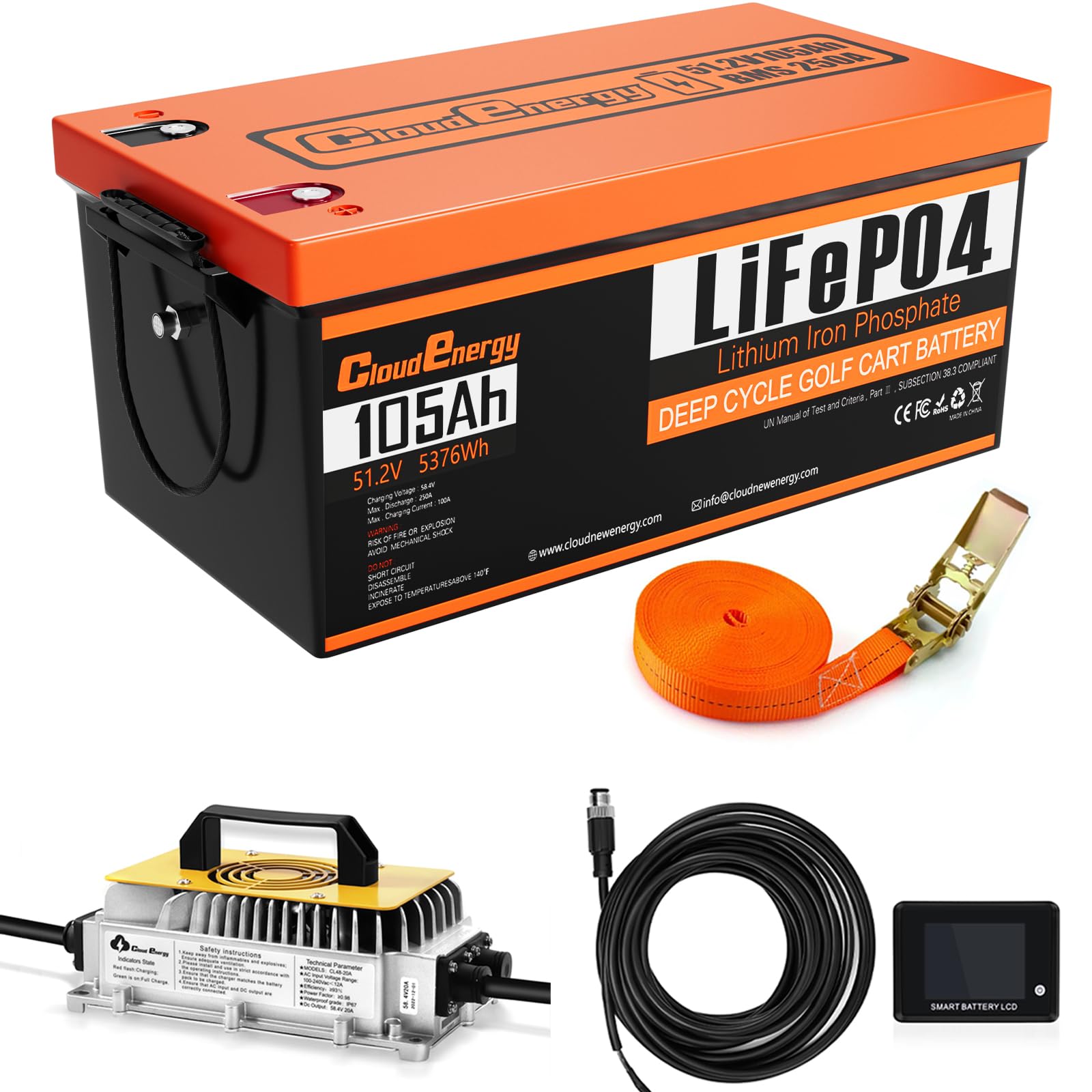
1. Cloudenergy 48V 105Ah Lithium Golf Cart Battery
Our pick — 4.5+★ from 400+ verified ratings; the strongest balance of quality and price.
The complete swap-in kit that carries a 250A BMS and a touchscreen in one box.
This is the pack most Yamaha 48V owners end up with, and the spec that earns it is the 250A BMS — the circuit board that guards the cells and caps current draw. That 250A ceiling is a big step above the 120A guard on the Lithova and the 100A limit on the DC HOUSE Mini, which means a loaded four-seater pulling hard up a grade has real headroom instead of tripping protection. The 105Ah capacity at 48V gives you genuine days between charges rather than a nervous countdown.
Everything you need ships together: a 58.4V 20A fast charger, a 2.8-inch LCD touch screen for live battery readouts, and a 78.74-inch mounting strap to lock the pack down. No hunting for a separate charger or a display to add later. The 250A BMS ships with low-temperature cutoff, so charging stops on its own when the pack gets too cold, and the ABS case is IP67 rated — sealed against dust and water — for carts that live outside or get hosed down.
Buyers report roughly 30 miles per charge, and the pack sheds around 300 lbs against the old lead-acid bank, which is why the cart feels quicker and climbs without strain. The maker bills the pack at more than 6000 deep cycles at 80% depth of discharge, against only about 300 to 600 cycles for lead-acid. As owners put it, install is quick — one conversion is described as done in about 2 hours — and the pack is well worth the money.
Where this kit pulls ahead
- 250A BMS gives the most current headroom of the mid-range pack — more than the 120A Lithova and 100A DC HOUSE Mini.
- Charger, touchscreen, and strap all included, so there is nothing extra to buy.
- IP67 case and low-temperature cutoff suit unheated garages and wet storage.
- Around 6000 deep cycles at 80% depth of discharge, per the maker.
What deserves a second look
- At 82.7 pounds it is far from featherweight for one person to lift into the bay.
- 48V only — no use in a 36V cart.
- Verify your battery compartment clears the 10.59″D x 20.55″W x 8.66″H footprint before ordering.
Go for this if: you run a 48V Yamaha and want the fullest all-in-one package with the strongest current margin in the mid tier.
Pause if: your cart is 36V, since this pack will not suit that motor and controller.
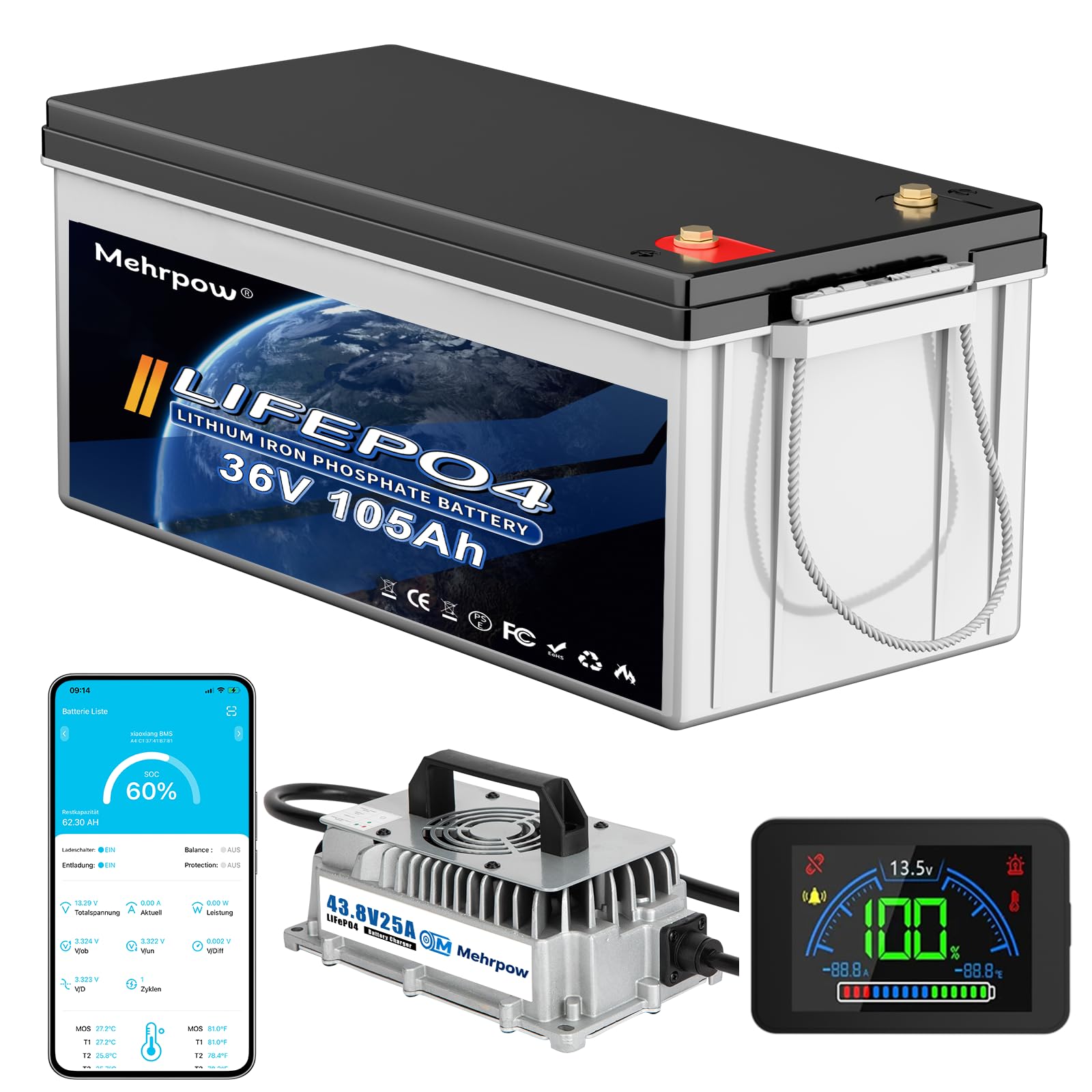
2. Mehrpow 36V105Ah lithium golf cart Battery with Charger
The 36V pack that keeps older carts in the game with 105Ah of range.
Older Yamaha carts run 36V, and most big lithium kits skip that voltage entirely. This one does not. It packs 105Ah at 36V into a 27 kg case, which is billed as 60% lighter than the lead-acid bank it replaces, so the cart turns in quicker and accelerates harder off the line. The 3.84kWH capacity and 5KW maximum motor power give you real hill ability, and the maker lists a 40-50 mile range, though a buyer’s real-world 30 miles is the figure to plan around.
The control hardware is where this earns trust. The upgraded 200A BMS throws a 1000A peak current for a 3-second pulse to clear inclines up to 25°, with the usual overcharge, over-discharge, overcurrent, short-circuit, and temperature guards. What buyers respond to most is that it simply works and installs clean — it is said to connect right from the start. Two ways to watch the pack, a Bluetooth app and an LCD display, both read voltage, current, and state of charge in real time.
Cold-weather protection is baked in: it stops charging below 0°C/32°F and stops discharging below -20°C/4°F, so a frozen garage does not become a dead-cell problem. Weight is 27 kg, so get a second set of hands for the drop-in. Fitment runs to Club Car, EZ-GO, Yamaha, and LVTONG, plus boats, motorhomes, and camping gear if you want the pack to double up off the course.
The light-packing payoff: a 36V 105Ah LiFePO4 pack at 27 kg replaces the old lead-acid blocks and keeps a 36V motor alive without a controller swap.
The natural fit: 36V Yamaha owners who want big range and a Bluetooth-monitored BMS without changing voltage.
Not your pack: if your cart runs 48V, this voltage will not match your controller.
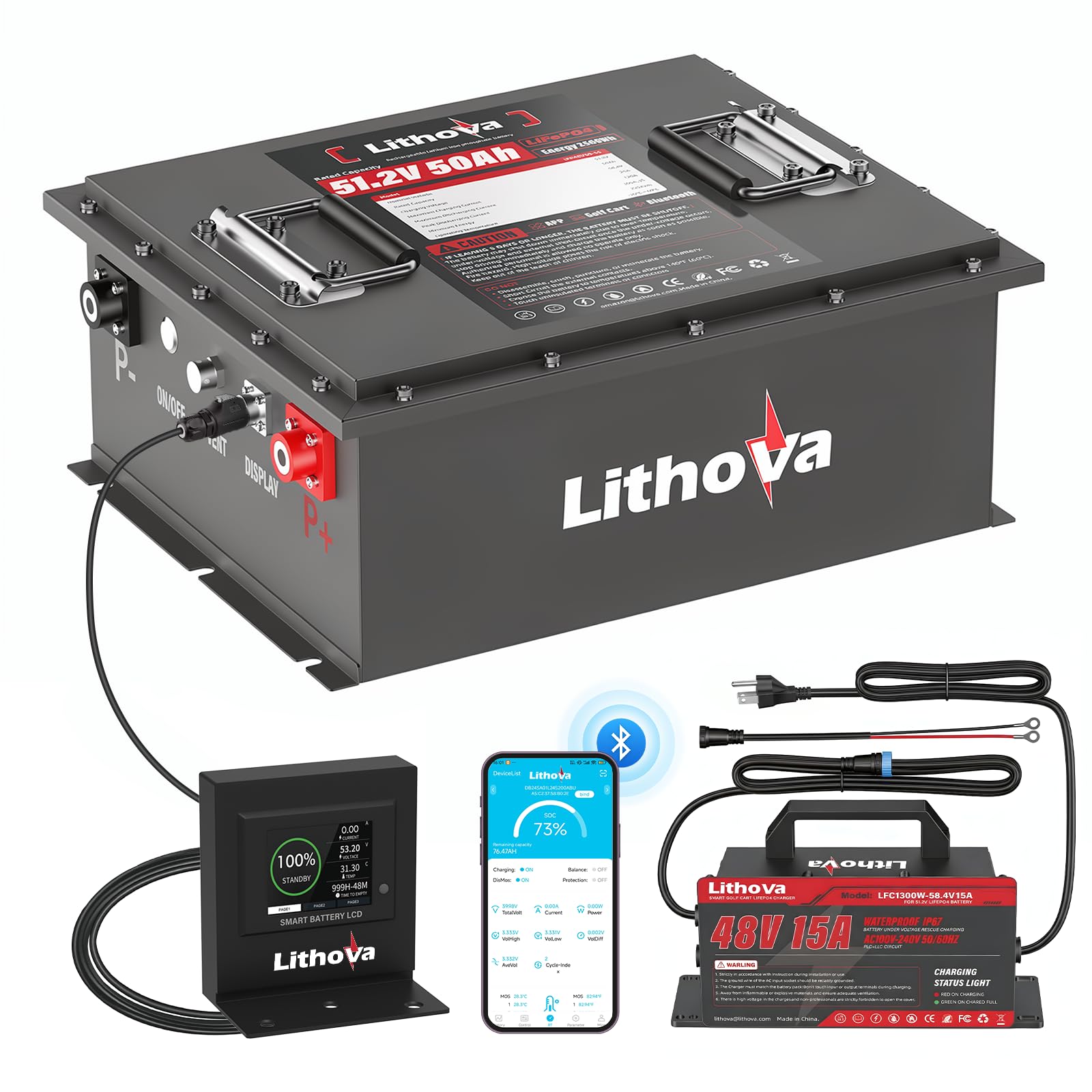
3. Lithova 48V 50Ah Lithium Golf Cart Battery
The armored case you pick when you want a lighter pack without losing a full round.
Most lithium packs arrive in plastic. This one ships in a sturdy, fireproof, anti-collision sheet metal case with a vent and a one-key safety switch, and the maker claims the metal casing stands up to impact better than ordinary ABS-cased batteries. It also uses semi-solid LiFePO4 cells, which the maker says will not catch fire or explode even when pierced by a metal needle — a peace-of-mind angle on a heavy metal box bolted under your seat. The locking bracket holds the semi-solid cells in place and the maker claims it lowers swelling risk.
The 48V 50Ah capacity suits the short-trip owner: a 25-mile range covering 3-5 rounds of 18 holes, enough for a cart that stays near the clubhouse. A 120A BMS with 6.14KW constant discharge and 18.4KW peak power handles the climbs. The included 15A charger runs at 900W and the maker lists a full charge in 3.3 hours, with auto-stop when done.
You get an LCD touchscreen or phone app for battery capacity, voltage, and fault checks from anywhere on the course, plus a low-temperature cutoff that stops charging in extreme cold. The catch is capacity: 50Ah is a step down from the 105Ah Cloudenergy, so the 105A BMS headroom on this one sits below that pack’s 250A too — a reminder that this is a short-trip tool, not a marathon pack.
The armor question: the metal case and semi-solid cells are the whole pitch here — if you want physical toughness over outright capacity, this is built for exactly that.
Made for: a 48V cart doing regular short loops where a rugged metal case ranks above total range.
Look elsewhere if: you need 100Ah-class range or a stronger current margin for a heavy-loaded cart.
4. DC HOUSE 48V 50Ah Mini Lithium Golf Cart Battery Kit

A slim 50Ah pack that slips into cramped bays and charges in about three hours.
When the battery compartment on your Yamaha is tight, this is the one to measure for first — the compact, stackable design helps it use the space you actually have. It is still built around a 50Ah LiFePO4 bank of A-grade cells rated for more than 4,000 cycles, so it carries you through daily cart duty without the lead-acid upkeep. Need more? Two identical packs can run in parallel for up to 100Ah, though the maker warns against series wiring and says peak current must stay under 100A when running a pair.
The built-in monitor shows battery percentage, voltage, current, capacity, and operating data across three interfaces. Bluetooth lets you pull voltage, current, state of charge, and battery health off your phone whenever you want to check. The included 18A charger fills it in roughly 3 hours and guards against overvoltage, overcurrent, short circuits, and overheating, plus a 0V mode that can reactivate the battery after BMS protection has tripped.
The 100A BMS is the number to weigh against the bigger packs — it caps current draw lower than the 200A and 250A units, so a heavy-loaded cart on a steep grade will not have the same headroom. Cold-weather protection is handled with an operating range of 0°C–55°C for charging and -20°C–55°C for discharging. Owners mention a cart that runs far quicker after the swap and shaves weight against the old bank.
Reach for this if: your bay is short on room and flat-course duty is your normal day.
Think twice if: you pull hard current up long grades, where the 100A BMS ceiling is the limiting factor.
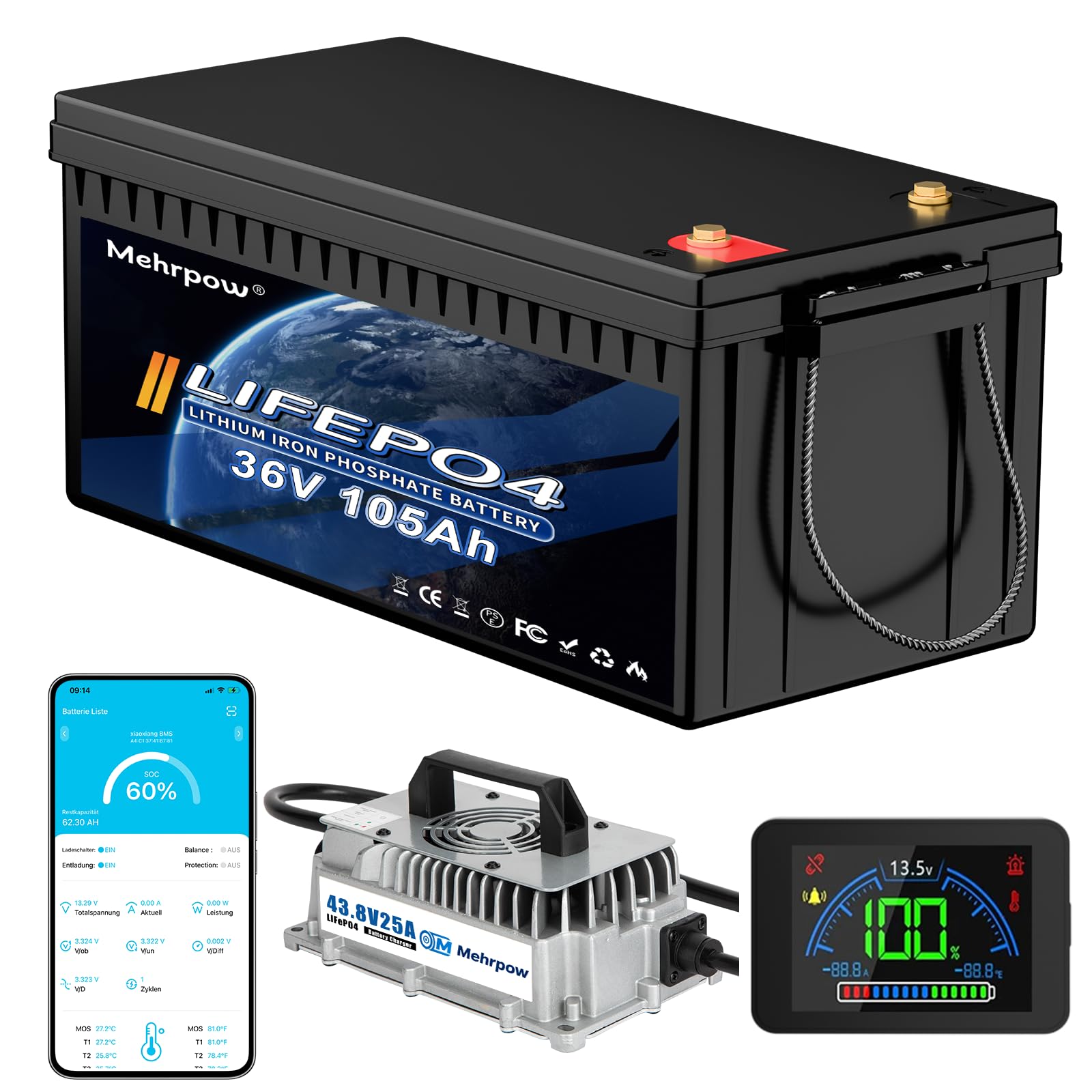
5. Mehrpow 36V 105Ah LiFePO4 Golf Cart Battery for 36V Systems
A 36V pack that pulls hard on steep grades and keeps its charge for days.
Steep hills are where a weak pack shows its limits, and this 36V 105Ah Mehrpow is built to answer them. The 200A smart BMS guards against overcharge, over-discharge, overcurrent, short circuits, and temperature issues, and the LiFePO4 chemistry is made for deep cycling with less maintenance than lead-acid. Customers note a cart that pulls well on steep hills and holds its charge for 3-4 days between top-ups — the kind of behavior you want when the cart sits idle between weekend rounds.
Capacity here is 105Ah at 36V, and the maker lists a 30-40 mile range, though plan around a real-world 30-40 figure rather than the top end. You can watch the pack through the Bluetooth app or the LCD display, and low-temperature protection manages charging and discharging in cold. It is a walk-in fit for Club Car, EZGO, Yamaha, and LVTONG carts, with a 20-milliohm internal resistance spec that tracks to a healthy, stable cell build.
Two things to note. It weighs 27 kg, so it is not a one-hand lift. And because it is 36V, it will not serve a 48V cart — the voltage has to match your motor and controller. Buyers praise the fit and the weight drop against the old lead-acid blocks, which is the change you will feel in the first hundred feet.
Why it holds a hill
- 200A BMS guards the cells while clearing real grades.
- 105Ah at 36V with a maker-listed 30-40 mile range.
- Bluetooth app plus LCD display for live status.
- Low-temperature protection for charging and discharging.
The fine print
- 27 kg means a two-person job to drop in.
- 36V only — no fit for 48V carts.
- Weight and top-end range are maker figures; the everyday number runs lower.
Your pack if: you own a 36V cart with real elevation on your route and want charge that lasts days.
Not for you if: your cart is wired for 48V.
6. DC HOUSE 48V 100Ah Lithium Golf Cart Battery Kit

The metal-cased 100Ah pack built for full rounds and long days on the course.
Volume is the headline on this DC HOUSE: 100Ah at 48V in a fireproof, anti-collision sheet metal case that the maker says outlasts ordinary ABS-cased batteries. The 200A BMS handles 2C discharge and throws a 670A peak for half a second, so a loaded cart climbs and accelerates without stalling. Six BMS protections include low-temperature cutoff that stops charging at 32-131°F and discharging at -4-131°F, which matters for a cart parked in a cold garage.
Range is the headline: the maker lists up to 56 miles, and reviewers point out four rounds of golf with a quarter of the charge left. That is a step above the Lithova’s 25-mile figure and beyond the DC HOUSE Mini’s shorter run. Metal fixtures secure grade A cells and the maker says they cut swelling risk. A 48V 18A charger fills the pack in 5.5 hours with auto-stop, and a Bluetooth LCD monitor pairs with the app so you can read capacity, voltage, and fault codes from your phone.
Fit is the honest caveat: the maker itself warns that varying battery compartment designs can cause improper fit, so measure your bay and check it against the 11.1″D x 20.3″W x 9.6″H footprint before you buy. At 95.9 pounds it is a two-person install. And you get a 3-year warranty, shorter than the 5-year coverage some rivals list, so factor the longer-term support into the choice.
The range headline: a maker-listed 56 miles on a 100Ah pack is the figure that makes this a full-round workhorse rather than a short-trip standby.
For the long day: 48V cart owners who want maximum range and a rugged metal case.
Consider the shorter warranty: 3 years here versus the 5-year cover some picks list.
7. Elefast 105AH 48V Lithium Battery Golf Cart Kit

The pick for the tinkerer who wants a touchscreen and the specs to back it up.
If you like watching your pack’s numbers in real time, this Elefast puts a 2.8-inch LCD touch screen right in the kit. Tap through it to see and control the battery live, or drop into Bluetooth and monitor from your phone. The 105Ah capacity at 48V rides on automotive-grade Grade A+ EVE cells with a stable 5.37kwh of energy and a very low self-discharge rate, so capacity stays where you left it. The maker claims the pack is 20% more powerful than other lithium batteries and clears the 3C discharge limit with a 1000A peak for 3-5 seconds.
Charging is brisk: the included 58.4V 18A LiFePO4 charger fills the pack from 0% to 100% in 5.8 hours, which the maker frames as faster than a typical 5A unit. The 200A intelligent BMS blocks overcharging, overdischarging, overloads, high temperature, and short circuits, and it drops low-temperature cutoff when the temperature sensor reads below -4°F or 32°F. The maker lists 6000+ deep cycles and claims 10-plus years of service. Range, per the maker, is up to 50 miles on a charge.
The compatibility line is wide — EZGO, Club Car, Yamaha, and ICON controllers — and the maker provides an install video for a one-person job with no complex wiring. The honest note: the maker’s spec sheet is packed with headline claims, and the 5-year after-sales service is the thing to confirm in writing. At 100 pounds it is a two-person install, and the 12.6″D x 20.08″W x 8.86″H footprint needs measuring against your bay.
Built for: owners who want touchscreen control and a fast 18A charger in one kit for a 48V cart.
Do not order for: a 36V cart, since the voltage will not match.
8. OGRPHY 48V 100Ah Lithium Golf Cart Battery

A 100Ah pack with a 6-hour charge and app diagnostics from anywhere.
The 6-hour charge is the pitch: the included 58.4V 18A charger runs at 90% efficiency to fill this 100Ah pack, so you can do a full top-up overnight and roll out the next morning. The 200A BMS handles overcharge, over-discharge, short circuit, and temperature protection, and the IP65-rated housing is built to shrug off water and dust better than a lead-acid bank. This one is a 51.2V pack in a 100Ah shell, and the maker lists a 50-mile range with a stable speed over 25 MPH.
Monitoring is the other strength. The Bluetooth module connects to a phone app for voltage, cell balance, and temperature in real time, and the LCD touchscreen adds 24/7 remote diagnostics — handy when you want to check state of charge without walking out to the cart. The maker claims more than 4,000 deep cycles and a 10-year lifespan from self-balancing cells, backed by a 5-year warranty and 24-hour technical support.
Two things to weigh. At 88.1 pounds it is a substantial lift, so plan for two people. And the maker’s 1000A peak and 50-mile range are headline figures — real-world range on a big 48V cart tends to land under the top claim, so plan around the published number with a little room to spare. The 5-year warranty and US-warehouse dispatch are the trust anchors here, not the marketing math.
Fits well if: you want a fast overnight charge and phone-based monitoring on a 48V Yamaha.
Not a match if: your cart runs 36V, or you want the absolute lightest pack to lift alone.
9. HumsiENK 48V 100Ah Golf Cart Battery 2Pack

Two metal-cased 100Ah packs for the build that needs serious capacity headroom.
This HumsiENK ships as a two-pack: two 48V 100Ah batteries, each with its own monitor, so you get a matched pair for a big build rather than buying twice. Each pack runs a 200A smart BMS with a 10.24kW continuous output and a 700A (1s) peak burst, which the maker aims squarely at fully loaded four-seaters climbing steep inclines. The cylindrical LiFePO4 cells sit in a heavy-duty, impact-resistant metal casing that the maker says dissipates heat faster than plastic and includes a forced power switch for instant one-touch BMS resets.
Monitoring is generous for a two-pack: each battery comes with an external LCD screen that mounts to the dash for visible real-time readings, plus a Bluetooth 5.0 app for state of charge, live voltage, temperature, and cell health. Weight per pack is 89.4 lbs, and the maker says the swap sheds 150-plus pounds versus 4-to-6 lead-acid blocks. Range is listed at over 50 miles per charge, and the BMS includes a low-temperature cutoff that blocks charging below 0°C (32°F) to protect the cells in a freezing garage. The packs are IP65 and carry CE, FCC, RoHS, and UN38.3 listings.
The honest catch is in the charger: this kit does not include one, so you supply the charging hardware for both packs. Charging performance is also the mixed note in the reviews — worth reading the fine print if fast top-ups matter to you. At this capacity you also need to confirm both packs clear your battery compartment, and the 10.47″D x 23.35″W x 8.54″H footprint runs long for a tight bay.
For the big build
- Two matched 100Ah packs with a monitor each.
- 700A peak burst for steep, loaded climbs.
- Metal casing with a one-touch BMS reset switch.
- Over 50 miles of range per charge, per the maker.
Weigh before you buy
- No charger included — you supply both.
- Charging performance reads mixed in buyer feedback.
- Two packs of this size need real bay space and two sets of hands.
The right call for: a heavy-duty dual-pack build where capacity headroom and peak power matter most.
The honest holdback: no charger in the box, so budget the charging setup into your plan.
Know the Specs
Voltage (36V vs 48V)
Voltage is the one spec you cannot fudge. Your Yamaha’s motor and controller were built for either 36V or 48V, and a lithium pack has to match. A 48V cart needs a 48V pack; a 36V cart needs a 36V pack. Getting this wrong risks the controller or leaves the cart unable to run, so check the old battery label or the owner’s manual before you order.
Capacity (Ah) and Range
Ah, or amp-hours, sets how far you go between charges. A 50Ah pack suits short neighborhood loops and a few holes. A 100Ah or 105Ah pack carries you through a full round with margin. Higher capacity runs heavier, so a 105Ah pack weighs more than a 50Ah one — the trade-off between range and a light, nimble cart.
BMS Amp Rating
The BMS is the circuit board that guards the cells and caps current draw. Its amp rating tells you how much power your cart can pull at once. A 100A BMS suits flat courses; a loaded four-seater on steep terrain wants a 200A or 250A ceiling. Check your controller’s peak draw against the BMS rating before you buy.
Charger Amperage and Charge Time
The charger’s amp rating decides how long you wait. A 15A charger is more relaxed; an 18A or 20A charger tops up faster. Match the charger to the pack and confirm it ships in the box — some kits leave it out. Auto-stop when full and low-temperature cutoff are the safety features to look for.
Common Questions
How do I know if my Yamaha cart needs a 36V or 48V battery?
Can I put a 48V lithium pack in a 36V Yamaha cart?
What is a BMS and why does its amp rating matter?
How many miles of range can I expect from a 105Ah pack?
Will a lithium pack save weight over my lead-acid batteries?
Do these lithium kits work in cold weather?
How long does it take to charge a 48V lithium golf cart battery?
Do I need a separate charger or is it included?
What happens if the pack does not fit my Yamaha battery compartment?
How long do these lithium golf cart batteries last?
The Bottom Line
For most 48V Yamaha owners, the yamaha golf cart batteries winner is the Cloudenergy 48V 105Ah kit because it pairs the strongest current margin in the mid tier — a 250A BMS — with a charger, touchscreen, and IP67 case all in one box. If you are running an older 36V cart, grab the Mehrpow 36V 105Ah, which keeps 105Ah of range on a voltage the big kits skip. And for the heavy-duty dual-pack build that needs peak power and capacity headroom, the HumsiENK 48V 100Ah two-pack is the one to plan around — just add your own chargers. One nudge worth acting on: the Cloudenergy holds the highest score among the volume sellers here, 400+ owners have rated it 4.5+ stars, and that track record is the strongest single reason to start your shortlist there.
How we choose
We do not accept paid placement. Every pick is matched to a real buyer and a real use-case; we do not hands-on test units.
Sources
Specifications: manufacturer listings and product documentation. Review insights: verified customer reviews, as of November 2026. Pricing: not shown on this page (it changes often); check the current price via the retailer link.
As an Amazon Associate, Tactical Gear Guy earns from qualifying purchases. This does not affect which products we feature.