Specs are compiled from manufacturer listings and verified buyer reviews and can change over time — please confirm the key details on the product page before buying.
Your neighbor’s Yamaha charger may not fit your cart at all, and the plug is why. Yamaha G19 and G22 carts use a 2-pin connector, while G29 Drive and Drive2 carts use a different end. Match the plug first, then pick the amperage (the charging current, in amps) and charging logic that fit how you actually use your cart.
This guide is built by comparing the manufacturers’ published specifications and the patterns across verified customer reviews, so you get each pick’s real strengths and trade-offs instead of marketing spin.
Fit is the first filter, but charging speed, weatherproofing, and whether a unit can leave batteries topped up for weeks all shape what you live with. Below is a plain-English walkthrough of the yamaha 48 volt golf cart charger options that earn their place.
Top Picks

How To Choose The Best Yamaha 48 Volt Golf Cart Charger
Start with the socket on your cart, not the charger listing. A charger built for a Yamaha G19 will physically refuse a Yamaha G29’s charging port, and no amount of clever charging tech fixes a plug that will not seat. Confirm your cart model and the shape of the existing plug before you read another spec.
Match the connector before anything else
The Yamaha G19 and G22 generation uses a 2-pin Yamaha plug. The G29 Drive and Drive2 use a 4-pin leaf plug on some units and a 3-pin round plug on others. Universal chargers like the multi-vehicle ZEKOODL use bare M8 ring terminals instead, which means wiring rather than plugging in. Get this wrong and the charger sits in a box.
Decide how fast you actually need to charge
A 15A charger pushes more current per hour than a 6A trickle unit, so a full top-up happens in a shorter session. A trickle charger is the opposite tool — it holds a battery at level over long idle stretches rather than racing to full. Daily drivers benefit from amperage; seasonal carts often do fine with a slower, gentler hold.
Check the weather rating if the charger lives outdoors
An IP67 rating means the housing is sealed against dust and against short water immersion — a real comfort if your charger hangs on a garage wall or rides on an open trailer. A charger with no stated rating belongs under cover.
Know if you want repair or just charging
Most of these units only charge; they will not rescue a dead or sulfated pack. A few add dead-battery activation and multi-stage maintenance logic. If your pack is healthy, plain charging is enough. If it has sat all winter, the rescue features start to matter.
Side-by-Side Comparison
| Model | Best For | Amperage | Connector | Weight | Amazon |
|---|---|---|---|---|---|
| MODZ Max48 (G19-G22)★ Best Overall | G19/G22 owners wanting a light, sealed fast charger | 15 A | 2-Pin Yamaha | 7 lb | Amazon |
| ZEKOODL 48V Smart ChargerSmartest Charger | Multi-vehicle owners with bare-terminal batteries | 15 A | M8 | 5.5 lb | Amazon |
| 10L0L 15A Yamaha G29 | G29 owners who want app monitoring and OBC flexibility | 15 A | 3-Pin Round | 7.7 lb | Amazon |
| MODZ Max48 (G29 Drive) | Drive and Drive2 owners wanting proven durability | 15 A | 4-Pin Leaf | 7 lb | Amazon |
| MAX 48 Crowfoot | Carts with a crowfoot receptacle | 15 A | Crowfoot | 8 lb | Amazon |
| Schauer JAC1548H | G29 owners wanting adjustable lead-acid profiles | 15 A | 3-Pin | — | Amazon |
| Smart Parts 48V 6A | Seasonal carts that sit idle | 6 A | Yamaha G19/G22 | 2.6 lb | Amazon |
Detailed Reviews
1. MODZ Max48 15 AMP Golf Cart Battery Charger
Our pick — 4.5+★ from 200+ verified ratings; the strongest balance of quality and price.
An older Yamaha cart gets modern sealed fast charging without the bench-press weight.
If you own a Yamaha G19 or G22, this is the charger that makes the least fuss. It runs 15 amps through a 2-pin Yamaha plug that seats directly into the older cart’s socket, so there is no adapter hunt. It weighs 7 pounds and comes with a carry handle, which means hauling it from the garage to the cart is a one-hand job.
Owners describe this as a straight upgrade over the factory Yamaha charger, and the numbers back the pace: 15 A versus 6 A on the Smart Parts trickle unit further down, so a full charge comes around faster. It also takes less wall space, at 3″D x 11″W x 6″H versus 8″D x 16″W x 8″H on the G29 version of the same MODZ line. The die-cast aluminum alloy casing takes knocks without complaining. The IP67 rating (sealed against dust and brief water immersion) suits a wall-mounted life in a damp garage. Eight feet of AC cable plus eight feet of DC gives you 16 feet of total reach to the nearest outlet.
The catch is what it does not do — a MODZ Max charges a healthy pack but will not diagnose or revive a damaged battery. If your pack has sulfated over a long idle season, buy a rescue-capable charger instead. Also note the “plug and forget” soft switch holds a battery at level rather than racing it, so an all-day charge from empty takes time. The charger is charging-only by design and the maker states this plainly.
Where it earns its keep
- 15 A output through a 2-pin Yamaha plug — seats in a G19 or G22 socket without an adapter
- IP67 sealed housing shrugs off garage damp, dust, and trailer vibration
- 7 lb with a carry handle, versus OEM chargers that feel like boat anchors
- 16 feet of combined cable lets the cart sit far from the outlet
What to weigh first
- Charging only — no battery diagnostics or repair for a weak pack
- Higher power draw means you notice the amperage on a home circuit differently than a trickle unit
Reach for it if: you run a Yamaha G19 or G22 and want a sealed 15 A charger you can carry one-handed.
Choose a rescue unit instead: if your batteries have sat flat and need reviving rather than topping up.
2. 48V Battery Charger 15A 1000W
One 15A charger for the cart, the boat, and the shed — if you can wire it in.
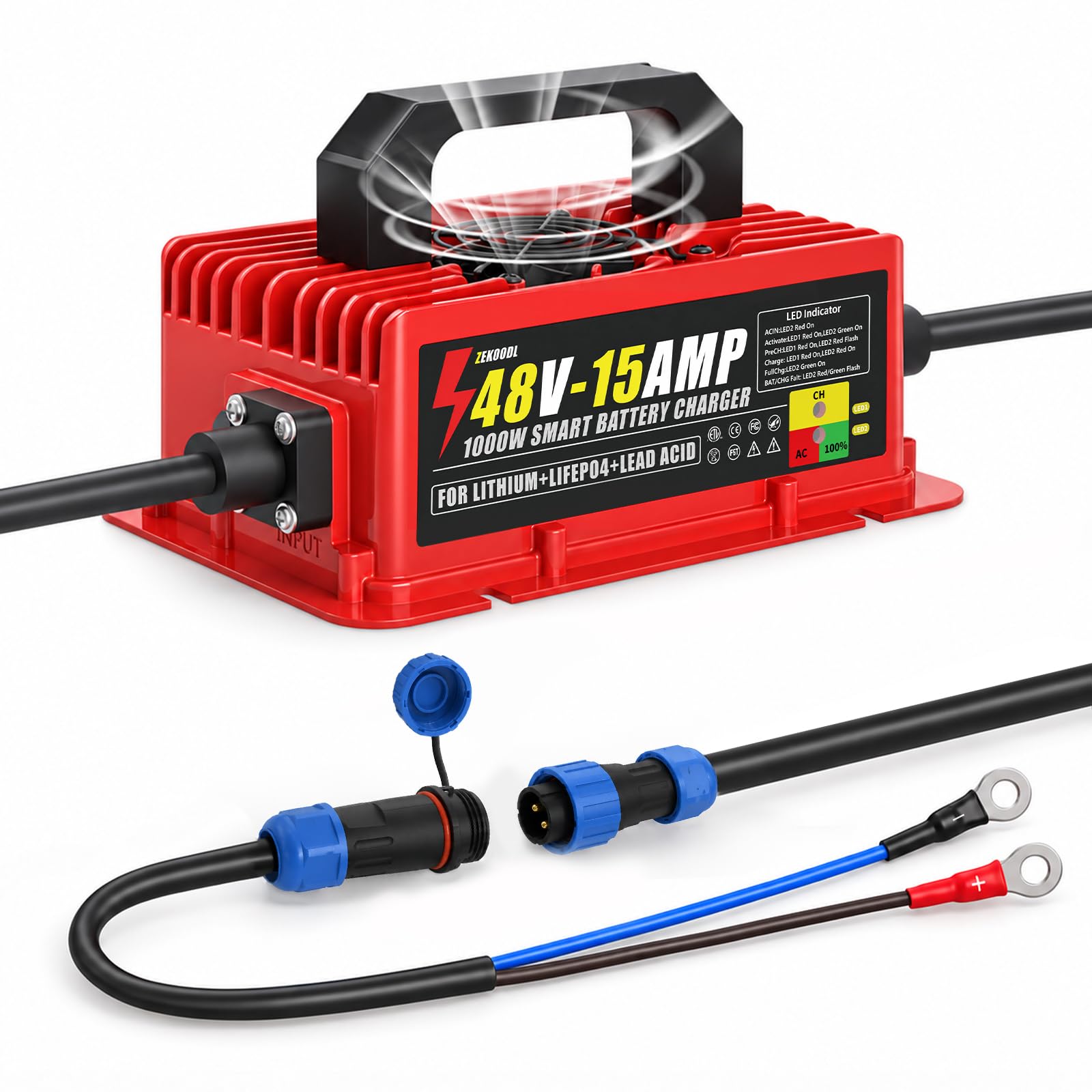
The selling point here is 1000W of continuous output that adapts its charging profile to the chemistry it finds. That covers LiFePO4, lithium-ion, and every lead-acid flavor including AGM, GEL, EFB, and MF. For a shed holding a Yamaha cart, a forklift, and a boat, one charger doing all three is a tidy answer.
The safety layer is where this one separates itself. It can revive a fully discharged 0V battery and reset a BMS-locked lithium pack. The 8-stage algorithm watches for overcharging, overvoltage, short circuits, and reverse polarity across the whole charge. A 12-hour auto-shutoff timer means you can plug in overnight without babysitting it. The cast-aluminum shell carries an IP67 waterproof, dustproof, and shockproof rating, and the maker lists an operating window from -4°F to 140°F. An internal fan holds temperatures down during sustained 15A runs.
Here is the honest trade-off: the M8 connector is a bare ring terminal, not a Yamaha plug. You need to attach it to your battery terminals yourself rather than click it into the cart’s socket. That is fine for a battery-bank owner and a nuisance for someone expecting a plug-and-go fit. It weighs 5.5 pounds and ships with a 16-foot heavy-duty cable, so the extra reach does offset some of that wiring work.
The real reason to pick it: the chemistry flexibility. One charger covers a golf cart, an RV house bank, a trolling setup, and a floor scrubber without juggling three separate bricks.
The wiring caveat: ring terminals mean a deliberate install, so this suits a battery-savvy owner more than someone who just wants to clip the cart’s existing plug in.
Best fit for: a multi-vehicle owner who wants one heavy-duty smart charger and does not mind wiring the terminals.
Look elsewhere if: you want the charger to clip straight into a Yamaha cart socket.
3. 10L0L 15 Amp 48 Volt Golf Cart Charger for Yamaha G29
A G29 charger that tells your phone exactly what the pack is doing.
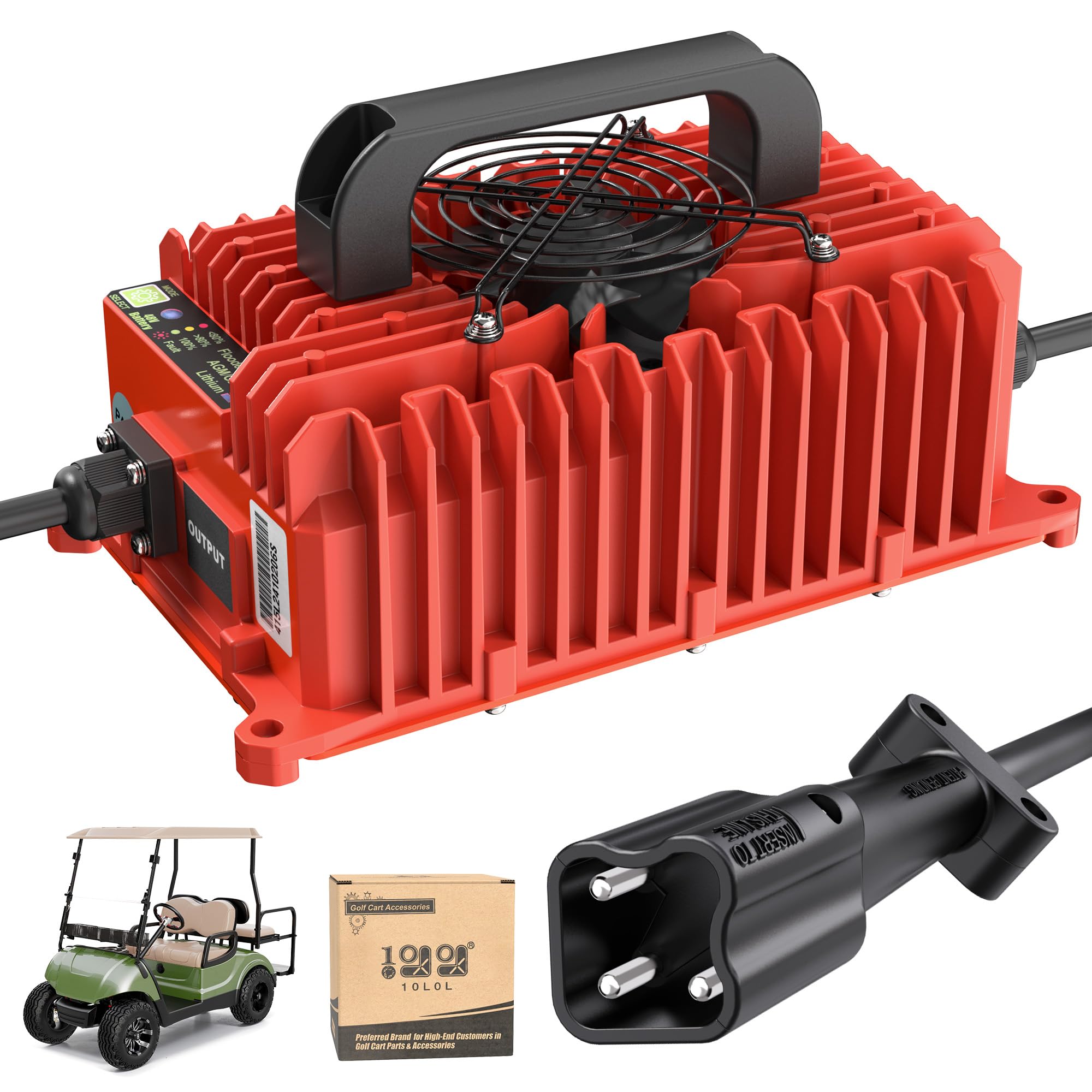
The 10L0L is the pick for a G29 owner who wants app-based charge data. A dedicated app streams real-time charging progress, historical data, and instant fault alerts, and lets you adjust the charging curve from the phone. That is unusual in a golf cart charger and genuinely useful if the cart lives in a shared community rack and you want to know the last session finished cleanly.
The core spec matters too: 15A at 48 volts brings a Yamaha G29 pack to full in 10 hours. Compared with the Smart Parts 6A trickle unit, that shorter top-up window is the difference between an overnight session and a flat cart on a Friday evening. Three battery chemistries are supported — lead-acid, maintenance-free, and lithium iron phosphate — so it adapts across whatever your G29 carries.
OBC-compatible cables let it work on carts with or without an onboard computer, which is the exact pain that trips people on a G29. Aluminum casing plus dual cooling fans handle overheating, and an IP67 rating seals it against water, dust, and vibration. Total cable reach is 121 inches plus 89 inches, enough to stretch from a wall outlet to the cart nose without an extension cord. The 7.7-pound body is portable enough to move between bays.
What makes it different
- App monitoring and fault alerts from the phone — real-time, not after-the-fact
- Three chemistry support including LiFePO4 handling
- OBC and non-OBC cable kit covers both G29 builds
- IP67 sealed with dual fans for long 15A runs
Where it asks for attention
- 10-hour charge time means planning ahead on a long day
- App reliance adds one extra thing to set up before the first charge
The ideal owner: a G29 driver who wants visibility — a phone-side view of charge state and faults.
skip it if: a simple one-button charger with no app step is all you want to deal with.
4. Max48 15 AMP Golf Cart Charger

A die-cast aluminum body built to survive trailer travel and garage knocks.
Drive and Drive2 owners get the same Max48 chassis as the G19 pick, here fitted with the 4-pin leaf plug these carts use. The 15A rating means overnight sessions, and owners consistently report the pack is fully charged by morning. The die-cast aluminum alloy casing is the same tough build across the line, and buyers report its durability holds up when the charger travels rather than stays on a wall.
The specs that decide the buy: IP67 weather rating for damp and dust, a soft-switch “plug and forget” behavior that holds without draining the pack, and the same 16 feet of combined AC plus DC cable. At 8″D x 16″W x 8″H it is the larger footprint of the two MODZ variants in this list, so wall space is a real consideration. The 7-pound weight still moves easily with the handle.
What you give up is battery rescue. This is a charging-only unit — it will not repair a damaged or defective pack, and the maker says so directly. If your cart sat flat over a winter, plan for a separate reconditioning step. The 18-month warranty offers real coverage, though, which softens the risk on a unit you expect to run for years.
The design worth trusting: the same tough body uses a 4-pin leaf plug that seats into the G29 Drive and Drive2 port without an adapter, plus a warranty term that says the maker expects it to last.
The gap to note: no diagnostics. This charger expects a healthy pack, so pair it with a battery care routine if your cart sits idle.
Right for you if: you drive a G29 Drive or Drive2 and want a sealed, warrantied 15A charger that travels well.
Think twice if: your batteries are already tired and need reviving.
5. MAX 48 Golf Cart Rapid Charger

A crowfoot connector that plays with more cart brands than any other pick here.
The crowfoot plug is the reason to look at this one. It connects to compatible 48V carts across Bad Boy Buggies, Club Car, Columbia ParCar, Cushman, EZGO, Fairplay, Harley Davidson, Hyundai, Karrior, Legend, Melex, Noland, Nordskog, Pargo, Taylor-Dunn, Tomberlin, Westinghouse, and Yamaha. If you own more than one cart, or a small fleet, this is the plug that keeps you out of adapter limbo.
The rest of the package matches the MODZ line — 15A output, an IP67 housing sealed against water and dust, soft-switch plug-and-forget behavior, and 16 feet of combined AC plus DC cable. It weighs 8 pounds, the heaviest in the group, so it is the one to leave on the wall rather than carry between carts. It carries Energy Star, FCC, and RoHS certifications, which matters if you want documented compliance behind the electronics.
The functional upsides are real: 15A 48-volt charging in an IP67 housing that tolerates a rough garage environment. What it does not do is diagnose or repair a damaged pack — it charges healthy batteries only. And because the crowfoot interface is a wider standard than the Yamaha 2-pin or 4-pin leaf, confirm the receptacle on your specific cart before you buy.
The case for the crowfoot
- Works across a wide list of 48V cart brands, with Yamaha included
- 15A output with IP67 sealing for outdoor garage life
- Energy Star, FCC, and RoHS certified electronics
- Soft-switch plug and forget charging
The honest limits
- 8 lb is the weight to expect — not a pocket carry
- No battery rescue or diagnostics, so a flat pack is not recovered
The fleet pick: one charger for mixed carts, driven by the crowfoot plug and a broad brand list.
The caution: check your receptacle against crowfoot compatibility before you commit.
6. JAC1548H Yamaha 48 volt Charger

A lead-acid specialist with a float mode that holds the pack at rest.
The Schauer JAC1548H is the pick for someone who thinks about their batteries chemically. It runs constant-current charge up to a constant voltage, then drops into a float standby, and it can be left on the battery in that maintaining mode indefinitely. That is the best pattern for a cart that sits between weekend rounds — no repeated plugging, no float loss.
The adjustable profile is what separates it. It can be set for any lead-acid type, including conventional, non-maintenance, deep cycle, gel, and valve-regulated chemistry. Cyclic voltages are specified per cell: flooded batteries want 2.47 volts per cell, while gel and AGM want 2.4 volts per cell. It ships with a 3-pin connector for the Yamaha Drive G29, runs at 15A, and holds a UL listing on the electrical side.
The honest read is the fit note. Owners have mixed experiences on functionality and charging consistency according to their own reviews, which usually points to cart-specific fit or setup rather than a defective charger. The input spec also lists 240 volts, so check your outlet before you commit — the wrong supply voltage means a return trip. The 3-pin plug is the one to verify against your receptacle.
The reason to buy: real profile control for a lead-acid pack and a float mode designed to sit untouched between charges.
Check before you commit: mixed reviewer functionality feedback plus a 240-volt input spec means verifying your outlet and socket first.
Made for: the G29 owner who wants a float-maintained, profile-tunable lead-acid charger and will verify the supply first.
Not the easy drop-in: if you want simple plug-and-go without voltage checks.
7. 48V Golf Cart Battery Charger 6 Amp
The trickle charger for a cart that sits more than it moves.
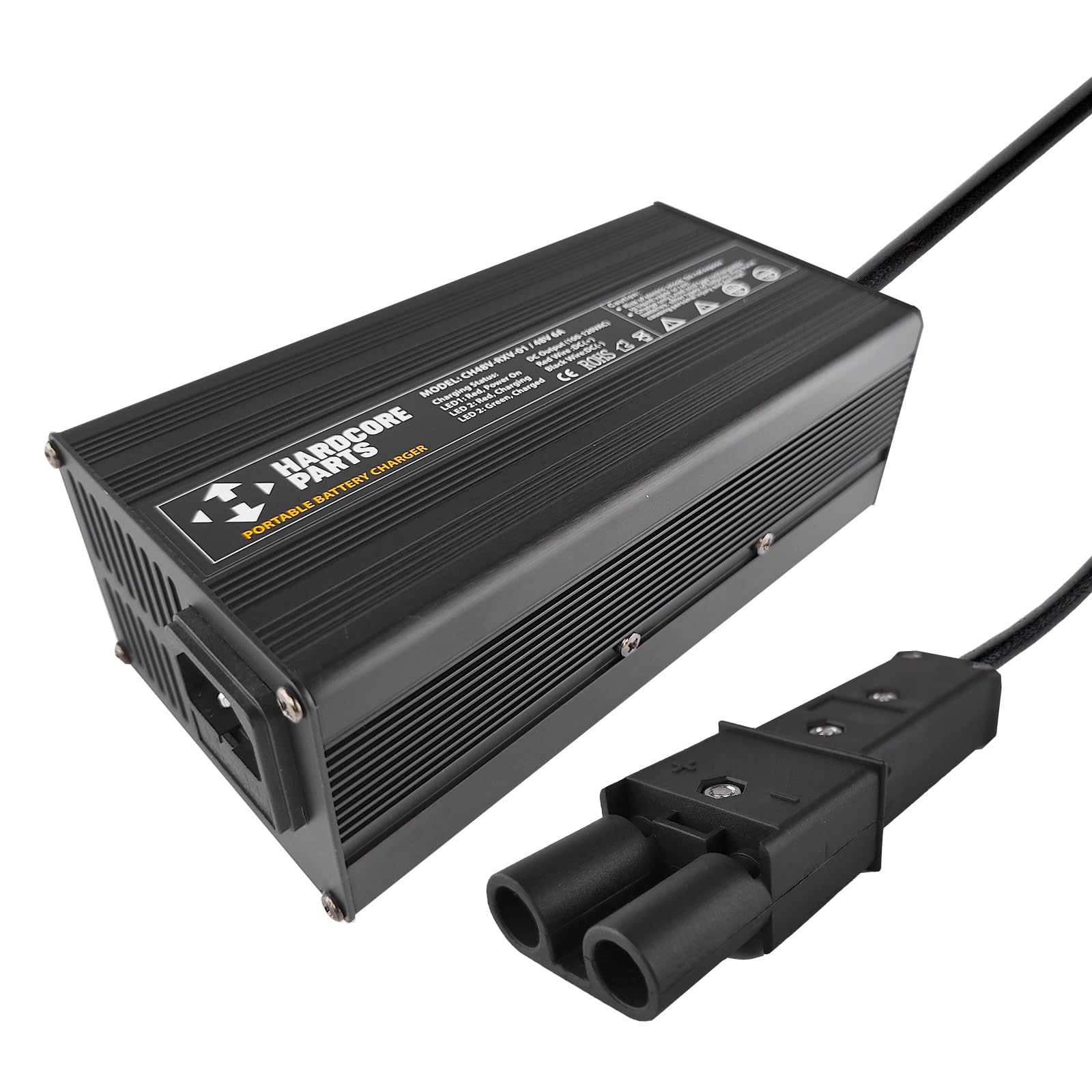
Some carts live on a seasonal cycle — used hard for a month, then parked for months. That is where a 6A trickle charger earns its place. The Smart Parts unit is automatic and compact at 2.6 pounds, which is the lightest in this whole list. Hanging it on a hook next to the outlet and forgetting it between seasons is exactly the job it was built for.
Fit is the headline: it uses the Yamaha G19/G22 2-pin connector, so older-cart owners get a direct plug rather than an adapter. The maker states a 6-hour charge time at 48 volts and 6 amps. For a cart that needs a top-up, the slower trickle is gentler than a full 15A rush. The CE mark appears on the spec sheet for the internal electrics.
Where it falls short: at 6A versus the 15A MODZ and 10L0L picks, the top-up window stretches when your pack is deeply drained. If you drive the cart daily, a 15A unit is the practical choice. This one is the seasonal hold, not the daily driver’s workhorse.
Pick it when: your G19 or G22 sits idle between long breaks and 6A of gentle trickle is all the pack needs.
Look to the MODZ Max48 instead: if the cart runs daily and you want 15A top-ups rather than a slow hold.
Know the Specs
Connector type — why it is a make-or-break spec
The plug shape is the one spec that gets people into trouble, because the wrong connector simply will not seat. Yamaha G19 and G22 carts use a 2-pin plug. G29 Drive and Drive2 carts use a 4-pin leaf or a 3-pin round depending on the build. Crowfoot is a wider shape used by many cart brands. M8 is a bare ring terminal for wiring, not a plug. Match the plug to the cart socket first, then worry about everything else.
Amperage and charge time — a straight trade
Amperage is the flow rate of current into the batteries. A 15A charger moves electrons faster than a 6A trickle unit, so a full session finishes sooner. The 10L0L quotes a 10-hour charge time on a Yamaha G29 at 15A; the Smart Parts trickle quotes 6 hours at 6A. Amperage does not make a pack healthier, it just shortens the wait. Pick based on how often you drive, not the biggest number on the box.
IP67 — what the rating actually means
IP67 is shorthand for sealed against dust and against short immersion in water. For a charger that hangs in a damp garage or rides on an open trailer, that sealing is the difference between a long life and a corroded failure. It does not make the charger a pool toy — keep it off standing water — but it does mean rain spray and settled dust are not the enemies they would be on an unsealed unit.
Float mode versus automatic shutoff
A float-mode charger drops into a low maintaining current after the main charge completes. That keeps a stored pack topped up rather than letting it drift. A plain automatic charger simply stops when full. For a cart that sits weeks between uses, float mode saves you from repeat plug-ins. For a daily driver, either works — the difference is convenience over time.
Common Questions
Will a 2-pin Yamaha charger fit my G29?
Is a 15A charger better than a 6A trickle charger?
Does a higher amperage charger shorten battery life?
Can I leave my charger plugged in all the time?
What does IP67 mean on a golf cart charger?
Do I need an OBC-compatible charger on a Yamaha G29?
Will a crowfoot charger work on my Yamaha?
Can a charger revive a completely dead 48V battery pack?
Can I use an extension cord with a golf cart charger?
Is a 15A charger too much for a lithium golf cart battery?
The Bottom Line
For most Yamaha owners, the yamaha 48 volt golf cart charger winner is the MODZ Max48 15 AMP. It pairs a 2-pin Yamaha plug with 15A output, IP67 sealing, and a 7-pound body any owner can lift one-handed. If you drive a G29 and want to watch the charge on your phone, the 10L0L 15 Amp covers OBC and non-OBC builds (with and without the cart’s onboard computer) with app visibility. And if your cart sits idle for long stretches, the Smart Parts 6A trickle unit is the gentle hold it needs between seasons.
How we choose
We do not accept paid placement. Every pick is matched to a real buyer and a real use-case; we do not hands-on test units.
Sources
Specifications: manufacturer listings and product documentation. Review insights: verified customer reviews, as of November 2026. Pricing: not shown on this page (it changes often); check the current price via the retailer link.
As an Amazon Associate, Tactical Gear Guy earns from qualifying purchases. This does not affect which products we feature.