Specs are compiled from manufacturer listings and verified buyer reviews and can change over time — please confirm the key details on the product page before buying.
A clean hole starts with a table that does not wander. An XY table (a sliding worktable that moves your workpiece left-right and forward-back under a drill or mill) fails you in one way that matters: slack in the ways, the sliding dovetail tracks that guide the table. Any slack in those dovetail ways lets the table drift off center mid-cut. So judge a table on whether it holds position under load and moves in small, repeatable steps without fighting the handwheels. For most bench-drill owners: pick the largest cast-iron table your bench, budget and drilling stock can carry, then check the gibs (the adjustable strips that tighten the ways) before you trust any number on the dial.
This guide is built by comparing the manufacturers’ published specifications and the patterns across verified customer reviews, so you get each pick’s real strengths and trade-offs instead of marketing spin.
You will see how travel, T-slot size, table material and height separate a smooth operator from a table that fights back, and which of these picks earns its place. Each entry below is a real, verified compound slide or cross-slide table you can mount on a bench drill today, and the spread runs from compact aluminum units to heavy cast-iron slabs. Here is the honest shortlist for the best XY Table.
Top Picks


How To Choose The Best XY Table
The table you want is the one that holds a workpiece still while you move it in tiny, repeatable steps. Size, material and height are fit questions against your drill press and your bench. Here is what to weigh before you commit.
Start with travel, not table size
Travel is how far the table slides in each direction, and it decides how much of a workpiece you can reach without unclamping. The LLDSIMEX 18×6 Inch unit gives 12″ of longitudinal travel and 7 1⁄2″ of cross travel. The HHIP 3900-0027 gives 8 inches of longitudinal travel and 5 inches of transverse travel. A compact aluminum table like the HFS 330x95mm runs 190mm of X stroke and 67mm of Y stroke. Match that travel to your biggest realistic part first, since a plate you cannot position is a plate you cannot drill.
T-slot size and spacing
Your clamps, step blocks and hold-downs must seat in the slots. The LLDSIMEX accepts 9/16″, 1/2″, 3/8″ and 5/8″ T-slot hardware across its slots. The HHIP runs 5/8 inch wide T-slots on 2-1/2 inch centers. The VEVOR 7.3 x 4 inch table uses a 0.4 inch T groove with a 1.4 inch groove interval. If your clamp kit is built for one slot width, confirm the table’s slot width and spacing match it before ordering.
Cast iron versus aluminum alloy
You get less flex with cast iron because it is dense, which is why the big tables weigh what they do — the LLDSIMEX tips the scales at 61 lbs, and the VEVOR 17.7×6.7 in at 66 pounds against the small VEVOR’s 22 pounds. Aluminum alloy saves weight and space, and the HFS and Drealin tables are built from dovetail-slot aluminum. Heavier iron dampens vibration; lighter alloy is easier to lift on and off a bench drill.
Height and mounting on a bench drill
Table height above your drill base sets how much vertical room your drill bit and chuck have left. The HFS sits at 3.15 inches minimum height, and the LLDSIMEX at 5 inches. A tall table plus a tall workpiece can run you out of quill travel. Check the height figure against the space under your spindle before you buy.
Gibs, screw quality and the dial scale
The gibs and lead screw are where cheap tables give themselves away. A vernier scale or a zero-adjustment scale lets you return to a position; the Hozan K-50 runs 1 scale 0.05 on its handle, with 1 rotation moving 0.05 mm. Look for adjustable gibs, Acme or trapezoidal thread spindles, and lock nuts you can tighten to take slack out of the slide.
Side-by-Side Comparison
| Model | Best For | Table Size | Travel (X / Y) | Material | Amazon |
|---|---|---|---|---|---|
| LLDSIMEX 18×6 Inch Compound Slide Table★ Best Overall | Big travel on a bench drill | 6×18″ Inch | 12″ long / 7 1⁄2″ cross | Cast Iron | Amazon |
| Hozan K-50 X-Y TableFine-Position Pick | Fine small-part positioning | 8.3 x 2.8 inches | — | Metal | Amazon |
| Drealin Mini Milling Machine Work Table | Portable bench-drill setup | 330 × 95mm | 190mm X / 65mm Y | Aluminum alloy | Amazon |
| VEVOR 17.7×6.7 in Compound Milling Work Table | Heavy cast-iron stability | 17.7 X 6.7 Inch | 8.3 in X / 4.3 in Y | Cast Iron (45#, HT200) | Amazon |
| HHIP 3900-0027 Compound Slide Table | Clamping large fixtures | 5-1/2 x 12 Inch | 8″ long / 5″ transverse | — | Amazon |
| VEVOR 7.3 x 4 inches Compound Slide | Entry-level bench drilling | 7.3 x 4 inches | 3.2 inch | Cast Iron | Amazon |
| HFS (R) Multifunction Worktable | Tight-workspace aluminum slide | 330*95mm (13*3.7in) | 190mm X / 67mm Y | Aluminum | Amazon |
Detailed Reviews
1. 18×6 Inch Compound Slide Table CNC Table
Our pick — 4.0+★ from 70+ verified ratings; the strongest balance of quality and price.
The big-travel cast-iron table that gives your bench drill a real machining axis
The LLDSIMEX 18×6 Inch Compound Slide Table is the pick here because it gives you the most room to work: a 6×18″ Inch table riding on 12″ of longitudinal travel and 7 1⁄2″ of cross travel. That travel is the whole point. It lets you reach across a long workpiece and reposition it in fine steps instead of unclamping after every hole.
The build is what steadies it. A cast-iron table on dovetailed ways with adjustable gibs, Acme thread lead screws and vernier scales gives you a slide you can tighten and read back to a position. The frame is carbon steel with a painted black finish, and it accepts 9/16″, 1/2″, 3/8″ and 5/8″ T-slot hardware, so most clamp kits have a slot to grab. It weighs 61 lbs, which is the trade: this is a table you mount once and leave on the drill.
What wins people over is the quality and the feel of the slide — it moves smoothly with little to no slop, and it holds up as a drill-press table. The honest caveats sit in the hardware. Some handwheels have arrived not fitting cleanly on the screws, and the Acme screw has been called rough, so plan on a little fitting and a light clean-up before the first cut.
Where it pulls ahead
- 12″ longitudinal and 7 1⁄2″ cross travel covers large workpieces
- Adjustable gibs and vernier scales let you dial in and repeat a position
- Cast-iron body with dovetailed ways resists flex under load
- T-slot hardware range of 9/16″, 1/2″, 3/8″ and 5/8″
The honest caveats
- 61 lbs is a two-person lift onto the drill base
- Handwheels and Acme screw can need fitting before smooth use
- Some owners find the travel adjustment less flexible than expected
Made for this: bench-drill owners drilling long setups who want maximum travel in a rock-solid iron table.
Weigh before you buy: at 61 lbs, it wants a permanent spot on a strong bench, not a shelf.
2. Hozan K-50 X-Y Table
Small-part precision where one handle turn is a known, repeatable step
If your workpiece fits in a vise and your aim is repeatable positioning rather than hogging metal, the Hozan K-50 is built for exactly that. The handle scale runs 1 scale 0.05, with 1 rotation moving 0.05 mm — a fine, quantified step you can count back. That is the Hozan’s whole identity: it is a positioning table for small, delicate work, not a heavy milling platform.
The table measures 8.3 x 2.8 inches (210 x 70 mm), small enough to sit on a compact drill or staging setup. It clamps are included, the slide dimensions are given as Front and Rear 23 / Left 66 mm, and a K-24 mini vise can be installed on it. It is compatible with K-21, so if you already run that Hozan setup, this slots into the same family.
What it is for: microscope staging, fine drilling and precise cut-off positioning where you need a small, controllable move and an exact scale reading.
Where it stops: the 8.3 x 2.8 inch table and modest travel suit small parts — the opposite of the 18×6 LLDSIMEX above for big plate work.
Reach for this: when small-part accuracy and a documented scale matter more than reach or heft.
Pass if: you need to hold down a large, heavy workpiece — this table’s small footprint is the limit.
3. Mini Milling Machine Work Table Vise

The take-it-anywhere slide for a mini drill and a small bench
The Drealin mini table is built around being light and small. It weighs 2.4 kg, so you can lift it off the bench drill one-handed and stow it. The table size is 330 × 95mm, and adjustment runs 190mm in the X direction and 65 mm in the Y direction, with grooves spaced 34mm apart.
That groove spacing is the number to match against your clamp bolts — it is set by the design, so measure your hardware first. The table is composed of several adjustable dovetail-slot aluminum alloy sections, a construction meant to keep the footprint minimal while holding accuracy, and the handwheel carries an adjustable scale where a ring equals 1.5mm. It is designed for mini drill and drill bracket series, and can be adapted to other suitable machines.
Fit it to your drill: the 330 × 95mm table and 190mm X / 65mm Y adjustment suit small parts and a mini drill, so match it to a light drill bracket rather than a floor-standing mill.
One thing to confirm: the 34mm groove spacing and 2.4 kg weight mean this is a light-duty slide — if you need to hog a heavy plate, go iron, not alloy.
Best for: hobbyists with a mini drill who want a light, movable slide that stores out of the way.
Think twice if: your work involves large, heavy stock — 2.4 kg of alloy is the ceiling here.
4. VEVOR Milling Working Table 17.7×6.7 in
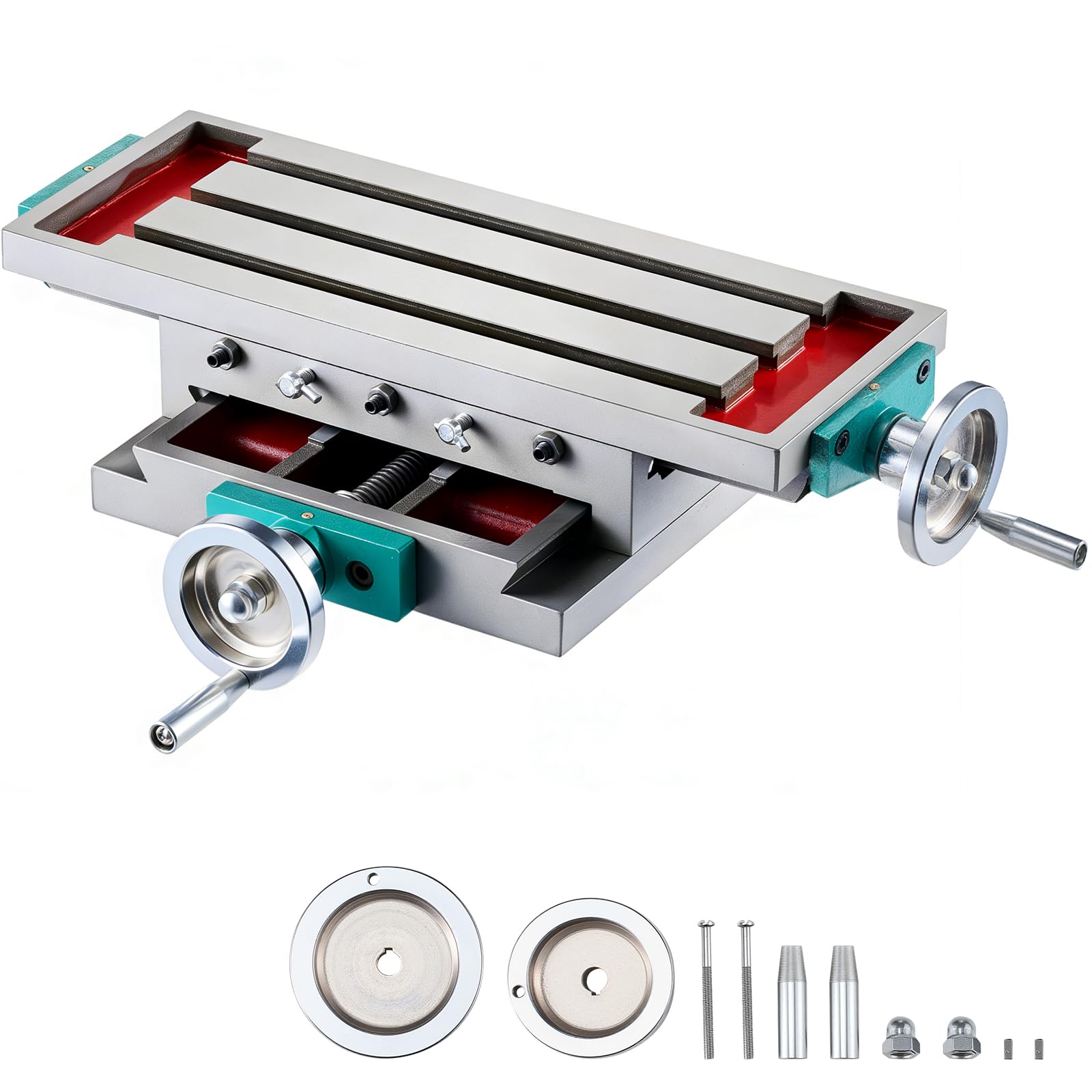
A broad iron table that trades some portability for footprint and three clamping slots
The VEVOR 17.7×6.7 in is the biggest surface in this group, a 17.7 X 6.7 Inch table built from 45# and HT200 cast iron with three precise T-slots to spread clamping loads. Travel runs 8.3 in / 210 mm on the X-axis and 4.3 in / 110 mm on the Y-axis, and a precise scale on the slide lets you return to a working position.
Weight is the honest headline: 66 pounds versus 22 pounds on the smaller VEVOR 7.3 x 4 inch table below. That mass is why it feels planted, and it is also why you want a permanent bench spot for it. Tightness adjustment runs through several bolts and nuts so you can dial the slide’s play to taste, and the whole unit is hand powered — no motor, just handwheels on trapezoidal thread spindles.
What buyers value most is the price-to-capability read — a large iron table for the money. The trade-offs are real but small: handles that do not always align cleanly, and occasional alignment gripes around the hole design. Judge it on delivery condition and be ready to fettle the cranks on arrival.
What you get in the box
- 17.7 x 6.7 Inch cast-iron table with three T-slots
- 8.3 in X-axis and 4.3 in Y-axis travel with a scale
- Bolts and nuts for tightening out the slide’s slack
What to expect
- 66 pounds means a fixed bench location
- Handles can need alignment work on arrival
- Adjustability is mixed depending on the unit you receive
Suits you if: you want maximum iron surface and three clamp slots and you have a bench that can hold 66 pounds.
Skip the fuss if: you expect perfect handle alignment straight out of the delivery box — budget time to fit it.
5. HHIP 3900-0027 5-1/2 x 12 Inch Compound Slide Table

Built to clamp big fixtures with wide slots on generous centers
The HHIP 3900-0027 leads with its clamping hardware: 5/8 inch wide T-slots on 2-1/2 inch centers. Wide slots on that spacing let you bolt down larger fixtures and step blocks that a narrow-groove aluminum table cannot hold. It offers 8 inches of longitudinal travel and 5 inches of transverse travel, and the rugged slide is made for heavy loads.
It is the heaviest-duty purpose in this set — positioned for precise positioning, milling, drilling, microscope viewing and staging operations, with an adjustable base for small jig boring and precision cut-off work. It weighs 36.6 pounds. Quality is what buyers single out most, and it is regarded as strong value for a slide in this class.
The honest watch-out is durability and fit. The leadscrew has drawn mixed comment, and one clamping point has frustrated buyers — it is not always possible to clamp everything tight to the table top. So check how your specific fixture will sit against those 5/8 inch slots before you rely on this as your only clamping surface.
Its strongest card: 5/8 inch T-slots on 2-1/2 inch centers give you real clamping capacity for larger fixtures.
The honest limit: mixed feedback on the leadscrew and on clamping to the table top means a fit check against your own fixture is wise.
Choose it when: wide, widely spaced T-slots matter and you need 8 inches of longitudinal travel in a stout slide.
Check first if: your fixture relies on tight clamping right at the table top — feedback on that point is only mixed.
6. VEVOR Milling Working Table 7.3 x 4 inches

A light iron starter slide for small bench-drill jobs
The VEVOR 7.3 x 4 inch table is the lighter iron option in this group: a 7.3 x 4 inch worktable weighing 22 pounds, against 66 pounds for the big VEVOR above. That weight gap is the deciding difference. At 22 pounds you can set it on a small drill stand without upgrading your bench, and still get cast iron under the workpiece.
Travel is 3.2 inch, with a 0.4 inch T groove width and a 1.4 inch groove interval. It uses two chip grooves on the working surface and trapezoidal thread spindles for adjustment, with a scale for positioning. It is aimed at mounting on drilling machines and drill stands for precise positioning when jig boring or drilling, for home and commercial use.
The recurring gripe is stability — this smaller iron table can move during operation if it is not locked down well, so bolt it to your stand firmly and adjust the gibs snug. The upside is that it functions well as a compact positioning table and buyers like the size. For a first XY table on a light drill, it does the job.
Why people like it
- 7.3 x 4 inch cast-iron table at 22 pounds lifts on easily
- Two chip grooves keep the working surface cleaner
- Trapezoidal thread spindles with a positioning scale
Where it can disappoint
- Can shift during use if not clamped down firmly
- Assembly and edge finish draw some mixed notes
- 3.2 inch travel is limited compared with the big slides
Good fit for: a small drill stand where a light iron slide at 22 pounds does the positioning work.
Be prepared to: bolt it down firmly and snug the gibs — stability improves once it is locked to the stand.
7. HFS Multifunction Worktable Milling Machine

Low-profile alloy slide that drops into tight drill-press space
The HFS starts with a height advantage: a 3.15 inch minimum that sits lower than the taller iron tables, leaving more vertical room under the spindle. The worktable is 330*95mm(13*3.7in), with X stroke (transverse) of 190mm(7.48in) and Y stroke (longitudinal) of 67mm(2.64in), plus a 34mm(1.34in) slot pitch. Built from dovetail-slot aluminum alloy, it keeps the footprint small while aiming at accuracy.
Adjustment runs through screws on both the X and Y axes with handwheels that carry a zero-adjustment scale, so you can fine-tune and then tighten the lock nut to remove cross-slide looseness. The polished surface and rigid structure are meant to keep movement smooth in both directions, and it is designed to pair with bench drills for small and large projects in garages and workshops.
You save weight and space with aluminum alloy, but durability is the recurring point of contention — several describe it as flimsy, and value for money splits between those who find it cheap and those who would not recommend it. It looks good and works fine for light needs; just do not push it like cast iron.
What it does well: a low 3.15 inch minimum and 13*3.7in alloy table slip into tight drill space, and the zero-adjustment scale helps fine positioning.
The honest catch: durability is the most-discussed concern — treat it as a light-duty slide and match it to lighter jobs.
Reach for this: when bench height and space are tight and your work is light-duty positioning.
Look elsewhere if: you need to hog heavy stock — cast iron tables above are built for that load.
Know the Specs
Travel (X and Y)
Travel is how far the slide moves in each direction — X is the transverse (side-to-side) move and Y is the longitudinal (front-to-back) move. More travel lets you reach the far end of a longer workpiece without unclamping. The LLDSIMEX gives 12″ longitudinal and 7 1⁄2″ cross; the HHIP gives 8 inches longitudinal and 5 inches transverse. Match travel to your largest realistic part.
T-slot width and spacing
The T-slots are the grooves in the table where your clamps and hold-downs lock in. The slot width must match your bolt heads, and the spacing must match your clamp pattern. The LLDSIMEX accepts 9/16″, 1/2″, 3/8″ and 5/8″ hardware; the HHIP runs 5/8 inch slots on 2-1/2 inch centers. Check both numbers against your clamp kit before ordering.
Table material: cast iron versus alloy
Cast iron is dense and resists flex and vibration, which is why the big tables weigh so much — 61 lbs and 66 pounds on the two large VEVOR/LLDSIMEX units. Aluminum alloy saves weight and space for tight benches, as on the HFS and Drealin tables. Heavy iron dampens chatter; light alloy is easier to mount and stow.
Height, gibs and scale
Height sets your vertical clearance under the drill chuck — 3.15 inches on the HFS, 5 inches on the LLDSIMEX. The gibs (adjustable strips in the ways) let you remove slack so the slide does not wobble. A scale lets you return to a position; the Hozan K-50 turns 1 scale 0.05, moving 0.05 mm per rotation.
Common Questions
How do I know an XY table will fit my bench drill?
What is the difference between X travel and Y travel?
Will my clamp kit fit the T-slots on these tables?
Is cast iron better than aluminum alloy for an XY table?
What is a gib and why does it matter on a cross-slide table?
Can I mount a vise on these tables?
How heavy a table can my bench drill handle?
What does the handle scale mean in practice?
Do these tables come powered or hand-operated?
Why do some tables arrive with rough screws or poor fit?
The Bottom Line
The winner for most bench-drill owners is the LLDSIMEX 18×6 Inch Compound Slide Table, because 12″ of longitudinal and 7 1⁄2″ of cross travel on adjustable-gib cast iron covers long workpieces without unclamping. If small-part precision matters more than reach, the Hozan K-50 X-Y Table gives you a documented 0.05 mm step per rotation. And when you need wide clamping for big fixtures, the HHIP 3900-0027 leads on 5/8 inch T-slots on 2-1/2 inch centers.
Whichever you choose, buy the table whose travel, slot pattern and weight match the drill and bench you already own — that fit is what turns a slide into an accurate axis.
How we choose
We do not accept paid placement. Every pick is matched to a real buyer and a real use-case; we do not hands-on test units.
Sources
Specifications: manufacturer listings and product documentation. Review insights: verified customer reviews, as of November 2026. Pricing: not shown on this page (it changes often); check the current price via the retailer link.
As an Amazon Associate, Tactical Gear Guy earns from qualifying purchases. This does not affect which products we feature.