Specs are compiled from manufacturer listings and verified buyer reviews and can change over time — please confirm the key details on the product page before buying.
You want to open your XPS 13 with a finger press instead of typing a password every single time. Every laptop below has a built-in fingerprint reader, so you can log in with one touch. The differences come down to the screen, the processor, and how much memory and storage you get alongside that sensor.
This guide is built by comparing the manufacturers’ published specifications and the patterns across verified customer reviews, so you get each pick’s real strengths and trade-offs instead of marketing spin.
Some of these machines run on Intel chips and some on Qualcomm, and that choice shapes everything from battery endurance to which apps feel snappy. Here is a practical walk-through of the xps 13 fingerprint reader options worth your attention.
Top Picks

How To Choose The Best XPS 13 Fingerprint Reader
So the sensor is the starting point, not the whole decision. You still have to pick the screen, the processor, and the memory that fit how you actually work.
Confirm the sensor is really there
On an XPS 13 the reader is usually built into the power button or listed as an integrated fingerprint reader on the keyboard deck. Check the listing says “Fingerprint Recognition” under the security features. That one line is the difference between a laptop that open up with a touch and one that does not.
Pick your screen before anything else
Settle resolution and panel type first, since the screen is what you look at all day. An OLED panel gives deep blacks and rich color, which helps with photo and video work. An IPS panel with a matte finish tends to fight glare better in a bright room.
Match memory and storage to your workload
Memory (RAM) is your scratch space for open apps, and the SSD is where your files live. If you juggle spreadsheets, browser tabs, and a video call at once, more RAM keeps things from stalling. If you keep large project files or a media library, a bigger SSD saves you from carrying an external drive.
Side-by-Side Comparison
| Model | Best For | Processor | Memory | Display | Amazon |
|---|---|---|---|---|---|
| Dell XPS 13.4″ 2.5K OLED Touchscreen★ Best Overall | Creative work and big screens | Intel Core Ultra 9 288V | 32GB RAM | 13.4″ 2.5K OLED touch | Amazon |
| Dell XPS 13 9345 SnapdragonPremium Pick | All-day battery and AI features | Snapdragon X Elite X1E-80-100 | 32GB RAM | 13.4″ FHD+ 500 nits | Amazon |
| Dell XPS 13 7390 | Entry-level everyday use | Intel Core i7-10710U | 16GB RAM | 13.3″ FHD InfinityEdge touch | Amazon |
Detailed Reviews
1. Dell XPS 13.4″ 2.5K OLED
The sharpest screen here, paired with the punchiest parts Dell puts in a 13-inch body.
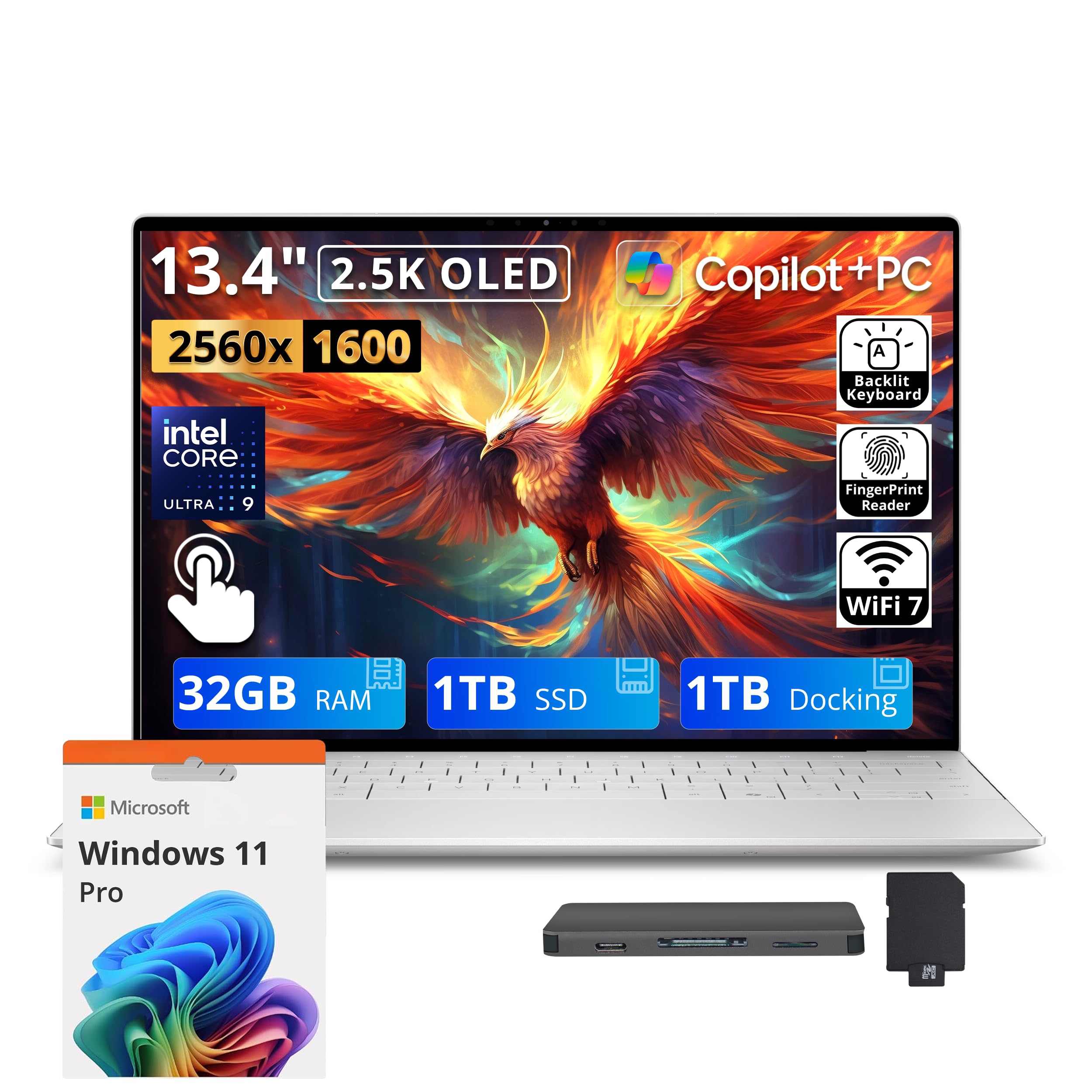
If your work is visual — editing photos, cutting video, designing slides — this is the configuration that gives your eyes the most to work with. The 13.4″ 2.5K OLED touch display runs at 3024 x 1964, and an OLED panel lights each pixel on its own, so blacks look truly black instead of washed grey. The touch layer means you can tap and scroll directly rather than reaching for the trackpad every time.
Under the hood sits an Intel Core Ultra 9 288V processor, which can push up to 5.2 GHz for heavy moments like rendering or compiling. That is backed by 32GB of RAM, enough that a dozen browser tabs, a spreadsheet, and a video call can all live open without the machine grinding to a halt. Storage totals 2TB, split between a 1TB SSD inside the laptop and a 1TB docking station set in the box — honestly one of the roomier setups you can get in an ultra-portable.
For security, the fingerprint reader replaces your password with a single press, so you are back in your work in about a second instead of typing a long string. The backlit keyboard keeps the keys visible in a dim room. At 2.59 lbs it slides into a bag without dragging on your shoulder, and Windows 11 Pro adds business tools like BitLocker encryption and Remote Desktop.
What wins people over on this machine is having the OLED panel and the top chip in one package — the screen is the reason to stretch for it. Do budget for the fan spooling up under sustained heavy load; power this concentrated in a thin chassis tends to make itself heard.
What moves the needle
- 2.5K OLED touch screen at 3024 x 1964 gives deep contrast and rich color for creative work.
- Core Ultra 9 288V hitting 5.2 GHz handles demanding software without stutter.
- 32GB of RAM keeps many applications open at once with no slowdown.
- 2TB total storage across the internal 1TB SSD and the included 1TB docking station.
- Fingerprint login, backlit keyboard, and Wi-Fi 7 in one 2.59 lb package.
Where it asks for patience
- It is the heaviest-ticket, heaviest-spec option here — more laptop than a casual web browser needs.
- The internal drive is opened for the upgrade, so the seller warranty covers the RAM and SSD rather than Dell covering the whole machine.
Built for creators: photo and video editors, designers, and anyone who wants the best screen and the fastest Intel chip in the lineup.
Overkill for the basics: if your day is email and documents only, the OLED and 32GB here are more than you will ever use.
2. Dell XPS 13 9345
Thirty-two cores of Snapdragon muscle in a 2.62 lb shell built for the road.
This is the pick for the traveler who wants a fast laptop that barely registers in a backpack. The CNC-machined aluminum chassis in Platinum weighs 2.62 lbs from the starting point and measures 0.60 inches thin. You get the same 1920 x 1200 resolution as the Intel 9350 below, but on a non-touch IPS panel rated at 500 nits with an anti-glare finish and EyeSafe technology for long viewing sessions.
The engine is the Qualcomm Snapdragon X Elite X1E-80-100, a 12-core processor topping out at 4.0 GHz with a Qualcomm Adreno GPU for graphics. It is paired with 32GB of LPDDR5X memory running at 8400 MT/s and a 2TB SSD, so the machine holds a large project library and keeps multiple windows fluid. That memory figure is double what the 9350 offers in its standard build — a 32GB versus 16GB gap that shows up when you run real multitasking.
Security is covered by a fingerprint reader plus an IR camera, Microsoft’s TPM 2.0 chip for hardware-level encryption, and Windows 11 Pro. Wi-Fi 7 and Bluetooth 5.4 keep your connection current, and the two USB4 Type-C ports push up to 40Gbps with DisplayPort and Power Delivery. A 55Wh three-cell battery with a 60W USB-C adapter keeps the whole thing charged.
One honest note on the Snapdragon route: some older or specialized Windows apps are built for Intel chips and can run into compatibility snags. Big-name software generally runs fine, but check the tools you rely on before committing to this ARM-based machine.
Why it leads the premium tier
- 32GB of LPDDR5X memory double the 16GB on the 9350, for heavy multi-window work.
- 2TB SSD stores large media and project files without an external drive.
- Fingerprint reader plus IR camera and TPM 2.0 cover security at the hardware level.
- 2.62 lb aluminum body at 0.60 inches travels easily.
Worth knowing before you buy
- It is a non-touch display — you tap the keyboard, not the screen.
- The Snapdragon chip can hit app-compatibility limits with tools written for Intel.
Best for mobile professionals: consultants, students, and business travelers who want maximum memory and storage in a light frame.
Check your software first: if you depend on a niche Windows app built for Intel, verify it runs on ARM before you commit.
3. Dell XPS 13 9350

The entry point: a touchscreen XPS with a fingerprint reader and the smallest storage of the group.
For a first laptop or a light daily machine, this 7390 covers the essentials. The 13.3-inch FHD InfinityEdge touch screen squeezes into an 11-inch footprint with an 80.7% screen-to-body ratio, so the bezels stay thin and the body stays compact. The display covers 100% of the RGB color spectrum, which sharpens how colors and shadows read on screen. A 1500:1 contrast ratio gives bright scenes more definition.
It runs a 10th-gen Intel Core i7-10710U with UHD graphics, paired with 16GB of RAM and a 256GB SSD. That 256GB is the smallest drive in this lineup — half the 512GB on the 9310 above. It ships with Windows 10 Home and a black English keyboard with an FPR (fingerprint reader for one-touch sign-in). A microSD card reader plus USB 3.0, USB 3.1 Type-C, and Thunderbolt ports give you plenty of ways to plug in.
The chassis is cut from a single block of aluminum, which adds rigidity you can feel when you grip it. A 400-nit anti-reflective screen helps when you work near a window. Its processor is an older generation than the others here, so it is the slowest of the bunch for heavy tasks.
Good first laptop: students and light users who want a touchscreen, fingerprint login, and solid aluminum build on a tight budget.
Skip if storage is king: the 256GB drive fills quickly once you add photos and video — a larger SSD pick suits media hoarders better.
Know the Specs
Fingerprint reader and security
The sensor sits in the power button or on the keyboard deck, and one press signs you in without a typed password. It sits alongside software-level protection, and on the premium models you also get an IR camera and TPM 2.0 (a hardware chip that stores encryption keys). Together that covers both convenience and data security without any passwords to remember.
Processor: Intel versus Qualcomm
Intel chips like the Core Ultra 9 and Ultra 7 are built for the widest range of Windows software. Qualcomm’s Snapdragon X Elite runs on an ARM architecture, which brings efficiency but can trip up older apps written for Intel. Check the specific programs you rely on before choosing the Snapdragon route.
Display type and resolution
OLED panels light each pixel individually, giving deep blacks and vivid color — great for creative work. IPS panels with a matte finish handle glare better in bright rooms. Higher resolution like 3024 x 1964 shows more detail, while a 120Hz refresh rate makes motion feel smoother. Choose based on whether color accuracy or battery-saving glare control matters more to you.
Memory and storage
RAM is your short-term workspace for open apps; an SSD is long-term storage for files. 16GB handles everyday multitasking, while 32GB keeps far more apps open at once. For storage, 256GB is tight for media libraries, 512GB is comfortable, and 1TB or 2TB lets you skip external drives almost entirely.
Common Questions
Does the fingerprint reader work for Windows Hello sign-in?
Can I use the fingerprint reader without a Microsoft account?
Which XPS 13 has the brightest screen for outdoor use?
Is the Snapdragon X Elite better than the Intel Ultra chips?
How much storage do I really need on an XPS 13?
Do these laptops have Thunderbolt ports?
What does a renewed or refurbished XPS 13 mean?
Is the 13.4-inch XPS 13 screen too small for editing photos?
Which XPS 13 lasts longest on battery per charge?
The Bottom Line
For the most capable all-round pick in this lineup, the winner is the Dell XPS 13.4″ 2.5K OLED Touchscreen, because it pairs a 3024 x 1964 OLED touchscreen with a Core Ultra 9 288V and 32GB of RAM — the sharpest screen and the fastest Intel chip here. If battery life and a light frame matter more, reach for the XPS 13 9350 at up to 26 hours. And if you want the most memory and storage in a portable shell, the Snapdragon-powered XPS 13 9345 brings 32GB and a 2TB SSD. Whichever you choose, each of these machines logs you in with a single finger press instead of a typed password.
How we choose
We do not accept paid placement. Every pick is matched to a real buyer and a real use-case; we do not hands-on test units.
Sources
Specifications: manufacturer listings and product documentation. Review insights: verified customer reviews, as of November 2026. Pricing: not shown on this page (it changes often); check the current price via the retailer link.
As an Amazon Associate, Tactical Gear Guy earns from qualifying purchases. This does not affect which products we feature.